Vol. 7, No. 3, 2014, 230-245
ISSN 1307-5543 – www.ejpam.com
Total Least Squares Fitting the Three-Parameter Inverse Weibull
Density
Dragan Juki´c, Darija Markovi´c
∗Department of Mathematics, J.J. Strossmayer University of Osijek, Trg Ljudevita Gaja 6, HR-31 000 Osijek, Croatia
Abstract. The focus of this paper is on a nonlinear weighted total least squares fitting problem for the three-parameter inverse Weibull density which is frequently employed as a model in reliability and lifetime studies. As a main result, a theorem on the existence of the total least squares estimator is obtained, as well as its generalization in thelqnorm (1≤q<∞).
2010 Mathematics Subject Classifications: 65D10, 62J02, 62G07, 62N05
Key Words and Phrases: inverse Weibull density, total least squares, total least squares estimate, existence problem, data fitting
1. Introduction
The probability density function of the random variableThaving a three-parameter inverse Weibull distribution (IWD) with location parameterα≥0, scale parameterη >0 and shape parameterβ >0 is given by
f(t;α,β,η) =
(
β η
η
t−α
β+1e−( η t−α)
β
t> α
0 t≤α. (1)
If α= 0, the resulting distribution is called the two-parameter inverse Weibull distribution. This model was developed by Erto[6].
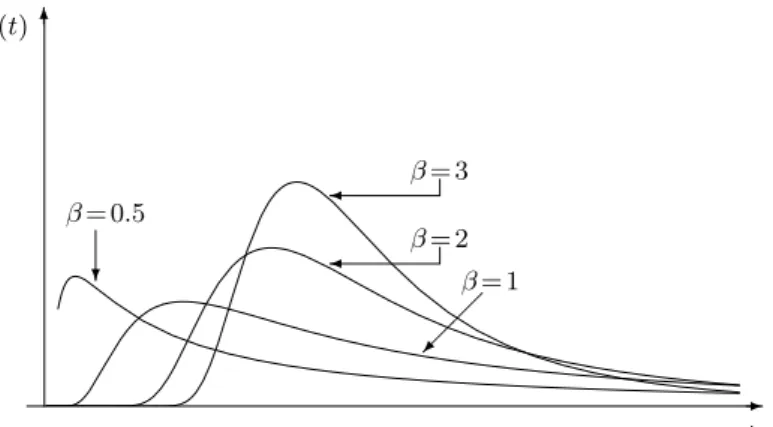
The IWD is very flexible and by an appropriate choice of the shape parameterβ the den-sity curve can assume a wide variety of shapes (see Fig. 1). The denden-sity function is strictly increasing on (α,tm] and strictly decreasing on [tm,∞), where tm = α+η(1+1/β)−1/β. This implies that the density function is unimodal with the maximum value attm. This is in contrast to the standard Weibull model where the shape is either decreasing (for β ≤ 1) or unimodal (forβ >1). Whenβ = 1, the IWD becomes an inverse exponential distribution;
∗Corresponding author.
Email addresses:[email protected](D. Juki´c),[email protected](D. Markovi´c)
whenβ=2, it is identical to the inverse Rayleigh distribution; whenβ=0.5, it approximates the inverse Gamma distribution. That is the reason why the IWD is a frequently used model in reliability and lifetime studies (see e.g. Cohen and Whitten [5], Lawles [18], Murthy et al.[21], Nelson[22]).
t f(t) ✻
✲ β= 0.5
❄
β= 3 ✛
β= 2 ✛
β= 1
✠
Figure 1: Plots of the inverse Weibull density for some values ofβand by assumingα=0 and η=1.2
In practice, the unknown parameters α, β andηof the three-parameter inverse Weibull density (1) are not known in advance and must be estimated from a random samplet1, . . . ,tn consisting ofnobservations of the three-parameter inverse Weibull random variableT. There is no unique way to estimate the unknown parameters and many different methods have been proposed in the literature (see e.g. Abbasiet al.[1], Lawless[18], Maruši´cet al.[20], Murthyet al. [21], Nelson[22], Silverman[26], Smith and Naylor[27, 28], Tapia and Thompson[29]).
A very popular method for parameter estimation is the least squares method. The non-linear weighted ordinary least squares (OLS) fitting problem for the three-parameter inverse Weibull density is considered by Maruši´cet al. [20]. In this paper we consider the
nonlin-ear weighted total least squares (TLS) fitting problem for the three-parameter inverse Weibull density function. The structure of the paper is as follows. In Section 2 we briefly describe the TLS method and present our main result (Theorem 1) which guarantees the existence of the TLS estimator for the three-parametric inverse Weibull density. Its generalization in thelq norm (1≤q<∞) is given in Theorem 2. All proofs are given in Section 3.
2. The TLS Fitting Problem for the Three-parameter Inverse Weibull Density
Both the OLS and the TLS method require the initial nonparametric density estimates ˆf which need to be as good as possible (see e.g. Silverman[26], Maruši´cet al.[20]). Suppose
we are given the points(ti,yi),i=1, . . . ,n,n>3, where 0<t1<t2<. . .<tn
The goal of the OLS method (see e.g. [2, 3, 8, 11, 13, 14, 19, 25]) is to choose the unknown
parameters of density function (1) such that the weighted sum of squared distances between the model and the data is as small as possible. To be more precise, let wi > 0, i= 1, . . . ,n, be the data weights which describe the assumed relative accuracy of the data. The unknown parametersα,β andηhave to be estimated by minimizing the functional
S(α,β,η) = n X
i=1
wi[f(ti;α,β,η)− yi]2
on the set
P :=(α,β,η)∈R3:α≥0;β,η >0 .
A point (α⋆,β⋆,η⋆) ∈ P such that S(α⋆,β⋆,η⋆) = inf(α,β,η)∈P S(α,β,η) is called the OLS estimator, if it exists. As we have already mentioned, this problem has been solved by Maruši´c et al.[20].
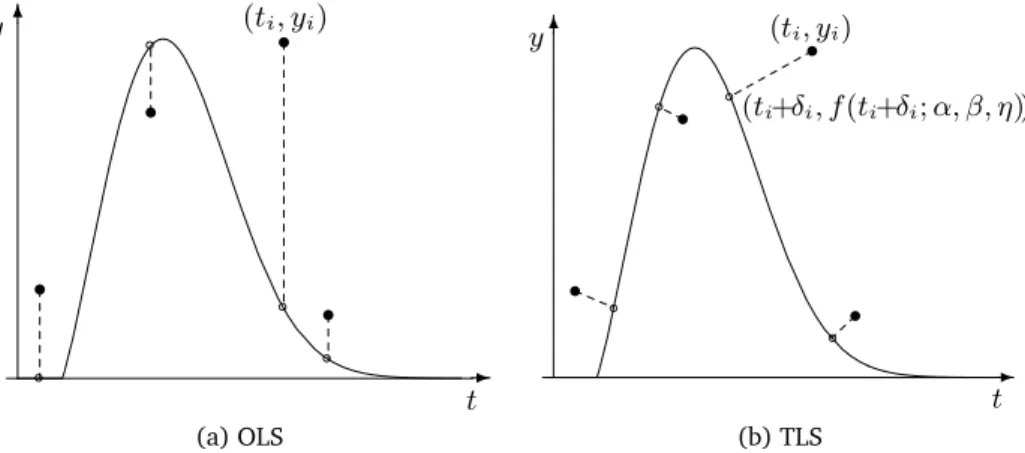
In the OLS approach the observations ti of the independent variable are assumed to be exact and only the estimates yi of the density (dependent variable) are subject to random errors. Unfortunately, this assumption does not seem to be very realistic in practice, and many errors (sampling errors, human errors, modeling errors and instrument errors) prevent us from knowing ti exactly. In such situation, when also the observations of the independent variable contains errors, it seems reasonable to estimate the unknown parameters so that the weighted sum of squares of all errors is minimized. This approach, known as the total least squares (TLS) method, is a natural generalization of the OLS method (see e.g. [7]). In the statistics
literature, the TLS approach is known aserrors-in-variables regression ororthogonal distance regression, and in numerical analysis it was first considered by Golub and Van Loan[9].
The TLS method can be described as follows. Letwi,pi>0,i=1, . . . ,n, be some weights. If we assume that yi contains unknown additive error ǫi and that ti has unknown additive errorδi, then the mathematical model becomes
yi= f(ti+δi;α,β,η) +ǫi, i=1, . . . ,n.
The unknown parameters α,β andη of density function (1) have to be estimated by mini-mizing the weighted sum of squares of all errors, i.e. by minimini-mizing the functional (see e.g.
[4, 7, 10, 17, 24])
T(α,β,η,δ) = n X
i=1
wi[f(ti+δi;α,β,η)−yi]2+ n X
i=1
piδ2i (2)
on the setP ×Rn. A point(α⋆,β⋆,η⋆)inP is called thetotal least squares estimator(TLS
es-timator) of the unknown parameters(α,β,η)for the three-parameter inverse Weibull density, if there existsδ⋆∈Rnsuch that
T(α⋆,β⋆,η⋆,δ⋆) = inf
(α,β,η,δ)∈P ×RnT(α,β,η,
δ).
Numerical methods for solving the nonlinear TLS problem are described in Boggs et al.
minimization of the sum of squares it is still necessary to ask whether the TLS estimator exists. In the case of nonlinear TLS problems it is still extremely difficult to answer this question (see e.g.[3, 7, 12, 15–17]).
The difference between the OLS and the TLS approach is illustrated in Fig. 2. Geometri-cally, ifwi=pi for alli=1, . . . ,n, minimization of functionalT corresponds to minimization of the weighted sum of squares of distances from data points to the model curve.
(ti, yi)
❛
❛
❛
❛
t y ✻
✲
(a) OLS
(ti, yi)
❛ ❛
❛
❛
t
y ✻
✲ (ti+δi, f(ti+δi;α, β, η))
(b) TLS
Figure 2: The difference between the OLS and TLS approaches
Our main existence result for the TLS problem for the three-parameter inverse Weibull density is given in the next theorem.
Theorem 1. Let the points(ti,yi), i=1, . . . ,n, n>3, be given, such that0<t1<t2<. . .<tn and yi >0, i=1, . . . ,n. Furthermore, let wi,pi >0, i =1, . . . ,n, be some weights. Then there exists a point(α⋆,β⋆,η⋆,δ⋆)∈ P ×Rn such that
T(α⋆,β⋆,η⋆,δ⋆) = inf
(α,β,η,δ)∈P ×RnT(α,β,η,
δ),
i.e. the TLS estimator exists.
The proof is given in Section 3. The following total lq norm (q ≥ 1) generalization of Theorem 1 holds true.
Theorem 2. Suppose1 ≤ q < ∞. Let the points and weights be the same as in Theorem 1. Define
Tq(α,β,η,δ):= n X
i=1
wif(ti+δi;α,β,η)−yi q
+ n X
i=1
pi|δi|q. (3)
Then there exists a point(α⋆q,βq⋆,η⋆q,δ⋆
q)∈ P ×R
n such that
Tq(α⋆q,β
⋆
q,η
⋆
q,δ
⋆
q) =(α,β,η,infδ)∈P ×RnTq(α,β,η,
δ).
3. Proof of Theorem 1
Before starting the proof of Theorem 1, we need some preliminary results. Lemma 1. Suppose we are given data(wi,ti,yi), i∈I:={1, . . . ,n}, n>3, such that
0<t1 <t2<. . .<tn and yi >0, i∈I . Let wi,pi >0, i∈I , be some weights. Given any real number q,1≤q<∞, and any nonempty subset I0of I , let
ΣI0:= X i∈I\I0
wiyiq+X i∈I0
pi|ti−τ0|q,
where
τ0∈argmin x
n X
i=1
pi|ti−x|q.
Then there exists a point inP ×Rnat which functional Tqdefined by(3)attains a value less than
ΣI0.
Summation P i∈I0
is to be understood as follows: The sum over those indicesi≤nfor which i ∈ I0. If there are no such indices, the sum is empty; following the usual convention, we define it to be zero. Summation P
i∈I\I0
has similar meanings.
It is easy to verify that t1≤mini∈I0ti ≤τ0≤maxi∈I0ti ≤tn. Note that for the case when
q = 2,τ0 is a well known weighted arithmetic mean, and for the case whenq =1, τ0 is a weighted median of the data (see e.g. Sabo and Scitovski[23]).
Proof. Sinceτ0 is an element of the closed interval[t1,tn], there existsr ∈ {1, . . . ,n}such that
τ0∈(tr−1,tr],
where t0=0 by definition. Let us first choose real y0such that 0< y0<min
i∈I yi (4)
and then define functionsα,β,η:(0, 1)→Rby:
β(b):=τ0y0e b
b η(b):=τ0b1/β(b),
α(b):=τ0−η(b)b−1/2β(b)=η(b)b−1/β(b)−b−1/2β(b). Clearly, functionsβ andηare positive. Furthermore, by using the inequality
b−1/β(b)−b−1/2β(b)>0, which holds for everyb∈(0, 1), it is easy to show that functionαis also positive. Thus, we have showed that(α(b),β(b),η(b))∈ P for all b∈(0, 1). Let us now associate with each realb∈(0, 1)a three-parametric inverse Weibull density function
f(t;α(β),β(b),η(b)) =
β(b)
t−α(b)
η(b)
t−α(b)
β(b)
e− t−η(αb()b)
β(b)
t> α(b)
0 t≤α(b).
This function has maximum at the point
α(b) +η(b)(1+1/β(b))−1/β(b)=τ0−ǫ(b), where
ǫ(b):=η(b)b−1/2β(b)−1+ 1 β(b)
−1/β(b) .
It is strictly increasing on(α(b),τ0−ǫ(b)]and strictly decreasing on[τ0−ǫ(b),∞). Further-more, by a straightforward calculation, it can be verified that
f(τ0+α(b);α(b),β(b),η(b)) = y0, (6) lim
b→0β(b) =∞, (7)
lim
b→0η(b) =τ0, (8)
lim
b→0α(b) =0. (9)
Now we are going to show that
lim
b→0f(t;α(b),β(b),η(b)) =0, t6=τ0. (10) First, in view of (8) and (9), we obtain
lim b→0
η(b) t−α(b)
= τ0 t .
Ifτ0<t, then from (7) and (9) it follows readily that limb→0e−
η(b) t−α(b)
β(b)
=1 and limb→0β(b)
η(b) t−α(b)
β(b)
=0, and therefore
lim
b→0f(t;α(b),β(b),η(b)) =blim→0
β(b) t−α(b)
η(b) t−α(b)
β(b)
e− t−η(αb()b)
β(b)
=0.
Ifτ0>t, then there exists a sufficiently greatk0∈Nsuch that
e< η(b) t−α(b)
k0
for every sufficiently smallb>0. Now, by using the inequality x<ex (x ≥0) we obtain
β(b)<eβ(b)< η(b) t−α(b)
k0β(b)
, b≈0,
and therefore, for any b≈0 we have
0<f(t;α(b),β(b),η(b)) = β(b) t−α(b)
η(b) t−α(b)
β(b)
e− η(b) t−α(b)
< 1 t−α(b)
η(b) t−α(b)
(k0+1)β(b)
e− t−ηα(b()b)
β(b)
.
Since
lim b→0
η(b) t−α(b)
(k0+1)β(b)
e− η(b) t−α(b)
β(b)
=0, then from the above-mentioned inequality it follows that
lim
b→0f(t;α(b),β(b),η(b)) =0, t> τ0. Thus, we proved the desired limits (10).
Note that
f(τ0;α(b),β(b),η(b)) = β(b) τ0−α(b)
η(b) τ0−α(b)
β(b)
e− τ0η−(αb)(b)
β(b)
= β(b) τ0−α(b)
p be−
p
b= τ0y0eb−
p
b
(τ0−α(b))pb, from where taking the limit asb→0 it follows that
lim
b→0f(τ0;α(b),β(b),η(b)) =∞. (11) Due to (9), (10) and (11), we may suppose that bis sufficiently small, so that
0< α(b)<t1 (12) 0< f(ti;α(b),β(b),η(b))< yi, if ti 6=τ0 (13)
f(τ0;α(b),β(b),η(b))>max
i∈I yi. (14)
Let us now show that for eachi∈I0and for everyb∈(0, 1)there exists a unique number τi(b)such that (see Figure 3)
ti < τi(b)< τ0−ǫ(b)< τ0, ifti< τ0 ti < τi(b)<ti+ǫ(b), ifti=τ0 τ0< τi(b)<ti, ifti> τ0
(15)
and
f(τi(b);α(b),β(b),η(b)) = yi. (16) First, since the function t 7→ f(ti;α(b),β(b),η(b))has maximum at the pointτ0−ǫ(b)and it is strictly increasing on(α(b),τ0−ǫ(b)]and strictly decreasing on[τ0−ǫ(b),∞), by using (4), (6), (13) and (14) we obtain
The existence of the desired numbersτi(b),i∈I0, follows from the well-known Intermediate Value Theorem which states that a continuous real function assumes all intermediate values on a closed interval, while uniqueness follows from monotonicity.
t f(t) ✻
✲
τ0−ε(b) τ0 τ0+ε(b) ❝
s
s
(tj, yj)
(τj(b), yj) ❝ s
s ❝
(ti, yi) (τi(b), yi) s
Figure 3: i,j ∈ I0, ti < τ0, tj > τ0; 0 < δi(b) = τi(b)− ti < τ0−ǫ(b)−ti < τ0− ti; τ0−tj< τj(b)−tj=δj(b)<0
Setting
δi(b):=
¨
τi(b)−ti, ifi∈I0
0, if i∈I\I0, (17)
(16) becomes
f(ti+δi(b);α(b),β(b),η(b)) = yi, i∈I0. (18) Note that only one of the following two cases can occur:
(i) |I0|=1, or (ii) |I0|>1.
Case(i): |I0|=1. In this case we haveτ0= tr. It follows from (15) that 0< δr(b)< ǫ(b). Without loss of generality, in addition to (12)-(14) we may suppose thatbis sufficiently small, so that
tr−1+ǫ(b)<
tr−1+tr
2 <tr−ǫ(b) and
f((tr−1+tr)/2;α(b),β(b),η(b))<min i∈I yi.
Ifti<tr, then
0<f(ti;α(b)−δr(b),β(b),η(b)) = f(ti+δr(b);α(b),β(b),η(b)) <f(ti+ǫ(b);α(b),β(b),η(b))≤ f(tr−1+ǫ(b);α(b),β(b),η(b)) <f((tr−1+tr)/2;α(b),β(b),η(b))<min
i∈I yi ≤ yi, (19)
whereas if ti>tr, then
0<f(ti;α(b)−δr(b),β(b),η(b)) = f(ti+δr(b);α(b),β(b),η(b))
<f(ti;α(b),β(b),η(b))< yi. (20) Thus, it follows from (18), (19) and (20) that, for every b∈(0, 1),
Tq(α(b)−δr(b),β(b),η(b),0) = n X
i=1
wif(ti;α(b)−δr(b),β(b),η(b))−yi q
< n X
i=1 i6=r
wiy q i = ΣI0
Case|I0|>1. Note that only one of the following two subcases can occur: (i) τ06=ti for alli∈I0, or
(ii) τ0=tr for somer∈I0.
Subcase(i): In this subcase, it follows from (13), (15), (17) and (18) that, for everyb∈(0, 1), Tq(α(b),β(b),η(b),δ(b)) = X
i∈I\I0
wif(ti;α(b),β(b),η(b))−yi q+
X
i∈I0
pi|δi(b)|q
< X i∈I\I0
wiy q i +
X
i∈I0
pi|ti−τ0|q= ΣI0.
Subcase(ii): Assume thatτ0=trfor somer∈I0. Let indexs∈I0be such thatts< τ0. Then by (15), for everyb∈(0, 1),
0< δr(b)< ǫ(b)and 0< δs(b)<tr−ǫ(b)−ts and therefore
ps|δs(b)|q+pr|δr(b)|q<ps|tr−ǫ(b)−ts|q+prǫq(b). It can be easily shown that the above right-hand side is less than
ps|tr−ts|q
wheneverbis small enough. Therefore, for every small enoughbwe have
Tq(α(b),β(b),η(b),δ(b)) = X
i∈I\I0
wi
+pr|δr(b)|q+ps|δs(b)|q+ X i∈I0\{r,s}
pi|δi(b)|q
< X i∈I\I0
wiyiq+X i∈I0
pi|ti−τ0|q= ΣI0.
This completes the proof of the lemma.
Proof of Theorem 1.
Proof. Since functional T is nonnegative, there exists T⋆:= inf
(α,β,η,δ)∈P ×RnT(α,β,η,
δ).
To complete the proof it should be shown that there exists a point(α⋆,β⋆,η⋆,δ⋆)∈ P ×Rn
such thatT(α⋆,β⋆,η⋆,δ⋆) =T⋆.
Let(αk,βk,ηk,δk)be a sequence inP ×Rn, such that
T⋆= lim
k→∞T(αk,βk,ηk,
δk) = lim k→∞
X
i∈I
wi f(ti+δik;αk,βk,ηk)−yi2+X i∈I
pi(δik)2
= lim k→∞
¦ X
ti+δik≤αk
wiyi2+ X
ti+δik>αk
wiβk ηk
η
k ti+δki −αk
βk+1
e−
ηk
ti+δk i−αk
βk −yi2
+X i∈I
pi(δki) 2©
. (21)
whereI={1, . . . ,n}. The summation P ti+δik≤αk
(or P
ti+δik>αk
) is to be understood as follows: The
sum over those indices i≤nfor which ti+δki ≤αk (or ti+δik > αk). If there are no such pointsti, the sum is empty; following the usual convention, we define it to be zero.
There is no loss of generality in assuming that all sequences(αk),(βk),(ηk),(δk1), . . . ,(δnk) are monotone. This is possible because the sequence (αk,βk,ηk,δ1k, . . . ,δkn) has a subse-quence (αl
k,βlk,ηlk,δ
lk
1, . . . ,δ lk
n), such that all its component sequences are monotone; and since limk→∞T(αlk,βlk,ηlk,δ
lk) =lim
k→∞T(αk,βk,ηk,δk) =T⋆.
Since each monotone sequence of real numbers converges in the extended real number system ¯R, define
α⋆:= lim
k→∞αk, β
⋆:= lim
k→∞βk, η
⋆:= lim
k→∞ηk, δ
⋆:= lim
k→∞δ
k= (δ⋆
1, . . . ,δ⋆n). Note that 0 ≤ α⋆,β⋆,η⋆ ≤ ∞, because (αk,βk,ηk) ∈ P. Also note thatδ⋆i ∈ R for each
i =1, . . . ,n. Indeed, if|δ⋆i|=∞for some i, then it would follow from (21) that T⋆= ∞, which is impossible.
To complete the proof it is enough to show that(α⋆,β⋆,η⋆)∈ P, i.e. that
It remains to show that(α⋆,β⋆,η⋆)∈ P. The proof will be done in five steps. In step 1 we will show thatα⋆< tn. In step 2 we will show thatβ⋆6=0. The proof thatη⋆ 6=∞will be done in step 3. In step 4 we prove thatη⋆6=0. Finally, in step 5 we show thatβ⋆6=∞.
Step 1. Ifα⋆≥tn, from (21) it follows thatT⋆=Pni=1wiyi2+Pi∈Ipiδ⋆i2. Since according to Lemma 1 (forq=2 andI0={1}) there exists a point inP ×Rnat which functionalT attains
a value smaller thanΣI0and sinceΣI0<Pni=1wiyi2+ P
i∈Ipiδ⋆
2
i , this means that in this way (α⋆≥t
n) functional T cannot attain its infimum. Thus, we have proved thatα⋆<tn.
Before continuing the proof, let us introduce some notation and make one remark. First let us define
I0:=
¨
Iα⋆, ifIα⋆ 6=; {1}, otherwise where Iα⋆ :={i∈I:ti+δ⋆
i =α
⋆}. Let us note that Lemma 1 withq=2 implies that
T⋆< X i∈I\I0
wiyi2+X i∈I0
pi(ti−τI0)2=:ΣI0, (22)
whereτI0=
P
i∈I0piti
P
i∈I0pi .
By taking an appropriate subsequence of(αk,βk,ηk,δk), if necessary, we may assume that if ti+δ⋆i < α
⋆, then t
i+δki < αk for everyk∈N. Similarly, if ti+δ⋆i > α
⋆, we may assume
that ti+δki > αkfor everyk∈N. Due to this, now it is easy to show that from (21) it follows that
T⋆≥ X ti+δ⋆i<α⋆
wiyi2+ lim k→∞
¦ X
ti+δ⋆i>α⋆
wiβk ηk
η
k ti+δik−αk
βk+1
e−
ηk
ti+δk i−αk
βk
−yi2©
+X i∈I
piδ⋆
2
i . (23)
Step 2. Ifβ⋆=0, then by using the inequalityx <ex (x≥0) we obtain
0< βk ηk
ηk
ti+δk i −αk
βk+1
e−
ηk
ti+δk i−αk
βk
< βk ti+δk
i −αk
, if ti+δ⋆i > α
⋆,
wherefrom it follows readily that
lim k→∞ β k ηk η k ti+δik−αk
βk+1
e−
ηk
ti+δk i−αk
βk
=0, if ti+δ⋆i > α⋆.
Now, from (23) it follows that
T⋆≥ X
i∈I\I0
wiyi2+ X
i∈I0
piδ⋆
2
= X i∈I\I0
wiyi2+X i∈I0
pi(ti−α⋆)2
≥ X
i∈I\I0
wiyi2+X i∈I0
pi(ti−τI0)2= ΣI0, (24)
which contradicts (22). Therefore, in this way (β⋆=0) functionalTcannot attain its infimum.
Thus, we have proved thatβ⋆6=0.
The last inequality in (24) follows directly from a well-known fact that the quadratic func-tion x7→Pi∈I
0pi(ti−x)
2attains its minimumP
i∈I0pi(ti−τI0)
2at pointτ I0.
Step 3. Let us show thatη⋆6=∞. We prove this by contradiction. Suppose on the contrary that η⋆ = ∞. Without loss of generality, we may then assume that if ti+δ⋆i > α⋆, then e< ηk
ti+δki−αk for allk∈
N. Then from the inequalityx<ex(x ≥0) it follows that ifti+δ⋆i > α
⋆,
then
βk<eβk <
ηk
ti+δki −αk βk
, k∈N.
Thus, ifti+δ⋆i > α⋆, then
0<βk ηk
ηk
ti+δk i −αk
βk+1
e−
ηk
ti+δk i−αk
βk
= βk ti+δk
i −αk
ηk
ti+δk i −αk
βk
e−
ηk
ti+δk i−αk
βk
< 1 ti+δk
i −αk
ηk
ti+δk i −αk
2βk
e−
ηk
ti+δk i−αk
βk
. (25)
Furthermore, since limk→∞ ti+δηkik−αk
=∞andβ⋆6=0, we have limk→∞ ηk
ti+δki−αk
βk
=∞
and therefore limk→∞ ηk
ti+δki−αk
2βke− ηk
ti+δk i−αk
βk
=0, so that from (25) it follows that
lim k→∞
βk ηk
ηk
ti+δik−αk βk+1
e−
ηk
ti+δk i−αk
βk
=0, if ti+δ⋆i > α
⋆.
Putting the above limits into (23), we immediately obtain
T⋆≥ X
i∈I\I0
wiyi2+
X
i∈I
piδ⋆i2≥ΣI0,
which contradicts (22). Hence we proved thatη⋆6=∞.
So far we have shown thatα⋆< tn,β⋆6=0 andη⋆ 6=∞. By using this, in the next step we will show thatη⋆6=0.
(i) η⋆=0 andβ⋆∈(0,∞), or (ii) η⋆=0 andβ⋆=∞.
Now, we are going to show that functionalT cannot attain its infimum in either of these two cases, which will prove thatη⋆6=0.
Case(i): η⋆=0 andβ⋆∈(0,∞). In this case we would have
lim k→∞
βk ηk
ηk
ti+δk i −αk
βk+1
e−
ηk
ti+δk i−αk
βk
= lim k→∞
βk ti+δk
i −αk
ηk
ti+δk i −αk
βk
e−
ηk
ti+δk i−αk
βk
=0, ifti+δ⋆i > α⋆ and hence from (23) it would follow that
T⋆≥ X ti+δ⋆i6=α⋆
wiyi2+X i∈I
piδ⋆i2≥ΣI0
which contradicts assumption (22).
Case(ii): η⋆=0 andβ⋆=∞. Sinceηk→0, there exists a real numberL>1 and sufficiently greatk0∈Nsuch that ifti+δ⋆
i > α
⋆andk>k
0, thenηk/(ti+δik−αk)<1/L. Without loss of generality, we may assume thatk0=1. Thus, ifti+δ⋆i > α
⋆, then
0<βk ηk
η
k ti+δik−αk
βk+1
e−
ηk
ti+δk i−αk
βk
= βk ti+δki −αk
η
k ti+δki −αk
βk
e−
ηk
ti+δk i−αk
βk
< 1 ti+δik−αk
β k Lβk
e−
ηk
ti+δk i−αk
βk
. (26)
Furthermore, since
lim k→∞
βk Lβk
=0 and lim k→∞e
− ηk ti+δk
i−αk
βk
=1, from (26) it follows that
lim k→∞
βk ηk
ηk
ti+δik−αk βk+1
e−
ηk
ti+δk i−αk
βk
=0, if ti+δ⋆i > α⋆.
Finally, from (23) we obtain T⋆≥ Pt
i+δ⋆i6=α⋆wiy
2 i +
P i∈Ipiδ⋆
2
i ≥ ΣI0, which contradicts
Step 5. It remains to show that β⋆ 6= ∞. We prove this by contradiction. Suppose that β⋆=∞. Arguing as in case (ii) from step 4, it can be shown that
lim k→∞
βk
ti+δki −αk
ηk
ti+δik−αk βk
e−
ηk
ti+δk i−αk
βk
=0, if 0< η
⋆
ti+δ⋆i −α⋆
<1. (27)
If η⋆
ti+δ⋆i−α⋆
>1, then there exists a sufficiently greatk0 ∈N such that e< ηk
ti+δik−αk
k0. Now,
by using the inequality x<ex (x ≥0) we obtain
βk<eβk <
η
k ti+δik−αk
k0βk
, k∈N,
and therefore
0< βk ti+δki −αk
η
k ti+δik−αk
βk
e−
ηk
ti+δk i−αk
βk
< 1 ti+δki −αk
η
k ti+δik−αk
(k0+1)βk
e−
ηk
ti+δk i−αk
βk
. (28)
Since limk→∞ ti+δηkik−αk
βk
=∞, we have that
lim k→∞
ηk ti+δik−αk
(k0+1)βke− ηk
ti+δk i−αk
βk
=0
and therefore from (28) it follows that
lim k→∞
βk
ti+δki −αk
ηk
ti+δki −αk βk
e−
ηk
ti+δk i−αk
βk
=0, if η
⋆
ti+δ⋆i −α⋆
>1. (29)
From (23), (27) and (29) we would obtain T⋆≥ Pt
i+δ⋆i6=α⋆wiy
2 i +
P i∈Ipiδ⋆
2
i ≥ ΣI0, which
contradicts (22). Thus, we have proved thatβ⋆6=∞and completed the proof.
References
[1] B. Abbasi, A.H.E. Jahromi, J. Arkat, and M. Hosseinkouchack. Estimating the parameters
of Weibull distribution using simulated annealing algorithm. Applied Mathematics and Computation, 183:85-93, 2006.
[2] D.M. Bates and D.G. Watts.Nonlinear regression analysis and its applications. Wiley, New
[3] Å. Björck.Numerical Methods for Least Squares Problems. SIAM, Philadelphia, 1996. [4] P.T. Boggs, R.H. Byrd, and R.B. Schnabel. A stable and efficient algorithm for nonlinear
orthogonal distance regression. SIAM Journal on Scientific and Statistical Computation, 8:1052-1078, 1987.
[5] A.C. Cohen and B.J. Whitten. Parameter Estimation in Reliability and Life Span Models.
Marcel Dekker Inc., New York and Basel, 1988.
[6] P. Erto. New Practical Bayes estimators for the 2-Parameter Weibull distribution. IEEE Transactions on Reliability, R-31:194-197, 1982.
[7] W.A. Fuller.Measurement Error Models. Wiley, New York, 2006.
[8] P.E. Gill, W. Murray, and M.H. Wright.Practical Optimization. Academic Press, London,
1981.
[9] G.H Golub and C.F. Van Loan. An analysis of the total least squares problem.SIAM Journal on Numerical Analysis, 17:883-893, 1980.
[10] S. Van Huffel and H. Zha.The Total Least Squares Problem. Elsevier, North–Holland,
Am-sterdam, 1993.
[11] D. Juki´c. On thels-norm generalization of the NLS method for the Bass model.European Journal of Pure and Applied Mathematics, 6:435-450, 2013.
[12] D. Juki´c and D. Markovi´c. On nonlinear weighted errors-in-variables parameter
estima-tion problem in the three-parameter Weibull model.Applied Mathematics and Computa-tion, 215:3599-3609, 2010.
[13] D. Juki´c and D. Markovi´c. On nonlinear weighted least squares fitting of the
three-parameter inverse Weibull distribution.Mathematical Communications, 15:13-24, 2010.
[14] D. Juki´, M. Benši´c, and R. Scitovski. On the existence of the nonlinear weighted least
squares estimate for a three-parameter Weibull distribution.Computational Statistics and Data Analysis, 52:4502-4511, 2008.
[15] D. Juki´c, K. Sabo, and R. Scitovski. Total least squares fitting Michaelis-Menten enzyme
kinetic model function. Journal of Computational and Applied Mathematics, 201:230-246, 2007.
[16] D. Juki´c, R. Scitovski, and H. Späth. Partial linearization of one class of the nonlinear
total least squares problem by using the inverse model function.Computing, 62:163-178, 1999.
[17] D. Juki´c and R. Scitovski. Existence results for special nonlinear total least squares
[18] J.F. Lawless.Statistical models and methods for lifetime data. Wiley, New York, 1982. [19] D. Markovi´c, D. Juki´c, and M. Benši´c. Nonlinear weighted least squares estimation of a
three-parameter Weibull density with a nonparametric start. Journal of Computational and Applied Mathematics, 228:304-312, 2009.
[20] M. Maruši´c, D. Markovi´c, and D. Juki´c. Least squares fitting the three-parameter inverse
Weibull density.Mathematical Communications, 15:539-553, 2010.
[21] D.N.P. Murthy, M. Xie, and R. Jiang.Weibull Models. Wiley, New York, 2004. [22] W. Nelson.Applied life data analysis. Wiley, New York, 1982.
[23] K. Sabo and R. Scitovski. The best least absolute deviations line - properties and two
efficient methods for its derivation.ANZIAM Journal., 50:185-198, 2008.
[24] H. Schwetlick and V. Tiller. Numerical methods for estimating parameters in nonlinear
models with errors in the variables. Technometrics, 27:17-24, 1985.
[25] G.A.F. Seber and C.J. Wild.Nonlinear Regression. Wiley, New York, 1989.
[26] B.W. Silverman.Density estimation for Statistics and Data Analysis. Chapman & Hall/CRC,
Boca Raton, 2000.
[27] R.L. Smith and J.C. Naylor. A comparison of maximum likelihood and Bayesian
estima-tors for the three-parameter Weibull distribution.Biometrika, 73:67-90, 1987.
[28] R.L. Smith and J.C. Naylor. Statistics of the three-parameter Weibull distribution.Annals of Operations Research, 9:577-587, 1987.
[29] R. A. Tapia and J. R. Thompson.Nonparametric probability density estimation. Johns