Storage and Security Management of Data on
Cloud using FHE and Run Length Encoding
Compression Approach
Amandeep KaurPG Research Scholar,Department of CSE Punjabi University Regional Centre for IT and
Management, Mohali,Punjab.
Abstract- There is different types of encryption techniques but by implementing them the user cannot use that data unless it is decrypted. With the help of FHE, the owner does not need to decrypt the data or provide the private key to the trusted third party for computation. The third party can themselves perform the computation, the result of which will be sent to the owner of the data. The owner will then decrypt the result using its private key and will send back the result in decrypted form. As the data on the cloud is accessible publicly some kind of security mechanism needs to be there so that only trusted people can be given access to the cloud. This can be achieved by using OTP (One Time Password). OTP is generated at each login and it is sent to the party’s registered mobile or email address. Using the OTP, one can successfully login. Another problem that is created is the size of data using FHE increases tremendously which needs to be solved using some kind of lossless compression technique.
Keyword: Cloud Computing, OTP, FHF, RLE.
1. INTRODUCTION
Cloud computing depends on sharing of assets to accomplish intelligibility and economies of scale, like a utility (like the power matrix) over a network. At the establishment of cloud computing is the more extensive idea of met foundation and imparted administrations [1].
Cloud computing, or in more straightforward shorthand simply "the cloud", focuses on extending the suitability of the bestowed assets. Cloud assets are regularly granted by diverse customers and also reallocated by each hobby. This can work for dispensing assets to customers. A valid example, a cloud PC office that serves European customers in the midst of European business hours with a specific application (e.g. email) may reallocate the same resources for serve North American customers in the midst of North America's business hours with a substitute application (e.g., a web server). This procedure is utilized to help the usage of figuring power in like manner diminishing normal mischief
Navpreet Kaur
Assistant Professor,Department of CSE Punjabi University Regional Centre for IT and
Management, Mohali, Punjab.
additionally since less power, cooling, rack space and so on are required for mixed bag of capacities. With conveyed processing, different customers can get to server to recoup and redesign their data without gaining licenses for assorted applications [3].
1.1 SERVICE MODELS
1.1.1 Infrastructure as a service (IaaS)- In the most essential cloud-administration model & as indicated by the IETF (Internet Engineering Task Force), suppliers of IaaS offer PCs – physical or (all the more regularly) virtual machines – and different resources. (A hypervisor, for example, Xen, Oracle Virtual Box, KVM, VMware ESX/ESXi, or Hyper-V or cloud.ca runs the virtual machines as visitors). Pools of hypervisors inside the cloud operational supportive network can support substantial quantities of virtual machines and the capacity to scale administrations all over as per clients' fluctuating prerequisites.) IaaS often regularly offer extra assets [2].
1.1.2 Platform as a service (PaaS)- In the PaaS models, cloud provider deliver a computing platform, programming language execution environment, programming language execution environment, database, and web server. Application engineers can create and run their product arrangements on a cloud stage without the expense and multifaceted nature of purchasing and dealing with the fundamental equipment and programming layers. With some PaaS offers like Microsoft Azure and Google App Engine, the basic PC and capacity assets scale naturally to match application request so that the cloud client does not need to allot assets physically.
disposes of the need to introduce and run the application on the cloud client's own PCs, which simplify support and maintenance. Cloud applications are not quite the same as different applications in their versatility which can be accomplished by cloning assignments onto various virtual machines at run-time to meet changing work demand. Load balancers convey the work over the arrangement of virtual machines. This procedure is straightforward to the cloud client, who sees just a single access point. To accommodate a substantial number of cloud clients, cloud applications can be multitenant, that is, any machine serves more than one cloud client association.
1.2 TECHNIQUES USED
1.2.1 Fully Homomorphic Encryption- Fully Homomorphic Encryption combines security with usability. It can help preserve customer privacy while outsourcing various kinds of computation to the cloud, besides storage. Some concrete and valuable applications of FHE have been mentioned in [6]. They have considered situations where data streams from multiple sources, is uploaded in encrypted form to the cloud, and processed by the cloud to provide valuable services to the content owner. There are two aspects of the computation considered: the data itself (confidentiality) and the function to be computed on this data (circuit privacy).
1.2.2 Run length Encoding Approach- Run-length encoding (RLE) is a very simple form of information pressure in which keeps running of information (that is, arrangements in which the same information worth happens in numerous sequential information components) are put away as a solitary information esteem and check, as opposed to as the first run. This is most valuable on information that contains numerous such runs. Consider, for instance, basic realistic pictures, for example, symbols, line drawings, and activities. It is not valuable with records that don't have numerous keeps running as it could incredibly expand the document size. Run-length encoding performs lossless information pressure and is appropriate to palette-based bitmapped pictures, for example, PC symbols. It doesn't function admirably at all on ceaseless tone pictures, for example, photos, despite the fact that JPEG utilizes it viably on the coefficients that stay in the wake of changing and quantizing picture squares. Normal organizations for run-length encoded information incorporate True vision TGA, Pack Bits, PCX and ILBM. ITU likewise portrays a standard to encode run-length-shading for fax machines, known as T.45. Run-length encoding is utilized as a part of
fax machines (joined with different systems into Modified Huffman coding). It is moderately productive in light of the fact that most faxed reports are by and large white space, with incidental intrusions of dark [8].
2. RELATED WORK
Feng Zhao et al [1] “A cloud computing security solution based on fully homomorphic encryption” With the quick advancement of Cloud figuring, more clients store their information and application on the cloud. However, the improvement of Cloud processing is obstructed by numerous Cloud security issue. Distributed computing has numerous attributes, e.g. multi-client, virtualization, versatility et cetera. Due to these new attributes, customary security advancements can't make Cloud figuring completely safe. In this way, Cloud processing security turns into the ebb and flow examination center and is additionally this current paper's exploration heading.
Ahmed DheyaaBasha et al [2] “Mobile
Applications as Cloud Computing: Implementation and Challenge” Starting now, portable application and processing is getting a high force and accepting an essential part in overhauling the web figuring establishment. Furthermore, the mobile phones and their applications have high methodology in the administration ever had, and became rapidly. Portable distributed computing is obliged to deliver out and out more creative with multi applications.
Alabbadi, M.M et al [3] “Cloud computing for education and learning: Education and learning as a service (ELaaS)” This paper discusses the usage of disseminated figuring in the educational and learning open air theater, to be called "Preparing and Learning as a Service" (ELaaS), underlining it's possible points of interest and offerings. It is key for an enlightening and learning relationship, with its budgetary arrangement repressions and viability challenges, to use the cloud improvement in a perfect world prepared for a particular IT development. The Jericho Forum proposes a dispersed figuring plan model, called the Cloud Cube Model (CCM), which is in perspective of 4 criteria.
token with appropriated affirmation of cancellation coded data, our arrangement fulfills the joining of limit precision insurance and data goof restriction.
3. PROBLEM FORMULATION In Cloud Computing, Various services are provided by Cloud Environment. Data on the cloud is transmitted using various approaches so that data can be sent safely and in a secure way. To secure the data on the cloud various types of security mechanisms need to put into place so that confidential data cannot be used by various malicious users. There are different types of encryption techniques but by implementing them the user cannot use that data unless it is decrypted. With the help of FHE, the owner does not need to decrypt the data or provide the private key to the trusted third party for computation. The third party can themselves perform the computation, the result of which will be sent to the owner of the data.
The owner will then decrypt the result using its private key and will send back the result in decrypted form. As the data on the cloud is accessible publicly some kind of security mechanism needs to be there so that only trusted people can be given access to the cloud. This can be achieved by using OTP (One Time Password). OTP is generated at each login and it is sent to the party’s registered mobile or email address. Using the OTP, one can successfully login. Another problem that is created is the size of data using FHE increases tremendously which needs to be solved using some kind of lossless compression technique.
In order to accomplish the proposed problem statement, following objectives have been set
To implement Fully Homomorphism encryption on data a cloud.
To compress data using Run Length Encoding compression approach.
To validate data integrity of share data between user and service provider.
To analyze parameters for performance evaluation of purposed work.
4. METHODOLOGIES
For analyzing the purposed problem various previous approaches for data security has been studied. On the basis of the existing techniques the FHE approach has been implemented for data security and run length coding for compression of the data.
In the first step the cloud environment has been simulated that has been used for storing the data on
the local disk space. The cloud defines the characteristics to a valid user. In the cloud environment the user that has been firstly register him for authentication and accruing space on the cloud.
In the second phase the registration the user has to be validating him by providing the one time password that has been sent via e-mail to a registered mail id. This one time password validates the integrity of the user. If the user provide same password then he is authenticated user and can access the space for various operation, otherwise he is not able to access the cloud storage.
In the third phase the user can upload his confidential data on the cloud space for storage purpose. The data that has been uploaded on cloud storage has been uploaded by using the fully homomorphic encryption approach. This data has been converted into cipher text by using the addition and multiplicative homo encryption.
In the fourth phase the run length coding compression approach has been implemented that compressed the file size and store the data on the cloud work space.
5. RESULTS AND DISCUSSIONS
Table 5.1 Encrypted File Size for encryption of data of different file sizes
Sr . No.
Files (in bytes)
Pur posed wor k
Semi Hom omor ph ism En cr ypted Files (in bytes)
1 2681 5276 6368
2 3431 6964 8348
3 4386 8684 13008
4 5546 16304 19544
Fig 5.11 Comparison graph for encryption size after encryption
This figure represents the comparison graph for encryption size using purposed approach and semi homomorphic approach.
Table 5.2 Computation
This table r epr esen ts th e value for computation time for en cr yption of di ffer en t size files. Th e values for computation time h ave been evaluated for pur posed wor k an d semi h omomor phic en cr yption appr oach.
Fig 5.12 Comparison graph for computation time for encryption
This figure represents the comparison graph for computation time using purposed approach and semi homomorphic approach.
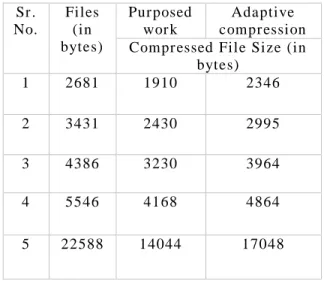
Table 5.3 Compressed File Size after compression of data of different sizes and
Sr . No.
Files (in bytes)
Pur posed wor k
Adaptive compr ession Compr essed File Size (in
bytes)
1 2681 1910 2346
2 3431 2430 2995
3 4386 3230 3964
4 5546 4168 4864
5 22588 14044 17048
This table r epr esen ts th e value for compr essed file size for en cr yption of differ en t size files. Th e values for compr ession size h ave been evaluated for pur posed wor k an d semi h omomor phic en cr yption appr oach .
0 2000 4000 6000 8000 10000 12000 14000 16000 18000
1 2 3 4 5
F
il
e
S
iz
e
i
n
b
yte
s
Files
Encrypted File Size
Purposed work
Adaptive compression
0 2000 4000 6000 8000 10000 12000 14000 16000 18000
1 2 3 4 5
TI
m
e
in
m
s
Files
Computation Time
Purposed work
Adaptive compression
Sr . No.
Files (in bytes)
Pur posed wor k
Semi Hom omor ph ism Time (in ms)
1 2681 105 132
2 3431 125 165
3 4386 231 285
4 5546 302 365
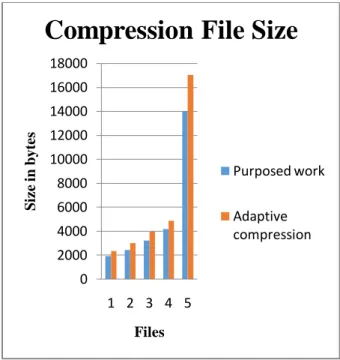
Fig 5.13 Comparison graph for compression file size after compression
This figure represents the comparison graph for compression file size using purposed approach and adaptive compression approach.
6. CONCLUSION
Cloud computing environment provides different storage management for information storage. The homomorphic encryption use different arithmetical and logarithmic formulas for conversion of data from secret information to cipher text. To reduce the storage on the cloud RLE compression has been implement that reduces the file size. The file size has been get reduced and stored on the cloud. The purposed work provides better storage management of the data on the cloud environment. The purposed work reduces the storage capacity of the data and can be easily stored on data. In the purposed work the encryption size and compution time has been used for performance evaluation. The purposed work provide 15% more efficiecy than previous work using semi homomorphism approach.
REFERENCES
[1] Feng Zhao “A cloud computing security solution based on fully homomorphic encryption”, IEEE Conf. on FHE, 2014, pp 485-488.
[2] Ahmed DheyaaBasha, Irfan Naufal Umar, and Merza Abbas, Member, IACSIT “Mobile Applications as Cloud Computing: Implementation and Challenge”, 7865-7564, IEEE, 2013.
[3] Alabbadi, M.M “Cloud computing for education and learning: Education and learning as a service (ELaaS)”, ISSN 978-1-4577-1748-2, PP 589 – 594, IEEE, 2011.
[4] Cong Wang, Qian Wang, Kui Ren and Wenjing Lou “Ensuring Data Storage Security in Cloud Computing”, IEEE, 2009.
[5] Farzad Sabahi, “Cloud Computing Security Threats and Responses”, IEEE Trans. on Cloud Computing., vol. 11, no. 6, pp. 670 - 684, 2002.
[6] Gaurav Raj, Dheerendra Singh, Abhay Bansal, “Using Batch Mode Heuristic Priority in Round Robin (PBRR) Scheduling”, IEEE, 2012.
[7] Jianfeng Yang, Zhibin Chen “Cloud Computing Research and Security Issues” Vol. 978-1-4244-5392-4/10/$26.00 ©2010 IEEE
[8] Jaber, A.N. “Use of cryptography in cloud computing”, ISSN978-1-4799-1506-4, PP 179 – 184, IEEE, 2013. [9] Kalagiakos, P. Karampelas, P “Cloud computing
learning” 978-1-61284-831-0, pp. 1 – 4, IEEE, 2011. [10] Mehmet Yildiz, Jemal Abawajy, Tuncay Ercan and
Andrew Bernoth “A Layered Security Approach for Cloud Computing Infrastructure” 2009 10th International Symposium on Pervasive Systems, Algorithms, and Networks. © 2009 IEEE.
[11] Md. Imrul Kayeset al. “Test Case Prioritization for Regression Testing Based on Fault Dependency” ISSN 978-1-4244-8679-3/11, IEEE, 2013.
[12] Mohammed Achemlal, Saıd Gharoutand Chrystel Gabber “Trusted Platform Module as an Enabler for Security in Cloud Computing” Vol. 978-1-4577-0737-7/11/$26.00 ©2011 IEEE.
0 2000 4000 6000 8000 10000 12000 14000 16000 18000
1 2 3 4 5
S
iz
e
i
n
b
yte
s
Files
Compression File Size
Purposed work