MJCCA9 – 645 ISSN 1857-5552, e-ISSN 1857-5625
Received: March 3, 2014 UDC: 544.654.2
Accepted: May 24, 2014 Rewiew
COMPARATIVE ANALYSIS OF THE POLARIZATION AND MORPHOLOGICAL
CHARACTERISTICS OF ELECTROCHEMICALLY PRODUCED POWDER FORMS
OF THE INTERMEDIATE METALS
Nebojša D. Nikolić1*, Predrag M. Živković2, Bojan Jokić2, Miomir G. Pavlović1, Jasmina S. Stevanović1
1
ICTM – Institute of Electrochemistry, University of Belgrade, Njegoševa 12, 11 000 Belgrade, Serbia 2
Faculty of Technology and Metallurgy, University of Belgrade, Karnegijeva 4, Belgrade, Serbia [email protected]
The polarization and morphological characteristics of powder forms of the group of the intermedi-ate metals were examined by the analysis of silver and copper electrodeposition processes at high overpo-tentials. The pine-like dendrites constructed from the corncob-like forms, which are very similar to each other, were obtained by electrodeposition of these metals at the overpotential belonging to the plateaus of the limiting diffusion current density. A completely different situation was observed by the electrodeposi-tion of silver and copper at the overpotential outside the plateaus of the limiting diffusion current density in the zone with the fast increase in current density with the overpotential. Silver dendrites, which were very similar to silver and copper dendrites obtained inside the plateaus of the limiting diffusion current density, were obtained at the overpotential outside the plateau. Due to the lower overpotential for hydro-gen evolution for copper, hydrohydro-gen produced during the copper electrodeposition process strongly af-fected the surface morphology of copper. The same shape polarization curves with completely different surface morphologies of Cu and Ag electrodeposited at overpotentials after the inflection point clearly in-dicate the importance of morphological analysis in the investigation of polarization characteristics of the electrodeposition systems. The role of hydrogen as a crucial parameter in the continuous change of cop-per surface morphology from dendrites to honeycomb-like structures was investigated in detail. On the basis of this analysis, the transitional character of the intermediate metals between the normal and inert metals was considered. The typical powder forms characterising electrodeposition of the intermediate metals were also defined and systematized.
Keywords: electrodeposition; copper; silver; dendrite; hydrogen; pores; cauliflower-like forms
СПОРЕДБА НА ПОЛАРИЗАЦИОНИТЕ И МОРФОЛОШКИТЕ КАРАКТЕРИСТИКИ НА ЕЛЕКТРОХЕМИСКИ СОЗДАДЕНИ ПРАШКОВИДНИ ОБЛИЦИ
НА ИНТЕРМЕДИЈАРНИ МЕТАЛИ
површината на Cu и Ag создадени при електродепозиција со пренапони повисоки од оние што одговараат на точката на инфлексија, сосем јасно ја нагласуваат важноста на анализата на морфолошките облици при испитување на поларизационите карактеристики на даден систем на електродепозиција. Улогата на водородот како параметар со круцијална важност за контину-ираното менување на морфологијата на површината на бакарот од дендритна до структура слична на саќе со мед, беше испитувана во детали. Врз основа на ваквата анализа беше утврдено дека карактерот на интермедијарните метали се менува од оној сличен на нормалните во оној на инертните метали. Исто така беа дефинирани и систематизирани типичните облици на прашоците што ја карактеризираат електродепозицијата на интермедијарните метали.
Клучни зборови: електродепозиција; бакар; сребро; водород; пори; депозити со облик сличен на карфиол
1. INTRODUCTION
The surface morphology, as the most im-portant characteristic of electrodeposited metal, mainly depends on the kinetic parameters during the electrodeposition process and on the overpo-tential or current density applied [1]. Also, compo-sitions of electroplating solutions, temperature, time of electrolysis and the type of working trode strongly affect the final morphology of elec-trodeposited metal.
According to their general kinetic behaviour in aqueous solution, metals can be classified into three classes [2, 3]. These classes are:
(a) Class I, so-called normal metals: Pb, Sn, Tl, Cd, Hg, Ag (simple electrolytes), Zn. These metals have characteristic low melting points and high exchange current densities (j0 > 1 A dm–2; j0 is
the exchange current density). Also, they show high overpotentials for hydrogen discharge.
(b) Class II, intermediate metals: Cu, Au, Ag (complex electrolytes). These metals are char-acterized by moderate melting points, medium ex-change current densities (j0 in the interval from 10–2
to 1 A dm–2) and lower hydrogen overpotentials. (c) Class III, inert metals: Fe, Co, Ni, Mn, Cr, Pt. These metals have high melting points, low exchange current densities and very low hydrogen overpotentials. For this class of metals, j0 is
be-tween 10–2 and 10–12 A dm–2.
The most often irregular (or powder) mor-phological forms obtained by the electrodeposition processes are: dendrites, flakes, fibrous, spongy, nanowires, the honeycomb-like structures and cau-liflower-like particles [4–26]. These forms may be either useful (the production of powders [4–6, 15, 16] and the creation of open porous structures that are suitable for electrodes in electrochemical de-vices and in catalysis [17–25]) or undesirable (in electrowining and electrorefining processes, in batteries [27]).
From a technological point of view, the elec-trodeposition technique has been shown to be a valuable method for synthesis of the above-men-tioned useful morphological forms. The main ad-vantages of the formation of powders by electroly-sis in relation to other methods of powder produc-tion (mechanical commuting, chemical reacproduc-tion and liquid metal atomization) are the high purity of the produced powder, which can be easily pressed and sintered, and the low oxygen content [4]. The honeycomb-like or 3D (three-dimensional) foam electrodes are formed by the one-step electrode-position process, where hydrogen bubbles function as a dynamic template for metal deposition, re-sulting in the creation of an open porous structure with an extremely large surface area [17]. Com-pared with hard templates, such as porous polycar-bonate membranes, anodic alumina membranes, colloidal crystals and echinoid skeletal structures, the hydrogen bubble dynamic template method possesses several advantages: low cost, ease of preparation, facile control of structure, and facile one-step synthesis process, including preparation of the template, metal deposition, and elimination of the template [18].
As already mentioned, the group of intermedi-ate metals is situintermedi-ated between the normal and inert metals, and it is logical to suppose that they possess some characteristics of both groups of metals. In spite of numerous investigations of the formation of pow-der forms of the intermediate metals via electrolysis, these investigations have been quite chaotic and un-systematic. Considering the various applications of these metals, the need for a systematization of their morphological characteristics is necessary.
in-termediate metals. Also, the mechanism for their formation and the transitional character between normal and inert metals will be considered.
2. EXPERIMENTAL
Silver electrodeposition. – Silver was elec-trodeposited from 0.1 M AgNO3 in 0.5 M
(NH4)2SO4 solution to which ammonium
hydrox-ide was added to dissolve the silver sulphate pre-cipitate. Electrodeposition was performed at over-potentials of 650 and 1000 mV on vertical cylin-drical graphite electrodes. The polarization curve for silver electrodeposition was recorded using a platinum cylindrical electrode covered with thin silver film. This thin silver film was electrodepos-ited from the same solution at the overpotential of 150 mV for 5 min. The counter and reference elec-trodes were pure silver.
Copper electrodeposition. – Copper was electrodeposited from 0.1 M CuSO4 in 0.5 M
H2SO4 solution at overpotentials of 650, 750, 850
and 1000 mV on vertical cylindrical copper elec-trodes. The counter and reference electrodes were pure copper.
Double-distilled water and analytical grade chemicals were used for the preparation of solu-tions used for the electrodeposition of all metals. All experiments were performed in an open cell at room temperature. The counter-electrodes were corresponding metallic foils with 0.80 dm2 surface area and were placed close to the cell walls. The reference electrodes were wires of the corre-sponding metals whose tips were positioned at a distance of about 0.2 cm from the surface of the working electrodes. The working electrodes were placed in the centre of a cell, in the same location for each experiment. The quantity of electricity was 10 mA h cm–2.
Morphologies of the copper and silver de-posits were examined using a scanning electron microscope – TESCAN Digital Microscopy.
For determination of the average current ef-ficiency of hydrogen evolution, an electrochemical cell with the same arrangement of copper elec-trodes as that used for the preparation of copper deposits for SEM analysis was employed. The electrodes were situated under a burette with the surface facing upwards so that the total amount of hydrogen evolved during the electrodeposition processes went into the burette. During the electro-deposition process, the volume of evolved hydro-gen V(H2) and the current of electrodeposition I
after a time t were recorded. Then, after graphical
integration I – t, the current efficiency for hydro-gen evolution I(H2) in a time t was determined
according to Eq. (1):
tt
I
V
0 2 2 2 Id
H
μ
)
H
(
H
(1) where:
Ah
cm
446
Ah
8
.
26
2
cm
900
23
H
μ
3 3 2
nF
V
(2)and nF is the number of Faradays per mole of con-sumed ions and V is the molar volume of a gas at a temperature of 18.0 °C (i.e. 23900 cm3). The aver-age current efficiency of hydrogen evolution,
I,av(H2) is determined after graphical integration I(H2) – t as:
t t t d ) H ( ) / 1 ( ) H ( 2 0 I 2 av
I,
.The specification of the experimental proce-dure for the determination of the average current efficiency of hydrogen evolution is given by Niko-lić et al. [19].
3. RESULTS AND DISCUSSION
3.1. Polarization characteristics of the intermediate metals
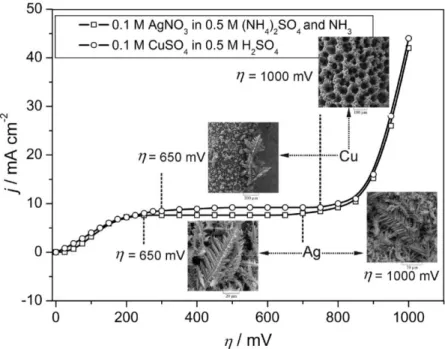
The polarization curves for the electrode-position of copper and silver as the typical repre-sentatives of the group of intermediate metals are shown in Figure 1.
The exchange current densities of 0.11 mA cm–2 for Cu [1] and 0.25 mA cm–2 for Ag [28] clearly confirm the affiliation of these electro-chemical systems to the group of metals character-ized by the medium exchange current densities. At first sight, the polarization curves were very simi-lar to each other, with well-defined plateaus of the limiting diffusion current density. The plateaus of the limiting diffusion current density were from 300 to 750 mV for Cu and from 250 to 700 mV for Ag. The end of the plateaus was determined by a sharp increase in the current density with a further increase in the overpotential.
3.2. Morphologies of irregular forms of the inter-mediate metals obtained by electrodepositions
at high overpotentials
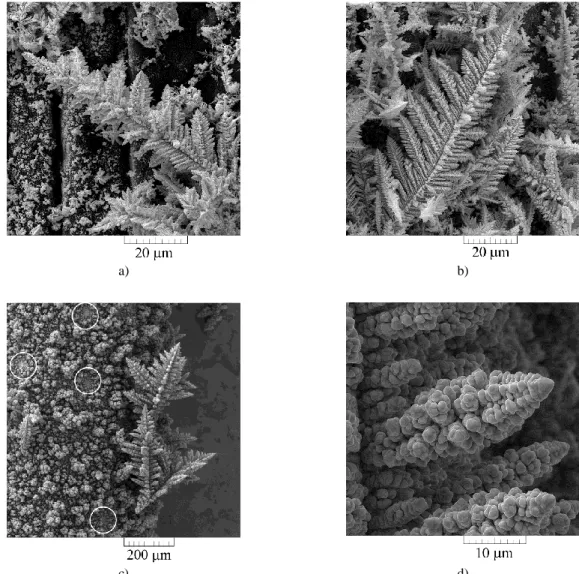
Figure 2 shows silver (Fig. 2, a and b) and copper (Fig. 2, c and d) deposits obtained at an
overpotential of 650 mV, which belongs to the plateaus of the limiting diffusion current density. The very branchy 3D (three-dimensional) den-drites, which were very similar to each other, were the dominant morphological forms obtained by the electrodeposition of these metals. The shape of dendrites was pine-like (Fig. 2, a and c) with corn-cob-like forms as their basic element (Fig. 2, b and d). Aside from very branchy dendrites, small cauli-flower-like forms were also obtained by electrode-position at this overpotential. In the case of Cu, the presence of individual holes formed from detached hydrogen bubbles (part in circles in Fig. 2 c) was also noticed. A completely different situation was observed during the electrodeposition of Ag and Cu at an overpotential of 1000 mV (the parts of the polarization curves characterized by the fast in-crease in current density with increasing overpo-tential).
a) b)
c) d)
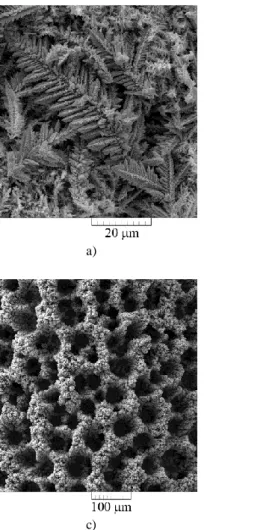
The very branchy pine-like dendrites of Ag, which were very similar to those electrodeposited at 650 mV, were obtained by electrodeposition at 1000 mV (Fig. 3, a and b). On the other hand, holes formed of detached hydrogen bubbles surrounded by the cauliflower-like agglomerates of Cu grains were formed by copper electrodeposition (Fig. 3, c and d). This type of structure represents the typical honeycomb-like structure and vigorous hydrogen
evolution is responsible for its formation. The ap-pearance of individual holes (Fig. 2 c) and forma-tion of the honeycomb-like structure (Fig. 3 c) clearly confirms the fact that hydrogen evolution reaction on copper electrode is somewhat faster than on silver electrode [29]. In the case of Ag, there is no hydrogen evolution even at an overpo-tential of 1000 mV vs. Ag reference electrode.
a) b)
c) d)
Fig. 3. Morphologies of: a) and b) silver, and c) and d) copper deposits obtained by electrodeposition at an overpotential of 1000 mV
3.3. Characteristics of dendritic growth of the intermediate metals
The pine-like dendrites of Cu and Ag (Figs. 2, 3, a and b) are of high structural symmetry, con-sisting of a long trunk or stem with corncob-like forms oriented in all directions. It is interesting to note that the corncob-like forms were mutually par-allel and oriented at an approximate angle of about 60o in relation to the stalk or trunk, indicating the existence of the growth of silver and copper crystals in a preferential direction. The corncob-like copper
and silver forms were constructed from small ag-glomerates of metal grains indicating the similarity between copper and silver dendrites, not only on the macro-level but to also on the micro-level. The treatment of copper dendrites using ultrasound [30] showed that the corncob-like forms represent the basic element of which these dendrites were con-structed. In accordance with Wranglen`s definition of a dendrite [31], it is clear that the corncob-like forms represent the primary branches of a dendrite.
protru-sion that grows under activation control, while electrodeposition to the macroelectrode is pre-dominantly under diffusion control [1, 32, 33]. Dendritic growth is initiated at some overpotentials belonging to the plateau of the limiting diffusion current density. For the group of intermediate met-als, the minimum overpotential for the initiation of dendritic growth, i is given by Eq. (3) [1]:
0 L c i
ln
3
.
2
j
j
b
(3)where jL is the limiting diffusion current density
and bc is the cathodic Tafel slope. The critical
overpotential for dendritic growth initiation, i,
denotes overpotential at which the system enters diffusion control of the electrodeposition. The outer limit of the diffusion layer of the macroelec-trode was not disrupted by the formation of both the cauliflower-like agglomerates of grains and dendrites inside the plateau of the limiting diffu-sion current density.
The critical overpotential for instantaneous growth of dendrites, c, is given by Eq. (4) [1]:
h
j
j
b
0 L c cln
3
.
2
(4)where is the diffusion layer thickness and h is the height of protrusion from which the growth of dendrite starts.
The critical overpotential for instantaneous dendritic growth, c, is the overpotential at which
diffusion control becomes complete, and this over-potential corresponds to the inflection point at the polarization curve [34]. The formation of only dendrites at an overpotential of 1000 mV (Fig. 3, a and b) confirms this fact. After the inflection point, the electrodeposition system remains under diffu-sion control and the rapid increase in current den-sity with the further increase in overpotential is due to the rapid growth of dendrites followed by the strong increase in the surface area. Considering the electrochemical definition of a dendrite, this sud-den and rapid increase in current sud-density after the inflection point can be mainly ascribed to the acti-vation-controlled electrodeposition at the tips of the formed dendrites. It is very clear that both the trunk and branches of tips contribute to overall control of the electrodeposition process, causing the disruption of the outer limit of the diffusion layer of the macro-electrode. This is valid for met-als with high overpotentimet-als for hydrogen evolu-tion, like Ag and normal metals. The situation is completely different for metals with medium (Cu)
and low (the inert metals) overpotentials for hy-drogen evolution, which will be discussed later. For the intermediate metals, the difference between
c and i (Eqs. (3) and (4)) will never reach zero,
making this one of the substantial differences be-tween intermediate and normal metals.
The Ag dendrites from the ammonium elec-trolyte were very similar to the Ag dendrites ob-tained in the presence of tungstosilicate [11] and citric [12] acids. The common characteristic of these electrolytes for Ag electrodeposition is their affiliation to the group of complex electrolytes. The surface morphology of these dendrites was completely different compared to Ag irregular forms which were created by the basic electrolytes [9]. The processes of Ag electrodeposition from the basic electrolytes belong to the rapid electro-chemical processes (j0 → ) and the processes for
the complex formation of Ag(I) ions lower the exchange current density (i.e. it decreases the rate of electrochemical process) and enable the transfer of Ag from the group of normal to the group of intermediate metals. In this way, analysis of the shape of Ag dendrites can be a good auxiliary cri-terion for the rapid estimation of the rate of the Ag electrodeposition process. The similarity of copper and silver dendrites obtained from the complex electrolytes with Au dendrites [35] (the third very important representative of the group of intermedi-ate metals) clearly indicintermedi-ates that this shape of den-drites represents the typical form of a dendrite characterizing the group of intermediate metals.
3.4. Effect of hydrogen evolution on Cu electrodeposition process – inhibition
of dendritic growth
The honeycomb-like structure (Fig. 3, c and d) was formed under the conditions of hydrogen evolution, which were vigorous enough to change the hydrodynamic conditions in the near-electrode layer [19]. The effect of evolved hydrogen on the change in the surface morphology of Cu from very branchy pine-like dendrites to honeycomb-like structures can be considered as follows:
Figure 4 shows the dependencies of the current of electrodeposition and the volumes of evolved hy-drogen on the time of electrodeposition at overpoten-tials of 650 and 750 mV (Fig. 4 a) and 850 and 1000 mV (Fig. 4 b). The current efficiency of hydrogen evolution in a time t, I(H2), were calculated by the
use of Eq. (1) and the average values calculated as
t t t d ) H ( ) / 1 ( ) H ( 2 0 I 2 av
I,
a) b)
Fig. 4. The dependencies of the current of electrodeposition and the volumes of evolved hydrogen on the time of electrodeposition obtained at overpotentials of: a) 650 and 750 mV, b) 850 and 1000 mV
T a b l e 1
The values of the average current efficiency of hydrogen evolution, I,av(H2), at overpotentials,,
of 650, 750, 850 and 1000 mV
/ mV 650 750 850 1000
I,av(H2) / % 2.0 14.5 30.7 46.8
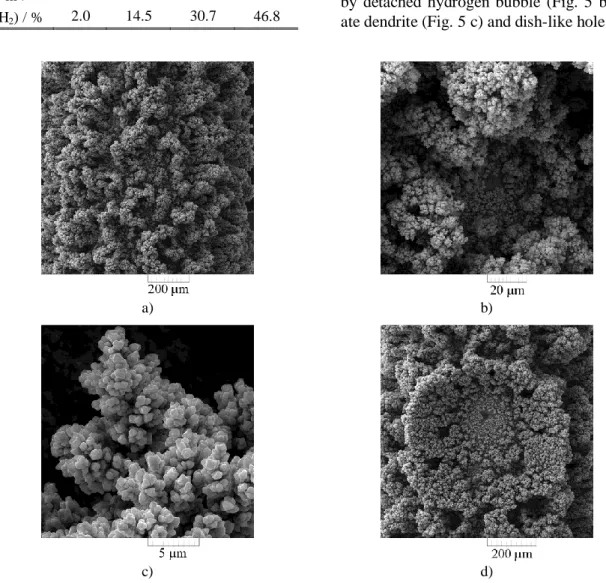
Figure 5 shows the morphology of electro-deposited copper at an overpotential of 750 mV (“top view”, Fig. 5 a) and the typical elements of this surface morphology as follows: hole formed by detached hydrogen bubble (Fig. 5 b), degener-ate dendrite (Fig. 5 c) and dish-like hole (Fig. 5 d).
a) b)
c) d)
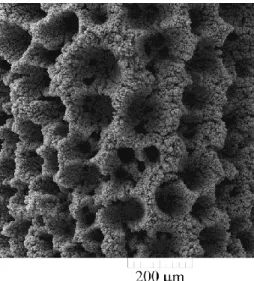
The analysis of the surface morphology of copper obtained at an overpotential of 850 mV (Fig. 6) reveals the formation of the honeycomb-like structure at this overpotential. The analysis of Figs. 2, c and d, 3, c and d, 5 and 6 provides com-plete insight into the effect of hydrogen evolution on the copper electrodeposition process. Hydrogen evolution as the second reaction to copper electro-deposition commences at some overpotentials be-longing to the plateau of the limiting diffusion cur-rent density, which is confirmed by the presence of individual holes in the morphology of Cu deposits that are electrodeposited at 650 mV (Fig. 2 c).
Fig. 6. The typical honeycomb-like structure obtained by Cu electrodeposition at an overpotential of 850 mV
The critical overpotential for the beginning of hydrogen evolution can be estimated from the dependence of the average current efficiency of hydrogen evolution, I,av(H2), on an overpotential
to be approximately 590 mV (Fig. 7). The amount of evolved hydrogen at 650 mV (I,av(H2) = 2.0 %)
was not sufficient to achieve any effect on the Cu electrodeposition process. The strong non-uniform electrode surface obtained at 650 mV (very branchy dendrites, small cauliflower-like agglom-erates of Cu grains, and rare holes with an origin of detached hydrogen bubbles) clearly confirms that the diffusion layer of the macroelectrode is not disturbed by this amount of generated hydrogen.
Increasing the overpotential intensifies hy-drogen evolution and the effect of evolved hydro-gen on Cu electrodeposition becomes visible in the morphology of Cu deposits obtained at 750 mV (I,av(H2) = 14.5 %; Fig. 5 a). Dendritic growth is
partially inhibited by evolved hydrogen and degen-erate dendrites (Fig. 5 c) are formed instead of normal dendrites by electrodeposition at this
over-potential. Due to the more intense hydrogen evolu-tion at 750 mV, the number of holes formed is larger than that at 650 mV. Also, large holes with clearly defined shoulders (dish-like holes) [20] were formed at this overpotential. Also, evolved hydrogen achieved an effect on the hydrodynamic conditions in the near-electrode layer, but the non-uniformity of the electrode surface was not com-pletely eliminated. The evolved hydrogen caused stirring of the electrolyte in the near-electrode layer, leading to a decrease in the thickness of the diffusion layer, an increase in the limiting diffusion current density and a decrease in the degree of diffusion control of the electrodeposition process.
Fig. 7. The determination of the critical overpotential for the beginning of hydrogen evolution from
0.1 M CuSO4 in 0.5 M H2SO4
The mechanism behind the formation of the honeycomb-like structures is completely different to that responsible for the formation of dendrites. The concept of “effective overpotential” was pro-posed to explain the formation of this type of struc-ture [19]. According to this concept, when hydro-gen evolution is vigorous enough, the electrode-position process occurs at an overpotential which is effectively lower than that specified, and this overpotential is denoted as “effective” in a deposi-tion process. From the morphological point of view, this means that the morphologies of metal deposits become similar to those obtained at some lower overpotentials at which hydrogen evolution does not occur or is very slow. The formation of cauliflower-like agglomerates of copper grains instead of branchy dendrites clearly indicates the existence of a smaller degree of diffusion control at overpotentials of 850 and 1000 mV than at 650 mV. Hence, the zone of the fast increase of the current density with increasing the overpotential after the inflection point is related to the hydrogen evolution reaction and its effect on the hydrody-namic conditions in the near-electrode layer.
3.5. The transitional characteristics of the intermediate metals between
the normal and inert metals
It can be concluded from the above consid-eration that the typical shape of dendrites which characterize the intermediate metals is pine-like with corncob-like elements as branches. Hydrogen evolution is a crucial factor leading to the
inhibi-tion of dendritic growth and changes in the surface morphology of Cu from dendrites to cauliflower-like particles formed around holes, making both dendrites and cauliflower-like particles via the typical powder forms, thus characterizing the in-termediate metals. Also, it is clear that there is a correlation between the polarization characteristics and morphology of electrodeposited metal. The same response for the polarization curve gives a completely different surface morphology in the zone responsible for the rapid increase in the cur-rent density with the overpotential after the inflec-tion point. In the case of silver, the rapid increase in the current density with increasing overpotential is ascribed to the activation controlled electrode-position at the tips of dendrites. This polarization behaviour for Ag is similar to the polarization characteristics of the normal metals (the high j0,
the high hydrogen overpotential) [41, 42]. In the case of copper, the fast growth of the current den-sity after the inflection point is due to competition between the hydrogen evolution reaction and the copper electrodeposition process. This continuous increase in the current density with increasing overpotential due to the strong effect of evolved hydrogen on the hydrodynamic conditions in the near-electrode layer is a characteristic of the inert metals (the low j0, the low hydrogen
overpoten-tial). In this way, the transitional character of the intermediate metals between the normal and inert metals can be determined and defined. A compara-tive survey of the polarization and morphological characteristics of these typical representatives of the intermediate metals is given in Figure 8.
Nevertheless, copper electrodeposition proc-esses at high overpotentials where hydrogen evo-lution reactions occur parallel to Cu electrodeposi-tion can be seen as an introducelectrodeposi-tion to understand-ing of metal electrodeposition from the third group (the inert metals). It should be noted that the cop-per dendrites and cauliflower-like particles [4, 5], as well as the honeycomb-like structures [17, 18, 37] obtained in the galvanostatic regimes of elec-trolysis, were very similar those obtained in the potentiostatic regime and shown here. The most important metals from the group of inert metals from both scientific and technological points of view are Fe, Ni and Co. Electrodeposition of these metals is always accompanied by a hydrogen evo-lution reaction. At the macro-level, morphologies of the different irregular forms (or powder parti-cles) of these metals were comparable to those observed with copper electrodeposition in the hy-drogen co-deposition range. Holes formed from detached hydrogen bubbles, cauliflower-like ag-glomerates of metal grains and globules were the dominant morphological forms of powder particles obtained by the electrodeposition of inert metals such as Ni, Co and Fe [15, 16, 43]. All of these powder particles were formed under the condition of vigorous hydrogen evolution and the concept of “effective overpotential” is applicable to explain the formation of these powder particles. Jović et al. [15] analyzed polarization characteristics for the electrodeposition of Co and Ni and showed that the shape of polarization curves for these metals is a consequence of the so-called “electrode effect” which is connected to the bubble formation at high current densities; as a result, the evolution of bub-bles became the rate-limiting step of the electro-chemical process. The current for hydrogen evolu-tion at more negative potentials reached 60–70 % of the total current, which is in excellent agreement with the values obtained during the electrodeposi-tion of copper in the hydrogen co-deposielectrodeposi-tion range. Simultaneously, the honeycomb-like structures of nickel [44] were very similar to those of copper. Under the determined electrodeposition conditions, very branchy nickel dendrites were formed [14] which were more similar to the dendrites of inter-mediate metals than those belonging to the group of normal metals. The shape of Ni, Co and Fe powder particles did not depend on the composi-tion of solucomposi-tion, which is understandable due to the vigorous hydrogen evolution during the formation of these particles via the electrolysis processes.
It is clear that macrostructures of copper de-posits obtained in the hydrogen co-deposition range are comparable with those characterizing the
group of inert metals. The appearance of macro- pores (the honeycomb-like structures) and cauli-flower-like agglomerates of copper grains in the hydrogen co-deposition range approached the structural characteristics of copper to those from the group of inert metals, additionally establishing the transitional characteristic of the intermediate metals between normal and inert metals.
4. CONCLUSIONS
The processes responsible for the electrode-position of silver (the ammonium electrolyte) and copper at the high overpotentials, as the typical representatives of intermediate metals, were ana-lyzed. The polarization characteristics were corre-lated with the morphologies of silver and copper deposits characterized by scanning electron mi-croscopy (SEM).
The dendrites of silver and copper obtained at the overpotentials belonging to the plateaus of the limiting diffusion current density were very similar to each other. They had a pine-like shape constructed from the corncob-like branches as the basic elements. This type of dendrite represents the typical form of dendrites characterizing the inter-mediate metals.
A completely different situation was ob-served in the part of the polarization curves char-acterized by the rapid increase in the current den-sity with increasing overpotential. Due to the lower overpotential for hydrogen evolution, the process of Cu electrodeposition was strongly affected by the hydrogen evolution reaction. Unlike silver dendrites, which have similar results to those ob-tained at the plateaus of the limiting diffusion cur-rent density, holes formed by detached hydrogen bubbles surrounded by cauliflower-like agglomer-ates (the honeycomb-like structure) were obtained by Cu electrodeposition in this zone.
The typical irregular (or powder) morpho-logical forms (the pine-like shape of a dendrite and cauliflower-like particles) characterizing the inter-mediate metals are defined. By analyzing the po-larization and morphological characteristics of Cu and Ag, the transitional character of intermediate metals between the normal and inert metals is es-tablished.
Acknowledgements. The work was supported by the
REFERENCES:
[1] K. I. Popov, S. S. Djokić, B. N. Grgur, Fundamental aspects of electrometallurgy, New York, Kluwer Academic/Plenum Publishers, 2002, pp 1–305.
[2] R.Winand, Electrodeposition of metals and alloys – new results and perspectives, Electrochim. Acta, 39, 1091– 1105 (1994).
[3] V. M. Kozlov, L. Peraldo Bicelli, Influence of the nature of metals on the formation of the deposit's polycry-stalline structure during electrocrystallization, J. Cryst. Growth, 203, 255–260 (1999).
[4] G. Orhan, G. Hapci, Effect of electrolysis parameters on the morphologies of copper powder obtained in a rotating cylinder electrode cell, Powder Technol., 201, 57–63 (2010).
[5] G. Orhan, G. G. Gezgin, Effect of electrolysis para-meters on the morphologies of copper powder obtained at high current densities,J. Serb. Chem. Soc., 77, 651– 665 (2012).
[6] N. D. Nikolić, G. Branković, M. G. Pavlović, Correlate between morphology of powder particles obtained by the different regimes of electrolysis and the quantity of evolved hydrogen, Powder Technol., 221, 271–277 (2012).
[7] Y. Ni, Y. Zhang, L. Zhang, J. Hong, Mass synthesis of dendritic Bi nanostructures by a facile electrodeposition route and influencing factors. CrystEngComm, 13, 794– 799 (2011).
[8] M. Yang, Fern-shaped bismuth dendrites electro-deposited at hydrogen evolution potentials, J. Mater. Chem., 21, 3119–3124 (2011).
[9] C. Ding, C. Tian, R. Krupke, J. Fang, Growth of non-branching Ag nanowires via ion migrational-transport controlled 3D electrodeposition, CrystEngComm, 14, 875–879 (2012).
[10] T-H. Lin, C-W. Lin, H-H. Liu, J-T. Sheu, W-H. Hung, Potential controlled electrodeposition of gold dendrites in the presence of cysteine, Chem. Commun., 47, 2044– 2046 (2011).
[11] J. Han, J. Liu, Electrodeposition of Crystalline Dendritic Silver in 12-Tungstosilicate Acid System, J. Nanoeng. Nanomanuf., 2, 171–174 (2012).
[12] M. V. Mandke, S-H. Han, H. M. Pathan, Growth of silver dendritic nanostructures via electrochemical route,
CrystEngComm, 14, 86–89 (2012).
[13] J. Wang, L. Wei, L. Zhang, Y. Zhang, C. Jiang, Electro-lytic approach towards the controllable synthesis of symmetric, hierarchical, and highly ordered nickel dendritic crystals, CrystEngComm, 14, 1629–1636 (2012). [14] N. D. Nikolić, H. Wang, H. Cheng, C. Guerrero, E. V.
Ponizovskaya, G. Pan, N. Garcia, Magnetoresistance Controls Arboreous Bead-Dendritic Growth of Magnetic Electrodeposits: Experimental and Theoretical Results,
J. Electrochem. Soc., 151, C577–C584 (2004).
[15] V. D. Jović, B. M. Jović, V. M. Maksimović, M. G. Pavlović, Electrodeposition and morphology of Ni, Co and Ni–Co alloy powders: Part II. Ammonium chloride
supporting electrolyte, Electrochim. Acta, 52, 4254– 4263 (2007).
[16] V. D. Jović, V. M. Maksimović, M. G. Pavlović, K. I. Popov, Morphology, internal structure and growth mechanism of electrodeposited Ni and Co powders,
J. Solid State Electrochem., 10, 373–379 (2006). [17] H. Shin, J. Dong, M. Liu, Nanoporous Structures
Prepared by an Electrochemical Deposition Process,
Adv. Mater., 15, 1610–1614 (2003).
[18] Y. Li, W Jia, Y. Song, X. H. Xia, Superhydrophobicity of 3D porous copper films prepared using the hydrogen bubble dynamic template, Chem. Mater., 19, 5758–5764 (2007).
[19] N. D. Nikolić, K. I. Popov, Lj. J. Pavlović, M. G. Pavlović, The effect of hydrogen codeposition on the morphology of copper electrodeposits. I. The concept of effective overpotential, J. Electroanal. Chem., 588, 88– 98 (2006).
[20] N. D. Nikolić, Lj. J. Pavlović, M. G. Pavlović, K. I. Popov, Formation of dish-like holes and a channel structure in electrodeposition of copper under hydrogen co-deposition, Electrochim. Acta, 52, 8096–8104 (2007). [21] N. D. Nikolić, G. Branković, M. G. Pavlović, K. I. Popov, The effects of the pause to pulse ratio in the regime of pulsating overpotential on the formation of honeycomb-like structures, Electrochem. Commun., 11, 421–424 (2009).
[22] N. D. Nikolić, G. Branković, Effect of parameters of square-wave pulsating current on copper electro-deposition in the hydrogen co-electro-deposition range,
Electrochem. Commun.,12, 740–744 (2010).
[23] S. Cherevko, X. Xing, C-H. Chung, Electrodeposition of three-dimensional porous silver foams, Electrochem. Commun., 12, 467–470 (2010).
[24] S. Cherevko, C. Chung, Impact of key deposition parameters on the morphology of silver foams prepared by dynamic hydrogen template deposition,Electrochim. Acta,55, 6383–6390 (2010).
[25] S. Cherevko, C. Chung, Direct electrodeposition of nanoporous gold with controlled multimodal pore size distribution,Electrochem. Commun.,13, 16–19 (2011). [26] R. Sivasubramanian, M. V. Sangaranarayanan,
Electro-deposition of silver nanostructures: from polygons to dendrites, CrystEngComm, 15, 2052–2056 (2013). [27] M. Rosso, E. Chassaing, V. Fleury, J-N. Chazalviel,
Shape evolution of metals electrodeposited from binary electrolytes, J. Electroanal. Chem., 559, 165–173 (2003). [28] K. I. Popov, N. V. Krstajić, S. R. Popov, Fundamental
aspects of plating technology. II. Morphological aspects of metal electrodeposition from complex salt solutions,
Surf. Technol., 20, 203–208 (1983).
[29] S. Trasatti, Work function, electronegativity, and electrochemical behaviour of metals: III. Electrolytic hydrogen evolution in acid solutions, J. Electroanal. Chem., 39, 163–184 (1972).
evolved hydrogen, Powder Technol., 185, 195–201 (2008).
[31] G. Wranglen, Dendrites and growth layers in the electrocrystallization of metals. Electrochim. Acta, 2, 130–146 (1960).
[32] J. W. Diggle, A. R. Despić, J.O’M. Bockris, The mechanism of the dendritic electrocrystallization of zinc,
J. Electrochem. Soc., 116, 1503–1514 (1969).
[33] A. R. Despić, K. I. Popov, Transport controlled deposition and dissolution of metals, in: Modern Aspects of Electrochemistry, B. E. Conway, J. O`M. Bockris (Eds), Vol 7, Plenum Press, 1972, pp 199–313.
[34] N. D. Nikolić, K. I. Popov, P. M. Živković, G. Branković, A new insight into the mechanism of lead electrodeposition: ohmic–diffusion control of the electrodeposition process, J. Electroanal. Chem., 691, 66–76 (2013).
[35] Z-Y. Lv, A-Q. Li, Y. Fei, Z. Li, J-R. Chen, A-J. Wang, J-J. Feng, Facile and controlled electrochemical route to three-dimensional hierarchical dendritic gold nano-structures, Electrochim. Acta, 109, 136–144 (2013). [36] N. D. Nikolić, G. Branković, V. M. Maksimović, Effect
of the anodic current density on copper electrodeposition in the hydrogen co-deposition range by the reversing current (RC) regime, J. Electroanal. Chem., 661, 309– 316 (2011).
[37] N. D. Nikolić, G. Branković, K. I. Popov, Optimization of electrolytic process of formation of open and porous
copper electrodes by the pulsating current (PC) regime,
Mater. Chem. Phys., 125, 587–594 (2011).
[38] N. D. Nikolić, G. Branković, M. G. Pavlović, Effect of the electrolysis regime on the structural characteristics of honeycomb-like electrodes, Maced. J. Chem. Chem. Eng., 32, 79–87 (2013).
[39] H. Shin, M. Liu, Copper Foam Structures with Highly Porous Nanostructured Walls, Chem. Mater., 16, 5460– 5464 (2004).
[40] J.-H. Kim, R.-H. Kim, H.-Sang Kwon, Preparation of copper foam with 3-dimensionally interconnected spherical pore network by electrodeposition, Electro-chem. Commun., 10, 1148–1151 (2008).
[41] N. D. Nikolić, V. M. Maksimović, G. Branković, Morphological and crystallographic characteristics of electrodeposited lead from the concentrated electrolyte,
RSC Adv., 3, 7466–7471 (2013).
[42] N. D. Nikolić, Dj. Dj. Vaštag, P. M. Živković, B. Jokić, G. Branković, Influence of the complex formation on the morphology of lead powder particles produced by the electrodeposition processes, Adv. Powder Technol., 24, 674–682 (2013).
[43] V. D. Jović, B. M. Jović, M. G. Pavlović, Electro-deposition of Ni, Co and Ni–Co alloy powders,
Electrochim. Acta, 51, 5468–5477 (2006).