Abstract—Aims: Effect of pH on polarographic waves of ascorbic acid were studied by recording polarograms of ascorbic acid solution, between 0 to 400 mV at different pH (0.065 to 9.6) using 0.008% solution of gelatin and 0.05 M potassium hydrogen phthalate buffer (containing 0.25% oxalic acid) as maxima suppressor and supporting electrolyte respectively.
Methods: Ascorbic acid is strong reducing agent and produces an anodic wave which shifts with pH. There is no significant change in height of wave with change in pH from 2.25 to 4.85.
For determination of ascorbic acid pH 4.0 is chosen. Ascorbic acid present in synthetic sample is determined by calibration, external standard addition and internal standard addition methods. The results obtained are in good agreement with the quoted values.
Result: The number of electrons taking part in the reversible reaction is found to be 2. The half-wave potential is found to be independent of the ascorbic acid concentration.
Index Terms—Ascorbic acid, calibration method, external standard addition method, internal standard addition method, polarographic determination.
I. INTRODUCTION
Ascorbic acid (Vitamin C) is rapidly finding new applications in protecting against endothelial dysfunction, high blood pressure, and the blood vessel changes that precede heart disease [1]-[3]. While often taken for granted, vitamin C is a critical supplement in our program to improve cardiac health and avoid degenerative diseases.
Ascorbic acid is an example of an unsaturated hydroxylactone and also gives a cathodic wave. The observation was made in 2 % metaphosphoric acid solution and a wave was reported at -1.7 V [4].
The ascorbic acid oxidation wave is interpreted on the basis of a mechanism involving a reversible electrode reaction followed by the irreversible conversion of an unstable intermediate to stable dehydroascorbic acid. The theoretical relationship between current, potential, conversion rate and drop time is rigorously derived, and found to agree satisfactorily both with earlier approximations and with experimental data. The data do not support a mechanism in which the electrons transfer is the rate-determining step [5].
It has been shown that the oxidation of ascorbic acid at a carbon paste electrode is similar to that at a platinum electrode. The half-peak potential is somewhat higher than the half-wave potential at a dropping-mercury electrode. The
Manscript received January 23, 2014; revised July 1, 2014.
Swaroopa Rani N. Gupta is with the Department of Chemistry, Brijlal Biyani Science College Amravati, Maharashtra, India (e-mail: [email protected]).
peak current is proportional to the concentration of ascorbic acid in the range 10–6–10–3M and the reproducibility is better than ±1 per cent. Chloride and sulphur compounds, such as sulphides and thiols, do not interfere, and sulphite can be determined at the same time as the ascorbic acid. Some substituted phenols interfere but can often be detected by reversing the direction of polarisation. Reductones interfere but tin(II) and manganese(II) do not. A method has also been developed to determine ascorbic acid in the presence of an excess of iron. Different extraction media are discussed in terms of their influence on the redox potential of iron. Comparative titrimetric determinations of ascorbic acid in some fruits, vegetables and beverages gave higher results than the voltammetric method [6].
A polarographic study of the oxidation mechanism of L-ascorbic acid and of the reduction mechanism of dehydro-L-ascorbic acid was carried out in an acid medium. For L-ascorbic acid, the oxidation process involves a two electron transfer. The polarographic curve shows that the limiting current is governed by diffusion. On the rising portion of the wave, the two electron oxidation process consists of two consecutive one electron transfers, the second being the rate determining step. The reaction orders, together with the Tafel slopes, were calculated. The reduction of dehydro-L-ascorbic acid at the limiting current is kinetically controlled and involves a two electron transfer. The reaction kinetic pathways were studied and the reaction orders and Tafel slope were calculated. It is deduced that, for low overvoltages, the second one electron transfer is the rate determining step [7].
Dehydro-L-ascorbic acid (DAA) which is formed from ascorbic acid (AA) by oxidation with active charcoal (Norit A) gives 2 well defined polarographic reduction waves caused by diffusion controlled currents in deoxygenated acetate buffer (pH 3.6) containing O-phenylenediamine (OPD). The diffusion currents of the 2 waves depend on the time after the addition of OPD, the concentration of OPD, pH and temperature. Since the linear relation between the diffusion current and the concentration of DAA exists, the polarographic OPD method can be used for the determination of DAA. Both of the waves are suited for analysis, but the 2nd wave is preferable. Vitamin C in foods was determined satisfactorily by the method [8].
Ascorbic acid, folic acid, nicotinamide and riboflavin were determined in the presence of one another, without prior separation by polarography. Na citrate-borate buffer (pH 12) was the best solvent. The excipients influenced the half-wave potential and the height of the polarography wave, but for the type of tables tested the interference was considered contant. The values of half wave potential (mV), diffusion current
Development of Calibration and Standard Addition
Polarographic Determination of Ascorbic Acid
(µA), and pH were: ascorbic acid - 270, 8.863 and 12; folic acid - 483, 0.389 and 3; nicotinamide – 1740, 2.121 and 12; riboflavin – 446, 1.234 and 6 respectively [9].
Ferrocene attached to the surface of a platinum electrode catalyzes the electrochemical oxidation of ascorbic acid in acidic buffer solutions. The overpotential for ascorbic acid oxidation is decreased by 150 mV at pH 2.2 compared with reaction at bare platinum; and an increase in anodic current and decrease in cathodic current for the redox reaction of ferrocene occurs on addition of ascorbic acid to the solution. The ferrocene – modified electrode is useful for the voltammetric determination of ascorbic acid in natural fruit juices. The advantages result from the electro catalytic effect and from the prevention of adsorption of inhibitory substances from solution [10].
Concentrations of L-ascorbic acid in fresh and processed fruit and vegetables were determined by differential pulse polarography (DPP). This method has been found to be convenient for the determination of L-ascorbic acid in all investigated vegetables, as well as in citrus fruits, strawberries, raspberries and currants. The method cannot be recommended for L-ascorbic acid determination in cherries, sour cherries and bananas due to an inhibition of the electrode reaction or to the nature of vitamin C decomposition pathways in certain fruits [11].
The ascorbic acid content of fruit and vegetables was determined by normal polarography. It was found that oxalic acid and EDTA protected the vitamin during the sample preparation procedure but oxalic acid was preferred to be used for polarographic analysis. Citrate buffer was used as the supporting electrolyte since it was already present in fruit and vegetables and resisted the change in pH upon the addition of the fruit extract. The most suitable pH of the supporting electrolyte was determined to be 4.5. A procedure is suggested for the determination of ascorbic acid in fruit and vegetables. The standard deviation for the method based upon the pooled precision data was found to be 1.0 for tomatoes and 3.1 for oranges [12].
Interactions between lead and ascorbic acid were investigated by polarography and voltammetry. The following techniques were applied: sampled polarography, differential pulse anodic stripping voltammetry, and square-wave voltammetry. Measurements were performed in perchlorate aqueous solutions under physiological ionic strength (0.15 mol dm(-3)). Electrochemical reaction of the lead(II) ascorbate complex was studied in various electrolyte compositions to find the optimal measurement conditions for determination of the corresponding stability constants ([Pb2+] = 4 × 10(-7) mol dm(-3), pH = 5.5; total concentration of ascorbic acid between 10(-5) and 10(-1) mol dm(-3)). Determination of stability constants of labile lead(II) ascorbate complexes was based on the DeFord-Hume methodology, and they were calculated from the dependence of the shift of Pb-II peak potential on the free ascorbate ion concentration. The computed stability constants were: log beta(1) = 9.3 +/- 0.2 and log beta(2) = 18.0 +/- 0.1[13].
L-ascorbic acid was determined in aqueous media by linear-scan voltammetry on a gold electrode; ranging between (1-175 μg/mL). In biologic samples, for elimination of uric acid or some sugars and effects, a significant interference of
copper ions whose presence reduces the height of the L-ascorbic acid oxidation peak was used [14].
A differential pulse polarographic (DPP) method has been developed for the determination of ascorbic acid (AA) and dehydroascorbic acid (DHA), the two main forms of Vitamin C. The method consists of the DPP analysis of a quinoxaline obtained by the derivatization of DHA with o-phenylenediamine. Results using the proposed method correlated well with those obtained by two reference methodologies: the common iodometric method and a published chromatographic methodology. It was also used in the study of Vitamin C degradation in fruit juices, showing that it involves an initial oxidation of AA to DHA, followed by hydrolytic degradation of the latter [15].
DC polarographic method was developed for estimation of ascorbic acid (vitamin C) in pharmaceutical formulations. Parameters like concentration of supporting electrolyte, maximum suppressor, pH, mercury flow rate and drop time were optimized. Under optimum conditions, a well-defined sigmoid curve was observed with diffusion current proportional to the concentration of ascorbic acid. Analytical quality control was carried out with determination of relative mean deviation, standard deviation and regression studies. The method was found to be simple, rapid and reproducible. The optimized method was applied to various pharmaceutical formulations available in local market. The results obtained were found to be in agreement with the certified values [16].
II. METHODOLOGY
All chemicals were of A.R. grade. D.C. Toshniwal manual polarograph with a digital display to read current and voltage was used to record the polarograms. Dropping Mercury Electrode (D.M.E.) was used as anodic current indicator while Saturated Calomel Electrode (S.C.E.) was used as cathode. Saturated KCI salt bridge was used to connect them. The mercury drop rate was maintained at around 20 drops per minute. 50 ml total volume was maintained for each measurement.
A. Effect of pH on Polarographic Waves of Ascorbic Acid Polarograms of 7.98 × 10⁻⁴ M ascorbic acid solution were recorded after removal of oxygen with a stream of nitrogen, between 0 to 400 mV at different pH (0.065 to 9.6) using 0.008% solution of gelatin and 0.05 M potassium hydrogen phthalate buffer (containing 0.25% oxalic acid) as maxima suppressor and supporting electrolyte respectively. Further experiments were carried out in presence of same quantities of maxima suppressor and supporting electrolyte.
B. Polarographic Determination of Ascorbic Acid
(Calibration Method)
Six systems were prepared at pH 4.0 by taking different amount (3, 4, 5, 6 and 7 ml) of ascorbic acid solution (176 mg/100 ml) and polarograms of all systems were recorded using D.M.E. as anode and SCE as cathode. A calibration curve for heights of anodic waves (id) against concentration of
ascorbic acid was plotted. The id for the unknown sample was
C. Polarographic Determination of Ascorbic Acid (External Standard Addition Method)
The polarograms of systems containing unknown sample were recorded before and after addition of 2 ml of 9.97 × 10⁻³ M ascorbic acid solution, between 0 to 250 mV using D.M.E. as anode and S.G.E. as cathode as before. The ascorbic acid present in unknown sample was computed.
D. Polarographic Determination of Ascorbic Acid (Internal Standard Addition Method)
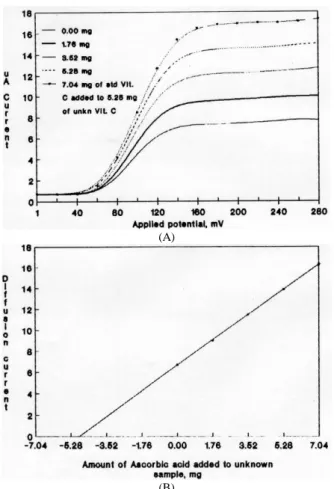
Internal standard addition method was developed for the determination of ascorbic acid from synthetic samples. Five systems were prepared by taking an aliquot of this solution equivalent to about 5 mg of ascorbic acid, 1 ml 0.4% (pH = 4) gelatin solution and measured amount of a standard solution of ascorbic acid (pH = 4) containing 0, 1.76, 3.52, 5.28 and 7.04 mg of it. Each system was diluted to 50 ml with buffer solution (pH = 4) and polarogram was recorded on Toshniwal Manual Polarograph as described earlier. The resulting diffusion currents were plotted against the concentration of the standard solutions that were added to the unknown. The extrapolated line intersecting the response axis indicated the concentration of the ascorbic acid in the unknown sample. The values were also calculated using the standard addition equation. The determination of ascorbic acid in synthetic sample is carried out by dissolving accurately weighed powered quantity of the synthetic sample, containing about 100 mg of ascorbic acid in 100 ml of the buffer pH 4.0.
III. OBSERVATION
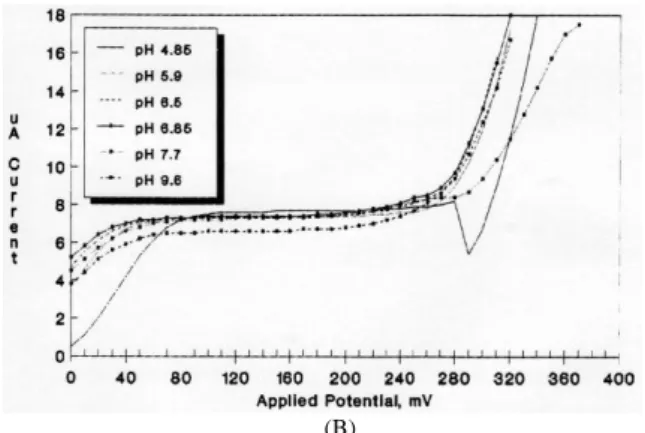
The effect of pH on anodic waves of ascorbic acid is shown in Fig. 1 (A) and (B). The decomposition potential, diffusion current and the potential at which adsorption phenomenon takes place read out from the polarograms at different pH. The polarograms are well defined between pH 2.25 and 4.12; at higher pH, the waves are not well defined and complete. The wave heights are practically constant. The decomposition potential is 200mV at pH 0.065 whereas the same has come down to 30 mV at pH 4.1 indicating that the decomposition as well as half-wave potentials vary significantly with pH. For determination of ascorbic acid pH 4.0 is chosen.
Calibration polarogram for ascorbic acid determination in potassium hydrogen phthalate buffer (pH 4.0) containing 0.25% oxalic acid and 0.008% gelatin are shown in Fig. 2 (A). Plot of id vs concentration of ascorbic acid is represented in
Fig. 2 (B). It is found that the value of diffusion current increases with increase in concentration.
(A)
(B)
Fig. 1. Effect of pH on the anodic wave of 7.98×10⁻⁴ M ascorbic acid in
presence of 0.05 M potassium hydrogen phthalate buffer containing 0.25 % oxalic acid and 0.008 % gelatin.
Fig. 3 represents the polarograms of a synthetic sample, before and after addition of standard amount of ascorbic acid. Anodic waves for application of the method of internal standard addition in the determination of ascorbic acid in a synthetic is shown in Fig. 4 (A) and (B).
(A)
(B)
Fig. 2. Calibration polarogram (A) and Calibration curve (B) for ascorbic acid.
(A)
(B)
Fig. 4. Polarographic determination of ascorbic acid in synthetic sample by internal standard addition method.
IV. RESULT AND DISCUSSION
Ascorbic acid is a naturally occurring organic compound with antioxidant properties. It is a white solid, but impure samples can appear yellowish. It dissolves well in water to give mildly acidic solutions. Ascorbic acid and its sodium, potassium, and calcium salts are commonly used as antioxidant food additives. These compounds are water-soluble and thus cannot protect fats from oxidation: For this purpose, the fat-soluble esters of ascorbic acid with long-chain fatty acids (ascorbyl palmitate or ascorbyl stearate) can be used as food antioxidants.The analysis of ascorbic acid is an important analytical problem.
A. Effect of pH on Polarographic Waves of Ascorbic Acid
Ascorbic acid (vitamin C) is easily oxidized to dehydroascorbic acid. This oxidation can be achieved not only by chemical oxidizing agents, but also electrochemically at the surface of the dropping mercury electrode. The oxidation takes place at rather positive potentials and results in negative currents are recorded. On polarographic curves, the oxidation of ascorbic acid thus results in anodic waves.
A potassium hydrogen phthalate buffer (pH 0.065 to 9.6) containing 0.25% oxalic acid is used as supporting electrolyte. 0.008% Gelatin is used as maxima suppressor. Oxalic acid is the extracting substance for vitamin C which does not interfere with the anodic wave and which does not affect the vitamin. The method is highly precise. Defined anodic diffusion current waves are obtained if the potential range of the polarograph is 0-300 mV. The oxidation potential of ascorbic acid depends much on the pH of the solution; the decomposition potential at pH 0.065 against a saturated calomel electrode is 200 mV whereas the same has come down to 30 mV at pH 4.1 indicating that the half wave potential shifts to more positive values with decrease in pH. The polarograms are well defined between pH 2.25 and 4.1, at higher pH, the waves are incomplete due to their shift in decomposition potential towards negative potential side.
Because of the ene-diol system, ascorbic acid is a strong reducing agent and produces an anodic wave which shifts with pH. It will be noted that the anodic diffusion currents in Fig. 1 (A) (B) from pH 0.065 to 4.85 show a sharp decrease at about 290 mV, just preceding the rapid increase in the negative current. This rapid increase in the negative current at 320 mV is due to the anodic dissolution of mercury from the dropping electrode. Probably a film of mercury phthalate is formed at the electrode surface which interferes with the normal electrode reactions just before the dissolution of mercury and cause the decrease in current. At pH ≥ 5.9 dissolution of mercury predominates the adsorption of mercury phthalates, process proceeds unhindered, thus a continuous increase in the negative current is observed + 190 mV onward.
The value of diffusion current for 7.98 × 10⁻⁴ M ascorbic acid at different pH value is computed after making necessary corrections of residual current. There is no significant change in the height of the wave with change in pH from 2.25 to 4.85. At pH 0.065 and 1.0 the adsorption phenomenon is observed as mentioned earlier. Therefore, for these systems the limiting values of diffusion current are not obtained.
B. Polagraphic Determination of Ascorbic Acid
Ascorbic acid is a strong reducing agent at higher pH values reduces even atmospheric oxygen. Therefore, low pH values are preferred for preparation of standard ascorbic acid solution. A potassium hydrogen phthalate buffer (pH 4.0) containing 0.25% oxalic acid has proved useful for the preparation of supporting electrolytes used in determination of ascorbic acid. The absence of atmospheric oxygen gives good anodic waves but the presence of oxygen does not affect the wave.
TABLEI:POLAROGRAPHIC DETERMINATION OF ASCORBIC ACID IN
SYNTHETIC SAMPLE
Method of determination
Amount of ascorbic acid, mg
Taken Found %
Error Calibration method 8.8 8.8 ± 0.0 0.0 External standard addition method 8.8 8.75 ± 0.0 0.6 Internal standard addition method 5.28 5.0 ± 0.1 5.3
internal standard addition methods. The results of polarographic estimation of ascorbic acid in a synthetic sample by calibration, external standard addition as well as internal standard addition methods are given in Table I.
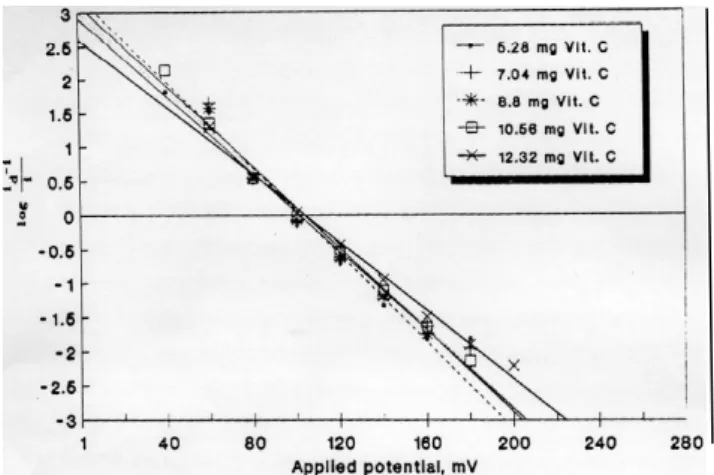
The results thus obtained are in good agreement with the quoted values. The methods are rapid and sensitive with good accuracy. The method is highly precise as indicated by low values of standard deviation. It is found that the values of diffusion current increases with increase in concentration of ascorbic acid. The straight line obtained by plotting Ed.e.
against log id-i / i of different concentration of ascorbic acid are shown in Fig. 5.
Fig. 5. Log plots of the waves of ascorbic acid at various concentrations in potassium hydrogen phthalate buffer containing 0.25 % oxalic acid (pH 4.0)
with 0.008 % gelatin; Experimental points from Fig. 2 (A).
The slope of the straight line is 0.031 to 0.037 V, in good agreement with the theoretical value 0.030 V for the oxidation involving 2 number of electrons. Hence the number of electrons taking part in the reversible reaction is found to be 2. The potential corresponding to the zero value for the log terms is the half-wave potential; its value is found to be independent of the ascorbic acid concentration.
V. CONCLUSION
Based on Polarographic studies of ascorbic acid it is concluded that Ascorbic acid (vitamin C) is easily oxidized to dehydroascorbic acid electrochemically at the surface of the dropping mercury electrode. The oxidation takes place at rather positive potentials. Oxalic acid is the extracting substance for vitamin C which does not interfere with the anodic wave and which do not affect the vitamin. Defined anodic diffusion current waves are obtained if the potential range of polarograph is 0-300 mV. The oxidation potential of ascorbic acid depends much on the pH of the solution; the half wave potential shifts to more positive values with decrease in pH. There is no significant change in the height of the wave with change in pH. The number of electrons taking part in the reversible reaction is found to be 2.
REFERENCES
[1] L. Rossig, J. Hoffmann, B. Hugel et al., “Vitamin C inhibits endothelial cell apoptosis in congestive heart failure,” Circulation, vol. 104, no. 18, pp. 2182-2187, Oct. 30, 2001.
[2] M. Fotherby, J. Williams, L. Forster, P. Craner, and G. Ferns, “Effect of vitamin C on ambulatory blood pressure and plasma lipids in older persons,” J. Hypertens, vol. 18, no. 4, pp. 411-415, April 2000. [3] R. Salonen, K. Nyyssonen, J. Kaikkonen et al., “Six-year effect of
combined vitamin C and E supplementation on atherosclerotic progression: the antioxidant supplementation in atherosclerosis prevention (ASAP) study,” Circulation, vol. 107, no. 7, pp. 947-953, Feb. 25, 2003.
[4] M. Kirk, “Polarographic determination of ascorbic acid,” Ind. Eng.
Chem. Anal. Ed., vol. 13, no. 9, pp. 625–626, 1941.
[5] D. Kern, “The polarographic oxidation potential of ascorbic acid,” J.
Am. Chem. Soc., vol. 76, no. 4, pp. 1011–1015, 1954.
[6] J. Lindquist, “Voltammetric determination of ascorbic acid by use of a carbon paste electrode,” Analyst, vol. 100, pp. 339-348, 1975. [7] J. Ruiz, A. Aldaz, and M. Dominguez, “Mechanism of L-ascorbic acid
oxidation and dehydro-L-ascorbic acid reduction on a mercury electrode, I. Acid medium,” Can. J. Chem., vol. 55, p. 2799, 1977. [8] K. Shizuko and K. Susumu, “Polarographic reduction wave of
L-ascorbic acid,” Utsunomiya Daigaku kyoikugakubu kiyo, Dai-2-bu, vol. 28, pp. 57-66, 1978.
[9] J. Miklos, S. Gyorgy, and S. Katalin, “Polarographic determination of the ascorbic acid, folic acid, nicotinamide and riboflavin content of polyvitamin tablets,” Acta Pharm. Hung., vol. 50, no. 4, pp. 153-160, 1980.
[10] P. Marianne, “Electrocatalytic oxidation of ascorbic acid and voltammetric determination with a ferrocene - modified platinum electrode,” Anal. Chem. Acta, vol. 187, pp. 333-338, 1986.
[11] S. Kozar, A. Bujak, J. Eder-Trifunović, and G. Kniewald, “Determination of L-ascorbic acid in fresh and processed fruit and vegetables by differential pulse polarography,” Fresenius' Zeitschrift für analytische Chemie, vol. 329, issue 7, pp 760-763, 1988. [12] F. Sahbaz and G. Somer, “Determination of ascorbic acid in fruit and
vegetables using normal polarography,” Food Chemistry, vol. 44, issue 2, pp. 141–146, 1992.
[13] B. Gina, M. Mirjana, and O. Dario, “Voltammetric determination of stability constants of lead complexes with vitamin C,” Croatica
Chemica Acta, vol. 79, no. 1, pp. 77-83, 2006.
[14] A. Behfar, N. Sadeghi,B. Jannat, and M. Oveisi, “Determination of L-Ascorbic acid in plasma by voltammetric method,” Iran J Pharm Res., vol. 9, no. 2, pp. 123–128, 2010.
[15] J. Rodrigues, I. Valente, L. Gonçalves, J. Pacheco, and A. Barros, “Polarographic determination of vitamin C after derivatization with o-phenylenediamine,” Collection of Czechoslovak Chemical
Communications, vol. 75, p. 731, December 2013.
[16] C. Masram and R. Jugade, “Polarographic studies of ascorbic acid and estimation in pharmaceutical formulations and fruit juices,” Int. J.
Pharm. Sci. Rev. Res., vol. 22, no. 2, pp. 285-287, Sep.–Oct. 2013.
Swaroopa Rani N. Gupta was born on February 28,
1965 in Nagpur, Maharashtra, India. She got her S.S.C. in Somalwar High School, Khamla, Nagpur, Maharashtra, India, maths, science, social science in 1981; H.S.S.C. in Hislop College, Nagpur, Maharashtra, India in maths & statistics, chemistry, biology in 1983; B.Sc. in Shivaji Science College,
microbiology in 1986; M.Sc. in Post Graduate Teaching Department of Chemistry, Nagpur, Maharashtra, India in chemistry specialization: analytical chemistry in 1988; M.Phil. in Post Graduate Teaching Department of Chemistry, Nagpur, Maharashtra, India in coordination chemistry, polymer chemistry in 1989; Ph.D. in Post Graduate Teaching Department of Chemistry, Nagpur, Maharashtra, India in chemistry in 1993.
She was now an associate professor in the Department of Chemistry, Brijlal Biyani Science College, Amravati, Maharashtra, India
Her research interests are in the field of chemistry especially analytical chemistry, environmental science and recent technologies connected to different field. She wants to explore world through great research interest in all aspect of world problem.