78
AREAL LIMIT IN THE ROMANIAN TERRITORY: 6. SECALE STRICTUM
BORUZ VIOLETA1, DIHORU G.2, RĂDUŢOIU D.3 1 University of Craiova, Botanical Garden “Al. Buia”; 2 - Institute of Biology, Romanian
Academy, Bucharest; 3 - University of Craiova, Faculty of Agriculture and Horticulture
Keywords: Secale strictum, areal, Romania
ABSTRACT
In this paper are presented data on the areal limit of the species Secale strictum (C. Presl) C. Presl on the Romanian territory. There are included observations on species distribution in Romania and also some ecological and coenological considerations. Secale strictum is one of the Poaceae species rarely found by botanists and therefore less researched. It is a species with southern area which does not pass north of the Carpathian.
INTRODUCTION
Series of species with a limited spreading area in Romania, started with Alyssum
minutum Schlecht. ex DC. (Dihoru, 1987), continues with the species Secale strictum (C. Presl) C. Presl. A kind of cereal that wanders on rocky ridges of the mountains, so that
some botanists have regarded even as Secale cereale. In terms of chorology is
appreciated just as rare plant and so (Oltean et al., 1994).
History. F. Schur (1866) does not mention it, and Borza (1947) quotes it only from Bucegi, as a great rarity, where it was indicated for the first time in Romania A. Beldie (1943), in a draft with several rows.
MATERIAL AND METHODS
The material was analyzed according to Romanian and foreign botanical literature (Ciocârlan, 2009; Sârbu et al., 2013; Tutin et al., (1964-1980); Bor, 1970, and others).
Eco-coenology species Secale strictum is deduced after reviewing several situations,
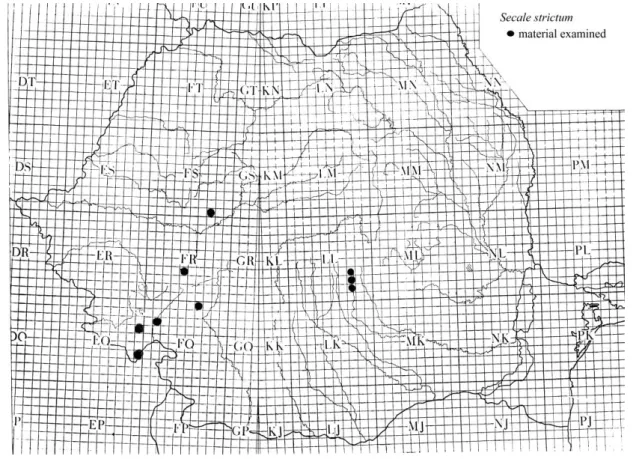
particularly from synthetic tables where it can be found alongside varied species. Common species in different geographical points were denoted with an asterisk. The chorology species in Romania is presented by counties. Data comes from the literature (including the phytocoenological tables) and from the main collections in the country. The herbariums were abbreviated according to Index herbariorum (Thiers, 2011). For the localities transposition on the map, where the presence of the plant was indicated, the UTM grid system (Universal Transverse Mercator) was used, with UTM indexes (Lehrer, Lehrer, 1990).
RESULTS AND DISCUSSIONS Nomenclature – taxonomy
Secale strictum (C. Presl) C. Presl 1826, Fl. Sicul. 46.
Basionym: Triticum strictum C. Presl 1820, Cyperaceae et Gramineae Siculae 48.
Syn.: Secale montanum Guss. 1827, Fl. Sic. Prodr. 1: 145; Boiss. 1884, Fl. Or. 5: 670; Bor 1960, Grasses Burma Ceyl. Ind. Pak. 678; Bor in Towns., Guest & Al-Rawi 1968,
Fl. Iraq 9: 262; Bor in Rech. f. 1970, Fl. Iran. 70: 214; Tzvelev 1976, Poaceae URSS 172;
Heathcote in Tutin et al. 1980, Fl. Eur. 5: 203; - S. dalmaticum Vis. 1842, Fl. Dalm. 1: 97.
The generic name originated in Latin draining - to cut, because we can cut the
79
name comes from the Celtic segal, derived from sega - sickle, arrived in Latin draining - to
cut, then cut wheat with a sickle.
Because it closely resembles S. cereale, some authors (Ciortuz, Peia, 1960)
reported it under this name on the top of limestone Svinecea (1226 m) of Almăj Mountains
(Hodişan, 1964). S. strictum is perennial and rachis fragments at maturity.
Ecology
Mountain plant, grows on limestone cliffs and sunny screes, the beech and spruce floors. It is subxerophilic-mesophilic, subthermophilic-heliophyllic, saxicolous-calcicolous.
Coenology
In the Zănoaga Reservation grows at about 1450 m, on the south-eastern slope, in clusters, with Achillea stricta, Aconitum anthora, A. lycoctonum subsp. vulparia, Anchusa barrelieri, Astragalus depressus, Athamanta turbith subsp. hungarica, Carduus candicans,
Cerinthe glabra, Digitalis grandiflora, Erysimum witmannii, Festuca stricta subsp.
saxatilis, Galium lucidum, Gentiana phlogifolia, Gymnadenia conopsea, *Irisaphylla, Isatis tinctoria, Knautia longifolia, Peucedanum austriacum, Phleum montanum, Pimpinella saxifraga, *Poa nemoralis, *Sedum telephium subsp. maximum, *Senecio squalidus subsp. rupestris, Silene nutans subsp. dubia, Sorbus graeca, Thymus comosus,
Valeriana sambucifolia, *Verbascum lychnitis etc. (Beldie, 1943, 1952, 1956), and in
Ialomiţa Cave Reservation with *Iris aphylla and Trisetum macrotrichum (Beldie, 1967).
On the steep base Dâmbău Mountain, 1000 m, grows on calcareous sedimentary
rocks and cohabiting with *Acer pseudoplatanus, Allium oleraceum, *Asplenium
scolopendrium, Clematis recta, Corylus avellana, Euonymus latifolius, *Iris aphylla, *Melica ciliata, *Parietaria officinalis, *Poa nemoralis, Polypodium vulgare, Scutellaria altissima, *Sedum telephium subsp. maximum, *Urtica dioica, *Verbascumlychnitis (Hodişan, 1964).
In Almăj Mountains, on a fired field, 15 years ago, growing with many different
species: *Acer pseudoplatanus, Aconitum toxicum, Actaea spicata, *Asplenium
scolopendrium, Brachypodium sylvaticum, Calamagrostis arundinacea, Campanula trachelium, Chaerophyllum temulentum, Chelidonium majus, Cotoneaster pyrenaicus,
Dactylis glomerata, Daphne mezereum, Festuca stricta subsp. sulcata, Geranium robertianum, Geum aleppicum, Hypericum perforatum, Seseli libanotis, *Melica ciliata,
Moehringia muscosa, Origanum vulgare, *Parietaria officinalis, *Poa nemoralis, Rubus idaeus, Salix caprea, Sambucus ebulus, S. racemosa, Saxifraga paniculata, S.
rotundifolia, Sedum album, S. hispanicum, *S. telephium subsp. maximum, *Senecio squalidus subsp. rupestris, Sesleria rigida, Spiraea chamaedryfolia, Syringa vulgaris,
*Urtica dioica (Ciortuz, Peia, 1960).
If it had not been requoted in this mountain (Schrött, 1972), after cohabitant species
we would be tempted to seek to Secale cereale.
After many of cohabitant is regarded as a species from Seslerio-Festucion to
Seslerietalia.
Distribution in Romania
In general we can say that is a fairly rare species in the flora of the country, present only in some mountains, belonging to the following counties (Fig. 1):
Alba: Feneş on Feneş Valley, Zlatna on Dâmbău Hill, 1000 m (Hodişan, 1964,
80
Fig. 1. Distribution ofSecale strictum (C. Presl) C. Preslin Romania (original).
Caraş-Severin: Almăj Mountains on the Svinecea Peak (Anina Mountains on Plevişeviţa Mică) (Ciortuz, Peia, 1960; Schrött, 1972; Váczy, Beldie, 1976); Domogled and Hurcu Mountains, in the company of thermophilic species (Popescu-Domogled, 1966; Ştefureac, 1976).
Dâmboviţa: Zănoaga Gorges, July 1954, ? leg. et det., Remarks: Picking probably
the faculty teaching [BVS 41776-41778]; Bucegi, Zănoaga - Zănoaga Gorges, leg. Al.
Beldie, 1943 [CL 508161], (Beldie, 1943) and on Bătrâna (between Turnul Seciului and
Ialomiţa Cave) - (Beldie, 1956, 1967; Borza, 1947; Anghel, Beldie, 1972; Ştefureac, 1976; Ciocârlan, 2009), and in Ialomiţa Cave Reservation (Beldie, 1967).
Gorj: Vâlcan Mountains (Anghel, Beldie, 1972; Ciocârlan, 2009); Vâlcan Mountains
- Piatra Boroştenilor Mountain (Muică, 1995).
Hunedoara: Gura Zlata (Retezat Mountains), leg. E. Vicol, 1967 [CL 653304].
Vâlcea: Căpăţânii Mountains: Oale Mountain above Pahomie Hermitage (Păun, Popescu, 1974; Păun, Popescu, 1978).
Area
Central Asia and Asia Minor, North Africa, Southern Europe.
CONCLUSIONS
In the flora of Romania, Secale strictum arrived from the Balkans, but does not pass
north of the Carpathian. It is appreciated as a Mediterranean-Balkan element. It is quite rare in the flora of the country, present only in some mountains, regarded as a species
from Seslerio-Festucion to Seslerietalia.
ACKNOWLEDGMENT
81
“Alexandru Ioan Cuza” University Iasi), M. Puşcaş (“Al. Borza” Botanical Garden, Cluj-Napoca).
BIBLIOGRAPHY
1. Anghel, G., Beldie, A., 1972 - Secale L., In Săvulescu T. (ed.),Flora Rep. Soc.
Rom.,Edit. Acad. Rep. Soc. Rom., Bucureşti. Vol. 12: 595-600.
2. Beldie, A., 1943 - Secale montanum în România (en Roumanie), Bul. Grăd. Bot. Cluj, 23(1-2): 222.
3. Beldie, A., 1952 - O insulă de vegetaţie termofilă în munţii Bucegi, Comunic. Acad. R.P.R., 2(9-10): 565-574.
4. Beldie, A., 1956 - Rezervaţia naturală “Bucegi”, Ocrot. Nat., 2: 31-63.
5. Beldie, A., 1967 - Flora şi vegetaţia Munţilor Bucegi, Edit. Acad. Rep. Soc. Rom., Bucureşti, 578 pag.
6. Bor, N. L., 1970 - Secale L., In Rechinger K. H. (ed.) Fl. Iran., Edit. Akademische Druck-u. Verlagsanstalt Graz Austria. Vol. 70: 213-214.
7. Borza, A., 1947 - Conspectus florae Romaniae regionumque affinium, Tipogr. “Cartea
Românească”, Cluj.Vol. 1, 160 pag.
8. Ciocârlan, V., 2009 - Flora ilustrată a României. Pteridophyta et Spermatophyta, Edit. Ceres, Bucureşti, 1143 pag.
9. Ciortuz, I., Peia, M., 1960 - Însemnări floristice din Banat, Com.Bot. (1957-1959): 173-177. SSNG.
10. Coste, H., 1937 - Flore descriptive et illustree de la France de la Corse et des contrees limitrophes, Librairie Sciences et des Arts, Paris. Vol. 3, 807 pag.
11. Dihoru, G., 1987 - Alyssum minutum Schlecht. ex DC., Revue Roum. Biol., Biol. Veget., 32(1): 11-14.
12. Hodişan, I., 1964 - Plantes nouvelles du teritoire de la vallée du Feneş (district D’Alba,
Région de Hunedoara), Revue Roum. Biol. – Bot., 9(4): 231-234.
13. Hodişan, I., 1965 - Analiza florei de pe Valea Feneşului (Raion Alba, Regiunea
Hunedoara), Contr. Bot.: 99-106.
14. Hodişan, I., 1965 - Flora şi vegetaţia din Bazinul văii Feneşului (raion Alba,
reg. Hunedoara), Rezumatul tezei de doctorat, Cluj.
15. Lehrer, A. Z., Lehrer, Maria, 1990 - Cartografierea faunei şi florei României
(coordonate arealografice), Edit. Ceres, Bucureşti, 290 pag. + 5 hărţi.
16. Muică, Cristina, 1995 - Munţii Vâlcanului. Structura şi evoluţia peisajului, Edit. Acad. Române, Bucureşti.
17. Nejshtadt, M. I., 1948 - Opredelitelj rastenij srednej polosî evropejskoj chasti
SSSR,476 str.Gosud.Ucheb.-Pedag. Izd. Min. Procv. RSFSR. Moskva.
18. Oltean, M., Negrean, G., Popescu, A., Roman, N., Dihoru, G., Sanda, V., Mihăilescu, Simona, 1994 - Lista roşie a plantelor superioare din România. Studii,
Sinteze, Documentaţii de ecologie,Acad. Rom., Inst. Biol. Bucureşti, 52 pag.
19. Păun, M., Popescu, G., 1974 - Secale montanum Guss. şi S. sylvestre Host în flora spontană a Olteniei. St. şi Cerc. COMN Oltenia, Slatina, 127-129.
20. Păun, M., Popescu, G., 1978 - Date despre vegetaţia erbacee a catenei calcaroase
Buila-Vânturariţa din Mţii Căpăţânii, Jud. Vâlcea. Anal. Univ. din Craiova, Vol. 9 (19): 67-73.
21. Popescu-Domogled, P. C., 1966 - Contribuţii floristice din Banat.Stud. Cerc. Biol. -
Bot.,18(1): 43-47.
22. Sârbu, I., Ştefan, N., Oprea, A., 2013 - Plante vasculare din România. Determinator ilustrat de teren, Edit. Victor B Victor, Bucureşti, 1320 pag.
23. Schur, F., 1866 - Enumeratio Plantarum Transsilvaniae, Vindobone, 984 pag.
24. Schrött, L., 1972 - Flora şi vegetaţia rezervaţiei naturale Beuşniţa-Cheile Nerei
82
25. Ştefureac, T., 1976 - Plante ocrotite şi rarităţi în flora României, In Săvulescu T. (ed.), Flora Republicii Socialiste România, Edit Acad. Rep. Soc. Rom., Bucureşti. Vol. 13: 112-117.
26. Thiers, B., 2011 - Index Herbariorum: A global directory of public herbaria and associated staff. New York Botanical Garden's Virtual Herbarium. New York [http://sweetgum.nybg.org/ih/ accessed: 10.03.2013].
27. Tutin, T. G., Heywood, V. H., Burges, N. A., Moore, D. M., Valentine, D. H., Walters, S. M., Webb, D. A. (Eds.), 1964-1976 - Flora Europaea, Cambridge University
Press, Cambridge. Vol. 1: 464 pag., maps 5; Vol. 2: 455 pag., maps 5; Vol. 3: 370 pag.,
maps 5; Vol. 4: 505 pag., maps 5.