STAND FOR DETERMINING THE WEAR OF ACTIVE BODIES UNDER
ACCELERATED REGIME
GRIGORE I.1),MARIN E.1), SORICĂ E.1), SORICĂ C.1), DANCIU A.1), VLĂDUŢ V.1),MATACHE M.1),UNGUREANU N.2), GHEORGHE G.1), MIRCEA C.1)
1)INMA Bucharest; P.U. Bucharest E-mail: [email protected]
Keywords:soil, wear, chisel, stand, combiner
ABSTRACT
This paper presents the results of experimental research for the comparative testing of chisel knives for soil processing (manufactured of steel type 30MnCrB5, respectivelyof those charged with electrode made of tungsten carbide in the coating), from combiners, by analyzing their mass wear at different speeds and working depths in friction with the abrasive media (fine quartz sand) on the stand.
INTRODUCTION
In terms of the lack of rainfall in recent years and hence the existance of water shortage in the soil, it has become a necessity to use the methods of tillage that do not return furrow and maintain into the soil a quantity of water which is already quite small.
Under these circumstances, the use of equipment for soil processing that performs in a single pass soil crumbling,became widespread, the equipment type combiner being provided with active bodies type notched disks, chisel and leveling.
The agricultural combiner is a machine used for seedbed preparation in order to sowing. It features multiple rows and types of active bodies (type chisel or arrow), adapted to both soil type and tractor power.
Soil processing with the agricultural combiner represents an alternative solution to the traditional method of soil processing by plowing, followed by harrowing or other operations leading to soil crumbling proper for seeding.
Current combiners are designed as complex aggregates consisting of modules with different active bodies, mounted one after another so that in a single pass to perform several operations which will ultimately lead to a high quality of soil processing.
Given the existence of various processes of hardening of active working bodies, it appears the necessity to assess comparatively these processes, in terms of the degree of wear [1, 2].
Wear is a process of destruction of the surface layer of a solid body to the mechanical interaction with another solid body, with a fluid or with a fluid with suspended solid particles.
If the mechanical interaction occurs under the action of external loads and because of the relative motion of the bodies, hence the friction, then it can be defined the frictional wear. The process of destructionalso involves structural, chemical and physical changes in the surface layers, deformations, material detachment.
Wear is analyzed according to applied loads, speed and medium. Thus, there is destruction in static conditions (deformation, corrosion) and dynamic conditions (there are loads and relative motion), which are called tribodestructions. Characteristics of the medium (temperature, composition, pressure, etc.) can significantly influence the evolution of destruction of the superficial layer [3].
Depending on the predominant component of a process of destruction, experts admit four fundamental types of wear: adhesion, abrasion, fatigue, corrosion [4].
Active bodies of agricultural machinery have relatively small lifetime, due to wear caused by abrasive particles in the soil (sand, gravel, etc.) that theycomein friction. The abrasive particles in friction with the active bodies produce their wear, resulting in changing their shape, dimensions and mass.
The intensity of active bodies wear is determined by the amount of quartz in the soil, soil compactness (soil pressure on the active body) and resistance to wear of the body of which the piece is made.
Wear of active bodies over the allowable limit affects the quality of work of the machine or equipment and also energy consumption.
In order to cut the weeds, cultivator knives should have the edge below 0.6 mm. At a thickness of the cutting edgeof 0.8-1 mm, during work may remain between 20-30% uncut weeds [5].
MATERIAL AND METHOD
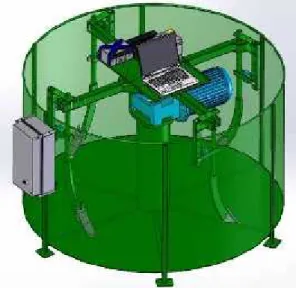
In order to determine the degree of wear, by weighing, of the chisel type active bodies of the combiner, INMA has designed and produced a stand for testing under laboratory conditions (Fig. 2).
The stand is formed of the following main parts: - basin with sand;
- drive reducer type worm-worm wheel; - overall support arms for the working bodie; - force transducer arm;
- command and control system; - force transducer;
- laptop;
- acquisition system with amplifier.
The stand allows to modify the following functional parameters of chisel knives: - working depth – by vertical movement of the support of active body (Fig. 3);
- side angle towards the moving direction – by rotating in horizontal plane of the support of active body (Fig. 4);
- speed of gear motor drive (using a frequency converter).
Fig. 3. Adjusting the working depth Fig. 4. Adjusting the angle
With set overall and functional dimensions, the stand allows the testing of chisel knives on a circular path with a diameter of 1600 mm at a maximum depth of 300 mm.
Main technical characteristics of the stand are presented in Table 1.
Table 1
No.
crt. Characteristic M.U Value
1. Gear motor type - screw worm wheel MRV 100 U02A
2.
Electric drive - power - frequency - speed
- transmission ratio
kWHz rpm
7.5 50 1460
1:10 3. Maximum depth of adjustment mm 300
4.
Overall size
- outer diameter of the basin - basinheight
mm mm
2000 1000
In order to reduce the influence of various physical parameters characterizing the agricultural soil and to maximize its effect on the wear of chisel knives for soil processing, it was decided to conduct the experiments in an medium that favors basic observations on the chisel knife-soil interaction.
granulometric class of coarse sand and fine sand (after Attenberg scale), with particle sizes between 0 and 0.3 mm.
By using this testing medium is intended to determine data in purely fictional testing mediums. The used testing medium is a fictional medium, without cohesion and without structure, with effect of maximum wear (the wear is maximum when the percentage of abrasive particles with a size of 0.25 mm has a maximum value).
By means of the stand were tested in laboratory conditions the foollowing types of chisel knives:
- chisels loaded with an electrode experimentally coated by tungsten carbide, brand SUDOTIM AS;
- chisel made of steel, type 30MnCrB5 (provided by Maschio)
For the tests were used measuring equipment and devices that were checked metrologically (Table 2).
Table 2
No.
crt. Name of equipment or device
Measuring range
Measurement uncertainty/ Allowable error
1. Measuring roulette 08 m uncertainty U=0.5+10-4L mm
2. Indoor-outdoor digital slide caliper
rule 0300 mm uncertainty U=0.02+5*10-5L mm
3. Mettler electronic balance 06,1 kg uncertainty U=133.8 mg 4. Automatic weighing machine 0100 kg uncertainty U=0.08 g
RESULTS
Experiments were conducted for three speeds (30 rpm, 55 rpm and 73 rpm) and two working depths (5 cm and 7.5 cm). Mean values of the obtained results are presented in Table 3.
Table 3 Chisel Current frequency [Hz] Speed
[rpm] Operation time
Working depth Initial mass [g] Final mass [g]
SUDOTIM AS brand 15 30 20 h 15 min 5cm 1688.45 1685.23 type 30MnCrB5
(provided by Maschio) 15 30 20 h15min 5 cm 1902.95 1899.17 SUDOTIM AS brand 20 55 28 h 20 min 5 cm 1685.23 1680.46
type 30MnCrB5
(provided by Maschio) 20 55 28 h 20 min 5 cm 1899.17 1897.63 SUDOTIM AS brand 20 55 31 h 5 min 5 cm 1680.46 1680.07
type 30MnCrB5
(provided by Maschio) 20 55 31 h 5 min 5 cm 1897.63 1897.16 SUDOTIM AS brand 25 73 36 h 5 min 5 cm 1680.07 1667.37
type 30MnCrB5
(provided by Maschio) 25 73 36 h 5 min 5 cm 1897.16 1895.86 SUDOTIM AS brand 15 30 42 h 35 min 7.5 cm 1667.37 1664.65
type 30MnCrB5
(provided by Maschio) 15 30 42 h 35 min 7.5 cm 1895.86 1895.75 SUDOTIM AS brand 20 55 32 h 5 min 7.5 cm 1664.65 1657.58
type 30MnCrB5
(provided by Maschio) 20 55 32 h 5 min 7.5 cm 1895.75 1893.82
Table 4
Repetition / Moisture, %
R1 R2 R3 R4 R5 Mean
4.0 4.2 4.0 3.8 3.6 3.92
Fig. 5. Determining the moisture of the testinf medium
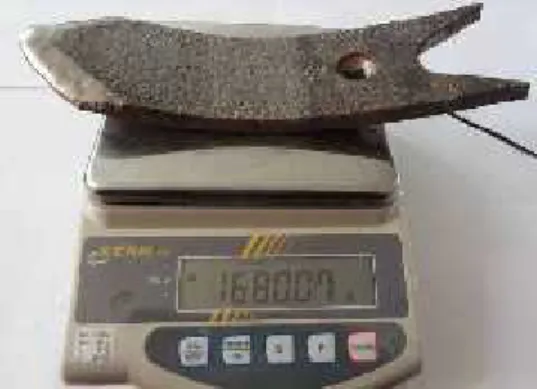
Wear was determined by measuring the initial masses and those resulting after a certain number of functioning hours of the active bodies (chisel), using the electronic balance (Fig. 6).
Fig. 6. Measurement of chisel knives mass with the electronic balance
CONCLUSIONS
The aim of experimental research was to identify a solution of hardening for the chisel type active bodies so that they can be used longer for soil processing (higher resistance to wear).
It was found that, after a certain number of functioning hours under the same conditions, the speed of wear was higher in chisel knives brand SUDOTIM AS, compared to the 30MnCrB5 type (provided by Maschio). Also, it was found that under the functioning conditins of the stand at high speed, the wear was lower.
ACKNOWLEDGEMENT
This work has been funded by Ministry of National Education and Research through the UEFISCDI, within the project entitled „Conservative Technology for Soil Processing”,
BIBLIOGRAPHY
1. Braharu D., Băjenaru S., Vlăduţ V., Matache M., 2007 - Researches regarding materials selection of the operating parts manufacturing for soil cultivation. Materials and treatments used for theirs design, ANNALS OF THE UNIVERSITY OF CRAIOVA
-Agriculture, Montanology, Cadastre, vol. XXXVII/B 2007, Craiova – Romania, pp. 48-55; 2. Braharu D., Gângu V., VlăduţV., PostelnicuE., BăjenaruS.,2007 - Fundamental research regarding the methods of anti-wear deposit, adaptable to components for agricultural equipment, ANNALS OF THE UNIVERSITY OF CRAIOVA - Agriculture, Montanology, Cadastre, vol. XXXVII/B 2007, Craiova – Romania, pp. 36-47;
3. Matache M., Ganga M., Mihai M., PostelnicuE., BajenaruS.,2008 -Researches regarding determination of mechanical and wear characteristics for friction materials, Scientific Papers (INMATEH), vol. 24, pp. 120-123;
4.Praporgescu G.,2010 - TRIBOLOGY, University of Petroşani, Faculty of Mechanical and Electrical Engineering, Department of Machines, Installations and Transports, Courses, PETROŞANI;