SECURE ROUTING AND ATTACK DETECTION IN
WIRELESS AD HOC NETWORK
.
Dr.C.Kumar Charliepaul
1K.Megala Devi
2Principal Assistant professor / ECE
A.S.L Pauls College of Engg & Tech, A.S.L. Paul College of Engineering & Tech
Coimbatore Coimbatore
[email protected]
[email protected]
Abstract— Wireless ad hoc network is a network formed without any central infrastructure which consists of nodes that use a
wireless interface to send packet data. Linkage error and malicious packet dropping are two sources for packet losses in wireless ad hoc network. A sequence of packet losses are present in the network, it determines whether the losses are caused by linkage errors only, or by the joint effect of linkage errors and malicious drop. In the interior-attack case, whereby malicious nodes that are part of the route utilize their knowledge of the communication framework to selectively drop a small amount of packets vital to the network performance. This is because the packet dropping rate is comparable to the channel error rate. Conventional algorithms are used to detect the packet loss rate that cannot reach acceptable detection accuracy. We proposed to improve the detection accuracy. So we developed the correlations between lost packets and to ensure truthful calculation of these correlations, the homomorphic linear authenticator (HLA) is used. HLA is based on public auditing architecture that allows the detector to verify the truthfulness of the packet loss information reported by nodes. This development is privacy protect, scam proof, and low communication and storage overheads. It reduce the computation overhead, a packet-block based method is also proposed, which allows one to trade detection truthfulness for lower computation complexity. The proposed mechanisms obtain much better detection accuracy than conventional methods.
Index Terms—Wireless Adhoc Network, Public Auditing, Selective Dropping, Homomorphic Linear Authenticator
I.INTRODUCTION
Wireless ad hoc networks are collections of wireless nodes, that communicate directly over common wireless channel. The nodes are equipped with wireless transceiver. They don’t need any additional infrastructure, such as base station or wired access point, etc. Therefore, each node doesn’t only plays the role of an end system, but also acts as a router, that sends packets to desired nodes. The ad hoc are expected to do assignments, which the infrastructure can’t do. Ad hoc networks are mostly used by military, rescue mission team, taxi driver. Their works can’t rely on a infrastructure’s network. As an illustrative example, imagine fire fighters put out hazardous fire in a big forest. They have to communicate each other, but establishing a infrastructure or cabling in such area is impossible or too expensive. The main problems in ad hoc networks are routing and characteristic of wireless communication. In infrastructure’s networks a node can communicate with all nodes in the same cell. In ad hoc a node can communicate only with nodes in its area, this node can communicate with other nodes, but a routing algorithm is necessary. Unlike wired communication, wireless networks have transmission problem with data transmission such as, possibility of asymmetric connections and higher interferences. The aim of this overview article is to provide informations on ad hoc networks and specially WANET, their structure, their applications on the current time, as well as
their strong and weakness in comparison with infrastructure networks.
to the desired node. It seems like, that the ad hoc networks are not powerful enough. Each node has its own transmission range, if these small transmission areas are combined, they will form a much bigger transmission area. The nodes transmit their data with single or multiple hopping technique. Now a suitable routing algorithm must be implemented, so the process of transmitting data will be more effective.
Fig. 1. IEEE 802.11
The wireless networks can be categorized based on their system architecture into two basic versions. The one is Infrastructure and second is ad-hoc network. The biggest difference in them is infrastructure networks consist of access point and nodes, meanwhile the ad hoc networks are independent from access point. In the infrastructure version, a terminal can’t communicate directly with other terminals in the same cell and other cell. A access point here perform control messages. Messages are sent to the access point and then the access point distributes the messages to the desired terminal. If a terminal want to communicate with a terminal, which is located in other cell, the access point will relay the message to other access point, which has control over desired cell. The access points are normally wired connected. The problem in infrastructure, if the access point fails, all terminal in this cell can’t perform any communication. Unlike the infrastructure, the ad hoc networks have a different method to distribute messages. In a given network, N1 want to communicate with N5. N5 is located outside N1 transmission range, so N1 must hop the message to N4-N3-N5 or N2-N3-N5. Routing algorithm will decide, which route performs the best. There will be no problem if N4 leaves the network, because N1 still has a route to N5. Therefore ad hoc networks are robuster than infrastructure.
Fig. 2. Transmission area in ad hoc
A.Public auditing
The public auditor should not be able to decern the content of a packet delivered on the route through the auditing information submitted by individual hops, no matter how many independent reports of the auditing information are submitted to the auditor. Second, our construction incurs low communication and storage overheads at intermediate nodes. At last, to significantly reduce the computation overhead of the baseline constructions so that they can be used in computation-constrained mobile devices, a conventional-based algorithm to achieves scalable signature generation and detection. This mechanism allows one to trade detection accuracy for lower computation complexity.
A malicious node that is occurred on the route can exploit its information of the network protocol and the communication context to launch an insider attack–an attack that is intermittent, but can achieve the network performance degradation. Detecting selective packet-dropping attacks is extremely challenging in a highly dynamic wireless environment. The difficulty comes from the requirement that we need to not only detect the place (or hop) where the packet is dropped, but also identify whether the drop is intentional or unintentional.(e.g., fading, noise, and interference, a.k.a., link errors), or by the insider attacker.
The above problem has not been well addressed in the literature. The most of the related works preclude the ambiguity of the environment by assuming that malicious dropping is the only source of packet loss, so that there is no need to account for the impact of link errors. On the other hand, for the small number of works that differentiate between link errors and malicious packet drops, their detection algorithms usually require the number of maliciously-dropped packets to be significantly higher than link errors, in order to achieve an acceptable detection accuracy.
II.LITERATURE SURVEY
Tao Shu and Marwan Krunz, Privacy-Preserving and Truthful Detection of Packet Dropping Attacks in Wireless Ad Hoc Networks [14], In a multi-hop wireless network, nodes cooperate in relaying or routing traffic. An adversary can exploit this cooperative nature to launch attacks. For example, the adversary may first pretend to be a cooperative node in the route discovery process. Once being included in a route, the adversary starts dropping packets. In the most severe form, the malicious node simply stops forwarding every packet received from upstream nodes, completely disrupting the path between the source and the destination. Eventually, such a severe Denial-of-Service (DoS) attack can paralyze the network by partitioning its topology. Even though persistent packet dropping can effectively degrade the performance of the network, from the attacker’s standpoint such an “always-on” attack has its disadvantages. First, the continuous presence of extremely high packet loss rate at the malicious nodes makes this type of attack easy to be detected . Second, once being detected, these attacks are easy to mitigate.
or by the combined effect of link errors and malicious drop. We are especially interested in the insider-attack case, whereby malicious nodes that are part of the route exploit their knowledge of the communication context to selectively drop a small amount of packets critical to the network performance. Because the packet dropping rate in this case is comparable to the channel error rate, conventional algorithms that are based on detecting the packet loss rate can achieve satisfactory detection accuracy.
S.Amutha, K.Balasubramanian, Secure Implementation of Routing Protocols for Wireless Ad hoc Networks [10],Routing is a fundamental networking function in every communication system including wireless Ad hoc networks. Attacks on ad hoc network routing protocols disrupt network performance and reliability. In addition intermediate nodes can be corrupted and thus exhibit arbitrary behavior. Route discovery messages are protected by pair wise secret keys between a source and destination. The performance of secure implementation of the existing routing protocols can be compared with Dynamic Source Routing (DSR) and Adhoc On-demand Distance Vector (AODV).It is difficult to keep addresses on each nodes.
T.Shu, M.Krunz and S.Liu, Secure Data Collection in Wireless Sensor Networks Using Randomized Dispersive Routes [10], To overcome the ‘black holes’ that are formed due to compromised-node (CN) and denial-of-service (DOS) by using some routing mechanisms. Basic idea of developing this paper is nothing but combat the vulnerability of existing system in handling such attacks due to their deterministic nature i.e., once an obstructionist can gather or acquire the routing algorithm can figure out the same routes known to the source, and hence intimidate all information sent over these routes.A randomized multi-path routing algorithm that can overcome the black holes formed by Compromised-node and denial-of-service attacks. It is to compute multiple paths in a randomized way each time an information packet needs to be sent, such that the set of routes taken by various shares of different packets keep changing over time. the packet is no longer forwarded is considered a suspect for misbehaving because of random routing
A.Proano and L.Lazos, Packet-Hiding Methods for Preventing Selective Jamming Attacks [11], Denial-of-Service attacks on wireless networks. Typically, jamming has been addressed under an external threat model. However, adversaries with internal knowledge of protocol specifications and network secrets can launch low-effort jamming attacks that are difficult to detect and counter. In this work, address the problem of selective jamming attacks in wireless networks. In these attacks, the adversary is active only for a short period of time, selectively targeting messages of high importance. To illustrate the advantages of selective jamming in terms of network performance degradation and adversary effort by presenting two case studies; a selective attack on TCP and one on routing. The selective jamming attacks can be launched by performing real-time packet classification at the physical layer. To mitigate these attacks, Its to develop three schemes that prevent real-time packet classification by
combining cryptographic primitives with physical-layer attributes. To analyze the security of the methods and evaluate their computational and communication overhead are little bit highly complex.
. III. DESCRIPTION OF THE SYSTEM
A. System Model
Consider an arbitrary path PSD in a multi-hop wireless ad hoc network, as shown in Figure 1. The source node S continuously sends packets to the destination node D through intermediate nodes n1, . . . , nK , where ni is the upstream node of ni+1, for 1 i K 1. We assume that S is aware of the route PSD, as in Dynamic Source Routing (DSR) .If DSR is not used, S can identify the nodes in PSD by performing a traceroute operation. Here we mainly focus on static or quasi-static wireless ad hoc networks, i.e., we assume that the network topology and link characteristics remain unchanged for a relatively long period of time. Example networks include wireless mesh networks (WMNs) and ad hoc networks formed in nomadic computing. Extension to a highly mobile environment is out of our scope and will be considered in the future work.
Fig. 3. Network and Attack Model.
route disruption the dominant cause for packet losses. In this case, maintaining stable connectivity between nodes is a greater concern than detecting malicious nodes. The function fc(i) can be calculated using the probing approach in [1]. In brief, a sequence of M packets are transmitted consecutively over the channel. By observing whether the transmissions are successful or not, the receiver obtains a realization of the channel state (a1, . . . , aM ), where aj 2 f0, 1g for j = 1, . . . , M. In this sequence, “1” denotes the packet was successfully received, and “0” denotes the packet was dropped. fc(i) is derived by computing the autocorrelation function of this def sample sequence: fc(i) = Efajaj+i g for i = 0, . . . , M, where the expectation is calculated over all transmitted packets j = 1, . . . , M. This autocorrelation function describes the correlation between packet transmissions (successful/lost) at different times, as a function of the time lag. The time invariant nature of fc is guaranteed by the WSS assumption of the wireless channel. The measurement of fc(i) can take place online or offline. A detailed discussion on how fc(i) is derived is out of the scope of this paper, and we simply assume that this information is given as input to our detection algorithm.
There is an independent auditor Ad in the network. Ad is independent in the sense that it is not associated with any node in PSD and does not have any knowledge of the secrets (e.g., cryptographic keys) held by various nodes. The auditor is responsible for detecting malicious nodes on demand. Specifically, we assume S receives feedback from D when D suspects that the route is under attack. Such a suspicion may be triggered by observing any abnormal events, e.g., a significant performance drop, the loss of multiple packets of a certain type, etc. We assume that the integrity and authenticity of the feedback from D to S can be verified by S using resource-efficient cryptographic methods such as the Elliptic Curve Digital Signature Algorithm (ECDSA). Once being notified of possible attacks, S submits an attack-detection request (ADR) to Ad. To facilitate its investigation, Ad needs to collect certain information (elaborated on in the next section) from the nodes on route PSD. We assume that each such node must reply to Ad’s inquiry, otherwise the node will be considered as misbehaving. We assume that normal nodes will reply with truthful information, but malicious nodes may cheat. At the same time, for privacy reasons, we require that Ad cannot determine the content of the normal packets delivered over PSD from the information collected during the auditing.
Fig. 5. Comparison of Correlation of lost packets.
B. Proposed Detection Scheme
The proposed mechanism is based on detecting the corre-lations between the lost packets over each hop of the path. The basic idea is to model the packet loss process of a hop as a random process alternating between 0 (loss) and 1 (no loss). Specifically, consider that a sequence of M packets that are transmitted consecutively over a wireless channel. By observing whether the transmissions are successful or not, the receiver of the hop obtains a bitmap (a1, . . . , aM ), where aj 2 f0, 1g for packets j = 1, . . . , M. The correlation of the lost packet is calculated as the auto-correlation function of this bitmap. Under different packet dropping conditions, i.e., link-error vs. malicious dropping, the instantiations of the packet-loss random process should present distinct dropping patterns (represented by the correlation of the instance). This is true even when the packet loss rate is similar in each instantiation. To verify this property, in Figure 2 we have simulated the auto-correlation functions of two packet loss processes, one caused by 10% link errors, and the other by 10% link errors plus 10% malicious uniformly-random packet dropping. It can be observed that significant gap exists between these two correlation functions. Therefore, by comparing the auto-correlation function of the observed packet loss process with that of a normal wireless channel (i.e., fc(i)), one can accurately identify the cause of the packet drops.
The benefit of exploiting the correlation of lost packets can be better illustrated by examining the insufficiency of the conventional method that relies only on the distribution of the number of lost packets. More specifically, under the conventional method, malicious-node detection is modeled as a binary hypothesis test, where H0 is the hypothesis that there is no malicious node in a given link (all packet losses are due to link errors) and H1 denotes there is a malicious node in the given link (packet losses are due to both link errors and malicious drops). Let z be the observed number of lost packets on the link during some interval t. Then,
z ={
x, under H0 (no malicious nodes)
x + y, under H1 (there is a malicious node)
where x and y are the numbers of lost packets caused by link errors and by malicious drops, respectively. Both x and y are random variables.
C. Audit Phase
understate its packet loss, i.e., it cannot claim the reception of a packet that it actually did not receive. This mechanism cannot prevent a node from overly stating its packet loss by claiming that it did not receive a packet that it actually received. This latter case is prevented by another mechanism discussed in the detection phase.
D. Detection Phase
The public auditor Ad enters the detection phase after receiving and auditing the reply to its challenge from all nodes on PSD. The main tasks of Ad in this phase include the following: detecting any overstatement of packet loss at each node, constructing a packet-loss bitmap for each hop, calculating the autocorrelation function for the packet loss on each hop, and deciding whether malicious behavior is present. More specifically, Ad performs these tasks as follows. The auditor calculates the autocorrelation function.
The detection process applies to one end-to-end path. The detection for multiple paths can be performed as multiple independent detections, one for each path. Although the optimal error threshold that minimizes the detection error is still an open problem, our simulations show that through trial-and-error, one can easily find a good ϵth that provides a better detection accuracy than the optimal detection scheme that utilizes only the pdf of the number of lost packets.
IV.PERFORMANCE EVALUATION
Simulation Setup
The detection accuracy which can be achieved by the Conventional algorithm with the optimal maximum likelihood algorithm that utilizes the distribution of the number of lost packets. For given packet-loss bitmaps, the detection on different hops is conducted separately. So, only need to simulate the detection of one hop to evaluate the performance of a given algorithm. It assume packets are transmitted continuously over this hop, i.e., a saturated traffic environment and assume channel fluctuations for this hop follow the Gilbert-Elliot model, with the transition probabilities from good to bad and from bad to good given respectively. The two types of malicious packet dropping: random dropping and selective dropping. In the random dropping attack, a packet is dropped at the malicious node with probability . In the selective dropping attack, the adversary drops packets of certain sequence numbers.
Selective Packet Dropping
The detection error as a function of the number of maliciously dropped packets. Similar performance trends can be observed to the case of the random packet dropping. Fewer detection errors are made by both algorithms when more packets are maliciously dropped. In all the simulated cases, the proposed algorithm can detect the actual cause of the packet drop more accurately than the ML scheme, especially when the number of maliciously dropped packets is small. When the number of maliciously dropped packets is
significantly higher than that caused by link errors (greater than 4 packets in our simulation), the two algorithms achieve comparable detection accuracy. In this scenario, it may be wise to use the conventional ML scheme due to its simplicity (e.g., no need to enforce truthful reports from intermediate nodes, etc).
Dropping of Control Packets
The simulations so far have not made any application-semantic (use case) assumption on the dropped packets. In reality, however, because these packets are usually used for control purposes, the loss of these packets may generate significant impacts on the transmission of other (i.e., data) packets. In this series of simulations, to evaluate how the correlation between the control and data packets affects the performance of the proposed scheme. In particular, consider a multi-hop cognitive radio network, where control packets are exchanged over an end-to-end path to maintain channel synchronization between consecutive hops.
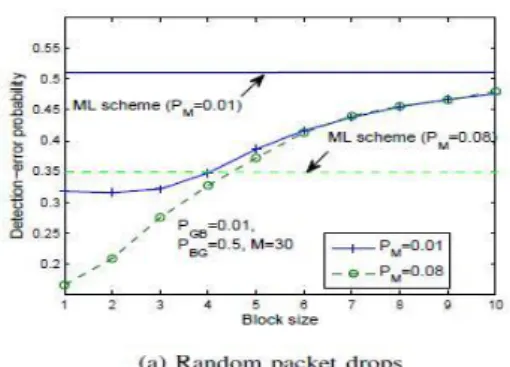
Block-Based Detection
Fig.6. Detection accuracy of block-based algorithms.
VI. CONCLUSION
An accurate method for detecting selective packet drops made by insider attackers is proposed in this paper. It also provides a truthful and publicly verifiable decision statistics as a proof to support the detection decision. The high detection accuracy is achieved by exploiting the correlations between the positions of lost packets, as calculated from the auto-correlation function (ACF) of the packet-loss bitmap–a bitmap describing the lost/received status of each packet in a sequence of consecutive packet transmissions. The basic idea behind this method is that even though malicious dropping may result in a packet loss rate that is comparable to normal channel losses, the stochastic processes that characterize the two phenomena exhibit different correlation structures (equivalently, different patterns of packet losses).
CONCLUSION
Therefore, by detecting the correlations between lost packets, one can decide whether the packet loss is purely due to regular link errors, or is a combined effect of link error and malicious drop. The algorithm takes into account the cross-statistics between lost packets to make a more informative decision, and thus is in sharp contrast to the conventional methods that rely only on the distribution of the number of lost packets. It is compared with conventional detection algorithms that utilize only the distribution of the number of lost packets, exploiting the correlation between lost packets significantly improves the accuracy in detecting malicious packet drops.
REFERENCES
[1] Tao Shu and Marwan Krunz “Privacy-Preserving and Truthful
Detection of Packet Dropping Attacks” in Wireless AdHoc Networks”, June 2014.
[2] Amutha.S, Balasubramanian.K, “Secure Implementation of
Routing Protocols for Wireless Ad hoc Networks” pp. 960-965, Feb 2013.
[3] Shu.T, Krunz.M, and Liu.S, “Secure data collection in wireless
sensor networks using randomized dispersive routes”. Vol. 9, no. 7, pp. 941–954, Mar 2010.
[4] Proano.A and Lazos.L “Packet-hiding methods for preventing
selective jamming attacks” Dependable and Secure Computing., vol. 9, no. 1, pp. 101–114, Aug 2012.
[5] Awerbuch.B, Curtmola.R, Holmer.D, Nita-Rotaru.C, and
Rubens.H. “ODSBR: an on-demand secure byzantine resilient routing protocol for wireless ad hoc networks”, Vol. 10 , no. 4, 2008.
[6] Hayajneh.T, Krishnamurthy.P, Tipper.D, and Kim.T, “Detecting
malicious packet dropping in the presence of collisions and channelerrors in wireless ad hoc networks” (2009).
[7] Kozma Jr.W and Lazos.L “REAct: resource-efficient
accountabilityfor node misbehavior in ad hoc networks based on random audits”. Wireless Network Security, (2009)
[8] Liu.K, Deng.J, Varshney.P, and Balakrishnan.K “An
acknowledgement-based approach for the detection of routing misbehavior in MANETs”. Vol. 6, no.5, pp.536–550, May 2006
[9] Malhotra. A, Kirtani. S , Agarwal.T “Detection of malicious route in wireless adhoc networks” PP.1-4,Mar2010.
[10]Ateniese.C, Burns.R, Curtmola.R, Herring.J, Kissner.L,
Peterson.Z, and Song.D, “Provable data possession at untrusted stores”., pages 598–610, Oct. 2007.
[11]Ateniese.G, Kamara.S, and Katz.J. “Proofs of storage from
homomorphic identification protocols” on Theory and Application of Cryptology and Information Security, (2009) .
[12]Wang.C, Wang.Q, Ren.K, and Lou.W. “Privacy- preserving
public auditing for data storage security in cloud computing”, Mar. 2010.
Author Biography:-
Kumar Charlie Paul, Principal of A.S.L Pauls College of Engineering & Technology. Had did many National and International Conferences and published many papers in journals. He also guided many students for their Ph.D project works. Having more than 23 years of experience in teaching field.