EUROPEAN COMMISSION
RADIATION PROTECTION NO 174
EUROPEAN GUIDELINES ON MEDICAL
PHYSICS EXPERT
Directorate-General for Energy
Directorate D — Nuclear Safety & Fuel Cycle
Unit D.3 — Radiation Protection
These "European Guidelines on Medical Physics Expert" have been prepared in the context of the EC project "Guidelines on Medical Physics Expert", financed by the EC (Contract TREN/ 09 /NUCL /SI2.549828). The report was prepared by a consortium led by the European Federation of Organizations for Medical Physics (EFOMP) and represents the author's views on the subject matter. These views have not been adopted or in any way approved by the Commission and should not be relied upon as a statement of the Commission's views. The European Commission does not guarantee the accuracy of the data included in this report, nor does it accept responsibility for any use made thereof.
Core team responsible of elaborating present document: E. Guibelalde
S. Christofides C. J. Caruana S. Evans
W. van der Putten
Europe Direct is a service to help you find answers to your questions about the European Union
Freephone number (*):
00 800 6 7 8 9 10 11
(*) Certain mobile telephone operators do not allow access to 00 800 numbers or these calls may be billed.
More information on the European Union is available on the Internet (http://europa.eu). Luxembourg: Publications Office of the European Union, 2014
ISBN 978-92-79-35786-2 doi: 10.2833/18393 © European Union, 2014
Reproduction is authorised provided the source is acknowledged.
FOREWORD
Luxembourg, February 2014
Physics has significantly contributed to advances in medicine, especially through the development of radiation-based medical diagnosis and treatment in the past hundred years. During this period medical physics has been established as a clinical specialty dealing with,
inter alia, important aspects of medical uses of radiation and contributing to patient safety
and quality of care. The past few decades have brought another physics-based revolution in medicine, through huge advances in medical imaging. As a result of these advances, the role of the medical physicist in clinical environment has become more important than ever.
European legislation acknowledged the importance of physics in radiation protection of patients in the 1980s by requiring a "qualified expert in radiophysics" to be available to "sophisticated departments of radiotherapy and nuclear medicine". In the 1990s the term "medical physics expert" (MPE) was introduced and the involvement of MPEs was foreseen also in "other radiological practices". The most recent revision of the European basic legislation for radiation protection (Council Directive 2013/59/Euratom) considerably strengthened and expanded the MPE's role in patient radiation safety.
Recent developments in medical imaging and changes in regulatory requirements have highlighted the difficulties encountered by some EU Member States regarding the availability of suitably qualified MPEs. This report is intended to provide guidelines to Member States, national authorities, hospitals and other interested parties on the role of the MPE in a clinical environment, their qualification framework, recognition arrangements and staffing levels. The MPE European Guidelines have been developed by a team in which the European Federation of Organizations for Medical Physics (EFOMP) played a key role and which consulted a wide range of other stakeholders. The Guidelines' implementation by European countries is expected to facilitate mutual recognition and the free movement of MPEs within the EU's borders.
The Group of Experts (GoE) established under Article 31 of the Euratom Treaty has recommended the publication of this report in the Commission's Radiation Protection series of publications.. The MPE European Guidelines were reviewed and agreed by the GoE's Working Party on Medical Exposures (WP MED); however, the technical Annexes to the report have not been subject to the same level of scrutiny and represent rather the opinion of the authors.
Ivo Alehno
CONTENTS
FOREWORD ... 3
CONTENTS ... 5
LIST OF ABBREVIATIONS ... 7
1
INTRODUCTION ... 9
1.1 Background ... 91.2 Purpose and scope ... 10
2
THE ROLE OF THE MEDICAL PHYSICS EXPERT (MPE) ... 11
2.1 Role of the MPE in the revised Basic Safety Standard (revised BSS) ... 11
2.2 Mission statement and key activities for MPEs ... 12
2.3 Areas of medicine involving the MPE ... 13
2.4 Key activities of the MPE ... 13
3
QUALIFICATION AND CURRICULUM FRAMEWORKS FOR THE MPE IN
EUROPE ... 15
3.1 Introduction ... 15
3.2 Qualification Framework ... 15
3.3 Curriculum Framework for MPE programmes in Europe ... 18
4
RECOGNITION OF THE MPE ... 23
4.1 Introduction and Background ... 23
4.2 Recommendations ... 23
5
MEDICAL PHYSICS EXPERT STAFFING LEVELS IN EUROPE ... 25
5.1 Introduction ... 25
5.2 Recommendations ... 26
LIST OF
ABBREVIATIONS
AAPM American Association of Physicists in Medicine
BSS Euratom Basic Safety Standards (Council Directive 2013/59/Euratom) CPD Continuing Professional Development
CR Computed Radiography CT Computed Tomography DDR Direct Digital Radiography
DGMP Deutsche Gesellschaft für Medizinische Physik DR Diagnostic Radiology
D&IR Diagnostic and Interventional Radiology (in this document ‘interventional’ refers to all interventional procedures including those undertaken outside the Diagnostic
Radiology department e.g., Cardiology) EANM European Association of Nuclear Medicine EC European Commission
ECTS European Credit Transfer System
EFOMP European Federation of Organisations for Medical Physics EHEA European Higher Education Area
EQF European Qualification Framework ESR European Society of Radiology
ESTRO European Society for Therapeutic Radiology and Oncology
EU European Union
FTE Full Time Equivalent
HTA Health Technology Assessment IAEA International Atomic Energy Agency
ICRP International Commission on Radiological Protection IMRT Intensity-Modulated Radiation Therapy
IOMP International Organisation for Medical Physics IPEM Institute of Physics and Engineering in Medicine IR Interventional Radiology
ISTISAN Istituto Superiore di Sanità
KSC Knowledge, Skills and Competences LO Learning Outcome
MED Medical Exposure Directive (Council Directive 97/43/Euratom) MP Medical Physicist
MPE Medical Physics Expert MPS Medical Physics Service NM Nuclear Medicine
PET Positron Emission Tomography QA Quality Assurance
R&D Research & Development RO Radiation Oncology RP Radiation Protection
RPA Radiation Protection Adviser RPE Radiation Protection Expert
RT Radiotherapy
R&D Research and Development SABR Stereotactic Ablative Radiotherapy SBRT Stereotactic Body Radiotherapy SEFM Sociedad Española de Física Médica
SPECT Single-Photon Emission Computed Tomography UCM University Complutense of Madrid
UK United Kingdom
UNSCEAR United Nations Scientific Committee on the Effects of Atomic Radiation WHO World Health Organisation
Introduction
1
INTRODUCTION
1.1
Background
Council Directive 97/43/Euratom (Medical Exposures Directive, MED) (Council of the European Union, 1997) defines the Medical Physics Expert (MPE) as "an expert in radiation physics or radiation technology applied to exposure, within the scope of this Directive, whose training and competence to act is recognized by the competent authorities; and who, as appropriate, acts or gives advice on patient dosimetry, on the development and use of complex techniques and equipment, on optimization, on quality assurance, including quality control, and on other matters relating to radiation protection, concerning exposure within the scope of this Directive".
Article 6.3 of MED requires that the MPE be closely involved in radiotherapeutic practices, be available in nuclear medicine practices and be involved, as appropriate, in other radiological practices, for consultation and giving advice on radiation protection issues including optimisation of protection, patient dosimetry, QA, etc.
Article 7.1 of MED requires Member States to ensure that MPEs have adequate theoretical and practical training for the purpose of radiological practices, as well as relevant competence in radiation protection. For this purpose Member States shall ensure that appropriate curricula are established and shall recognise the corresponding diplomas, certificates or formal qualifications.
The European Commission (EC) is aware of the present situation in many Member States, where there is an insufficient number of adequately trained MPEs to address the needs of medical procedures applying ionising radiation; this situation is especially startling in today's context of constantly growing use of higher-dose medical equipment (e.g. CT, PET). One possible solution to address this situation and bring forward the effective implementation of EU legislation and initiatives is to support the harmonisation of MPE education in the Member States, aiming at easier mutual recognition and improved mobility of these professionals. For this purpose, in 2010, the EC launched a 2-year project on the MPE to provide for improved implementation of the MED and to facilitate the harmonisation of the MPE among the Member States aiming at their cross-border mobility. This project has been supervised by the Working Party on Medical Exposure (WP MED) established by the Group of Experts referred to in Article 31 of the Euratom Treaty.
The project included the following tasks, eventually assigned to the Consortium led by the Complutense University of Madrid1
1. an EU-wide study on the status and the legal and practical arrangements in the Member States regarding the training, education and recognition of the MPE (European Commission Project, 2012),
2. organisation of a European Workshop on the MPE (European Commission Workshop, 2012),
3. development of a European Guidance document on the MPE containing appropriate recommendations on:
a. harmonising education, training and recognition requirements for the MPE in the European Union within the existing EU legislative network and
1
European guidelines on medical physics expert
10
b. MPE staffing levels necessary to ensure adequate radiation protection of patients, depending on the size and type of the radiological practice.
Soon after the publication of the 2007 Recommendations of the International Commission on Radiological Protection (ICRP, 2007) the EC launched a revision of the Euratom Basic Safety Standards Directive. This also involves a simplification of the Community legislation on radiation protection by integrating five current Euratom Directives2, the Medical Exposure Directive (MED) included, into a single revised Euratom Basic Safety Standards Directive (BSS). The Council of the European Union has adopted the revised BSS on 5 December 2013 (Council of the European Union, 2013).
The revised BSS defines the roles and responsibilities of experts who should be involved in ensuring that technical and practical aspects of radiation protection are managed with a high level of competence. It defines the role of the Radiation Protection Expert (RPE) and the Medical Physics Expert (MPE). The requirements for information, training and education are also addressed and strengthened in a specific title in order to highlight the importance of education and training in radiation protection.
1.2
Purpose and scope
The purpose of this European Guidance on Medical Physics Expert (MPE) is to provide for improved implementation of the Medical Exposure Directive and revised BSS provisions related to the MPE and to facilitate the harmonisation of the education and training of medical physicists to MPE level among the Member States aiming at an improvement in cross-border mobility.
This European Guidance contains appropriate recommendations on harmonising education, training and recognition requirements for MPEs in the European Union within the existing EU legislative framework. It makes recommendations for the most appropriate education and training structure, based on the European Higher Education Area and on the European Qualifications Framework for Lifelong Learning (European Parliament and Council of the European Union, 2008), to achieve the defined required professional competences. It proposes detailed syllabuses for the education and training of MPEs. The Guidance also contains recommendations on the MPE staffing levels -depending on the size and type of the radiological practice-necessary to ensure adequate radiation protection of patients. It also includes radiation protection of staff when impacting medical exposure.
2
– Council Directive 96/29/ Euratom of 13 May 1996, laying down basic safety standards for the protection of the health of workers and the general public against the dangers arising from ionising radiation, – Council Directive 97/43/Euratom of 30 June 1997 on health protection of individuals against the dangers
of ionising radiation in relation to medical exposure,
– Council Directive 89/618/Euratom of 27 November 1989 on informing the general public about health protection measures to be applied and steps to be taken in the event of a radiological emergency, – Council Directive 90/641/Euratom of 4 December 1990 on the operational protection of outside workers
exposed to the risk of ionising radiation during their activities in controlled areas,
– Council Directive 2003/122/Euratom of 22 December 2003 on the control of high-activity sealed radioactive sources and orphan sources.
The Role of the Medical Physics Expert (MPE)
2
THE ROLE OF THE MEDICAL PHYSICS EXPERT (MPE)
2.1
Role of the MPE in the revised Basic Safety Standard (revised
BSS)
Medical Physics Experts are defined and their roles are specified in the revised BSS. The more pertinent articles are:
Article 4: Definitions
(49) "medical physics expert" means an individual or, if provided for in national legislation, a group of individuals3, having the knowledge, training and experience to act or give advice on matters relating to radiation physics applied to medical exposure, whose competence in this respect is recognised by the competent authority;
Article 14: General responsibilities for the education, training and provision of information 2. Member States shall ensure that arrangements are made for the establishment of education, training and retraining to allow the recognition of radiation protection experts and medical physics experts …
Article 22: Practices involving the deliberate exposure of humans for non-medical imaging purposes
4(c) for procedures using medical radiological equipment
(i) relevant requirements identified for medical exposure as set out in Chapter VII are applied, including those for equipment, optimisation, responsibilities, training and special protection during pregnancy and the appropriate involvement of the medical physics expert;
Article 57: Responsibilities
1. Member States shall ensure that:
(b) the practitioner, the medical physics expert and those entitled to carry out practical aspects of medical radiological procedures are involved, as specified by Member States, in the optimisation process;
Article 58: Procedures
Member States shall ensure that:
(d) In medical radiological practices, a medical physics expert is appropriately involved, the level of involvement being commensurate with the radiological risk posed by the practice. In particular:
(i) in radiotherapeutic practices other than standardised therapeutic nuclear medicine practices, a medical physics expert shall be closely involved;
(ii) in standardised therapeutical nuclear medicine practices as well as in radiodiagnostic and Interventional radiology practices, involving high doses as referred to in point (c) of Article 61(1), a medical physics expert shall be involved;
3 Authors’ note: By ‘group of individuals’ is meant a group of Medical Physics Professionals with at least one
who has reached the status of MPE in each specialised area of radiation physics applied to medical exposure e.g., Diagnostic and Interventional Radiology or Radiation Oncology or Nuclear Medicine or a sub-speciality of these e.g., Brachytherapy, Nuclear Medicine therapy, Interventional Imaging in Cardiology as owing to the rapid expansion in medical technology it is becoming increasingly difficult for any single
European guidelines on medical physics expert
12
(iii) for other medical radiological procedures, not covered by (i) and (ii), a medical physics expert shall be involved, as appropriate, for consultation and advice on matters relating to radiation protection concerning medical exposure.
Article 83: Medical physics expert
1. Member States shall require the medical physics expert to act or give specialist advice, as appropriate, on matters relating to radiation physics for implementing the requirements set out in Chapter VII and in point (c) of Article 22(4) of this Directive.
2. Member States shall ensure that depending on the medical radiological practice, the medical physics expert takes responsibility for dosimetry, including physical measurements for evaluation of the dose delivered to the patient and other individuals subject to medical exposure, give advice on medical radiological equipment, and contribute in particular to the following:
(a) optimisation of the radiation protection of patients and other individuals subjected to medical exposure, including the application and use of diagnostic reference levels;
(b) the definition and performance of quality assurance of the medical radiological equipment;
(c) acceptance testing of medical radiological equipment;
(d) the preparation of technical specifications for medical radiological equipment and installation design;
(e) the surveillance of the medical radiological installations;
(f) the analysis of events involving, or potentially involving, accidental or unintended medical exposures;
(g) the selection of equipment required to perform radiation protection measurements; (h) the training of practitioners and other staff in relevant aspects of radiation protection; 3. The medical physics expert shall, where appropriate, liaise with the radiation protection expert.
2.2
Mission statement and key activities for MPEs
In order to make the role more understandable to decision makers and management of healthcare institutions and provide direction for role holders a mission statement was formulated by the consortium based on the above articles of the revised BSS. The mission statement is the following:
“Medical Physics Experts will contribute to maintaining and improving the quality, safety and cost-effectiveness of healthcare services through patient-oriented activities requiring expert action, involvement or advice regarding the specification, selection, acceptance testing, commissioning, quality assurance/control and optimised clinical use of medical radiological devices and regarding patient risks from associated ionising radiations including radiation protection, installation design and surveillance, and the prevention of unintended or
accidental exposures4; all activities will be based on current best evidence or own scientific
research when the available evidence is not sufficient. The scope includes risks to volunteers
in biomedical research, carers and comforters” (Legido-Quigley H, McKee M, Nolte E, Glinos
4
This document concerns the medical use of ionising radiation; however, as the linking of non-ionising radiation devices to ionising radiation devices is on the increase (e.g., PET/MRI, SPECT/MRI), it is highly recommended that an MPE is appropriately knowledgeable regarding the medical use of such other physical agents.
The Role of the Medical Physics Expert (MPE)
IA, 2008) (European Commission. DG Health and Consumer Protection, 2005) (European Commission, 2007) (CPME, 2005) (Caruana CJ, 2011).
2.3
Areas of medicine involving the MPE
MPEs are traditionally located in departments of diagnostic and interventional radiology (D&IR), nuclear medicine (NM) and radiation oncology/radiotherapy (RO). MPEs also provide services in other areas of medicine ranging from dentistry to cardiology and neurology.
2.4
Key activities of the MPE
The mission of the MPE is expressed in many aspects of medical radiological practice. The consortium has identified and defined the key activities of MPEs. These are shown in Table 1:
Table 1: Definition and elaboration of the Key Activities of MPEs
Key Activity Main Actions
Scientific problem solving service
Comprehensive problem solving service involving recognition of less than optimal performance or optimised use of medical radiological devices, identification and elimination of possible causes or misuse, and confirmation that proposed solutions have restored device performance and use to acceptable status. All activities are to be based on current best scientific evidence or own research when the available evidence is not sufficient. Dosimetry
measurements
Measurement and calculations of doses received by patients, volunteers in biomedical research, carers, comforters and persons subjected to non-medical imaging procedures using non-medical radiological equipment for the purpose of supporting justification and optimisation processes; selection, calibration and maintenance of dosimetry related instrumentation; independent checking of dose related quantities provided by dose reporting devices (including software devices); measurement of dose related quantities required as inputs to dose reporting or estimating devices (including software). Measurements to be based on current recommended techniques and protocols.
Patient safety / risk management (including volunteers in biomedical research, carers, comforters and persons subjected to non-medical imaging exposures)
Surveillance of medical radiological devices and evaluation of clinical protocols to ensure the on-going radiation protection of patients, volunteers in biomedical research, carers, comforters and persons subjected to non-medical imaging exposures from the deleterious effects of ionising radiations in accordance with the latest published evidence or own research when the available evidence is not sufficient. Includes optimisation, the development of risk assessment protocols, including the analysis of events involving, or potentially involving, accidental or unintended medical exposures and dose audit.
European guidelines on medical physics expert
14
Key Activity Main Actions
Occupational and public safety / risk management when there is an impact on medical exposure or own safety5
Surveillance of medical radiological devices and evaluation of clinical protocols with respect to the radiation protection of workers and public when impacting the exposure of patients, volunteers in biomedical research, carers, comforters and persons subjected to non-medical imaging exposures or responsibility with respect to own safety. Correlation of occupational and medical exposures – balancing occupational risk and patient needs. To this effect, the MPE shall, where appropriate, liaise with the Radiation Protection Expert.
Clinical medical device management
Provide technical advice and participate in the specification, selection, acceptance testing, commissioning, installation design and decommissioning of medical radiological devices in accordance with the latest published European or International recommendations. The specification, management and supervision of associated quality assurance / control programmes. Design of all testing protocols is to be based on current European or international recommended techniques and protocols.
Clinical involvement Carrying out, participating in and supervising everyday patient radiation protection and quality control procedures to ensure on-going effective and optimised use of medical radiological devices and including patient specific optimisation, prevention of unintended or accidental exposures and patient follow-up. Optimization of protocols before first use with patients via the use of anthropomorphic phantoms and simulation using specialized dosimetry software.
Development of service quality and cost-effectiveness
Support the introduction of new medical radiological devices into clinical service, lead the introduction of new medical physics services and participate in the introduction/development of clinical protocols/techniques whilst giving due attention to economic issues.
Expert consultancy Provision of expert advice to outside clients (e.g., smaller clinics with no in-house medical physics expertise).
Education of healthcare professionals (including medical physics trainees)
Contributing to quality healthcare professional education through knowledge transfer activities concerning the technical-scientific knowledge, skills and competences supporting the clinically-effective, safe, evidence-based and economical use of medical radiological devices. Participation in the education of medical physics students and organisation of medical physics residency programmes.
Health technology assessment (HTA)
Taking responsibility for the physics component of health technology assessments related to medical radiological devices and/or the medical uses of radioactive substances/sources.
Innovation Developing new or modifying existing devices (including software) and improved use of protocols for the solution of hitherto unresolved clinical problems.
5
When the reduction of occupational and public risk would have an impact on medical exposure (e.g., in interventional radiology in which patient and occupational exposure are correlated, or nuclear medicine in which patient, occupational and public risk are correlated) optimisation may require input from both an MPE and a Radiation Protection Expert (or an individual recognised as both). The MPE is also required to have knowledge and skills in occupational radiation protection sufficient to take responsibility for own protection. Competences (which in the EQF framework refer to responsibility) in occupational and public safety / risk management are the responsibility of the Radiation Protection Expert.
Qualification and Curriculum Frameworks for the MPE in Europe
3
QUALIFICATION AND CURRICULUM FRAMEWORKS
FOR THE MPE IN EUROPE
3.1
Introduction
This section presents the qualification and curricular frameworks for the MPE in Europe. Use of the frameworks will facilitate harmonisation of MPE qualifications, education and training leading to improved mobility. All qualification frameworks in Europe should be referred to the European Qualifications Framework (EQF) for lifelong learning (European Parliament and Council of the European Union, 2008). In the EQF, learning outcomes are expressed as inventories of knowledge, skills and competences (KSC).
3.2
Qualification Framework
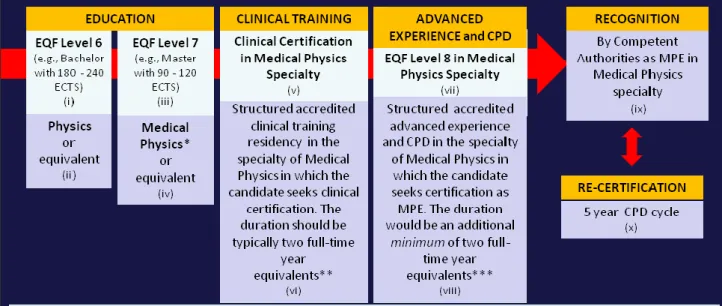
The proposed qualification framework (figure 1) is based on the results of the project survey; the various systems of qualifications used in Europe were evaluated and a framework developed based on the best features of each system taking into account the modernisation of scientific careers envisaged in the field. Owing to the rapid expansion of medical device technology and research results, it is becoming increasingly difficult for an MPE to be competent in more than one specialty of medical physics covered by the revised BSS (i.e., diagnostic and interventional radiology, nuclear medicine and radiation oncology/radiotherapy); therefore, the MPE should be independently recognised in each specialty of medical physics. The KSC for the recognition of MPE status by the competent authorities are to be gained initially through learning in an institution of higher education and structured clinical training in a residency within an accredited healthcare institution and subsequently developed further through structured advanced experience and CPD. Explanatory notes to the qualification framework diagram plus associated rationales are shown in Table 2.
European guidelines on medical physics expert
16
Figure 1: The Qualification Framework for the MPE in Europe
Table 2: Notes to the Qualification Framework diagram
Note Rationale
(i) The fundamental educational level for medical physics professionals is a level 6 in physics and associated mathematics (Eudaldo T, Olsen K, 2010).
Medical physics professionals need to have good foundations in physics and mathematics as Medical Physics is a physical, numeric and exact science.
(ii) ‘Equivalent’ here meaning EQF level 6 with a high level of physics and mathematics content.
This will make it possible for graduates from other Level 6 programmes which include a high level of physics and mathematics (e.g., engineering, biophysics) to enter the field.
(iii) The educational entry level for the medical physics professional has been set at EQF level 7. (Eudaldo T, Olsen K, 2010).
At entry level the medical physics professional needs to have highly specialised knowledge, critical awareness of knowledge issues in the field, specialised problem-solving skills, ability to manage work contexts that are complex and ability to review the performance of teams. (European Parliament and Council of the European Union, 2008) Medical physics professionals require highly specialised knowledge in radiation protection and the medical devices covered by the revised BSS and specialised problem-solving and troubleshooting skills. The medical physics professional is involved in clinical contexts that may be very complex and reviews the performance of radiation
Qualification and Curriculum Frameworks for the MPE in Europe
Note Rationale
protection and quality control teams in own specialty of medical physics.
(iv) ‘Equivalent’ here meaning EQF level 7 with a high level of physics and mathematics content plus the educational component of the core KSC of medical physics and the educational component of the KSC specific to the specialty of medical physics for which the candidate would be seeking clinical certification (as specified in this document). This additional education can be concurrent with the training.
This will make it possible for candidates with Masters in physics, biophysics, engineering etc. to enter the field; however, such candidates need to undertake an additional educational programme which includes the educational component of the core KSC of medical physics and the educational component of the KSC specific to the specialty of medical physics for which the candidate would be seeking clinical certification.
(v) The medical physics professional at entry level is a professional with clinical certification in medical physics i.e., having a level of education in medical physics at a level intermediate between EQF levels 7 and 8, having typically 2 years full-time equivalent accredited clinical training and recognized as competent to act independently through enrolment in a national register for Medical Physics professionals.
The education and training to clinical certification in medical physics is a necessary foundation for further development to MPE EQF Level 8.
(vi) Structured accredited residency based training for clinically based development of the core KSC of medical physics and the KSC specific to the specialty of medical physics for which the candidate would be seeking clinical certification. The duration of this structured training is typically two full-time year equivalents.
The IAEA recommends that clinical certification would need a training period of two full-time year equivalents for any one specialty of medical physics (IAEA, 2009) (IAEA, 2010) (IAEA, 2011).
(vii) The MPE in a given specialty of medical physics is a professional with clinical certification in a specialty of medical physics who has achieved the highest level of expertise in that particular specialty. The medical physics professional through structured advanced experience, ongoing extensive CPD and commitment places the KSC at the highest possible level i.e., EQF level 8.
The qualification level for the MPE has been set at EQF Level 8 because the MPE requires knowledge at the most advanced frontier of a field of work and at the interface between fields, the most advanced and specialised skills and techniques, including synthesis and evaluation, required to solve critical problems in research/innovation and to extend/redefine existing professional practice, demonstrate substantial authority, innovation, autonomy, professional integrity and sustained commitment to the development of new ideas or processes at the forefront of work contexts including research (European Parliament and Council of the European Union, 2008). To carry out activities requiring expert action, involvement or advice with authority and autonomy and which are based on current best evidence (or own scientific research when the available evidence is not sufficient), the MPE requires frontier knowledge in own specialty of medical physics and
European guidelines on medical physics expert
18
Note Rationale
at the interface between physics and medicine. The MPE requires specialised skills and techniques in radiation protection and comprehensive experience regarding the effective and safe use of the medical devices in own specialty, and the synthesis and evaluation skills required to solve critical problems in service development, research, innovation and the extension and redefinition of existing professional practice.
(viii )
This will mean that to reach MPE status (Level 8) in the specialty area requires a minimum total of four years equivalent clinical training (2 years equivalent of foundation training in the specialty area to clinical certification and a further two years equivalent of advanced, structured experience and CPD in the specialty).
It should be emphasised that the further 2 years to reach MPE status must consist of advanced, structured experience and CPD and not simply CPD designed to maintain competence. The two years minimum of advanced experience must be measured from the time when the advanced experience commences. The advanced experience and CPD might not follow immediately the 2 years of basic training if the candidate is not deemed to be sufficiently prepared. It is to be understood that senior MPEs practicing in large medical centres with a full range of devices would need more years of advanced experience than the 2 years minimum. On the other hand small facilities can be serviced by novice MPEs working under the guidance of a senior MPE.
(ix) A person who is currently recognised as an MPE and is in possession of the core KSC of medical physics and the KSC specific to the specialty for which recognition is sought should be deemed to satisfy the requirements for recognition as an MPE if they are currently on active duty as an MPE and are deemed to have reached level 8.
This is a grandparenting clause.
(x) This is the requirement for an MPE to maintain recognition.
A five year cycle for re-certification (i.e. recognition by the Competent Authorities as having maintained a level 8 in the particular specialty of Medical Physics) is recommended.
3.3
Curriculum Framework for MPE programmes in Europe
The curriculum framework (figure 2) consists of a structured inventory of KSC underpinning the role, mission and key activities of the MPE. The proposed curriculum framework is intended to be comprehensive yet concise. It is designed to make the commonalities between the various specialties of medical physics apparent and emphasise common terminology - hence facilitating collaboration between MPEs from the different specialties (e.g. in hybrid imaging, radiotherapy planning).
The KSC are classified in two categories: generic skills and subject specific KSC (EC Tuning Project, 2008). Generic skills consist of transferable skills which are expected of all professionals at a particular level of the EQF. In this case the relevant levels are level 7 (EC Tuning Project, 2008) and level 8(Tuning Physics Subject Area Group, 2007). Subject specific KSC are specific to a profession. These are further classified into sub-categories as
Qualification and Curriculum Frameworks for the MPE in Europe
determined by the particular profession. The following classification is based on proposals by EFOMP (Christofides S. et al., 2009), and Caruana (Caruana CJ, 2011):
(a) Medical physics core KSC: these KSC are expected of all MPEs irrespective of their
specialty:
i. KSC for the MPE as physical scientist: these are fundamental physics KSC expected of all physical scientists
ii. KSC for the MPE as healthcare professional: these are KSC expected of all healthcare professionals
iii. KSC for the MPE as expert on the clinical use of medical radiological devices and protection from associated ionising radiations (and other physical agents as appropriate): these represent medical device and safety KSC common to all specialties of medical physics.
(b) Medical physics specialties KSC: these KSC are highly specific to each specialty of
medical physics (i.e., diagnostic and interventional radiology or nuclear medicine or radiation oncology/radiotherapy) and therefore cannot be included in the core
It is important to note that an MPE from one specialty of medical physics who is required to assume specific responsibilities from another specialty may be certified to carry out those specific responsibilities following the acquisition of the corresponding KSC. Such cases may arise for example in a small nuclear medicine facility who requires its nuclear medicine MPE to take responsibility for the management of quality control testing of the CT component of a PET/CT system or at a small radiation oncology/radiotherapy facility which requires its radiation oncology/radiotherapy MPE to take responsibility for protocol optimization of a given imaging modality.
The core KSC inventory and three specialty KSC inventories are given in Annex 1. A
candidate seeking recognition by the competent authorities as an MPE in a given specialty of medical physics should reach level 8 in the core KSC and the KSC specific to that particular specialty.
The question arises which of these KSC are expected to be achieved by the medical physics professional at the end of the two years equivalent clinical training following the Masters in Medical Physics (EQF level 7+) and which at the MPE level (EQF level 8). In general most of the knowledge, a substantial number of the skills and some of the competences should be acquired by the end of the initial two year clinical training. The skills and competences to be acquired by the end of the two years equivalent clinical training following the Masters in
Medical Physics (EQF level 7+) are those defined by the IAEA training documents (IAEA,
2009), (IAEA, 2010), (IAEA, 2011). However, as Medical Physics is by nature complex it must be emphasized that these skills and competences are developed over a period of years. The majority of the skills and competences would be acquired to the appropriate effective and safe level only at the MPE level i.e., level 8.
Education and training programmes should be based on the most updated textbooks and reports in the literature such as:
a. Medical physics textbooks such as the handbooks and training manuals produced by the IAEA for physics in radiation oncology, nuclear medicine and diagnostic and Interventional radiology
b. International, European and national legislation including all EU Directives relevant to radiation protection, medical devices, physical agents and personal protective equipment c. Relevant EC reports, recommendations and protocols (e.g., Radiation Protection Series
http://ec.europa.eu/energy/nuclear/radiation_protection/medical/publications_en.htm) d. Reports, recommendations and protocols from relevant International organisations (e.g.,
European guidelines on medical physics expert
20
e. Reports, recommendations and protocols from International, European and national medical physics professional bodies (e.g., IOMP, EFOMP, AAPM, IPEM)
f. Reports, recommendations and protocols from European professional and scientific bodies associated with the specific areas of medical physics practice (e.g., ESTRO, ECR, EANM)
g. Reports, recommendations and protocols from relevant national authorities (e.g., HPA (UK), STUK (FI))
h. Primary research reports and review articles from the research literature.
Educational and training methods should take into account modern developments in education and be based on approaches specific to adult learning (e.g., case-based learning).
Qualification and Curriculum Frameworks for the MPE in Europe Figure 1: Curriculum Framework for MPE programmes in Europe
Recognition of the MPE
4
RECOGNITION OF THE MPE
4.1
Introduction and Background
The definition of the MPE – as given by Directive 97/43/Euratom (Council of the European Union, 1997) and the revised BSS (Council of the European Union, 2013) – states that the “training and competence to act is recognised by the competent authorities”. Both these documents specify in various articles the roles and responsibilities of the Competent Authorities. The Directive 97/43/Euratom also defines Competent Authorities as “any authority designated by a Member State”, and the revised BSS as “an authority or system of authorities designated by Member States as having legal authority for the purpose of this directive”.
These definitions clearly allows Member States to designate different authorities to deal with specific aspects of these Directives, which has led to variation in said designation for the recognition of the MPE in the Member States.
Within the work carried out by this project, the Medical Physics Expert survey (European Commission Workshop, 2012) results identified differing interpretations of the MPE role and of the level of training and competence required for the designation of the MPE across the European Union. This may have arisen because the definition of MPE does not define the word ‘expert’.
The survey results also showed that recognition of the MPE is achieved mainly through registration, and that the existing registers recognise the competence of medical physicists but only a few explicitly recognise the competence of the MPE. The survey and professional interviews carried out during the project also showed that there was confusion in many Member States about how professional registration operates, but it was clear that a system in which MPEs need to have some formal accreditation or registration was seen as positive. The results of the survey and interviews also indicated that there is no harmonisation between Member States in the recognition of the MPE. An additional factor contributing to this and the above discrepancies is that the level of expertise that an MPE should have is mainly dictated by the level and sophistication of the technology available in each Member State. This hinders harmonisation of competence and hence the mobility of the MPE between Member States.
4.2
Recommendations
In order to reach harmonisation in the recognition of the MPE and to allow free mobility of the MPE between the Member States it is recommended that a formal mechanism for recognising an individual’s status as an MPE should be put in place in each Member State:
1. Each Member State should consider designating, through a legal instrument, a Competent Authority specifically for the recognition of the MPE.
2. Recognition should be achieved by registration. It is highly recommended that a professional register should be kept by an official authority (e.g. Ministry of Health or Radiation Protection Authority). This task could also be delegated to a professional body such as professional medical physics societies if an official mandate is given.
3. The Competent Authority designated for the recognition of the MPE, should use the Qualifications Framework and KSC of the MPE specified in the present document, for the recognition of the MPE to Level 8 of the EQF.
European guidelines on medical physics expert
24
4. The educational establishments of each Member State involved in medical physics education and training should use the KSCs of the present guidelines.
5. To allow the mobility of the MPE between Member States, it is recommended that the education and training of each MPE be recorded in a document that can be used as proof of the recognised competence.
6. MPE education and training requires formal steps that should be implemented by the competent authorities as recommended in the Qualification and Curriculum Frameworks to be found in this document.
7. It is highly recommended that MPE recognition should be overseen by a joint board of experts from the various stakeholders (i.e. Ministry of Education, Ministry of Health, Radiation Protection Authorities and Professional Societies, as appropriate).
The implementation of the above recommendations will ensure that the recognition of the MPE is harmonised throughout the Member States and will facilitate the mobility of MPEs from one Member State to the other.
Medical Physics Expert Staffing Levels in Europe
5
MEDICAL PHYSICS EXPERT STAFFING LEVELS IN
EUROPE
5.1
Introduction
To ensure adequate protection of the patient it is essential to have the appropriate number of MPEs and supporting staff. Annex 2 provides suggested factors that allow the numbers of MPEs required for radiotherapy, diagnostic and interventional radiology and nuclear medicine to be calculated. The numbers will relate to the need to assure that the key activities of the MPE derived from Article 57 of the revised BSS be achieved identifying the scope of the MPE from Article 85 of the revised BSS and as identified by this project. The factors should be used by relevant stakeholders such as healthcare decision makers and hospital administrators to identify the number of MPEs required. It is not practicable to provide guidelines for all types and complexity of clinical services (e.g. very specialised procedures, advanced clinical research etc.) and services involved in such activities will therefore have additional MPE requirements.
In deriving the factors given in Annex 2 use was made of comprehensive literature reviews and data collected from surveys to inform the group of experts associated with this project. In deriving the factors it was noted that the number of standard working hours per year varies between different Member States. For instance, the working hours per year in Ireland are around 1670 compared with around 1650 hours in the UK. However, due to the uncertainties in the factors, it is recommended that no adjustments to the factors be attempted unless staff is specifically employed to work long hours or overtime.
The MPE staffing factors required in radiotherapy, nuclear medicine and diagnostic and interventional radiology are dealt with separately. The number of MPEs required is dependent upon the size and complexity of the service. There will be a constant relationship between the ratio of MPEs to the number of individuals needed to provide a service of the same complexity (although there could be some variation in this relationship for very small or very large services). For each service, the number of MPEs or ‘group of individuals’ (Chapter 2.1) together with ancillary staff is denoted here as the medical physics service or MPS. To obtain the required staffing levels, the factors in Annex 2 have to be multiplied by the number of elements associated with each factor and the results summed together to calculate the total WTE (Whole Time Equivalent) of MPEs and staff in the MPS.
Comparisons using these factors to calculate staffing levels with other data available in the literature were found to be difficult, particularly for nuclear medicine and diagnostic and interventional radiology, due to the differing ways in which staffing numbers can be derived. Only the total medical physics staffing levels in an MPS could be compared since there was no data in the literature found relating specifically to the staffing levels associated with the MPE.
For radiotherapy, the MPE factors were based on the reports by IPEM (IPEM, 2002) (IPEM, 2009). The calculated MPS staffing levels required for a typical radiotherapy department was shown to be in reasonably good agreement with the total staffing levels associated with a range of other literature (ISTISAN, 2002), (Klein EE, 2010), (SEFM, 2002), (IAEA, 2010). For nuclear medicine and diagnostic and interventional radiology, the MPE factors were based on the survey results and analysis by the relevant Special Interest Groups in IPEM and from expert opinion by the core working group associated with the Guidelines on Medical Physics Expert Project(European Commission Project, 2012).
The MPS staffing levels associated with a range of diagnostic and interventional equipment found in typical nuclear medicine and diagnostic and interventional radiology departments appeared to be in reasonably good agreement with the total staffing levels suggested by the
European guidelines on medical physics expert
26
AAPM (AAPM, 1991). However, they resulted in greater levels compared to those suggested by some other literature (EFOMP, 1997), (IAEA, 2010), (SSRMP, 2009), (DGMP, 2010). Reasonable agreement with these reports did exist, however, if the factors associated only with just routine work were used.
The factors associated specifically with patient activity for high dose radiology procedures have not normally been assessed separately in other reports. These have been specifically included in the present work because of the increased attention placed on the hazards associated with CT and interventional radiology studies.
Additional factors associated with the MPE for service delivery are: on-going service development, clinical governance, audits, research and development including clinical trials, education and training within service and management of scientific service.
The MPE may also, from time to time, need to liaise with a radiation protection expert. For example when there is new equipment installed or new room shielding. The extent of this liaison will depend to a considerable degree on the implementation of the revised BSS in each EU member state.
5.2
Recommendations
Recommended staffing factors, given in Annex 2, have been set for estimating the number of MPEs required for a given medical physics service involving the use of ionising radiations for radiotherapy, nuclear medicine and diagnostic and interventional radiology services. The factors are both equipment and task/patient based.
They provide methods that can be used by departmental managers and administrators to obtain the number of MPEs that should be employed to provide a high quality, safe, efficient and productive service with the innovation necessary for the introduction of new equipment and techniques. Additional elements for research and development have been identified separately but the amount of staff employed within pure research will be mainly a function of additional external funding and is not within the scope of this report.
For radiotherapy, the nature of the involvement of medical physics will require the presence of MPEs, recognised in the relevant specialties, to be on site for at least part of the standard working day and available for consultation during extended working days and weekends. It is expected that at least two MPEs will be required to provide this assurance. Outside normal working hours and for satellite sites, an MPE must be available for consultations at all times the service is operating, and if circumstances require, can be on-site quickly to take adequate measures to assure the radiation protection of the patient should any unforeseen or emergency situation arise.
For nuclear medicine and diagnostic and interventional radiology, the nature of this involvement will require the presence of MPEs, recognised in the relevant specialties, to carry out measures related to radiation protection of the patient and quality assurance of the equipment, to optimise practices, to respond appropriately to individual patient-specific issues, to assist in matters of organisation and to be available for consultations at all other times the service is operating.
The number of MPEs required will depend upon the number and type of equipment and their complexity together with the amount of patient activity.
All MPEs should have time allocated for CPD some of which may take the form of in-house training, and service development projects to meet the needs of the department.
When the WTE is not a whole number, an MPE may be employed to carry out other duties commensurate with their experience. Alternatively, an MPE may be employed part time or form partnerships with other services.
Medical Physics Expert Staffing Levels in Europe
In an MPS there should be one or more MPEs within each specialty who assumes responsibility for the service provision in that specialty. The MPS should employ other medical physics staff to support the work of the MPE. The skill-mix for the support staff should be decided in consultation between the employer and the MPE. Without the appropriate level of experience and supervision of staff within an MPS there is an increased risk of failure in patient safety standards. Inadequate staff resources may directly impact on the quantity and quality of the service provided to patients. Where there is a shortfall of staff compared to these guidelines there is a potential for under usage of expensive equipment, non-optimal exposures, patients not receiving state of the art care and an increase in patient overexposures. For all MPSs some form of management and administration will be required. The amount required will depend upon the size and complexity of the service and may contribute a further one WTE per service.
For staff working at multiple locations, an additional WTE component may need to be factored into the calculated staffing levels to account for the time it takes staff to travel to the different locations.
Healthcare decision makers and hospital administrators should audit the staffing levels at intervals of no more than two years and ensure reasonable compliance with this guidance is achieved.
References
REFERENCES
AAPM. (1991). Staffing Levels and Responsibilities of Physicists in Diagnostic Radiology.
Report 33 of Task Group 5, Diagnostic X-ray Imaging Committee, American Association of
Physicists in Medicine. http://www.aapm.org/pubs/reports/RPT_33.pdf.
Caruana CJ. (2011). The Tuning process and the Masters in Medical Physics in Europe - a personal vision. In S. P. Editors: Tabakov S, Medical Physics and Engineering - Education
and Training. Italy: ICTP Press. ISBN 92-95003.
Christofides S. et al. (2009). An Initial EFOMP Position on the Tuning Process for Masters Programs in Medical Physics in Europe. In Dössel O and Schlegel WC (Eds.): WC 2009,
IFMBE Proceedings 25/XIII, 70-73.
Council of the European Union. (1997). Council Directive 97/43/Euratom of 30 June 1997 on health protection of individuals against the dangers of ionizing radiation in relation to medical
exposure, and repealing Directive 84/466/EURATOM. Official Journal L-180 of 09.07.1997,
22.
Council of the European Union. (2013). Council Directive 2013/59/Euratom laying down basic safety standards for protection against the dangers arising from exposure to ionising radiation, and repealing Directives 89/618/Euratom, 90/641/Euratom, 96/29/Euratom,
97/43/Euratom and 2003/122/Euratom. Official Journal L-13 of 17.01.2014.
CPME. (2005). Standing Committee of European Doctors. Stakeholders' position paper on
patient safety,
http://www.ehtel.org/forum/tasks-sources/tf-patient-safety-emedication/stakeholders_position_on_patient_safety.pdf.
DGMP. (2010). Ausgearbeitet von einem Arbeitsausschuss. Deutschen Gesellschaft für Medizinische Physik. http://www.dgmp.de/oeffentlichkeitsarbeit/papiere/Bericht21.pdf.
EC Tuning Project. (2008). Tuning - Universities' contribution to the Bologna Process (2nd ed.). (W. R. González J, Ed.) Publicaciones de la Universidad de Deusto. http://www.unideusto.org/tuningeu/images/stories/Publications/ENGLISH_BROCHURE_FOR _WEBSITE.pdf.
EFOMP. (1997). European Federation of Organisations for Medical Physics. Policy statement 7: Criteria for Staffing Levels in a Medical Physics Department. Physica Medica, XIII, 187-194.
Eudaldo T, Olsen K. (2010). European Federation of Organisations for Medical Physics. Policy Statement No.12: The present status of Medical Physics Education and Training in Europe. New perspectives and EFOMP recommendations. Physica Medica, 26, 1-5.
European Commission. (2007). WHITE PAPER. Together for Health: A Strategic Approach for the EU 2008-2013. COM(2007) 630 final,
http://eur-lex.europa.eu/LexUriServ/site/en/com/2007/com2007_0630en01.pdf.
European Commission. (2012). Radiation Criteria for Acceptability of Medical Radiological Equipment Used in Diagnostic Radiology, Nuclear Medicine and Radiotherapy. Radiation
Protection Series 162.
European Commission Project. (2012). Guidelines on Medical Physics Expert.
European Commission Workshop. (2012). Proceedings of the "Guidelines on Medical Physics Expert Project".
European Commission. DG Health and Consumer Protection. (2005). Luxembourg Declaration on Patient Safety.
European guidelines on medical physics expert
30
http://www.eu2005.lu/en/actualites/documents_travail/2005/04/06Patientsafety/Luxembourg_ Declaration_on_Patient_Safety_05042005-1.pdf.
European Parliament and Council of the European Union. (2008). Recommendation 2008/C 111/01 on the establishment of the European Qualifications Framework for Lifelong Learning.
Official Journal of the European Union 6.5.2008,
http://eur-lex.europa.eu/LexUriServ/LexUriServ.do?uri=oj:c:2008:111:0001:0007.
IAEA. (2009). Clinical Training of Medical Physicists Specializing in Radiation Oncology.
Training Course Series, 37, International Atomic Energy Agency,
http://www-pub.iaea.org/MTCD/publications/PDF/TCS-37_web.pdf.
IAEA. (2010). Clinical Training of Medical Physicists Specializing in Diagnostic Radiology.
Training Course Series, 47, International Atomic Energy Agency,
http://www-pub.iaea.org/MTCD/publications/PDF/TCS-47_web.pdf.
IAEA. (2010). El físico médico: criterios y recomendaciones para su formación académica, entrenamiento clínico y certificación en América Latina. STI/PUB/1424, International Atomic Energy Agency. http://www-pub.iaea.org/MTCD/publications/PDF/P1424_S_web.pdf.
IAEA. (2011). Clinical Training of Medical Physicists Specializing in Nuclear Medicine.
Training Course Series, 50, International Atomic Energy Agency,
http://www-pub.iaea.org/MTCD/publications/PDF/TCS-50_web.pdf.
ICRP. (2007). The 2007 Recommendations of the International Commission on Radiological
Protection. ICRP publication 103. Ann ICRP. 37(2-4):1-332. International Commission on
Radiological Protection.
IPEM. (2002). Guidelines for the Provision of a Physics Service to Radiotherapy. York (UK): Institutre of Physics and Engineering in Medicine.
IPEM. (2009).
http://www.ipem.ac.uk/Portals/0/Documents/Recommendations%20for%20Prov%20of%20P hys%20Serv%20to%20RT.pdf. York (UK): Institute of Physics and Engeenering in Medicine. ISTISAN. (2002). Garanzia di qualità in radioterapia. Linee guida in relazione agli aspetti clinici e tecnologici. Rapporti ISTISAN 02/20, Gruppo di studio Istituto Superiore di Sanità“Assicurazione di Qualità in Radioterapia. http://www.iss.it/binary/publ2/cont/02-20.1140606202.pdf.
Klein EE. (2010). A grid to facilitate physics staffing justification. Journal of Applied Clinical
Medical Physics, 11, 263-273.
Legido-Quigley H, McKee M, Nolte E, Glinos IA. (2008). Assuring the quality of health care in the European Union. Observatory Studies Series No 12,
http://www.euro.who.int/__data/assets/pdf_file/0007/98233/E91397.pdf.
SEFM. (2002). Medios humanos y materiales necesarios en la unidad de radiofísica para la garantía de calidad en radioterapia. SEFM20022, Sociedad Española de Física Medica. http://www.sefm.es/fisica-medica/es/documentos/6/documentos-sefm/33.
SSRMP. (2009). Medical physicist staffing for nuclear medicine and dose-intensive X-ray procedures . Schweizerische Gesellschaft für Strahlenbiologie und Medizinische Physik.
Report No. 20.
Tuning Physics Subject Area Group. (2007). Third cycle studies in Physics. http://www.unideusto.org/tuningeu/tuning-3rd-cycle/physics.html.