Do Bankruptcy Codes Matter? A Study
of Defaults in France, Germany,
and the U.K.
SERGEI A. DAVYDENKO and JULIAN R. FRANKS∗
ABSTRACT
Using a sample of small firms that defaulted on their bank debt in France, Germany, and the United Kingdom, we find that large differences in creditors’ rights across countries lead banks to adjust their lending and reorganization practices to mitigate costly aspects of bankruptcy law. In particular, French banks respond to a creditor-unfriendly code by requiring more collateral than lenders elsewhere, and by relying on collateral forms that minimize the statutory dilution of their claims in bankruptcy. Despite such adjustments, bank recovery rates in default remain sharply different across the three countries, ref lecting very different levels of creditor protection.
HOW DO BANKRUPTCY CODES AFFECT DISTRESSEDreorganizations, and can lenders
overcome the lack of creditor protection by adjusting their lending practices at loan origination? We use a large sample of defaulted small-to-medium size firms from 10 banks in France, Germany, and the United Kingdom to address these questions, and find country bankruptcy codes to be important determinants of outcomes of distress, despite significant adjustments in banks’ practices in response to particular provisions of their respective codes.
With f lexibility in writing and renegotiating debt contracts, the effect of state-imposed bankruptcy law on lending and distress is an empirical question. On the one hand, one might expect different outcomes of default depending on the level of creditor protection provided by the bankruptcy code. For example, in debtor-friendly countries, where creditors have little control in bankruptcy, ∗Sergei Davydenko is at Joseph L. Rotman School of Management, University of Toronto. Julian
Franks is at London Business School and the Centre for Economic Policy Research. This study has been made possible through the initiative and continuous support of Standard and Poor’s Risk Solu-tions. We thank the 10 banks in France, Germany, and the United Kingdom, which wish to remain anonymous, for providing us with the data and for their cooperation throughout. We are deeply indebted to Arnaud de Servigny, Michael Baker, Antje Brunner, R´egis Blazy, and the numerous officers of the 10 banks for their collective effort to make the data available. Earlier collaboration with Oren Sussman was very helpful in the design of data collection. We gratefully acknowl-edge helpful comments from Viral Acharya, Ken Ayotte, Ian Cooper, Fritz Foley, Francisco Gomes, Gerard Hertig, Kose John, Roger Stein, Ilya Strebulaev, Alois Stutzer, an anonymous referee, and participants at the American Finance Association Philadelphia meetings, Western Finance Associ-ation Portland meetings, European Finance AssociAssoci-ation Moscow meetings, 2005 NBER Corporate Finance meetings, Moody’s/LBS II Credit Risk Conference, the ETH Z ¨urich Workshop in Law & Economics, and the seminars at the Bank of England, Boston College, London Business School, and University of Strasbourg.
their recovery rates may be lower than in creditor-friendly jurisdictions. On the other hand, lenders may anticipate this and adjust the terms of the loan contract by, for example, requiring more collateral or increasing the interest rate on loans. This paper studies empirically the nature of such adjustments and the extent to which they mitigate the effect of the bankruptcy code on the outcome of default.
We focus on three European countries that have very different bankruptcy codes: France, Germany, and the United Kingdom. In the creditor-unfriendly code of France, the state imposes court-administered procedures in bankruptcy with the explicit objective of preserving the firm as a going concern and main-taining employment. To achieve these goals, French bankruptcy courts are given control of the bankruptcy process and are not mandated to sell firm assets to the highest bidder. The role of creditors is reduced to an advisory function, and their approval is not required by the court in determining a reorganiza-tion plan. By contrast, in the United Kingdom, although the state provides court-administered bankruptcy procedures, secured creditors can veto them and enforce the default provisions as specified in the debt contract. In the prin-cipal bankruptcy procedure used for small firms in the United Kingdom at the time of our study, known as administrative receivership, secured lenders have full discretion to sell the defaulted firm’s assets as they choose in order to ensure repayment of their claims, without much interference from the courts. Germany provides an intermediate level of creditor protection, where collec-tive court-administered procedures are imposed on the parties in bankruptcy, but creditors retain significant control over the restructuring process and their agreement is required to approve any reorganization plan. These differences across the three countries are ref lected in the creditors’ rights scores of La Porta et al. (1998, LLSV), which range from a minimum of 0 for France, to 3 for Germany, and to a maximum of 4 for the United Kingdom.
To study the effects of these differences in bankruptcy codes, we construct a unique data set of 2,280 small-to-medium size firms in France, Germany, and the United Kingdom, almost all of them privately owned, that have defaulted on their bank debt. Under the initiative of Standard and Poor’s Risk Solutions, the data have been collected specifically for this study from the private records of 10 commercial banks, each with a significant market share in its country. The data include detailed information on the terms of the loan contracts, the event of default and its resolution (either bankruptcy or workout), collateral values and the proceeds from asset sales, and banks’ recovery rates.
Our main findings can be summarized as follows. First, we find that banks significantly adjust their lending and reorganization practices in response to the country’s bankruptcy code. In particular, collateral requirements at loan origination directly ref lect the bank’s ability to realize assets upon default. Thus, because the proceeds from collateral sales are lower in France, at loan origination French banks demand higher levels of collateral per dollar of debt. Moreover, the composition of different types of collateral ref lects their expected value in default. While real estate collateral is the most important source of banks’ recovery in Germany and the United Kingdom, it is far less valuable in
France, both because sales proceeds there are diluted by preferential creditors such as employee wages and bankruptcy fees, and because French bankruptcy courts tend to sell assets below their potential market prices in order to preserve employment. By contrast, accounts receivable and personal guarantees can be realized by French banks directly, and the proceeds are not subject to dilution by preferential creditors. As a result, these collateral types are used more often than real estate at loan origination in France.
Second, the observed adjustments mitigate but do not eliminate the ef-fect of bankruptcy codes on outcomes of default. Banks’ losses in default re-main sharply different, with median undiscounted recovery rates of 92% in the United Kingdom, 67% in Germany, and 56% in France. Notwithstand-ing these differences, they would have been even larger in the absence of en-dogenous adjustments. The differences in recoveries are due to very different outcomes of bankruptcy, where the inf luence of the bankruptcy code is great-est. By contrast, recovery rates in workouts are very similar across the three countries.
Third, differences in practices across countries do not always conform to expectations. For example, it is often argued that defaulted firms are less likely to survive as going concerns in creditor-friendly countries such as the United Kingdom, where secured creditors have wide discretion to sell their collateral (Hart 2000, Acharya, Sundaram, and John 2006). Contrary to this prediction, however, we find that the proportion of going-concern reorganizations is actu-ally higher in the United Kingdom than in France, where the primary stated objective of insolvency is to ensure the survival of the troubled firm. The ex-plicit preference of the U.K. banks for going-concern reorganizations and the willingness of the U.K. banks to go to great lengths to turn around the ail-ing firm (Franks and Sussman 2005) is consistent with the fact that they are often residual claimants in default, and therefore have strong incentives to maximize the total recovery. Moreover, in response to large losses in the early 1990s, most U.K. banks have switched to managing distressed firms through centralized “business support units” in order to improve coordination and avoid oversupply of bankrupt firm assets in the resale market (Armour, Cheffins, and Skeel 2002, Franks and Sussman 2005). By contrast, the deprivatized nature of bankruptcy in France provides few economic incentives to reorganize the firm in an efficient manner.
Finally, our findings underscore the importance of understanding broader institutional considerations in discerning the effects of bankruptcy legislation. For example, we find that loan spreads charged by U.K. banks are similar to those in France, notwithstanding higher U.K. loan recovery rates combined with similar default probabilities in the two countries. The ability of U.K. banks to charge high interest rates despite relatively low expected losses is consistent with higher industry concentration and lower levels of competition in the bank-ing industry in the United Kbank-ingdom, with its market-oriented financial system, compared with the bank-oriented systems in Germany and France.
Our paper contributes to the strand of the literature studying the inf luence of creditors’ rights on debt contracts and distressed reorganizations. Claessens
and Klapper (2005) analyze how legal origins and creditor protection affect the incidence of formal bankruptcy procedures at the country level, Qian and Strahan (2007) examine their inf luence on the terms and pricing of bank loans, and Bae and Goyal (2004) focus on the effect of property rights on loan spreads across countries. These papers find that differences in creditors’ rights, partic-ularly relating to the treatment of collateral, significantly inf luence the terms
of loan contracts.1Djankov et al. (2006) use survey responses from insolvency
practitioners in 88 countries for a hypothetical insolvency case to study how default outcomes and the overall efficiency of the reorganization process de-pend on the country’s characteristics, including the provisions of its bankruptcy code. Unlike these papers, we use firm-level data to conduct a detailed study of bankruptcy laws in a small number of countries, instead of a limited number of metrics of creditors’ rights in a wider cross-section of countries. This approach allows us to relate differences in debt contracts and outcomes directly to partic-ular provisions of a set of bankruptcy codes and procedures, such as the dilution of collateral sale proceeds by preferential creditors in France, and to account for institutional differences across countries that may attenuate the effects of bankruptcy law.
We know of no other paper that provides a comparative study of defaults in different countries while strictly controlling for data comparability. Most
available evidence on financial distress comes from large U.S. corporations.2
Studies of other jurisdictions include papers on bankruptcy auctions in Fin-land by Ravid and Sundgren (1998), and in Sweden by Str¨omberg (2000) and Thorburn (2000). Data limitations usually restrict available evidence to formal bankruptcies. An exception is Franks and Sussman (2005), who study the reor-ganization of small firms in the United Kingdom, although the lack of country comparisons makes it more difficult for them to study the impact of bankruptcy rules on the outcome of default and bankruptcy.
The remainder of the paper is organized as follows. Section I brief ly out-lines the main features of the bankruptcy codes in France, Germany, and the United Kingdom, and provides a discussion of our hypotheses concern-ing the effects of bankruptcy codes on debt contracts and outcomes of default. Section II describes our data set and reports firm characteristics, recovery rates, and statistics on levels and types of collateral. Section III provides regres-sion results concerning cross-country comparisons of default outcomes, recov-ery rates, and interest spreads at loan origination. Section IV concludes. Fur-ther details on the bankruptcy codes in the three countries are provided in the Appendix.
1Several papers, including La Porta et al. (1998) and Djankov, McLiesh, and Shleifer (2007),
study at the country level the link between the development of debt markets, investor protection, and the country’s legal origin.
2See Asquith, Gertner, and Scharfstein (1994), Baird, Bris, and Zhu (2006), Franks and Torous
I. Bankruptcy Codes and Testable Hypotheses A. Bankruptcy Codes in the Three Countries
Bankruptcy laws and procedures in France, Germany, and the United Kingdom are significantly different. The French and German codes require both collective procedures and court supervision, while that in the United King-dom requires neither. The French code emphasizes the preservation of the going concern and employment, while the code in the United Kingdom leaves the con-tracting parties to the debt contract largely free to implement the procedure stipulated in the contract. These differences are ref lected in the very different LLSV (1998) scores of creditors’ rights cited earlier.
Table I summarizes the main features of the principal bankruptcy procedures of the three countries, and also those of the United States for comparison; more
information is provided in the Appendix.3In the United Kingdom, in the event
of bankruptcy control rights pass to the creditors. In the principal procedure used for small-to-medium size enterprises (SMEs) at the time of our study, namely, administrative receivership, a secured creditor (designated in the debt contract) appoints a registered insolvency practitioner (called “an administra-tive receiver”) to assume all the powers of the company’s board of directors, with the sole purpose of realizing sufficient funds to repay the debts owing to the secured creditor. The receiver does not need to consider the interests of other creditors, in particular unsecured lenders, and has full discretion over whether to sell the firm as a going concern, or to close it and liquidate its assets piecemeal. However, he must respect the security rights of other lenders and the order of priority of their claims, as provided for in the loan contracts.
In the French bankruptcy procedure calledredressement judiciare, the court
appoints an administrator who takes control of the company. The objectives of the administrator, as specified by statute, are to maintain the firm as a going concern, preserve employment, and satisfy creditors’ claims, in that order. The court decides whether the firm should be liquidated or preserved as a going concern, and in the event of firm sale the court can choose a low-value
bid if it provides for better prospects of employment preservation.4 Creditors
cannot veto the decision of the administrator, and can only communicate their concerns through nonbinding recommendations of a court-appointed creditor representative.
In Germany, the current bankruptcy code took effect in 1999, although it was passed in 1994. Under the current code, a court-appointed administrator supervises the bankrupt company and formulates a reorganization plan. The current code introduced for the first time an automatic stay of three months on creditors’ claims, the potential for super-priority finance that ranks above all
3Our description pertains to the codes that were in effect in the three countries at the time when
our data set was collected. Some changes to the French and U.K. codes have been enacted since then, but they do not affect our sample firms.
4Blazy and Combier (1997) provide evidence that French bankruptcy courts often fail to sell
T able I Bankruptcy Procedures in F rance, Germany , the United Kingdom, and the United States The table lists principal bankruptcy procedures in the United Kingdom, F rance , Germany , and the United States , and compares their main charac-teristics . The bottom row reports creditor protection scores given by La P orta et al. (1998). U .K. F rance Germany U .S . Administrative Redressement Insolvenzordnung Main procedure receivership judiciare (the 1999 code) Chapter 11 Chapter 7 Bankruptcy trigger Default (covenant Cessation of pa yments Cessation of pa yments No objective test. No objective breac h) (inability to meet or over -borrowing Solvent firm ma y test current liabilities) enter Chapter 11 Control rights Secured Court-appointed Creditors under court Debtor , creditors Trustee creditor administrator supervision (secured collectively , creditors ha ve more power) bankruptcy court supervision Automatic sta y None Unlimited 3 months Unlimited None Super -priority financing None Y e s Creditors ’ approval required Y e s None Dilution of secured claims None Signif icant Limited Limited None LLSV creditors ’ score (max = 4) 4 0 3 1 N/A
pre-bankruptcy debt, and majority voting rules for approving the reorganiza-tion plan. A majority of secured creditors is required for the plan to be approved; otherwise the firm must be sold. The principal pre-1999 procedure subjected the bankrupt firm to a compulsory auction, where the priority of claims and collat-eral rights were strictly respected. Discussions with German bankers indicate that because the 1999 rules were passed in 1994, they inf luenced procedures prior to the law’s 1999 effective date. As a result, for practical purposes the degree of creditor protection allowed in the German pre- and post-1999 codes is likely to be very similar.
The differences in the three bankruptcy codes are best seen from the perspec-tive of a secured creditor. In the United Kingdom, upon default secured cred-itors are firmly in control of the company. There is no automatic stay against creditors’ claims nor are there provisions for super-priority finance. Unsecured creditors have few control rights and do not participate in the sale of the firm’s assets. They do not, as a matter of contract and practice, obtain any payout un-less secured creditors’ claims have been completely satisfied. As a result, there are no deviations from strict absolute priority, and recovery rates for junior creditors are negligible (Franks and Sussman (2005)).
In Germany, the position of secured creditors is a little weaker, since a col-lective procedure is imposed on the parties, with a three-month automatic stay on all claims. Although voting procedures can dilute the rights of dissenting creditors, the approval of a majority of secured creditors is required for any plan to be passed by the court.
In France, the rights of secured creditors are most at risk, as their approval is required neither for the sale of their collateral, nor for confirmation of a reorga-nization plan. In addition, the state places its own claims and those of employees first in priority when collateral is sold in bankruptcy. An exception occurs in the case of some types of “cash” collateral, such as guarantees and debtors (ac-counts receivable), which can be realized directly by the secured creditor and are not diluted by preferential creditors. The administrator in bankruptcy can raise super-priority financing without the approval of creditors, thereby fur-ther reducing the priority of their claims on the firm’s assets. Super-priority financing is also available in Germany, but creditors’ approval is required. It is not available in receivership in the United Kingdom.
The LLSV creditors’ rights score for Chapter 11 of the U.S. code is only slightly above that of France (1 vs. 0). However, the two codes are fundamentally differ-ent. Whereas in the United States the bankruptcy court performs the role of a referee between the different creditors and the debtor as they work out a reor-ganization plan, the French court both supervises and controls the bankruptcy process, determining the outcome. By statute the French court can choose a plan that reduces the value and redistributes the proceeds of bankruptcy, in the name of employment preservation, without any requirement for creditors’ approval. Such a process is equally “unfriendly” to both the debtor and the creditors.
B. Testable Hypotheses
Coase’s theorem suggests that private contracts will adjust to minimize costs and inefficiencies of any bankruptcy code. In creditor-unfriendly jurisdictions such adjustments should help market participants overcome, at least partially, constraints on lending. Djankov, McLiesh, and Shleifer (2007) argue that banks may respond to poor creditor protection by screening and monitoring borrowers more carefully at loan origination. Qian and Strahan (2007) study how credi-tor protection affects loan characteristics at origination, while Bae and Goyal (2004) focus on loan pricing. Acharya et al. (2006) predict that the allocation of control rights in bankruptcy should affect the firm’s choice of optimal capital structure.
In this paper, we use a sample of defaulted firms to study how lending and reorganization practices are modified depending on the country’s bankruptcy code, and the extent to which such adjustments allow banks to mitigate creditor-unfriendly provisions of the code and hence reduce their losses in default. Our first hypothesis predicts that for similar firms across the three countries, banks’ recovery rates in formal bankruptcy increase with the level of creditors’ rights, implying the lowest recovery rates in France and the highest in the United Kingdom. Since French bankruptcy courts are not obliged to sell bankrupt con-cerns to the highest bidder, the value of the firm’s assets will be reduced on average even in the absence of direct bankruptcy costs. These lower sales pro-ceeds will be further diluted by preferential creditors, which should result in lower recovery rates for secured creditors. By contrast, German banks retain significant control over the bankruptcy process, while U.K. banks have virtually all the control rights to recover their claims, and therefore are likely to realize higher recovery rates.
It is important to stress that this hypothesis is expected to hold only for
sim-ilar firms in formal bankruptcies. In general, recovery rates will be affected
by the endogenous adjustment of the characteristics of firms in default. One such adjustment could be through the levels of collateral and other contractual loan characteristics. Also, firms typically have latitude in the timing of default, in that they can declare default earlier or later in distress. Cross-country dif-ferences in the timing of the default decision may affect default outcomes. For example, the “alert” procedure specified in the French code subjects managers to criminal penalties for failing to report liquidity problems promptly to the Banque de France. If in response to the bankruptcy code firms default early in distress, this may allow lenders to take remedial action and increase their
recovery rates.5
Our second hypothesis concerns how bankruptcy codes affect the relative
incidence of formal versus informal procedures.6 Since banks in France have
5Because of data limitations, we do not study whether firms in different countries default at
dif-ferent stages of economic distress, implying differences in firm market values on entering default. See Davydenko (2007) for U.S. evidence on the determinants of the timing of default.
6Claessens and Klapper (2005) study how the proportion of firms that file for bankruptcy each
limited control rights in bankruptcy, resulting (as we show) in low recovery rates, they should have a stronger incentive to restructure in workouts and avoid bankruptcy. However, other factors may also affect the incidence of work-outs. For example, the much greater control rights that U.K. banks enjoy in bankruptcy procedures may potentially increase their bargaining power out-side bankruptcy, making workouts easier to negotiate with firm owners. Also, borrowing from multiple banks is much more common in France and Germany than in the United Kingdom, increasing renegotiation costs and making work-outs more difficult. Which of these effects dominates is an empirical question.
While the above two hypotheses are related to default outcomes and preferred reorganization procedures, the third concerns the effect that bankruptcy codes have on the terms of the debt contract at origination, and in particular, those related to collateral. If, as we expect, secured creditors’ lack of control rights over the sale of assets and the dilution of their claims decreases the value of collateral for French banks, then banks may respond by demanding more collateral per dollar of debt to ensure the same level of security protection. Moreover, we expect French banks to rely more on particular types of “cash” collateral specified in the bankruptcy code that are not subject to dilution by preferential creditors.
Finally, we hypothesize that loan interest rates should ref lect banks’ expected losses from default in each country. In particular, if low recovery rates for banks in France result in greater overall expected losses from SME portfolios, then loan spreads in France should be higher than in other countries. This may not be the case, of course, if higher losses conditional on default in France are offset by lower default rates. Indeed, if overall loan portfolio quality is better in France due to more efficient screening and monitoring, then for new loans expected default losses may actually be lower than in other countries, despite high loss rates for firms that do default (and end up in our sample). To estimate banks’ expected losses, we look at recovery rates in conjunction with default rates, and also at the banks’ aggregate loss provisions reported on their balance sheets. We then investigate whether loan spreads across countries ref lect the ranking of expected losses.
II. The Data A. Data Sources and Sampling Procedures
Ten banks participated in this study: three in France, three in Germany, and four in the United Kingdom. Each observation in the sample corresponds to a particular firm that defaulted during the sample period. In the large majority of cases our bank was the borrower’s main bank. For each firm, we collect detailed data on loan terms at origination, the default event and its resolution, recovery rates for creditors, the different types of collateral at default, and the
whether the differences they report across countries are due to different default rates, or to the relative incidence of workouts conditional on default.
proceeds from collateral sales. Where the banks provided us with names of the companies, we use public data sources to supplement bank records on balance sheet and P&L account information and details of reorganization proceedings. We focus on SMEs, applying the following selection criteria. (1) We include in our sample firms with annual sales turnover below 75 million euros and total debt outstanding with the participating bank in excess of 100,000 euros. (2) We use the Basel II definition of default as our criterion for including a particular firm in our sample. According to this definition, a company is considered in default if any of the following conditions are present: the bank’s loan is more than 90 days past due on a scheduled debt payment, formal insolvency proceed-ings have been initiated against the borrower, a specific loss provision has been raised by the bank against the exposure, or the bank’s officers have indicated
that a material loss was likely, using an internal rating.7
To monitor the quality of data collection, particularly in light of differences of language and institutions, in each of the three countries we employed schol-ars and practitioners who have knowledge of the local bankruptcy code and familiarity with data collection for distressed firms. For each country, a tem-plate was designed to collect data on a company-by-company basis. A similar template was used for all banks within a country to ensure data comparability. We conducted numerous interviews with authorities in the banks responsi-ble for managing distressed firms, and in many cases we were allowed unre-stricted access to the banks’ original files. We also held extensive conversations with insolvency practitioners and judicial authorities in the three countries in order to improve our understanding of bankruptcy laws, procedures, and practices.
B. Summary Statistics
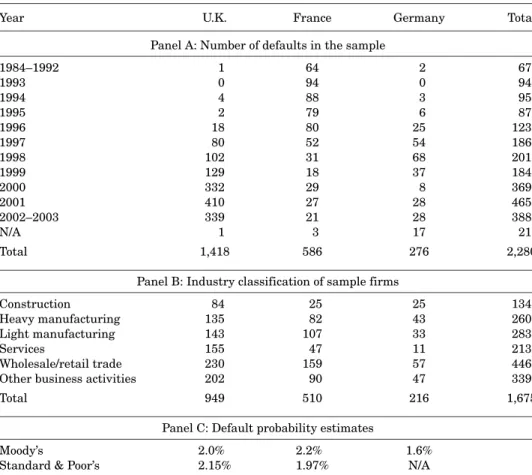
Panels A and B of Table II report the number of companies in our sample by year of default and by broad industry group. The U.K. and German samples are concentrated in the years 1996 to 2003, while the French sample is spread over the period 1993 to 2003. In each of the three countries, the defaulted SMEs are most frequently found in wholesale/retail trading and less frequently in the construction business. There are very few utilities or financial firms of this size. Since our sample is conditional on default, we do not have independent data that would allow us to estimate default rates for SMEs in the three coun-tries. Instead, we report default probabilities for private companies provided by
the rating agencies Moody’s and Standard and Poor’s.8 Similar to our sample
7Our conversations with banks’ officers indicate that in practice, in the great majority of cases
it is the last three criteria that were important for the selection of the sample, but that it was unlikely that an officer would downgrade a borrower to default unless a scheduled payment was more than 90 days overdue or the loan limit had been persistently exceeded.
8Estimates by Moody’s are obtained from technical reportsMoody’s RiskCalcTMfor Private Com-paniesfor the United Kingdom, France, and Germany, available at www.mkmv.com. Standard & Poor’s estimates are fromCredit Risk Tracker Technical Documentationreports for the United Kingdom and France, downloadable from www.creditrisktracker.com.
Table II
Sample Description and Default Probability Estimates
Panel A reports the number of firms in the sample in each of the three countries by year of default. Panel B reports the number of firms in the sample by broad industry group. The sample consists of defaulted firms with loan exposure at default to the participating bank greater than 100 K. and with annual turnover less than 75 M. The default event is defined according to Basel II criteria as described in Section II. Panel C presents estimates of the probability of Basel II default in the three countries by rating agencies Moody’s and Standard & Poor’s. Estimates by Moody’s are reported in technical reportsMoody’s RiskCalcTMfor Private Companies,for the United Kingdom,
France, and Germany. Standard & Poor’s estimates are reported inCredit Risk Tracker Technical Documentationreports for the United Kingdom and France.
Year U.K. France Germany Total
Panel A: Number of defaults in the sample
1984–1992 1 64 2 67 1993 0 94 0 94 1994 4 88 3 95 1995 2 79 6 87 1996 18 80 25 123 1997 80 52 54 186 1998 102 31 68 201 1999 129 18 37 184 2000 332 29 8 369 2001 410 27 28 465 2002–2003 339 21 28 388 N/A 1 3 17 21 Total 1,418 586 276 2,280
Panel B: Industry classification of sample firms
Construction 84 25 25 134
Heavy manufacturing 135 82 43 260
Light manufacturing 143 107 33 283
Services 155 47 11 213
Wholesale/retail trade 230 159 57 446
Other business activities 202 90 47 339
Total 949 510 216 1,675
Panel C: Default probability estimates
Moody’s 2.0% 2.2% 1.6%
Standard & Poor’s 2.15% 1.97% N/A
selection criteria, both agencies use the Basel II definition of default, includ-ing workouts as well as formal bankruptcies. Both agencies focus on private
companies with annual sales turnover in excess of 500 thousand, but do not
filter out large private firms.9 Standard and Poor’s estimates for the United
9In addition, Moody’s excludes start-up firms, financial firms, subsidiaries, and public sector
Kingdom and France are based on historical default frequencies between 1998 and 2004 obtained from private bank records; it does not report statistics for Germany. Moody’s arrives at its estimates using several different approaches, including the use of private bank data. The default probability statistics are reported in Panel C of Table II. For France and the United Kingdom the two agencies’ estimates are similar, between 2.0 and 2.2% per year. For Germany, Moody’s reports the baseline default probability of 1.6% per year, but stresses that this figure corresponds to a boom period with relatively few defaults.
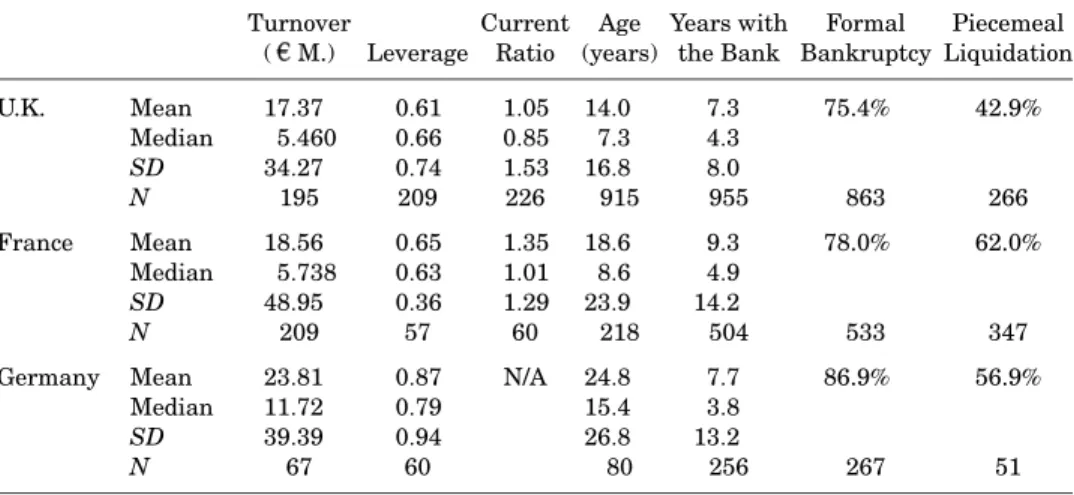
Company characteristics are summarized in Table III. Accounting data are taken from the last accounting statement (audited or managerial) available
prior to default. Average sales turnover before default is 17.4 million in the
United Kingdom, 18.6 million in France, and 23.8 million in Germany.
Me-dian book leverage at default is 66% in the United Kingdom, 63% in France, and 79% in Germany. These numbers are high compared with those for nondis-tressed listed firms reported by Rajan and Zingales (1995), which are, respec-tively, 18%, 25%, and 16%. A second measure of distress, the current ratio (current assets/current liabilities), suggests higher liquidity for French firms at 1.35, compared with only 1.05 in the United Kingdom; both are well below the benchmark level of 2.00 generally considered the minimum level for healthy firms. The higher ratio for French companies may be affected by the legal pro-vision that compels French managers to inform officials of difficulties in paying suppliers, and subjects them to criminal penalties in the event of noncompli-ance. Overall, high leverage and low current ratios confirm that firms in all countries are seriously distressed.
Defaulted SMEs in the sample are rarely start-up firms, with the median age at default varying from 7 years in the United Kingdom to more than 15 years in Germany. They have long-standing relationships with the main bank, with medians ranging from 3.8 to 4.9 years. Table III shows that the pro-portion of defaulting firms reorganized in a formal bankruptcy, as opposed to a workout, is similar in the United Kingdom and France, at 75.4% and 78.0%, but higher in Germany at 86.9%. Thus, contrary to our expectations, we do not find a lower incidence of bankruptcies in France, even though French banks do not control the bankruptcy process and therefore should have a strong incen-tive to reorganize in a workout. Also contrary to expectations, the proportion of piecemeal liquidations (where the firm is closed and assets are sold, either in bankruptcy or in a private sale), reported in the last column, is not low-est in France, despite the explicit commitment in the bankruptcy code toward preserving the troubled firm as a going concern. In fact, the incidence of liquida-tions is much lower in the United Kingdom, at 42.9%, than in France (62.0%) or Germany (56.9%). These results may be surprising in the light of Hart’s (2000) argument that, because senior secured creditors are in control of the U.K. bankruptcy process, they will have less interest in the going concern value, and as a result there will be more (inefficient) piecemeal liquidations. However, this argument assumes that the senior creditor is not impaired in default and therefore is not the residual claimant. By contrast, our evidence and that re-ported in Franks and Sussman (2005) imply that, in fact, upon default U.K.
Table III
Firm Characteristics
The table reports sample statistics for the firms in the sample.Turnoveris sales turnover before default.Leverageis the ratio of total debt to the sum of total debt and shareholder equity.Current ratiois the ratio of current assets to current liabilities.Ageis the age of the company from incor-poration to default.Years with the bankis the age of the relationship with the participating bank at default.Formal bankruptcyandPiecemeal liquidationare the proportions of defaulted firms in each country that were reorganized under formal bankruptcy vs. liquidated piecemeal (in or out of bankruptcy), respectively.Turnover,Leverage, andCurrent ratioare as of the date of the last pre-default audited accounts dated no more than 12 months before pre-default, if available, or management accounts otherwise. The sample consists of firms with loan exposure at default to the participating bank greater than 100 K., and with annual turnover less than 75 M., that defaulted on their bank debt according to Basel II criteria.
Turnover Current Age Years with Formal Piecemeal ( M.) Leverage Ratio (years) the Bank Bankruptcy Liquidation U.K. Mean 17.37 0.61 1.05 14.0 7.3 75.4% 42.9% Median 5.460 0.66 0.85 7.3 4.3 SD 34.27 0.74 1.53 16.8 8.0 N 195 209 226 915 955 863 266 France Mean 18.56 0.65 1.35 18.6 9.3 78.0% 62.0% Median 5.738 0.63 1.01 8.6 4.9 SD 48.95 0.36 1.29 23.9 14.2 N 209 57 60 218 504 533 347
Germany Mean 23.81 0.87 N/A 24.8 7.7 86.9% 56.9% Median 11.72 0.79 15.4 3.8
SD 39.39 0.94 26.8 13.2
N 67 60 80 256 267 51
banks are often residual claimants, and therefore have a strong incentive to maximize the total recovery. We analyze the determinants of the incidence of bankruptcies and liquidations in Subsection III.A, and discuss factors that may be affecting our cross-country comparisons.
The incidence of formal bankruptcy conditional on Basel II default in the SME sector that we document is relatively high. For the United Kingdom, it is significantly higher than the 31.5% reported in Franks and Sussman (2005). However, their firms are considerably smaller (sales turnover of 1.2 million vs. 5.5 million in our sample), and their sample consists of firms that banks place in their “intensive-care” units. Those firms have not necessarily defaulted, but
they give the bank cause for concern.10By contrast, firms in our sample have
all defaulted, and therefore are likely to be considerably more distressed on av-erage. We know of no reliable statistics on the incidence of formal bankruptcies in default for small unlisted firms in France or Germany. In the United States, for a sample of large publicly listed firms, Gilson, John, and Lang (1990) report 10Franks and Sussman (2005) report that U.K. banks may transfer a firm to their intensive care
unit because they do not approve of the management’s strategy and therefore require specialized monitoring, rather than because they expect the firm to default in the foreseeable future.
that about 53% of distressed U.S. firms end up in a Chapter 11 bankruptcy, while 47% successfully restructure out-of-court. Baird, Bris, and Zhu (2006) find that the large majority of Chapter 11 cases are small companies that do not survive as going concerns.
C. Debt Contract Characteristics
For each firm in the sample, we analyze all loans and overdrafts (credit lines) that were outstanding at the time of default with the bank that provided data
for this study.11For 96% of the firms in the U.K. sample, our bank is the main
bank lending to the firm. For the French sample the equivalent figure is only 56%, ref lecting the fact that multiple bank lending to an individual firm is more frequent than in the United Kingdom. For a small sample of German firms for which these data are available, our bank is the main bank in about 62% of the cases. In a majority of our tests, we aggregate all loans and overdrafts, calcu-lating the firm’s total debt outstanding at default and total resulting losses,
and report the bank’s overall recovery rate for the firm.12 This approach
al-lows us to avoid the issue of the arbitrary allocation by banks of recovery proceeds to different loans of the same firm, and to focus on the bank’s total losses.
Table IV summarizes the characteristics of bank debt at default. The table shows that the mean total debt outstanding at default with the participating bank, which we refer to as Exposure at Default (EAD), is 960,000 in the United Kingdom, 600,000 in France, and 2.41 million in Germany. The medians are smaller, at 244,000, 269,000, and 1.23 million, respectively. These statistics confirm that German firms in the sample are larger than those in the United Kingdom and France on the basis of debt exposure as well as sales turnover. In the analysis below we use EAD as a measure of the company’s size.
The second column in Table IV reports the proportion of outstanding debt that is secured (collateralized) at the time of default. This is the ratio of the last available pre-default estimate of the value of collateral, divided by the EAD. The table shows substantial differences in the levels of collateral across the three countries. While the median value of collateral is only 41% of the total debt outstanding in Germany, it is 62% in the United Kingdom, and as high as 104% in France. Thus, German firms are able to borrow without posting as much collateral as United Kingdom or French firms. This ordering of countries is consistent with Qian and Strahan (2007), who find that the proportion of (mostly large and syndicated) loans that are secured by collateral is 53% for Germany, 57% for the United Kingdom, and 67% for France. Since, as we show below, collateral has a major impact on creditors’ recovery rates, high levels of 11Although some firms may have banking relationships with several banks, we only have
infor-mation from participating banks on their own debt facilities.
12In addition to loans and overdrafts, banks may provide firms with “noncash” facilities, such
as performance bonds, bank guarantees, and interest rate swaps. We exclude such facilities from the study, since our analysis suggests that banks’ losses on these facilities are typically quite low, even in formal bankruptcy.
T able IV Bank Debt Characteristics The table reports sample statistics by company on loans , overdrafts , and other cash facilities outstanding with the bank at default date . Exposure at Default (EAD) is the total debt amount outstanding on cash facilities owed to the participating bank at the date of default. F raction secured is the value of collateral and guarantees at default as a percentage of exposure . No . o f loans is the number of cash facilities at default. Long-term is the value-weighted fraction of facilities with initial maturity more than one year . F ixed-rate is the value-weighted fraction of facilities with a fixed interest rate . Overdrafts is the value-weighted fraction of overdrafts among all facilities . Maturity if long-term is the a verage initial lending term for facilities with maturity exceeding one year . Interest spread is the equivalent floating-rate loan spread over the 3-month LIBOR rate in eac h country at loan origination, measured in percentage points . The sample consists of firms with loan exposure at default to the participating bank greater than 100 K. and with annual turnover less than 75 M., that defaulted on their bank debt according to Basel II criteria. EAD F raction No . o f Long-F ixed-Over -Maturity if Interest ( M.) Secured Loans term Rate drafts Long-term Spread U .K. Mean 0.960 85% 3.51 31% 2.8% 55% 8.77 2.23 Median 0.244 62% 3 0 % 0 % 100% 7.25 2.17 SD 2.657 104% 2.80 39% 12% 37% 4.57 0.63 N 1418 816 1386 275 291 315 183 568 F rance Mean 0.600 124% 2.20 43% 52% 47% 6.48 2.24 Median 0.269 104% 2 21% 75% 36% 5.01 2.02 SD 1.382 108% 1.40 44% 48% 44% 3.48 1.53 N 586 513 586 578 248 583 562 263 Germany Mean 2.412 60% 1.88 19% 21% 75% 8.50 2.90 Median 1.231 41% 1 0 % 0 % 100% 6.52 3.21 SD 3.594 80% 1.34 34% 33% 35% 5.10 2.16 N 276 259 72 67 70 67 44 93
collateral in France may provide a means to allow banks to mitigate the effects of creditor-unfriendly provisions of the French bankruptcy code. The differences in levels of collateral may also ref lect differences in valuation methods, such as the degree of conservatism shown by the banks in valuation, and the timing of revaluations. For example, U.K. banks tend to formally update their collateral value estimates for distressed companies, whereas French banks do not. We also find that our German banks appear relatively conservative in their valuations, often placing zero value on personal and company guarantees. Finally, some banks use the original cost or (written down) book values, rather than the open market values, for particular types of collateral. These differences in practices may have important implications. For example, more frequent revaluations of collateral may lead banks to demand more collateral in distress if there is a decline in asset values, and this practice may improve recovery rates. We later investigate whether the frequency of collateral revaluations affects collateral recovery.
Table IV also provides statistics on the average number of loans per distressed company; the proportion of loans that are long-term (defined as more than one year to maturity at origination); and the proportion of overdrafts (credit lines), which are typically subject to repayment on demand. Long-term financing is more common for defaulted firms in France (43%), and less common in Germany (19%). Much of the lending in France (52% of the total) is at fixed interest rates, while as much as 94% of United Kingdom lending is contracted at variable rates. These comparisons are consistent with the fact that the median defaulted firm is 100% overdraft-financed in both Germany and the United Kingdom, while in France almost two-thirds of debt is in term loans, which are more likely to be long-term fixed-rate facilities. The average maturity of long-term loans calculated at loan origination is between 6.5 and 8.8 years, depending on the country. Overall, debt characteristics in the three countries differ significantly along a number of dimensions.
The last column of the table reports statistics on the interest rate spread stipulated in the loan contract at its origination. For f loating-rate loans, this is the loan spread specified in the loan contract, adjusted for the difference between the reference rate (such as the Bank of England base rate) and the ap-plicable LIBOR rate. For fixed-rate loans, it is the difference between the loan rate and the level of the reference rate in the respective country on the date of loan origination, adjusted by the applicable fixed-to-LIBOR swap spread. Table IV shows that interest spreads for our sample firms are very similar in France and the United Kingdom, and highest in Germany. The mean spread is 224 basis points in France, 223 in the United Kingdom, and 290 in Ger-many, whereas the median is the lowest in France at 202 basis points, com-pared with 217 in the United Kingdom and as much as 321 in Germany. This ranking is not consistent with the levels of creditor protection in the three countries, nor with the evidence we report below regarding expected losses on bank loans in different countries. We discuss these issues in detail in Subsection III.C.
D. Banks’ Recovery Rates
We calculate the bank’s recovery rate for the firm as one minus the ratio of
the total final loss (write-off)13 to EAD, which is the total debt amount on all
loans outstanding with the bank at default. We focus on nominal (undiscounted) recovery rates, because information on the timing of cash f lows is only rarely available. The median total length of reorganization proceedings between de-fault and case closure for sample firms is 1.45 years in the United Kingdom, 3.05
years in France, and 3.82 years in Germany.14 However, in many cases most
of the bank’s cash f lows are received shortly after default. For a subsample of
firms for which the data are available, the mediandurationof cash f lows from
the date of default is 0.78 years in the United Kingdom, 1.81 years in France, and 3.58 years in Germany. Looking at discounted recoveries for these firms, we find that for discount rates of around 15%, longer reorganization periods in Germany make economic recovery rates closer to those in France, but for lower discount rates the ordering of countries is the same as that for nominal recoveries, which we focus on below.
Table V summarizes undiscounted recovery rates for defaulted firms in the three countries. Consistent with the LLSV ranking of creditors’ rights, median recovery rates for all firms, reported in Panel A, are lowest in France (56%) and highest in the United Kingdom (92%), with Germany in between (67%). The differences across countries are significant, both economically and statistically, despite possible adjustments in banks’ lending and reorganization practices de-signed to mitigate the effect of creditor-unfriendly provisions of their country’s bankruptcy code. Using regression analysis, we show in Subsection III.B that in the absence of such adjustment the differences that we document would have been even larger.
It is interesting to compare these recovery rates with those in the United States, where the bankruptcy code is usually considered to be relatively creditor-unfriendly. For large U.S. corporations, Gupton, Gates, and Carty (2000) estimate average recovery rates on traded senior secured bank loans of 70%; this number falls to 52% for senior unsecured loans. For the middle-market segment in the United States, Araten, Jacobs, and Varshney (2004) document bank recovery rates of 70%, while for all loans in their sample the average is slightly higher at 73%. These recovery rates are higher than what one might expect given that the LLSV index of creditors’ rights for Chapter 11 of the U.S. code is 1, compared with 0 for France, 3 for Germany, and 4 for the United Kingdom. The small difference in the scores between France and the United States fails to ref lect the substantive differences in bankruptcy procedures in the two countries. The former provides for explicit court intervention that reduces the value of secured creditors’ claims by subordinating them to 13Less than 10% of the cases were still open when we collected the data, and final write-offs
were not yet available. In those cases we use the bank’s latest available specific loss provision as an estimate of future losses on resolution.
14For comparison, for middle-market firms in the United States, Araten, Jacobs, and Varshney
T able V Company Recovery Rates by Country , Type of Reorganization, Industry , and Collateralization The table reports global undiscounted recovery rates by firm, def ined as one minus the ratio of the bank ’s total final loss to the total debt exposure at default, for the participating banks . P anel A reports the statistics for all firms . P anel B reports recovery rates for informal renegotiations , fo rmal bankruptcies , and for firms eventually liquidated piecemeal (in or out of bankruptcy). P anel C reports recovery rates by broad industry group . P anel D reports recovery rates by fraction secured , the value of collateral and guarantees at default as a percentage of exposure . The sample consists of firms with loan exposure at default to the participating bank greater than 100 K. and with annual turnover less than 75 M., that defaulted on their bank debt according to Basel II criteria. U .K. F rance Germany Mean Median SD N Mean Median SD N Mean Median SD N P anel A: Recovery for all firms All firms 0.74 0.92 0.34 1,405 0.54 0.56 0.40 575 0.61 0.67 0.34 226 P anel B: Recovery by type of procedure and outcome Informal renegotiation 0.78 1.00 0.34 199 0.83 1.00 0.28 115 0.76 0.79 0.26 26 F ormal bankruptcy 0.69 0.82 0.35 645 0.47 0.39 0.39 460 0.59 0.61 0.35 198 Going concern 0.78 1.00 0.33 149 0.74 0.96 0.36 132 0.70 0.79 0.34 22 Piecemeal liquidation 0.68 0.78 0.34 110 0.40 0.31 0.37 245 0.40 0.41 0.37 27 P anel C: Recovery by industry Construction 0.70 0.90 0.38 84 0.62 0.70 0.38 25 0.68 0.75 0.28 22 Hea vy manufacturing 0.73 0.89 0.35 130 0.56 0.57 0.36 81 0.55 0.50 0.34 37 Light manufacturing 0.76 0.94 0.31 142 0.56 0.61 0.41 106 0.64 0.75 0.33 29 Services 0.71 0.88 0.36 153 0.57 0.63 0.40 47 0.80 0.91 0.24 9 Wholesale/retail trade 0.66 0.83 0.38 227 0.50 0.44 0.41 153 0.49 0.46 0.38 53 Other business activities 0.69 0.81 0.35 200 0.56 0.55 0.40 87 0.69 0.74 0.32 41 P anel D: Recovery by fraction of debt secured 0.0% (unsecured) 0.58 0.71 0.39 41 0.35 0.14 0.40 44 0.50 0.50 0.35 59 0 – 40% 0.58 0.59 0.36 61 0.36 0.19 0.36 50 0.58 0.54 0.32 31 40 – 80% 0.59 0.62 0.33 133 0.42 0.39 0.35 56 0.64 0.69 0.31 95 80 – 120% 0.78 0.93 0.31 191 0.62 0.76 0.38 111 0.79 0.86 0.29 18 120% + 0.86 1.00 0.27 465 0.58 0.63 0.38 232 0.74 0.80 0.29 18 All secured 0.76 0.94 0.32 1,049 0.54 0.57 0.38 507 0.64 0.72 0.32 171
preferential claims and by the courts’ ability to sell the firm below the market price to preserve employment. By contrast, creditors have significantly more power to inf luence reorganization in the United States, and the role of the bankruptcy court there is solely to obtain agreement between the different creditors and the debtor on a reorganization plan. The extent of the control that senior creditors are now able to exercise in bankruptcy leads Baird et al. (2006) to argue that “changes in Chapter 11 practice over the last 15 years close the gap between Chapter 11 and other regimes that make explicit use of the market and grant senior creditors greater control” (p. 8). Thus, notwithstand-ing the low LLSV creditor protection score, recoveries for secured creditors in the United States may be expected to be closer to those in the United Kingdom
and Germany than in France.15
It may also be the case that Chapter 11 and its associated provisions are more widely used for larger companies (the subject of most existing studies of recovery rates) than for the small-to-medium size unlisted companies, which comprise our sample. Baird et al. (2006) state that while two-thirds of all cor-porate Chapter 11 filings are either converted to Chapter 7 liquidations or dismissed altogether, these outcomes are far more likely for very small firms. To the extent that firms can also file for Chapter 7 directly, Chapter 7, rather than Chapter 11, may provide an important benchmark procedure for SMEs in the United States.
Figure 1 shows the distributions of recovery rates by country. In Germany and the United Kingdom, the most common outcome is full recovery for the bank. By contrast, a distinct feature of the French distribution is its bimodal shape, with
zero recovery being the second-most common outcome.16 To understand the
reasons for this bimodal distribution, we look at all individual zero-recovery cases in our sample for which verbal case descriptions were provided by the banks. In France, in 20% of the zero-recovery cases the bank’s debt was secured, but collateral realization proceeds were fully diluted by preferential creditors or other banks ranking higher in priority. In a further 64% of the cases the bank either had no collateral, or its security could not be realized (for example, when the owner of the firm disappeared). In these cases the bank either made no attempt to pursue its claims, or received nothing due to its low ranking relative to other claimants. Thus, the large number of zero-recovery cases in France appears attributable to the banks’ low priority in many defaults, coupled with generally low values of assets in bankruptcy, which may be insufficient to satisfy the claims of preferential and other senior creditors. In the United Kingdom, the incidence of multibanking in the SME sector is much smaller, and preferential 15Consistent with the above evidence on recovery rates, for a hypothetical insolvency case
Djankov et al. (2006) estimate that reorganization preserves 86% of the firm value in the United States, compared with 92% in the United Kingdom, 57% in Germany, and 54% in France.
16This bimodal shape of the distribution of recovery rates is not exclusive to France. Araten,
Jacobs, and Varshney (2004) report a similar distribution of loan recoveries in the United States, albeit with a more pronounced tilt toward full recovery, and less toward full loss. Hu (2006) finds that “in bankruptcy settlements, obligors tend to either suffer complete loss or are able to obtain total recovery” (p. 43).
0.0 0.1 0.2 0.3 0.4 0.5 Fraction 0.0 0.2 0.4 0.6 0.8 1.0 Recovery rate UK 0.0 0.1 0.2 0.3 0.4 0.5 Fraction 0.0 0.2 0.4 0.6 0.8 1.0 Recovery rate France 0.0 0.1 0.2 0.3 0.4 0.5 Fraction 0.0 0.2 0.4 0.6 0.8 1.0 Recovery rate Germany
Undiscounted recovery of principal by country
Figure 1. Distributions of company recovery rates by country.These graphs show the distributions of undiscounted recovery rates by firm, defined as one minus the ratio of the total final loss to the total debt exposure at default, for the participating banks in the three countries. The distributions are truncated to be between zero and one. The sample consists of firms with loan exposure at default to the participating bank greater than 100 K. and with annual turnover less than 75 M., that defaulted on their bank debt according to Basel II criteria.
creditors cause little dilution of senior creditors’ claims (Franks and Sussman (2005)); as a result, zero-recovery cases are rare.
The impact of the bankruptcy code on default outcomes should be most pro-nounced in formal bankruptcy and when assets are liquidated. Panel B of Table V reports recovery rates by the type of reorganization procedure (bankruptcy or workout) and by outcome (piecemeal liquidation or going con-cern). As expected, recovery rates are lower and cross-country differences are more pronounced for formal bankruptcies and for piecemeal liquidations, com-pared with workouts and going-concern reorganizations. The median recov-ery rate in bankruptcy is 82% in the United Kingdom, 61% in Germany, and only 39% in France. This country ranking coincides with that for all defaulted firms in Panel A, and ref lects differences in creditor protection in the three countries.
In contrast to formal bankruptcies, average recovery rates in workouts are between 76% and 83%, and are not statistically different across countries. Thus, large differences in bankruptcy outcomes do not translate into similar
differences in workouts. Our case-by-case analysis of workouts for which case descriptions were available suggests that in all three countries banks are will-ing to renegotiate outside of bankruptcy only when little or no loss is likely. For example, when the personal guarantee of the owner-manager is valuable, a mere threat of enforcement of that guarantee is often enough to ensure full repayment of the firm’s loan. Nonbankruptcy defaults may also involve sales of “cash” collateral directly by the bank, repayments from asset sales and friendly liquidations, or cases in which the firm is simply allowed to trade out of trouble or rebank. Cases in which high recovery in a workout is unlikely are usually transferred to bankruptcy. In this sense, asking why recovery rates in work-outs are similar in the three countries is equivalent to asking why higher ex-pected losses from bankruptcy in France do not make banks more willing to accept write-downs in renegotiations. A similar question arises in Franks and Sussman (2005), who find that U.K. banks almost never forgive debt, even though forcing bankruptcy may result in even larger losses. They argue that by consistently refusing to forgive debt, U.K. banks effectively commit to being tough in renegotiations, which in turn ensures that borrowers do not default strategically in order to secure debt concessions. Our finding that write-downs in workouts are rare not only in the United Kingdom but also in France and Germany lends additional support to this hypothesis.
Panel B of Table V also compares recovery rates for firms reorganized as going concerns with those liquidated piecemeal. In all countries going-concern recovery rates are significantly higher than those in liquidation. The differ-ence between the two varies across countries, ref lecting the degree of cred-itor protection. In France, median recovery rates for liquidated firms are less than one-third of those for going concerns (31% vs. 96%), while in the United Kingdom the difference is much smaller, at 22%. Still, this difference is economically important, providing U.K. banks an incentive to preserve the firm as a going concern. This contrasts with the common wisdom that banks with strong control rights will have incentives to sell the firm’s assets piece-meal quickly. Table V further shows that banks’ recovery rates in liquidation are only slightly higher in Germany than in France, and that both realize only about half of what U.K. banks are able to recover.
Panel C of Table V reports recovery rates by industry. In the United Kingdom, they are very similar across industries, with medians all between 81% and 94%. In France and Germany some cross-industry differences are econom-ically large, but typeconom-ically statisteconom-ically insignificant. Recovery rates in construc-tion and light manufacturing are higher than average, and in retail/wholesale they are smaller. However, collateral accounts for much of the difference in recoveries. For example, in Germany levels of collateral in the construction in-dustry amount to 95% of the loan, while in wholesale/retail they represent only 53%. Regression analysis, reported below, shows that industry is insignificant in explaining recovery rates once the levels of collateral are controlled for. This raises the interesting question as to whether differences in levels of collateral across industries are due to constraints on supply, related to asset characteris-tics in a particular industry. Studies of recovery rates in the United States
typically also find cross-industry differences to be insignificant, except for utility firms, which recover significantly more (Acharya, Bharath, and Srini-vasan (2007), Araten et al. (2004), Gupton et al. (2000)). For small-to-medium size private firms the importance of the firm’s industry for recovery rates is likely to be reduced by the common use of industry-insensitive types of collat-eral, such as personal guarantees and real estate.
Our data on recovery rates in default can be used in conjunction with default probabilities in the three countries to estimate banks’ expected losses from their SME loan portfolios. Since differences in recovery rates are much higher than potential differences in default rates (see Panel C of Table II), the ranking of total losses across countries mirrors that of recovery rates, ref lecting differences in creditor protection in the three countries. We discuss this question in more detail in Subsection III.C.
E. The Use of Collateral
Panel D of Table V reports recovery rates by the fraction of debt that is se-cured by collateral at default. For all three countries, recovery rates increase (almost) monotonically with the percentage of the loans secured. In the United Kingdom, the large majority of the sample firms have collateral in excess of 80% of the loans outstanding. There are few companies with collateral below 40%, and even for these, recovery rates are almost 60% or more of the loan’s face value. This suggests that the few firms that are able to obtain loans without providing significant collateral are of high quality, implying effective screen-ing of unsecured borrowers by the bank. In France, the proportion of defaulted firms with high levels of collateral is also quite high. However, for defaulted firms with collateral below 40%, median recovery rates are below 20%, con-tributing to the spike at zero on the distribution of recovery rates presented in Figure 1. In Germany, unsecured lending is relatively more common, and there are few firms with collateralization levels above 80%, in part ref lecting more conservative valuation policies. For comparison, in the United States Araten et al. (2004) report recovery rates of about 72% for secured loans, and close to 60% for unsecured loans, once again suggesting that despite the low LLSV creditor protection score, recovery rates in the United States are among the highest of the four countries.
In response to particular provisions of the bankruptcy code, banks may adjust
not only the total amount of collateral, but also thecompositionof collateral they
require. Table VI presents statistics on the importance of different collateral types at default (Panel A), and on the net proceeds that banks receive when the collateral is sold (Panel B). Columns (1) to (3) of Panel A show the composition of collateral by type (for secured borrowers only), whereas columns (4) to (6) report the ratio of the value of each type of collateral to debt outstanding at default (including both secured and unsecured borrowers). In both the United Kingdom and Germany collateral is dominated by commercial and residential real estate, whose value exceeds that of all other types combined. By contrast, real estate is far less important in France, where it amounts to only 11% of
Table VI
Collateral Value at Default and on Realization
The table summarizes the relative importance of different collateral types in the three countries. Panel A reports for each firm the value of collateral at default, expressed in columns (1)–(3) as a fraction of total collateral (only for firms that post collateral), and in columns (4)–(6) as a fraction of the total debt exposure at default (for all firms, both with and without collateral). Panel B shows the effectiveness of different collateral types on realization, by collateral item. It reports the bank’s undiscounted net realized proceeds from collateral realization, expressed in columns (1)–(3) as a fraction of the item’s estimated value at default, and in columns (4)–(6) as a fraction of the bank’s total undiscounted recovery for the firm. All ratios are given in percentage points. The sample consists of firms with loan exposure at default to the participating bank greater than 100 K. and with annual turnover less than 75 M., that defaulted on their bank debt according to Basel II criteria.
U.K. FR GE U.K. FR GE
(1) (2) (3) (4) (5) (6)
Panel A: Estimated collateral value at default, by firm
As % of total collateral As % of EAD
Real estate 64 11 55 53 18 27
Guarantees (indiv. or firm) 17 35 4.4 13 44 12 State/bank guarantees 3.6 4.5 14 2.1 4.9 8.2
Debtors 8.6 19 7.9 8.7 18 3.8
Stock 2.9 1.7 6.2 2.8 1.8 2.4
Plant & machinery 2.7 8.9 7.0 3.4 13 4.5 Cash & marketables 0.5 2.3 2.0 0.6 2.4 1.7
Other 1.6 17 0 1.4 23 0
N 458 440 164 793 507 239
Panel B: Bank’s realization of collateral, by collateral item
As % of estimated value As % of total recovery
Real estate 97 30 72 37 3.8 24
Guarantees (indiv. or firm) 25 25 32 7.1 10.4 1.7 State/bank guarantees 94 60 89 6.3 3.7 8.7
Debtors 92 66 50 5.3 23 3.6
Stock 121 47 9 2.4 0.8 1.0
Plant & machinery 125 14 49 1.9 2.8 2.8 Cash & marketables 79 82 88 0.7 1.5 0.4
Other 87 34 N/A 0.7 10.6 0.0
All types combined 76.3 34.5 72.9 60.9 56.4 42.3
N 387 364 120 1245 543 146
total collateral in default. The most often-used collateral types in France are guarantees and debtors (accounts receivable), which in default can be realized directly by the bank without suffering dilution by preferential claimants even when the company is in formal bankruptcy.
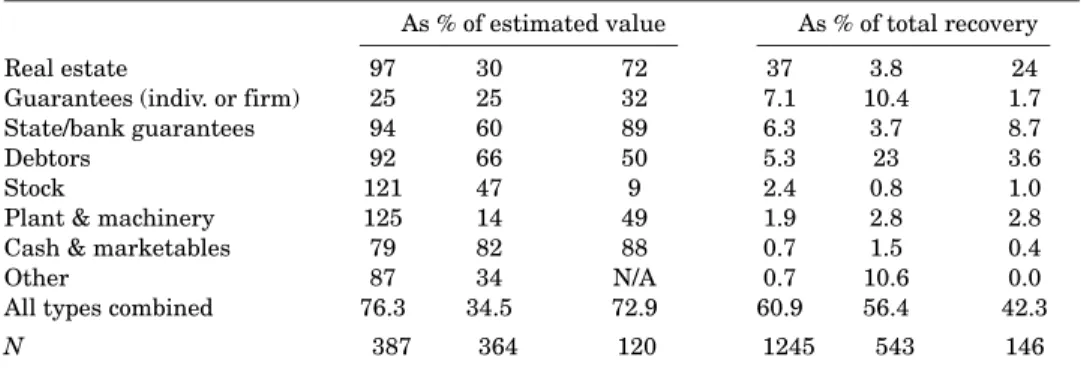
Panel B of Table VI illustrates that banks’ collateral requirements at loan origination, documented in Panel A, ref lect differences in expected proceeds in the event of default. Columns (1) to (3) of Panel B show the ratio of the bank’s proceeds (net of costs) from the realization of collateral expressed as a
proportion of its estimated value recorded at default. With the exception of per-sonal and firm guarantees, which on average recover between one-quarter and
one-third in all three countries,17in the United Kingdom almost all collateral
types are very effective, recovering for all secured loans on average 76.3% of the estimated collateral value. Collateral recovery is also similar in Germany, at 72.9% of the estimated value. By contrast, in France secured lenders in default may expect to recover only 34.5% of the value of their collateral. This makes collateral much less valuable in France, and explains why French firms need to provide more collateral per dollar of debt to obtain lending.
Comparisons of different collateral types are also revealing. Sales of real estate provide 72% of the estate’s estimated value in Germany, and as much as 97% in the United Kingdom. Columns (4) to (6) of Panel B, which report the contribution of different collateral types to the bank’s total secured and unsecured proceeds, show that real estate sales are the most important source of recovery from collateral in those two countries. In France, only 4% of the total recovery comes from real estate, and sales proceeds for the bank amount to only 30% of the value pledged.
In untabulated tests, we explore the effectiveness of collateral in France using a sample of 243 collateral items for which we know both the gross realization of collateral and the net proceeds received by the bank. We find that for collat-eral types not subject to dilution by preferential creditors, such as guarantees and debtors, the bank receives almost all of the proceeds. In contrast, for real estate only 59% of the total sales’ proceeds accrue to the bank. Thus, as much as 41% of proceeds either cover the costs of sale or are diluted by preferential
creditors. Moreover,grossproceeds from “noncash” collateral, such as real
es-tate, inventories, and plant and machinery, are also lower in France than in other countries, consistent with the tendency of French bankruptcy courts in asset sales to favor buyers who promise to preserve employment, rather than the highest bidder (Blazy and Combier (1997)). As Table VI demonstrates, an-ticipating the lack of ex-post efficiency of these collateral types, French banks tend to require relatively less of them at loan origination.
Comparisons of collateral are affected by a number of different factors. For example, German banks are not allowed to accept real estate collateral in ex-cess of the value of the loan, and are generally conservative in valuing many collateral types, such as personal guarantees. Also, once the loan has been extended, French banks appear to update their estimates of the value of col-lateral less frequently than U.K. or German banks. Due to such factors, data on collateral values and realizations are inherently noisy. This caveat notwith-standing, Table VI clearly shows that both the amount and the composition of collateral required by banks in France is different from those in the United Kingdom and Germany, consistent with banks making endogenous adjust-ments to their lending practices in direct response to particular provisions 17The statistics on the effectiveness of guarantees on realization are likely to be biased
down-wards because of their residual nature in high-recovery cases, as banks will not enforce the guar-antee if the loan is already fully repayed from other sources. Similar considerations also apply to other collateral types when banks obtain full recovery.