M
ECHATRONICS ENGINEERING TECHNOLOGY
M
ISSISSIPPI
C
URRICULUM
F
RAMEWORK
Mechanical Engineering (Program CIP: 14.1901)
September 2018
F
ACULTY
W
RITING
T
EAM
M
EMBERS
Roger Jones, Hinds Community College, Raymond Campus Barry Corley, Mississippi Delta Community College, Moorhead, M
Published by:
Mississippi Community College Board
Division of Workforce, Career, and Technical Education
3825 Ridgewood Road
Jackson, MS 39211
Phone: 601-432-6155
Email:
[email protected]
2
F
ACULTY
W
RITING
T
EAM
M
EMBERS
Chad Ainsworth, Hinds Community College, Raymond David Roberts, Hinds Community College, Rankin Geoffrey Horne, Hinds Community College, Vicksburg Ben Harris, East Mississippi Community College Jason Throop, East Mississippi Community College Greg Griffith, Jones County Junior College
Cody Robertson, Jones County Junior College
A
DMINISTRATOR
W
RITING
T
EAM
M
EMBERS
Joe Cook, Dean, Career & Technical Education, East Mississippi Community College, Mayhew Sherry Franklin, Associate Vice President, Hinds Community College, Rankin
Cindy West, Dean, Career & Technical Education, Hinds Community College, Raymond
B
USINESS
A
ND
I
NDUSTRY
C
ONTRIBUTING
M
EMBERS
*Jason Barlow, PACCAR, Mayhew, MS *Gino Perkins, Nissan, USA
*Steven Collins, Xerium, Starkville, MS
*Denotes an industry member who attended the writing team meeting.
O
FFICE
O
F
C
URRICULUM
A
ND
I
NSTRUCTION
T
EAM
M
EMBERS
Scott Kolle, Ph.D., Director of Curriculum, Mississippi Community College Board Sheriece Robinson, Ed.D., Curriculum Specialist, Mississippi Community College Board LaToya Sterling, Ph.D., Curriculum Specialist, Mississippi Community College Board
3
The Office of Curriculum and Instruction (OCI) was founded in 2013 under the Division of Workforce, Career, and Technical Education at the Mississippi Community College Board (MCCB). The office is funded through apartnership with The Mississippi Department of Education (MDE), who serves as Mississippi’s fiscal agent for state and federal Career and Technical Education (CTE) Funds. The OCI is tasked with developing statewide CTE
curriculum, programming, and professional development designed to meet the local and statewide economic demand.
Copyright© 2018 by Mississippi Community College Board For information, please contact [email protected].
4
Contents
ADOPTION OF NATIONAL STANDARDS……….5
INDUSTRY JOB PROJECTION DATA ... 6
ARTICULATION ... 7
TECHNICAL SKILLS ASSESSMENT ... 7
ONLINE AND BLENDED LEARNING OPPORTUNITIES ... 7
INSTRUCTIONAL STRATEGIES ... 7 ASSESSMENT STRATEGIES ... 7 RESEARCH ABSTRACT ... 8 REVISION HISTORY ... 8 CREDIT BY EXAMINATION ... 9 PROGRAM DESCRIPTION ... 10
SUGGESTED COURSE SEQUENCE ... 11
GENERAL EDUCATION CORE COURSES ... 13
MECHANICAL ENGINEERING COURSES ... 14
COURSE DESCRIPTIONS ... 15
MNT 1114 Manufacturing Skills Basic ...………...……….……….15
MNT 1123 Industrial Electricity ……….………..……….17
MNT 1134 Industrial Control Systems ………..……….………..19
MNT 1142 Mechanical Power Transmission I ………..……….……….21
MNT 1153 Basic Industrial Robotics ……….…………...……….22
MNT 1213 Programmable Logic Controllers ……….………..………..…….23
MNT 1224 Fluid Power ………..……….24
MNT 1233 Electronic Motion Control ………..………….……….26
MNT 1242 Mechanical Power Transmission II ………..……….…………...27
MNT 2114 Mechatronics Programming I ……….………...29
MNT 2123 Fundamentals of Instrumentation ………..……...30
MNT 2133 Mechatronics Troubleshooting and Repair ………..………....31
MNT 2214 Mechatronics Procss Control ………...32
MNT 2224 Mechatonics Programming II ………...…………..33
MNT 2234 Mechatronics Special Project ………...34
MNT 2314 Maintenance Welding and Metals ………..………35
MNT 2324 Power Tools, Machining and Materials……….36
MNT 2333 Computer Aided Design………37
MNT 2344 CNC/Computer Assisted Manufacturing……… 39
MNT 2354 Preventative Maintenance ………40
MNT 2364 Industry 4.0 with Data Acquistion……….45
MNT 2373 Servo Control Systems ………..………..46
MNT 2384 Mechatronics Robotics ……….………..47
APPENDIX A:RECOMMENDED TOOLS &EQUIPMENT………..49
APPENDIX B:CURRICULUM DEFINITIONS AND TERMS ... 52
APPENDIX C: COURSE CROSSWALK ... 54
5
A
DOPTION OF
N
ATIONAL
C
ERTIFICATION
S
TANDARDS
The National Coalition of Certification Centers (NC3) mission is to provide industry and education partners with the
technology and design engineering support needed to develop the workforce of today and tomorrow.
The National Coalition of Certification Centers focus is to provide specialized technical and Industry 4.0 curriculum
with hands-on training and information students need to become industry experts- learning as the technology evolves, with the flexibility to shape and mold career paths with endless possibilities.
Permission was granted by the National Coalition of Certification Centers to include the competencies and objectives in this curriculum. More information related to these standards can be found at the following website:
6
I
NDUSTRY
J
OB
P
ROJECTION
D
ATA
Mechatronics Engineering Technology
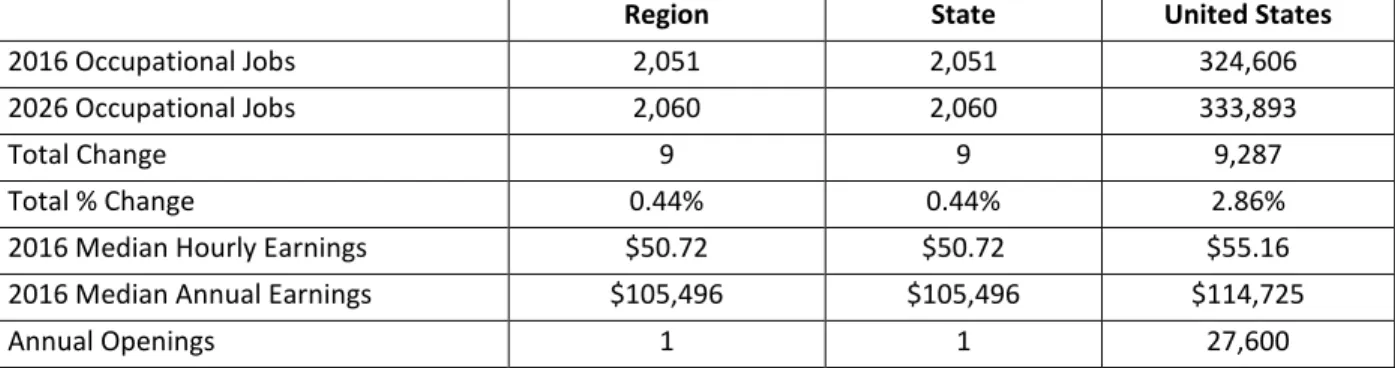
Electro-Mechanical Workers are Electrical and Electronics Engineering Technicians and Mechanical Engineering Technicians. There is 5% increase in occupational demand at the national level. Median annual income for Electro-Mechanical Technician is $55, 470 at the national level. A summary of occupational data from www.bls.gov is displayed below:
Table 1: Education Level
Program Occupations Education Level
ENGINEERING MANAGERS BACHELOR’S DEGREE PLUS WORK EXPERIENCE
ENGINEERS, ALL OTHER BACHELOR’S DEGREE
ENGINEERING TEACHERS, POSTSECONDARY MASTER’S DEGREE
Table 2: Occupational Overview
Region State United States
2016 Occupational Jobs 2,051 2,051 324,606
2026 Occupational Jobs 2,060 2,060 333,893
Total Change 9 9 9,287
Total % Change 0.44% 0.44% 2.86%
2016 Median Hourly Earnings $50.72 $50.72 $55.16
2016 Median Annual Earnings $105,496 $105,496 $114,725
Annual Openings 1 1 27,600
Table 3: Occupational Breakdown
Description 2016 Jobs 2026 Jobs Annual Openings 2016 Hourly Earnings 2016 Annual Earnings 2,080 Work Hours Engineering managers 1,269 1,277 1 $54.90 $114,192
Engineers, all other 781 782 0 $48.67 $101,234
Engineering Teachers, Postsecondary 1 1 0 $18.83 $39,166
Total 2,051 2,060 1 $50.72 $105,498
Table 4: Occupational Change
Description Regional Change Regional
% Change State % Change National % Change Engineering managers 8 0.63% 0.63% 2.98%
Engineers, all other 1 0.13% 0.13% 1.46%
7
A
RTICULATION
T
ECHNICAL
S
KILLS
A
SSESSMENT
Colleges should report the following for students who complete the program with a career certificate, technical certificate, or an Associate of Applied Science Degrees for technical skills attainment. To use the approved Alternate Assessment for the following programs of study, colleges should provide a Letter of Notification to the Director of Career Technical Education at the MS Community College Board. Please see the following link for further instructions: http://www.mccb.edu/wkfEdu/CTDefault.aspx.
CIP Code Program of Study
14.1901 Mechanical Engineering
Standard Assessment Alternate Assessment NC3 Industry 4.0 Certification
Level 1: Electricity Fundamentals Level 1: Fluid Power Fundamentals Level 1: Mechanical Systems Level 1: PLC Fundamentals
O
NLINE
A
ND
B
LENDED
L
EARNING
O
PPORTUNITIES
Course content includes lecture and laboratory semester credit hours. Faculty members are encouraged to present lecture related content to students in an online or blended learning environment. Training related to online and blended learning will be available to faculty members through the MS Community College Board
.
SEC Program PS Program PS Courses
S 2014 Welding Technology/Welder (CIP: 48.0508)
PS 2014 Industrial Mechanics & Maintenance Technology (CIP: 47.0303)
IMM 1734 Maintenance Welding and Metals
8
R
ESEARCH
A
BSTRACT
In the fall of 2018, the Office of Curriculum and Instruction (OCI) met with the different industry members who made up the advisory committees for the mechanical engineering program. An industry questionnaire was used to gather feedback concerning the trends and needs, both current and future, of their field. Program faculty,
administrators, and industry members were consulted regarding industry workforce needs and trends.
Industry advisory team members from the college involved with this program were asked to give input related to changes to be made to the curriculum framework. Specific comments related to occupation related skills needed in this program include problem solving, comprehension of technical skills, and knowledge of systems.
Included in this curriculum development is the sequence of courses required for this new programs of study.
R
EVISION
H
ISTORY
9
C
REDIT
B
Y
E
XAMINATION
The following NCCER modules are aligned to courses listed below. Each module will serve as the state recommended exam to reward credit for prior learning experiences. Colleges have the local autonomy to create a college-level exam when awarding credit.
Course Number and Name NCCER Credential and Module
MNT 2314
Maintenance Welding & Metals
NCCER Welding Level 1 Curriculum
1. Module 29101 Welding safety 2. Module 29102 Oxyfuel cutting 3. Module 29103 Plasma arc cutting
4. Module 29104 Air-carbon arc cutting and gouging 5. Module 29105 Base metal preparation
6. Module 29106 Weld quality
7. Module 29107 SMAW equipment and setup 8. Module 29108 SMAW electrodes
9. Module 29109 SMAW beads and fillet welds 10. Module 29110 Joint fit-up and alignment 11. Module 29111 SMAW groove welds with backing 12. Module 29112 SMAW-open- root groove welds-plate
10
P
ROGRAM
D
ESCRIPTION
The Mechanical Engineering program is an Associate of Applied Science degree program with a one semester Advanced Technical Certificate option. Mechatronic technicians are responsible for assembling, installing, and maintaining/repairing machinery used in the manufacturing or industrial environment as well as troubleshooting, repair, and programming of automated systems. Graduates are prepared to enter the job market as entry level technicians.
Students receive training in mechatronics, robotics, process control, CNC/CAM, mechatronics troubleshooting, data acquisition and industrial communications programming.
11
S
UGGESTED
C
OURSE
S
EQUENCE
MECHANICAL ENGINEERING ACCELERATED PATHWAY
SCH Breakdown Certification
Information Course Number Course Name Semester
Credit Hours
Lecture Lab Total Contact Hours MNT 1114 or IMM 1934 Manufacturing Basic Skills 4 2 4 90 NC3 MNT 1123 Industrial Electricity 3 1 4 75 NC3 MNT 1134 Industrial Control Systems 4 2 4 90 NC3 MNT 1142 Mechanical Power Transmission I 2 0 4 60 NC3 Technical Elective 2 TOTAL 15
MECHANICAL ENGINEERING CAREER CERTIFICATE REQUIRED COURSES
SCH Breakdown Certification
Information Course Number Course Name Semester
Credit Hours
Lecture Lab Total Contact Hours MNT 1114 or IMM 1934 Manufacturing Basic Skills 4 2 4 90 NC3 MNT 1123 Industrial Electricity 3 1 4 75 NC3 MNT 1134 Industrial Control Systems 4 2 4 90 NC3 MNT 1142 Mechanical Power Transmission I 2 0 4 60 NC3 MNT 1213 Programmable Logic Controllers 3 2 2 60 NC3 MNT 1224 Fluid Power 4 3 2 75 NC3 MNT 1233 Electronic Motion Control 3 1 4 75 MNT 1242 Mechanical Power Transmission 2 2 0 4 60 NC3 Technical Elective 6 TOTAL 31
12
MECHANICAL ENGINEERING TECHNICAL CERTIFICATE REQUIRED COURSES
SCH Breakdown Certification
Information Course
Number
Course Name Semester
Credit Hours
Lecture Lab Total
Contact Hours MNT 2114 Mechatronics Programming I 4 2 4 90 MNT 2123 Fundamentals of Instrumentation 3 2 4 90 MNT 2133 Mechatronics Troubleshooting and Repair 3 1 4 75 Technical Elective 5 TOTAL 15
MECHANICAL ENGINEERING ADVANCED TECHNICAL CERTIFICATE REQUIRED COURSES
SCH Breakdown Certification
Information Course
Number
Course Name Semester
Credit Hours
Lecture Lab Total Contact Hours MNT 2214 Mechatronics Process Control 4 2 4 90 NC3 MNT 2224 Mechatronics Programming 2 4 2 4 90 MNT 2234 Mechatronics Special Projects 4 0 8 120 Technical Elective 3 TOTAL 15
13
G
ENERAL
E
DUCATION
C
ORE
C
OURSES
To receive the Associate of Applied Science Degree, a student must complete all of the required coursework found in the Career Certificate option, Technical Certificate option and a minimum of 15 semester hours of General Education Core. The courses in the General Education Core may be spaced out over the entire length of the program so that students complete some academic and Career Technical courses each semester or provided primarily within the last semester. Each community college will specify the actual courses that are required to meet the General Education Core Requirements for the Associate of Applied Science Degree at their college. The Southern Association of Colleges and Schools (SACS) Commission on Colleges Standard 2.7.3 from the Principles of Accreditation: Foundations for Quality Enhancement1 describes the general education core.
Section 2.7.3 In each undergraduate degree program, the institution requires the successful completion of a general education component at the collegiate level that (1) is substantial component of each undergraduate degree, (2) ensures breadth of knowledge, and (3) is based on a coherent rationale. For degree completion in associate programs, the component constitutes a minimum of 15 semester hours or the equivalent. These credit hours are to be drawn from and include at least one course from the following areas: humanities/fine arts, social/behavioral sciences, and natural science/mathematics. The courses do not narrowly focus on those skills, techniques, and procedures specific to a particular occupation or profession.
General Education Courses
SCH Breakdown Certification
Information
Course Number Course
Name
Semester Credit Hours
Lecture Lab Total Contact
Hours
Humanities/Fine Arts 3 3 45
Social/Behavioral Science 3 3 45
Math/Science Elective 3 3 45
Other academic courses per local community college requirements for AAS
degree. 6
Total 15
1
Southern Association of Colleges and Schools Commission on Colleges. (2012). The principles of accreditation: Foundations for quality enhancement. Retrieved from
14
MECHANICAL ENGINEERING
C
OURSES
*Any course not listed as a required course may be used as an elective.
SCH Breakdown Certification
Information Course
Number
Course Name Semester
Credit Hours
Lecture Lab Total Contact Hours
MNT 1114 Manufacturing Skills Basic 4 2 4 90 NC3
MNT 1123 Industrial Electricity 3 1 4 75 NC3
MNT 1134 Industrial Control Systems 4 2 4 90 NC3
MNT 1142 Mechanical Power
Transmission I 2 0 4 60 NC3
MNT 1153 Basic Industrial Robotics 3 2 2 60 NC3
MNT 1213 Programmable Logic
Controllers 3 1 4 75 NC3
MNT 1224 Fluid Power 4 2 4 90 NC3
MNT 1233 Electronic Motion Control 3 1 4 75
MNT 1242 Mechanical Power Transmission II 2 0 4 60 NC3 MNT 2114 Mechatronics Programming I 4 2 4 90 MNT 2123 Fundamentals of Instrumentation 3 2 2 60 MNT 2133 Mechatronics Troubleshooting and Repair 3 1 4 75
MNT 2214 Mechatronics Process Control 4 2 4 90 NC3
MNT 2224 Mechatronics Programming II 4 2 4 90
MNT 2234 Mechatronics Special Project 4 0 8 120
MNT 2314
Maintenance Welding and
Metals 4 1 6 105
MNT 2324
Power Tools, Machining and
Materials 4 2 4 90
MNT 2333 Computer Aided Design 3 2 2 60
MNT 2344
CNC/ Computer Assisted
Manufacturing 4 2 4 90
MNT 2354 Preventative Maintenance 4 2 4 90
MNT 2364
Industry 4.0 with Data
Acquisition 4 2 4 90 NC3
MNT 2373 Servo Control Systems 3 2 2 60
MNT 2384 Mechatronics Robotics 4 2 4 90 NC3
15
C
OURSE
D
ESCRIPTIONS
Course Number and Name: MNT 1114 Manufacturing Skills Basic
Description: Manufacturing Skills is the initial course designed to provide the student with the basic skills needed to be successful in a high-performance manufacturing environment. The course covers 5 major areas of knowledge that are considered critical for employment in a high-performance manufacturing company. The topics covered include: Basic Computer Literacy, Safety and CPR, Blueprint Reading, Precision Measurement, and an introduction to
manufacturing improvement methods that covers Lean Manufacturing, Quick Changeover, 5S, Teamwork and Problem-solving.
Hour Breakdown:
Prerequisite: None
Student Learning Outcomes:
1. Complete a 10 hour OSHA Safety training program that includes the following topics at a minimum: OSHA 29CFR-1910 10 hour certification
a. Introduction to OSHA b. Electrical
c. Exit Routes, Emergency Action Plans, Fire Prevention Plans, and Fire Protection d. Flammable and Combustible Liquids
e. Personal Protective Equipment f. Hazard Communication g. Machine Guarding h. Ergonomics
i. Walking-Working Surfaces j. Lockout/Tag out Procedures k. Workplace violence
l. Safety and Health Programs
2. Apply skills needed to read industrial blueprints NC3 (1 Mechanical Systems) a. Read an orthographic drawing
b. Read various different types of drawings used in manufacturing such as isometric, auxiliary and sectional views
c. Determine dimensions from various mechanical drawings
d. Demonstrate the ability to recognize symbols used in different types of drawings 3. Apply precision measurement skills NC3(Precision Measurement Instrument Certification)
a. Recognize precision measuring instruments
b. Demonstrate the proper use and care of precision measuring instruments c. Demonstrate the ability to measure accurately with English measurement scales d. Demonstrate the ability to measure accurately with metric measurement scales e. Apply precision measurement devices in simulated job tasks
4. Apply techniques used in high-performance manufacturing a. Demonstrate Teamwork and problem-solving skills
b. Describe High-Performance manufacturing procedures to include:
Semester Hours Lecture Lab Contact Hours
16
i. Lean manufacturingii. 5S iii. SMED
iv. Identifying customers and their needs v. Quality control
vi. Understanding of ISO 70 vii. Value stream mapping
c. Research and present a manufacturing topic 5. Apply basic interviewing skills
a. Perform interviewing skills
b. Create a resume for a job interview 6. Perform basic computer literacy skills
a. Run a program from the desktop and the Start Menu b. Demonstrate how to operate a browser
c. Enter a website by entering the URL
d. Demonstrate how to save a website URL as a favorite or bookmark e. Demonstrate how to use a search engine
f. Establish and use an email account
g. Demonstrate how to create and save a word processing file h. Create and save a spreadsheet file
i. Send, receive, save and open an attachment using an email account 7. CPR American Heart Association or American Red Cross
National Coalition of Certification Centers
NC3 (1 Mechanical Systems)
NC3(Precision Measurement Instrument Certification)
OSHA 29CFR-1910 10 hour certification
17
Course Number and Name: MNT 1123 Industrial Electricity
Description: Principles and theories associated with AC and DC circuits used in the electrical trades. Includes the study of electrical circuits, laws and formulas, and the use of test equipment to analyze AC and DC circuits.
Hour Breakdown:
Semester Hours Lecture Lab Contact Hours
3 1 4 75
Prerequisite: None
Student Learning Outcomes:
1. Discuss and apply proper safety procedures for electrical maintenance including lockout/tagout NC3(1 Electricity)
a. Define terms related to electrical lockout/tagout applications
b. Determine correct application of lockout/tagout on electrical enclosures, panels, and switching devices
2. Basic Electrical Circuits NC3(1 Electricity) a. Define electricity
b. Describe the two types of electrical current
c. Describe the function of the 4 basic components of an electrical circuit d. Describe the function of an electrical schematic
3. Electrical Measurements NC3(1 Electricity), NC3 (504 Meter)
a. Define voltage and give its unit of measurement b. Measure voltage in a circuit with DMM and oscilloscope c. Define series, parallel and combination circuits
d. Define current and give its unit of measurement e. Measure current in a circuit with DMM and oscilloscope f. Define resistance and give its unit of measurement g. Measure resistance in a circuit
h. Demonstrate measuring waveforms frequency using an oscilloscope 4. Circuit analysis NC3(1 Electricity)
a. Define Ohm’s law and give its importance
b. Use Ohm’s law to calculate the voltage, current, and resistance in a circuit c. Define Kirchhoff’s Law
d. Define electrical power and give its units for measurement 5. Inductance and Capacitance NC3(1 Electricity)
a. Define electromagnetism
b. Define inductance and give its unit of measurement c. Describe the effect of an inductor on a DC and an AC circuit d. Define capacitance and give its unit of measurement e. Describe the effect of a capacitor in a DC and an AC circuit 6. Transformers NC3(1 Electricity)
a. Describe the function of a transformer b. Calculate the output voltage of a transformer
c. Calculate the size a transformer based on input voltage, output voltage, and load 7. National Electric Code
a. Calculate the size a conductor based on load b. Describe the importance of proper grounding
18
c. Locate information in the NEC8. 3-phase electricity
a. List the two types of three-phase power distribution configurations b. Describe how to reverse the rotation direction of a three-phase motor c. Operate a DMM to determine the voltage at a three-phase disconnect
National Coalition of Certification Centers
NC3(1 Electricity) NC3 (504 Meter)
19
Course Number and Name: MNT 1134 Industrial Control Systems
Description: Instruction in the operation and function industrial control circuits and devices. Emphasis is placed on the student’s ability to diagram, wire and troubleshoot a variety of circuits, control devices and actuators.
Hour Breakdown:
Prerequisite: Instructor Approved
Student Learning Outcomes:
1. Introduction NC3(1 Electricity)
a. Describe the purpose of the Lockout / Tagout procedures used in industry b. Explain the importance of an equipment ground connection
c. Describe the operation of 3-phase power d. Use a voltmeter to verify supply voltage e. Use a voltmeter to check a fuse
2. Control Transformers NC3(1 Electricity)
a. Describe the operation of a transformer and give its schematic symbol b. Calculate the turns ratio of a transformer
c. Calculate the secondary voltage of a transformer given the input voltage and turns ratio d. Test a control transformer using a meter
e. Size a control transformer given an application 3. Control Logic
a. Describe the function of an indicator lamp and give its schematic symbol b. Describe the function of a pushbutton switch and give its schematic symbol c. Describe the function of a selector switch and give its schematic symbol d. Describe the function of a ladder diagram NC3(PLC-AB), NC3(PLC-S)
e. Describe the six elements of control logic NC3(PLC-AB), NC3(PLC-S) 4. Control Relays and Motor Starters
a. Describe the function of a control relay and give its schematic symbols
b. Describe the function of a magnetic motor starter and how it differs from a control relay c. Connect and operate a two wire motor control circuit
d. Connect and operate a three wire motor control circuit
e. Connect and operate a multiple operator station three wire motor control circuit 5. Troubleshooting NC3(1 Electricity)
a. Use a meter to test a manual switch b. Use a meter to test a control relay c. Use a meter to test a motor starter d. Use a meter to test an overload relay
e. Use a meter to test the windings of a 3-phase motor f. Use a meter to measure voltage in a circuit
g. Use a meter to measure voltage drop in a circuit h. Use a clamp on ammeter to measure current in a circuit
i. Describe systems troubleshooting methods and give examples of each 6. Reversing Motor Control
a. Describe the function of a reversing magnetic motor starter
Semester Hours Lecture Lab Contact Hours
20
b. Describe the function of an interlockc. Connect a reversing motor control circuit with an interlock d. Describe the function of automatic and manual modes e. Describe the operation of a hand-off-automatic control circuit 7. Automatic input devices NC3 (1PLC-sensors1)
a. Mechanical switches
i. Describe the function of a limit switch and give its schematic symbol ii. Describe the function of a float switch and give its schematic symbol iii. Describe the function of a pressure switch and give its schematic symbol b. Electronic Sensors
i. Describe the function of an inductive proximity sensor and give its schematic symbol ii. Describe the function of a capacitive proximity sensor and give its schematic symbol iii. Describe the function of a photoelectric sensor and give its schematic symbol c. Sequence control
i. Describe the function of a sequence control circuit 8. Timers
a. Describe the function of an on-delay timer b. Describe the function of and off-delay timer c. Use a meter to test a time delay relay 9. Motor Braking
a. Describe the function of braking in motor control b. List motor braking methods
10. Reduced voltage motor starting
a. Describe reduced voltage motor starting methods 11. Industrial controls in Fluid power
a. Describe solenoid operated valves
b. Use the manual override to operate a cylinder c. Control a fluid power system using electrical controls 12. System Sequencing
a. Demonstrate the ability to sequence a machine with both fluid power actuators and electric motors utilizing electric controls
National Coalition of Certification Centers
NC3(1 Electricity) NC3 (1PLC-sensors1) NC3(PLC-AB) NC3(PLC-S)
21
Course Number and Name: MNT 1142 Mechanical Power Transmission I
Description: This course includes instruction and lab exercises related to motor mounting and alignment, key fasteners, and power transmission systems.
Hour Breakdown:
Prerequisite: None
Student Learning Outcomes:
1. Mechanical Power Transmission Safety NC3 (1 Mechanical Systems) a. Demonstrate proper Lockout / Tagout
2. Machine Installation NC3 (1 Mechanical Systems)
a. Demonstrate precision leveling technique 3. Motor Mounting NC3 (1 Mechanical Systems)
a. Describe typical mounting used for electric motors
b. Demonstrate the procedure to correct for a soft foot condition 4. Shaft speed measurement NC3 (1 Mechanical Systems)
a. Demonstrate the use a tachometer to measure motor speed b. Use a stroboscope to measure motor speed
5. Keyseat Fasteners NC3 (1 Mechanical Systems)
a. Describe the function of a Key Fastener b. Describe the 6 types of Keys
c. Measure the actual size of a key and keyseat 6. Intro. To Shafts NC3 (1 Mechanical Systems)
a. Identify a shaft size
b. Describe the function of a shaft in power transmission 7. Intro. To Bearings NC3 (1 Mechanical Systems)
a. Describe the function of a bearing b. Define three types of bearing loads
c. Demonstrate ability to remove and install a variety of bearings d. Identify causes of failure of bearings
8. Intro. To Couplings NC3 (1 Mechanical Systems) a. Describe the function of a coupling
b. Identify several different types of couplings
c. Demonstrate ability to remove and install a coupling 9. Shaft Alignment NC3 (1 Mechanical Systems)
a. Describe the purpose of shaft alignment b. Align two shafts in a power transmission system
National Coalition of Certification Centers
NC3 (1 Mechanical Systems)
Semester Hours Lecture Lab Contact Hours
22
Course Number and Name: MNT 1153 Basic Industrial Robotics
Description: This course provides a hands-on learning environment to develop and practice basic robotics safety, robotics systems, robotic operations and robotic
programming.
Hour Breakdown:
Prerequisite: Instructor Approved
Student Learning Outcomes:
1. Robotics Safety Fanuc Handling Tool and or ABB programming 1, NC3 (1Robotics) a. Apply safety rules when working with industrial robotics b. Demonstrate knowledge of industrial robot safety systems 1. Robot System Fanuc Handling Tool and or ABB programming 1, NC3 (1Robotics)
a. Identify components of industrial robot systems
b. Demonstrate ability to operate industrial robot teach pendant 3. Robot Operations Fanuc Handling Tool and or ABB programming 1, NC3 (1Robotics)
a. Identify the axes of an industrial robot
b. Demonstrate ability to jog robot in various coordinate systems c. Identify robot positional information
d. Demonstrate knowledge cartesian coordinate system as it relates to industrial robots
e. Demonstrate ability to change industrial robot reference point and cartesian coordinate system f. Demonstrate ability to change tool center point
4. Robot Programming Fanuc Handling Tool and or ABB programming 1, NC3 (1Robotics)
a. Demonstrate ability to create industrial robot motion programs b. Demonstrate use of robot program instructions
5. Robot I/O Fanuc Handling Tool and or ABB programming 1, NC3 (1Robotics)
a. Demonstrate use of industrial robot peripheral equipment b. Demonstrate use of I/O and robot programming
National Coalition of Certification Centers
NC3 (1Robotics)
Fanuc Handling Tool and or ABB programming 1
Semester Hours Lecture Lab Contact Hours
23
Course Number and Name: MNT 1213 Programmable Logic Controllers
Description: This course covers use of programmable logic controllers (PLCs) in modern industrial settings as well as the operating principles of PLCs and practice in the accelerated programming, installation and maintenance of PLCs.
Hour Breakdown:
Prerequisite: MNT 1134 Industrial Control Systems
Student Learning Outcomes:
1. Explain principles of PLCs NC3(PLC-AB), NC3(PLC-S)
a. Identify components and operational principles of PLCs b. Differentiate between a PLC and a computer
2. Identify different types of PLC hardware NC3(PLC-AB), NC3(PLC-S)
a. Identify and wire different types of input and output modules
b. Identify different types of PLC processor modules, memory capabilities and programming devices 3. Explain numbering systems, encoding / decoding, and logical operations NC3(PLC-AB), NC3(PLC-S)
a. Convert numbers from one system to another
b. Explain logical operations using truth tables and ladder logic diagrams 4. Program different types of internal and discrete instructions NC3(PLC-AB), NC3(PLC-S)
a. Demonstrate how to program examine on and off instructions b. Demonstrate how to program on-delay and off-delay instructions c. Demonstrate how to program up-counter and down-counter instructions
d. Demonstrate how to program sequencer instructions for real-world output devices e. Demonstrate how to program latch and unlatch instructions
5. Troubleshoot and maintain different programmable controller systems NC3(PLC-AB), NC3(PLC-S) a. Identify and troubleshoot the power supply
b. Identify and troubleshoot the inputs and outputs c. Identify and troubleshoot real-world inputs and outputs
6. Use program control instructions and subroutines to control program function NC3(PLC-AB), NC3(PLC-S) 7. Use math instructions to manipulate outputs of a program NC3(PLC-AB), NC3(PLC-S)
a. Demonstrate the ability to enter and edit a PLC program that uses the add instruction b. Demonstrate the ability to enter and edit a PLC program that uses the multiply instruction c. Demonstrate the ability to enter and edit a PLC program that uses the divide instruction d. Demonstrate the ability to enter and edit a PLC program that uses a data move instruction 8. Program several types of high order instructions NC3(PLC-AB), NC3(PLC-S)
a. Demonstrate the ability to program and set up an analog input card b. Demonstrate the ability to program and set up an analog output card
National Coalition of Certification Centers
NC3(PLC-AB) NC3(PLC-S)
Semester Hours Lecture Lab Contact Hours
24
Course Number and Name: MNT 1224 Fluid Power
Description: Instruction in the basic principles of hydraulics and pneumatics and the inspection, maintenance and repair of hydraulic and pneumatic systems.
Hour Breakdown:
Semester Hours Lecture Lab Contact Hours
4 2 4 90
Prerequisite: None
Student Learning Outcomes:
1. Describe and discuss basic principles of pneumatics as related to industrial maintenance NC3(1 fluid power-pneumatics)
a. Define pneumatics and give benefits and drawbacks to the system b. Describe and discuss pneumatic safety
c. Components of a Pneumatic System
i. Describe the use and operation of pneumatic system components and give the schematic symbol of each
d. Pressure and flow
i. List common units of measurement for pressure and flow ii. Describe the difference between gauge and absolute pressure iii. Define Pascal’s law
iv. Calculate the extension and retraction forces of a pneumatic cylinder v. Define Boyle’s law
e. Speed control
i. Describe the difference between meter-in and meter-out speed control and give advantages of each
ii. Describe the difference between pressure port and exhaust port speed control and give advantages of each
f. Pneumatic sequencing
i. Describe methods of event sequencing in pneumatic systems g. Vacuum Systems
i. Describe methods of generating a vacuum using pneumatics and give an application h. Maintenance
i. Demonstrate preventative maintenance on an air compressor ii. Demonstrate the ability to service an air drier
iii. Describe methods of lubrication i. Troubleshooting
i. Describe and perform methods of identifying leaks ii. Use a flowmeter to identify the source of an internal leak iii. Use pressure gauges to identify a restriction in the system
2. Describe and discuss basic principles of hydraulics as related to industrial maintenance NC3(1 fluid power-hydraulics)
a. Define hydraulics and give benefits and drawbacks to the system b. Describe and discuss hydraulic safety
c. Components of a hydraulic system
i. Describe the use and operation of various types of hydraulic components and give the schematic symbol of each
25
i. Calculate extension and retraction forces of a cylindere. Speed Control
i. Describe the difference between meter-in and meter-out speed control and give advantages of each
ii. Define independent speed control iii. Calculate cylinder speed given a flow rate f. Hydraulic Sequencing
i. Describe methods of sequencing hydraulic circuits g. Accumulator Applications
i. Describe how to use an accumulator to give auxiliary / emergency power in a hydraulic circuit
ii. Describe how to use an accumulator to compensate for leakage or temperature expansion in a hydraulic circuit
h. Motor Braking
i. Describe how design a hydraulic motor braking circuit i. Regeneration
i. Describe regeneration and its uses in a hydraulic circuit j. Maintenance
i. Describe the importance of maintenance in a hydraulic system ii. Demonstrate the ability to change a hydraulic filter
iii. Monitor system temperature and how it affects performance k. Troubleshooting
i. Use a flowmeter to check performance of a pump ii. Use a flowmeter to identify an internal leak
iii. Use pressure gauges to identify a restriction in the system
National Coalition of Certification Centers
NC3(1 fluid power-pneumatics) NC3(1 fluid power-hydraulics)
26
Course Number and Name: MNT 1233 Electronic Motion Control
Description: This course explains applications and operating procedures of solid state controls, reduced-voltage starters, and adjustable frequency drives as well as troubleshooting procedures.
Hour Breakdown:
Prerequisite: MNT 1123 Industrial Electricity
Student Learning Outcomes:
1. Select and install solid-state relays for specific applications in motor control circuits 2. Install non-programmable and programmable motor circuit protection
3. Select and install electromechanical and solid-state timing relays for specific applications in motor circuits 4. Recognize the different types of reduced-voltage starting motor controllers and describe their operation 5. Demonstrate the ability to connect and program adjustable frequency drives to control a motor
6. Demonstrate the special precautions used when handling and working with solid-state motor controls 7. Apply preventative maintenance and troubleshooting techniques in motor control circuits
Semester Hours Lecture Lab Contact Hours
27
Course Number and Name: MNT 1242 Mechanical Power Transmission II
Description: This course includes instruction and lab exercises related to V belt drives, chain drives, gear drives, and multiple shaft systems.
Hour Breakdown:
Semester Hours Lecture Lab Contact Hours
2 0 4 60
Prerequisite: MNT 1142 Mechanical Power Transmission I
Student Learning Outcomes:
1. Belt drives NC3 (1 Mechanical Systems)
a. Describe the functions of the 3 basic components of a belt drive b. Calculate the pulley ratio of a belt drive system
c. List 5 types of belt drives
d. Install and align a belt drive system
e. Adjust the belt tension of a belt drive system 2. Chain Drives NC3 (1 Mechanical Systems)
a. Describe the functions of the 3 basic components of a chain drive b. Calculate the sprocket ratio of a chain drive system
c. List 4 types of chains
d. Install and align a chain drive system
e. Adjust the chain tension of a chain drive system
f. Demonstrate the ability to cut a chain to length and install using a master link 3. Gear drives NC3 (1 Mechanical Systems)
a. Describe the function of the 3 components of a gear drive system b. Calculate the gear ration of a gear drive system
c. List the 4 types of parallel shaft gears d. Install and align a spur gear system
e. Measure and adjust gear backlash in a gear drive system f. Describe different types of gear drives
i. Spur Gear ii. Bevel Gear iii. Worm Gear iv. Helical Gear
v. Planetary Gear
g. Install and align a bevel gear drive system in a gearbox 4. Multiple shaft systems NC3 (1 Mechanical Systems)
a. Describe how to determine direction of rotation of a multiple shaft system b. Install and align a multiple shaft system
5. Gaskets NC3 (1 Mechanical Systems)
a. Describe the function of a gasket b. Describe the function of sealant c. Assemble two parts with a gasket 6. Seals NC3 (1 Mechanical Systems)
a. Describe 3 types of seals
b. Demonstrate the ability to remove, identify, and install a lip seal 7. Linear drives NC3 (1 Mechanical Systems)
28
vi. Screwvii. Rack & Pinion viii. Fluid
b. Demonstrate the ability to measure backlash / free play in a screw drive c. Identify which drive is the most precise and explain why
d. Service and align a ball screw 8. Variable speed belt drives NC3 (1 Mechanical Systems)
a. Describe how a variable speed belt drive works 9. Vibration analysis NC3 (1 Mechanical Systems)
a. Describe sources of vibration in various drive systems
b. Demonstrate the use a vibration meter to isolate the cause of a vibration
National Coalition of Certification Centers
29
Course Number and Name: MNT 2114 Mechatronics Programming I
Description: This course provides a hands-on learning environment to develop and practice the techniques used in programming and sequencing mechatronics systems.
Hour Breakdown:
Semester Hours Lecture Lab Contact Hours
4 2 4 90
Prerequisite: MNT 1213 Programmable Logic Controllers
Student Learning Outcomes:
1. Introduction to Mechatronics a. Define Mechatronics
b. Explain why Mechatronics is important in the world today
c. Explain the importance of common applications of mechatronics in our everyday lives d. Explain Mechatronics safety
2. Mechatronic Systems
a. List a variety of systems used in mechatronic systems and give an application 3. Discuss the operation of a Mechatronic System
a. Discuss why (in many cases) machines require a startup / shutdown procedure b. Describe the function of Start, Stop, Emergency Stop and Reset controls c. Describe the difference in manual and automatic modes
d. Give examples of how mechatronics systems are used in industry
e. Describe the function of an HMI and how it differs from traditional controls 4. Programming of a Mechatronic System
a. Describe the function of a programmed interlock
b. Describe the function of a programmed fault detection/protection
c. Demonstrate the ability to program of a variety of mechatronic devices given a sequence of operation
d. Define discrete I/O handshaking and give an application
e. Demonstrate the ability to work as a team, alter existing programs to allow for multiple station control for startup, and flexible manufacturing
30
Course Number and Name: MNT 2123 Fundamentals of Instrumentation
Description: This course provides students with a general knowledge of instrumentation principles as they relate to the electrical industry. This course includes instruction in the basis of hydraulics and pneumatics and the use of electrical circuits in the instrumentation process.
Hour Breakdown:
Semester Hours Lecture Lab Clock Hours
3 2 2 60
Prerequisite: Instructor Approved
Student Learning Outcomes:
1. Demonstrate a working knowledge of instrumentation as it pertains to the electrical industry a. Define terms associated with instrumentation
b. Discuss basic theory of hydraulics, pneumatics, and electromagnetic controls
c. Identify basic symbols used with hydraulics, pneumatics, and electromagnetic systems 2. Identify the type of instrumentation input and output devices, and describe their applications
a. Describe control elements for pressure, flow, temperature, and level b. Identify the types of input and output devices
c. Describe the input and output devices
3. Identify the types of electrical signals used in instrumentation
a. Describe the transmission of information to include current, pressure, and frequency b. Explain the principles of the transmission information input and output
4. Describe fundamentals of electrical and electronic process controls
a. Label a block diagram of an open loop system and a closed loop system b. Describe characteristics of an open loop and a closed loop system 5. Design a preventive maintenance program for instrumentation systems
a. Describe the techniques and procedures for troubleshooting, calibrating, and repairing an instrumentation system
b. Demonstrate the ability to sketch a piping and instrument drawing 6. Demonstrate the ability to install and calibrate various instrumentation devices
31
Course Number and Name: MNT 2133 Mechatronics Troubleshooting and Repair
Description: This course provides a hands-on learning environment to develop and practice the techniques used in troubleshooting complex mechatronics systems.
Hour Breakdown:
Semester Hours Lecture Lab Contact Hours
3 1 4 75
Prerequisite: Instructor Approved
Student Learning Outcomes:
1. Overview
a. Define Troubleshooting
b. Define and describe Troubleshooting Steps i. Preparation
ii. Observation
iii. Define Problem Area iv. Identify Possible Causes
v. Determine Most Probable Cause vi. Test and Repair
vii. Follow-up 2. Troubleshooting Techniques
a. Discuss various troubleshooting techniques and their application 3. System Troubleshooting
32
Course Number and Name: MNT 2214 Mechatronics Process Control
Description: A study of the instruments and instrument systems used in chemical processing including terminology, primary variables, symbols, and control loops.
Hour Breakdown:
Prerequisite: Instructor Approved
Student Learning Outcomes:
1. Describe and apply the major elements of process technology NC3 (2 Sensors 2)
a. Define pressure and apply related measurements and processes used in the process industry b. Define temperature and apply related measurements and processes used in the process industry c. Define level and apply related measurements and processes used in the process industry d. Define flow and apply related measurements and processes used in the process industry e. Define analytical instrumentation and apply related measurements and processes used in the
process industry
2. Describe and explain the functions and components of process control NC3 (2 Sensors 2)
a. Identify and describe the various pieces of equipment used in instrumentation (transmitters; transducers; differential pressure cells; analog, pneumatic and digital instruments; etc.) b. Describe valves used in instrumentation (globe, three-way, butterfly, etc.)
c. Explain the functions and components of a control loop and contrast the differences between open and closed controls
d. Describe the relationship between measurement instruments and their role in the overall control loop process
3. Describe and interpret the types of process industry drawings
a. Compare and contrast piping and instrument diagrams (P&IDs) and process flow drawings (PFDs) b. Describe the lettering and numbering standards based on ISA instrumentation symbols
c. Describe how to determine the instrument type from the symbol information d. Describe the standards for line symbols
4. Describe the role and function of advanced controls and controllers in process operations a. Identify the different advanced controls and controllers and their primary function 5. Explain the different practices related to process technicians’ troubleshooting process instruments
a. Explain the importance of process knowledge in troubleshooting
b. Identify typical malfunctions found in primary sensing elements and transmitters
c. Explain the methods used for determining if a sensing/measuring device is malfunctioning d. Demonstrate how to properly tune a PID control loop
National Coalition of Certification Centers
NC3 (2 Sensors 2)
Semester Hours Lecture Lab Contact Hours
33
Course Number and Name: MNT 2224 Mechatronics Programming II
Description: This course provides a hands-on learning environment to develop and practice the techniques used in advanced programming and network integration of mechatronic systems.
Hour Breakdown:
Prerequisite: MNT 2114 Mechatronics Programming I
Student Learning Outcomes:
1. Analog inputs and Outputs
a. Integrate an analog sensor into an existing mechatronics system b. Integrate an analog output device into an existing mechatronics system 2. Networking
a. Demonstrate the ability to set up a network to allow data sharing between devices 3. HMI Integration
a. Create a HMI application to remote control a mechatronics station b. Create a HMI application to remote control multiple mechatronics stations
c. Create a HMI application to provide fault warnings and troubleshooting information 4. Vision Systems
a. Demonstrate the ability to set up and calibrate a vision system 5. Data Collection Systems
a. Create a program for a flexible manufacturing system that builds a part based on information read from that part (bar code, data matrix, RFID)
Semester Hours Lecture Lab Contact Hours
34
Course Number and Name: MNT 2234 Mechatronics Special Project
Description: This course provides practical application of skills and knowledge gained in their Mechatronics Technician program of study. The instructor works closely with the student to ensure the selection of a project will enhance the student’s learning experience.
Hour Breakdown:
Semester Hours Lecture Lab Contact Hours
4 0 8 120
Prerequisite: MNT 2114 Mechatronics Programming I
Student Learning Objectives:
1. Develop a written plan and blueprints that detail the activities and projects to be completed a. Utilize a written plan that details the activities and projects to be completed b. Perform written occupational objectives in the special project
2. Assess accomplishment of objectives
a. Prepare daily written assessment of accomplishment of objectives
b. Present weekly written reports to the instructor in activities performed and objectives accomplished
3. Utilize a set of written guidelines for the special project
35
Course Number and Name: MNT 2314 Maintenance Welding and Metals
Description: This course includes different metals and their properties and in basic SMAW welding and oxy-fuel cutting and brazing. Components of this course are adopted from the NCCER Welding Level 1 Certification. Instructors for this course must be certified as an NCCER Instructor if administering the certification.
Hour Breakdown:
Semester Hours Lecture Lab Contact Hours
4 1 6 105
Prerequisite: None
Student Learning Outcomes:
1. Discuss and apply proper safety procedures for welding 2. Identify common metals, and discuss their properties
a. Identify the following metals commonly used in industrial machinery: cold rolled steel, hot rolled steel, stainless steel, titanium, aluminum, brass, copper, and cast iron
b. Discuss the properties of these metals as related to industrial maintenance 3. Perform basic SMAW welding operations
a. Practice safety procedures for SMAW welding operations
b. Discuss the properties of electrodes commonly used in SMAW welding operations including E6010, E7018, stainless steel electrodes, and cast-iron electrodes
c. Set up SMAW welding equipment for a specific job d. Prepare metal for SMAW welding
e. Demonstrate basic elements and techniques used in SMAW welding, including speed, position, joint preparation, arc gap, and so forth
f. Perform basic welding operations using SMAW welding equipment g. Fabricate a welding project to specifications
4. Perform basic oxy-fuel cutting, welding, and brazing operations
a. Practice safety procedures for oxy-fuel cutting and brazing operations b. Set up oxy-fuel equipment for cutting
c. Set up oxy-fuel equipment for welding and brazing d. Perform oxy-fuel cutting operations on mild steel e. Perform oxy-fuel welding operations on mild steel
f. Demonstrate the ability to silver-braze or solder copper fittings to a copper line
36
Course Number and Name: MNT 2324 Power Tools, Machining, and Materials
Description: This course is designed to provide fundamental skills associated with all mechanical maintenance courses. This course includes safety, powered hand and stationary tools, use of a calculator, test equipment familiarization and terminology.
Hour Breakdown:
Prerequisite: None
Student Learning Outcomes:
1. Identify, select, apply and maintain common hand power tools used by industrial maintenance mechanics and technicians
a. Inspect, adjust and operate side grinders in a safe and proper manner b. Identify, select, apply and maintain power cutting and threading tools 2. Demonstrate the safe and proper use of bench grinders
a. Inspect, set-up and adjust a bench grinder for proper use b. Grind angles on metal
c. De-burr metal using a bench grinder 3. Demonstrate the safe and proper use of a drill press
a. Inspect, set-up and adjust a drill press for safe and proper use b. Locate, drill and ream holes in metal to specifications
4. Demonstrate the safe and proper use of a pipe threading machine
a. Inspect, set-up and adjust a pipe threading machine for safe and proper use b. Cut and thread various lengths and diameters of pipe to specifications 5. Identify, select and process metals
a. Identify the differences between iron, steel and alloy steel b. Identify the benefits and drawbacks of aluminum
c. Demonstrate how to read an alloy number and identify the characteristics of that material d. Identify the appropriate material for a job
Semester Hours Lecture Lab Contact Hours
37
Course Number and Name: MNT 2333 Computer Aided Design I
Description: This course is designed to develop basic operating system and drafting skills on CAD.
Hour Breakdown:
Semester Hours Lecture Lab Contact Hours
3 2 2 60
Prerequisite: Instructor Approved
Student Learning Outcomes:
1. Manage the operating system
a. Examine the contents of storage devices
b. List, erase, rename, and copy files on storage devices
c. Examine, create, remove, and move files between folders and subfolders d. Access information services (e.g., Internet, e-mail, and networks) 2. Use the basic hardware of the CAD system
a. Input data using keyboard and graphics tablet, or mouse b. Access files and/or symbols from the hard disk
c. Store, retrieve, copy, and delete drawings and files 3. Draw a line using various point entry methods
a. Draw a series of lines using absolute coordinates b. Draw a series of lines using relative
c. Draw a series of lines using polar
d. Draw a series of lines using direct distance entry 4. Manipulate drawing aids to increase accuracy and productivity
a. Discuss grid mode b. Discuss snap mode c. Discuss polar tracking d. Discuss the mode e. Utilize object snap
f. Discuss object snap tracking
g. Utilize different object selection methods to be effective in the use of modify commands 5. Establish line standards and layer concepts
a. Create layers in accordance to ANSI Standards regarding line type and line weight b. Manage layers
c. Copy layers and line types between drawings 6. Create text styles and multiline text
a. Revise text height b. Revise text fonts c. Utilize symbols d. Create single line text e. Create multiline text f. Check spelling
7. Utilize modify commands to improve efficiency
a. Use the FILLET command to draw fillets, rounds and other radii b. Place chamfers and angled corners using the CHAMFER command c. Separate objects using BREAK command
38
d. Combine objects using the JOIN commande. Edit objects using TRIM and EXTEND commands
f. Change objects using STRETCH and LENGTHEN commands g. Edit the size of objects using the SCALE command
h. Use the EXPLODE command
i. Use the OFFSET command to create parallel lines 8. Perform drafting functions on the CAD system
a. Construct single-view and multi-view drawings b. Modify or edit an existing drawing
39
Course Number and Name: MNT 2344 CNC/ Computer Assisted Manufacturing
Description: An introduction of computer numerical control (CNC) and computer assisted manufacturing (CAM) techniques and practices. Includes the use of the Cartesian coordinate system, programming codes and command, and tooling requirements for CNC/CAM machines.
Hour Breakdown:
Prerequisite: Instructor Approved
Student Learning Outcomes:
1. Discuss and apply general machine shop safety a. Identify, discuss, and test safety procedures b. Demonstrate safety procedures
2. Describe CNC machining, uses, and applications of CNC program
a. Describe the capabilities and limitations of computer numerical control (CNC)/computer assisted manufacturing (CAM) equipment
b. Describe the Cartesian coordinate system as used in a CNC machine program
c. Describe the differences in absolute and incremental dimensioning as related to an ISO programming of a CNC machine
d. Describe procedures for CNC machine start-up 3. Discuss commands for CNC machine codes
a. List and describe the purpose or function of the preparatory commands for a CNC machine (Gcodes)
b. Explain the purpose or function of the miscellaneous commands used with a CNC machine (Mcodes)
c. State the purpose of other alphabetical commands used in programming operations of a CNC machine
4. Discuss tooling for CNC operations, and safely use CNC mill, CNC lathe, and CNC machine centers to project specifications
a. Describe the different types of tooling required for CNC mills, CNC lathes, and CNC machine centers
b. Select tooling required for a specific job on a CNC mill, CNC machine centers, and CNC lathe c. Write and manually input program data
d. Execute programs for CNC mill, CNC lathe, and CNC machine center according to project specifications
Semester Hours Lecture Lab Contact Hours
40
Course Number and Name: MNT 2354 Preventative Maintenance
Description: This course includes four major performance domains that are aligned to the Certified Maintenance Reliability Professional Certification. Domains include maintenance practices, preventive and predictive maintenance and analysis, and corrective maintenance.
Hour Breakdown:
Prerequisite: None
Student Learning Outcomes:
Module I: Maintenance Practices
1. Adhere to safety, health, and environmental standards and policies by taking personal responsibility in order to prevent injury or illness from exposure to hazards by successfully demonstrating the following:
a. Blood borne pathogens b. Confined space entry c. Electrical safety
d. Emergency response (ER) and evacuation e. Environmental compliance f. Ergonomics g. Eye protection h. Fall protection i. Fire safety j. HAZCOM/MSDS k. Hearing conservation l. Ladder safety m. Lockout/tagout procedures
n. Personal protective equipment (PPE) o. Process safety management (PSM) p. Respiratory protection
q. Rigging
r. Safety system and devices s. Scaffolding
2. Inform production control personnel about the maintenance activity required in accordance with company protocol in order to adjust the operations schedules by successfully demonstrating the following:
a. Lockout/tagout procedures b. Process overview
c. Work permits
3. Perform the proper lockout/tagout procedures on equipment in accordance with applicable standards in order to ensure zero energy state prior to commencing maintenance work and minimize health, safety, and environmental hazards to employees and the community by successfully demonstrating the following:
a. Lockout/tagout procedures b. Multiple energy sources c. Zero energy states
Semester Hours Lecture Lab Contact Hours
41
4. Perform a pre-use inspection on maintenance tools and equipment using established standardsand guidelines in order to ensure safe operation and to extend the life of the tools and equipment by successfully demonstrating the following:
a. Cranes and hoists b. Field machinery and tools c. Ladder safety
d. Rolling stock/mobile equipment (e.g., mobile cranes, man-lift/scissor lift, fork lift) e. Shop machinery and tools
f. Rigging equipment (e.g., slings, shackles, eyebolts, chains, hooks)
5. Use maintenance tools and equipment in accordance with manufacturers’ specifications and established safety policies in order to ensure safety and efficiency by successfully demonstrating the following:
a. Equipment and tool specifications
b. Established equipment and tool-safety policies and procedures
6. Use measuring tools and equipment in a manner that will ensure accurate measurements in order to perform maintenance tasks properly by successfully demonstrating the following:
a. Application of specific tools
b. Basic math (e.g., fractions, addition, subtraction, multiplication, division) c. Calibration requirements for measurement tools (e.g., torque wrench, calipers,
alignment tools)
d. Conversion of appropriate measurement and engineering units
e. Measurement principles (e.g., mass, force, motion, distance, acceleration, power, fluid, bulk)
f. Measurement tools (e.g., rulers, gauges, tapes, micrometer, calipers, lasers) 7. Handle all maintenance materials and parts in accordance with established standards and
procedures in order to prevent damage to the parts and equipment by successfully demonstrating the following:
a. Company safety policies
b. Material handling techniques and procedures c. Material storage procedures
d. Original equipment manufacturers' (OEM) instructions
8. Maintain housekeeping by adhering to established site standards and by removing all maintenance related parts and waste in order to ensure a safe and orderly job site by successfully demonstrating the following:
a. Facility and regulatory policies on housekeeping b. Hazards of improper housekeeping
c. Proper organization and cleaning of job site
9. Document maintenance activities using the facility’s maintenance management system in order to record history, assist with planning and scheduling, and support root-cause failure analysis by successfully demonstrating the following:
a. Documentation systems (e.g., paper filing systems, computer filing systems, email) b. Maintenance planning and scheduling
Module II: Preventive and Predictive Maintenance
10. Use PF curve to demonstrate life cycle of equipment components from Design to Function Failure or end of life:
a. Design
b. Installation or repair c. Potential Failure d. Deterioration over time