Models and algorithms for solving
packing problems in logistics
DISSERTATION FOR THE DEGREE OF DOCTOR OF COMPUTER SCIENCE
TO BE PRESENTED WITH DUE PERMISSION OF THEDEPARTMENT OF
COMPUTER SCIENCE, FOR PUBLIC EXAMINATION AND DEBATE
Author: Mar´ıa Teresa Alonso Mart´ınez
Supervisors: Dr. Ram ´on ´Alvarez-Vald ´es Olagu´ıbel Dr. Francisco Parre ˜no Torres
“We ourselves feel that what we are doing is just a drop in the ocean. But the ocean would be less because of that missing drop.”
Acknowledgements
This is the last page of my dissertation that I write. I could not imagine myself in this situation, but finally it has arrived. I have written my Thesis.
Now it is time to think about the process that has brought me here and express my gratitude to that people that have helped me to do it.
As everybody can imagine, it is rather difficult to thank all the people that have contributed to this Thesis, along my career and also in my per-sonal life. Therefore, I would like to thank all these people since they have marked my life and there are no words to express my gratitude, especially my heroines, those women who have marked my life in any sense. They remain with me forever, wherever they may be.
Firstly, I would like to highlight the work of my supervisors, Ram ´on ´
Alvarez-Vald ´es and Francisco Parre ˜no. Without their help and guidance it would have been impossible to reach this step. From the beginning, they had surprising confidence in my skills and work, and they were right. Fi-nally, here I am, completing my Thesis. Many thanks for believing in me and for giving me the chance.
Secondly, I would like to mention the work of my collaborators, Manuel Iori and Joaquim Gromicho, who accepted me and gave me the opportu-nity to work with them. Special thanks to Jose Tamarit, I miss those pieces of knowledge that only you have about the tools.
Thirdly, I would like to thank all my teachers and lectures. I am here in great part because of your dedication to the world of teaching. I love learning. Thank you for your education you impart and your lessons in life. Fourthly, I want to express my gratitude to my family, especially my parents, Carmen and Jorge, for giving me the opportunities, that have enabled me to be here. There are no words to express my gratitude and love for them.
Special thanks to Jose, my boyfriend, you always encouraged me to continue, supporting me during these years and sweetening my life every-day. Together we will be great.
All of them are in this Thesis, not in the content, but they are present in the spirit that has led me here. Life continues and I hope all of them continue with me.THANK YOU.
Abstract
Nowadays, Logistics is an important sector in the process of making goods. The global world means that products are made in one part of the word but are purchased by customers located in another part of the word. Here is where Logistics, the process of warehousing and transportation, plays an important role in the sales process.
Many optimization problems arise in this context and the companies have to take decisions that affect their economy, e.g., when the products are finished, it is necessary for them to be packed into an appropriate box, deciding which size of boxes is the correct one to meet all the demand for the different products. If the demand is big enough and the location of the customers is far away, it is usual for the products to be sent in containers. How to load the containers while trying to occupy the space as much as possible, is another decision that has to be taken. In contrast, if the cus-tomer is not far away, the products can be delivered by truck. How to place the load onto the truck in order to maximize the load while respecting the law of each country is other decision that has to be taken.
All these decisions have a great impact on the cost of the products, so taking the correct decisions is important for the companies.
In this Thesis we address these problems that arise in the logistic area. All the problems are real problems that companies face on a daily basis. Each chapter presents a problem with an introduction explaining the con-text, an analysis of the data provided by the companies, and our solution. We have tried to solve them by applying different methods and techniques that provide good solutions for each one. We have used mathematical models and metaheuristics to obtain solutions. All the approaches are in-troduced in each chapter, with the corresponding results and conclusions.
solutions for the companies, adding a drop, our drop, to the ocean of re-search.
Contents
Abstract v
1 Introduction 1
1.1 Logistics . . . 2
1.2 Distribution process . . . 5
1.3 Cutting and packing problems . . . 10
1.4 Motivation . . . 16
1.5 Thesis structure . . . 17
2 The problem of packing products into shippers 19 2.1 Introduction . . . 19
2.2 Literature review . . . 22
2.3 Problem formulation . . . 24
2.4 Lower bounds . . . 29
2.4.1 Bound based on a multi-knapsack problem . . . 30
2.4.2 Imposing the maximum number of shipper sizes . . 31
2.4.3 A model based on the p-median and the facility lo-cation models . . . 31
2.5 Obtaining feasible solutions . . . 33
2.5.1 Generating packing patterns . . . 34
2.5.2 Reducing the set of possible shipper types . . . 35
2.6 Improving the feasible solution . . . 36
2.6.1 Reducing the size of the shipper types chosen . . . 36
2.6.2 Using an algorithm for the Multiple Bin-Size Bin Pack-ing Problem . . . 37
2.6.3 Partial substitution of the shipper types selected . . 37 vii
2.7.1 Instances . . . 39
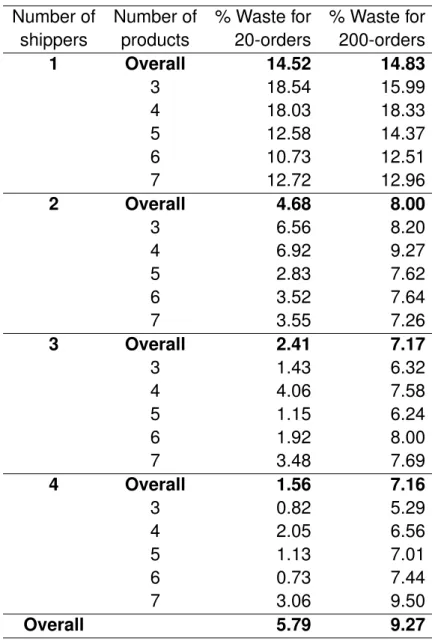
2.7.2 Solving the problem defined by the sample of orders 40 2.7.3 Applying the procedures to large samples of future orders . . . 45
2.8 Summary . . . 48
3 The problem of packing shippers into containers 49 3.1 Introduction . . . 49 3.2 Literature review . . . 50 3.2.1 Container constraints . . . 51 3.2.2 Item constraints . . . 52 3.2.3 Cargo constraints . . . 53 3.2.4 Load constraints . . . 54 3.2.5 Solution approach . . . 54 3.2.6 Load-bearing strength . . . 55 3.3 Problem formulation . . . 57 3.4 Data structure . . . 58 3.5 Constructive algorithm . . . 60
3.6 Criteria for selecting the block to pack . . . 63
3.7 GRASP algorithm . . . 65
3.7.1 Constructive phase . . . 67
3.7.2 Improvement phase . . . 68
3.8 Computational results . . . 71
3.8.1 Comparing the performance of the objective functions 73 3.8.2 Choosing the best strategies . . . 75
3.8.3 Results of the improvement phase . . . 76
3.8.4 Comparison with other heuristic algorithms . . . 78
3.8.5 Comparison with the exact approach of Junqueira et al. [54] . . . 80
3.8.6 Extending the study to a new set of test instances . 82 3.9 Summary . . . 83
4 A case study of delivering products by trucks 85 4.1 Introduction . . . 85
4.1.1 Pallet building . . . 86 4.1.2 Truck loading . . . 88 4.1.3 Objective . . . 90 4.2 Literature review . . . 91 4.3 Problem Approach . . . 94 4.4 Approximate approach . . . 94 4.4.1 Problem formulation . . . 95 4.4.2 Data analysis . . . 96
4.4.3 The problem approach . . . 103
4.4.4 Constructive phase . . . 104
4.4.5 Deterministic constructive results . . . 107
4.4.6 Randomized constructive algorithm . . . 110
4.5 Solving the problem by using mathematical models . . . 112
4.5.1 Problem formulation . . . 112
4.5.2 Data analysis . . . 116
4.5.3 Basic models . . . 119
4.5.4 Introducing pallets into the model . . . 127
4.5.5 Additional constraints . . . 133
4.6 Summary . . . 141
5 Conclusions, Contributions and Future Work 143 5.1 Conclusions . . . 143
5.2 Contributions . . . 145
5.3 Future Work . . . 146
5.4 Publications and Collaborations . . . 147
5.4.1 Papers published in JCR journals . . . 148
5.4.2 International Conference Papers . . . 148
5.4.3 International Collaborations . . . 150
5.4.4 Projects . . . 150
5.4.5 Research activities . . . 151
List of Figures
1.1 Annual growth rate in EU 1995-2012 . . . 3
1.2 Material and information flow in logistics processes . . . 4
1.3 Types of containers . . . 9
1.4 Packing problem structure . . . 11
1.5 Basic C&P problems . . . 15
1.6 Overview of the Thesis structure . . . 18
2.1 Different types of shippers . . . 21
2.2 Two types of standard shippers sizes . . . 25
2.3 Percentage deviation. Shippers vs. orders . . . 44
2.4 Distribution of waste percentages . . . 46
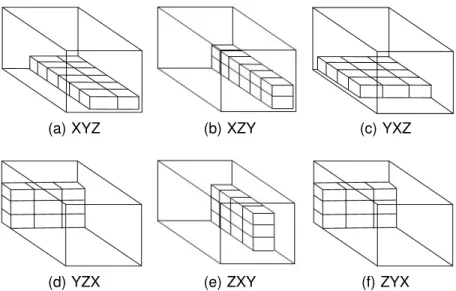
3.1 Arrangement of three boxes . . . 59
3.2 Types of blocks for 12 identical boxes . . . 62
3.3 Improving solutions eliminating stacks . . . 70
3.4 An example of exchanging blocks . . . 71
3.5 An example of filling a partial solution . . . 72
3.6 Percentage occupation of each heuristic . . . 75
4.1 Dimensions and axles positions of the truck . . . 89
4.2 Cereal box . . . 95
4.3 Layer of cereal boxes . . . 96
4.4 Pallet with 4 layers of cereal boxes . . . 96
4.5 Truck overview, divided into two parts . . . 105
4.6 First floor arrangement . . . 106
4.7 Pallets arranged at the second level . . . 106
4.8 Solution for instance 1 with two trucks . . . 108 xi
4.10 Lever principle example . . . 114 4.11 Parameters of the truck for calculating axles forces . . . 115 4.12 Distribution of instances by types of products and quantity . 117 4.13 Distribution of the lower bounds . . . 118
List of Tables
2.1 Deviation from the best known solution . . . 40
2.2 Feasible solutions with different reduction methods . . . 42
2.3 Results of reduction methods . . . 43
2.4 Results of the improvement methods . . . 45
2.5 Results for 200-order samples . . . 47
3.1 Box dimensions, weights and load-bearing limits . . . 59
3.2 Ngoi’s representation . . . 59
3.3 Spaces found in Table 3.2 according to the criteria . . . 61
3.4 Results of the heuristics . . . 73
3.5 Relative performance of the heuristics . . . 74
3.6 Comparing RCL lists . . . 76
3.7 Comparingδvalues . . . 77
3.8 Comparing improvement moves . . . 77
3.9 The effect of increasing the number of iterations . . . 78
3.10 Comparison with other heuristic algorithms . . . 79
3.11 Comparison with Junqueira et al. [54] exact algorithm . . . 81
3.12 Comparing classes BR1-BR7 with BR8-BR15 . . . 83
4.1 Data of the 11 test instances . . . 98
4.2 Layer information for day 1 of instance 5 . . . 101
4.3 Lower bounds for each instance and day . . . 102
4.4 Deterministic constructive algorithm results . . . 109
4.5 Trucks in the deterministic constructive . . . 110
4.6 Trucks in the randomized constructive . . . 111
4.7 Axle forces per section . . . 115
4.8 Statistical analysis of the type and number of layers . . . . 117 xiii
4.10 Results of Model 1 . . . 121
4.11 Instances in which Model 1 does not achieve the optimum . 121 4.12 Results of Model 2 . . . 123
4.13 Bounds for instances 17 and 106 . . . 124
4.14 Results of Model 2 for instances 17 and 106 . . . 124
4.15 Results of Model 3 . . . 125
4.16 Instances in which Model 3 does not achieve the optimum . 126 4.17 Summary of results of Models 1, 2, and 3 . . . 126
4.18 Results of Model 4 . . . 129
4.19 Instances in which Model 4 does not achieve the optimum . 130 4.20 Results of Model 5 . . . 132
4.21 Instances in which Model 5 does not achieve the optimum . 132 4.22 Summary of results with one and two pallets per position . 133 4.23 Results of Model 6 . . . 135
4.24 Instances in which Model 6 does not achieve the optimum . 136 4.25 Results of Model 7 . . . 137
4.26 Instances in which Model 7 does not achieve the optimum . 138 4.27 Effect of adding the center of gravity constraints . . . 138
4.28 Effect of minimizing the number of pallets . . . 140
Chapter 1
Introduction
The purpose of the Thesis is to contribute to an efficient solution to several packing problems that arise involving logistics, in the process of delivering products from producers or distribution centers to their final customers. The solution of these problems will be achieved by using models and ex-act algorithms, whenever possible, or by using metaheuristic procedures that do not guarantee optimality but are able to produce high quality solu-tions in short computing times. More specifically, the problems this Thesis deals with are how to determine the size of the boxes used to pack the products to be sent, how to load boxes into containers in order to max-imize the cargo, and how to load pallets onto trucks. In all cases, the problems include realistic constraints that arise in the practical problems being solved.
The field of the Thesis is Operational Research, a discipline that deals with the application of advanced analytical methods to help make better decisions [51]. For this reason the motivation of the Thesis is to provide applications for making better decisions in the logistic process, taking into account the most usual real-world constraints. The objective is to obtain solutions which are useful in practice, helping the decision makers in their complex tasks.
1.1
Logistics
We are living in a global world where products are made in part of the world and are consumed in another. Many companies are involved in this process, making products for national or international markets, or import-ing raw materials for their production. Logistics manages the processimport-ing of the raw materials, components, and final products. Nowadays, logistics is very important, so companies have a specific department to manage this aspect of their business.
The word “logistics” has its origin in a Greek word, which means “ ma-terial flow”. “Logistics”, as we understand it today, came into being during World War I for military purposes, and was used to describe the manage-ment of all kinds of supplies and resources.
According to the Council of Supply Chain Management Professionals (CSCMP) [70], Logistics is the process of planning, implementing, and controlling procedures for the efficient and effective transportation and storage of goods, including services, and related information from the point of origin to the point of consumption with the purpose of conforming to cus-tomer requirements. This definition includes inbound, outbound, internal, and external movements.
To provide an overview of the sector, we shall list some statistics con-cerning transport and storage services in the European Union (EU). The source is the European Commission of Mobility and Transport [22]. In gen-eral, the transport and storage service sector amounts to overe548 billion in Gross Value Added (GVA) at basic price, representing 4.8% of total GVA of the EU in 2011.
The sector employs around 11.2 million people, which is roughly 5.0% of the total workforce. Around 55% of them work in land transport (road, rail and pipelines), 2% in water transport, 4% in air transport and 24% in warehousing and supporting transport activities. The remaining 15% work in postal and courier services.
In 2012, total transportation activities in the EU were estimated at 3768 billion tkm (tonnes per kilometer). This figure does not include activities
1.1. Logistics 3 between the EU and the rest of the world, only intra-EU. Road transport accounted for 44.9% of the total, rail for 10.8%, inland waterways for 4% and pipelines for 3%. Maritime transport intra-EU was the second most important mode, with a share of 37.2%, while intra-EU air transport only accounted for 0.1% of the total. Figure 1.1 shows the growth rate of logis-tics in the EU of 28 countries, from 1995 until 2012, for goods, passengers and Gross Domestic Product (GDP).
Figure 1.1. Annual growth rate in EU for passengers, goods, GDP 1995-2012. Source: European commission of mobility and transport [22]
These statistics show the importance of the sector in the EU economy. The mission of logistics is basically to get the right goods or services to the right place, at the right time, and in the desired conditions, while making the greatest contribution to the company, as Morabito et al. [66] point out.
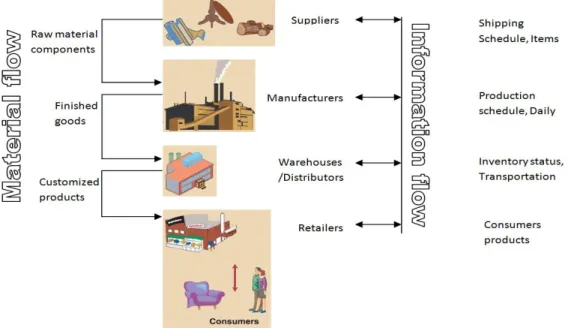
In the logistic process two kinds of movements, materials, and informa-tion flow are involved, as can be seen in Figure 1.2. In the left-hand side of the figure, we can follow the flow of goods. It starts when the suppliers provide the raw materials to the productive system, then the products are manufactured and stored in the warehouses until they are ordered by the retailers, which sell the products to the final customers.
Simultaneously with the goods flow, there is an information flow, but in the reverse direction, as can be seen in the right-hand side of Figure 1.2. The retailers start the information flow when ordering the products. According to the demand, the warehouses stock and deliver the products. The manufacturing process adjusts production for supplying the demand and the suppliers provide the raw materials necessary for production.
Figure 1.2. Material and information flow in logistics processes. Source: Operations management [84]
All the information flow has to be managed by the company in an ef-ficient way and it is here where operational research is at their service, providing an optimization of the resources in each part of the logistic pro-cess, as follows:
• Procurement. A plan has to be defined to decide the date and quantity for supplying the raw materials when the production system needs them, in order to obtain them in the right quantities and at the right time.
• Production. In this process a master production schedule is neces-sary to decide what to produce and with which resources at each
1.2. Distribution process 5 period of the planning horizon, as well as a scheduling program to assign tasks to machines.
• Storage. The products have to be stored according to the turnover. High turnover products should be placed at easy access positions of the warehouse in contrast with low turnover products. The distribution of the products in the warehouse, the stock of the products, and the picking and delivery process are some of the optimization problems in a warehouse. From the warehouse to their final destination, the products go through different processes. Some of these processes are:
– Distribution. Several decisions have to be made: how to pack the manufactured products, how to load the boxes on the different means of transport, how to decrease the cost of transportation by optimizing the routes.
– Retailers. They know what the consumers want and their requi-sites. According to this information, the retailers plan the order to the distribution center and stock the products, until they are sold, like a small warehouse. For this reason they have the same storage process problems, but on a smaller scale.
This Thesis is focused on the distribution processes, trying to optimize solutions to some of the problems arising at this stage. The consequences of optimization will be a boost in profits and a reduction in greenhouse gas emissions. For these reasons, it is important to make an effort to improve these processes as much as possible.
1.2
Distribution process
We focus now on the distribution and storage processes, describing them and identifying which optimization problems appear and have to be solved. According to the Council of Supply Chain Management Professionals (CSCMP) [70], distribution is the set of activities associated with moving
materials from source to destination. It can be associated with movements from manufacturers or distribution centers to customers, retailers, or other secondary warehousing/distribution points. The objective is to deliver the product or service to its final consumer at the right moment and place.
In this process we can find many optimization problems and here we wish to point out some of them to give an idea of how a distribution center or warehouse is managed.
When we start up a distribution center, the first problem is where the warehouse should be located. The problem is known as the “Facility lo-cation problem”, a problem related to locating or positioning at least one new facility among several existing facilities in order to optimize (minimize or maximize) at least one objective function (such as cost, profit, revenue, travel distance, service, waiting time, coverage, and market shares) [33].
Once the warehouse is located, the processes in the warehousing are grouped into three classes, according to Hompel and Schmidt [50]: the basic technical structure of the warehouse, the operational and organiza-tional framework, and finally the coordination and controlling systems for warehouse operations.
The basic technical structure involves the distribution of the warehouse, the dimensions and the placement of the equipment, a problem known as “layout design”. In this problem we have to decide where the conveyors, shelves, and doors are placed. This is very important for further optimiza-tion tasks because it has a significant impact on the order-picking, the task of going around the warehouse picking the products to compose an order. The operational and organizational framework combines different ar-eas, e.g. business management, inventory management, organization management, transportation management,.... All these processes belong to areas described later in this section.
The coordination and controlling systems control and optimize the op-erations in the warehouse. These opop-erations involve the storage of goods, the utilization of the workforce, and the management of the flow of people, machines, tasks, and goods.
1.2. Distribution process 7 The basic processes in a warehouse are receiving, storing, putting-away, picking/retrieving, and shipping goods, as Karasek [55] points out. The description of each task is as follows:
• Receiving. The task starts when the goods arrive. They have to be unloaded, counted, identified, passed through a quality control, and accepted.
• Storing. This task consists in distributing the goods to storage ar-eas, assigning them to a storage bin according to the dimensions and weight of the goods, and the distribution policy of the company. There are two basic assignment strategies, therandom strategy, which as-signs a good to an arbitrary empty location, and the dedicated strat-egy, which stores the good at a specific position. In order to decide the best strategy the company can take into account the turnover of the good, the stock, and the clustering of the goods infamily groups, ac-cording to the similarity between products or orders, or inclass-based storage, according to the frequency of the orders.
• Put-away is the process of determining the storage location. It is very important for the information system to know which locations are available, which is the location of a specific good, and where each particular pallet is stored. This information is used for designing the pick-list, the list each worker has for going around the warehouse picking the goods required for an order.
• Picking or Retrieval. This task covers a lot of subtasks. Touring the warehouse, searching for the goods, extracting them and taking them to the output points. The picking can be homogeneous, when the picker operates with a whole pallet orheterogeneouswhen the picker collects a given quantity of each type of product. The planning of this process is based on the orders and, according to the demand, a route around the warehouse is configured in order to minimize the distance walked or traveled by the picker.
• Consolidation. If an order is picked by more than one picker, this task joins the goods collected by the pickers for completing the order.
• Checking. This task checks if the order is complete and accurate. • Packing. The goods are packed for transportation in the right package
according to the type of good and the means of transport.
• Shipping. This task consists in assigning packages to means of trans-port, trucks or containers, according to the destination, to optimize the load. This process involves several management tasks such as plan-ning the delivery route of the trucks, the placement of the packages into the trucks according to the delivery route, and the assignment of goods to trucks or containers.
There are many optimization problems involved in these tasks or pro-cesses. This Thesis is about the two last tasks, namely packing and ship-ping. The context of the Thesis begins when the products are manufac-tured or collected in the warehouse. The products have to be packed in boxes or shippers. We use here the term “shipper” as a synonym of box or container, as in Dowsland et al. [27]. The mission of the shippers is the preservation of the product until it reaches final destination. The com-pany has to take a decision about the size and type of shippers. The type of shipper depends on the type of product, the itinerary, and the means of transport. Important features are the form, the size, and the weight because they have an impact on the cost and the quality of the transporta-tion. For instance, a shipper cannot be too bulky and heavy because the bulkier or heavier the shipper, the higher the transportation cost. More-over, there are many types of shippers: cardboard boxes, pallets, sacks, drums, etc. The company has to decide which type and size of shipper is best for complying with customer specifications and for protecting the products from damage. This is the first problem the Thesis deals with, and is the focus of Chapter 2.
In the second part of the process, when the product is packed into ship-pers, the company has to send the shippers to their final destination and, depending on the destination area, they choose one means of transport or another. The means of transport can be sea transportation, ground transportation or air transportation, and each one has different features:
1.2. Distribution process 9 • Sea transportation: the products are loaded into containers called “dry containers”, which are made of either aluminium or steel. There are many types of containers for different requirements. (See Figure 1.3 (a)).
• Air transportation: the products are loaded onto “Unit Load Devices” (ULDs), which are pallets with the load held by a net, or in specific containers for airplanes. (See figures 1.3(b) and (c)).
• Ground transportation: in this case, the products are distributed onto pallets or in boxes that are placed into trucks. (See Figure 1.3 (d)).
(a) Dry Containers (b) ULD containers (c) ULD pallet (d) Truck
Figure 1.3. Types of containers
The products are exported directly by the manufacturing company or can go through a distribution center. When the products have to be sent in containers by sea to other continents, the shippers have to be packed into the containers and the problem is how to load the shippers to maximize the cargo in the container. This is the second problem we deal with, and is the focus of Chapter 3.
Sometimes the retailer or customer is not far away. In this case the product is delivered by truck. The shippers are placed onto pallets and the pallets are loaded onto trucks. We deal with the optimization of these problems in Chapter 4.
All the problems described in the Thesis, namely the choice of shipper sizes, how to load a container or how to place shippers onto pallets and pallets into trucks belong to a general type of problems known as pack-ing problems. These problems deal with the optimization of the available
space on the pallets, in containers, or trucks, trying to load as much cargo as possible. Apart from maximizing the load, other relevant issues such as the stability of the load, accessibility of the products in the unloading task, or not exceeding the maximum weight should be taken into account in order to produce useful loading plans.
Throughout this Thesis, packing problems related with the logistics pro-cess in industry are covered, from manufactured products, which have to be packed in boxes, up to their distribution in containers or on trucks. In all of these processes, packing problems are present. In the next section we describe these problems and their typology.
1.3
Cutting and packing problems
An informal definition of packing problems could be that they are a set of problems about how to place items or products into boxes or containers, in a way that maximizes the load. For cutting problems, a set of problems which deal with how to cut big pieces or boards into small pieces in a way that minimizes the waste.
Many Cutting and Packing problems appear in the logistic process, for instance how to load items into boxes while maximizing the load, how to distribute the load on a truck based on the delivery route, or how to allocate the products to a container that have to be sent by sea to their destination, satisfying constraints about the allocation of the products.
There is a large number of scientific studies (413 papers by 2005 [94]) dealing with various aspects of the problems in different disciplines such as Management Science, Engineering Sciences, Computer Science, Mathe-matics, as well as Operational Research. In fact, there is a group that brings together all the community that deals with this kind of problems, the Euro Special Interest group on Cutting and Packing (ESICUP). ES-ICUP gathers practitioners, researchers and Operations Research edu-cators with interests in the area of Cutting and Packing. The purpose of ESICUP is to improve communication among individuals working in this
1.3. Cutting and packing problems 11 field, as is stated on their web page [31]. The group has now around 500 members from all over the world.
The topic of Cutting and Packing problems, C&P in the following, is characterized by the fact that all the problems have the same structure. Let us illustrate the structure with two simple examples. The first one is a problem of cutting tubes for making pipes. On the one hand, there is unlimited stock of large tubes of fixed length that are used for producing smaller tubes. On the other hand, there is a list of small tubes that have to be cut from the large tubes. The stock of large objects and the list of small tubes are the basic data of the problem. Combinations of the small tubes create patterns that are assigned to large objects, with the objective of optimizing a given criterion while satisfying some specific constraints.
The second example concerns a packing problem, specifically a con-tainer loading problem. The basic data are, on the one hand, a stock of large objects consisting of one or more containers and, on the other hand, a set of small items that has to be packed into the containers, as can be seen in Figure 1.4 (a) and (b). The problem deals with the geometrical combination of small items to produce packing patterns which can be as-signed to containers, producing solutions such as that in Figure 1.4 (c).
(a) Boxes (b) Container (c) Solution
Figure 1.4. Packing problem structure
The common structure of C&P problems is defined as follows:
1. The basic data, whose elements are the stock of large objects and the list of small items.
2. The patterns, that is, the combinations of the small items assigned to large objects.
Dyckhoff [28] establishes the relation between cutting and packing as a duality between raw material and space. The cutting problem can be seen as the problem of packing the space occupied by the items into the space of the large object. This is the reason why Cutting and Packing are con-sidered just one type of optimization problems.
A formal definition was introduced by W ¨ascher et al. [94]. Cutting and Packing problems have an identical structure that can be summarized as follows. There are two sets of elements,“large objects”, the input data or the stock, and the “small items”, the output or demand. These elements are defined in one, two, three, or more dimensions. The problem consists in selecting some or all the small items, grouping them into one or more subsets and assigning each of the resulting subsets to one of the large objects such that the geometric conditions holds, i.e, the small items of each subset have to be laid out on the corresponding large object such that all the small items of the subset lie entirely within the large object and the small items do not overlap, and a given objective function is optimized. A solution of the problem can contain some or all the large objects and some or all the small objects.
As a consequence of this structure, there are five subproblems that have to be solved simultaneously in order to achieve the“global” optimum:
• The choice of the large objects • The choice of the small items
• The grouping of the small items into subsets to form patterns • The allocation of the patterns to the large objects
• The arrangement of the small items on each of the selected large object according to the geometrical constraints
In order to illustrate the five subproblems, we have selected a packing problem, consisting in loading products into containers. We have small
1.3. Cutting and packing problems 13 items, the boxes we want to load, and large objects, the containers. The problem deals with loading all the boxes into the containers in a way that minimizes the number of containers used. The five subproblems we have to solve to achieve the “global” optimum are:
• The choice of the large objects, how many containers and of which types, if there are containers of more than one type
• The choice of the small items, in this case all the boxes have to be loaded
• The grouping of the boxes into subsets
• The allocation of the subsets to the containers
• The arrangement of the boxes in each container according to the ge-ometrical constraints
This is an example of packing problems in the logistic context. We have defined the small and the large objects, and the objective function in the context of the problem. And then, the problem is solved by grouping, allocating and arranging the items into the large objects. There are multiple versions of a problem, such as how to load all the boxes into the minimum number of containers or how to load the maximum number of boxes into just one container or a fixed number of containers. For that reason, it is necessary to have a classification or typology of the problems in the field of Cutting and Packing. Recently, W ¨ascher et al. [94] have proposed a typology that extends the classical typology of Dyckhoff [28].
The W ¨ascher et al. typology establishes the criteria for the definition of the type of problem as follows:
• Dimensionality. It distinguishes between one-, two- or three-dimensional problems
• Kind of assignment. Two situations are considered:
– Output maximization. A set of small items is assigned to a given set of large objects. The set of large objects is not enough to
accommodate all the small items and all the large objects have to be used. In this case there is no selection problem of the large object because all of them have to be used, and the objective is to maximize the value of the small object assigned to them.
– Input minimization. A set of small items has to be assigned to a set of large objects, but in this case the set of large objects is enough to accommodate the small objects. All the small items have to be assigned to a selection of the large objects with the minimal value.
• Assortment of small items. Three cases can be distinguished:
– Identical small items. All the items are of the same shape and size.
– Weakly heterogeneous assortment. The items can be grouped into few classes, in each class the shape and size of the items are identical.
– Strongly heterogeneous assortment. There are few items with the same size and shape so each item can be treated as an individual element.
• Assortment of large objects There are two cases:
– One large object. A single element with fixed dimensions or one or more variable dimensions.
– Several large objects, with all dimensions fixed, where all the ob-jects can be identical, weakly heterogeneous or strongly hetero-geneous.
• Shape of small items. They can be regular like rectangles, circles, boxes, cylinders, etc. or irregular.
The basic types of C&P problems are a combination of two criteria, type of assignment and assortment of small items, as can be seen in Figure 1.5.
1.3. Cutting and packing problems 15
Figure 1.5. Basic C&P problems. Source: W ¨ascher et al. [94]
For instance, the problem of loading a set of boxes into a container can be classified as output maximization, because we have only one large object, the container, and it is not enough to accommodate all the small items. Therefore, we have to select a set of small items to maximize the load in the container. The assortment of the large object is one with fixed dimensions. In contrast, the assortment of the small items depends on the variety of the dimensions of the boxes. If they are all identical, the problem is an “Identical item packing problem”. If they are weakly heterogeneous, the problems is a “Placement problem”, and if they are strongly heteroge-neous, the problem is a “Knapsack problem”, as is the problem depicted in Figure 1.4.
Another example is the problem of cutting boards of wood for manu-facturing furniture. We have a set of large objects, the boards of wood, and a list of small pieces that have to be cut to compose the furniture. In this case it is an input minimization problem, because all the small pieces have to be assigned to large objects, the boards, that are in a quantity that is sufficient to supply all the demand for small pieces. The assortment of the large object is several large objects with all dimensions fixed,
identi-cal large objects, because the boards are of the same size. The assort-ment of the small objects can be weakly heterogeneous if the pieces have few different dimensions, and in this case the problem is a “Cutting stock problem”, or it can be strongly heterogeneous if each piece has different dimensions, and the problem is a “Bin packing problem”.
In the Thesis we have studied some Cutting and Packing problems in the context of logistics, and classified according to the W ¨ascher et al. [94] typology explained above.
1.4
Motivation
The purpose of this dissertation is to provide a contribution to cutting and packing research through the analysis of real problems in the logistics field, finding solutions that could be applied in the industry. We analyze the process in which each problem appears and provide solutions according to their specific characteristics.
As we mentioned above, the Thesis is focused on the storage and dis-tribution processes, once the products are manufactured. The main ob-jective of the dissertation is to optimize some processes in that stage, pro-cesses that are related with the cutting and packing problems appearing in the distribution centers or warehouses. Our contribution is to provide bet-ter solutions, improving the way in which the problems are currently being solved.
In addition to this, other objectives we set out to achieve are:
• To analyze the practical or real problems the industry has. The distri-bution sector deals with many optimization problems. What we wish to do is to identify and analyze these problems and to include their specific requirements in our research.
• To study non-standard constraints of the problems that are required by the industry. As a consequence of the industrial problems analysis, new requirements and constraints will be added to our research.
1.5. Thesis structure 17 • To design and develop efficient algorithms based on metaheuristic and exact techniques, for solving cutting and packing problems in the logistic sector. Our contribution is to design algorithms for optimizing the process, or at least for solving them in a more efficient way.
• To apply the algorithms designed to instances provided by the com-panies involved in the sector, in order to check wether the solutions are satisfactory and can be used in practice.
1.5
Thesis structure
This Thesis is organized in five chapters as follows.
Chapter 1 gives a brief introduction to the Thesis, putting it in context, introducing the logistic process and the problems appearing in this field, and the cutting and packing problems, focusing on the problems of the distribution centers and warehouses.
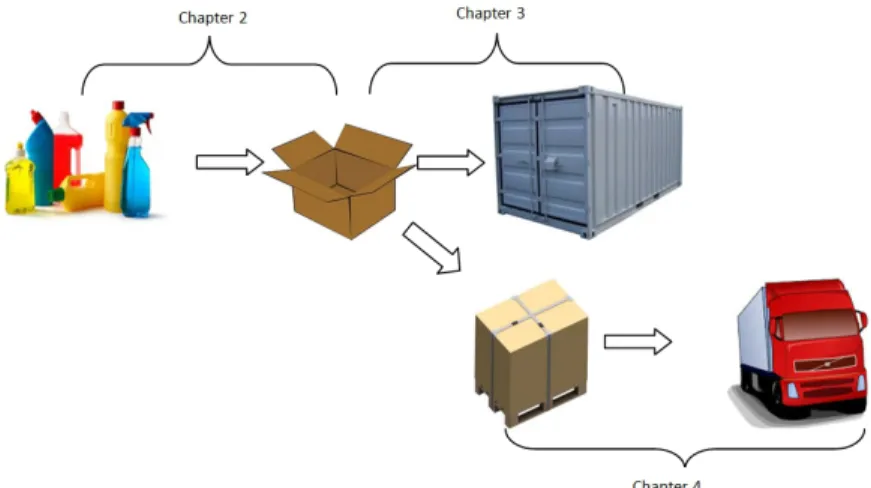
The first problem that we solve starts when the products are manufac-tured. The manufacturing company has to decide how to pack the prod-ucts, in which package of which size. In Chapter 2 we deal with the prob-lem of determining the best package sizes for containing the manufactured products in order to supply all the demands. This chapter includes the de-scription of the problem, which is a real problem of a Spanish distribution center, the literature review, the approach we have followed, and the re-sults and conclusions.
Once the product is packed, it has to be sent to the customer. The dis-tribution centers collect all the products for the same destination and send them together using a means of transport according to the destination dis-tance. In Chapter 3 we study the problem of the distribution center in which boxes of multiple products have to be sent to the final customer by sea us-ing containers. This is the well-known container loadus-ing problem, in which our contribution is a metaheuristic approach for the problem that involves constraints related with the load-bearing strength of the boxes. A
descrip-tion of the problem, the literature review, and the proposed algorithm are included in this chapter.
Sometimes the transportation to the customers can be performed by trucks. In some cases these products are first put onto pallets to facili-tate the loading and unloading operations and then pallets are placed into trucks to be sent to each destination. Chapter 4 covers the problem of sending goods by truck, studying it from different approaches and apply-ing models and metaheuristic algorithms for solvapply-ing it. In this chapter we describe the problem of a distribution company, which has motivated our research, and show the results obtained.
Finally, Chapter 5 summarizes the main conclusions, contributions, and future work of this Thesis.
In Figure 1.6 we graphically show the chapter distribution of the Thesis.
Chapter 2
The problem of packing
products into shippers
2.1
Introduction
In this chapter we consider the logistic process which involves a distribu-tion center and a set of retailers. The distribudistribu-tion center receives, clas-sifies, and stores large quantities of many products. These products are then distributed to retail shops. Each week each shop sends an order to the distribution center consisting of a list of products with their required quantities. The products to be sent to each shop are then retrieved from the warehouse and packed together using an appropriate package. A package is a bounded material object designed to contain temporarily the products during their manipulation, storage and transportation. The pack-age is usually a box, which is made of cardboard, wood, or metal, and can be adapted to all means of transport. Moreover, it is homogeneous and stable and can be made in different shapes and sizes.
The election of the package is very important because it protects the products inside, preventing damage. As a result, this election determines the quality and the cost of transportation, having a direct influence on the total cost of the products. Obviously, it cannot be heavy and bulky be-cause it would be difficult to handle and that increases the transportation
cost. For that reason, the companies have to study the dimensions of the packages they use, trying to send the packages as full as possible.
In this chapter, the packages will be called shippers, as in Dowsland et al. [27], to distinguish them from the boxes used to pack each item of a product. When designing the shippers, certain aspects have to be considered:
• Product features, volume, weight, type
• Life cycle of the distribution, itinerary, means of transport, handling • Demand for the products
• Cost of the packing material
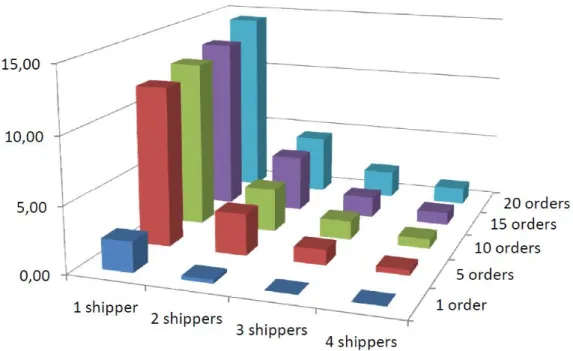
The distribution center faces two related problems: first, how many dif-ferent shipper types to keep in store, and second, what the dimensions of these shipper types should be in order to minimize the total transportation cost of the shippers required to supply all the shop orders. The first ques-tion is clearly open to a trade-off. On the one hand, having many shipper types at hand increases the efficiency of packing and thus reduces trans-portation costs. On the other hand, a greater variety of shipper types results in an increase in shipper locations within the warehouse and an increase in costs, because ordering different shipper sizes in small quan-tities is more costly than ordering a few different sizes in large quanquan-tities. Determining the right number of shipper types is a difficult task because many different factors have to be taken into account. Therefore, the distri-bution company prefers not to fix this number beforehand, but to be offered several solutions for different numbers of shipper types. We consider this number as a parameter provided by the user when he/she calls the pro-gram. In our experimental results, we will report results for four alterna-tives, ranging from one to four shipper types, though the proposal could easily be extended to larger numbers of shipper types. In Figure 2.1 sev-eral different types of shippers are shown.
Once the number of shipper types has been set, the problem is to deter-mine the dimensions of each of the shipper types kept at the warehouse in
2.1. Introduction 21
Figure 2.1. Different types of shippers
order to minimize the total transportation cost of sending all the products to the clients. This problem is the object of this chapter. We have to combine two kinds of data. First, the possible shipper dimensions. The company does not need to choose among a set of predetermined sizes. As retail-ers order in large quantities, the company can decide the dimensions of each shipper type in centimeters. To facilitate the handling of shippers, the company imposes some conditions on the shippers’ size and shape, limit-ing the number of possibilities. These conditions will be described in detail in Section 2.3, but even with these reductions the set of potential sizes can be very large.
The second type of data corresponds to the retail shop orders. As we are only concerned with packing, we group the products into sets defined by their dimensions. Several products with the same dimensions are con-sidered as the same product for packing purposes. In the remainder of the chapter, we will use the term product to refer to product groups. The type and number of products ordered by each shop each week depend on customer behaviour, which cannot be predicted exactly. The company, on the basis of historical data and demand forecasts, provides the information about the weekly shop orders in the form of two probability distributions, one of the number of items each order will contain and the other of what percentage of each product the order will consist of. They are confident that the orders will follow these probability distributions week by week dur-ing a given season.
The approach we follow to solve this problem is to determine the shipper sizes that best fit a representative sample of the potential orders, gener-ated as a random sample from the given probability distributions. Once the sample has been generated, the problem involves determining the set of shipper sizes, among those satisfying the company’s conditions, that will accommodate a given set of orders so as to minimize the transportation cost.
We have developed an integer linear model for this problem, extend-ing the cuttextend-ing stock problem proposed by Beasley [8], and we have also studied several relaxations that produce lower bounds. As the model in-volves a very large set of variables, we have designed several reduction procedures that produce reduced instances that can be efficiently solved. The optimality of the solution is no longer guaranteed, but we obtain good quality solutions in reasonable times. Furthermore, these solutions can be improved by using some metaheuristic algorithms we have adapted from related packing problems. In the final step, the solution obtained using the sample is tested on larger samples, which can be considered representa-tive of the whole population of orders, to assess the expected performance of the solution when dealing with future orders.
The study of this problem has been motivated by a distribution center in Spain. This center has provided us with their data, which will be used for the computational study. Nevertheless, the problem is common to many distribution centers that face the same, or very similar, challenges.
2.2
Literature review
In the Cutting and Packing literature, a closely related problem to that be-ing considered in this work is the assortment problem which is encoun-tered in industries concerned with the cutting of large rectangular items, as they face the problem of choosing the best stock rectangles for meeting customer requiremens. Pentico [76] in his survey defines the assortment problem as the election of : ”’the set of sizes or qualities of some product that should be stocked when it is not possible or desirable to stock all of
2.2. Literature review 23 them and substitution in one direction (larger for smaller or higher-quality for lower-quality) is possible at some cost.”’.
Chambers and Dyson [19] propose one of the earliest of such ap-proaches. First, a cutting-stock problem with all possible resource types is solved. If the solution uses a number of sizes which is lower than or equal to the limit, the process finishes. Otherwise, the size with the best estimation over the total cost is eliminated from the solution. The proce-dure continues until only p stock sizes remain. Beasley [8] proposes a greedy procedure for generating two-dimensional cutting patterns, a linear program for choosing the cutting patterns to use, and an interchange pro-cedure to decide the best subset of stock rectangles to cut. Gemmill and Sanders [41, 42] first propose a Monte Carlo method and then other simu-lation techniques in order to select a set ofpgood stock sizes. Gemmill [40] develops a genetic algorithm to solve the problem for the one-dimensional case.
Agrawal [1] proposes a method developed for an automobile press shop to determine stock-sheet sizes to minimize total trim loss. The shop stocks sheets of a limited number of sizes and uses them to manufacture a num-ber of parts. In this problem only one type of product can be cut from each stock size. Theoretically, there is an infinite number of sheet sizes to choose from, since the sheet dimension is a continuous variable. Agrawal uses efficient partitions to reduce the number of stock sizes. In his case the set is not too big because only one piece can fit into one sheet size. Holthaus [48, 49] works on a similar problem to ours but for the one-dimensional case. He considers a real-world cutting problem arising from caravan manufacturing companies in which he has to minimize the total cost of the stock material needed for cutting the smaller sizes in a yearly production plan. The best combination of stock sizes to keep in inventory has to be selected and for each caravan model the cutting patterns have to be determined. Holthaus presents a methodology for simultaneously solving the stock size selection problem and a series of cutting pattern selection problems, a methodology, which is based on an enumeration scheme for the possible combinations of different stock sizes. The main difference with respect to our problem is that in ours the number of
possi-ble stock sizes has to be computed and it is huge compared with the set in his problem.
Arbib and Marinelli [5] propose a heuristic algorithm called thep-median size selection procedure for an application in the glass industry. They have to solve the stock size for quantities of a product, but each stock size can only be cut by guillotine cuts to obtain only one type of product. Arbib and Marinelli [6] also develop a branch and price algorithm for a class of assortment problems. They propose an exact algorithm for the case with one product type per resource unit. Both papers take into account the two-dimensional case. Dowsland et al. [27] also address a two-two-dimensional case with the condition that every shipper contains only one product. As the set of possible sizes is very large, some reduction procedures based on properties of the physical problem are introduced and incorporated into a hyperheuristic-driven simulated annealing solution approach.
Another algorithm designed to obtain the number and types of stock sizes during a planning period, but in the one-dimensional case, is that of Kasimbeyli et al. [56]. This algorithm considers a one-dimensional cut-ting problem and the authors propose a heuristic algorithm for solving the mathematical model. In this case the set of possible roll sizes which are available for the producer is known.
The problem of the Spanish distribution center has some differences with respect to other assortment problems found in the literature. On the one hand, the demand is not known in advance and, on the other hand, the shippers to be sent to clients may contain several different products.
2.3
Problem formulation
In this Section we will describe the elements of the problem in more de-tail and formulate an integer linear model. The company receives a set of I different product types. The products are packed into the shippers in one single layer with one particular dimension always placed vertically. The condition of fixing the vertical dimension is similar to the “this side up” constraint that appears very frequently when dealing with fragile
ob-2.3. Problem formulation 25
Figure 2.2. Two types of standard shippers sizes
jects. In this case, the constraint is due to the fact that the products have a bar code in this position that has to be read when opening the lid of the shipper, without taking the products out. This reduces the original three-dimensional problem to a two-dimensional one. Therefore, for each product, i, i = 1, . . . I, its length, li, and width, wi, are known and
inte-gers, given in centimeters. The products can be rotated. We assume that the composition of a set of weekly orders is known. For each order k, k = 1. . . K, the number of units of product i in the order k is denoted by bik.
The dimensions of the possible shipper types are denoted by Lj, Wj,
j = 1, . . . J. The third dimension, H, is fixed for all shipper types and all products. The transportation cost of shipper type j is denoted as Cj.
Initially, Lj and Wj may take any positive value in centimeters, but there
are several considerations which reduce the sets of possible values. For handling reasons, the user can impose certain lower and upper limits on the relation between dimensions. For instance, 1 ≤ Lj/Wj ≤ 6, ∀j =
1, . . . , J, to avoid shippers being too long and narrow. There can also be lower and upper limits on the volume of the shippers or on the number of products the shippers can accommodate. For example, 4 ≤ LjWjH
li1wi1H ≤ 12, where product i1 is the product with the largest volume that can fit into shipper boxj, limits the number of products per shipper to between 4 and 12.
We can also reduce the possible set of shippers by taking symmetry into account. If we have a two-dimensional problem in which all the products can be rotated, shipper(Lj, Wj, H)is the same as(Wj, Lj, H). Therefore,
we only have to consider shippers with Wj ≤ Lj. Finally, we can observe
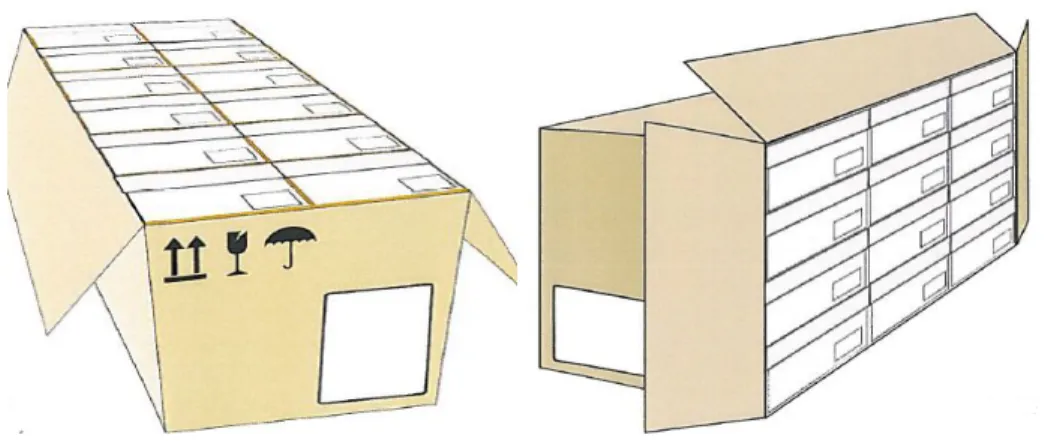
that there is no point in using a shipper with any dimension that is not a linear combination of the dimensions of the products which could be packed into it. If we used such a shipper and obtained a feasible solution, we could check if the solution is a linear combination of products, 2.1 and 2.2, if not, the dimensions can be reduced accordingly, as in Figure 2.2. Therefore, the only values for dimensionsLandW will be the sets:
L ={ I X i=1 k1i∗li+k2i∗wi|0≤k1i ≤bik; 0≤k2i ≤bik;k1i, k2i ∈N} (2.1) W ={ I X i=1 k1i∗li+k2i∗wi|0≤k1i ≤bik; 0≤k2i ≤bik;k1i, k2i ∈N} (2.2)
Even with these reductions, the number of possible shippers is very high. For instance, with 7 products, 20 orders and the above-mentioned constraints on dimensions and volume, we can have more than 10,000 possible shipper types.
The objective, for a given integer p, is to find a set of p shipper types from among a set of possible shipper types j, j = 1, . . . J, to be used for sending all the products over a series of weeks, such that the total cost of transportation is minimized. We can use as many copies of each shipper type as we need in order to pack the products in each order. Each individual shipper can be filled with different products. According to the W ¨ascher [94] typology, the problem can be considered as an MBSBPP (Multiple Bin-Size Bin Packing Problem) with a huge set of available bin sizes.
In order to develop an integer linear model for the problem, we take the cutting patterns model proposed by Beasley [8] as the starting point. He had to solve an assortment problem in which a subset ofptwo-dimensional stock sizes had to be selected from among a setnavailable sizes, in order to packmdifferent piece types, with known dimensions and demands. His
2.3. Problem formulation 27 approach associates with each possible cutting pattern l involving size j a variablexjl that counts the number of times this pattern l is used in the
solution, and defining variables yj to indicate whether size j is part of the
solution.
Our model is an extension of Beasley’s model. The set of demands in his cutting problem can be considered as one order in our problem, and we have to extend the model to cope withk orders. LetPjk be the set of all
packing patterns for products of the order k in shipper type j and let dijkl
be the number of products of typeithat appear in the lth packing pattern
of the orderk in shipper typej. We define the following variables:
xjkl= number of times pattern lof shipperj is used for orderk.
yj= 1, if shipper j is used; 0, otherwise.
The formulation of the model is:
M in J X j=1 Cj K X k=1 |Pjk| X l=1 xjlk (2.3) subject to: J X j=1 |Pjk| X l=1 dijklxjkl ≥bik i= 1, . . . , I; k = 1, . . . , K (2.4) K X k=1 |Pjk| X l=1 xjkl ≤M yj j = 1, . . . , J (2.5) K X k=1 |Pjk| X l=1 xjkl ≥yj j = 1, . . . , J (2.6) J X j=1 yj ≤p (2.7) xjkl≥0, integer j = 1, .., J;k = 1, .., K; l = 1, ..,|Pjk| (2.8) yj ∈ {0,1} j = 1, . . . , J (2.9)
whereM is a large positive constant, for instance,M =PI
i=1
PK
k=1bik. We can adjust the valueM for this formulation by using for eachj a value Mj =
P
kMjk, whereMjk is an upper bound on the number of typej
ship-pers necessary to pack all the boxes of the order k. Mjk can be obtained
with a heuristic for the bin packing problem ( [73]) in which we have a bin with the dimensions of shipper typej and the set of products for orderk.
For each packing orderk, constraint set (2.4) ensures that the demand for any product i needed for any order k is met. If any packing pattern is used for a shipper of type j, constraint set (2.5) forces yj = 1. If no
cutting pattern is used for a shipper type j, then the left-hand sides of the corresponding two inequalities in constraint sets (2.5) and (2.6) are zero, and therefore constraint set (2.6) forces yj = 0. Constraint (2.7)
guarantees that at most p different types of standard lengths, equation (2.1) and (2.2), are used. Finally, the integrality constraints are modelled in expressions (2.8) and (2.9).
The difficulty with this formulation is that the set of possible packing pat-ternsPjk for any stock rectanglejcan be very large and so the assortment
problem as formulated above is a very large integer program. In this type of problem, a frequently used procedure is that of column generation, in which, starting from the master problem with a reduced set of patterns, a series of subproblems are solved, producing new patterns whose incorpo-ration into in the master problem progressively improves the linear solution. Recent studies by Pisinger [79], on the Multiple Bin-Size Bin Packing Prob-lem, and by Furini et al. [37], on the Cutting Stock Problem with multiple stock sizes, are good illustrations of the advantages and difficulties of this method.
In our case, we would start with a reduced set J0 of shipper sizes and for eachj ∈J0, and each orderk, a reduced set of patternsL0jk. The main difficulty would be to solve the subproblems. There would be one for each possible shipper sizej and each orderk, and we would have to solve a 2D Knapsack Problem, which is NP-hard. We have addressed this problem in a previous study (Alvarez-Vald ´es et al. [2]), and Pisinger and Sigurd [79] and Furini et al. [37] also propose some procedures to deal with it, but in
2.4. Lower bounds 29 all these cases there are a small number of large objects (stock sheets, shippers) and just one order to be served.
Therefore, we follow a different strategy. In Section 2.5 we describe several ways of selecting a set of shipper sizes and, for each of them and each order, several procedures to determine an efficient set of patterns. Using only the variables corresponding to these elements, the model can be used to obtain a feasible solution.
The objective function defined in the model is the total cost of the ship-pers used. A simplification could consider this cost equal to the volume of the shipper, which would be appropriate in some cases, but if the trans-portation is undertaken by an external carrier, the costs usually take into account the weight and the shape of the shippers. Therefore, assigning a valueCj to each shipper typej is more general and can be applied to any
situation. Another alternative could have been to include the number of shipper types in the objective function, with a fixed costFj associated with
the use of each shipper typej. Then, we could have solved the model with this objective function: PJ
j=1Fjyj+ PJ j=1 PK k=1 P|Pjk| l=1 xjlk. However, in our experience the user prefers to consider each number of shipper types sep-arately. It is difficult to assign a cost to the use of an extra type of shipper because of the many factors involved.
2.4
Lower bounds
A first lower bound for the problem is the trivial lower bound based on the total volume of the products. LetV =PI
i=1
PK
k=1vibik, wherevi =li∗wi∗H is the volume of producti. Then
LB0 = C∗
V∗V (2.10)
whereC∗ and V∗ correspond to the shipper type with the lowest cost/vol-ume ratio, is a valid lower bound for the original problem.
We can obtain better bounds by formulating and solving relaxations of the original problem.
2.4.1
Bound based on a multi-knapsack problem
A first relaxation of the original problem consists of a model that can be seen as a multi-knapsack problem. We define a variable:
yjk = number of shippersj used for orderk
and denote by Vj the volume of shipperj, and by Vpk = PIi=1vibik the
total volume of the products in orderk.
Then the integer linear problem we have to solve is the following:
M in J X j=1 Cj k X k=1 yjk (2.11) subject to J X j=1 Vjyjk ≥Vpk k = 1, . . . , K (2.12) yjk ≥0, integer, j = 1, .., J; k = 1, .., K (2.13)
We only have the set of constraints (2.12) forcing us to choose enough shippers to cover the total volume of each order.
This bound can be improved if, instead of using Vj, we use Vjk, the
maximum volume of the shipper j that can be used for the order k. For eachj andk, this value can be obtained by solving the knapsack model:
M ax Vjk = I X i=1 Vixik (2.14) subject to I X i=1 vixik ≤Vj (2.15) bik ≥xik ≥0, integer, i= 1, .., I; k = 1, .., K(2.16)
where variablesxik correspond to the number of productsiin the order
k packed into the same shipper.
We denote byLB1the bound obtained by solving the model (2.11-2.13) when in expression (2.12) the coefficients are taken from the optimal solu-tion of model (2.14-2.16).
2.4. Lower bounds 31
2.4.2
Imposing the maximum number of shipper sizes
In the previous relaxation we have not taken into account the maximum number of shippers to be used. In the following formulation we include this constraint. In order to do so, we add variablesyj = 1, if a shipper of sizejis used; 0, otherwise. M in J X j=1 Cj k X k=1 yjk (2.17) subject to: J X j=1 Vjkyjk ≥Vpk k = 1, . . . , K (2.18) K X k=1 yjk ≤M yj j = 1, . . . , J (2.19) J X j=1 yj ≤p (2.20) yjk ≥0, integer, j = 1, .., J; k = 1, .., K (2.21) yj ∈ {0,1} j = 1, . . . , J; (2.22)
This model includes the set of constraints (2.20) which force us to use a maximum of p shipper boxes. Constraints (2.19) link the two sets of variables. The optimal solution of this model is denoted asLB2. The linear relaxation of the model is also a valid lower bound, denoted asLB3.
2.4.3
A model based on the p-median and the facility
lo-cation models
Some features of the problem to be solved resemble the p-median prob-lem ( [83]), while some others make it also similar to the capacitate facility location problem ( [23], [91]). Therefore, bearing in mind both the clas-sical models, we have developed a specific integer linear model that is a relaxation of the problem being considered.
Letqk =PIi=1bik be the total number of products for orderk, and letM
be a large positive constant, e.g.,M =PI i=1
PK k=1bik. We define the following variables:
xijlk= number of productsiof orderkallocated to copyl of shipperj
yj= 1, if shipper j is used; 0, otherwise.
yjlk= 1, if copyl of the shipperj is used for orderk; 0, otherwise.
The formulation is:
M in J X j=1 Cj K X k=1 qk X l=1 yjlk (2.23) subject to: J X j=1 qk X l=1 xijlk ≥bik i= 1, .., I; k = 1, .., K (2.24) I X i=1 vixijlk ≤Vjyjlk j = 1, .., J; l = 1, .., qk; k = 1, .., K(2.25) qk X l=1 K X k=1 yjlk ≤M yj j = 1, .., J (2.26) J X j=1 yj ≤p (2.27) xijlk ≥0, integer ∀i, j, l, k (2.28) yjlk, yj ∈ {0,1} ∀j, l, k (2.29)
Constraint set (2.24) ensures that the demand for any product i in any order k has to be met. Constraint set (2.25) ensures that the volume of the products packed into copy l of shipper j cannot exceed the volume Vj of this shipper. If any product is assigned to a shipper of type j, then
constraint set (2.26) forces yj = 1. The last equation (2.27) ensures that
we can use at mostpshipper types.
This formulation is a relaxation of the original problem because we only take into account the volume of the products, not their geometry, so it
2.5. Obtaining feasible solutions 33 really is the one-dimensional relaxation of the original problem. However, this relaxed problem may involve a huge number of binary and integer decision variables, which causes difficulties in the solution process.
In order to enhance the previous formulation, we include some new constraints. First, we can add upper bounds on variablesxijlk, considering
the maximum number of productsithat can fit into a shipper boxj, which can be done using simple upper bounds from the pallet loading problem. We have used the upper bounds proposed by Barnes [7].
Second, we can add a set of constraints to this formulation:
I X i=1 vixijl−1k ≤ I X i=1 vixijlk ∀j, k, l= 1, .., qj (2.30)
thus forcing the different copies of each shipper type to be used in non-decreasing order of occupied volume.
Finally, we have used Dual Feasible Functions ( [34]) and Data-Dependent Dual Feasible Functions ( [17]). These functions modify the dimensions of the pieces and these modified dimensions can be used to generate new volume constraints (2.25). We include a new constraint if the modified volume of at least one piece is greater than its original volume.
The solution of this model, including the three enhancements, is a lower bound denoted asLB4.
2.5
Obtaining feasible solutions
In order to obtain feasible solutions we use the model described in Section 2.3. As this model involves a huge number of variables and cannot be solved by directly using an integer linear programming code, we follow a procedure which is performed in two phases. First, we solve the model us-ing only a selected subset of shipper types and cuttus-ing patterns, and sec-ond, we improve the solution obtained by applying several improvement
strategies. In this section we describe some ways of selecting the shipper types and in Section 2.6 we describe the improvement procedures.
In Subsection 2.5.1 we build a reduced number of patterns for each shipper type by using several constructive algorithms. In Subsection 2.5.2 we initially consider all possible shipper types and then apply some reduc-tion strategies to obtain a subset of manageable size.
2.5.1
Generating packing patterns
It is usually not possible to generate the complete set of patterns for each orderkand each shipper typejin a given instance, so we have to generate a subset of patterns heuristically. We have to achieve a balance between the number of patterns generated and the quality of the patterns. If we use very few patterns, the model is easy to solve but the solution can be very poor. If we include an extensive set of patterns, the model is very difficult to solve.
To generate the patterns we use well-known algorithms for the container loading problem and the bin packing problem.
• For each product iwe generate a pattern by packing as many items of i as possible and filling the remaining space with other products. This producesI packing patterns.
• We generate another pattern using the constructive heuristic for the container loading problem by Parre ˜no et al. [73] with all the products. • We generate furtherI patterns using again the constructive heuristic by Parre ˜no et al. [73] for the container loading problem with all the products except one product in turn.
• We use the constructive algorithm for the bin packing problem by Parre ˜no et al. [75]. This algorithm can generate several patterns, one for each bin (nbins).
![Figure 1.1. Annual growth rate in EU for passengers, goods, GDP 1995- 1995-2012. Source: European commission of mobility and transport [22]](https://thumb-us.123doks.com/thumbv2/123dok_us/9228295.2407764/19.918.203.758.432.680/figure-annual-passengers-source-european-commission-mobility-transport.webp)
![Figure 1.5. Basic C&P problems. Source: W ¨ascher et al. [94]](https://thumb-us.123doks.com/thumbv2/123dok_us/9228295.2407764/31.918.197.786.149.548/figure-basic-c-amp-p-problems-source-ascher.webp)