Available online at www.jlls.org
JOURNAL OF LANGUAGE
AND LINGUISTIC STUDIES
ISSN: 1305-578XJournal of Language and Linguistic Studies, 16(1), 458-473; 2020
Is printed-text the best choice? A mixed-method case study on reading
comprehension
Semin Kazazoğlu1
Yıldız Teknik Üniversitesi, Eğitim Fakültesi ,Yabancı Diller Eğitimi Bölümü , B121, Davutpaşa Kampüsü, Esenler, İstanbul, 34220, Turkey
APA Citation:
Kazazoğlu, Semin. (2020). Is printed-text the best choice? A mixed-method case study on reading comprehension. Journal of Language and Linguistic Studies, 16(1), 458-473. Doi: 10.17263/jlls.712879
Submission Date:02/03/2020 Acceptance Date:17./03/2020
Abstract
Reading is a basic language skill which is essential not only because it develops the literacy skills of the students but because enables them to comprehend and formulate the discourse within a language. Lack of reading, on the other hand, causes impairment of comprehension and affects the academic progress of students greatly. The range of studies suggesting that screen-based reading has a greater effect than primarily paper-based is growing each day. Accordingly, this study aims to set forth the effects of screen-based versus paper-based reading on reading comprehension of English. This is a mixed-method case study, conducted by a group of 30 freshmen, majoring in English Language Teaching undergraduate program at a state-run university. As a tool for data collection, performance tests and written opinion forms were used. Before the study, three different reading texts have been specified. Of these, two were printed, and four of them were digital. Two of the digital text was plain text (pdf); the other two texts were enriched with pictures and links (hypertext). After reading the texts, the participants answered the reading comprehension questions provided by the researcher. Besides, after each application, the written views of the participants have been gathered. In the process of data analysis, performance tests have been scored, and written views are divided into themes. As a result, the success of the application with the highest means score has been identified as the first and fourth reading texts, which were printed. The two lowest success means are identified as containing links to text pictures and hypertext. The findings additionally discovered that students who study texts in print, scored substantially higher at the studying comprehension tests than the students who study the texts digitally. All in all, this study involves several pedagogical implications for reading comprehension in the field of foreign language settings.
© 2020 JLLS and the Authors - Published by JLLS.
Keywords: EFL; reading comprehension; printed-text; digital text; hypertext.
1.
Introduction
1
Corresponding author. Tel.: 0 (212 )383 48 53
Reading is a skill that contributes to the language, mind, social, and cultural development of students. The reader synthesizes the pre-knowledge with the information in the text and hence reaches new understandings and implants them in the brain so that continually learns new information by reading and improves him/herself. Reading is not only about learning, but it also contributes to the improvement of skills such as communicating effectively with the environment, researching, interrogating, making conscious decisions, and problem-solving. That’s why it is important to improve the reading skills and habits of the students (Güneş, 2009; Nuttall, 1996; Brown, 1994).
1.1.Literature review
In order to promote a reading culture, some researchers point out the benefits of digital reading. Computerized or electronic materials permit the incorporation of multi-media components like sound and video clips, which cannot be displayed in print books (Bodomo, Lam & Lee, 2003). Computerized writings offer a diverse education road for the users, which can control font-size, word reference utilization, text-to-speech highlights, and note-taking resources (Larson, 2010). In traditional texts, visuals such as graphics, shapes, and illustrations are used whereas in digital texts a variety of visual and audial components such as videos, sounds, and animations can be implemented in the environment in addition to those visuals. That’s why the concept of digital text has multi-faceted characteristics with written, spoken, visual, and audial components (Landow, 2013). As a result of this people’s “reading” and “writing” skills have changed. It has been common practice to read from devices such as mobile phones, computers and e-book readers and write using the same devices as an alternative to reading from printed materials and writing in paper (Mazzoleni, 2012). On the other hand, Brown (2001) states that the methods and techniques of understanding that are applied while reading printed texts may be ineffective in the process of reading from the screen. That’s why skills, methods, and techniques should be questioned and developed in terms of reading from the screen.
Numerous studies have been conducted to investigate the reading habits of L1 and L2 students. Most of them have put forward that computers can play a valuable part in helping students to read more quickly; the challenge of moving text is reportedly motivating and the readers’ progress is charted without the need for tedious calculations; since the computer takes care of those (Nuttall, 1996). The computers' ability to display text and then delete words, jumble texts, move bits of texts about on the screen, etc. and above all the way it can offer the students choices about what action to take, make it ideal for practicing some of the text attack strategies (Nuttall, 1996). When compared with the other
features of technology, screen reading seems to be the most influential in the educational setting with its features of accessing and saving materials such as articles, book reviews, and, books easily. However, it has also a few challenges as well as opportunities (Vandenhoek, 2013).
Some of the studies emphasize the distinct advantages of reading a paper copy of a book over an electronic copy. For instance, the existence of distracting items on the screen can cause difficulty in focusing on the text, you can drift away from the main text by heading to different programs or internet, the brightness of the screen can exhaust your eyes and cause headaches. Solak (2014) put forward that computer screens have tiring and irritating effects that prevent readers to use reading strategies properly. Besides, the paper-based materials provide instant access to the text. Furthermore, the readers have a command on the length of the text with its physical and tactile properties (Mangen et al., 2010).
more superficial reading on computers, possibly with no attempts at coming back to the previous parts (Cazacu & Banica, 2001).
According to Chauhan and Lal (2012) reading and writing of nowadays have evolved into a tech-centered way. This caused the emergence of a new reading type called “reading from the screen”.
Reading from the screen is the act of reading texts, which are monitored on a screen like that of a computer in a digital way (Chou, 2009). This new type of reading has emerged as screens have replaced papers. Halme (2011) emphasizes the fact that the act of reading from the screen has had a steep increase after 2000 throughout the world. According to Gardener (2011) the act of reading from the screen will develop proportionally to the increase in computer and internet use.
There are some differences between reading from the screen and reading from the paper in terms of understanding and the formation of information in the mind. Lots of studies have been carried out on the pros and cons of printed and digital texts. According to the results of the studies in question, the most significant pros of digital texts are ease in saving and organizing information, text sizing, saving paper, high storage capacity, and containment of related texts. On the other hand, its most significant cons are causing physical tiredness, extreme mental load, and tiring the eyes (Güneş, 2010).
In screen reading, text as big as half of a paper is presented on the screen consecutively and the reader tries to make sense of these pieces of information. That’s why screen reading is also referred to “particle reading” (Güneş, 2009). While screen reading is actualized, tasks such as seeing, perception, recognition, understanding, and structuring in the mind are done with respect to the screen. Another point that should be concerned about screen reading is electronic books. Electronic books have provided reading activities with pace, ease, and functionality. Opportunities such as seeing the reference sources, taking notes, marking, and making a connection to similar texts make e-books to be an appealing type of reading (Maden, 2012).
In Spencer’s (2006) study the university students revealed their choices of reading in favour of printed texts. Besides, even those who fully embraced the new technologies and rarely printed their text material indicated their desire to have the option of print available to them for reasons of convenience, portability, reliability, annotation, highlighting, and ergonomics.
According to Güneş (2010) screen reading has disadvantages such as moving pages make it more difficult to find the structure of the text. Moreover, the reading process constantly gets interrupted because of the aiding components of the computer such as mouse and keyboard. Despite all, she states that screen reading has become more widespread, information is acquired quickly, and learning takes place quickly and information is transferred easily by using this method of reading.
Connell et al (2012) in their comparative research found that printed materials had quicker reading occasions than digital ones. Besides, the participants of the study also stated the tablet as the most usable material for reading.
Dündar and Akçayır (2012) examined 5th grade students’ reading speed, comprehension, and performance via the use of a tablet, PC, and printed books. They found that there is no significant difference means between the types of reading sources.
According to Tuncer and Bahadır (2014), reading from printed out material is more efficient than screen reading. In their study, the effect of screen reading and reading from printed out material on student success and permanency was investigated. The results of the studies revealed that reading from printed out material is more efficient than screen reading.
1.2.Research questions
1. What are the EFL students’ thoughts about the prons and cons of screen reading?
2. Is there a correlation between the medium of reading and reading comprehension achievement?
2. Method
In the research design of the study, a mixed method was used including a combination of quantitative and qualitative methods. The Mixed Method allows the researcher to examine the subject in depth by using two or more stages of analysis or data collection in the same study (Green, Krayder & Mayer, 2005; Creswell & Plano Clark, 2007; Given, 2008:526). In the hybrid method, the aim of bringing together the textural findings, examine the results, use either method to give information about the other, is to explore the contradictions and increase reliability by developing a holistic perspective (Creswell, 1994:158; Luo & Dappen, 2005:110). Descriptive sequential patterns from mixed-method research patterns were used in the research. The descriptive sequential pattern is defined as consisting of two phases and supporting, explaining or sampling the data collected by a quantitative method by qualitative method (Creswell & Plano, 2014: 79; Creswell, 2017:38-39). While the data obtained by the quantitative method is collected by the survey method, the data obtained by qualitative method is provided by interview method. The research aimed to eliminate deficiencies arising from the nature of research by using a combination of quantitative and qualitative data
Qualitative content analysis techniques were used for the analysis of the data obtained. There are three basic phases of qualitative content analysis in the form of preparation, organization, and reporting of findings. The preparation phase is the process of collecting data, sampling strategies and analysis units, the organization phase is the process of establishing categories and themes, and the presentation phase is the process of reporting findings and analysis (Elo et al., 2014)
The study includes 30 participants studying ELT at a state university. The students were accustomed to be lectured in both a traditional classroom setting and computer labs. Accordingly, the teacher utilized printed textbooks and digital reading materials as well. In general, the students were competent in operating digital materials since they have never mentioned any complexity or drawbacks of computerized text reading during the course. The data was recorded and analyzed in SPSS (statistical package for social sciences) for windows 22. In order to decide which tests (parametric/nonparametric tests) to apply, assumptions have been tested. For deciding the normality of distribution of Kolmogorov-Smirnov; the other assumptions of the normal distribution for Skewness and Kurtosis values and histogram graphics were used. Two or more unbound one-way analysis of variance in comparison of excess groups and source of difference Tukey testing from post hoc tests was used. To determine homogeneity of the variance, Levene statistic was analyzed and the homogeneous variances were found to be (p>0.05). In deciding whether the values obtained are meaningful or not 0.05 was used as a measure of significance in its interpretation.
2.1. Participants
2.2. Instrument(s)
This study examined reading comprehension and three different reading conditions (printed, pdf, hypertext) which were on the length of a regular class period (40 minutes). A unique sample group with a repeated measures design (also known as a within subjects design) was adopted in this work to compare the same measure, reading comprehension, under three different reading conditions. Therefore, the pdf and hypertext reading tasks employed in this study (as shown in Figure1) were designed as the comparative condition, in comparison with the printed reading. “The within-subjects designs require fewer participants, they often take less time, and subject variables remain constant across the experimental conditions” (Schweigert, 2012, p.117).
The interview sessions were carried out after each implementation of the tasks. Accordingly, semi-structure interview questionnaire was developed by the researcher, consisted of five questions focusing on the students’ preferences of reading conditions. The interviews were tape-recorded and transcribed.
2.3. Data collection procedures
The data is collected via the open-ended questionnaire and interview sessions. Furthermore, the correlation between the types of reading and comprehension is questioned by the weekly tasks designed by the researcher. The texts and the questions were selected from the text-book Advanced Reading Power (Mikulecky & Jeffries, 2007). The length of the texts was attempted to be chosen close to each other. That’s why the researcher found it reasonable to prepare all of the text within the same text-book. Furthermore, some of the texts have been converted into hypertexts in order to test the influence of screen-based reading on the comprehension of the students. Therefore, the tasks were directed either on screen or in print which consisted of comprehension questions, finding the synonyms and antonyms, and word activities. The interview sessions were carried out after each of the comprehension tasks and lasted approximately 15 minutes. The data was tape-recorded and the frequent words and phrases were gathered under an umbrella term. That is, the content analysis has been conducted and the themes have been identified and divided into three major sub-branches: (a) comprehension problems experienced by the students during the screen and in-print sessions (b) students’ positive attitudes of reading either on-screen or printed (c) students’ negative attitudes of reading either on-on-screen or printed.
3
.
Results
The scope of this study is to set forth the effects of screen-based reading on reading comprehension of English. The study group consists of 30 freshmen, majoring in English Language Teaching undergraduate program. This is a case study of 6-weeks research. As a tool for data collection, performance tests and written opinion forms were used. First of all, six reading passages were selected from the text-book Advanced Reading Power (Mikulecky & Jeffries, 2007) for the study. Two reading passages were prepared as printed paper, and the other 4 passages were in the digital environment (pdf). To elicit the facility value (simplicity and difficulty), an expert opinion was taken. Table 1 shows the titles of the reading passages, in which context they were given to the students and when they were applied.
Table 1. Information about the reading passages
Text no Title Form Date
Text 2 Mexico City: Water Shortages and Sinking City
Digital (.pdf) Week 2
Text 3 Moon Landings Hypertext Week 3
Text 4 Human Responses to Disaster Printed Text Week 4
Text 5 Super Size Me Digital (.pdf) Week 5
Text 6 Persistent Pests Hypertext Week 6
Two digital reading passages were printed texts (Text 1 and Text 4); Text 2 and Text 5 were pdf texts, the other two (Text 3 and Text 6) were hypertexts enriched with pictures and related links. Figure 1 presents the screen shots of the reading passages.
Figure 1. Screen shots of the reading passages
In the process of the study, the students studied one reading passage per week and answered the reading comprehension questions at the end of the study. In addition; the students were asked to write their opinions about the activities.
This is a multiple case study that enables the researcher to explore differences within and between cases (Yin, 2003). Namely, the goal is to replicate findings across cases. Then, data were transcribed
and encoded for analysis according to grounded theory principles. The data acquired from the reading comprehension questions were analyzed by the researcher and scored – out of 100. The data gathered from the writings of the students were computerized via word processing software and the frequency value of them was estimated by coding.
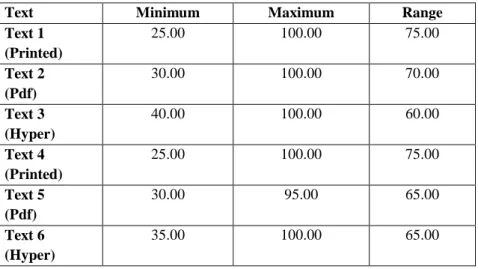
This part of the study presents the findings of the reading comprehension questions and writing an analysis of the participants. Table 2 shows the grades of students for reading comprehension questions.
Table 2. The lowest and highest grades of reading comprehension
Text Minimum Maximum Range
Text 1 (Printed)
25.00 100.00 75.00
Text 2 (Pdf)
30.00 100.00 70.00
Text 3 (Hyper)
40.00 100.00 60.00
Text 4 (Printed)
25.00 100.00 75.00
Text 5 (Pdf)
30.00 95.00 65.00
Text 6 (Hyper)
35.00 100.00 65.00
When the number of participants who took the lowest and highest grades in each week was examined, it is seen that students got the lowest grades from the Text 3 (hypertext), whereas the highest grades from Text 1 which is printed. It can be concluded that when compared to hypertext, printed-text was the ideal type in terms of reading task achievement. Similarly, Kim (2013) examined the variation between digital and conventional reading performances. The findings suggested that teenagers scored significantly higher on the paper reading comprehension tests than the electronic ones. Besides, Kerr and Symons (2006) in their study found that children were more efficient at comprehending text when reading on paper.
Table 3. The findings of the analysis of the writings
Text Themes Codes n %
Text 1 (Printed Text)
positiv e statem
ents
familiar, time-saving, easy, more useful, manageable, running text, note-taking friendly, awareness,
8 20.51
Text 2 (Plain Digital)
easy to manage, sharable, easy to follow,
attractive, 5 12.82
Text 3 (Hypertext)
joyful, colourful, attractive, fun, comprehensible, easy, motivating, not ordinary, time-saving, energetic
10 25.64
Text 4 (Printed Text)
easy, protects eyes, easy to follow,
Text 5 (Plain,Digital)
technological, easy to access, convertible,
easy to edit, printable 5 12.82
Text 6 (HyperText)
fun, scientific, time-saving, easy, enhances computer skills, motivational, extra-ordinary,
7 17.95
Text 1 (Printed Text)
negativ e statem
ents
boring, routine, dull, useless, asocial,
common, not simultaneous, isolation 8 22.86
Text 2 (Plain Digital)
feeling of loneliness, difficult, triggers
laziness, too boring, sometimes pausing. 5 14.29
Text 3 (Hypertext)
tiring, the sound of the keyboard is disturbing, time-consuming, causes headache
4 11.43
Text 4 (Printed Text)
traditional, ordinary, colourless, is not technological, is not remarkable, limited, not interesting, not multi-dimensional
8 22.86
Text 5 (Plain, Digital)
habit of using paper, feeling of loneliness, lack of classroom environment, boring, difficult,
5 14.29
Text 6 (HyperText) noisy, distraction, limited attention, tiring,
complex, 5 14.29
As it is seen in table 3, Text 1 and Text 4 were the printed papers. The positive perceptions on Text 1 (printed paper) were the easiness of reading from printed paper, awareness about it and being time- saving; yet the negative perceptions of Text 1 were the limited information on printed papers, dullness, and ordinariness. Additionally, when the perceptions on printed papers Text 1 and 4 were compared, the researcher found that students had more negative perceptions towards Text 4 which was printed. These negative perceptions were that texts were traditional, ordinary, colorless, and they were also not technological, interesting and multi-directional. On the other hand, positive perceptions were that they were easy to read and they did not strain eyes. In the contrary, Tseng (2008) in his study found that when reading hypertext the students displayed some physical responses such as eyestrain and headaches. However, Shang et al. (2015) suggested a strong and positive relationship between the use of hypertext reading and attempt of future hypertext use, which suggests that the EFL reading process may be directed to hypertext reading in the future.
When the writings of the students on Text 2 and 5 (plain digital) were analyzed, it was seen that negative perceptions of Text 2 were that it made students feel alone and it prompted students to laziness. As for Text 5 students stated that they prefer reading from printed paper, Text 5 made them feel alone, it was boring and difficult, and it did not make them feel as if they were in the classroom.
Table 4. Findings on Normality of Data
Kolmogorov-Smirnova Shapiro-Wilk
Skewness Kurtosis Statistic df Sig. Statistic df Sig.
Text 1
(Printed) 0.16 30.00 0.04 0.94 30.00 0.12 -0.27 -1.08 Text 2
(Pdf) 0.15 30.00 0.07 0.96 30.00 0.29 -0.23 -0.85 Text 3
(Hyper) 0.19 30.00 0.01 0.89 30.00 0.01 -0.96 0.03 Text 4
(Printed) 0.11 30.00 .200
* 0.94 30.00 0.10 -0.53 -0.69
Text 5
(Pdf) 0.18 30.00 0.01 0.93 30.00 0.05 -0.75 -0.24 Text 6
(Hyper) 0.25 30.00 0.00 0.86 30.00 0.00 -1.22 0.90
In order to determine the analyses, Kolmogorov-Smirnov, Shapiro Wilk, and skew-flatness coefficients were examined to consider whether the data showed normal distribution within the groups. As seen in Table 1, the data obtained from the Shapiro Wilk tests with a significance level greater than 0.05 was considered to show a normal distribution. In the data with a significance level less than 0.05, it was accepted that the values were normally distributed in the case of plainness and skew values between ±2.0 (George and Mallery, 2010) and statistical analyses were carried out by parametric tests.
Table 5. ANOVA Test for Comparing Exam Scores According To Text Types
Sum of Squares df Mean Square F Sig. η2
Between
Groups 8288.778 5 1657.756
4.762 0.01
0.12 Within
Groups 60572.467 174 348.118
Total 68861.244 179
Descriptive statistics for exam grades obtained by 3 text types are given in Table 6.
Table 6. Summary Statistics of 3 Exam Scores
N Mean Std. Deviation
Text 1
(Printed) 30 81.30 16.35
Text 2
(Pdf) 30 68.00 18.38
Text 3
(Hyper) 30 65.73 19.79
Text 4
Text 5
(Pdf) 30 69.87 19.38
Text 6
(Hyper) 30 66.97 21.03
When Table 6 is examined it is observed that there is a statistically significant difference between the exam scores of at least one text group. ( F (5,179)=4.76 p<0.05) the calculated effect size value (η2) was found to be 0.12. The value of the effect magnitude is known as an objective and standardized measure of the magnitude of the observed effect (Field, 2005, p. 33).
Table 7. Tukey Test for Differences Between Groups
Mean
Difference (I-J)
Std. Error Sig.
95% Confidence Interval Lower
Bound
Upper Bound
Text 1 (Printed)
Text 6 14.33* 4.82 0.04 0.45 28.22
Text 3 15.56* 4.82 0.02 1.68 29.45
Text 2 13.30 4.82 0.07 -0.58 27.18
Text 5 11.43 4.82 0.17 -2.45 25.32
Text 4 -0.97 4.82 1.00 -14.85 12.92
Text 2 (Pdf)
Text 6 1.03 4.82 1.00 -12.85 14.92
Text 3 2.27 4.82 1.00 -11.62 16.15
Text 1 -13.30 4.82 0.07 -27.18 0.58
Text 5 -1.87 4.82 1.00 -15.75 12.02
Text 4 -14.26* 4.82 0.04 -28.15 -0.38
Text 3 (Hyper)
Text 6 -1.23 4.82 1.00 -15.12 12.65
Text 1 -15.56* 4.82 0.02 -29.45 -1.68
Text 2 -2.27 4.82 1.00 -16.15 11.62
Text 5 -4.13 4.82 0.96 -18.02 9.75
Text 4 -16.53* 4.82 0.01 -30.42 -2.65
Text 4 (Printed)
Text 6 15.30* 4.82 0.02 1.42 29.18
Text 3 16.53* 4.82 0.01 2.65 30.42
Text 1 0.97 4.82 1.00 -12.92 14.85
Text 2 14.26* 4.82 0.04 0.38 28.15
Text 5 12.40 4.82 0.11 -1.48 26.28
Text 5 (Pdf)
Text 6 2.90 4.82 0.99 -10.98 16.78
Text 3 4.13 4.82 0.96 -9.75 18.02
Text 1 -11.43 4.82 0.17 -25.32 2.45
Text 2 1.87 4.82 1.00 -12.02 15.75
Text 4 -12.40 4.82 0.11 -26.28 1.48
Text 6 (Hyper)
Text 3 1.23 4.82 1.00 -12.65 15.12
Text 1 -14.33* 4.82 0.04 -28.22 -0.45
Text 2 -1.03 4.82 1.00 -14.92 12.85
Text 5 -2.90 4.82 0.99 -16.78 10.98
Text 4 -15.30* 4.82 0.02 -29.18 -1.42
according to type 6 and Type 3 of the test. (p<0.05) when we look at mean differences, exam scores prepared according to type 1 are higher than exam scores prepared according to type 6 and exam scores prepared according to type 3.
There are statistically significant differences between exam scores prepared according to type 4 and exam scores prepared according to type 6, Text 3 and Text 2. (p<0.05) when we look at the average differences, the exam scores prepared according to type 4 are higher than the exam scores prepared according to type 6, Text 3 and Text 2.
That is, when the types of texts are compared students performed the best in the printed-text reading condition.
4.
Discussion
This study focuses on the effect of different conditions of reading on reading comprehension. In line with modern technology, there is a wide variety of opportunities for students to develop reading skills. However, the practicality and preference issues have to be examined in order to maintain sustainable progress. In this study, it is observed that the participants expressed appreciation for hyper-text across a wider array of qualities. That is, the participants of this study were in favor of reading hyper-texts (%43,59) as course material. However, in the case of the scores that are obtained from the reading comprehension exams, the students didn’t perform well in the hyper-text condition. On the contrary, it is seen that the students got the highest grades in the printed-text exams carried on twice in the study. It can be put forward that hypertext reading condition affects reading comprehension negatively.
The future of teaching foreign languages is associated with a digital culture, which will affect both educational materials and curriculum as well. Within the context of foreign language education, the material developers are aware of the fact that most of the researches have cast their route to digitalized learning environments. However, the substitution of printed materials for digital texts is still questionable in terms of reading comprehension. In this study, it is clear that preference and competence may not go hand in hand. That is, although the hyper-texts received much more appreciation by the participants the reading exam results proved that printed-texts were more comprehensible.
5.
Conclusions
Technological innovations are likely to alter the conventional types of materials in the field of foreign language education. In this respect, there seems to be a shift from traditional reading to screen reading. It is probable that future curriculum studies would be based on 'screen reading' rather than paper-bound. Accordingly, the new materials should be designed with reference to this consideration.
The findings of this study suggest that EFL students are in favor of reading texts, containing links to text pictures and hyper-text. The findings also revealed that students who prefer reading digital texts, didn’t grade better on the reading comprehension tests. This finding is not in line with the writings of the participants obtained from the interviews in which they consider paper-based texts as routine, time-saving and easy while appreciating digital texts on condition that they consist of pictures and multi-links.
students as they got the highest grades from the printed versions. Accordingly, reflecting pedagogy via technology-mediated language teaching shouldn’t be taken for granted and it needs to be studied and developed in the other fields of teaching. Bearing in mind the increasing demand for digital reading, a broad theoretical perspective, and related strategies should be offered. Besides, reading processing on computers has to receive special education.
6.
Ethics Committee Approval
The author confirms that the study does not need ethics committee approval according to the research integrity rules in their country. (Date of Confirmation: 24.03.2020)
References
Bodomo, A., Lam, M., & Lee, C. (2003). Some students still read books in the 21st Century: A study of user preferences for print and electronic libraries, The Reading Matrix, 3, 3.
Brown, D. (1994). Teaching by principles. An interactive approach to language pedagogy. USA: Prentice Hall.
Brown, G. J. (2001). Beyond print: Reading digitally. Library Hi Tech, 19 (4), 390-399.
Cazacu, S. T., & Banica, L. (2001). Reading long (continuous) texts on paper and on computer’, in Arabski, J. (ed.). Challenging tasks for psycholinguistics in the new Century, Proceedings of the 7th ISAPL Congress, Katowice, University of Silesia, 188-292.
Chauhan, P., & Lal, P. (2012). Impact of information technology on reading habits of college students. IJRREST: International Journal of Research Review in Engineering Science and Technology, 1(1), 101-106.
Chou, I. C. (2009). Exploring international ESL students’ on-screen reading behaviours with two academic reading purposes. Doctoral dissertation. The Ohio State University, USA.
Connell, C., Bayliss, L., Farmer, W. (2012). Effects of e-book readers and tablet computers on reading comprehension, International Journal of Instructional Media, 39, 2, 131.
Creswell, J. W. (1994). Research design: Qualitative and quantitative approaches. Thousand Oaks: Sage Publications.
Creswell, J. W. & Plano Clark, V. L. (2007). Designing and conducting mixed methods research (1st
Edition). London: Sage Publications Ltd.
Dündar, H., & Akçayır, M. (2012). Tablet vs. paper: The effect on learners' reading performance, International Electronic Journal of Elementary Education, 4 (3), 441-450.
Elo S, Kaariainen M, Kanste O, Polkki T, Utriainen K, Kyngas H. (2014). Qualitative content analysis: A focus on trustworthiness. SAGE Open, 4(1):1-10.
Fischbein, E. & Nachlieli, T. (1998). Concepts and figures in geometrical reasoning, International Journal of Science Education, 20(10), 1193–1211.
Given, L. (Ed.). (2008). The SAGE encyclopaedia of qualitative research methods. Vol. 1, 2. Los Angeles, CA: Sage.
Greene, J. C., Krayder, H., & Mayer, E. (2005). Combining Qualitative and Quantitative Methods in Social Inquiry. In B. Somekh & C. Lewin (Eds.). Research Methods in the Social Sciences (p. 275-282). London: Sage Publishing.
Güneş, F. (2009). Speed reading and meaning configuration. Ankara: Nobel Publishing.
Güneş, F. (2010). Öğrencilerde ekrandan okuma ve ekranik düşünme, Journal of Social Sciences Institute, 7, 14.
George, D., & Mallery, M. (2010). SPSS for windows step by step: A simple guide and reference, 17.0 update (10a ed.), Boston: Pearson.
Halme, O. (2011). E-Reading devices as a new medium for newspaper reading. Unpublished master’s thesis. Department of Marketing, Aalto University, School of Economics: Finland.
Kerr, M. A., & Symons, S. E. (2006). Computerized representation of Text: Effects on children's reading of informational material. Special Issue on Reading Comprehension, Part II., Reading and Writing: An Interdisciplinary Journal, 19 (1), 1-19.
Landow, J. (2013). Reading from an LCD monitor versus paper: Teenagers’ reading performance. International Journal of Research Studies in Educational Technology, 2, (1), 15-24.
Larson, L. C. (2010). Digital readers: The next chapter in E-Book reading and response. The Reading Teacher, 64, 1, 15-22.
Luo, M., & Dappen, L. (2005). Mixed-methods design for an objective-based evaluation of a magnet school assistance project. Evaluation and Program Planning, 28(1), 109-118.
Maden, S. (2012). Screen reading types and opinions of prospective teacher of Turkish language towards Screen reading. International Eurasian Journal of Social Sciences, 3(7), 16-28.
Mangen, A., Walgermo, B. R., & Bronnick, K. (2013). Reading linear texts on paper versus computer screen: Effects on reading comprehension, International Journal of Educational Research, 58, 61-68.
Mazzoleni, A. K. (2012). Digital and paper-based: The complex literacies of composition students and instructors. Unpublished master’s thesis. Miami University, Oxford, Ohio.
Mikulecky, B. S., & Jeffries, L. (2007). Advanced reading power, Pearson Longman, NY.
Mikuska, D., & Seaton, M. (2011). Paper or Electronic Books: Reading World Literature with High School Students and Staff. International Journal of the Book, 8, 1, 32-42.
Nuttall, C. (1996). Teaching reading skills in a foreign language, Macmillan Publishers Limited, Oxford.
Schweigert, W.A. (2012). Research methods in psychology: A Handbook. Long Grove, IL: Waveland Press, Inc.
Shang, H. F. (2015). An investigation of scaffolded reading on EFL hypertext comprehension. Australasian Journal of Educational Technology, 31. 293-312.
Spencer, C. (2006). Research on learners’ preferences for reading From a printed text or from a computer screen, Journal Of Distance Education, 21, 1, 33-50.
Tuncer M., & Bahadır F. (2014). Effect of screen reading and reading from printed out material on student success and permanency in introduction to computer lesson, The Turkish Online Journal of Educational Technology, 13, issue 3.
Tseng, M. (2008). Comparing EFL learners’ reading comprehension between hypertext and printed text, CALL-EJ Online, 9(2).
Vandenhoek, T. (2013). Screen reading habits among university students, International Journal of Education and Development using Information and Communication Technology (IJEDICT), 9, 2, 37-47.
Yin, R. K. (2003). Case study research: Design and methods (3rd ed.). Thousand Oaks, CA: Sage Publications.
APPENDIX A. The Comprehension Questions
HUMAN RESPONSES TO DISASTER 1. Define the following vocabulary with your own words:
a) Catastrophe: b) Survivor: c) Extreme: d) Resource: e) Demand:
2. Give examples to catastrophic events.
3. What are the five stages of human responses to disaster? 4. Why is human trauma studies are difficult to conduct?
5. Which one is the most crucial stage of human responses to disaster? Why? 6. Replace following vocabulary of the passage with their synonyms.
a) range (1st paragraph, line 6)
b) undergone (1st paragraph, line 9)
c) immediately (2nd paragraph, line 1)
d) effort (3rd paragraph, line 13)
e) involve (6th paragraph, line 4)
7. Why would a person experience existential problems during the fifth stage, explain? 8. Write possible headings for each paragraph of the passage.
9. What do you think would be the most devastating disaster in an individual’s life?
10. Have you ever experiences a disaster or witnessed someone experience a disaster. Share your experiences.
PERSISTENT PESTS
1. Use following words in sentences. You can use them in different forms or tenses.
a) Predominantly
……… b) Eliminate
c) Falter
……… d) Thwart
……… e) Offspring
………. 2. Write the antonyms of words below.
a) Eradicate: b) Noble: c) Poison: d) Encouraging e) Local
3. What is the reason behind the efforts of eradicating the mosquitoes?
4. What surprised scientist about their efforts on eradicating mosquitoes?
5. What caused the eradication plan to fail after some time? Explain with your own words.
6. How would you try to manage a pesticide problem with your home or garden if you encounter resistant pests?
7. What is the role of natural selection to our lives? Explain with your own words?
8. Do you believe natural selection will change our lives dramatically making small creatures bigger and stronger?
MOON LANDINGS
1. One field that was undoubtedly effected by the moon landings was……… 2. What is the restriction for the manned exploration to the moon?
3. Why do the scientists send rockets to the lunar surface? 4. Do astronaouts have difficulty in travelling to lunar craters? 5. What is the reason of sending a good deal of rockets to the moon? 6. What are the size of the craters?
7. What is the reason of a serious limitation for the future lunar missions? 8. Which of the moon landing was productive.First one or the sixth one? 9. How did the astronauts travel farther from the landing site?
Basılı metin en iyi seçim mi? Okuduğunu anlama üzerine karma yöntemli vaka
çalışması
Öz
Okuma, sadece öğrencilerin okuma yazma becerilerini geliştirmesini değil, aynı zamanda bir dil içindeki söylemi kavramasını ve formüle etmesini sağlayan temel bir dil becerisidir. Diğer yandan, okuma eksikliği ise, anlama bozukluğuna yol açmakta ve öğrencilerin akademik ilerlemelerini önemli ölçüde etkilemektedir. Ekrandan okumanın, kağıtdan okumadan daha etkili olduğunu öne süren çalışmaların sayısı her geçen gün artmaktadır. Bu çalışmanın temel amacı, ekrandan okumanın İngilizce'de okuduğunu anlama üzerindeki etkilerini ortaya koymaktır. Çalışma, bir devlet üniversitesinde İngilizce Öğretmenliği lisans programında öğrenim gören 30 birinci sınıf öğrencisi ile yürütülen karma yöntemli vaka çalışmasıdır. Veri toplama aracı olarak performans testleri ve yazılı görüş formları kullanılmıştır. Çalışma öncesinde altı farklı okuma metni belirlenmiştir. Bunlardan ikisi basılı ve dördü dijitaldir. Pdf formundaki dijital metinlerden ikisi düz metindir; diğer iki metin ise resimler ve bağlantılar ile zenginleştirilmiştir. Metinleri okuduktan sonra katılımcılar, araştırmacı tarafından hazırlanan okuduğunu anlama sorularını yanıtlamıştır. Ayrıca her uygulamadan sonra katılımcıların yazılı görüşleri toplanmıştır. Veri analizi sürecinde performans testleri puanlanmış ve yazılı görüşler temalara ayrılmıştır. Sonuç olarak, en yüksek ortalama puanına sahip uygulamanın, basılı okuma metni olduğu belirlenmiştir. En düşük iki başarı ortalaması ise, çalışmanın üçüncü ve beşinci haftasında uygulanan metin resimlerine ve hipermetne bağlantılar içeren hiper metin olarak belirlenmiştir. Bulgulara göre, metinleri basılı olarak okuyan öğrencilerin, okuduğunu anlama testlerinde dijital metin okuyan öğrencilere göre önemli ölçüde daha iyi puan aldıklarını ortaya koymuştur. Buna göre; çalışma yabancı dil öğrenimi alanında okuduğunu anlama üzerine çeşitli pedagojik öneriler içermektedir.
Anahtar sözcükler: EFL; okuduğunu anlama; basılı metin, dijital metin, hiper metin
AUTHOR BIODATA