Workload Cluster Balance Algorithm to Improve
Wireless Sensor Network Performance
Ahmed Jedidi
CES laboratory, National Engineering School, University of Sfax, Tunisian Computer Engineering department, College of Engineering, Ahlia University, Bahrain
Abstract: Wireless sensor Networks (WSNs) became in one of the important technologies in our days in which it is applied in many applications and domains. The low cost technology of the WSNs is the first obstacle to improve performance in these applications. However, the usual methods of routing algorithm cannot be applied in WSNs. Consequently, an adaptive routing algorithm is critical issue in the current deployment of WSN applications. The main contribution of this paper is to develop a new routing protocol that address performance challenges in WSNs this will consequent extend the network lifetime of WSN. Moreover, this proposed algorithm uses a new cluster system to define a route from source node to sink node in which the balance load cluster routing algorithm consists to balance the workload between the different nodes. The workload balance has an objective to keep the lifetime for the nodes then for the whole network. As a result, the proposed algorithm improve the network lifetime by 22% compare to existing algorithms and the average of the energy consumption is decreased by 18%.
Keywords: Wireless sensor network, Cluster, Lifetime, Residual energy, Routing, Balance workload,
1.
Introduction
Wireless Sensor Network (WSN) is presented as a promoting technology in various domains. According his low cost technology, WSN became the backbone of Internet of Things (IoT) and many others applications which the performance of the network presents one of the high priority and importance criteria. IoT is defined as the connection between the physical environments and the digital one. Recently, IoT involves in various areas industrial, militarily and ecosystem, which it takes place more and more indispensable. In addition, these areas required a high quality of service (QoS), particularly: security, efficiency and energy consumption [1].
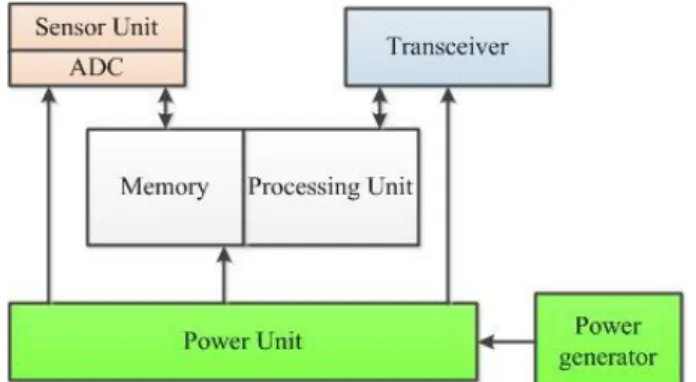
A typical WSN is a particular type of Mobile Ad-hoc NETwork (MANET) with challenging constraints [2-3]. It is composed of independent set in the range of few to thousands of tiny devices that are known as sensors or nodes or sensor nodes [4]. These nodes incorporate an embedded CPU, limited computational power, storage capabilities, and some smart sensors cooperatively communicate to each other via several wireless media to sensing and controlling the physical environment [5] as shown in figure 1.
The sensor node architecture characterized by limited resources such as processor performance, low memory and limited energy life become the first and major obstacle to implement an appropriate routing algorithm in WSN. Furthermore, monitor and optimize the communication between the different nodes is one of the important areas which researches focus their works and studies. Particularly, they focus their studies to find a routing algorithm to improve energy consumption and to cope with the WSNs limitation. To satisfy these requirements, many methods are proposed to
compromise between energy consumption and low resources used. Specifically, widely routing mechanisms are used the cluster-based routing. General, routing techniques based on clustering are the most effective way to reduce energy consumption in WSNs. In clustering process, sensors nodes are divide into two main groups named cluster head (CH) and cluster member (CM) [6-7]. Each sensor node should belong to one and only one cluster role. As a result, the main idea of the cluster process is that the sensor nodes send their data to their corresponding CHs, then CHs then aggregate them and send it to sink node.
Figure 1. Basic architecture of sensor node.
In this paper, we propose a new routing algorithm based on clustering process to improve the energy consumption, the data delivery and the lifetime in WSN. Furthermore, this proposed routing algorithm based on two parts. First, the classification of nodes in three status which it defines the role of each node in WSN. Second, the routing protocol based on the workload balance elaborates the route from the source node to sink node. The Balance Load Cluster Routing algorithm (BLCR) compromise between the energy consumption and the workload with taking on consideration the limit technologies of the WSN.
2.
Cluster-Based Protocols
2.1 Definition
As mention before wireless sensor network is the backbone of many hostile applications where the QoS is indispensable. Moreover, WSNs are a high distributed network which deployed thousands of sensors, which the management and monitor of the data are critical. As a result, the energy consumption and workload in WSNs are very important. There are several routing protocols have been proposed and implemented to deploy an efficient WSN communication. This section discusses the related works regarding the clustering system [8-9].
The cluster-based routing is an energy efficient strategy in which the nodes is perform diverse responsibilities in WSN and typically are organized into several clusters based on specific requirements each cluster encompasses of cluster member (CM) or ordinary node (ON) in addition to a leader node called cluster head (CH) [10-11]. In general, nodes with high energy can be considered as candidate nodes and act as CH for processing and sending data while the nodes with low energy acts as CM which can be used for sensing and sending information to the cluster heads (CHs) [12]. Therefore, this property contributes to the scalability, reducing the load, maximize the lifetime, and minimize the energy, more robustness [13-14]. The cluster-based routing protocols categorized into three types: block cluster based, grid cluster based and chain cluster based [15].
Cluster head selection
Cluster Formation
Data Aggregation
Data Communication
Setup State Steady data transmission state Round
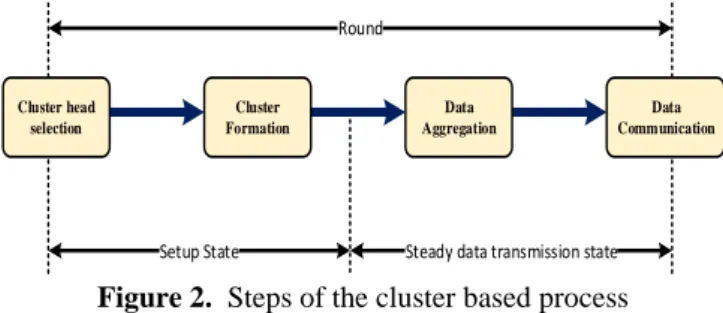
Figure 2. Steps of the cluster based process
In cluster-based protocol the WSN is divided into several regions depend based on some mechanism [15] such as the transmission range and sensing range called clusters. At the beginning of the cluster implementation, some of the sensor nodes declared as cluster heads become the monitor of CM activities and collecting sensed data from its associated nodes in the cluster. Then it aggregates the whole data sensed in its cluster and later transmit to the other CHs or sink node. A sensor node fitting to a cluster transmits its sensed data to its cluster head instead of the base station, by the mean of reducing the effective communication distance the energy consumption in these nodes are decreased [16-17]. Although these protocols can provide different mechanisms of the clusters formation and cluster head selection process, affording an energy efficiency protocol will rise the network lifetime directly and increased the network scalability [18-20]. Generally, the cluster-based process is divided into several rounds [19]. Each round consists of two main states, which are setup state followed by the steady data transmission state. Furthermore, each state is encompassing of two stages as shown in figure 2. In this section, we will present the two most famous protocols based on the cluster process Low Energy Adaptive Clustering Hierarchy (LEACH) and Power-Efficient GAthering in Sensor Information Systems (PEGASIS)
2.2 Low Energy Adaptive Clustering Hierarchy
Low Energy Adaptive Clustering Hierarchy (LEACH) is a self-organizing, probabilistic clustering-based energy efficient routing protocol that was proposed by W. Heinzelman in 2000 [3]. The mean idea of LEACH has motivated many successive clustering routing protocols [19]. The main objectives of LEACH are to prolong network lifetime, minimizing energy consumption of sensor nodes in communicating with the sink node by distributing the energy load uniformly to all the homogeneous and energy constrained nodes in the sensor network [20]. The process of LEACH is broken up into different rounds; each round is separated into two phases: the setup phase and steady state phase. In setup phase where all nodes have a chance to be randomly chosen as a CH for the current round with a probability 𝑝 between 0 and 1, if it is less than threshold value in every round 5% of nodes are CHs and they must broadcast their status to other sensor nodes in the network. The nodes will themselves find out the cluster to which they belong which required the least communication energy. This clustering allows the nodes to send the data based on TDMA indicated by the CH [21]. The role of selecting CH is periodically rotates among the various sensors in order to not drain the battery of a single sensor. Since there is a chance of a node with very low energy to be selected as a CH and when this node dies it will cause whole cluster to becomes dysfunctional for a certain time [21]. While in steady state phase, sensor nodes sense and transmit the data to their respective CH. Consequently, the CH compress data received from various sensor nodes aggregate or fused packet and send to the sink node directly. Once the send process is done the setup phase will start to choose another set of CHs. Although LEACH achieved 8 times improvement compared to the direct transmission, it has some drawbacks like performing a single-hop, which is inefficient for large region networks also real-time applications [19].
2.3 Power-Efficient GAthering in Sensor Information Systems
Lindsey et al. proposed a near optimal chain-based protocol as an improvement of LEACH named Power-Efficient GAthering in Sensor Information Systems (PEGASIS) [22]. The basic idea of PEGASIS is that each node establishes connection only with their close neighbor and takes turns being the leader for transmission to the sink node [23]. Furthermore, the sensor nodes structured themselves to form the chain based on uses the greedy approach. If any of the node dies in between then the chain is reconstructed to bypass the dead node, one leader node is assigned and that node will transmit the data to the sink node.
3.
System Model
Sensor nodes are the key component of the WSN in which it is a distributed network of many thousands of these tiny devices. In this section, we describe the sensor node model and the different assumptions adopted by this work. In addition, we present the network model used to implement the balance load cluster routing algorithm.
3.1 Node model
The sensor node model used in this work has the following features. First, we assume that all the sensor nodes are homogenous and initiate by the same amount of energy noted by𝐸𝑖𝑛𝑖𝑡. The sensor node plays two roles as receiver and transmitter, for that the energy consumption model are divided in two parts as describe in equation1. Moreover, we adopt the energy consumption model of [24] in which both free space and multi-path fading channels are employed according the distance between the receiver and the transmitter node. We define 𝑑0 the threshold distance that separate the free space fs and multipath mp. In addition, we assume that 𝜃𝑓𝑠 and 𝜃𝑚𝑝 the energy required by amplifier in free space and multipath respectively. Besides 𝛿𝑡 and 𝛿𝑟 the energy dissipated in transmitting and receiving one bit respectively. To transmit β bit data from node i to node j the consumption energy is given by equation 1. In addition, the consumption energy for the receiving β bit data by node j presented.
𝐸𝑡(𝑖, 𝑗) = {
(𝛿𝑡+ 𝜃𝑓𝑠 𝐷(𝑖↔𝑗)2 )𝛽, 𝐷(𝑖↔𝑗)< 𝑑0
(𝛿𝑡+ 𝜃𝑚𝑝 𝐷(𝑖↔𝑗)4 )𝛽, 𝑜𝑡ℎ𝑒𝑟𝑤𝑖𝑠𝑒
Transmitter (1)
𝐸𝑟(𝑗) = 𝛿𝑟𝛽 Receiver
Second, each sensor node has the capabilities to know his location and the location of his neighbors according some localization techniques such as proposed in [25]. In addition, each sensor node has given a unique identification number, sensing range, denoted by r, and communication range R where R =2r. Third, sensor node can transit between two states cluster head (CH) and cluster member (CM) according the balance Cluster Mechanism (SCM) that will be detailed in the next section. Fourth, two connected nodes ensures the exchange and delivery for the different information periodically such as energy, localization, state of connection and workload.
Ni,4
Ni+1,4
Ni,3
Ni+1,3
Ni+3,3
Stage 4 Stage 3 Ni-1,4
Ni+2,3
r
Ni,2
Ni+1,2
Ni-1,1
r
Stage 2 Stage 1 Sink node Sink node
Wireless sensor Network
Wireless sensor Network model
Figure 3. Wireless sensor network model
3.2 Network model
In this work, we adopt the network architecture presented in figure 3. The network model consists to organize the various sensor nodes in N stages which we assume that all nodes locate between d and d+r are belongs the same stage j of the network. Therefore, our network model compose by M sensor nodes distribute in N stages and sink node localizes in stage 1. Each node has the capability to connect to the nodes in the same stage and to the others nodes in the next and previous stages in condition that locate in the area of transmission R
4.
Balance Cluster Routing Algorithm
WSN presents a promising technology that the performance and the QoS are indispensable for the applications applied WSN. Particularly, energy consumption is one of the important features in WSN where routing algorithm is the first responsible. Consequently, to improve the WSN performance and QoS we should find an adequate routing algorithm to monitor and manage the traffic data in the whole network. In this section, we describe the main contribution of the balance load cluster routing algorithm (BLCR). Before, we detail the Balance Cluster Mechanism (BCM) that it is used to transit sensor nodes from state to another
4.1 Balance cluster mechanism
In traditional cluster concept, we have two members: Cluster Head (CH) and Cluster Member (CM). However, the balance cluster mechanism (BCM) presents a subdivision for the cluster head: cluster head level 1 (𝐶𝐻𝐿1) and cluster head level 2 (𝐶𝐻𝐿2). The figure 4 depicts the transition between the various states of BCM. Further, the different states of BCM has a specific characteristics, and to be one of the member of these states the sensor node should satisfies these requirements as cited in table 1.
Table 1. Cluster states features and privilege
State Features Privilege
CM All nodes start with this state 0
𝐶𝐻𝐿1
Residual energy of the node 𝑁𝑐 𝑖𝑛 𝑠𝑡𝑎𝑔𝑒 𝑖
𝐸𝑟𝑐> 𝐸𝑟0
&
∃ 𝑁𝑗∈ {𝑆𝑖−1∩ 𝑅𝑐} ↔ 𝑁𝑐
1
𝐶𝐻𝐿2
Residual energy of the node 𝑁𝑐 𝑖𝑛 𝑠𝑡𝑎𝑔𝑒 𝑖
𝐸𝑟𝑐> 𝐸𝑟1
&
∃ 1
2∗ 𝑁𝑗 ∈[1,𝑀]∈ 𝑅𝑐↔ 𝑁𝑐
3
First, the 𝐶𝐻𝐿1 required that the candidate node has a residual energy great than 𝐸𝑟0 (𝐸𝑟0 be fixed by BCM) and at least one of the sensor node in the previous stage and in the communication range R is connected with the candidate node. Second, the 𝐶𝐻𝐿2 presents a high value of privilege with the node should has more than the half of nodes in communication range R are connected and the residual energy is great than the𝐸𝑟1. Otherwise, all nodes begin with the CM state. These states define the connection privilege of each node and based on the privilege parameter the routing algorithm established the route from the source node to the sink node, which we use Balance cluster algorithm.
CM CHL1 CHL2 Erc>Er0
& ∃𝑁𝑗∈ {𝑆𝑖−1∩ 𝑅𝑐} ↔ 𝑁𝑐
Erc>Er0 & ∃1
2∗𝑁𝑗∈[1,𝑀]∈ 𝑅𝑐↔ 𝑁𝑐
Otherwise
Figure 4. Balance cluster mechanism transition
4.2 Balance load cluster routing algorithm
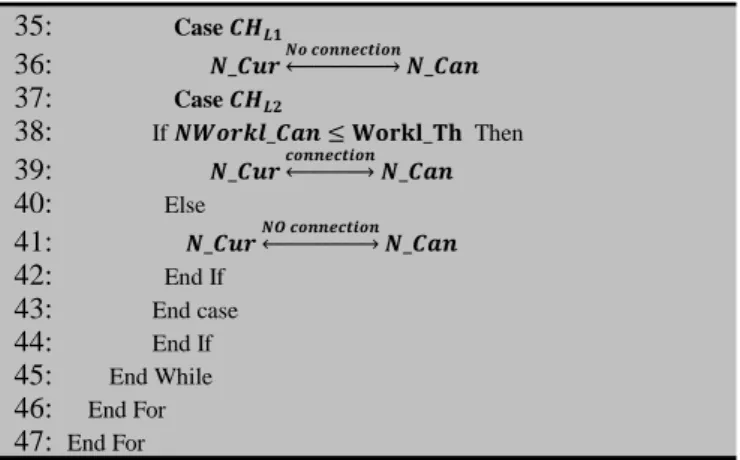
WSN performance is measured with several parameters, particular the energy consumption, the total live of the sensor components and network and the data deliver. Routing system is one of the principal factors that contributes in these parameters. Further, balance cluster load algorithm subscribe to improve energy consumption and lifetime in the overall network and the data deliver. The algorithm 1 describes the different steps of function for the BLCR.
Algorithm 1: Pseudo code for determine the connection between the nodes in WSN.
Input:
𝒏𝒐𝒅𝒆𝑰𝑫, 𝒏𝒐𝒅𝒆 𝒔𝒕𝒂𝒕𝒆, 𝒏𝒐𝒅𝒆 𝒔𝒕𝒂𝒈𝒆, 𝒏𝒐𝒅𝒆 𝒓𝒂𝒏𝒈𝒆 𝒕𝒓𝒂𝒏𝒔𝒎𝒊𝒔𝒔𝒊𝒐𝒏, 𝒂𝒏𝒅 𝒏𝒐𝒅𝒆 𝒘𝒐𝒓𝒌 𝒍𝒐𝒂𝒅
Output: find the connectivity between the nodes.
1: For𝒊 ← 𝟏To𝑴//M is the total number of nodes in the WSN
2: 𝑵_𝑪𝒖𝒓 ← 𝑵(𝒊)//N(i) is the current node ID
3: 𝑵𝑺𝒕𝒂𝒈𝒆_𝑪𝒖𝒓 ← 𝑵𝑺𝒕𝒂𝒈𝒆(𝒊)//NStage(i) is the stage of the
current node
4: For 𝒋 ← 𝟏 To 𝒁 ⊆ 𝑴 //Z is the total number of nodes with in the
transmission range
5: Do While 𝒊 ≠ 𝒋
6: For𝒌 ← 𝟏To𝒁
7: 𝑵_𝑪𝒂𝒏 ← 𝑵(𝑲)//N(k) is the candidate node ID
8: 𝑵𝑺𝒕𝒂𝒈𝒆_𝑪𝒂𝒏 ← 𝑵𝑺𝒕𝒂𝒈𝒆(𝒌)//NStage(k) is the stage of
the candidate node
9: 𝑵𝑾𝒐𝒓𝒌𝒍_𝑪𝒂𝒏 ← 𝑵𝑾𝒐𝒓𝒌_𝒍𝒐𝒂𝒅(𝒌) //NWork_load(k) is
the work load of the candidate node
10: 𝑵𝒔𝒕𝒂𝒕𝒆_𝑪𝒂𝒏 ← 𝑵𝒔𝒕𝒂𝒕𝒆(𝒌)//NState(k) is the state of
the candidate node
11: //determine the priority of the connected stage
12: If 𝑵𝑺𝒕𝒂𝒈𝒆_𝑪𝒖𝒓 = 𝑵𝑺𝒕𝒂𝒈𝒆_𝑪𝒂𝒏 Then
13: 𝒑𝒓𝒊𝒐𝒓 ← 𝒏𝒐𝒓𝒎𝒂𝒍
14: Else If 𝑵𝑺𝒕𝒂𝒈𝒆_𝑪𝒖𝒓 = 𝑵𝑺𝒕𝒂𝒈𝒆_𝑪𝒂𝒏 + 𝟏 Then
15: 𝒑𝒓𝒊𝒐𝒓 ← 𝒉𝒊𝒈𝒉
16: End If
17: //establish the connectivity between the source node and
the candidate node with the range transmission
18: If 𝒑𝒓𝒊𝒐𝒓 = 𝒉𝒊𝒈𝒉 Then
19: Select Case 𝑵𝒔𝒕𝒂𝒕𝒆_𝑪𝒂𝒏// the cluster node level i.e.
state (L1 or L2)
20: Case 𝑪𝑯𝑳𝟏
21: If 𝑵𝑾𝒐𝒓𝒌𝒍_𝑪𝒂𝒏 ≤ 𝐖𝐨𝐫𝐤𝐥_𝐓𝐡 Then
22: 𝑵_𝑪𝒖𝒓𝒄𝒐𝒏𝒏𝒆𝒄𝒕𝒊𝒐𝒏↔ 𝑵_𝑪𝒂𝒏
23: Else
24: 𝑵_𝑪𝒖𝒓𝑵𝑶 𝒄𝒐𝒏𝒏𝒆𝒄𝒕𝒊𝒐𝒏↔ 𝑵_𝑪𝒂𝒏
25: End If
26: Case 𝑪𝑯𝑳𝟐
27: If 𝑵𝑾𝒐𝒓𝒌𝒍_𝑪𝒂𝒏 ≤ 𝐖𝐨𝐫𝐤𝐥_𝐓𝐡 Then
28: 𝑵_𝑪𝒖𝒓𝒄𝒐𝒏𝒏𝒆𝒄𝒕𝒊𝒐𝒏↔ 𝑵_𝑪𝒂𝒏
29: Else
30: 𝑵_𝑪𝒖𝒓𝑵𝑶 𝒄𝒐𝒏𝒏𝒆𝒄𝒕𝒊𝒐𝒏↔ 𝑵_𝑪𝒂𝒏
31: End If
32: End case
33: Else If 𝒑𝒓𝒊𝒐𝒓 = 𝒏𝒐𝒓𝒎𝒂𝒍 Then
34: Select Case 𝑵𝒔𝒕𝒂𝒕𝒆_𝑪𝒂𝒏// the cluster node level i.e.
state (L1 or L2)
35: Case 𝑪𝑯𝑳𝟏
36: 𝑵_𝑪𝒖𝒓𝑵𝒐 𝒄𝒐𝒏𝒏𝒆𝒄𝒕𝒊𝒐𝒏↔ 𝑵_𝑪𝒂𝒏
37: Case 𝑪𝑯𝑳𝟐
38: If 𝑵𝑾𝒐𝒓𝒌𝒍_𝑪𝒂𝒏 ≤ 𝐖𝐨𝐫𝐤𝐥_𝐓𝐡 Then
39: 𝑵_𝑪𝒖𝒓𝒄𝒐𝒏𝒏𝒆𝒄𝒕𝒊𝒐𝒏↔ 𝑵_𝑪𝒂𝒏
40: Else
41: 𝑵_𝑪𝒖𝒓𝑵𝑶 𝒄𝒐𝒏𝒏𝒆𝒄𝒕𝒊𝒐𝒏↔ 𝑵_𝑪𝒂𝒏
42: End If
43: End case
44: End If
45: End While
46: End For
47: End For
The balance load cluster routing boosts the connection with the node located in the next stage. Furthermore, BLCR give a high priority for the node with state 𝐶𝐻𝐿1 located in 𝑠𝑡𝑎𝑔𝑒 𝑖 + 1 more than node with 𝐶𝐻𝐿2located in 𝑠𝑡𝑎𝑔𝑒 𝑖despite the 𝐶𝐻𝐿2privilege is great than the privilege of𝐶𝐻𝐿1. In addition, BLCR favorites the node that has a workload less than certain threshold(𝑤𝑜𝑟𝑘𝑙𝑜𝑎𝑑_𝑡ℎ0). As sample, we present a scenario which the candidate node is located in 𝑠𝑡𝑎𝑔𝑒 𝑖 + 1 and has a 𝐶𝐻𝐿2as state but the workload is great than the
𝑤𝑜𝑟𝑘𝑙𝑜𝑎𝑑_𝑡ℎ0BLCR do not establishes the connection.
Otherwise, in the same scenario, if exist another node with state 𝐶𝐻𝐿1and with workload less than the threshold BLCR establishes connection.
The basic concept of BLCR is to balance the workload between the different nodes in objective to keep the performance in the whole network and particular to increase the lifetime of the sensor nodes. First, the BCM select the state of the node based on the residual energy and the number of nodes connected with the candidate node. The combination between these two parameters effect the energy consumption and the performance at the node level. Moreover, as we define before the 𝐶𝐻𝐿2 has the high privilege on connection, then the sensor node that plays this state should forwards various packets. Consequently, it should has a minimum of residual energy to achieve the required work. In addition, BCM fixes a minimum number of the nodes connected to the candidate node to be𝐶𝐻𝐿2, this number of nodes should be great than the half of total number in the area of transmission R. The second requirement favorites the performance of the node on term of trust, availability and security. In this point, the main philosophy is when they have a more then the half of node connected to this candidate node means that they trusted it, consequently it guaranty a minimum of availability and security.
5.
Simulation Results and Discussion
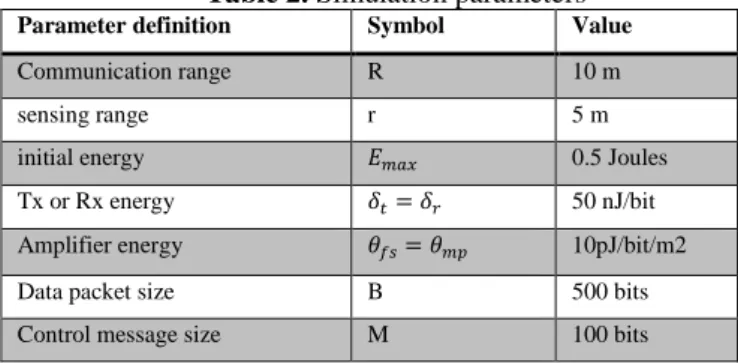
The limitations resources in WSN lead to notice that the traditional routing protocols are not useful to reach the high performance in the network. However, many routing protocols are proposed to satisfy these requirements, such as the energy consumption, the security and the lifetime. The proposed routing protocol based on balance of the workload between the different cluster head is new system to improve and optimize the energy consumption, the lifetime and the security. In this section, we evaluate the BLCR at these parameters and compare the results with the existing protocols (LEACH and PEGASIS). To evaluate the BLCR algorithm a set of simulation were conducted using Matlab as simulation platform. This simulator allows the scalability of the underlying network with the facility of defining various parameters of network such as deployment coverage area, transmission range and network size (number of nodes) as shown in table2.
Table 2. Simulation parameters
Parameter definition Symbol Value
Communication range R 10 m
sensing range r 5 m
initial energy 𝐸𝑚𝑎𝑥 0.5 Joules
Tx or Rx energy 𝛿𝑡= 𝛿𝑟 50 nJ/bit
Amplifier energy 𝜃𝑓𝑠= 𝜃𝑚𝑝 10pJ/bit/m2
Data packet size B 500 bits
Control message size M 100 bits
First, we study the behaviors of the cluster states as function the number of rounds as shown in figure 5. Furthermore, we notice that the number of nodes that adopt the 𝐶𝐻𝐿2 is great than the 𝐶𝐻𝐿1 at the beginning of the simulation and with the number of rounds increase the situation will be opposite. Indeed, all nodes start with initial energy that plentiful great compare with the threshold energy of the 𝐶𝐻𝐿2, then most of the nodes going to 𝐶𝐻𝐿1state. With the number of rounds increase, the residual energy decrease and the nodes states pass to the second threshold energy 𝐶𝐻𝐿1 before they died. In addition, we remark that the rate of the various states are almost the same in the middle of simulation time. However, this situation change in the beginning and in the end of the simulation. Particular, the state 𝐶𝐻𝐿2 decrease significantly around 6000 rounds compare to 𝐶𝐻𝐿1 in which the performance of the network rests acceptable and the data delivery keep running.
Figure 5. Cluster states behaviors
The second part of the implementation, test and validation of the proposed algorithm consists to evaluate the lifetime, the energy consumption and the data delivery for the whole network. Particularly, we compare the BLCR with the LEACH and PEGASIS protocols. First, we consider a network with 600 sensor nodes in which the proposed algorithm was running to evaluate the network lifetime as shown in the figure 6. We observe that the BLCR algorithm outperforms the others algorithms (LEACH and PEGASIS). Moreover, the BLCR keep the network in life by 20 % to 22% compare to LEACH and PEGASIS. Indeed, the gait of the dyeing sensor nodes is more slowdown than the others protocols precisely when the simulation time is between 1500 and 3000 rounds. We explain this result by the workload balance are relatively proportional distributed with the state of the sensor nodes in the step time 1500-3000 rounds. As a result, the sensor node lifetime has improved consequently the whole network lifetime increases.
Figure 6. Number of alive sensor nodes
Second, the figure 7 depicts the average of the residual energy as function of the number of rounds. We notice that the residual energy has improved for the BLCR algorithm compare to LEACH and PEGASIS in which the sensor node retention his energy long time, precisely between 1500 and 3000 rounds because it swapped through the different cluster states and played his appropriate role on synchronization with the workload mostly in this region of time. Moreover, the BLCR improve the residual energy by 18 % rate between 1500 and 3000 rounds compare to the others protocols. This result explains the network lifetime above which the sensor node life is the main factor to improve the whole network lifetime.
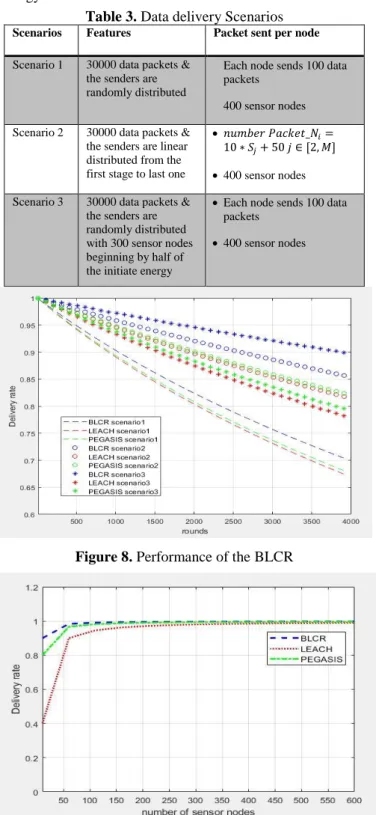
Third, the figure 8 presents the evaluation of the last parameter the data delivery or the performance of the network function. To measure this parameter we use three scenarios as shown in table 3. First, we running the proposed algorithm with 30000 data packet with random senders without any intervention in the network elements. Second, BLCR are running with the same number of packets but the distribution of the senders is linear from the first stage to the last one. Finally, the third scenario is to use 200 sensor nodes starting with the half of the initiate energy distributed randomly. We notice that the BLCR improve the data delivery with more than 16% compare to the others algorithms. Moreover, the impact of the BLCR is clearly understand in the second and third scenario, which the energy or the workload are needed.
Table 3. Data delivery Scenarios
Scenarios Features Packet sent per node
Scenario 1 30000 data packets &
the senders are randomly distributed
• Each node sends 100 data
packets
• 400 sensor nodes
Scenario 2 30000 data packets &
the senders are linear distributed from the first stage to last one
•𝑛𝑢𝑚𝑏𝑒𝑟 𝑃𝑎𝑐𝑘𝑒𝑡_𝑁𝑖=
10 ∗ 𝑆𝑗+ 50 𝑗 ∈ [2, 𝑀]
•400 sensor nodes
Scenario 3 30000 data packets &
the senders are randomly distributed with 300 sensor nodes beginning by half of the initiate energy
•Each node sends 100 data
packets
•400 sensor nodes
Figure 8. Performance of the BLCR
Figure 9. Data delivery rate vs size of the network
In addition, we compare the packet loss for the proposed algorithm as function the size of the network. We observe that the rate of the packet loss decreases compare to LEACH and PEGASIS as shown in figure 9. Indeed, BLCR improve the rate of the data delivery when the size of the network increase according that the workload balance and cluster mechanism are more efficiency when the number of sensor node is high.
6.
Conclusion
Recently wireless sensor network is one of the trend technologies because it presents the backbone of the internet of things. However, the limit resources of the components used in WSN depicts a real barrier for developing this technology. Routing protocol is one of the major actors that has a direct effect to reduce and to limit the WSN performance. Indeed, find an adequate routing protocol is the main subject that many research works are developed in this dedicates years. The objective of these researches is to improve the energy consumption, security and lifetime of the network. These works adopt many axes and one of the important concept is the cluster system. Besides, the cluster concept consists to divide the various sensor nodes on two states cluster member and cluster head, then the route defined from source to sink node via the different cluster head. The classification of the sensor nodes in cluster system is elaborated according specifics criteria which its change with the proposed algorithm. In this paper, we proposed a new routing algorithm based on cluster concept, which the balance of the workload is the main key. The balance load cluster routing algorithm (BLCR) proposes a new process for the cluster system, which it consists to define two level of cluster head CHL1 and CHL2. This selection is based on the residual energy and the number of nodes connected to the candidate node. In addition, the routing algorithm boosts the connection for the cluster heads located in the next stage with workload less than the fixed value. The implementation and the test of BLCR show that the proposed algorithm improve the energy consumption and the lifetime of the whole network compare to the traditional cluster algorithms. As a result, the BLCR improve the network lifetime by 22%.
References
[1] K. Mustafa and B. Ismail, “An Overview of Wireless Sensor Networks Towards Internet of Things”, 2017 IEEE 7th Annual Computing and Communication Workshop and Conference (CCWC), 2017, Las Vegas, NV, USA.
[2] H. Christian, W. Joachim and S. Viktor, "Realistic Simulation of Energy Consumption in Wireless Sensor Networks”, EWSN'12 Proceedings of the 9th European conference on Wireless Sensor Networks, Trento, Italy 2012.
[3] S. Priyanka and K. Inderjeet, "A Comparative Study on Energy Efficient Routing Protocols in Wireless Sensor Networks," IJCSI International Journal of Computer Science Issues, vol. 12, no. 4, pp. 98 - 106, July 2015.
[4] K. S. Shio , P. S. M and K. S. D, "A Survey of Energy-Efficient Hierarchical Cluster-Based Routing in Wireless Sensor Networks," Int J. of Advanced Networking and Applications, vol. 02, no. 02, pp. 570 - 580, 11 August 2010
[5] S. Mohammadi and H. Jadidoleslamy,“A Comparison of physical attacks on wireless sensor networks”, International Journal of Peer to Peer Networks (IJP2P) Vol.2, No.2,2011 [6] K. Venkatraman, J. Vijay, and G. Murugaboopathi, “Various
Journal of Soft Computing and Engineering (IJSCE), Volume-3, Issue-1, March2013
[7] M. Messai, “Classification of Attacks in Wireless Sensor Networks”, International Congress on Telecommunication and Application’14 University of A.MIRA Bejaia, Algeria, 23-24 APRIL 2014
[8] C. Tang, Q. Tan, Y. Han, W. An, H. Li and H. Tang, “An Energy Harvesting Aware Routing Algorithm for Hierarchical Clustering Wireless Sensor Networks”, KSII transactions on internet and information systems vol.10, no. 2,Febaury 2016 [9] K. Kadirvel, Y. Ramadass, U. Lyles et al, “A 330nA
energy-harvesting charger with battery management for solar and thermoelectric energy harvesting”, in Proc. of International Solid-State Circuits Conference Digest of Technical Papers, pp.106108,February 2012
[10] S. Rizvi, H. K. Qureshi, S. A. Khayam et al, “An energy efficient topology control algorithm for connected area coverage in wireless sensor networks”, Journal of Network and Computer Applications, vol. 35, no. 2, pp.597605, March 2012 [11] W. An, S. Ci, H. Luo et al, “Overall cost minimization for data aggregation in energy-constrained wireless sensor networks”, in Proc. of IEEE International Conference on Communications , pp.60146018, Budapest Hungary, 9-11June 2013.
[12] K.T. Kim and H.Y, Youn, “An Energy-Efficient and Scalable Routing Protocol for Distributed Wireless Sensor Networks”, Journal Ad Hoc and Sensor Wireless Networks, Vol. 29, pp. 195212, 2015.
[13] P. S. Santar and C. S. S., "A Survey on Cluster Based Routing Protocols in Wireless Sensor Networks", in International Conference on Advanced Computing Technologies and Applications, 2015, Procedia Computer Science 45 ( 2015 ) 687 – 695
[14] P. Anup and K. V. Divya, "Survey on Secure & Efficient Data Transmission in Cluster Based Wireless Sensor Network", International Journal of Computer Science and Mobile Computing, vol. 4, no. 3, pp. 16 - 20, March 2015.
[15] M. Shilpa and K. D. Pushpender, "Clustering in Wireless Sensor Networks: A Review," International Journal of Advanced Research in Computer Science, vol. 7, no. 3, pp. 198 - 201, June 2016.
[16] W. Osamy and A. M. Khedr, “An algorithm for enhancing coverage and network lifetime in cluster-based Wireless Sensor Networks”, International Journal of Communication Networks and Information Security, Vol. 10, No. 1, April 2018 [17] A.K. Das, R. CHAKI, K.N. Dey, “Secure energy efficient routing protocol for wireless sensor network”, Journal Foundations of computing and decision science, Volume 41: Issue 1, page 3-27,2016
[18] C. Korhan and D. Tamer, "A review on the recent energy-efficient approaches for the Internet protocol stack," EURASIP Journal on Wireless Communications and Networking, pp. 1 - 22, December 2015
[19] P. Gong, T.M. Chen, and Q. Xu, “An Energy Efficient Trust-Aware Routing Protocol for Wireless Sensor Networks”, Journal of Sensors Volume 2015, Article ID469793, 10pages,2015,Hindawi Publishing Corporation
[20] C. Karlof and D. Wagner, “Secure routing in wireless sensor networks: attacks and counter measures”, in Proceedings ofthe1st IEEE International Workshop on Sensor Network Protocols and Applications, pp.113 127, May 2003.
[21] J. Duan, D. Yang, H. Zhu, S. Zhang, and J. Zhao, “TSRF: A Trust-Aware Secure Routing Framework in Wireless Sensor Networks”, International Journal of Distributed Sensor Networks Volume 2014, Article ID 209436, 14 pages,2014 [22] M. M. Afsar and M.-H. Tayarani-N, "Clustering in sensor
networks: A literature survey," Journal of Network and Computer Applications, Volume 46, November 2014, Pages 198-226 2014
[23] R.A. Uthra and S.V.K Raja, “QoS Routing in Wireless Sensor Networks A Survey”, ACM Computing Surveys, Vol. 45, No. 1, Article 9, 2012.
[24] T. Amgoth,, P. K. Jana, “Energy-aware routing algorithm for wireless sensor networks”, Journal Computers and Electrical Engineering, issue 41,pp 357–367, 2015