AutoFolio: An Automatically Configured Algorithm Selector
(Extended Abstract)
∗Marius Lindauer
and
Frank Hutter
University of Freiburg
{
lindauer,fh
}
@cs.uni-freiburg.de
Holger H. Hoos
Leiden University
University of British Columbia
[email protected]
Torsten Schaub
University of Potsdam
INRIA Rennes
[email protected]
Abstract
Algorithm selection (AS) techniques – which in-volve choosing from a set of algorithms the one expected to solve a given problem instance most efficiently – have substantially improved the state of the art in solving many prominent AI prob-lems, such as SAT, CSP, ASP, MAXSAT and QBF. Although several AS procedures have been intro-duced, not too surprisingly, none of them domi-nates all others across all AS scenarios. Further-more, these procedures have parameters whose op-timal values vary across AS scenarios. In this ex-tended abstract of our 2015 JAIR article of the same title, we summarize AUTOFOLIO, which uses an algorithm configuration procedure to automatically select an AS approach and optimize its parameters for a given AS scenario. AUTOFOLIO allows re-searchers and practitioners across a broad range of applications to exploit the combined power of many different AS methods and to automatically con-struct high-performance algorithm selectors. We demonstrate that AUTOFOLIO was able to pro-duce new state-of-the-art algorithm selectors for
7well-studied AS scenarios and matches state-of-the-art performance statistically on all other sce-narios. Compared to the best single algorithm for each AS scenario, AUTOFOLIO achieved average speedup factors between1.3and15.4.
1
Introduction
Over the last decade, tremendous progress in Boolean con-straint solving technology has brought benefits to several ar-eas within AI. In all these arar-eas, multiple algorithms with complementary solving strategies exist, and none dominates all others on all kinds of problem instances. This fact can be exploited by algorithm selection (AS) [Rice, 1976] methods, which use characteristics of individual problem instances (so-calledinstance features) to choose a promising algorithm for each instance. Algorithm selectors have been shown empiri-cally to improve the state of the art for solving heterogeneous
∗
This paper is an invited extended abstract of our 2015 JAIR ar-ticle [Lindauer et al., 2015].
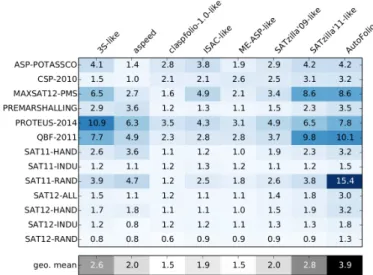
Figure 1: Factors by which the selection approach re-implemented inCLASPFOLIO2 outperformed the single best algorithm in the 13 ASLIBscenarios w.r.t. penalized average running time (PAR10, which counts each timeout as10times the given running time cutoff). These results are for10-fold cross-validation, ignoring test instances that were not solved by any solver. The last row shows the geometric mean over all 13 scenarios.
instance sets and, as a result, have won many prizes at com-petitions.
Figure 1 illustrates the performance benefits these existing selection strategies (as realized in CLASPFOLIO 2 [Hooset al., 2014]) yield across the wide range of AS benchmarks in the Algorithm Selection Library [Bischl et al., 2016]. We observe that each approach has strengths and weaknesses on different scenarios. The SATZILLA’11-like approach [Xuet al., 2011] performs best overall, but only achieves better per-formance than the other approaches considered on8out of the
13scenarios, with 3S [Kadiogluet al., 2011],ASPEED[Hoos
et al., 2015] or ISAC [Kadiogluet al., 2010] yielding better performance in the remaining cases.
Compute Features Instance
Select Algorithm Solve Instance with Algorithm Set of Algorithms
Machine Learning Model
Figure 2: General outline of algorithm selection
2011; Snoeket al., 2012; Thorntonet al., 2013; Feureret al., 2015a]). We note that the hyper-parameters of the machine learning methods used in Figure 1 were fixed manually, based on limited experiments. Therefore, the performance of some of these AS systems could likely be improved by using more carefully chosen hyper-parameter settings.
Facing a new AS problem, we thus have to answer three salient questions: (i) which selection approach to use; (ii) how to effectively set the parameters of the selection approach (and its underlying machine learning method); and (iii) how to make best use of techniques augmenting pure AS, such as pre-solving schedules [Xu et al., 2008; Kadioglu et al., 2011]. Instead of the common, manual trial-and-error ap-proach, we propose to automatically answer these questions by using automated algorithm configuration methods [Hut-teret al., 2009] to configure flexible AS frameworks. While the manual approach is error-prone, potentially biased and requires substantial human expert time and knowledge, the approach we introduce here is fully automatic, unbiased, and leverages the full power of a broad range of AS methods. It thus facilitates an easier and more effective use of algorithm selection and makes AS techniques accessible to a broader community.
Specifically, we present AUTOFOLIO, a general approach for automatically determining a strong AS method for a par-ticular dataset. The last column of Figure 1 previews the re-sults obtained with AUTOFOLIO and clearly shows signifi-cant improvements overCLASPFOLIO2 on10of the13
sce-narios in ASLIB.
2
Preliminaries on AS and AC
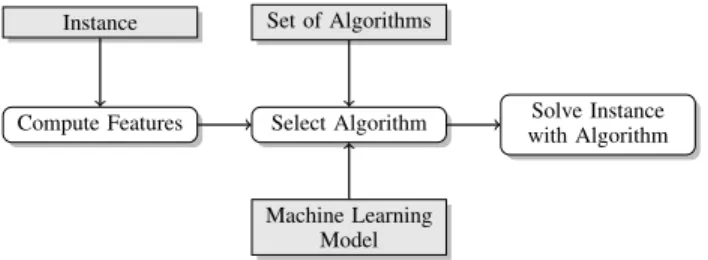
Algorithm Selection. Figure 2 shows the general outline of algorithm selection [Rice, 1976; Smith-Miles, 2008; Kot-thoff, 2014]. For a given problem instance, we first com-pute cheap instance features [Nudelmanet al., 2004]; these are numerical characteristics, including simple ones (such as the number of variables or clauses in a SAT instance) and more complex ones (such as statistics gathered from short probing runs of an actual SAT solver on the given in-stance). Based on these features, a machine learning model is used to select an appropriate algorithm from a set of al-gorithms to solve the given instance [Hubermanet al., 1997; Gomes and Selman, 2001].
Algorithm Configuration. Figure 3 shows a general out-line for algorithm configuration methods [Hutteret al., 2009]. Given a parameterized algorithmAwith possible parameter
Configuration Task InstancesI
AlgorithmA
and its Configu-ration SpaceC
Selectc∈ C AssessA(c)on someI0⊂I
Return Best Found Configurationˆc
Return Performance
Figure 3: General outline of algorithm configuration
settingsC, a set of training problem instancesI, and a per-formance metricm : C×I → R, the objective in the al-gorithm configuration problem is to find a parameter config-urationc ∈Cthat optimizemacross the instances inI. In the following, we assume w.o.l.g. that performance metricm
is to be minimized, as is the case for running time or clas-sification error. The configuration procedure (or short con-figurator) iteratively evaluates the performance of parameter configurationsc ∈ C (by runningA with them on one or more instances inI) and uses the result to decide about the next configurations to evaluate. After a given budget for the configuration process has been exhausted, the configurator re-turns the best known parameter configuration it found until then.
3
Configuration of Algorithm Selectors
We now present our AUTOFOLIO approach of using algo-rithm configurators to automatically customize flexible AS frameworks to specific AS scenarios. To apply algorithm configuration in this context, we need to specify a param-eterized selector and its configuration space, as well as the performance metric by which we judge its performance.
3.1
Formal Problem Statement
An AS scenario includes algorithmsA, problem instancesI, performance and feature dataD, and a performance metric
m : A×I → Rto be minimized, with the data split into disjoint sets Dtrain andDtest. LetS(Dtrain) : I → A
denote the selector learned by the AS systemSwhen trained on the data Dtrain. Then, the performance of S, P(S)is
the average performance of the algorithms it selects on the instances in the test data setDtest:
P(S) = 1 |Dtest|
X
i∈Dtest
m(S(Dtrain), i). (1)
Likewise, we can evaluate the performance of an AS sys-temScparameterized by a configurationcasP(Sc). In order
Configuration Task
Selection Scenario with dataDtrain
Randomly SplitDtrain
into{D(trainj) }j∈{1...k}
Algorithm SelectorS
and its Configuration SpaceC
Selectc∈Cand
j ∈ {1. . . k}
TrainScon
Dtrain\D
(j)
train
Return Best Configurationcˆ
EvaluateP(Sˆc)
Return Performance onD(trainj)
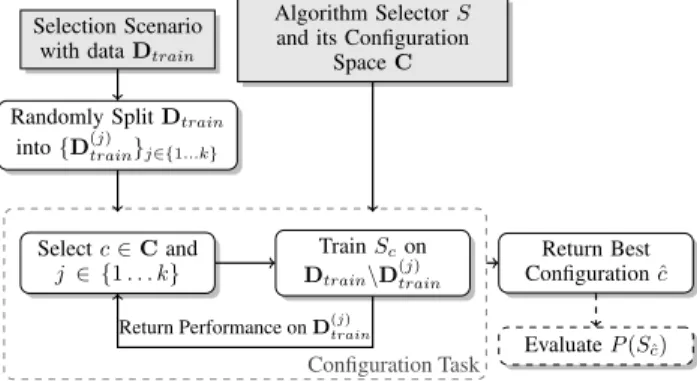
Figure 4: General outline of AUTOFOLIO
and (ii) we partition the training data further intokfolds (in our experiments, we usek= 10), which are used as follows.
LetD(1)train, . . . ,D(traink) be a random partition of the train-ing setDtrain. The cross-validation performanceCV(Sc)of Sc on the training set, which is optimized during
configura-tion, is then:
CV(Sc) = 1
k k
X
j=1
1
|D(trainj) |
X
i∈D(j)train
m(Sc(Dtrain\D
(j)
train), i)
We minimize CV(Sc) with an algorithm configuration
procedure to yield
ˆ
c∈arg min c∈C
CV(Sc).
We then evaluate the generalization performance of ˆc by training a selectorSˆc with it on the entire training data and
evaluatingP(Sˆc)onDtest, as defined in Equation 1.
Following Thornton et al. (2013), we use each of the
k folds D(trainj) as one meta-instance within the configura-tion process. We note that many configurators, such as Fo-cusedILS [Hutter et al., 2009], irace [L´opez-Ib´a˜nez et al., 2016] andSMAC[Hutteret al., 2011], can discard configura-tions when they perform poorly on a subset of meta-instances and therefore do not have to evaluate all kcross-validation folds for every configuration. This saves time and lets us evaluate more configurations within the same configuration budget. Based on these considerations, Figure 4 outlines the process to configure an algorithm selector with AUTOFOLIO.
3.2
Configuration Space of Selectors
Most existing algorithm selectors implement one specific AS approach, using one specific machine learning technique. However, most selection approaches, at least implicitly, ad-mit more flexibility, and in particular could be used with a range of machine learning techniques. Based on this obser-vation, we consider a hierarchically structured configuration space with a top-level parameter that determines the over-all AS approach. For most selection approaches, we can then choose between different regression techniques. Each of these machine learning techniques can be configured by its own (hyper-)parameters. Additionally, further techniques
can be used for preprocessing the training data and for pre-solving schedules, which can be configured independently from the selection approach, and are therefore also handled by top-level parameters.
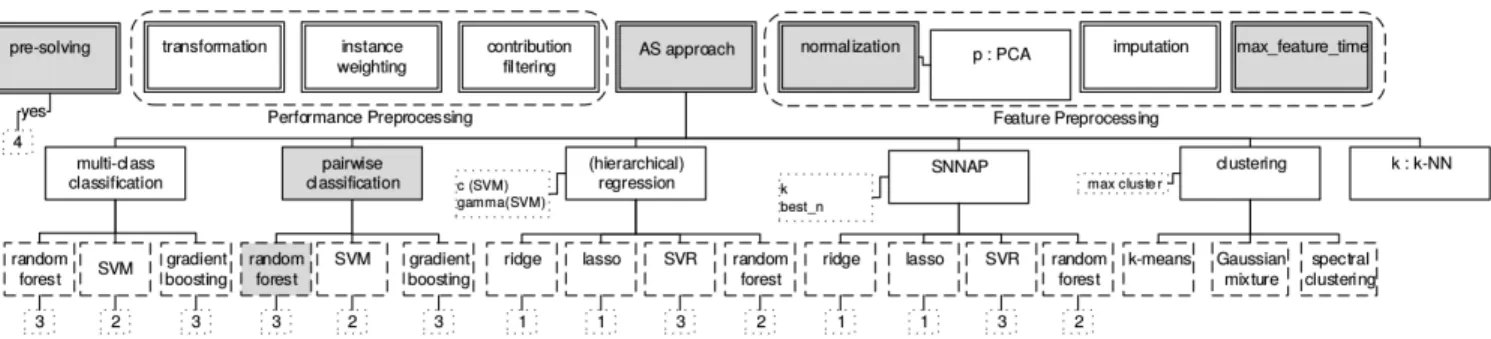
We implemented these choices in theCLASPFOLIO2 sys-tem. Figure 5 illustrates the complete configuration space thus obtained. Our current version, which we use for the con-crete implementation of our AUTOFOLIO approach, covers six different AS approaches:
(hierarchical) regression (inspired by SATZILLA’09; [Xu
et al., 2008]) learns a regression model for each algo-rithm; for a new instance, it then selects the algorithm with best predicted performance;
multiclass classification (inspired by LLAMA; [Kotthoff, 2013]) learns a classification model that directly selects an algorithm based on the features of a new instance;
pairwise classification (inspired by SATZILLA’11; [Xuet al., 2011]) learns a (cost-sensitive) classification model for all pairs of algorithms; for a new instance, it evalu-ates all models and selects the algorithm with the most votes;
clustering (inspired by ISAC; [Kadioglu et al., 2010]) de-termines subsets of similar training instances in the fea-ture space and the best algorithm on these subsets; for a new instance, it determines the nearest cluster center and selects the associated algorithm;
k-NN (inspired by 3S; [Kadioglu et al., 2011], and ME-ASP; [Marateaet al., 2014]) determines a set of similar training instances in the feature space for a given new instance and selects the algorithm with the best perfor-mance on this instance set;
SNNAP (inspired by [Collauttiet al., 2013]) predicts the per-formance of each algorithm with regression models and uses this information for a k-NN approach in the pre-dicted performance space.
For each of these approaches, CLASPFOLIO 2 covers at least three different machine learning techniques (where ap-propriate). For preprocessing strategies, it supports several feature and performance preprocessing strategies.
The current version of AUTOFOLIOemploys the algorithm configuratorSMAC[Hutteret al., 2011] to search for the best AS approach in this combined space. We choseSMAC, be-cause it performed best across the algorithm configuration problems we studied so far.
4
Empirical Performance Analysis
We studied the performance of AUTOFOLIOacross a wide va-riety of hard combinatorial problems from the algorithm se-lection library (ASlib [Bischlet al., 2016]).1 Figure 1 shows the performance of AUTOFOLIO(last column) compared to its components with fixed parameter settings. AUTOFOLIO
found well-performing configurations ofCLASPFOLIO2 and performed better than all other approaches on11out of the
1
Figure 5: Configuration space ofCLASPFOLIO2. Parameters in double boxes are top-level parameters; single boxes represent AS approaches based on classes of machine learning techniques, dashed boxes machine learning techniques, and dotted boxes the number of low-level parameters. Parameter boxes used in the default configuration are filled in grey.
Figure 6: Scatter plots comparing the per-instance perfor-mance of default CLASPFOLIO 2 (SATZILLA’11-like) and AUTOFOLIOon SAT12-ALL. AUTOFOLIOimproved
per-formance on most instances and also reduced the number of timeouts.
13ASlib scenarios. Figure 6 shows the performance differ-ence between the default ofCLASPFOLIO2 and AUTOFOLIO
on an per-instance basis on the ASlib scenario SAT12-ALL indicating much better performance of AUTOFOLIO.
Additionally, in our journal article [Lindaueret al., 2015b], we investigated several aspects of AUTOFOLIO’s behaviour in more detail:
1. We characterized the performance of AUTOFOLIOwith different configuration spaces, showing advantages of a small space if only few performance evaluations are fea-sible in the configuration budget;
2. We demonstrated that AUTOFOLIO performs more ro-bustly than other state-of-the-art selectors, establishing new state-of-the-art performance on7ASlib scenarios;
3. We applied parameter importance analysis [Hutter et al., 2014; Fawcett and Hoos, 2016] to identify that the following choices were crucial to obtain strong perfor-mance for a given ASlib scenario: feature computation time, the set of instance features and the AS approach.
5
Conclusions and Future Work
In this extended abstract of our JAIR article [Lindauer et al., 2015b], we summarized AUTOFOLIO—to the best of our knowledge, the first approach to automatically config-ure algorithm selectors. Using a concrete realization of this approach based on the highly parameterized AS framework
CLASPFOLIO2, we showed that by using state-of-the-art al-gorithm configurators, alal-gorithm selectors can be customized to robustly achieve peak performance across a range of AS scenarios. The resulting approach performs significantly (and sometimes substantially) better than manually configured se-lectors and can be applied out-of-the-box to previously un-seen AS scenarios.
In future work, we plan to investigate how the potential gains of larger configuration spaces (including feature and al-gorithm subset selection) can be used more effectively. To this end, we would like to (i) extend AUTOFOLIO’s configu-ration space by implementing more algorithm selection ap-proaches (e.g., CSHC [Malitsky et al., 2013]); (ii) shrink large configuration spaces based on the analysis of param-eter importance through fANOVA [Hutteret al., 2014] and ablation [Fawcett and Hoos, 2016], allowing the configura-tor to focus on the most important parameters; and (iii) auto-matically select between pre-configured algorithm selectors, based on features of a given AS scenario, and further improve performance by warmstarting automatic configuration from the configurations thus selected [Feureret al., 2015b]. An-other promising avenue for reducing the computational cost of our approach would be to pre-select algorithms, features, and problem instances based on the techniques proposed by Hooset al.(2013). Finally, we plan to investigate to which extent AUTOFOLIOcan configure AS systems for selecting parallel portfolios [Lindaueret al., 2015a] to exploit the in-creasing availability of parallel computing resources.
Overall, our results for AUTOFOLIOstrongly suggest that the automated configuration of AS systems can improve the performance and versatility of those systems across a broad range of application domains. Our AUTOFOLIO approach also facilitates future improvements, by making it easier to realize and assess the performance potential inherent in new design choices for the various components of an AS system. Our open-source implementation of AUTOFOLIOis available
References
[Bergstraet al., 2011] J. Bergstra, R. Bardenet, Y. Bengio, and B. K´egl. Algorithms for hyper-parameter optimiza-tion. InProc. of NIPS’11, pages 2546–2554, 2011. [Bischlet al., 2016] B. Bischl, P. Kerschke, L. Kotthoff,
M. Lindauer, Y. Malitsky, A. Frech´ette, H. Hoos, F. Hutter, K. Leyton-Brown, K. Tierney, and J. Vanschoren. ASlib: A benchmark library for algorithm selection. AIJ, pages 41–58, 2016.
[Collauttiet al., 2013] M. Collautti, Y. Malitsky, D. Mehta, and B. O’Sullivan. SNNAP: Solver-based nearest neigh-bor for algorithm portfolios. InProc. of ECML/PKDD’13, pages 435–450, 2013.
[Fawcett and Hoos, 2016] C. Fawcett and H. Hoos. Analysing differences between algorithm configurations through ablation. Journal of Heuristics, 22(4):431–458, 2016.
[Feureret al., 2015a] M. Feurer, A. Klein, K. Eggensperger, J. T. Springenberg, M. Blum, and F. Hutter. Efficient and robust automated machine learning. InProc. of NIPS’15, 2015.
[Feureret al., 2015b] M. Feurer, T. Springenberg, and F. Hutter. Initializing Bayesian hyperparameter optimiza-tion via meta-learning. InProc. of AAAI’15, pages 1128– 1135, 2015.
[Gomes and Selman, 2001] C. Gomes and B. Selman. Algo-rithm portfolios. AIJ, 126(1-2):43–62, 2001.
[Hooset al., 2013] H. Hoos, B. Kaufmann, T. Schaub, and M. Schneider. Robust benchmark set selection for boolean constraint solvers. InProc. of LION’13, pages 138–152, 2013.
[Hooset al., 2014] H. Hoos, M. Lindauer, and T. Schaub. claspfolio 2: Advances in algorithm selection for answer set programming. TPLP, 14:569–585, 2014.
[Hooset al., 2015] H. Hoos, R. Kaminski, M. Lindauer, and T. Schaub. aspeed: Solver scheduling via answer set pro-gramming. TPLP, 15:117–142, 2015.
[Hubermanet al., 1997] B. Huberman, R. Lukose, and T. Hogg. An economic approach to hard computational problems. Science, 275:51–54, 1997.
[Hutteret al., 2009] F. Hutter, H. Hoos, K. Leyton-Brown, and T. St¨utzle. ParamILS: An automatic algorithm config-uration framework. JAIR, 36:267–306, 2009.
[Hutteret al., 2011] F. Hutter, H. Hoos, and K. Leyton-Brown. Sequential model-based optimization for general algorithm configuration. InProc. of LION’11, pages 507– 523, 2011.
[Hutteret al., 2014] F. Hutter, H. Hoos, and K. Leyton-Brown. An efficient approach for assessing hyperparam-eter importance. In Proc. of ICML’14, pages 754–762, 2014.
[Kadiogluet al., 2010] S. Kadioglu, Y. Malitsky, M. Sell-mann, and K. Tierney. ISAC - instance-specific algorithm configuration. InProc. of ECAI’10, pages 751–756, 2010.
[Kadiogluet al., 2011] S. Kadioglu, Y. Malitsky, A. Sabhar-wal, H. Samulowitz, and M. Sellmann. Algorithm selec-tion and scheduling. InProc. of CP’11, pages 454–469, 2011.
[Kotthoff, 2013] L. Kotthoff. LLAMA: leveraging learn-ing to automatically manage algorithms. CoRR, abs/1306.1031, 2013.
[Kotthoff, 2014] L. Kotthoff. Algorithm selection for com-binatorial search problems: A survey.AI Magazine, pages 48–60, 2014.
[Lindaueret al., 2015a] M. Lindauer, H. Hoos, and F. Hutter. From sequential algorithm selection to parallel portfolio selection. InProc. of LION’15, pages 1–16, 2015. [Lindaueret al., 2015b] M. Lindauer, H. Hoos, F. Hutter,
and T. Schaub. Autofolio: An automatically configured algorithm selector. JAIR, 53:745–778, August 2015. [L´opez-Ib´a˜nezet al., 2016] M. L´opez-Ib´a˜nez, J.
Dubois-Lacoste, L. Perez Caceres, M. Birattari, and T. St¨utzle. The irace package: Iterated racing for automatic algorithm configuration. Operations Research Perspectives, 3:43– 58, 2016.
[Malitskyet al., 2013] Y. Malitsky, A. Sabharwal, H. Samu-lowitz, and M. Sellmann. Algorithm portfolios based on cost-sensitive hierarchical clustering. In F. Rossi, editor,
Proc. of IJCAI’13, pages 608–614, 2013.
[Marateaet al., 2014] M. Maratea, L. Pulina, and F. Ricca. A multi-engine approach to answer-set programming.TPLP, 14:841–868, 2014.
[Nudelmanet al., 2004] E. Nudelman, K. Leyton-Brown, A. Devkar, Y. Shoham, and H. Hoos. Understanding ran-dom SAT: Beyond the clauses-to-variables ratio. InProc. of CP’04, pages 438–452, 2004.
[Rice, 1976] J. Rice. The algorithm selection problem. Ad-vances in Computers, 15:65–118, 1976.
[Smith-Miles, 2008] K. Smith-Miles. Cross-disciplinary perspectives on meta-learning for algorithm selection.
ACM, 41(1), 2008.
[Snoeket al., 2012] J. Snoek, H. Larochelle, and R. P. Adams. Practical Bayesian optimization of machine learn-ing algorithms. In Proc. of NIPS’12, pages 2960–2968, 2012.
[Thorntonet al., 2013] C. Thornton, F. Hutter, H. Hoos, and K. Leyton-Brown. Auto-WEKA: combined selection and hyperparameter optimization of classification algorithms. InProc. of KDD’13, pages 847–855, 2013.
[Xuet al., 2008] L. Xu, F. Hutter, H. Hoos, and K. Leyton-Brown. SATzilla: Portfolio-based algorithm selection for SAT. JAIR, 32:565–606, 2008.