The handle
http://hdl.handle.net/1887/35460
holds various files of this Leiden University
dissertation
Author: Beekhuizen, Barend
A Usage-Based Model
Published by
LOT phone: +31 30 253 5775
Trans 10 e-mail: [email protected]
3512 JK Utrecht http://www.lotschool.nl
The Netherlands
Cover illustration: #9f4c62
ISBN: 978-94-6093-183-3 NUR: 616
A Usage-Based Model
of the Acquisition of Grammar
Proefschrift
ter verkrijging van
de graad van Doctor aan de Universiteit Leiden, op gezag van Rector Magnificus prof. mr. C.J.J.M Stolker,
volgens besluit van het College voor Promoties te verdedigen op dinsdag 22 september 2015
klokke 13.45 uur
door
Barend F. Beekhuizen
Promotiecommissie: Prof. Dr. Roberta D’Alessandro Dr. Afra Alishahi (Tilburg University)
Leonard Cohen, “Anthem”
Little feet take small steps
Acknowledgements . . . xi
1 Introduction 1 1.1 Early grammar . . . 3
1.2 Theoretical background . . . 4
1.3 Computational cognitive modeling . . . 5
1.4 Goals of this research . . . 6
1.4.1 Providing a comprehensive model . . . 7
1.4.2 The conception of learning . . . 7
1.4.3 Starting small . . . 8
1.4.4 Naturalism in meaning . . . 8
1.5 A note on notation . . . 9
1.6 Overview of the dissertation . . . 10
2 A usage-based conception of language acquisition 11 2.1 Usage-based linguistics and language acquisition . . . 12
2.1.1 Constructions and the constructicon . . . 14
2.1.2 Producing and understanding an utterance . . . 17
2.1.3 Acquiring a grammar . . . 18
2.2 Theoretical issues with the usage-based perspective . . . 21
2.2.1 Representational metaphors: blocks and streams . . . 21
2.2.2 Mechanisms operating on early representations . . . 22
2.2.3 Gradualism and simultaneity in learning . . . 24
2.3 Desiderata for a usage-based model of language acquisition . . 27
2.3.1 D1: Explicitness . . . 28
2.3.2 D2: Comprehensiveness . . . 28
2.3.3 D3: Simultaneity . . . 28
2.3.4 D4: Cognitive realism in representations . . . 29
2.3.5 D5: Cognitive realism in processes . . . 30
2.3.7 D7: Explanation . . . 32
2.4 Core developmental phenomena . . . 34
2.4.1 The abstractness of early representations . . . 34
2.4.2 Argument omission in early production . . . 41
2.4.3 Argument-structure overgeneralization in early produc-tion . . . 47
2.4.4 Explananda for a usage-based model of language acqui-sition . . . 52
2.5 Computational usage-based models of language acquisition . . 53
2.5.1 Semantic-grammar models . . . 53
2.5.2 Usage-based distributional models . . . 60
2.5.3 A comparison . . . 62
3 The Syntagmatic-Paradigmatic Learner 69 3.1 Introduction . . . 69
3.2 General properties of input items to the model . . . 70
3.2.1 Input items: utterances and conceptualizations of situa-tions . . . 70
3.2.2 The structure of the conceptual representations . . . 71
3.3 Constructions . . . 73
3.3.1 Constructions as representational primitives . . . 73
3.3.2 A formal definition of constructions and the constructicon 74 3.4 Defining the space of possible analyses . . . 77
3.4.1 Mapping constructions to situations . . . 77
3.4.2 Three general constraints . . . 80
3.4.3 Starting a derivation: concatenation . . . 81
3.4.4 Ignoring words . . . 82
3.4.5 Applying construction-mapping pairings . . . 82
3.4.6 An example of the space of possible derivations . . . 85
3.5 Selecting the best analysis . . . 95
3.5.1 The probability model for derivations . . . 95
3.5.2 Equivalent derivations: parses . . . 98
3.5.3 An example of the probability model . . . 100
3.5.4 Implementation: lineair processing and pruning . . . 103
3.5.5 SPL as a usage-based processing model . . . 105
3.6 Learning . . . 105
3.6.1 Reinforcement . . . 106
3.6.2 Syntagmatization . . . 109
3.6.3 Paradigmatization . . . 111
3.6.4 Cross-situational learning . . . 115
3.6.5 SPL as a usage-based learner . . . 118
3.7 Generation . . . 120
3.7.1 Differences with the analysis procedure . . . 120
3.7.2 Expressivity . . . 121
3.7.4 An example of the generation procedure . . . 122
3.8 Meeting desiderata with SPL . . . 124
4 Modeling the acquisition of meaning 129 4.1 Three problems in acquiring meaning . . . 130
4.2 The informativeness of the situation . . . 132
4.2.1 Earlier research . . . 132
4.2.2 How available are the communicated concepts . . . 137
4.2.3 Noise-reduction through understanding intentionality . 144 4.2.4 Interpretation and implications . . . 149
4.2.5 The issue of situational interdependence . . . 150
4.2.6 Discussion . . . 153
4.3 Towards a realistic simulation procedure . . . 155
4.3.1 Earlier methods . . . 155
4.3.2 Operationalization of the input generation procedure . . 157
4.4 Directions for modeling symbol acquisition . . . 162
5 Comprehension experiments 165 5.1 Measuring comprehension . . . 165
5.1.1 General evaluation . . . 166
5.1.2 Evaluating the used representations . . . 167
5.2 Global evaluation . . . 167
5.2.1 Identification . . . 167
5.2.2 Utterance coverage . . . 168
5.2.3 Situation coverage . . . 171
5.2.4 Robustness to uncertainty and noise . . . 173
5.3 Used representations . . . 174
5.3.1 The use of chunks . . . 174
5.3.2 The use of bootstrapping . . . 176
5.3.3 The use of concatenation . . . 179
5.3.4 The length and abstraction of the used representations . 180 5.4 Desiderata and explananda . . . 185
6 Entering the black box 189 6.1 Learning mechanisms . . . 189
6.1.1 Lexical learning . . . 190
6.1.2 Grammatical learning . . . 192
6.2 The representational potential . . . 194
6.2.1 Length of the acquired constructions . . . 194
6.2.2 Abstraction in the representational potential . . . 199
6.3 The independence of morphemes . . . 201
6.3.1 Entity words . . . 203
6.3.2 Attribute words . . . 204
6.3.3 Pronouns . . . 206
6.3.5 Role-marking words . . . 209
6.3.6 Comparing the classes . . . 210
6.3.7 Discussion . . . 211
6.4 The growth of the caused-motion construction . . . 213
6.5 Discussion . . . 216
7 Production experiments 221 7.1 Global development of production . . . 221
7.1.1 Evaluation . . . 221
7.1.2 Results . . . 222
7.1.3 An example . . . 224
7.1.4 Robustness to uncertainty and noise . . . 225
7.2 Error analysis . . . 227
7.2.1 Lexical errors . . . 228
7.2.2 Argument structure errors . . . 231
7.2.3 Argument omission . . . 232
7.3 Overgeneralization . . . 234
7.3.1 Motivation and Experimental set-up . . . 234
7.3.2 Results . . . 235
7.3.3 Factors in the overgeneralization and retreat . . . 240
7.4 Discussion . . . 241
8 Concluding remarks 243 8.1 Recapitulating SPL . . . 244
8.2 The behavior of SPL . . . 246
8.3 The representations acquired by SPL . . . 248
8.4 Desiderata and explananda . . . 249
8.5 Suggestions for the usage-based conception . . . 252
8.6 Suggestions for cognitive modeling . . . 253
Bibliography . . . 255
Summary . . . 269
Samenvatting . . . 277
Throughout the (almost) five years that I have been working on the project constituting this dissertation, I have had the pleasure of being surrounded by many great people who deserve to be acknowledged.
The first words of gratefulness definitely go out to my supervisors, Arie Verhagen and Rens Bod. With each of them packing a vast breadth and depth of knowledge, combined with their highly original and thorough ways of thinking, I could not have wished for a more nurturing home for my ideas.
Second, I would like to thank all other teachers and mentors that have ful-filled important exemplary roles in various phases of my academic develop-ment, both before and during my doctoral research. I would like to thank, in a somewhat chronological order, Gé Vaartjes, Leo van Santen, Ronny Boogaart, Cor van Bree, Ariane van Santen, Marijke van der Wal, Ton van der Wouden, Felix Ameka, Egbert Fortuin, Sandy Thompson, Pat Clancy, Jack DuBois, Stef Grondelaers, Remko Scha, Jelle Zuidema, Melissa Bowerman, Afsaneh Fazly, and Suzanne Stevenson for sharing their insights and stimulating my aca-demic growth.
Important parts of this research have been discussed with Libby Barak, Gideon Borensztajn, Ailis Cournane, Max van Duijn, Stewart McCauley, Aida Nematzadeh, and Gareth O’Neill, whose criticisms helped further my think-ing and writthink-ing and whose contributions I would like to acknowledge. The comments of the members of the committee, Afra Alishahi, Roberta D’Alessan-dro, and Ewa D ˛abrowska, stimulated me to dot the i’s and cross the t’s, for which I would like to thank them.
I am very grateful for the academic environments I have spent time in over the past years. Many thanks go out to the participants of the CLC-lab and the LaCo-group at the ILLC, University of Amsterdam, colleagues at the LUCL, and the members of the SuzGroup and, wider, the CL-group, during my stay at the University of Toronto.
Meulen, who laboriously and conscientiously coded the caregiver-child inter-actions. Those caregiver-child interactions would not have been there at all if it weren’t for Marinus van IJzendoorn and Marian Bakermans-Kranenburg of the department of Child Studies at Leiden University. Their generosity, in al-lowing me to use their data as well as occupying a desk in the department to digitize the material, is gratefully acknowledged. The input-generation pro-cedure described in the same chapter is an extension of that of Afra Alishahi, who generously allowed me to use her code.
In the academic years 2013-2014 and 2014-2015, I lectured at the depart-ment of Dutch Language. I would like to thank my colleagues there, Ronny Boogaart, Gijsbert Rutten, Ariane van Santen, Tanja Simons, Arie Verhagen, and Marijke van der Wal for helping me out, as an inexperienced teacher, and providing me with an inspiring environment.
The research reported in this dissertation could not have been carried out without the generousPromoties in de Geesteswetenschappengrant of the NWO, whose support I would like to acknowledge.
On a personal level, there are too many to be thanked. I am grateful for my family, friends, and (former) partners for all the support, wisdom, joy, and love I have experienced. A warm thank you to all of you.
One person definitely deserves the ‘last-but-not-least’: my dear friend Fol-gert Karsdorp. During times of academic and personal misery his support has made the difference. Folgert’s contributions at various stages of my disserta-tion research have been numerous and our conversadisserta-tions shaped chapters 5-7 to a large extent.
Introduction
When I utter the sentenceJohn kissed Mary, anyone having a sufficient com-mand of English will understand that I make an assertion, namely that an event took place in which some person whom we both know, namedJohn, en-gaged in the act of kissing another person, again known to both of us, named
Mary. In comprehension, language users connect an observable signal, in this case the string of sounds produced when utteringJohn kissed Mary, to an unob-servable conceptualization of the situation and the speaker’s communicative intent. In production, the reverse process takes place: given a conceptualiza-tion of a situaconceptualiza-tion and a communicative intenconceptualiza-tion, the speaker tries to figure out which observable signals to use in order for the hearer to arrive at the desired conception of the situation and communicative intent.
de-rived from other cognitive domains. Construction grammar, the theoretical perspective constituting the starting point of this dissertation, provides a dif-ferent perspective: the cognitive representations responsible for comprehend-ing and produccomprehend-ing complex utterances areconstructions– like words, conven-tional pairings of an (observable) signal and a signified meaning (e.g. Gold-berg 1995). Because the content and structure of these representations fully comes from other cognitive domains, a language user’s grammar is not an autonomous cognitive system. Furthermore, if the representations responsible for building complex linguistic structure are pairings of an observable signal and an inferred meaning, they are qualitatively the same as regular words, and as such, according to construction grammar, all linguistic representations can be regarded as constructions.
The magnificent task faced by an infant being born into a community of speakers, is to figure out how the connections between the observable sig-nals and the meanings work. Again, various theoretical frameworks differ in how they conceive of this task: in the Generative tradition, rooted in rational-ist thought, the language learner’s task is to deduce which properties from among a finite set of possibilities the grammar of her community’s language has (Baker 2001). The constructivist approach, on the other hand, argues that children build up their inventory of linguistic representations in a bottom-up way, and without any preconceptions concerning grammar-wide regularities. In the literature, one often finds a comparison of the frameworks, where empirical data is presented as being suggestive for the truth of the one and the falsehood of the other framework. To my mind, this approach is unwarranted given the state of any current theoretical framework. Because of their infor-mal nature, any datapoint presented by an adherent of one framework can be brought into accordance with another framework or simply be dismissed as non-data (because it is not part of the ‘core’ of language, or because it is a ‘theory-internal matter’). Of course, this possibility exists even with highly explicit and formalized theories in other fields of research, but it seems that challenges to any linguistic theory can be resolved too easily. This is not to lament the state of linguistics: independently, various theories have internally developed themselves to an enormous extent.
1.1
Early grammar
Before we turn to the more theoretical issues, let us have a brief look at what kinds of phenomena this dissertation will be occupied with. Children’s early linguistic productions differ in several ways from the utterances adults pro-duce. Their utterances are typically shorter, and markers of grammatical cat-egories such as tense and number are mostly omitted (Brown 1973, 98-99). The main phenomenon of interest in this research, however, is the realization of argument-structure patterns over development. The event expressed by a verb has certain roles, which are linguistically realized as the arguments of that verb. Some examples of deviations from the language of adults are shown below.
(1) open drawer (Kathryn 2;01, opening a drawer, Bloom, Lightbown & Hood (1975))
(2) I made (Eric, 1;1 1, just reassembled a train, Bloom et al. (1975)) (3) put truck window (Adam 2;3, Brown (1973))
(4) pick up (.) puzzle up (Adam 2;6, wants to pick the puzzle up, Brown (1973))
(5) Adam fall toy (Adam 2;3, dropped a toy, Brown (1973))
(6) eat Benny now (Ben, between 1;7 and 2;6, wants to eat Sadock (1982), cited in O’Grady (1997, 61))
(7) the bridge knock down (Aran 2;4, knocked the bridge down; Manch-ester corpus, cited in Marcotte (2005))
Examples (1)-(4) show how elements of the argument-structure patterns that are grammatically obligatory for adult speakers of English are omitted. We find subjects and objects being left unexpressed, for instance in examples (1) and (2), but also obligatory prepositions, as in example (3). As Bloom et al. (1975) note, children often produce patterns expressing different aspects of the event they want to express in a sequential way. Example (4) is such a case: to express an event that would be expressed by an adult asI want to pick up the puzzle, orI want to pick the puzzle up, the child uses two structures, sepa-rated by a short pause, seemingly because he was not able to integrate both under a single syntactic constellation. Some basic findings with regards to the argument omissions are that more arguments are expressed over time (Toma-sello 1992, 244) and that subjects more frequently omitted than objects (Bloom et al. 1975).
In examples like (5)-(7), we see cases of children’s productions where not only are elements omitted, but also rules applied that are not in line with the adult usage, so-called errors of commission. In a case like example (5), the
verb dropwould be used in the transitive frame, instead of fall, which can-not be used in a transitive syntactic frame. In example (6), the child’s wish would be expressed with a pre-verbal subject andwant to, as inBenny wants to eat now, but we find the child changing the word order of the subject and the verb. From this piece of behavior it is hard to glean what the underly-ing representation might have been: is the child applyunderly-ing a grammatical rule at all, and if so, which one? Example (7) is the mirror image of example (5): here, the noun expressing the patient role is expressed pre-verbally, in the po-sition where subjects are typically found. Some verbs, such asroll, allow for the alternation whereby the semantic patient role is expressed as the syntac-tic subject, butknock downis not among them. Again the question is: which representations underlie this production?
From a developmental perspective, the occurrence of both errors of omis-sion and commisomis-sion in the same time span (roughly, Roger Brown’s Stage I) is interesting, because the underlying representations and mechanisms produce both of them. As acquisitionists, we thus face the puzzle of how the learner both under- and overshoots the target. Despite decades of work on these early productions, a comprehensive account of the representations and cognitive mechanisms leading to these productions, and their development over time, has not been satisfactorily given.
1.2
Theoretical background
The constructivist theory of language acquisition, briefly introduced earlier, constitutes the starting point for our understanding of the phenomena I just outlined. Construction grammar centrally makes a representational claim: all linguistic representations are pairings of signifying elements, prototypically phonological form, and signified meaning or conceptualization. This holds for words, but also for grammatical patterns. A complementary addition to the representational claims of construction grammar is the usage-based per-spective. This perpective holds that linguistic representations are qualitatively and quantitatively grounded in language use (Langacker 1988). The qualita-tive grounding is taken to mean that the representations consist of the cog-nitive reflections of usage events. Importantly, only representational content derived from the processed usage events can be part of the linguistic repre-sentations. That is to say: the language learning child has no preconception of contentive elements that are expected to be part of linguistic representations. An important consequence is that there is no place in a usage-based construc-tivist theory of language for universal syntactic categories, such as ‘noun’ and ‘verb’.2At the core of linguistic representations should be elements of the ob-servable signal (sound structure for spoken languages) and elements of the
2The rejection of universal distributional or syntactic categories follows not only from
conceptualization of the world that these signaling elements are assumed to refer to.
Given this perspective, the language-acquiring child faces the task of build-ing up an inventory of representations allowbuild-ing her to communicate success-fully with the other members of her community. To do so, she has several, highly general mechanisms at her disposal. Primarily, these involve mecha-nisms of understanding other people’s intentionality, which emerge around the first birthday, and a set of abilities to recognize patterns (Tomasello 2003). The former allow the child to recognize that the speaker has communica-tive intentions with the speech signal he is producing and roughly what this communicative intention encompasses. The latter enable the learner to dis-cover patterns of regularity in the signal and inferred communicative intent. These patterns are discovered, furthermore, in a bottom-up and gradual way. If we assume that the child has no preconceptions of the content of the lin-guistic representations, any abstraction over the processed usage events can be expected to arrive through a comparison of the structure of various usage events. Abstraction in the inventory of linguistic representation therefore only emerges after multiple comparable usage events have been observed.
1.3
Computational cognitive modeling
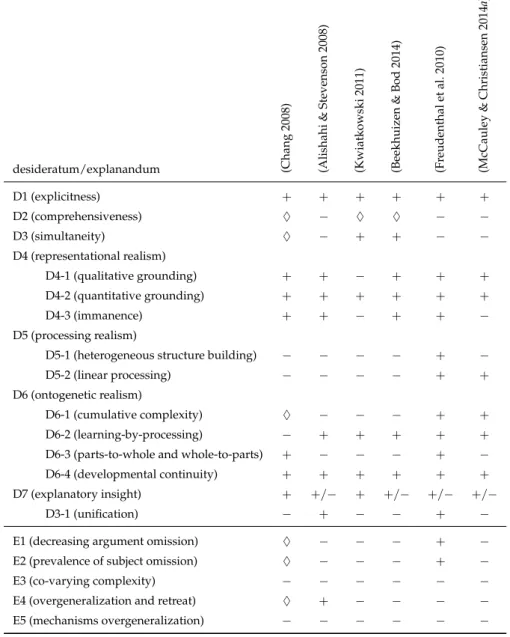
The past decade has seen a large number of publications on computational models of the acquisition of grammar from a usage-based constructivist per-spective. We find many learning models taking semantics into account, in line with the constructivist tenet that linguistic representations consist of pairings of form and meaning throughout. This does not only include work explicitly being framed as being constructivist, such as the dissertation of Chang (2008) and Alishahi & Stevenson’s (2008) clustering approach to argument-structure constructions, but also modeling research in other frameworks such as Combi-natorial Categorial Grammar (e.g. Kwiatkowski 2011). Distributional learners, taking only distributional properties of the phonological form into account, have shown how multi-word units, which are assumed to play a large role in language acquisition on the usage-based perspective, are extracted (McCauley & Christiansen 2014a), how the integration of the constructivist view and a connectionist, sub-symbolic representation can be achieved (Borensztajn 2011), how grammatical patterns assumed to be unlearnable can be learned from us-age data (Bod 2009), and how early patterns of languus-age production can be modeled (Freudenthal, Pine & Gobet 2010). Finally, highly interesting work on the appropriate analysis of corpus data of children’s early production have sparked interesting, and perhaps even productive back-and-forths between adherents of the usage-based perspective and generativist researchers (Lieven, Salomo & Tomasello 2009, Yang 2011).
to operationalize the concepts of a linguistic theory at a level of precision that allows a computer to run it as a piece of software. This means that the modeler has to make design choices in the representations and algorithms of the model that are not specified in the theory. The observed consequences of these design choices can then be ‘fed back’ into the theory. For this reason, it are not only the success stories that are interesting in modeling. In fact, the rhetorics of success can be misleading: when we regard modeling as an extension of theorizing, a model’s failure is essentially the exclusion of a logically possible variant of the theory. Through successive failures, we can gradually delimit the range of potentially successful theoretical options. Unfortunately, modeling failures are rarely shown.
Secondly, modeling allows us to observe the interaction of various com-ponents of the model. Rather than isolating the phenomenon of interest, as is often done in experimental studies, modeling allows us to observe what the effects are if multiple components of a theory interact in processing the data (cf. Beekhuizen, Bod & Verhagen 2014). This does not mean that all models do so, or should do so, but it is a possibility of the method that I believe is worth exploring. A further consequence of this approach is that we can work to-wards comprehensive models, that is, models being able to fully comprehend and produce utterances.
Finally, modeling allows us an evaluation of the theory both on a wide level and a narrow level. We can model both how an operationalization of the theory behaves across the board (e.g., in understanding or producing novel utterances), but also how the operationalized theory behaves in a simulation of a particular experimental set-up or in the case of a rare event. Both lines of inquiry are important: with linguistic theory often focussing on rare events (crossing dependencies, sentences likePat sneezed the foam off the capuchino), the more global behavior of the theory is often left out of consideration.
1.4
Goals of this research
It is to the background of the modeling inquiries presented in section 1.3 that the line of research reported on in this dissertation starts. At the time when I started it, there were several issues that I thought to be insufficiently ad-dressed in existing work. Four of them constitute the central theoretical issues of this dissertation: a call for greatercomprehensivenessof usage-based com-putational models, a scrutiny of theconception of learning, a plea for more
naturalismwhen the acquisition of meaning is concerned, and the reassess-ment of thestarting-smallposition.
note: this does not suggest that the conceptual work has any kind of primacy over the more empirically oriented work: both operate in a heuristic loop, in-forming and enhancing each other.
1.4.1
Providing a comprehensive model
The usage-based approach to language is a non-modular approach, meaning that what in componential theories are called ‘the lexicon’ and ‘the grammar’ are not distinct entities, both conceptually and cognitively. Because of this, it is not possible to fully isolate the acquisition of lexical constructions (‘words’) from that of grammatical constructions. At the very least, the mechanisms in-volved in them operate in lockstep: it is unthinkable (from any theoretical perspective, really) that the child waits until she has acquired an adult-like lexicon before she starts to figure out the grammatical rules. Starting from a usage-based perspective, even the weaker form (the child waits until it has a lexicon of some size before it starts learning the grammar) is not satisfying. As both are symbolic representations, roughly the same set of mechanisms have to be involved in acquiring them from situated utterances, and as such it has to be possible for a learner to pick them up at the same time. Except for a model that is, interestingly enough, not framed as a usage-based model (Kwiatkow-ski 2011), none of the models listed in section 1.3 does this. Models that do incorporate meaning start with many lexical form-meaning pairings already acquired (Chang 2008, Alishahi & Stevenson 2008). The first goal of this disser-tation therefore, is to develop a compudisser-tational model of language acquisition that starts with no representational symbolic content and that acquires lexical and grammatical constructions at the same time.
The comprehensiveness of a model bears on another issue too. If language users are able to form utterances on the basis of some conceptualization and a linguistic inventory and understand language on the basis of the utterance and the same linguistic inventory, we have to model the task of language use on both ends. That is to say: we want a model to be able to produce ances from a conceptualization of some situation and to comprehend utter-ances with its inventory of linguistic representations to arrive at an interpre-tation. Again, many computational models model only part of this task and do not show how they can account for comprehension on the basis of an ut-terance, and production on the basis of only a meaning to be expressed.
1.4.2
The conception of learning
a pre-existing hypothesis space, as rationalist approaches have it. This does not mean that there is no hypothesis space: given the nature of our cognition, certain representations are possible, whereas other, logically possible ones, are not. This ‘design space’, however, is not very informative, and it is mainly the learner’s exploration of the space through language use that is of interest for usage-based theorists. The learning algorithms used in usage-based models typically reflect this (e.g., unsupervised clustering in Alishahi & Stevenson (2008) and Bayesian Model Merging in Chang (2008)).
Another question is whether learning involves a rational decision mak-ing process. Lmak-inguistic production and comprehension arguably involves such processes: the speaker selects from his inventory a number of representations that allow him to produce of comprehend an utterance. Whether the learning process is also affected by (subconscious) decision making, is another issue. If we follow Langacker (1988) in the argument that learning is merely the effect of processing linguistic usage events, are there any cognitive mechanisms that only affect the learning taking place after the processing of the usage events but not the processing itself? This is not a question that I believe has been an-swered yet, but for the research presented here, I believe it to be the best null hypothesis to start from the idea that all learning takes place in the processing of usage events and the reinforcement of representations used in processing.
1.4.3
Starting small
One of the central tenets of construction grammar, as well as the usage-based perspective, is the idea that language users compute language with symbolic representations that are ‘bigger’ than a single word. This focus has led to the view in language acquisition that children often first acquire larger, unstruc-tured wholes, ‘chunks’ of linguistic material, which they subsequently start breaking down into their component parts.
There is definitely a lot to be said for this ‘starting-big’ approach. However, the wholes-to-parts account of language acquisition may be overemphasized in current usage-based approaches. Especially when we look at early produc-tion, it seems that, besides the use of chunk-like structures, there is also a grad-ual build-up of used representations taking place. If children produce increas-ingly more arguments with a verb, for instance, I believe it is likely that they are extending existing representations with additional valency roles, rather than learning the larger unit first as a chunk, then breaking it down, and only then recognizing its similarity with earlier acquired representations.
1.4.4
Naturalism in meaning
situation is to the child. If children are able to understand the communicative intention of the speaker, they must derive the content of this intention from some source. This source is often thought to be the situational context, but if we assume the situational context to provide the learner with a source for her meanings, we face a number of problems. The situational context, after all, is a confusing place if you want to learn meaning. Even granted that the child has joint-attentional skills that narrow down the set of conceptualizations that the speaker can possibly be trying to convey, there are still often many conceptu-alizations of the same situation possible, and often many situations co-present with the utterance that are likely to be expressed. On the other hand, some situations may simply be absent from the consideration of the learner. If we want to simulate the acquisition of meaningful structures, we have to make a realistic assessment of the overwhelmingness of other possible conceptual-izations and the frequency of the absence of the situation which the speaker is trying to express from the learner’s consideration.
1.5
A note on notation
In this thesis, I adopt Langacker’s (1987) Cognitive Grammar shorthand for-malism for describing constructions. I briefly describe this notation at the out-set, because I will use it throughout the dissertation. The formalism works as follows. Conceptual structure is represented in small capitals and phonolog-ical structure in italics. As a conceptual structure in the case of the model to be developed often has many features (e.g., the feature set behind the mean-ing of daddybeing {ENTITY,ANIMATE,MALE,PERSON,FAMILY-MEMBER, FA-THER}), I use only the most concrete, or otherwise most recognizable feature to represent the set of features (sodaddywould signify FATHER). Aunit, or construction, is a linguistic representation of a number of constituents where each constituent is given between square brackets.
If, in a constituent, a phonological and a conceptual structure are present, the phonological structure can be said tosymbolizethe conceptual structure, which is represented with a slash sign. The whole of constituents is delimited by square brackets as well. If the unit signifies conceptual structure beyond the meaning in the constituents, this meaning will be represented after the formal structure, marked with a pipe ‘|’.3In many cases the non-compositional meaning is not directly relevant, and will be omitted for the sake of space. Examples are given in (8) and (9).
(8) [BALL/ball]
(9) [ [HUMAN] [GRAB/grab] ]|GRAB(GRABBER(HUMAN))
Using this formalism, we can also describe complex analyses or constructs. Suppose the slot of the construction in (9) is filled (by means of what
gacker calls ‘elaboration’) with a construction [FATHER/daddy]. In that case we denote this slot-filling operation with an arrow after the slot, followed by the unit filling the slot, as in example (10).
(10) [ [HUMAN]→[FATHER/daddy] [GRAB/grab] ]|
GRAB(GRABBER(FATHER))
Another feature of Langacker’s notation is the use of parentheses for ex-tensions of known units. I will employ this notation in several cases. To give an example: the model to be presented allows for the concatenation of two partial analyses of an utterance without any construction governing both of them. We find a case of this concatenation operation in (11), where the partial analysis in (10) is concatenated with the unit given in (8).
(11) ( [ [HUMAN]→[FATHER/daddy] [GRAB/grab] ] [BALL/ball] )| GRAB(GRABBER(FATHER),GRABBEE(BALL))
Similarly, the notation in parentheses will be used for the so-called ‘boot-strapping’ of unknown words into open slots of constructions. When a word is bootstrapped into a schematic position of a construction, a novel represen-tation is created that links the hypothesized meaning of that word to its form. An example of the notation of the bootstrapping process is given in (12), where the unknown wordepidemiologistis bootstrapped into the slot of the construc-tion we saw before in examples (9) and (10).
(12) [ [HUMAN]→(EPIDEMIOLOGIST/epidemiologist) [ GRAB/grab] ]|
GRAB(GRABBER(EPIDEMIOLOGIST))
1.6
Overview of the dissertation
A usage-based conception of language acquisition
The research reported in this dissertation consists of a computational model that aims to operationalize the key concepts of a usage-based theory of lan-guage acquisition in order to investigate their validity. In this chapter, I present the usage-based perspective in some more detail (section 2.1) and criticize several of its proposals (section 2.2). This theoretical discussion leads to a set of theoretical desiderata which I believe a computational model should meet (section 2.3). These desiderata are not so much empirical constraints, but rather theoretical constraints on the kind of computational model to be built. The class of algorithms and representations accounting for the linguistic be-havior of the child may be vast, but as such this class is not very interesting. What we want to know, echoing, but non-trivially reinterpreting, Chomsky’s (1965) distinction between descriptive adequacy and explanatory adequacy,1
1Reinterpreting, because Chomsky’s notion is theory-laden, as the programmatic formulations
in the following quotes in Chomsky (1962) suggest:
• “In short,I think[emphasis mine, BB] that the development of the theory of grammar
[as, a.o.t., a class of potential grammars BB], and intensive application of this theory is a necessary prerequisite to any serious study of the problem of language acquisition.” (p. 534)
• “[I]t seems to me[emphasis mine BB] that the scope and effectiveness of heuristic, inductive
procedures has been greatly exaggerated. [. . . ] the task remaining to heuristic procedures is obviously lightened as we make the specification of the form of grammars increasingly narrow and restrictive” (p. 536).
struc-is to what extent a learning theory t, as operationalized in a computational model, is a better (more principled) cognitive theory than a competing theory
t0.
Next, I discuss how the usage-based perspective accounts for several broad-scale phenomena of child language acquisition (section 2.4). The work dis-cussed in this section gives us a set of empirical explananda that a compu-tational model starting from the usage-based vantage point has to meet as well. In section 2.5, I will present several usage-based computational cogni-tive models of language acquisition and discuss how they fare against the desiderata and explananda.
2.1
Usage-based linguistics and language
acquisi-tion
Over the recent history of linguistics, the focus of attention has shifted from a conception of language as a structural, abstract entity, to a more fine-grained conception of language as a cognitive and social phenomenon (cf. Chomsky’s (1986) ‘I-language’ and ‘E-language’, but also de Saussure’s (1916) ‘langue’ and ‘parole’). In this dissertation, I focus on the cognitive side of the medal, without denying the reality of language as a social phenomenon. When we take the perspective of language as a cognitive phenomenon, several posi-tions concerning the characterization of the cognitive representation of lan-guage are possible. The generative approach, broadly speaking, characterizes linguistic knowledge, in particular grammatical knowledge, as a modular cog-nitive system, that maintains interfaces with other cogcog-nitive modules (such as the sensory-motoric system for producing and processing sound, and the conceptual-intentional system, where the conceptualization underlying mean-ing resides). The core of grammatical knowledge is not only modular in the way it can be analyzed and described, but also ontologically: it is cognitively independent from either the two systems it interfaces with, as well as from lan-guage use. The usage-based and constructivist view can best be understood, at least historically, as denying the modularity of the grammatical system. Start-ing with Langacker (1988), who coined the term, the usage-based perspective holds that linguistic representations are grounded in experiences of language use. The cognitive processes involved in processing linguistic structures are furthermore not specific to the domain of language, but are shared with other cognitive domains, such as planning and inference.
This conception has several theoretical consequences. First of all, the rep-resentational system is tightly linked to the processing of language in
prehension and production. This means that the representations a language user employs in producing and understanding utterances are instructions for linking sound (or any other kind of observable signal) to a conceptualization, or: meaning. Construction grammar (Fillmore, Kay & O’Connor 1988, Gold-berg 1995) gives representational hands and feet to this idea by arguing that all linguistic knowledge, both ‘words’ and ‘grammatical rules’ constist of pair-ings of form and meaning.
The language learning child, having no preconception of what the sys-tem may look like, gradually finds the ways of linking sound to meaning that are conventional in her community. Langacker (1988) characterizes the system of constructions that thus emerges as non-reductive, bottom-up and maximalist. Assuming that the mind cares little about economy of storage, the set of constructions may display redundancy. More general or abstract pat-terns only come into existence after the language user has found evidence for the abstraction in the overlap between multiple more concrete construc-tions. However, these patterns are not separate cognitive entities, ‘extracted’ from more concrete instances and stored elsewhere, but are rather ‘imma-nent’ in the maximally concrete representations of the usage-events them-selves (Langacker 2000, 7).
Importantly, if this abstraction consists of the mere reinforcement of shared elements of form and function, abstraction per se can be thought to occur early. This seems to contradict the findings (by the same usage-based researchers) that children are conservative in generalizing abstract patterns to novel usage events (see section 2.4.1 below), but essentially does not do so. Although ab-stractions may arise as soon as some shared structure between two construc-tions is detected, the representational strength of this overlap may initially be too weak for the shared structure to be used. Through the recognition, use, and hence reinforcement, of this shared structure, it may grow stronger in repre-sentational strength, and become increasingly likely to be applied anew. This perspective can be found in Langacker (2000), and, from the perspective of the apparent opposition between exemplar-based and prototype-based views, in Abbot-Smith & Tomasello (2006).
2.1.1
Constructions and the constructicon
Constructions
If the processing of linguistic experiences leaves traces in the mind, and if the representations are not separate entities from these traces, it can be expected that linguistic representations consist of elements of the situated linguistic ex-perience and no elements from domains outside of it. This means that concep-tual structure and (for spoken languages) phonological structure are the main building blocks of linguistic representations.2Words, as the prototypical form-meaning pairings, can be easily explained from this vantage point: a word is a recurrent experience of some phonological structure and some conceptual structure which the language users assume to be conventional. The result-ing representation is an instruction about inference, if we follow the construc-tivist tenet that constructions are signs in the Saussurean sense (cf. Fillmore et al. 1988, Goldberg 1995): if a hearer hears a particular phonological string, he should make the inference that the speaker has a certain conceptualization in mind that she wants to convey. ‘Big words’, such as fixed idioms (e.g.,how are you?,top of the morning) can be accounted for similarly. But according to construction grammar, all sorts of ways of productively combining smaller word-like constructions into larger, structured, wholes, that is: those things traditionally considered to be the grammar, including morphology, are sym-bolic units as well (Langacker 1987, Goldberg 1995).
Goldberg’s (1995) case of argument-structure patterns constitutes an in-sightful example. For a sentence like he gave Pat a book, the ‘transfer’ sense and the distribution of conceptual roles over the nominal arguments can be said to be part of the lexical representation of the verbgive. Such an account becomes problematic forshe smiled herself an upgrade, where it is less sensible to assume that the ‘resultative’ sense and the interpretation of the nominal arguments (‘she caused herself to be in the state of receiving an upgrade by means of smiling’) is part of the lexical representation ofsmile. Rather, Gold-berg argues, language users have an inventory of grammatical constructions that contribute elements of meaning themselves to the composite conceptu-alization. This means that the instructions for combining elements into larger wholes should be considered signs as well.
When we assume that constructions only consist of phonological and con-ceptual structure, grammatical constructions pose a problem. If a sentence such asshe smiled herself an upgradeis generated with a ‘resultative construc-tion’, what is the form of this construction? For words, again, the question what the form is, is easily answered: it is the phonological structure. How-ever, in many construction-grammatical descriptions, no phonological form is specified, and we can find descriptions of a resultative constructions such as:
(13) [form: NPiV NPjNPk|meaning‘icausesjto be in a state ofk’]
2In fact, it is likely that language users store more information besides phonological and
This description involves representational entities that are not phonologi-cal or conceptual structure, such as ‘noun phrase’ (NP) and ‘verb’ (V). Tradi-tionally, notions such as ‘subject’, ‘noun phrase’, and ‘verb’ have been called grammatical categories or relations, but their role as primitives in a usage-based theory is doubtful. As Croft (2001) argues, their universality can be doubted on methodological and empirical grounds. His solution is to reverse the line of reasoning and consider the constructions primary and the paradigms they define (e.g., the four positions in the resultative construction above) as derived. Multiple paradigms across constructions may display a certain over-lap, creating (the appearance of) a category. However, even if such high-level cross-paradigmatic distributional categories exist, they are construction-speci-fic, and, more importantly, language-specific. Croft’s proposal, then, is that the slots suggested by the paradigms are in the end not defined in distributional terms, but in conceptual ones, thereby reducing the notion of grammatical form. Nonetheless, Croft does assume that a level of ‘morphosyntactic struc-ture’ is part of the form side of a form-meaning pairing (Croft 2001, 62)
Langacker (2005) reaches a slightly different conclusion. In his theory of Cognitive Grammar (cf. Langacker 1987), a sign consists of a semantic (con-ceptual) and a phonological pole. There is no room for grammatical cate-gories and, as Langacker argues, these can be reduced to conceptual struc-ture. This reduction constitutes a more parsimonious position and is for that reason worth pursuing. Langacker therefore proposes that the ‘form’-side of constructions only consist of phonological structure. Verhagen (2009) points out that this view is problematic as well, as a completely unspecified phono-logical structure provides no constraints on what can fit in a slot and thus any phonological string can be used to make the hearer recognize that part of a construction in processing language. Verhagen argues that it is fruitful to dis-tinguish the notion of ‘form’ as referring to phonological structure from ‘form’ as referring to the signifier of a construction (i.e., “what triggers the inference of something unobservable”, p. 136). When we consider a construction to be a sign, there is nothing that restricts us from considering conceptual structure to signify, or: trigger the inference of a more encompassing conceptual structure, as well.3This means that we still need only phonological and conceptual struc-ture, but that these building blocks are (partially) orthogonal to the roles they fulfill in constructions: phonological as well as conceptual structure may sig-nify, but only conceptual content can be signified. Membership of a paradigm of a construction, or strong conceptual and/or phonological resemblance to units that are members of that paradigm can thus be said to signify as well. In this research, I follow Verhagen’s critique of Langacker (2005) and consider as the form side (or rather: the signifying side) of a construction anything that can trigger the inference of a more complex, unobserved conceptual structure. This means that both phonological and conceptual structure can constitute the
3Interestingly, as Verhagen notes, this grounds the processing of grammatical construction in
signifying side of a construction.
I therefore take it to be crucial to the notion of constructions (be they lex-ical or grammatlex-ical) as signs to consider them as conventional instructions for making an inference. Conventionality, in Lewis’s (1969) sense, means that constructions are mutually shared solutions to a coordination problem. This aspect becomes important in the acquisition of the constructions, as it allows the learner to make use of additional pragmatically-defined notions such as contrast.
The constructicon
In order to produce and understand utterances, a speaker needs many con-structions, differing in size and shape. This inventory, often called the con-structicon, is not an unordered list, but is typically conceived as a network in which constructions bear different kinds of relationships to each other. A com-monly assumed relationship is that of ancestry, meaning that if one construc-tion is another construcconstruc-tion’s parent, the other construcconstruc-tion has all features the one construction has, and more, given the complete inheritance position (cf. Croft & Cruse 2004, 270). Besides complete inheritance, normal inheritance has also been hypothesized to be a possible ancestral link between constructions in the network (for a discussion, see Croft & Cruse 2004, 275-276). Normal in-heritance is the situation whereby certain features from a parent construction are inherited by a construction, but others are not inherited, for instance be-cause they conflict with another parent of that construction. In this research, inheritance plays no role. In fact, one can consider inheritance to be a super-fluous aspect of the constructivist theory if a usage-based perspective is taken. If abstraction is immanent in the more concrete representations it is derived from, the notion of inheritance emphasizes the misguiding metaphor of ab-stract constructions being separate cognitive entities, which makes the point of deciding between complete and default inheritance a moot one. Perhaps in-heritance has mainly a descriptive function, but I fail to see an important role for it in a theory of linguistic cognition.
expects a slot to be more productive the more different items are used in it. This expectation is constrained by the (functional) generalization that can be made over the items filling the slot. The acceptability of novel items, then, is (co-)determined by semantic fit with the slot (cf. Ambridge 2013).
2.1.2
Producing and understanding an utterance
Despite the adherence to the idea of language use as the central factor in the formation of linguistic representations, most usage-based work still focuses on the representational properties of the constructions rather than how they are used. Nevertheless, we find several ideas about the use of constructions in the literature.
Langacker (2000) describes the operation of combining representational units into larger, complex, wholes as thecompositionof linguistic units, or constructions. In order for language users to compose multiple units, they first have to recognize them, either by identifying a part of the linguistic usage event (the utterance and the conceptual context) with them, or by extending them to fit a particular part of the linguistic usage event (p.12)
Complex expressions, then, are assemblies of recognized symbolic struc-tures. Importantly, composition in a situated context always involves an el-ement of non-compositionality. That is: there are always aspects of the joint meaning of two units that go beyond the contributions of the two items them-selves. Langacker gives the example of novel noun-noun compounds in En-glish: although we may have a schematized representation allowing us to as-sign a generic meaning to two juxtaposed nouns, we always understand the conceptual value or meaning of the composition in a context. This conceptual value is not just the situated pragmatic resolution of a more abstract nominal-compound meaning, as it can become part of the conventional meaning of that particular nominal compound over historical time and the lexicalized mean-ing of that compound for a language user. The identification of the conceptual value with the nominal compound (say:beer belly) is, on the first encounter, an elaboration of the schematized meaning of nominal compounds (something like example (14), with the analysis in example (15)). Because a language user stores all conceptual detail present along with the specific formbeer belly(in the form of a neural co-activation pattern), he can, upon future encounters, identify part of the potentially intended meaning by means of identification of the more concrete representation in example (16), rather than the on-the-fly elaboration of the pattern in (14).
(14) [ [ENTITYi] [ ENTITYj ] ]|ENTITYj STANDS IN A CERTAIN RELATION
TO ENTITYi
(15) [ [ENTITYi]→[BEER/beer] [ENTITYj]→[BELLY/belly]|BELLYj IN
A PARTICULAR STATE THROUGH THE CONSUMPTION OF BEERi
(16) [ [BEERi/beer] [BELLYj /belly] ]|BELLYj IN A PARTICULAR STATE
This example also serves to illustrate another concept, viz. the primacy of low-level units over more schematic or abstract ones in Langacker’s con-ception of language use. Because a low-level schema shares more features with the target of identification (i.e., the conceptual space and the phonolog-ical structure of the speech situation), it is more readily activated and hence a better candidate for being selected as the activated unit. More generally, a language user will often have multiple units at his disposal for interpreting or producing an utterance. These units then compete with each other. Langacker describes this as a more general categorization problem: out of an ‘activation set’ of potentially applicable units, one has to be selected as the ‘active struc-ture’. Both the degree of entrenchment of the units and their fit with the con-ceptual and phonological structure play a role in deciding which unit wins the competition.
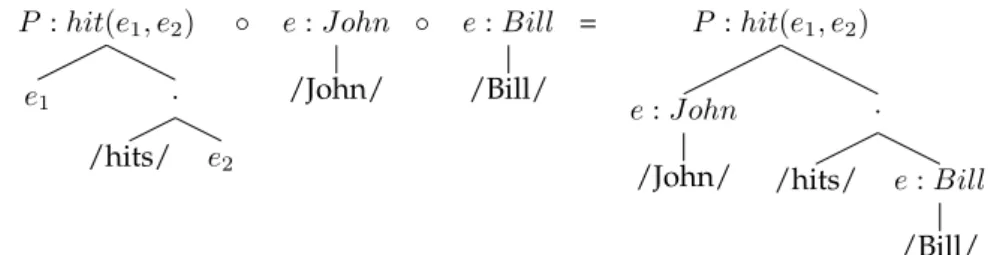
Langacker’s notion of composition involves all sorts of operations. Al-though he does not explicitly describe them, we find in the examples two types: slot-filler operations, whereby one unit is used as the constituent of another unit and the juxtaposition of two units. These units are similar to the ones D ˛abrowska (2014) describes, namelysuperimpositionand juxtapo-sition. In the former, two constructions are combined in such a way that the corresponding elements are ‘fused’ (p. 623). This can be through regular slot-filling, but also through overlaying two constructions (e.g., the hypothetical
[ [HEARER/you] [ACTION] [OBJECT/it] ] and the [ [ENTITYi] [GET/get]
[ENTITYj] ] constructions). Juxtaposition, on the other hand, merely involves
taking two constructions and listing them in some order. In production, mul-tiple verbalizations are possible given the same conceptualization, but the one that is retrieved first (i.e., the one with the most highly-entrenched construc-tions) will be selected, unless the speaker rejects it, for instance because of a low fit with the communicative intent.
D ˛abrowska furthermore makes a difference between a holistic and an an-alytic mode. In the former, language users use their highly concrete schemas to arrive at an utterance. In the analytic mode, language users use the more abstract schemas. As Bod (2009) argued, and in line with Langacker’s (2000) perspective, we can also regard the maximally concrete and maximally ab-stract schemas to be the end points of a scale. Following that line of reasoning, there may not be something like an analytic mode as opposed to a holistic mode: language users will try to stay as close as possible to what they know about the conventions of the language (i.e., the maximally concrete schemas), while sometimes experiencing the need to rely on more abstract units when novel meanings need to be expressed.
2.1.3
Acquiring a grammar
impor-tant, as discontinuity would be a less parsimonious explanation in want of an additional explanation. Whereas in Pinker’s (1984) version of the conti-nuity assumption, the contents of the representations are equal over time, in Tomasello’s (2003) version, the contents may vary over time, but the mecha-nisms with which language is processed, intentions are understood, and pat-terns are learned remain the same over time. However, perhaps a slightly stronger claim to content continuity can be made as well: if constructions consist of phonological and conceptual structure throughout development, a usage-based account can also claim content continuity on a qualitative level: constructions are built up out of phonological and conceptual components and this property is stable over time.
Tomasello (2003) assumes that two sets of domain-general cognitive capac-ities are central to answering the question how infants acquire an inventory of linguistic symbols allowing them to be proficient communicative agents in their communities, viz. intention-reading skills and cognitive pattern-finding mechanisms. Importantly, the same sets are used to acquire both words and grammatical patterns. The former allow a child to understand that other peo-ple are mental agents, with (communicative) intentions and belief states, like herself. On the basis of this understanding, the child can engage in cultural learning (cf. Tomasello 1999), that is: the reverse engineering of behavioral solutions to repeated coordination problems. Directing someone’s attention, manipulating someone’s behavior or knowledge state, or engaging in joint projects constitute some of these problems, a subset we could call ‘social coor-dination’. The language of a community can be regarded as the set of solutions of that community to these coordination problems (cf. Lewis 1969). The task of the language-acquiring child then, is to use her intention-reading and pattern-finding mechanisms to find out what these solutions are.
In this research I will focus on the latter set, the pattern-finding nisms, as it is more evident how a formal operationalization of these mecha-nisms may work and may help shed light on the hypothesized processes. As pattern-finding mechanisms, Tomasello lists such things as the ability to build up perceptual and conceptual categories, the ability to form sensory-motor schemas, performing distributional analysis over perceptual and behavioral sequences, and being able to analogize over larger structures, finding the com-monalities and differences (Tomasello 2003, 4). All of these skills are available to the child before she starts to speak, but it is only when social understanding starts to develop around the child’s first birthday that the child will substan-tially put them to work.
process whereby the child observes that, over multiple utterances, some ele-ments are identical while others vary, and that at the same time, some parts of the communicative intent are identical, while other parts vary. The varying elements are then abstracted over and a construction with a functionally de-fined slot emerges. Elements common across these slots in different patterns may give rise, through functionally based distributional analysis, to highly abstract categories, such as ‘noun’ and ‘noun phrase’. However, as Tomasello argues, these more abstract categories are still grounded in the function these elements fulfill communicatively. Secondly, processes of entrenchment (rou-tinization, automatization) cause certain symbols to be processed more read-ily than others. A pattern becomes more entrenched the more it is processed. Entrenchment plays a central role in the competition between similar patterns, as we have seen in section 2.1.2.
In Tomasello’s older work, we find a slightly different exposition of the learning mechanisms (Tomasello 1992, 234; 250-253). Two processes of ‘con-structional integration’ he discusses there are the expansion of paradigms (the widening of the initially narrow paradigmatic categories) and the addition of syntagmatic terms. In the former case, the allowed complexity of elements filling a paradigmatic position of a rule changes over time such that more com-plex linguistic structures are allowed in there. It is not clear whether Tomasello also includes the widening of the semantic scope of such a paradigmatic posi-tion. The addition of syntagmatic terms simply means that another semantic dependent is added to some semantic head. In the case of argument structure constructions, this means that another argument or adjunct of the verb can be expressed.
In addition to the parts-to-whole line of learning proposed by Tomasello, usage-based theorists often also argue that early representations may not even have an internal syntagmatic structure, but consist of unanalyzed chunks, in which gradually ‘slots’ over varying elements are learned (Bannard, Lieven & Tomasello 2009, Arnon 2010). That is to say, we can conceptualize a gradual build-up of the grammar both through bottom-up procedures, going from the parts to the wholes, as in Tomasello’s explanation, or through top-down pro-cedures, going from the wholes to the parts, as in Arnon’s (2010) explanation. The latter has been emphasized in usage-based studies, for historical reasons, but there are good reasons to also consider parts-to-whole learning to be a central mechanism in a usage-based account, as I will argue in section 2.2.3.
by-product of the attempt to construct complex messages using the syntagmatic relations the child has picked up by then.
2.2
Theoretical issues with the usage-based
perspec-tive
In the previous section, I have given a brief account of the usage-based per-spective on language. The presentation of the mechanisms and representa-tions serves as a starting point for developing a computational model of the acquisition of grammar. Several issues, however, are in want of further clarifi-cation or elaboration.
2.2.1
Representational metaphors: blocks and streams
Both in theoretical linguistic (e.g. Tomasello 2003, Goldberg 2006, D ˛abrowska 2014) and computational modeling work (e.g. Chang 2008), we find descrip-tions of the process of language use involving discrete building blocks that are combined into composite constructs by filling the slot of one construction with another construction. However, Langacker (2000, 8) argues that the con-ception of language use as stacking together building blocks is incomplete at best. Given the dynamic perspective on representation (units or constructions are always in development and any abstraction is immanent in the memories of the concrete usage events), the building-block metaphor unduly empha-sizes a static nature of the units. True as this may be, I believe that this should not stop us from cautiously pursuing the metaphor of ‘building blocks’, as it does yield great explanatory value. What I mean with explanatory value is the following. When operationalizing a theory in computational terms, many researchers take recourse to static structures and are able to explain what hap-pens in the model in the process of composing the building blocks. Such mod-els thus use a metaphor, which may foreground certain aspects of our concep-tion of linguistic representaconcep-tions and the way they form composite structures, while backgrounding other (nonetheless important) ones. The fact that it is relatively easy to ‘look under the hood’ and see what the model does in an-alyzing novel utterances, gives it the power to corroborate linguistic theories with relative ease.4
When one adopts a more classic parsing approach, as is taken in this re-search, the explanation of what is happening is relatively straightforward, as will be seen in later chapters. Acknowledging the inherently metaphorical na-ture of the formalization (just as Langacker does when he draws discrete box-diagrammatic representations and illustrates their combination by using
mul-4Of course, it is conceivable to radically rethink language use in more dynamic terms.
tiple such representations) is then a cautionary note which has to be kept in mind, but which should not stop us from using that metaphor for explanatory purposes.
Nonetheless, there are approaches which do emphasize a more dynamic conception of linguistic structure. Worth acknowledging here is Borensztajn’s (2011) model, in which a parse is a path through a self-organizing space. This space corresponds to a continuous version of distributional categories, akin to part-of-speech and other grammatical categories. By using this continu-ous space, Borensztajn does away with the often faulty metaphor of discrete-ness of categories while keeping the resulting parses relatively interpretable. However, one reason why I believe the parses in Borensztajn’s model are in-terpretable, is that the parses themselves do constitute well-defined discrete graphical representations (i.e., trees). If we were to give up on the discrete na-ture of the composition, as one should when taking Langacker’s (2000) ideas to their extreme, I believe the potential for the linguist’s interpretation of the resulting analyses would be seriously impeded.
2.2.2
Mechanisms operating on early representations
The parsing approach taken in this research does not imply that we have to use the traditional operations defined for parsing in the computational-linguistic literature. Most linguistic theories regard as their central operator a single op-erator that allows a language user to combine structure recursively in order to build a composite hierarchical structure. An interesting question follow-ing from this conception of adult lfollow-inguistic competence is whether language-acquiring children use hierarchical structure building mechanisms from the start as well. But it may be the case that early linguistic perception and pro-duction is to a large extent guided by non-hierarchical rules, and that the use of hierarchical rules only emerges later. To take this argument a little further, it may be the case that some (or even a lot) of adult linguistic processing is governed by processing mechanisms that are simpler and cognitively cheaper than building hierarchical structure. The burden of proof, however, is on those arguing for a multitude of mechanisms, as it is a less parsimonious account.
Tomasello’s (1992, 2003) perspective is of interest here. Tomasello (2003, 226) argues that when very early multiword utterances are not rote learned, they are not by necessity ‘grammatical’ in the sense that we say an adult’s production is, but rather instances of mere concatenation of linguistic items (even if the order of the concatenation is copied from the input language). For something like word order to be ‘grammatical’, in Tomasello’s (1992) view, it has to be used contrastively with another word order.5Importantly, Tomasello
5There is, however, a conceptual problem with defining ‘grammatical’ (in general) in terms of
be-(1992, 259) argues that concatenation, the mere stringing together of linguistic elements, is a possible mechanism that operates before the use of mechanisms giving rise to (hierarchical) structure. A related take on early production is the ‘groping patterns’ approach, which I will discuss in greater detail in section 2.4.3.
The idea that children may initially operate with a mechanism that linearly concatenates linguistic material is to be dispreferred on prior grounds, namely as a violation of the continuity assumption. However, the continuity assump-tion rests on the preconcepassump-tion that adults only use a single mechanism of hierarchical structure building. In several recent works outside language ac-quisition, we find support for the position that different cognitive structure-building mechanisms are at work in language production in the linguistic lit-erature. Jackendoff (2002), and more recently Jackendoff & Wittenberg (2014) argue that, although cognitively all methods of composition (stringing, com-bining into hierarchies) are available to all humans, different languages em-ploy different levels of syntactic complexity to different extents. Jackendoff & Wittenberg (2014) discern levels such as ‘word concatenation grammars’, ‘sim-ple (non-recursive) phrase grammars’ and ‘recursive phrase grammars’ (with increasing complexity). Simpler mechanisms, Jackendoff & Wittenberg (2014, 1) argue, “put more responsibility for comprehension on pragmatics and dis-course context”, as the syntax does not restrict the interpretation in structural ways. On a biologically, as well as culturally phylogenetic timescale, Jackend-off & Wittenberg (2014, 16-17) suggest, the simpler mechanisms probably pre-cede the more complex ones, although they admit that this is speculative, and at most plausible. A similar perspective is put forth in Frank, Bod & Chris-tiansen (2012), who argue that linear processing (most akin to Jackendoff & Wittenberg’s (2014) simple phrase grammar) may be what language users rely on most in processing and producing language, relating it to psycholinguistic processing studies (Frank & Bod 2011) rather than to structural analysis, as Jackendoff & Wittenberg (2014) do.
Interestingly, Jackendoff & Wittenberg (2014) claim that the early gram-matical production of a given language may rely more on the simpler mecha-nisms than the adult’s grammatical production of that language, thus allow-ing for some degree of quantitative discontinuity in the mechanisms used by the language-learning infant and the adult: “As the child’s grammar ac-quires more grammatical devices, it provides more resources for making com-plex thoughts explicit, reducing the workload on the hearer” (Jackendoff & Wittenberg 2014, 2). In other words: the increase of complexity of the acquired grammatical structure allows the child to verbalize more complex thoughts.
Concluding, both structural linguistic and psycholinguistic studies pro-vide epro-vidence that language users employ grammatical representations at dif-ferent levels of complexity in linguistic processing. Tomasello’s perspective
that early combinatorial productivity may not be guided by rules building hi-erarchical structure may be on the one hand less parsimonious, but may also reflect the cognitive mechanisms underlying (early) language production and understanding better. In the model to be developed, I will start off from this perspective, arguing that concatenation-like mechanism may play a central role in the development of a hierarchy-building mechanism but are not used in production.
2.2.3
Gradualism and simultaneity in learning
Whereas the usage-based conception has a relatively clear explanation of the development of linguistic behavior once some knowledge is in place, the ini-tial emergence of that knowledge remains somewhat obscure. Two questions require some more attention. First, how do the initial holophrastic, chunk-like units and later lexical constructions come into being? Second: how do gram-matical constructions develop from the initial lexical units?
Acquiring lexical constructions
The acquisition of lexical units is a process that is ongoing during the whole life of a language user. Given Tomasello’s notion of developmental continuity, we should expect the same mechanisms to be available to infants learning their first words, and an adult language user learning a new word, and in fact, they do (Golinkoff, Hirsh-Pasek, Bailey & Wenger 1992, Landau, Smith & Jones 1992). However, als Hollich, Hirsh-Pasek & Golinkoff (2000) suggest, the relative weight of different mechanisms may vary over time, and, contrary to the null-hypothesis of developmental continuity, different mechanisms may emerge at various points during ontogeny.
The varying weight of different mechanisms is easily explained from a usage-based perspective. Assume that a language user always has the capac-ity to identify the meaning of a phonological string in a top-down way, that is by looking at the syntactic context (e.g.,that’s a WORDvsLook! He’s WORD-ing; (cf. Brown 1957)). To do so, a learner first needs to know grammatical con-structions and the paradigmatic distribution over the words on the position of the novel word. This requires an inventory of linguistic units to be in place already, so this way of learning cannot be used at the very start of language acquisition.