AN OVERVIEW OF HYBRID CLOUD COMPUTING & IT’S ASPECTS WITH REFERENCE TO IT IN INDIA
EKTA SANGWAN1, Dr. OM PRAKASH2
Department of Computer Science and Engineering 1,2
OPJS University, Churu (Rajasthan), India
ABSTRACT
Hybrid cloud is the approach organizations need to embrace for its future in the cloud since hybrid cloud
enables you to help the limit or the capability of a cloud benefit by aggregation, joining or customization
with another cloud benefit. Those administrations can be both private and open. Actualizing a hybrid
cloud is a major procedure and organizations experience issues finding a decent standard for it. In this
proposal, the key focuses and impediments in the implementation of the hybrid cloud are pinpointed.
One obstruction, work processes are examined nearer. Work processes are the aftereffect of cloud
organization, course of action and coordination of automated assignments. The proposition covers the
implementation procedure of work processes.
1. CLOUD COMPUTING
In the previous 20 years, the idea of information
technology benefit outsourcing (ITSO) has been
"a seriously examined field inside IS research".
ITSO can be characterized as "the huge
commitment by outside merchants in the
physical and/or HR related with the whole or
particular segments of the IT infrastructure in
the client association". As indicated by
Leimeister et al., (2011) [1] the outsourcing of IT
administrations "has turned out to be a
standout amongst the most imperative
hierarchical ideas in late decades". Notable
advantages of information technology benefit
provisioning can incorporate cost reserve funds,
upper hands, adaptability and so on. The most
recent turbulent worldwide financial downturn
in conjunction with the quick evolution of IT
and the accessibility of modest computational
resources is requiring that the IT bureaus of
numerous associations consider receiving
expense and asset productive technology
stages. As opposed to embracing a protective
methodology and a securing everything, there is
potential for associations, to industrialist on the
inventive abilities of developing technology
stages keeping in mind the end goal to
accomplish an upper hand.
A case of a beginning advanced technology is
"speaks to an essential change in how
information technology is provisioned"
(Creeger, 2009),[2] in that it empowers
"computing offices, for example, stockpiling
figure power, network infrastructure and
applications to be conveyed as a metred benefit
over the internet, much the same as an utility".
Various reviews and reports have featured the
developing pattern and prevalence of
distributed computing technology. For instance,
a report led by Forrester research featured how
the worldwide distributed computing business
sector will develop from $58 billion of every
2013 to $191 billion out of 2020. At its most
primitive, distributed computing is a favorable
type of provisioning where equipment and
programming computing resources are given by
cloud suppliers "as-a-benefit" over a network
from substantial scale data focuses. While it has
been contended that distributed computing
may speak to the following evolution of
computational provisioning, there is proof to
propose that the cloud speaks to an essential
mechanical outlook change which separates
itself from customary IT provisioning through
various center attributes (e.g. pay-per-utilize
charging models, virtualization, and imaginative
plans of action, nuanced security and protection
challenges). As indicated by Schneider and
Sunyaev,[3] "distributed computing incites a
move in errand obligations amid choice
processes and self-benefit obtainment, gives
standardized administrations a smaller degree,
empowers new situations of outsourcing and
administration game plans, and uses here and
now utilization based contracts". In the
following segments of this chapter the
distributed computing idea is portrayed in more
prominent detail as it shapes one of the
investigation's focal research areas.
2. CONCEPT OF HYBRID CLOUD COMPUTING
Cloud computing has advanced and we are
currently taking a gander at the new time of
hybrid cloud. Gartner characterizes a hybrid
cloud benefit as a cloud computing
administration that is made out of some blend
of private, public and community cloud services
from various specialist co-ops. Cloud computing
as an idea emerged in the 1980's. In the 1990's
it wound up plainly feasible for clients to
associate with their PC's and trade information
and information and also utilization of remote
applications. Be that as it may, worldwide
sharing did not emerge before the presentation
of Web 2.0 toward the begin of 2000's. Cloud
came into the scene by demonstrating an IT
benefit show, which conveys an arrangement of
helpful, on-request and configurable computing
in a self-benefit design, independent of gadget
and area specialist co-op interaction [4].
Cloud computing is a computing worldview,
where a substantial pool of frameworks are
associated in private or public systems, to give
powerfully versatile infrastructure to
application, information and document
stockpiling requiring little to no effort To build
up a protected cloud computing model for
government information framework different
focuses must be considered. They incorporate
cloud computing sending model, (for example,
public, private, hybrid), architectural layers of
cloud computing, (for example, Software as a
Service (SaaS), Platform as a Service (PaaS),
Infrastructure as a Service (IaaS)), security
services, (for example, information security,
character security, information security,
physical infrastructure security, organize
security) and confirmation. Among them two
most difficult variables for government
information framework, which are considered
in this examination are cloud computing
organization model and verification [5].
3. HYBRID CLOUD COMPUTING MODEL
This examination has proposed a 5 layered
hybrid cloud computing model for government
information system and security. Our Hybrid
cloud show is blend of two cloud computing
models: public cloud and private cloud. Hybrid
cloud computing model can be accessed
through the web program utilizing web. By
utilizing hybrid cloud computing model
government can take advantages of both public
and private clouds. Government data are put
away on both the public and private cloud
according to the security prerequisites. Data
which isn't exceptionally delicate and helpful for
overall population is put away on the public
cloud some portion of the model. Data like
military data, money related data, court data,
police data and other basic data which is very
delicate and need high security is put away on
the private cloud [20]. The control of private
cloud stays with the administration and the
control of public cloud stays with the cloud
supplier. The layers of our model are: Access
Layer, Access Control Layer, User Diversion
Layer, Security Layer and Cloud Computing
Layer [6].
Equipment Device Based Authentication
Method: notwithstanding hybrid cloud
computing selection; this exploration proposes
another component of equipment based
authentication system for the administration
information system. Data put away in the
administration servers is profitable resource of
the legislature and nation, which should be
protected from unapproved access. The
unapproved client is solid authentication
system. By and large a secret word protection
technique is utilized for authentication reason
however that isn't adequate. To reinforce the
authentication procedure, a gadget
authentication system is utilized with client
name and secret key. When all is said in done
practices a different gadget like brilliant card or
USB tokens is utilized for gadget authentication.
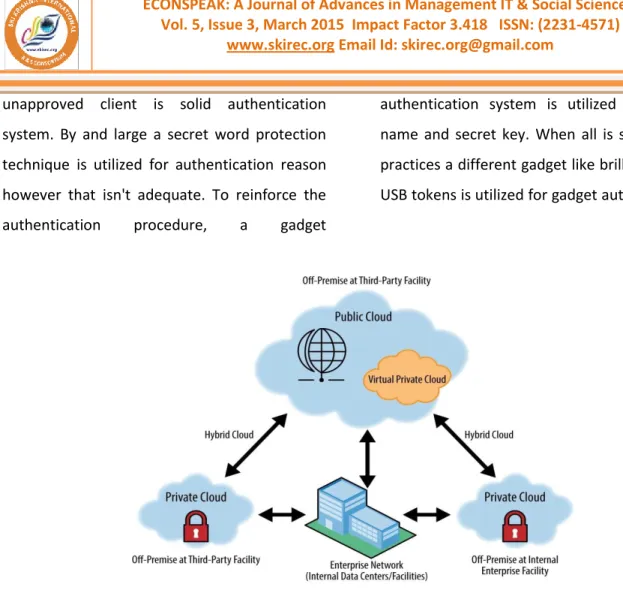
Figure 1: Hybrid Cloud Computing Model
In government offices for the most part PCs are
settled so the standard PC gadgets like hard
circle, CPU and so on can be utilized for gadget
authentication to influence authentication to
process more secure. This examination has
concentrate on utilizing hard circle serial
number for gadget authentication reason. A key
has been created by utilizing hard plate serial
number and aggregate circle space, and this key
is encoded utilizing an encryption key and
calculation, which delivers an authentication
key. The authentication enter is put away in
authentication server at the season of client
enrollment [7].
4. CLOUD BASED GOVERNMENT
INFORMATION SYSTEM
Cloud computing framework has different
points of interest over customary customer
server engineering of the administration
information framework. Governments around
the globe have begun utilizing cloud computing
models rather than conventional customer
server design because of favorable
circumstances of cloud computing. Much of the
of cloud computing model over the wide
economy. The administration contains general
information and information for nationals
however it additionally contains basic
information which needs high security [8].
Hybrid cloud joins both public and private cloud
models. Organizations are receiving hybrid
cloud computing model, where they can utilize
advantages of public cloud and security of
private cloud. With hybrid cloud, clients can
benefit services of outsider cloud supplier which
expands computing adaptability. Hybrid cloud
condition can give according to require and
versatile services to the customer offices. In
hybrid cloud show, if vital the assets of private
cloud can be expanded from the public cloud,
so the assets can be effortlessly overseen
according to the expansion or abatement in
workload. The fundamental favorable position
of utilizing private cloud as a piece of the hybrid
cloud is security. Private cloud is more secure
when contrasted with the public cloud. The
upside of utilizing public cloud as a piece of
hybrid cloud is its public nature and numerous
different points of interest like pay per utilize
and minimal effort and so forth.
Province of Utah is case of such associations. In
2009 province of Utah chose to utilize hybrid
cloud demonstrate for their necessities. Hybrid
cloud joins public and private cloud. Public
cloud replaces the state infrastructure, and a
private cloud gives specialized access and high
security [9].
Evaluating Wants and Needs: In
government cloud, cloud specialist co-op
necessities to give components and
apparatuses that enable government to
express their prerequisite and encourage
the acknowledgment of their objectives.
The administration's cloud computing
system needs: a cloud computing
arrangement display, a cloud computing
administration show, services trademark,
organize infrastructure readiness,
government readiness and security.
A cloud computing organization display: –
Cloud computing offers four sending
models: Private Cloud, Public Cloud, Hybrid
Cloud and Community cloud. Government
chairmen necessities to discover their
prerequisites, based on government's
necessities the cloud supplier chooses
which cloud computing model is best for
the legislature.
A Cloud Computing Service Model: – Cloud
computing offers three administration
models: Software as a Service (SaaS),
Platform as a Service (PaaS), and
Infrastructure as an administration (IaaS).
supplier chooses which benefit
demonstrate is most appropriate for a
particular government prerequisite.
Services Characteristic: – The fundamental
cloud computing attributes are: Service
interoperability, accessibility, execution,
reliability, versatility, flexibility and
transportability. Government can take
advantages of these qualities by benefiting
the cloud services. Versatility is extremely
helpful qualities, in which for the most part
the extent of the assets utilized by the
administration exceptionally time to time,
some of the time government require more
assets and here and there assets are free
and not required. By utilizing versatility of
the cloud computing, government can spare
cash by expanding or diminishing the
measure of the asset [10].
System Infrastructure Readiness: - Network
infrastructure can bolster the request of
higher transmission capacity required for
government's online interfaces when
different residents access government sites
all the while. System and infrastructure
readiness appraisal includes the survey and
review of all system infrastructure regions
that is influenced by the organization of
government sites on the cloud.
Government Readiness: - Agency ought to
consider regardless of whether the
legislature is prepared to move their
services to the cloud. Government needs to
choose which services can be moved to
cloud. Government and cloud supplier
needs to consent to Service Level
Arrangement (SLA), which incorporates all
terms and states of the administration and
security
Security – Security is the most imperative
part to consider when government intends
to move their data on the cloud.
Government needs to think, can cloud
specialist co-op offer same or better level of
security that an administration association
as of now has? Following security focuses
ought to be dealt with while moving
government data to cloud computing.
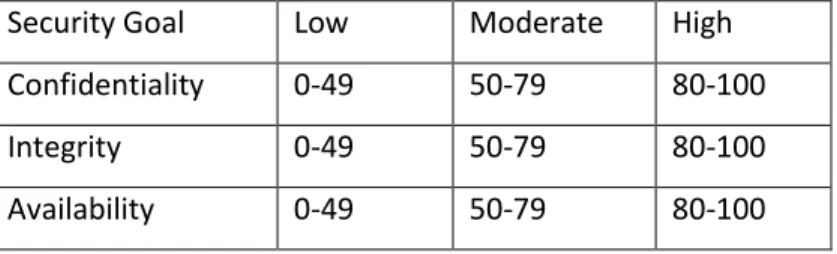
Table 1.1 Levels of Security Goals
Security Goal Low Moderate High
Confidentiality 0-49 50-79 80-100
Integrity 0-49 50-79 80-100
EQUIPMENT BASED VERSUS SOFTWARE BASED
SECURITY
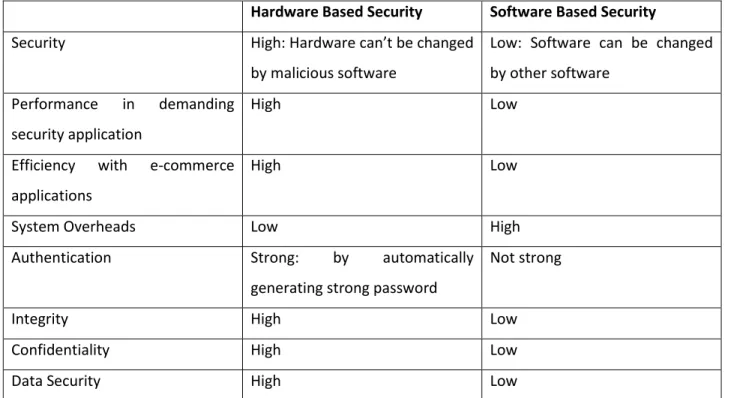
Equipment based security system is more
secure as contrasted and programming based
security system. At the point when equipment
based cryptography is connected legitimately, it
gives better security then programming based
cryptography. It is said that equipment based
cryptographic items can likewise exceptionally
in the level of protection they give against beast
constrain rewind assaults, disconnected parallel
assaults, or different cryptanalysis assaults [11].
Hardware Based Security Software Based Security
Security High: Hardware can’t be changed
by malicious software
Low: Software can be changed
by other software
Performance in demanding
security application
High Low
Efficiency with e-commerce
applications
High Low
System Overheads Low High
Authentication Strong: by automatically
generating strong password
Not strong
Integrity High Low
Confidentiality High Low
Data Security High Low
Table 1.2 Hardware and Software Based Security Comparison.
5. CONCLUSION
Utilizing the plan of action idea as a centering
focal point this examination set out to see how
distributed computing impacts ITSPs' plans of
action. This exploration objective was
accomplished utilizing an iterative
multi-strategy contextual analysis inquire about
approach including a few stages. While stages
one and two gave the exploration profundity
(e.g. cross-industry understanding), stage three
gave the exploration profundity (e.g. cross-case
analysis of two ITSP associations). These three
stages investigate approach demonstrated
exceptionally successful in giving a rich relevant
comprehension of the examination's
exploration objective. The experimental
discoveries in this postulation prompt the
distributed computing supports a move towards
plans of action which are orientated towards
open source production strategies, support Dev
Ops advancement techniques and require a
more unavoidable part for the client. Second,
particular hierarchical and cloud technological
level inhibitors were recognized which
adversely affect ITSPs' capacities to use
cloud-empowered plan of action benefits. At last, this
investigation is one of the first to give insights
from a cloud supply-side viewpoint into the
particular methods for dealing with stress ITSPs
are conveying keeping in mind the end goal to
moderate these inhibitors. In this manner, this
investigation establishes the framework for
making various salient commitments to both
theory and practice.
REFERENCES
[1]. Leimeister, S., Böhm, M., Riedl, C., &
Krcmar, H. (2010). The business
perspective of cloud computing: Actors,
roles and value networks. ECIS, Pretoria,
South Africa.
[2]. Creeger, M. (2009). CTO roundtable:
cloud computing. Communications of
the Acm, 52(8), 50-56.
[3]. Schneider, S., & Sunyaev, A. (2014).
Determinant factors of cloud-sourcing
decisions: reflecting on the IT
outsourcing literature in the era of cloud
computing. Journal of Information
Technology.
[4]. Venters, W., & Whitley, E. A. (2012). A
critical review of cloud computing:
researching desires and realities. Journal
of Information Technology, 27(3),
179-197.
[5]. Abts, D., & Felderman, B. (2012). A
guided tour of data-center networking.
Communications of the Acm, 55(6),
44-51.
[6]. A.B. Mohammed, J. Altmann, J. Hwang,
(2009). Cloud computing value chains:
understanding businesses and value
creation in the cloud, Economic Models
and Algorithms for Distributed Systems,
Birkhauser Verlag, Basel, Switzerland,
pp. 187–208.
[7]. Al-Debei, M. M., & Fitzgerald, G. (2010).
The design and engineering of mobile
data services: developing an ontology
based on business model thinking. In
Human benefit through the diffusion of
information systems design science
research (pp. 28-51). Springer Berlin
Heidelberg.
[8]. Afuah, A., & Tucci, C. (2001). Internet
Business Models and Strategies. Boston.
C. (2005). The information systems
identity crisis: Focusing on high-visibility
and high-impact research. MIS quarterly,
381-398.
[9]. Al-Debei, M. M., & Avison, D. (2010).
Developing a unified framework of the
business model concept. European
Journal of Information Systems, 19(3),
359-376.
[10]. Allee, V. (2009). Value-creating
networks: organizational issues and
challenges. Learning Organization, the,
16(6), 427-442.
[11]. Ballani, H., Costa, P., Karagiannis, T., &
Rowstron, A. (2011). The price is right:
Towards location-independent costs in
datacenters. Paper presented at the
Proceedings of the 10th ACM Workshop