Volume: INT - 14 “Department – Basic Education”
February 2007Department of Information Technology & Electronics
Government of Uttar Pradesh
Version 1.0
Submitted by:
PwC
IT / eGovernance Roadmap
Table of Contents
List of acronyms ...4
Executive Summary...6
CHAPTER 1: BASIC EDUCATION DEPARTMENT – A BACKGROUND... 17
1. Basic Education Department - A background... 18
1.1. Basic education department ... 18
1.2. Vision of the department... 19
1.3. Expectations from Information & Communications Technologies (ICTs)... 19
1.4. Department’s plan for next 5 years ... 20
1.5. Service delivery vision of the Department – 5 year perspective... 21
CHAPTER 2: AS – IS STATUS ... 22
2. As – Is status of computerization in the department... 23
2.1. Manpower resources at various offices of the department... 24
2.2. IT organization & people... 25
2.3. Nodal Officer, Web Master and eGovernance team within the department... 25
2.4. IT related skill sets in the department ... 26
2.5. Software applications in the department... 28
2.6. Hardware and Networking... 29
2.7. Data digitization ... 30
2.8. IT policies... 30
2.9. Key concerns of the department ... 30
2.10. Constraints to IT / eGovernance initiatives... 31
2.11. IT / eGovernance initiatives that are in progress ... 31
2.12. e-Governance Readiness score ... 32
2.13. Level of Computerization... 33
CHAPTER 3: e-GOVERNANCE ENVISIONING... 34
3. eGovernance... 35
3.1. Benefits of e-governance ... 35
3.2. Department’s envisioned state... 36
3.3. E-Governance Delivery Model ... 38
3.4. E-Governance Prioritization Framework ... 39
3.5. e-Governance Roadmap... 42
CHAPTER 4: GAP ASSESSMENT... 46
4. Gap Assessment... 47
4.1. The gaps with respect to the future plans of the department ... 47
CHAPTER 5: IDENTIFICATION OF SPECIFIC eGOVERNANCE PROJECTS ... 50
CHAPTER 6: DATA DIGITIZATION... 54
6. Data Digitization... 55
6.1. Data digitization strategy ... 55
6.2. Cost / financial outlay and timeframe for data digitization ... 56
CHAPTER 7: IT ROADMAP IMPLEMENTATION FOR THE DEPARTMENT ... 57
7. IT Roadmap Implementation... 58
7.1. Planning & Organization... 60
7.1.1. Define a strategic IT plan... 60
7.1.2. Define the IT organization, direction and relationships... 60
7.1.3. Define the IT Policies and Procedures ... 61
7.1.4. Define the Standards ... 62
7.1.5. Manage IT Investments ... 62
7.1.6. Communicate the Management aims and direction... 63
7.2. Acquisition and Implementation... 64
7.2.1. Define the user requirements ... 64
7.2.2. Acquire and Maintain application software ... 64
7.2.3. Acquire and maintain technology infrastructure... 65
7.2.4. Install and accredit systems ... 65
7.2.5. Manage changes ... 66
7.3. Delivery and Support ... 66
7.3.1. Define and manage service level... 66
7.3.2. Manage third party services... 66
7.3.3. Manage performance and capacity... 67
7.3.4. Ensure continuous service... 67
7.3.5. Ensure Secure System ... 68
7.4. Monitoring ... 69
7.4.1. Monitor the processes... 69
7.4.2. Assess internal control adequacy ... 69
7.4.3. Provide for independent audit and obtain independent assurance ... 69
CHAPTER 8: IMMEDIATE POSSIBLE COMPUTERIZATION INITIATIVES ... 70
8. Immediate possible computerization initiatives... 71
CHAPTER 9: ANNEXURES ... 72
9. Annexure... 73
9.1. Annexure -I: Contact details of the department... 73
9.2. Annexure -II: Solution deployment model... 74
9.3. Annexure -III: Training requirements of the department... 77
9.4. Annexure -IV: Best practices on Information technology usage on IT policies, standards and guidelines... 83
9.5. Annexure -V: Suggestive Information directory for the website ... 93
List of acronyms
AMC Annual Maintenance Contract
BPR Business Process Reengineering DHTML Dynamic Hypertext Markup Language DPR Detailed Project Report
DRP Disaster Recovery Plan DSS Decision Support System eGov Electronic Governance e mail Electronic Mail
G2C Government to Citizen G2G Government to Government GO Government Order
GPF Government Provident Fund GPR Government Process Reengineering GoUP Government of Uttar Pradesh HO Head Office
HOD Head of Department
HTML Hyper Text Markup Language
ICT Information & Communications Technology IT Information Technology
ISSP Information System Security Policy KBPS Kilo Bytes Per Second
LAN Local Area Network
MIS Management Information System MPR Monthly Progress Report
NeGP National eGovernance Plan NIC National Informatics Center OS Operating System
PC Personal Computer
PeMT Project eGovernance Mission Team
PERT Project Evaluation and Review Technique PKI Public Key Infrastructure
PPP Public Private Partnership PwC PricewaterhouseCoopers PMS Personnel Management System
RDBMS Relational Database Management System SDLC Software Development Life Cycle
SeMT State eGovernance Mission team SRS Software Requirement Study TNA Training Need Analysis UP Uttar Pradesh
UPDESCO Uttar Pradesh Development System Corporation XML eXtendible Markup Language
VSAT Very Small Aperture Terminal WAN Wide Area Network
Executive Summary
Success to eGovernance projects largely depends on three dimensions (a) People, (b) Processes and (c) Technology. Department of Basic Education needs concerted efforts in all the three dimensions to ensure that departmental services reach to its beneficiaries efficiently and eGovernance efforts help meet the department’s objectives successfully.
In order to align the department’s eGovernance initiatives with National eGovernance Plan (NeGP)
and State eGovernance efforts, Government of Uttar Pradesh has appointed PricewaterhouseCoopers (PwC) to undertake "As –Is assessment of Information Technology (IT)
usage and level of computerization in the department” and subsequently prepare 5 year eGovernance roadmap for the department.
This draft report summarizes the existing status of the department towards computerization and eGovernance initiatives. With the understanding of the department’s vision, services, stakeholders, expectations from Information Communications & Technology (ICT) and the envisioned state of the department for next 5 years in respect to interface with its beneficiaries / stakeholders, eGovernance roadmap has been prepared and presented with a 5 year view in this report.
The assessment and roadmap has been prepared after detailed interaction with department’s personnel and the response provided through the questionnaire submitted by PwC. This report has been prepared after interaction with SCERT, Directorate of literacy and alternative education, Basic Education directorate and Education for all project.
The focus of eGovernance is the services of the department that it renders to its beneficiaries / customers and not merely the activities that the department does.
The findings of “As –Is” study on IT usage and level of computerization for Department of Basic Education is as follows:
As –Is Assessment Status
Existence of Core departmental software application Does not exist LAN at HO (of all the offices) Does not exist LAN at other offices Does not exist WAN for the department Does not exists
No of computers in the department (approximately) 63 in Education for all Project
and Directorate of Literacy and alternative education
No of servers in the department 3
Official e-mail id of the departmental personnel Does not exist Existence of web site Yes
As –Is Assessment Status
State of data Manual
Skills (for IT and relevant area) Department would require to
train 40000 people in IT and relevant area
Existence of department’s eGovernance team Yes Existence of eGovernance Nodal Officer Yes Existence of web master No Existence of IT function / cell in the department No Existence of formal IT policies in the department No Level of computerization score (from three categories of High, Medium and Low)*
Low
Level of eGovernance readiness (from three categories of High, Medium and Low)*
Low
* Framework for level of computerization and eGovernance readiness score is provided in chapter -2 of this report.
The department envisages that all offices of the department viz Head office, and field offices are networked with each other so that the information flow is prompt and information related to decision making is available with out unnecessary delays. The department also envisages that Head office and field offices are connected to treasury so that electronic submission of documents and flow of funds can be facilitated.
In realizing the vision of providing services efficiently and promptly from each office of the department, it looks forward to provide personal computers upto the level of senior clerk / section officer. The basis of providing computers upto this level is that the paper work is mostly handled by them, and by automating the services upto this level of department, eGovernment services can be provided efficiently to the citizens. Automating the services in phased manner will enable the department to provide G2C and G2B and G2G services to the citizens / and other stakeholders in effective and efficient manner.
The department envisages framing of policies that help general public and for pressing effective services in those areas that require immediate and focused attention. In order to create such policies and provide effective services, department needs to have two way-communications for information and data with the field offices. On one hand, the basic data regarding the needs of
citizens / beneficiaries would be communicated to the top level authorities so that necessary action can be initiated, and on the other hand the department’s responsibilities towards its field offices regarding supply of material / technology / advice / funds could be expedited. The essence of this two way communication is to ensure that the beneficiaries of the department are provided with prompt services without hassles and cumbersome follow ups.
eGovernment is the achieved through meticulous planning, commitment from top management and dedicated personnel. It is essential that a very clear vision for the department is created and is percolated to all the employees. There are 4 stages in eGovernment; (1) Publish, (2) Interact, (3) Transact and (4) Integrate.
In stage one – Publish, the department aims in providing the information about the department through electronic mode like website. The basic idea of this stage is to have wider visibility and accessibility of the department.
The department could provide information regarding the procedures to avail the services, the acts / rules and various GOs, various documents that be of use to the citizens, performance indicators (both financial and physical) of past couple of years, future plans and targets for the current fiscal, management structure, names of the officers along with their contact numbers , email id etc.
In stage two - Interact, the department progresses from earlier stage – wherein one way communication (from the Government to the citizens) was possible, to the two way communication (between the Government and Citizens / Business etc).
The department could accept and write official emails to have closer interaction with the general public to cut short usually long communication time, could accept feedback on various issues and welcome comments on the delivery of services or any other issues.
In stage three – Transact, the department progresses from stage – II of merely informational communication, to transactional stage. In this stage the department attempts to deliver the services electronically. Certain specific services, for example, imparting of education (to students), treatment of a patient (to patient) or distribution of seeds (to farmers) cannot be provided through electronic modes, however, the delivery of such services can be facilitated with eGovernance. In reference to the above – cited examples, enrolment of student and for scholarship, registration or appointment
with the doctor or OPD (Out Door Patient Department) and registration & licensing of the retailer for the seed can be accelerated with eGovernance. In this stage the financial transaction between the beneficiary and the Government could be carried out through payment gateway with the help of electronic fund transfer (EFT), electronic banking, credit card, debit card etc without having the need to visit the Government department / treasury to do the financial transactions. It is not imperative for the beneficiary to have a credit card to avail of the facility of electronic fund transfer, most of the banks are moving to computerized environment and this facility (of EFT) can be availed from the bank of the beneficiary.
In stage four – Integrate, the department transcends its physical boundary and shares data and information with other departments to provide the services to its beneficiaries. In this stage the department shares its databases and other information electronically with concerning departments based on ‘need to know basis’. An example could be admission of a candidate in Government medical college. The verification of credentials at the time of admission could be done electronically like High School & Intermediate marks and subjects studied (from the department of Secondary Education), Caste status (from Rural / Panchayati Raj Department in case of rural candidate and Collectorate in case of urban candidate).
Successful eGovernment is achieved through gradual steps. The following activities could be undertaken as possible immediate computerization initiatives:
The following activities can be undertaken as possible immediate computerization initiatives: (1) Creation of IT function / cell
(2) Preparation of DPRs for
a. Hardware requirements b. Software requirements c. Networking (LAN structure)
d. Connectivity (between the offices of the department) e. Training (Training Need Analysis)
f. Web site g. Data digitization (3) Seek approval of DPRs
(4) Start the process of development of the software and implementation thereof (5) Start the training of the staff
In order to undertake eGovernance activities, approximate costs have been estimated for the following
(a) Hardware
(b) Software development (c) Data digitization
(d) Training, and Total cost for all the four components
(The costs and the requirements provided in this report are only an estimate, it is important to note that a detailed project report needs to be prepared for each project for precise estimation of cost)
Approximate costs for hardware components
Component Item Requirements Per unit cost Cost per item
PC 1197 35000.00 41895000.00
Dual Processor based server (for database, application and backup) 6 800000.00 4800000.00
Single processor based server (For web and proxy) 2 400000.00 800000.00
Servers & System Cost 47495000.00
LAN nodes 980 900 882000
Routers (For connectivity from SWAN terminal router) 903 250000 225750000
Switch 48 port 0 20000 0
Switch 24 port 0 10000 0
Switch 16 port 4 8500 34000
Switch 8 Port 86 7500 645000
Patch Panel 48 port 0 6000 0
Patch Panel 24 port 0 3500 0
Patch Panel 16 port 4 3000 12000
Patch Panel 8 port 86 2500 215000
Network Cost 227538000.00
5 KVA UPS (HO) 4 175000 700000
3 KVA UPS (1 each office) 899 100000 89900000
Laser Printer (1 each office) Network printer 4 35000 140000
Laser Printer 899 8000 7192000
Storage Solution 1 100000 100000
5 U Racks (for each office) 0 3000 0
42 U Racks (For head office) 1 30000 30000
Peripheral cost 98062000.00
AMC (for 4 years)
@10 % of Hardware cost 373095000.00 149238000.00 149238000.00 Se rv e rs & Sy st e m Ne tw o rk Per ip h er a ls (C) Ha rd w a re AM C AMC Cost (D) (A) (B)
Cost estimates for Software components
Cost estimates for Data digitization
Component Item Requirements Per unit cost Cost per item
OS license (per server) 8 12000 96000
Application Software license (Processor based) 2 500000 2000000
Database License (Processor based) 2 700000 2800000
Anti Virus 10 Agents 120 10000 1200000
Anti Virus 50 Agents 0 50000 0
MS Office 1197 8000 9576000
System Software cost 15672000.00
Software - one time cost 13000000 13000000
Recurring cost @10% per year 4 years 5200000
Customized software for departmental domain functions 18200000.00
33872000.00 Sy st e m So ft w a re (A) Cu st o m iz ed S / w fo r de pa rt m e n ta l do m a in func ti o n s (B) So ft w a re
TOTAL SOFTWARE COST
Data Number of records Rate (Rs per record) Amount Students 400000 3 1200000
School and school infrastructure details 100000 5 500000
Teachers details 250000 3 750000
Employee data 12000 5 60000
Data Digitization cost 2510000.00
(A) Dat a D ig iti za ti o n Dat a D ig iti za ti o n
Cost estimates for training
Total estimated cost for all the components
In order to have sustainable eGovernance initiatives change management plays vital role. Change management aims in bringing a paradigm shift in providing services to the customers of the department. This necessitates attitudinal change, technological skills enhancement, adaptability to respond to customers requirements in ever demanding scenario and commitment to provide superlative services. The department needs to provide training to its employees to work in computerized environment to undertake e-Governance initiatives and for change management. Various teams would be created and specific training would be provided to special team created for specific tasks. Training that needs to be provided to the departmental staff is detailed in this report in Annexure – III.
The department should start with creation of teams for successful implementation of eGovernance projects, preparation of detailed project reports for each of the activities under eGovernance, like development of core departmental software, data digitization, sustainability model (whether outsourced through a PPP model), site preparation, process reengineering, creation of LAN, training to departmental manpower resources, capacity building, change management etc.
Training Cost Rate No of participants Amount
Basic Computer training 3000 40000 120000000
Advance level including application software 5000 350 1750000
Training Cost 121750000.00 T ra ini ng T ra ini ng (A) Hardware 522333000.00 Software 33872000.00 Data Digitization 2510000.00 Training 121750000.00 680465000.00 Total Cost Co st Es ti m a te s Cost Estimates
The priority and software applications required by the department for its core and subsidiary functions are:
Priority
(High / Medium / Low)
Functional Objective of the software
High School Management System Students database
Medium Personnel management system Accounts / Budget / Audit
Low 1. Complaint management 2. File tracking system 3. Daak Management System
The departmental services have been studied and analyzed for the value that they would provide, both to the consumers (beneficiary) and the department, on their e-enablement. The assessment of value has been done using ‘service value analysis’ framework, a PwC methodology for identifying the value. The value to the consumer could be in terms of savings in time & money, no harassment, no follow-ups, prompt delivery of service / information etc. Value to the department could be in terms of efficient and proactive delivery, low cost, less manual work, less paper and file work etc.
Each service, subsequent to eGovernment that the department would offer, is assessed from the view of value (high or low) that it would render to the consumer and department.
The eGovernance roadmap is provided in Chapter 3 of this report, within which the activities that the department needs to undertake are provided in three phases. The services of phase 1 would provide high value both to the consumers and department. Activities in phase -1 are to be undertaken and implemented in the timeframe of 0 – 2 years. The key objective of the services / activities in this phase is to increase the visibility of the department. Services implemented in this phase have wide customer base and relatively simple delivery operations.
Phase -2 services / activities are to be undertaken and implemented in 2 to 4 years timeframe. The key objective of the services / activities in this phase is to build critical transactional services. Services implemented as a part of this phase enjoy high visibility and have relatively complex delivery operations.
Phase -3 services / activities are to be undertaken and implemented in 4 to 5 year timeframe. The key objective of the services / activities in this phase is to sustain value.
Phase -1
0 to 2 years
(I) People Related Initiatives
1. Create a committee that would look after all eGovernance initiatives for the department. Also create PeMT, office level team and identify eChampions. The team would look after the requirements for the entire department.
2. Create the IT function / cell in the department (Refer Chapter – 7 for more details in IT function in the department)
3. Provide training to the department officials (Refer annexure III for training requirements)
(II)Process / Operations Related Initiatives
1. Prepare detailed project reports (DPRs) for the enablement of e-Governance in the department. DPRs to be prepared are:
a. Data digitization b. Hardware requirements c. Software requirements d. Training
e. Networking and connectivity f. Web site
2. Carrying out Business Process Reengineering in the department
(III) Technology Infrastructure
1. Create e-mailing infrastructure within the department.
2. Procure and install the requisite hardware at the departmental locations. The locations where hardware would be installed in the first phase would be identified in the detailed project report
3. Development of core departmental integrated application software; Implementation at the core departmental application software at the locations where activities are high (as identified in the detailed project report)
4. Add the following functionality to the website
a Application forms to request the services of the department b Information on the procedures to avail the services
c Acceptance of grievance and complaints through the web site 5. Data digitization for
(i) Students details
(ii) School and school infrastructure details
(iii) Teacher’s details
(iv) Employees data
6. Create LAN infrastructure
7. Create e-mail id of all the important functionaries
8. Establish connectivity with the State Wide Area Network (SWAN) for inter office connectivity
Phase -2
3 to 4 years
(I) People
1. Implement the changes as recommended in the BPR exercise done in phase – 1
(II)Process / Operations Related Initiatives
1. Creation of Information Systems Security Policies (ISSP), Disaster Recovery Plan (DRP)
(III) Technology Infrastructure
1. Providing infrastructure throughout the department for intra-office communication through emails, share data / files / documents.
2. Undertake the implementation of software application for a. Personnel Management Software
b. Budgeting & Financial Management system c. E – procurement
d. Other softwares like Daak Management system, File tracking system etc
3. Implementation of Core departmental integrated application software at the offices that were not covered in phase -I
4. Creation of interactive website through which the beneficiaries / citizens can submit their documents and apply for the services
Phase -3
4 to 5 years
(I) Process / Operations Related Initiatives
1. Implementation of Information Security Policies (ISSP)
2. Develop the information sharing and privacy policy for sharing of department information with other departments (G2G).
(II)Technology Infrastructure
1. Enable the department to have Public Key Infrastructure (PKI) for secured electronic transactions
2. Creation of secured IT environment to enable the beneficiaries of the department transact safely
3. Provide the departmental services through the state portal
4. Implementation of DRP and creation of disaster recovery (DR) Site
5. Sharing of department information with the other government departments and agencies (G2G).
Cost for the activities in phases
The department needs computing at both head office offices and field offices, and with the kind of usage of core departmental functionalities it is recommended that a centralized architecture is adopted (various options of solution deployment model is provide in (Annexure – II) of this report).
Information Technology Implementation plan for the department is discussed in detail (in Chapter 7) for the four main areas (i) Planning and Organization, (ii) Acquisition & Implementation, (iii) Delivery & support, and (iv) monitoring.
Best practices on information technology usage is provided (Annexure - IV) for (i) security, (ii) privacy, (iii) disaster recovery and business continuity planning, (iv) database designing and implementation, (v) software architecture, (vi) Technology Infrastructure, (vii) Integration technologies, and (viii) Adoption of local language
Phase 3
Y ear 1 Y ear 2 Y ear 3 Y ear 4 Y ear 5
Hardware 373095000.00 37309500.00 37309500.00 37309500.00 37309500.00
Software 28672000.00 1300000.00 1300000.00 1300000.00 1300000.00
Data Digitization 1200000.00 60000.00
Training 120000000.00 1750000.00
Total (Y ear wise) 522967000.00 38609500.00 40419500.00 38609500.00 38609500.00
Phase 1 Phase 2
Objectives of the department:
1. To organize pre-service and in-service training programmes.
2. To develop textbooks, teacher manual, magazines and other relevant literature.
3. To encourage research and innovation programmes & projects.
4. To empower DIET faculty for planning and implementing strategy in the areas of improvement of the quality of achievement, access and retention
5. Expanding access to education by opening new schools, education centres etc.
6. Strengthening infrastructure in schools
7. Universal enrolment and universal retention of all children
8. Improving quality of teaching-learning 9. Community participation in basic education 10. To provide infrastructure for the schools run by
Basic Shiksha Parishad, make necessary arrangements for inspection of schools, ensure availability of teachers in schools, curriculum development, conduct examinations, recognition of Private Primary and Upper Primary Schools and their supervision and inspection.
11. To give advice to the govt. from time to time for the development of Basic Education.
12. To provide a Primary School in a radius of 1.5 km. and for a population of 300 and a Junior High School in a radius of 3.00 km. and for a population of 800.
13. To ensure availability of at least two teachers in a primary school.
14. To monitor regular attendance of teachers in schools.
15. To reduce the number of drop-outs in the schools.
16. Universalization of Primary Education
1.
Basic Education Department - A background
1.1. Basic education departmentThe state Government has accorded the highest priority to primary education for children in the age group of 6 to 14. In order to universalize education, the state government had a quick survey conducted to identify the gaps for primary and upper primary schools. On the basis of cluster of population the survey revealed that the department would need to open up 9524 primary schools and 4863 upper primary schools.
The primary schools are to be opened up in the radius of 1.5 km and upper primary in the radius of 3 km.
In order to have effective education system for the children of the state, Government has formulated various schemes, some of them are:
• Mid Day Meal
• Shiksha Mitra Scheme
• Prime Minister Gramoday Project
• Education Guarantee Scheme
The vision of SCERT is primarily concerned with ensuring quality in respect of planning, management, research, evaluation and training at the school level with a view to effecting changes in policy formulation and policy implementing strategies.
There are various implementing bodies for the schemes formulated by the Government. Some of the implementing agencies are:
1. State Council of Educational Research and Training (SCERT) 2. Education for all project
3. Training programme under education council 4. Literacy and Alternative Education
5. Urdu education
1.2. Vision of the department
The department has various implementing bodies each having distinct responsibilities. Vision of each of the implementing agency is as follows:
Vision of State Council of Educational Research and Training:
Vision of education for all project is
Vision of the department of basic education is:
1.3. Expectations from Information & Communications Technologies (ICTs)
With the use of ICT, department would like to provide services to the beneficiaries of the department:
The department looks forward to the following
The vision of Education For All Project is to make good quality free elementary education accessible and available to each child in the age group of 6 – 14 years
The Basic Education Department's vision is to impart basic education to all the children of the state in the age-group 6 to 14 years
(1) Monitoring of different training programmes (2) Evaluations and Survey analysis
(3) Greater help in implementing right to information act (4) Co-ordination among all units
(5) Monitoring of Staff strengthening (6) On line collaboration of experts (7) On line examinations
(8) To provide academic support to primary teacher for quality education (9) Monitoring of funds flow from head quarter to sub ordinate offices (10) To provide on line services e.g. research & evaluation, exams etc (11) On line Training programmes and monitoring the progress
(12) “We want that the we should integrate our Nyay Panchayat Resource Center to block and block to district so that all communication transfer of documents, letter, data entry of Educational Management Information System, reporting system can be online thru web”
(13) “We want that funds utilization at VEC level should informed through web, that they have utilized the funds”.
(14) Strengthening of District Institute of Educational Training (DIET), thru e-learning.
(15) To have official email ids for the staff up to the level of Section Head; this initiative would help the department to communicate efficiently both within and outside the department
(16) The department would like to have interactive web site for the purpose of taking feedback from the visitors of web site, acceptance of filled in application. In ideal condition, the feedback from the users through the website should go to the concerned person’s email id
1.4. Department’s plan for next 5 years
(1) To impart basic education to all the children upto age-group 14 years of the state
(2) To saturate the demand for additional infrastructure in schools (3) To saturate the demand for access to basic education
(4) To establish teacher pupil ratio of 1:40 and student classroom ratio of 1:40 (5) To ensure 100% enrolment and 100% retention
(6) To improve students learning levels
(7) Organization of qualitative pre-service and in-service teachers training programmes
(9) Capacity building of DIET faculty
1.5. Service delivery vision of the Department – 5 year perspective
1. To have “May I Help You” service in all offices of the department that is able to provide assistance to the consumers of the department
2. All the offices of the department across the state are computerized and consumers are attended promptly
3. The offices of the department have healthy, comfortable and conducive environment for the citizens and the employees as well
4. The services of the department are provided through the Common Service Centers (CSCs)
2.
As – Is status of computerization in the department
We have studied and assessed the department on the following parameters: (1) Manpower resources at various offices of the department
(2) IT Organization & people
(3) Nodal officer, Web Master and eGovernance team within the department (4) IT related skill sets of the department
(5) Application software inventory that are available with the department (6) Hardware and networking
(7) Data digitization (8) IT policies
(9) Key concerns of the department
(10) IT / eGovernance initiatives that are in progress (11) eGovernance readiness
2.1. Manpower resources at various offices of the department
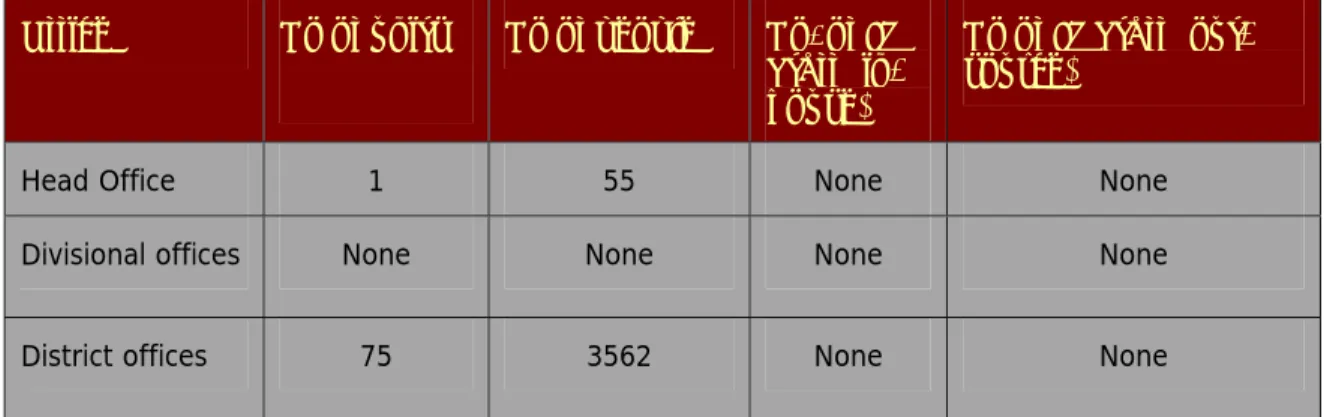
The following table gives the break up of the number of staff in the various offices.
Table 1 : Number of manpower resources in the department – SCERT set up
Office No of units No of people No. of IT Staff (in-house)
No of IT Staff (out-source)
Head Office 1 55 None None Divisional offices None None None None District offices 75 3562 None None
Table 2 : Number of manpower resources in the department – Education for all set up
Office No of units No of people No. of IT Staff (in-house)
No of IT Staff (out-source)
Head Office 1 55 None None Divisional offices None None None None District offices 70 Not provided None None
Table 3 : Number of manpower resources in the department – Literacy & Alternative Education set up
Office No of units No of people No. of IT Staff (in-house)
No of IT Staff (out-source)
Head Office 1 25 None None Divisional offices None None None None
Office No of units No of people No. of IT Staff (in-house)
No of IT Staff (out-source)
District offices 70 210 None None
Table 4 : Number of manpower resources in the department – Directorate of Basic education and field offices set up
Office No of units No of people No. of IT Staff (in-house)
No of IT Staff (out-source)
Head Office 1 254 None None Divisional offices 16 192 None None District offices 66 2052 None None Block 813 1360 None None
2.2. IT organization & people
The department does not have an IT section / cell to look after the needs of computerization
2.3. Nodal Officer, Web Master and eGovernance team within the department
Table 5 : Details of Nodal Officer, Web master and eGov team
Nodal Officers Web Master eGov team
1. Smt Vasumati Agnihotri, Deputy Director (Literacy & Alternative Education) 2. Shri K K Gupta, Joint
Director (DPEP)
3. Smt Partha Sarthi Sen
None Yes,
The department has formed an eGov Team
Nodal Officers Web Master eGov team
Sharma, Additional State Project Director (UP Education for all project)
4. Shri K M Tripathi Additional Director (Basic Education)
2.4. IT related skill sets in the department
Details of computer and IT related training that has been facilitated to the staff of the department is provided in the following table
Table 6 : Details of (IT related) training provided to the number staff of the department - SCERT
Training domain H.O. Dist office Provided by
Basic training on IT Nil Hardware & Networking Nil Nil OS (system admin) & Database admin Nil Nil Communications (email) Nil Nil Project Management Nil Nil Web and emerging technologies Nil Nil Others: Nil Nil
Table 7 : Details of (IT related) training provided to the number staff of the department – Education for all project
Training domain H.O. Dist office Provided by
Basic training on IT 11 70 Hardware & Networking Nil Nil OS (system admin) & Database admin 11 70
Training domain H.O. Dist office Provided by
Communications (email) Nil Nil Project Management Nil Nil Web and emerging technologies Nil Nil Others: Coral / page maker 4 Nil
Table 8 : Details of (IT related) training provided to the number staff of the department – Basic education Directorate
Training domain H.O. Dist office Provided by
Basic training on IT None None Hardware & Networking Nil Nil OS (system admin) & Database admin 11 70 Communications (email) Nil Nil Project Management Nil Nil Web and emerging technologies Nil Nil
Others: Nil Nil
Table 9 : Details of (IT related) training provided to the number staff of the department – Literacy and alternative education
Training domain H.O. Dist office Provided by
Basic training on IT 10 Nil Hardware & Networking 10 Nil OS (system admin) & Database admin Nil Nil Communications (email) Nil Nil
Training domain H.O. Dist office Provided by
Project Management Nil Nil Web and emerging technologies Nil Nil Others: Coral / page maker 4 Nil
2.5. Software applications in the department
The details of the application software that are in use in the department are given below:
S. No
Name of the application software
Functional objective Architect ure Database Location installed Developed / Procured from Current status of software 1. Financial Management System Maintain books of accounts 2 Tier Oracle 55 locations Compare
Infobase Delhi Functional (Only 35
locations)
2. DISE District Information of School Education 2 Tier Oracle 70 locations NIEPA, New Delhi Functional 3. House Hold
survey Trace Out details of out of school / disabled children
2 tier Oracle 70 locations
In house Functional
4. Payroll Prepare pay bill 2 tier SQL Anywher e
1 location In house Functional
5. Decisions Support System
Analysis of DISE data 2 tier Oracle 70 locations
In house Functional
6. DSS For
state Generate Analytical report of State
2.6. Hardware and Networking
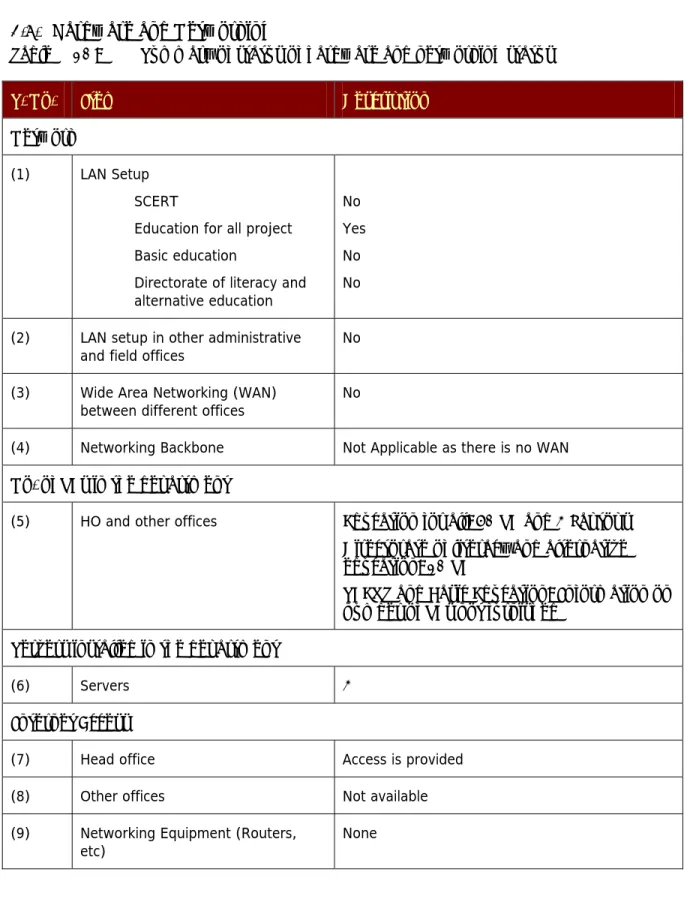
Table 10: Summary of status of hardware and networking status
S. No. Item Description
Network
(1) LAN Setup SCERT
Education for all project Basic education
Directorate of literacy and alternative education
No Yes No No (2) LAN setup in other administrative
and field offices No (3) Wide Area Networking (WAN)
between different offices No
(4) Networking Backbone Not Applicable as there is no WAN
No. of PCs in the department
(5) HO and other offices Education for all: 50 PC and 3 Laptops Directorate of literacy and alternative education: 10 PC
SCERT and Basic Education: Information on number of PCs not furnished
Servers installed in the department
(6) Servers 3 Internet Access
(7) Head office Access is provided (8) Other offices Not available (9) Networking Equipment (Routers,
2.7. Data digitization
a. Data that needs to be digitized for eGovernment
(a) Students details
(b) School and School Infrastructure details (c) Teachers details
(d) Employee details
b. Status of data; whether manual or digitized
Data is in manual form
c. Number of records to be considered for data digitization
S. No. Record type No. of records (Approx)
1 Students details 4 Lakhs 2 School and school infrastructure details inclusive of EGS
Centers 1 Lakh schools and centers 3 Teachers details 2.5 Lakhs
4 Employee details 12000
2.8. IT policies
The department currently does not have documented IT policies in place.
2.9. Key concerns of the department
The department officials try to provide the services to its customers in a timely fashion; however, the following areas hamper the efficiency of the department in the delivery of the services to the citizens / customers / beneficiaries / other departments / employees etc
• Departmental process are manual and therefore a lot of time is wasted in doing the exercise again and again
• The department has to wait for NLM sanctions
• Non availability of information for district level
• Lack of IT Facilities
• More than 50% posts are vacant
• We are not able to track out of school children which is essential to ensure enrolment of 100% children in the age group of 6 – 14 years
• Regular attendance of teachers and students is a problem which is the main reason of low quality of education as well as drop out.
• Teachers lack in motivation and commitment towards teaching which has affected the learning levels of students.
• There are large no. of teacher vacancies in schools which is affecting the proper teaching learning in schools.
• There is shortage of classrooms for students due to which multi-grade teaching – different classes being taught in the same classroom, has to be resorted to.
• Quality of cooked mid-day-meal programme for students has to be ensured.
2.10.Constraints to IT / eGovernance initiatives
Various constraints faced by the department in taking up the IT / eGovernance initiatives can be classified under the following heads:
Technical people are not available
Due to non sensitization of employees, they are resistant to IT No motivation for computerization
Existing staff is not trained
2.11.IT / eGovernance initiatives that are in progress
(1) Web site is being created
(2) Web based monitoring system approval is in process (3) Networking of computers at state level is in process
(4) Educational Management Information System data entry is in progress (5) Basic computer training of staff is in progress
2.12.e-Governance Readiness score
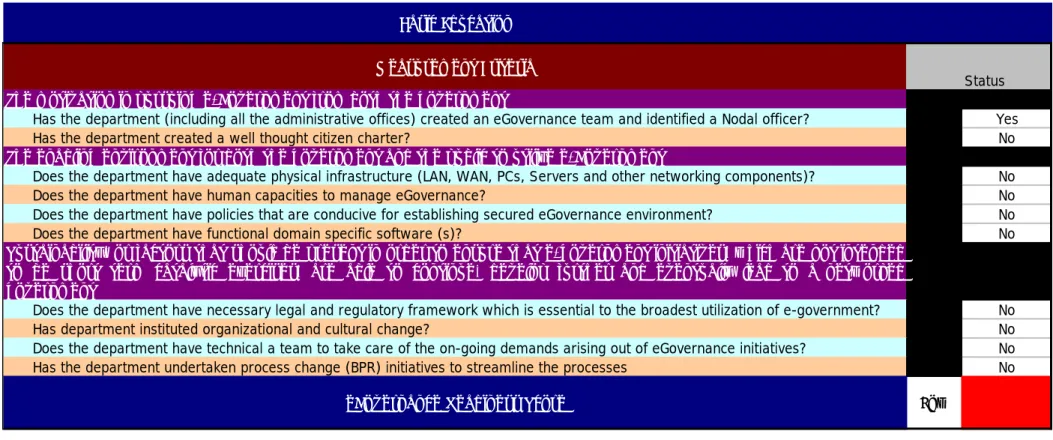
The following table is the graded score on level of preparedness evaluated through the as is studies for taking up eGovernance activities / applications. The scores have been classified in three categories: High, Medium and Low; we have used a framework to assess the level of eGovernance readiness of the department on various parameters. The level of preparedness is graded on following basis:
Score > 75% High; Between 75 and 35% Medium, and < 35% Low
Table 11: eGovernance readiness score
Basic Education Measurement Criteria
Status
The motivation in pursuing e-Government from both the government
Has the department (including all the administrative offices) created an eGovernance team and identified a Nodal officer? Yes
Has the department created a well thought citizen charter? No
The enabling environment for both the government and the public to utilize e-Government
Does the department have adequate physical infrastructure (LAN, WAN, PCs, Servers and other networking components)? No
Does the department have human capacities to manage eGovernance? No
Does the department have policies that are conducive for establishing secured eGovernance environment? No
Does the department have functional domain specific software (s)? No
Sustainability, or factors that should be present in order to ensure that e-government initiatives, which are not intended to be short term catalytic exercises, are able to continue, develop further and eventually lead to a networked government
Does the department have necessary legal and regulatory framework which is essential to the broadest utilization of e-government? No
Has department instituted organizational and cultural change? No
Does the department have technical a team to take care of the on-going demands arising out of eGovernance initiatives? No Has the department undertaken process change (BPR) initiatives to streamline the processes No
eGovernance Readiness Score Low
2.13.Level of Computerization
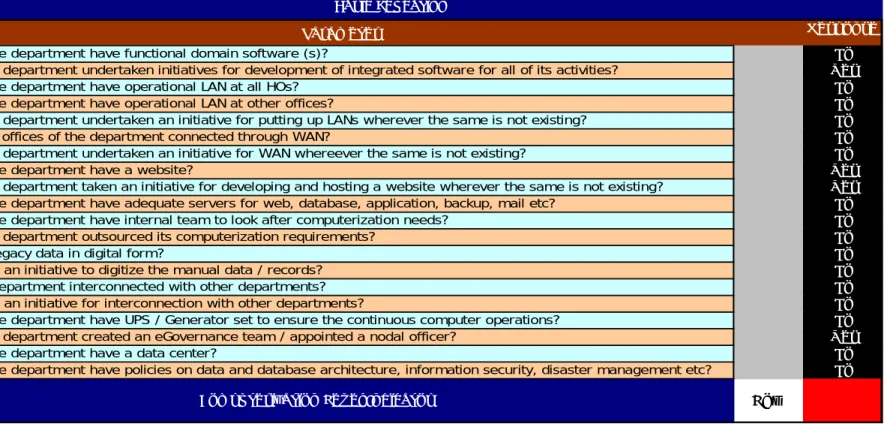
The following table gives a graded score on level of computerization. The scores have been classified in three categories: High, Medium and Low; we have used a framework to assess the level of computerization of the department on various parameters. The level of computerization is graded as: Score > 75% High; Between 75 and 35% Medium, and < 35% Low
Table 12: Level of computerization score
S.No Parameter Response
1 Does the department have functional domain software (s)? No
2 Has the department undertaken initiatives for development of integrated software for all of its activities? Yes
3 Does the department have operational LAN at all HOs? No
4 Does the department have operational LAN at other offices? No
5 Has the department undertaken an initiative for putting up LANs wherever the same is not existing? No
6 Are the offices of the department connected through WAN? No
7 Has the department undertaken an initiative for WAN whereever the same is not existing? No
8 Does the department have a website? Yes
9 Has the department taken an initiative for developing and hosting a website wherever the same is not existing? Yes 10 Does the department have adequate servers for web, database, application, backup, mail etc? No
11 Does the department have internal team to look after computerization needs? No
12 Has the department outsourced its computerization requirements? No
13 Is the legacy data in digital form? No
14 Is there an initiative to digitize the manual data / records? No
15 Is the department interconnected with other departments? No
16 Is there an initiative for interconnection with other departments? No
17 Does the department have UPS / Generator set to ensure the continuous computer operations? No
18 Has the department created an eGovernance team / appointed a nodal officer? Yes
19 Does the department have a data center? No
20 Does the department have policies on data and database architecture, information security, disaster management etc? No
Low 4
Basic Education
3.
eGovernance
E-government is a way for governments to use the new technologies to provide people with more convenient access to government information and services, to improve the quality of the services and to provide greater opportunities to participate in the democratic institutions and processes.
These include gains in efficiency and effectiveness from better use and management of information, whether in support of policy making or the administration of programs. Intranet technologies offer the possibility of establishing knowledge bases and cross departmental working.
It is the transformation of government to provide Efficient, Convenient & Transparent Services to the Citizens & Businesses through Information & Communications Technologies (ICT).
e-Governance is the continuous optimization of government service delivery and governance by transforming internal and external relationships through digital technology, the Internet and new media.
3.1. Benefits of e-governance
e-Governance can fundamentally change the way government operates and relates to the stakeholders, for example:
1. Tighter integration of delivery networks
2. Horizontal integration within Governments, across departments, organizationally and functionally;
3. Change in role from that of an implementer to that of a facilitator; and 4. Citizens gain greater visibility and insight into Government activities.
e-governance is defined as
“the application of electronic means in
(1) the interaction between government and citizens and government and businesses, as well as
(2) in internal government operations to simplify and improve democratic, government and business aspects of Governance.”
The department has identified the following objectives from the IT / e-government initiatives
3.1.1. Web based system for providing on-line submission of applications 3.1.2. Generation of reports on weekly / monthly / quarterly and annual basis 3.1.3. To provide online information system between district and the State
3.1.4. To develop direct linkage between the State and the NLMA(National Literacy Mission Authority)
3.1.5. Effective monitoring of various programmes and schemes
3.1.6. Better Co-ordination among the head office and various units at different level 3.1.7. To provide on line services to citizens
3.1.8. Implement web based monitoring system between district and state offices 3.1.9. Fully functional computerized management information system for educational
statistics
3.1.10. On line details of out of school children
3.1.11. Electronic transfer of funds to all Village education committees
3.2. Department’s envisioned state
The department’s IT envisioned state (based on the feedback from department officials) is provided in the table below
Table 13: Envision of the department
S. No. Dimension Envisioned state
1 Networking a. LAN at HOs (Basic Education, SCERT, Directorate of L&AE, Education for all project)
b. Total LAN nodes
i. HO: 16 nodes per office, 64 nodes ii. Div offices: 8 nodes per office: 256 nodes
iii. District offices: 8 nodes per office: =70*8 = 560 nodes
Total Nodes: 980 nodes
c. Connectivity with SWAN i. HO (4)
iii. District offices (70) iv. Block level: (813)
Total number of SWAN routers: 903
2 Hardware* * The exact number of hardware may change as per the need of the department. The envisioned number is a preliminary assessment of PC that could be required by the offices of the department
HO: 10 PC per administrative head office = 40 PCs Divisional Offices: 4 PC per office: 64 PCs
District Level: 4 PC per district office: 280 PCs Block Level: 1 PC: 813 PCs
Total PCs: 1197
3 Software 1. Database of school with following modules a. School details
b. Students in each class (name, father’s name, caste, address, class etc)
c. School infrastructure (number of class rooms, area, toilets, etc)
d. Teacher’s details (name, father’s name, qualifications etc) e. Accounts
f. Mid day meal
g. Medical assessment provided h. School uniform distributed i. Text books distribution j. Scholarship distribution 2. Employee details
4 Training The department would like to provide basic computer training to its employees upto Class III and to Shiksha Mitras at school level This would entails approximately: 40,000 people
5 Data digitization Students details: 4 Lakhs
3.3. E-Governance Delivery Model
The department envisions itself as providing prompt services to all of its beneficiaries in the state. This would require an extensive coordination with in all of its offices in the state. In order to have extensive coordination with all the supporting offices, the department sees itself interconnected with them, seamless transfer of information and having MIS that can help department develop sound policies and to facilitate services to the citizens.
The following figure gives illustrative network architecture for the service delivery in an e-Governance enabled environment
Figure 3: Illustrative delivery model
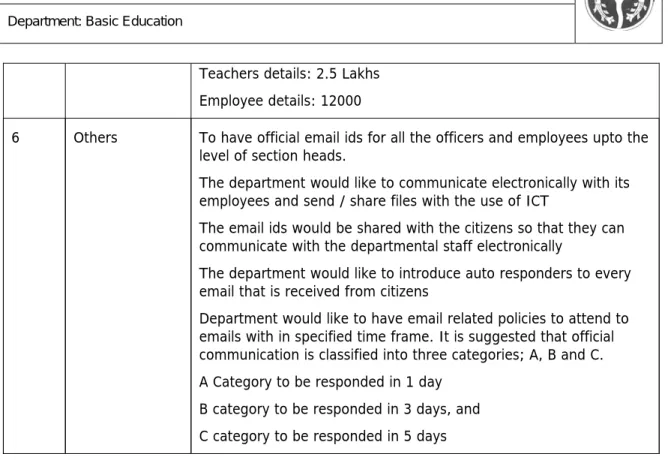
Teachers details: 2.5 Lakhs Employee details: 12000
6 Others To have official email ids for all the officers and employees upto the level of section heads.
The department would like to communicate electronically with its employees and send / share files with the use of ICT
The email ids would be shared with the citizens so that they can communicate with the departmental staff electronically
The department would like to introduce auto responders to every email that is received from citizens
Department would like to have email related policies to attend to emails with in specified time frame. It is suggested that official communication is classified into three categories; A, B and C. A Category to be responded in 1 day
B category to be responded in 3 days, and C category to be responded in 5 days
Value through e Government
Customer Value Measures
Department Value Measures 3.4. E-Governance Prioritization Framework
It is essential that the services of the department are provided electronically through the gradual stages of eGovernance. Investing in the right services is a critical factor for the success of the e - governance initiatives and accrual of the
benefits to the stakeholders of the department. The move towards E-Government should deliver key and tangible benefits to the stakeholders of the department. PwC in consultation with the department officials has followed a structured approach to identify what and when such “e-enablement” should take place.
We have implemented the approach of ‘Service Value Analysis’ to arrive at ‘Implementation priority’. We have used a structured 4-step approach to arrive at implementation priority. The four steps involved are described in detail below:
Service Value Analysis
1. Compile the List of Services – This step involved compiling the list of services provided by the department.
2. Collect information & statistics about the services – This step involved collecting operational statistics and information about each service to assist in the prioritization process. Such information includes transaction volumes, customer type, service type, number of departments involved in delivering the service, etc.
3. Prepare a Service value matrix - This step involved identifying the value that will accrue from the service if it is made
E-Government-enabled. This was done
through a consultative approach with the department and the analysis of the
information collected about the services in the departmental questionnaire. The
Service Value Analysis Implementation Priority
1
2
4 Step Approach
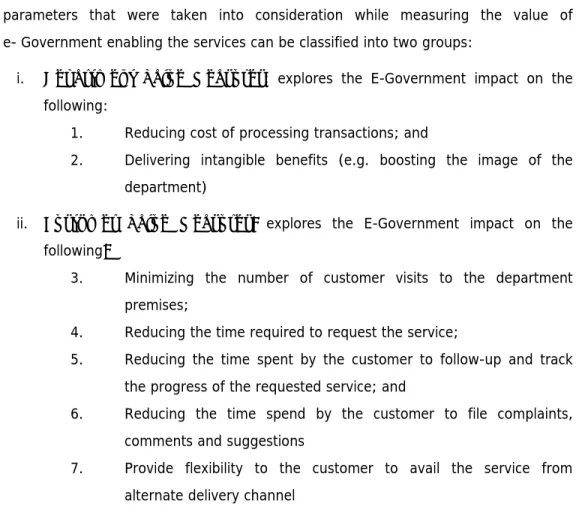
parameters that were taken into consideration while measuring the value of e- Government enabling the services can be classified into two groups:
i. Department Value Measures; explores the E-Government impact on the following:
1. Reducing cost of processing transactions; and
2. Delivering intangible benefits (e.g. boosting the image of the department)
ii. Customer Value Measures; explores the E-Government impact on the following:
3. Minimizing the number of customer visits to the department premises;
4. Reducing the time required to request the service;
5. Reducing the time spent by the customer to follow-up and track the progress of the requested service; and
6. Reducing the time spend by the customer to file complaints, comments and suggestions
7. Provide flexibility to the customer to avail the service from alternate delivery channel
The value that department would create for itself and the citizens subsequent to eGovernance has been assessed through the responses provided by the department in the Set –IV of the questionnaire provided by us. We have classified the services of the department into the service value matrix in the following table
Table 14: Service Value Matrix S.
No Service Value to beneficiary Value to Department Service value
1. Total literacy program for basic literacy
H H H H
S.
No Service Value to beneficiary Value to Department Service value
2. Post Literacy Programmes - for Strengthening of acquired literacy status
H H H H
3. Continuing Education Schemes - for Equivalency Programmes, Income Generating Programmes, Quality of Life Improvement Promotion Programme and Individual Interest Promotion Programme.
H H H H
4. Providing course material to
each teaching center H H H H 5. Providing education H H H H
6. Recognition to private
schools H H H H
7. Enrolment of 6 – 14 year age children and free education to them
H H H H
8. Opening of new schools in
un-served areas H H H H 9. Opening of EGS / AIE centers
& Bridge courses in small habitations for special category of children
H H H H
10. Cooked mid – day meal
scheme H H H H
11. Recruitment of shiksha mitras in schools, instructors of EGS / AIE centers , Bridge courses
H H H H
12. Medication assessment of disabled children and distribution of aids / appliances to them
People
People
People
People
Technology
Process
S.
No Service Value to beneficiary Value to Department Service value
13. Distribution of uniforms to
girls H H H H
14. Distribution of text books to
children H H H H
Step 4: Prioritize the implementation of the Initiatives-This step is involved in identifying when to implement the initiatives based on the service value identified in Step 3. The implementation priority for each high value service was defined based on the analysis of the following attributes:
1. Service Visibility – describes how significantly and extensively can customers feel and experience the benefits achieved from delivering the service through E-Government. Services of high volume of transactions and a large customer base would be more visible to the department customers than other services with a very limited customer base.
2. Service Complexity – describes how easy the service can be made E-Government-enabled. This depends on a number of factors such as the degree of existing automation, number of external parties involved and the number of customer documents processed.
3.5. e-Governance Roadmap
The department will need to undertake the e-Governance initiatives on the following dimensions.
Based on our ‘Implementation Priority Analysis’, we recommend that department undertakes the E- Government projected into three distinct phases.
4
Service
Visibility
Service
Phase - 1: The key objective of the services / activities in this phase is to increase the visibility of the department. Services implemented in this phase have wide customer base and relatively simple delivery operations. Services that are high value to both the beneficiaries and the department (HH) are taken up in this phase.
Phase - 2: The key objective of the services / activities in this phase is to build critical transactional services. This phase aims to establish the core critical transactional services required to support the key customer segments. Services that are High Value to the beneficiary and Low Value to the department are to be taken up for implementation in this phase. Services implemented as a part of this phase enjoy high visibility and relatively complex delivery
operations.
Phase- 3: The key objective of the services / activities in this phase is to sustain value. Services that are Low value to the beneficiaries and High value to the department and Low value to both the beneficiaries and the department could be implemented in this phase.
The following table gives the initiatives that the department needs to undertake in the three phases.
Table 15: Phase wise activities Phase 1
(0 – 2 Years) (2 – 4 Years) Phase 2 (4 to 5 Years) Phase 3 Phase - 1
Phase - 2
Phase I 0-2 years Phase II 2 to 4 years Phase III 4 to 5 Years
People People Processes/Operations and Services
(i) Create a committee that would look after all eGovernance initiatives for the department. Also create PeMT, office level teams and identify eChampions. The team would look after the requirements for the entire department.
(ii) Create an IT function / cell in the department (Refer Chapter – 7 for details on IT Function)
(iii) Provide training of departmental staff (Refer annexure III for training requirements)
(i) The BPR exercise taken in phase -1 would mandate various changes. Create the team for implementation of the changes.
(i) Implementation of Information Security Policies (ISSP)
(ii) Develop the information sharing and privacy policy for sharing of department information with other departments (G2G).
Process/Operations and Services Process/Operations and
Services Technology Infrastructure
(i) Prepare detailed project reports
(DPRs) for the enablement of eGovernance in the department. DPRS would need to be prepared for:
(a) Data Digitization
(b) Hardware requirement
(c) Software requirement
(d) Training
(e) Networking and connectivity
(f) website
(ii) Carry out Business Process Reengineering in the department
(i) Creation of Information Systems Security Policies (ISSP), Disaster Recovery Plan (DRP)
(i) Enable the department to have Public Key Infrastructure (PKI) for secured electronic transactions (ii) Creation of secure IT environment
to enable the beneficiaries of the department transact safely
(iii) Provide the departmental services through the state portal
(iv) Implementation of DRP and creation of disaster recovery (DR) site
(v) Sharing of department information with other government departments and agencies (G2G).
Technology Infrastructure Technology Infrastructure
(i) Create e-mailing infrastructure within the department.
(ii) Procure and install the requisite hardware at the departmental locations. The locations where hardware would be installed in the first phase would be identified in the detailed project report.
(iii) Development of core departmental
(i) Providing infrastructure throughout the department for intra-office
communication through emails, share data / files / documents.
(ii) Undertake the
implementation of software application for
1 Software applications like Personnel Management, Budget & Finance, Dak Management system, etc (the applications that are state level initiatives) are considered to be developed as common applications across the state departments, Their implementation is considered in Phase – II on account of the fact that these software applications will be readily available to the departments by that time.
application software; Implementation of core
departmental application software at the locations where activities are high (as identified in the detailed project report)
(iv) Add the following functionalities to the website
(a) Information on the procedures to avail the services
(b) Application forms to request the services of the department (c) Acceptance of grievance and
complaints
(v) Data digitization for
(i) Students details
(ii) School and school infrastructure details
(iii) Teachers details
(iv) Employees data
(vi) Create LAN infrastructure at HO and other field offices
(vii) Create e-mail id of all the important functionaries in the department
(viii) Establish connectivity with State Wide Area Network (SWAN) for inter office connectivity
(a) Personnel Management Software (b) Budgeting & Financial Management system1 (c) E – procurement (d) Other softwares like
Daak Management system, File tracking system etc
(e) Implementation of Core departmental integrated
application software at the offices that were not covered in phase -I
(iii) Creation of interactive website through which the beneficiaries / citizens can submit their documents and apply for the services
4.
Gap Assessment
As – Is assessment on IT usage and level of computerization was conducted through (a) structured questionnaire, (b) department’s performance reports / development plans, (c) discussion with key people / nodal officers.
The gaps are assessed for the following dimensions: (1) Hardware requirements
(2) Networking in offices of the department (3) Software requirements
(4) Connectivity requirements
(5) Policies that are critical for creating secured eGovernance environment (6) Skills
(7) Data digitization
Gaps on aforementioned dimension were assessed after understanding the requirements from the consumers of the department, expectations of the department from ICT, service delivery envisioning and comparing the same with the findings out of the As –Is assessment conducted by us.
4.1. The gaps with respect to the future plans of the department
Table 16: Gaps Matrix
S. No Components Existing level Envisaged level Gaps
(1) Hardware2 Education for all: 53
Directorate of literacy
and alternative education: 10
Total 63^^ Servers: 3
^^ kindly refer section 2.6
In addition to existing PCs the department would require PCs: 1197
Total Servers envisaged: 8
Additional requirements of PC: 1197
Servers: 8
(2) Network (1) No network is
existing #LAN Nodes: 980 # Kindly refer section 3.2 Total LAN: 980 nodes (3) Software (1) Financial
Management
Web based integrated software
on appropriate technology for (1) As mentioned in the envisaged level
2 Hardware envisioning and subsequently the gaps are approximate in nature and precise requirements along with hardware sizing can be derived only after carrying out detailed project exercise. The DPR is more systematic approach to arrive at the figures for hardware that would be required by the department