Course Title Working Capital Management
Professional Development Programme on Enriching
Course Title: Working Capital Management
Knowledge of the Business, Accounting and Financial Studies
(BAFS) Curriculum <Elective Part>
Expected
Learning
Outcomes
• Upon completion of this course, teacher
participants should be able to:
p p
‐‐Explain the importance of working capital
management (營運資金管理);
management (營運資金管理);
‐‐Describe the basic principles of cash
management (現金管理)and the relevance of
cash budgeting (現金預算);
Expected
Learning
Outcomes
‐‐Analyse factors affecting the formulation of
accounts receivable ((應收帳款)) and accounts
payable (應付帳款) policies;
Explain the objectives of inventory
‐‐Explain the objectives of inventory
management (存貨管理) and application of
l l h
simple inventory control techniques:
Economic Order Quantity (經濟訂貨量), and
Re‐order Level (再訂貨水平) methods .
Syllabus
in
HKDSE
Examination
• Importance of working capital management• Basic principles of cash management and theBasic principles of cash management and the
relevance of cash budgeting
F ff i h f l i f
• Factors affecting the formulation of accounts
receivable and accounts payable policies
• Objectives of inventory management and
application of simple inventory control application of simple inventory control
techniques: Economic Order Quantity (EOQ)
d d l l th d
Contents
(1)
• Working capital management (Illustration 1)
• Comparison of working capital in three HK listed companies
(Ill t ti 2) (Illustration 2)
• Changes of working capital in SME companies (Illustration 3)
C h d h i l (Ill i 4)
• Cash management and cash conversion cycle (Illustration 4)
• Receipts and payments in a company (Illustration 5)
h b d l d h b l ( ll
• Cash budget control and minimum cash balance (Illustration
6, 7 & 8)
A t i bl t d h di t ff d
• Accounts receivable management and cash discounts offered
to customers (Illustration 9)
• Accounts payable management and cash discounts offered by
• Accounts payable management and cash discounts offered by suppliers (Illustration 10 &11)
Contents
(2)
• Six cost elements in inventory control (Illustration 12)
• Inventory management and Economic Order Quantity (EOQ)
d i i d l (Ill t ti 13 & 14) decision model (Illustration 13 & 14)
• The relevant costs in EOQ by calculation (Illustration 15) and
by graph (Illustration 16) by graph (Illustration 16)
• Application of Just‐in‐time system for inventory management
• Re order level of inventory control under certain and
• Re‐order level of inventory control under certain and
The
Importance
of
Working
Capital
• What is working capital ?
C t t i t li biliti
– Current assets minus current liabilities.
(Note:
(
Current assets including stocks, account
receivables bank and cash;
receivables, bank and cash;
Current liabilities mainly including account
payables, accruals, and bank overdrafts )
What
is
working
capital
management
?
– to control the amount of stocks, accountsreceivables, cash and current liabilities.
‐‐ to minimize the average stock turnover days,
and accounts receivables turnover period and accounts receivables turnover period.
‐‐to keep optimum money in bank and cash, and
optimum order quantity of inventory.
‐‐to appropriately increase the accounts payable
‐‐to appropriately increase the accounts payable
Illustration 1: Extracted balance sheets of Success Ltd in Dec.,, 2010 and 2009. ($’000) 2010 2009 Current Assets: Current Assets: Inventory 1,000 100 Accounts receivable 5 500 1 000 Accounts receivable 5,500 1,000
Bank & cash 8,800 3,000
Current Liabilities:
Accounts payable 7,000 1,500
Other payables 500 400
d d’ ki i l h
How does Success Ltd’s working capital change
over the two years?
• Working capital is determined by : (Current Assets – Current Liabilities) (Current Assets Current Liabilities) =>Y2009 =$2,200,000
Y2010 $ 800 000 =>Y2010 =$7,800,000
• The workingg capitalp increased from Y2009 to
Y2010. This is confirmed by the increase in
accounts receivable and cash balances over
Is Success Ltd’s Working Capital Management Is Success Ltd s Working Capital Management
effective?
•
Before
we
can
assess
the
company’s
working capital management, the
working
capital
management,
the
following
assets
and
liabilities
must
be
examined:
examined:
‐‐
inventory
y
Æ
any
y
excessive
inventory
y
being
held
Æ
leading
to
obsolete
stocks,
and turnover period increased and hard
and
turnover
period
increased
and
hard
to
sell
them
all
in
a
short
period
of
time.
I S Ltd’ W ki C it l M t Is Success Ltd’s Working Capital Management
effective?
‐‐
Accounts
receivable
Æ
if
too lenient
trade
credit is granted to debtors bad debts
credit
is
granted
to
debtors,
bad
debts
will
increase.
Debtors
turnover
period
will
increase but
liquidity
will
decrease
;
Cash and Bank
Æ
too much cash
in hand
‐‐
Cash
and
Bank
Æ
too much cash
in
hand
will
lead
to
decrease
in
overall
return
(profitability)
to
the
company.
This
is
the
opportunity cost due to
reduction
in
opportunity
cost
due
to
reduction
in
investment income.
Is Success Ltd’s Working Capital Management
effective?
‐‐
Accounts
payable
Æ
an
increase
in
creditors
turnover
period
will
lead
to
a
decrease
in
cash
requirement
now
decrease
in
cash
requirement
now
because
creditors
are
only
repaid
in
a
future
period
of
time,
and
vice
versa.
What is Success’s liquidity position compared What is Success s liquidity position compared
to Industry ?
($’000) 2010 2009 Industry
Averageg
Current Ratio: 2.04 2.16 2.01
Liquidity Ratio: 1.91 2.11 1.50
Explanation: For both current and liquidity ratios,
h b h d
they are better than industry norms.
What is Success’s profitability compared to What is Success s profitability compared to
Industry ? ($’000) 2010 2009 Industry ($’000) 2010 2009 Industry Average Profit margin 16% 19% 22% Profit margin 16% 19% 22% Return on 10% 13% 15% Return on equity 10% 13% 15%
Explanation: From above data, we conclude that
Success Ltd attains poorer Success Ltd attains poorer
performance than industry norm.
Success Ltd–partially inefficient use of
15
Success Ltd partially inefficient use of working capital !
Ill t ti 2 E t t f C t A t d Illustration 2: Extracts of Current Assets and
Current Liabilities from three listed companies
in HK $’million 123 Yuexiu Property 728 China Telecom 627 U‐Right Int’l
$ million Yuexiu Property
(12/ 2010) China Telecom (12/2010) U Right Int l Ltd (3/2011) N t A t 16 019 424 229
Non‐current Assets 16,019 424,229 ‐‐‐
Current Assets (A) 45 161 66 560 72 Current Assets (A) 45,161 66,560 72 Current Liabilities (B) (23,279) (152,919) (1,670)
Net Current Assets/ (Liabilities) 21,882 ( 86,359) (1,598) (A + B)
Illustration 2
Suggested answer:
(1) 123 has been performing the general average (1) 123 has been performing the general average
by attaining a current ratio of 2:1
(2) 728 h l h i
(2) 728 has less current assets than its current
liabilities, because Telecom industry requires
heavy investment in non‐current assets. (3) 627 has suffered from serious Net Current
(3) 627 has suffered from serious Net Current
Liabilities , and has been under liquidation
d t i l
due to insolvency.
Illustration 3A
Identify any two consequences when a SME
companyp y increases its workingg capital.p
Lower risk of not meeting the short-term Lower risk of not meeting the short term liabilities, but the opportunity cost of not
using the idle funds for long term investment using the idle funds for long term investment will increase . Therefore, the return to the
Illustration 3B
Identify two results if a SME company reduces Identify two results if a SME company reduces
its working capital ?
‐‐if the company is profitable, the reduction of
workingg capitalp will result in increase in longg
term investment, leading to higher return to
company than before company than before.
‐‐if the company is making loss, it will result in
l d f ki it l i ldi
general decrease of working capital, or yielding
net current liabilities, leading to a risk of not
19
Study
1
• You may access to the following link:
• www.thehackettgroup.com/casestudies/cytec/www.thehackettgroup.com/casestudies/cytec/
• To have a study of the Cytec Industries Inc.‐‐‐a
h i l t di d f t i i
chemicals trading and manufacturing group in
USA ‐‐‐how to successfully reduce its working
Study
2
• What kind of support has been providing by
the Trade and Industryy Departmentp of the
HKSAR to SME ?
• www smefund tid gov hk/eng/sgs html
• www.smefund.tid.gov.hk/eng/sgs.html
• ÆWorking Capital Loans
Working
Capital:
Risk
&
Return
In Financial Management, it is well known that high risk may yield high return.g y y g
The benefits of maintaining effective working
capital management to a company capital management to a company:
‐‐attaining an optimum balance: liquidity Vs
return. To enhance shareholders’ return in the long run by releasing appropriate level of cash long run by releasing appropriate level of cash for investment.
bli hi d di hi i
‐‐establishing good creditworthiness to its
suppliers.
Cash
management
(
現金管理
)
• One of the major elements in Current Asset is Bank
and Cash
• WhyWhy does a company have to hold money ?does a company have to hold money ?
• (1) Requires for transactions of
the p rchases of fi ed assets in estment
‐‐ the purchases of fixed assets, investment,
inventory, financing trade debtors, and prepayments.
• (2) Sources of funding from above transactions
‐‐ credits received from suppliers in purchases
Definition
of
Cash
Conversion
Cycle(CCC)
• ‐‐This CCC (現金轉換循環) defines the time
period starting from inventory credit
p g y
purchased and received until the collection of
cash from debtors after sale The time from
cash from debtors after sale. The time from
order placement to the receipt of inventory
must be excluded
must be excluded.
• ‐‐ The cash cycle is the difference of time
period between inventory payment and cash
received from accounts receivable. received from accounts receivable.
Cash conversion cycle (a trading company)
Inventory credit purchased and
received Inventory sold
Accounts Inventory turnover Days 0 receivable period 45 30 75 period C h C l Accounts payable turnover Cash Cycle turnover period Inventory payment Cash received
How to determine the Cash Conversion Cycle (CCC) ?
Inventory turnover period (存貨周轉率)
+
Accounts receivables collection=
+
Accounts receivables collectionperiod (應收帳款收款天數):
A t bl t i d
‐ Accounts payables turnover period
(應付帳款付款天數)
CCC based on given data in previous page: CCC based on given data in previous page: = (45 + 30 ‐30 ) days = 45 days
Ill t ti 4 C l l ti f C h C i C l Illustration 4: Calculation of Cash Conversion Cycle
• The accountant of Success Ltd has collected the
following yearly data: following yearly data:
Credit sales $500,000 Credit purchases $250,000 Average inventory $ 50,000 Average accounts receivable $120,000 Averageg accounts payablep y $ 20,000
The selling price is normally based on cost of goods sold plus 25%. Determine the Cash Conversion Cycle for Success Ltd (A year
27
Conversion Cycle for Success Ltd. (A year = 365 days)
Ill
i
4
Illustration
4:
(1) The yearly cost of sales (note: Cost + 25%Cost =sales)
= ($500,000/1.25)=$400,000
(2) Inventory turnover period (存貨周轉率):
(2) Inventory turnover period (存貨周轉率):
=($50,000/$400,000) x 365 = 45.6 days
(3) Accounts receivable collection period (應收帳款收款天數):
= ($120 000/$500 000) x 365 = 87 6 days = ($120,000/$500,000) x 365 = 87.6 days
(4) Accounts payable turnover period(應付帳款付款天數):
($ /$ ) d
= ($20,000/$250,000) x 365 = 29.2 days
(5) Cash Conversion Cycle = (2)+(3)‐(4) = 45.6 + 87.6 – 29.2 = 104 days
How
to
increase
your
company’s
cash
?
‐‐To speed up collection from debtors or arrange
factoringg
‐‐To raise deposit requirement from customers
T ff h di
‐‐To offer cash discount to customers
‐‐Loan raised from banks
‐‐Overdrafts drawing from banks
‐‐Lease financing
‐‐Fund raisingFund raising from existingfrom existing shareholdersshareholders
Payments
required
in
a
trading
company
‐‐To settle accounts payable, and sundries ‐‐To pay for capital investment, or inventoryTo pay for capital investment, or inventory
purchases
T l l b d l h d
‐‐To settle labour cost and general overheads
Illustration
5
• Identify why a trading company shows profits
in its Income Statement, but has no cash
available for its daily operating.
It is because its cash inflows are slower than cash outflows. For example: Bought
excessive inventory with long inventory
conversion period. Extensive receivables
term compared to shorter payable period.
Cash
Budget(
現金預算
)
• A detailed plan of future cash receipts and
payments. The time period will range from a
p y p g
quarter to a year.
• The major elements included in a Cash Budget
• The major elements included in a Cash Budget
• ‐‐Cash Receipts
• ‐‐Cash Payments
N t Ch i C h f i d
• ‐‐Net Change in Cash for a period
Cash
Budget=
Management
Tool
?
• Yes:
• AA feed forwards controlfeed forwards control tool by projectingtool by projecting
cash inflows, outflows, and closing cash
balances and any loan arrangement required balances and any loan arrangement required.
• A comprehensive consideration of all various
items involved the cash budget within a
specified time period which is based on specified time period which is based on
weekly, or monthly depending on
management purpose
management purpose
How
to
prepare
a
Cash
Budget
?(1)
Step 1: Find the actual opening bank/ cashbalances.
Step 2: Determine the cash receipts from
accounts receivable and others accounts receivable, and others.
Step 3: Determine the cash payments due to
accounts payable and others.
Step 4: Calculate the closing period bank/ cash
Step 4: Calculate the closing period bank/ cash
How
to
prepare
a
Cash
Budget
?(2)
• Step 5: Identify any cash surplus/ (deficit)
duringg the period.p
• Step 6: Place any surplus fund to short term
investment Any deficit in fund must
investment. Any deficit in fund must
be covered by some external
f ( h l
financing (eg short term revolving
loan, long term bank loan,
shareholders’ placement, etc.)
Data required for Cash Budget Preparation
1. Sales forecast.
2. Information on collection policy from debtors. 2. Information on collection policy from debtors. 3. Forecast of purchases and their payment
terms.
4. Forecast of other cash paymentsp y : wages,g ,
utility charges, taxes, capital expenditure, etc.
5 C li t t h b l if
5. Company policy on target cash balance, if
Preparation of Cash Budget for Success Ltd in
Preparation of Cash Budget for Success Ltd in
September and October (1)
1. Sales: August ‐‐$320,000
September ‐‐$400,000
September $400,000
October ‐‐$600,000
‐‐with 5% cash sales, and 5% bad debts losses
(ie collections would total be 95% of monthly
( y
credit sales).
C dit l 30% f i bl ll t d i
‐‐Credit sales:30% of receivable collected in
the month of sales; the balance of
receivables collected in the following month.
P ti f C h B d t f S Ltd i Preparation of Cash Budget for Success Ltd in
September and October (2)
2. Purchases: August ‐‐$240,000
September‐‐$360,000
September $360,000
October ‐‐$420,000
‐‐It is the company policy to purchase stock
one month before sales.
‐‐40% of payables paid in the month of
h
purchase.
Preparation of Cash Budget for Success Ltd in Preparation of Cash Budget for Success Ltd in
September and October (3)
3. Utility charges: $35,000 (quarterly payment
in March, June, September,p December);) Monthly cleaning expenses: $8,000;
M hl $30 000
Monthly rent: $30,000.
4. Office equipmentq p depreciationp perp month:
‐‐$4,000.
5. August closing bank and cash balances
$59,000.
Preparation of Cash Budget for Success Ltd Preparation of Cash Budget for Success Ltd
(Workings 1) Cash collections
$’000 September October
Cash sales (1) 20 30
Credit sales Receipts (2) Credit sales Receipts (2)
311.6 418 Notes Notes (1) 400 x 5%=20 600 x 5%=30 (2) 304 x 0.65=197.6 380 x 0.65=247 (2) 304 x 0.65 197.6 380 x 0.3=114.0 311.6 380 x 0.65 247 570 x 0.3=171 418
Preparation of Cash Budget for Success Ltd Preparation of Cash Budget for Success Ltd
(Workings 2) Cash payments $’000 September October Purchases payment (1) 288 384 Other payments (2) 73 38 Notes : (1) 240 x 0.6 + 360 x 0.4 360 x 0.6 + 420 x 0.4 (2) 35 + 8 + 30 (depreciation excluded = 8 + 30 (depreciation excluded = non‐cash item)
Completion of cash budget for Success Ltd $
$’000 September October
Opening bank/ cash
balances 59.0 29.6
Add: total cash 331.6 448
receipts
390.6 477.6
Less: total cash payments
(361) (422)
p y
Closing surplus bank/ cash balances
Minimum
Cash
Balance
Success Ltd has a policy to maintain minimum cash
balance of $100,000. What would be the further
action proposed ? (Ignore interest payable)
It has been found that the closing cash balance of Success Ltd in
September is $29,600. It means that a short term loan of $70,400
will be required.q
Therefore, the revised closing balances of Success Ltd: (1) In September: $(29,600 + $70,400) = $100,000
(2) In October : $(100,000 + 448,000 – 422,000) = $126,000 (2) In October : $(100,000 + 448,000 422,000) $126,000
Therefore: partial repayment of short term loan:
$(126,000‐100,000) = $26,000 while its closing October cash
balance will still be $100 000 (after partial repayment)
43
Illustration
6
• Identify two advantages and two
disadvantagesg of settingg p up a Cash Budgetingg g
System within the Success Ltd.
Ad t Di d t
Advantages Disadvantages
(1) Within a SME, a proper way to
arrange an advanced loan if
Forecast may be wrong, and wrong
data leading to wrong forecast arrange an advanced loan , if
required
data leading to wrong forecast.
(2) To allow proper allocations of
surplus funds for short term
investment
A lot of paperwork and time
consuming in order to set up an
Illustration
7
• What are the reasons for Success Ltd to
maintain a minimum cash balance of
$100,000?
(1)If external economic condition is worse off the (1)If external economic condition is worse off, the
actual cash collected from sales will be decreased
(eg bad debt increased) (eg bad debt increased).
(2)Being a conservative approach, the forecast may
be wrong Buffer cash can allow the smooth be wrong. Buffer cash can allow the smooth
running of business.
(3)Available for immediate capital investment
45
Illustration
8
• How can a convenient store collect sufficient
cash inflows to meet its monthlyy p y payments ?
(1)Conducting regular promotions to increase sales (1)Conducting regular promotions to increase sales,
especially special discounted items for cash sales. (2)Introduction of bonus points system to allow
(2)Introduction of bonus points system to allow
customers to participate in gift redemption promotion process. Cash conversion cycle can be maintained at low level.
(3)To ask its holding company, if any, for short term borrowing
Contemporary application of Cash Budget Contemporary application of Cash Budget
Control
• All forecasted cash receipts and payments will
be laid down for the consideration. Cash
budget is a plan with the emphasis of feed
forward control forward control.
• Allowance for various aspects which are
l h l f h
critical to the survival of the company.
• The cash budget can beThe cash budget can be continually amendedcontinually amended to reflect variances due to ever changing
economic circumstances economic circumstances.
Accounts
Receivable
Management
Inventory creditpurchased and
received Inventory sold Accounts receivable
management Accounts Inventory turnover g Days 0 receivable period 45 30 75 period C h C l Accounts payable turnover Cash Cycle turnover period Inventory payment Cash received
What is accounts receivable management ?
‐‐A company allows its customers to purchase
on credit ((ie without payingp y g the goodsg at
once).
After some days (credit period) lapse the
‐‐After some days (credit period) lapse, the
customers will settle the accounts according
h l l f
to the sales agreement previously fixed.
‐‐If the customers default on the payments, theIf the customers default on the payments, the
company would suffer from bad debts loss.
This must be controlled by a strong and
This must be controlled by a strong and
flexible ‘Credit Policy’.
How to establish a Receivable Credit Policy ? (1)
(It is also termed as accounts receivable policy.) (It is also termed as accounts receivable policy.) (1) Establishment of ‘Credit Standards’ by
determining the basic level of credit score for a determining the basic level of credit score for a potential customer to possess. Poor credit rating
b ld hi h l l
score by a customer would mean a high level risk of bad debts—no credit granted, but only
Cash‐on‐delivery. A certain level of rating scored
or above would result in a credit limit granted
(eg less than $1 M).
(2) Determination of ‘Credit Period’ granted to a
(2) Determination of Credit Period granted to a
How to establish a Receivable Credit Policy ? (2)
(2) ‘Credit Period’ granted to a customer during
the credit sale ((ie how longg the customers
have to finally settle the invoice), the longer
period would mean a higher level of bad debt period would mean a higher level of bad debt
risk to the company. Therefore, on average, a
credit period of 1 month is better to the credit period of 1 month is better to the
selling company, but may not be welcome by
potential customers.
How to establish a Receivable Credit Policy ? (3)
(3) Establishing any ‘Cash Discount’ term to
customers. It means givingg g an extra amount of
discount to the customers if they can settle
the invoices at an earlier date stated in the the invoices at an earlier date stated in the
cash discount.
h f ‘ /
For instance, a cash discount term of ‘2/15,
net 30’ means an extra cash discount of 2% given to customers settled within 15 days
after sales. Or, the customers normally have to after sales. Or, the customers normally have to
How to establish a Receivable Credit Policy ? (4)
(4) Formulating the procedures by following up
anyy overdue invoices.
The aging report of accounts receivable
would disclose any overdue invoices Some would disclose any overdue invoices. Some
appropriate actions must be followed:
‐‐overdue statements issued with reminder/
warning, and customers’ office visits; warning, and customers office visits;
‐‐issue of legal letters; use of collection
agency.
Illustration
9
• Evaluate whether to offer a cash discount
term of: 1/5 net 30 for an invoice of $150,000 to C Ltd, assuming Success Ltd will use the cash collected to repay the outstanding loan cash collected to repay the outstanding loan at 15% per annum. Take 365 days= One year.
Benefit (Interest Saved) (A) Cost (B) Net (A‐B) $150,000 x (25/365) x 15% = $1,541 $150,000 x 1% =($1,500) +$41 valid to offer the cash the cash discount.
M j ff t C h id i dit Major effects on Company when considering credit
granted to customers
Effects to
company
Description of effects
Sales level due to offering longer credit term or higher credit limit to Sales level due to offering longer credit term, or higher credit limit to
customers.
Profit level longer credit term given to customers may result in Profit level longer credit term given to customers may result in
increasing the interest cost (or opportunity cost) of accounts
receivable amount financed .
L ll ti i d ld l lt i hi h b d d bt
Longer collection period would also result in higher bad debt
risk.
Liquidityq y level Inverselyy p p proportional to credit amount // term. Insolvencyy may have fatal effect to the company. It must be considered
in detail before offering the longer credit term to customers.
How to arrive at an optimum credit policy ?
(1) Consideration of all factors discussed
previously, and summarized into the elements
p y
of ‘Benefits’ and ‘Costs’;
(2) In financial term ‘Benefits’ > ‘Costs’ means (2) In financial term, Benefits > Costs means
overall net benefits enjoyed by the company ,
and vice versa.
(3) Liquidity is also a major element in (3) Liquidity is also a major element in
Accounts Payable Management
Inventory credit purchased and
received Inventory sold
Accounts Inventory turnover Days 0 receivable period 45 30 75 period C h C l Accounts payable turnover Cash Cycle turnover period Inventory payment Cash received A t P bl 57 Accounts Payable (AP) Management
What is Accounts Payable(AP) Management?
‐‐Due to the credit purchase by a company from
its suppliers,pp the ggoods will be settled with
payments after some days.
It is treated as a kind of interest free source of
‐‐It is treated as a kind of interest free source of
Factors considered in setting an AP Policy
(1) Negotiation of a better credit period.
(2) Consideration of accepting the cash discount (2) Consideration of accepting the cash discount
given by suppliers.
(3) I l i J i i l
(3) Implementing Just‐in‐time control system,
which is useful in reducing inventory level,
and hence the payable amount.
Negotiation for a better ‘Credit Period’
The longer the payable credit period, the
higherg benefit resulted to the ‘payablep y
company’. However, excessively long payable
credit period would result in suppliers’ credit period would result in suppliers
withholding of supplies, and overdue interests
charged on overdue amount Reference by
charged on overdue amount. Reference by
comparison to industry average can reveal a
S Ltd id ti f ti th h di t
Success Ltd ‐consideration of accepting the cash discount
offered by suppliers.
Success Ltd can evaluate the cash discount
policy by:
p y y
(a) comparing the benefits and costs.
(b) l l i h li d i
(b) calculating the annualized interest cost
for comparison with Success Ltd’s average
interest cost of borrowing.
Illustration 10: Cash discount (Accounts Payable)
‐‐Success Ltd has an overdraft facility line to
finance its workingg capital,p with an interest
rate of 15% per annum.
A Ltd has offered a cash discount with the
‐‐A Ltd has offered a cash discount with the
following term: 1.5%/10 net 45.
‐‐Success Ltd has a balance due and payable to A
Ltd at $140,000. Take a year =365 days. Ltd at $140,000. Take a year 365 days. Determine whether the cash discount is
t bl t S Ltd
Illustration
10:
Workings
(1)
(1) The benefits and costs of cash discount to
Success Ltd:
‐‐Benefits (cost savings)
$140 000 1 5% $2 100 = $140,000x1.5%=$2,100 ‐‐Interest costs = $140,000 x [(45‐10)/365] x 15% $2 013 7 = $2,013.7
‐‐Net benefits (savings) = +$86.3 (acceptable)
Illustration
10:
Workings
(2)
‐‐Alternative answer:
The annualised interest costs of cash discount:
=[ (Cash discount in %) (365) (100%) ]
(100% Cash discount in %) x (Normal credit days Cash discount days) (100%‐ Cash discount in %) x (Normal credit days–Cash discount days) = [(1.5%)(365)/ (100%‐1.5%) (45‐10)] x 100%
= 15.9%
‐‐Explanation: Success Ltd can borrow overdraft at the cost of 15% per annum, while its supplier has offered to Success Ltd
the equivalent annualised cash discount benefit of 15.9%. The AP cash discount is acceptable because of benefit > cost
(i 15%) (ie 15%).
Implementing Just in time (JIT) inventory Implementing Just‐in‐time (JIT) inventory
control system
‐‐The implementation of JIT system would result
in no excessive inventoryy, and the reduction of
Accounts Payable and Accounts Receivable to
a reasonable level a reasonable level.
‐‐However, the smaller quantity of purchase may
l h l f
result in the loss of quantity discount.
‐‐AnAn Economic Order Quantity (EOQ)Economic Order Quantity (EOQ) may helpmay help
to lower overall inventory costs. It will be
discussed in next section discussed in next section.
Illustration
11
A li h ff d h di S L d
A supplier has offered a cash discount to Success Ltd
on the following term: a cash discount of 2% if the
i l d i hi 5 d Th l di
amount is settled within 5 days. The normal credit
term is 30 days. The annual rate of borrowing by
S L d i 20% T k 365 d
Success Ltd is 20%. Take a year = 365 days.
The annual rate of cash discount will be (1) ; and the cash
discount will be (2) discount will be (2). (1) (2) a) 29.8% ; rejected a) 29.8% ; rejected b) 29.8% ; acceptable c) 28.8% ; rejected d) 28.8% ; acceptable
Illustration
11
‐‐
Answer
The annual rate of cash discount will be (1) ; and the cash
discount will be (2) . (1) (2) (1) (2) a) 29.8% ; rejected b) 29 8% ; acceptable b) 29.8% ; acceptable c) 28.8% ; rejected d) 28.8% ; acceptable 67
Inventory
Management
Inventorypurchased
and received Inventory sold
Inventory management Accounts Inventory turnover Days 0 receivable period 45 30 75 period C h C l Accounts payable turnover Cash Cycle turnover period Inventory payment Cash received
What
is
Inventory
Management
?
It is the planning coordinating and controlling It is the planning, coordinating, and controlling
activities (including period and cost):
‐‐(in a trading company) purchasing of
inventoryy ÆwarehousinggÆ deliveryy to
customers.
(in a manufacturing company)
‐‐(in a manufacturing company)
purchasing of raw materialsÆproducing work‐
in‐progressÆfinished goods completionÆ
warehousingÆdelivery to customers.
warehousingÆdelivery to customers.
Why do we have to implement inventory Why do we have to implement inventory
management ?
• With effective planning and controlling of the
activities in purchasingp g and managementg of
inventory or goods for sale, less cash is tied up
in inventory Other investment opportunities
in inventory. Other investment opportunities can be engaged.
h k f k l b l b
• The risk of stock loss and obsolescence can be
minimised. The company’s profitability can be
Inventory
Management
involves
:
1) Identification of Six types of costs in relationto inventoryy for sale.
2) Understanding and application of Economic
Order Quantity (EOQ) decision model Order Quantity (EOQ) decision model.
3) Inventory Control: Just‐in‐time (JIT) system. 4) Inventory Control: Re‐order level methods
under different demand conditions under different demand conditions.
Costs
Associated
with
Inventory
for
Sale
(2) Ordering Costs Costs (3) Carrying Costs (1) Purchasing Costs ( ) Costs (6) Normal Loss (4) Costs of Running Short (5) Quality Costs Loss Costs Short CostsCosts
Associated
with
Inventory
for
Sale
(1) Purchasing costs = Costs of inventorypurchased from suppliers, together with
p pp g
carriage inwards cost, and insurance cost, but
net of goods return Unit = $ per Kg or litre net of goods return. Unit $ per Kg or litre (2) Ordering costs = Costs of issuing purchase
h k h
orders, receiving and checking the quantity in
the orders, and matching invoices received
against purchase order and goods received
note to make payments. Unit= $ per order. note to make payments. Unit $ per order.
Costs
Associated
with
Inventory
for
Sale
(3) Carrying costs = all costs of holding aninventoryy until sale, inclusive of anyy
opportunity cost (eg interest cost) tied up in
inventory and costs of storage (eg rent inventory and costs of storage (eg rent,
insurance, obsolescence costs).
( ) f h ll l
(4) Costs of running short = all costs resulted
due to a confirmed customer orders unfulfiled
(eg short of stocks leading to lost sales from
customers and goodwill). customers and goodwill).
Costs
Associated
with
Inventory
for
Sale
(5) Quality costs = Totally 4 categories of costsincludingg p prevention, appraisal,pp internal
failure, and external failure due to not in
conformance with customer expectations conformance with customer expectations. (6) Normal loss costs = Any kinds of loss in
h l f h
physical quantity and amount of the inventory
(eg misclassification, theft, evaporation or
breakage, etc).
Illustration
12
Success Ltd is a SME which specializes in
manufacturingg a certain rangeg of USB storageg
devices. Since it has limited share capital, the
inventory will be financed by borrowing inventory will be financed by borrowing
money from bank.
h h f
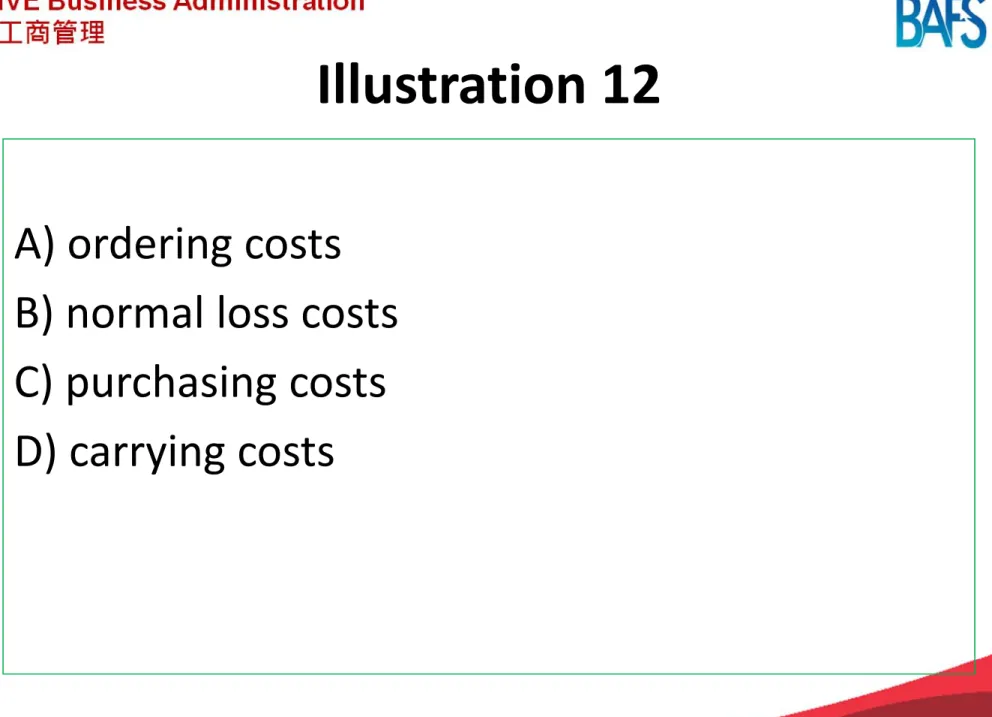
Which cost category of inventory
Illustration
12
A) ordering costsA) ordering costs
B) normal loss costs C) purchasing costs D) carrying costs
D) carrying costs
Illustration
12
Answer:A) ordering costs A) ordering costs
B) normal loss costs C) purchasing costs
D) carrying costs D) carrying costs
Effect
of
Inventory
Size
on
Costs
d i h i f i
• By reducing the average quantity of inventory
held generally:
‐‐increases ordering cost
‐‐reduces carrying cost
Disadvantage: Disadvantage:
‐‐increasing the chance of running short ofincreasing the chance of running short of
inventory. 79
Behaviour of Ordering and Carrying Costs on Behaviour of Ordering and Carrying Costs on
Inventory Size
Costs/ $
600 700
Carr ing Cost Ordering Cost 400 500 Carrying Cost 300 400 100 200 0 100 0 50 100 150 200 250
Inventory Management from Various Inventory Management from Various
Departments’ Perspective: (1)
Sales
department
In order to meet customers’ orders, they will favour a large size of inventory level.
Th i d i i ill ff i
Their decision will affect carrying cost
and cost of running short.
d d b
Production
department
In order to attain mass production by lowering down production costs, they
ill f t b i ffi i t
will favour to buy in sufficient raw
materials in stores to prevent from
production stoppages Their decision will production stoppages. Their decision will
affect ordering cost, carrying cost, cost of
running short and quality cost. running short and quality cost.
Inventory Management from Various Inventory Management from Various
Departments’ Perspective: (2)
Purchasing
department
In order to secure quantity discounts from suppliers, a large quantity of raw
t i l ill b ht Th i d i i
materials will be sought. Their decision will lead to decrease in purchasing cost, ordering cost and costs of running
ordering cost and costs of running short, but increase in carrying cost
and normal loss cost and normal loss cost.
Costing
department
They have to monitor with the total inventory costs with the aim to
department inventory costs, with the aim to
maintain an overall low inventory level in order to avoid capital held up in
in order to avoid capital held up in excessive inventory.
Economic Order Quantity (EOQ) Decision Economic Order Quantity (EOQ) Decision
Model
• How many quantities of inventory should be
ordered each time ?
‐‐By balancing not to order too many and not
too little the optimum costs associated with
too little, the optimum costs associated with
goods for sale can be attained by adopting the
l h h h l
EOQ decision model, which can help to
minimise the costs of ordering and carrying.
‐‐Application of EOQ has some basic
assumptions to follow with assumptions to follow with.
Basic
Assumptions
underlying
for
EOQ
(1) Same quantity ordered at each reorder
placed. p
(2) Constant demand, ordering costs and
carrying costs are known without
carrying costs are known without
uncertainty. The time between placing a
h l l k
purchase order and its delivery is also known. Thus, no cost of running short will happen.
(3) Purchase price of inventory remains constant
and unaffected by various ordered quantity and unaffected by various ordered quantity.
Benefit
from
applying
EOQ
Based on above assumptions, EOQ is a useful
decision model for a companyp y to find an
optimum order quantity in which the total
inventory costs are minimised It is beneficial inventory costs are minimised. It is beneficial
to the company because efficiency can be
enhanced Therefore profitability and liquidity enhanced. Therefore, profitability and liquidity
can be improved by the company.
Formula
of
EOQ
EOQ = (2) (D) (O)√ C
√ C
Where: 2 = a constant
D = Consumption in units for a time
period defined
p
O = Total ordering costs per order
l d h ti
placed each time
C = Total carrying costs per unit for a
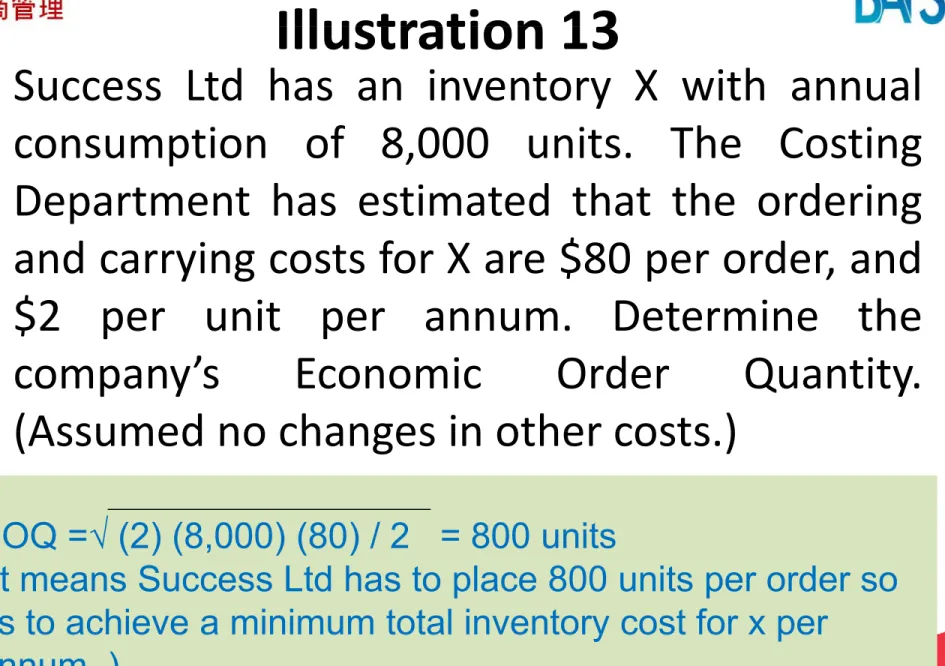
Illustration 13
Illustration
13
Success Ltd has an inventory X with annual
i f 8 000 i Th C i
consumption of 8,000 units. The Costing Department has estimated that the ordering and carrying costs for X are $80 per order, and $2 per unit per annum. Determine the
$ per unit per annum. etermine the
company’s Economic Order Quantity.
(Assumed no changes in other costs ) (Assumed no changes in other costs.)
EOQ =√ (2) (8 000) (80) / 2 = 800 units
EOQ =√ (2) (8,000) (80) / 2 = 800 units
(It means Success Ltd has to place 800 units per order so as to achieve a minimum total inventory cost for x per
87
as to ac e e a u tota e to y cost o pe
Illustration
14
Success Ltd has to purchase another inventory Z: (1) Annual demand: 1,000 units
(1) Annual demand: 1,000 units (2) Purchase Price =$10/unit
(3) Estimated total cost per order=$405
(including receiving and inspecting costs) (including receiving and inspecting costs)
(4) Estimated carrying cost per unit per year = 10% of purchase price
Determine the EOQ of Z Determine the EOQ of Z.
Illustration
14
‐‐
Answer
EOQ =√ (2) (1,000) (405) / (10) (0.1)= 900 unit per order 900 unit per order
What will be the relevant total costs per year?
=total no. of orders per year x each ordering cost
+ averageg carryingy g cost of Z pper unit perp yeary =(1000/900)(405) + (900/2)(1)
$
=$900 per year
Illustration
15
U i th d t i Ill t ti 14 b
Using the same data in Illustration 14 above,
with the order quantity is : (a) 750 units or (b)
1100 units, what will be the relevant total
Illustration
15
‐‐
Answer
(a)If order quantity is 750 units, the total relevant costs :
(1000/750) 405 (750/2) (1) $915
= (1000/750) 405 + (750/2) (1) = $915 per year (b) If order quantity is 1 100 units the total relevant (b) If order quantity is 1,100 units, the total relevant
costs:
= (1000/ 1100) 405 + (1100/2)(1) = $918 per = (1000/ 1100) 405 + (1100/2)(1) = $918 per year
It is proved that EOQ will give the lowest total
relevant costs (ie $900) by comparing to above
91
( ) y p g
EOQ b
hi l
th d
EOQ
by
graphical
method
Illustration: Annual Demand=350units; Cost/order =$50/order;
Carrying cost = $4/unit (Note Please prove it by calculation !)
700
Costs/ $
Carrying cost = $4/unit (Note Please prove it by calculation !)
500 600
EOQ EOQ
Relevant total costs
per year a + b a 300 400 EOQ EOQ b 200 0 100 0 50 100 150 200 250 EOQ=94 units
Illustration
16
By successfully reducing the total inventory level of Success Ltd, will there be any benefity to the company’s liquidity position?
Answer:
S Ltd tt i i di t
Success Ltd can attain immediate
improvement in cash/liquidity position. In
the long run, more cash can be applied to
other more profitable investments.
93
Inventory Control: Just‐in‐time(JIT) System (1)
(1)The implementation of JIT system can help a
companyp y to attain several ggoals. One of them
is zero closing inventory. The concept would
include the adopting of JIT purchasing include the adopting of JIT purchasing
technique—the delivery of materials by
approved suppliers immediately preceding
approved suppliers immediately preceding
their requirement by the company.
(2)By contracting with the suppliers having more
frequent deliveries, and agreed delivery time frequent deliveries, and agreed delivery time
Inventory Control: Just‐in‐time(JIT) System (2)
(3)A longer–term purchasing orders will be
placed to approved suppliers. Quality of
p pp pp y
inventory and quantity discount can be
ensured from the suppliers ensured from the suppliers.
(4)After the implementation of JIT system, the
b f f
company can benefit from reduced inventory
level, leading to the savings of factory space,
time in placing order, and good quality
maintained in inventory. maintained in inventory.
Inventory
Control
‐
Reorder
Level
Method
(A) How to apply Reorder point under constantdemand:
= Average requirement rate per day X Lead time in days (Lead time = the days measured from placing the
(Lead time the days measured from placing the
purchase order to the arrival of new inventory in
whichc thee e s existingg inventorye o y e e eac es e o level reaches zero. Thee
reasons causing lead time during delivery from
supplierspp : shippingpp g delays;y ; strikes,, bad weather
Ill t ti 17 R d i t t i d d d Illustration 17: Re‐order point – certain demand and
constant lead time (by graph)
l d f k
Inventory in units Note: Delivery Lead‐time for = 1 week
Number of inventory sold per week = 50 units
Re‐order point EOQ=100 units
0 0
1 Re order point EOQ=100 units
= 50 x1 = 50 units 0 0 1 50 0 Weeks 97 1 2 3 4
Inventory
Control
‐
Reorder
Level
Method
(B) Reorder point under uncertain demand:= Average inventory requirement rate during lead time
+ Safety Stock
[Where Safety Stock= (The difference between [Where Safety Stock (The difference between
Maximum Demand and Average Demand) x Purchase
Ill t ti 18 R d i t t i d d Illustration 18: Re‐order point – uncertain demand
and constant lead time (by graph)
d f d l f k
Inventory in units Note: Lead for delivery of inventory = 3 weeks
Average number of inventory sold per week = 50 units EOQ=600 units; Safety stock=100 units
EOQ=600 units; Safety stock=100 units
700 Reorder point : 50 x 3 + 100 = 250 units
EOQ
250
100
0 Safety stock Lead time = 3 days Days
Factors
contributing
to
unstable
demand
(1) A sudden increase or decrease in salesdemand.
(2) A sudden delay in inventory delivery.
(3) A li bl l di h d
(3) A severe quality problem leading to the drop
of customers’ demand of inventory.
(4) A change in disposal income of consumers
due to change in government policy due to change in government policy.
Further
Readings
h
Drury, C. (2008). Management and Cost Accounting, 7th edition
UK: South‐Western Cengage Learning. Chapters 15, 21 and 24.
Brigham, Houston (2009). Fundamental of Financial
Management 11th edition Harcourt College Publishers
Management, 11th edition. Harcourt College Publishers.
Chapters 16 and 17.
Ross, Westerfield & Jordan (2010), Fundamentals of Corporate
Finance, ninth edition, McGraw Hill. Chapters 19, 20 and 21
Finance, ninth edition, McGraw Hill. Chapters 19, 20 and 21
End of Presentation
End of Presentation
Please complete the evaluation form, and a
Please completepp the evaluation form,ff ,, and a
CPD certificate will be issued.
CPD certificate will be issued.
Thank You Very Much!