Daviess County Adult Drug Court
Implementation Evaluation
Daviess County Adult Drug Court
Implementation Evaluation
January 2003
Center on Drug and Alcohol Research University of Kentucky 335 Bowman Hall Lexington, KY 40506-0059 859-257-9062 mhiller@ uky.edu
Project Staff
University of Kentucky Center on Drug and Alcohol Research
Principal Investigator Matthew Hiller, Ph.D.
Drug Court Liaison Danielle Malluche
Senior Data Coordinator Barbara Patterson Graduate Research Assistant Valerie Bryan Administrative Assistant Louise Dupont
For an electronic version of this report, please email requests to Barbara Patterson at [email protected] or visit the Kentucky Drug Court website at www.kycourts.net
Table of Contents
EXECUTIVE SUMMARY ...vi
BACKGROUND AND SIGNIFICANCE ...1
Need for Adult Drug Court ...1
Drug Court in Kentucky...1
History and Development of the Daviess County Adult Drug Court ...3
PROCESS EVALUATION METHODOLOGY ...4
Interviews...4
Court Observation...5
Participant Records Review...6
Monthly AOC Statistical Reports ...6
Program Documentation ...7
Focus Group and Logic Model ...7
FINDINGS: PROGRAM DESCRIPTION ...7
Drug Court Program Structure and Processes ...7
Location ...7
Capacity and caseflow ...8
Drug Court staff and team members ...8
Referrals, eligibility and admission procedures...9
Program goals ...9
Phase structure ...11
Graduation...12
Logic model of the Drug Court program ...15
Drug Court Program Elements...19
Court sessions...19
Treatment ...21
Supervision ...22
Sanctions and rewards...23
Community service ...24
Good deeds...25
Journal assignments ...25
FINDINGS: DURING PROGRAM IMPACT AND OUTCOMES...25
Retention in Drug Court...26
Recidivism...26 Drug Use ...27 Education...27 Employment ...27 Sanctions ...28 Phase Promotions ...28
SUMMARY AND CONCLUSIONS ...30
Index of Figures and Tables
Figure 1 – Number of Participants Enrolled per Month ...8
Figure 2 – Logic Model: Daviess County Adult Drug Court ...15
Figure 3 – Number of Counseling Sessions per Month...22
Figure 4 – Number of Urine Drug Tests Collected per Month...23
Figure 5 – Average Number of Urine Drug Tests Collected per Month ...23
Figure 6 – Number of Participants Employed ...28
Figure 7 – Number of Phase Promotions Given ...29
Table 1 – Drug Court Key Components ...3
Table 2 – Program Goals and Measures ...10
Table 3 – Participant Goals...10
Table 4 – Drug Court Program Phase Requirements...12
EXECUTIVE SUMMARY
The current evaluation describes the implementation of the Daviess Adult Drug Court Program. To this end, data were collected on court operations and participants were examined in order to determine how effectively the Key Components (OJP, 2001), a set of standards defining effective Drug Court operations, were implemented by this court. Process evaluation methods included interviews with Drug Court team members, participant observation, and a focus group. The conclusion of this report is that the Daviess County Adult Drug Court is in compliance with the Key Components, specifically:
Key Component #1. Drug Courts integrate alcohol and other drug treatment services with justice system case processing.
Findings from the focus group and participant observation indicated that the Daviess Drug Court is a cohesive program which includes persons representing all aspects of the criminal justice system and the local treatment delivery system. The diverse representation of the team members on the Daviess Drug Court team serves to integrate treatment services with the goals of the criminal justice system. The Drug Court coordinator communicates with the treatment representative frequently inquiring about participants’ progress and positive efforts, as well as noncompliant behavior.
Key Component #2. Using a non-adversarial approach, prosecution and defense counsel promote public safety while protecting participants’ due process rights.
Results from the focus group and the participant observation showed that the Daviess Drug Court team members work together efficiently. The prosecutors and defense attorneys on the team communicate well with one another, which promotes program efficacy. The Drug Court staff work together when making decisions about the participants, and all staff members’ opinions are heard and taken into consideration. The prosecutor’s and defense attorney’s opinions are highly regarded by the team, thus insuring that the program promotes public safety and protects the rights of each individual participant.
Key Component #3. Eligible participants are identified early and promptly placed in the Drug Court program.
Findings from the focus group and the participant observation indicated that the Daviess County Drug Court team strives to target, assess and place eligible participants into the program. The team has established certain inclusionary and exclusionary criteria with which to assess adults who may be eligible to participate in Drug Court. All participants are assessed with the Kentucky Severity Index (ASI, Logan et al.) as quickly as possible. Eligibility screening, referral and assessment are generally completed within one week.
Key Component #4. Drug Courts provide access to a continuum of alcohol, drug, and other related treatment and rehabilitation services.
Results from the focus group and staff/team interviews revealed that the Daviess Drug Court program has access to a variety of different counseling programs which they can offer to their participants. The Drug Court sends each participant upon entry into intensive outpatient treatment. River Valley Behavioral Health conducts individual and gender specific group therapy. Alcoholics Anonymous groups are conveniently located for participants to attend regularly. Long-term residential treatment is also available for the Daviess Drug Court program.
Key Component #5. Abstinence is monitored by frequent alcohol and other drug testing.
Findings from the focus group and the staff/team interviews showed that the Daviess Drug Court program administers urine analysis to each participant frequently and randomly throughout the program. As participants advance through the phases, drug testing is done less frequently. Drug testing is done at least three times a week during phase I, two times in phase II, and one time and randomly in phase III. During the observation of a court session by researchers from the University of Kentucky, the Judge paid careful attention to urine drug test results and reviewed these with participants during the court session. Data from the Monthly Statistical Reports indicated that adults in the Drug Court appeared to be well-supervised. Urine
supervision was frequently used, with a total of 4,344 urine samples collected (an average of 362 urine screens were conducted each month). As shown in Figure 3, the fewest (n = 135) urine screens were conducted in July of 2001, and the most (n = 549) urine screens were conducted in December 2001.
Key Component #6. A coordinated strategy governs Drug Court responses to participants’ compliance.
Findings from participant observation, records examination, and staff/team interviews showed that the Daviess Drug Court participants gain rewards throughout the program by being compliant with program rules and by making significant progress towards their treatment goals. Rewards are prompted by clean drug screens, good journals, attendance, and by not violating probation. Rewards that are typically used for the participants’ progress are phase promotion, reduced amount of contact with treatment coordinator, curfew extensions, and acknowledgment from the Judge and the Drug Court Team.
Key Component #7. Ongoing judicial interaction with each Drug Court participant is essential.
Findings from participant observation and the Judge’s interview revealed that the Daviess Drug Court Judge meets with the Drug Court participants weekly. During the Drug Court
meetings, the progress of each participant is discussed, and sanctions or incentives are given as needed.
Key Component # 8. Monitoring and evaluation measure the achievement of program goals and gauge effectiveness.
An ongoing evaluation is conducted by a research team at the University of Kentucky Center on Drug and Alcohol Research.
Key Component # 9. Continuing interdisciplinary education promotes effective Drug Court planning, implementation, and operations.
Findings from staff interviews showed that several members of the Daviess County Drug Court team have attended a variety of educational workshops and trainings. The case
Specialist/treatments, commonwealth attorney and judge have attended trainings conducted by The National Drug Court Institute, in addition to other local and state workshops. By attending these educational training sessions, members of the Drug Court team are exposed to
interdisciplinary perspectives; this serves to promote a high level of professionalism, commitment, and collaboration.
Key Component # 10. Forging partnerships among Drug Courts, public agencies, and community-based organizations generates local support and enhances Drug Court effectiveness.
Results from participant observation and staff interviews indicated that the Daviess County Drug Court program has successfully forged partnerships with many essential agencies and community organizations. The Drug Court team consists of representatives from the court, prosecution, defense, treatment providers, social service agencies, and law enforcement. The Drug Court program has not only formed a relationship with River Valley Behavioral Health Comprehensive Care Center, but also has partnered with other counseling services such as Life Skills, Crossroads and Independence House to promote a comprehensive treatment program for all participants. Relationships have also been formed between the Drug Court program and other valuable community resources, such as job development services and adult education programs.
Suggested Improvements. The following suggestions were proposed by the respondents who were interviewed:
(1) Increase the number of treatment options in order to address the special needs of each participant.
(2) Hire additional Drug Court Staff, among these, a case manager. (3) Increase the number of participants to reach program capacity.
Strengths. The Daviess Drug Court program has many strengths, including the following: (1) keeping defendants drug free
(2) maintaining strong connections among the Drug Court Staff (3) performing random urine analysis
(4) providing intensive supervision by the court
(5) producing successful graduates and turning them into stable, productive, and responsible members in the community
BACKGROUND AND SIGNIFICANCE
Need for Adult Drug Court
Kentucky is similar to the nation with respect to rising rates of incarcerated drug
offenders. For example, prisoners incarcerated for a drug offense in Kentucky rose from 1,242 in 1992 to 3,279 in 2001. This increase is comparable to the national rates of drug offenders incarcerated in state prisons, which increased from 155,847 in 1990 to 251,000 in 2000 (Kentucky Department of Corrections, 2001; U.S. Department of Justice, 2002). The 32% recidivism rate for released drug offenders in Kentucky as of 1998 is also similar to recidivism rates for released drug offenders nationwide, reported as 32.6% in 1994 (Kentucky Department of Corrections, 1997; U.S. Department of Justice, 2002). The national recidivism rate increased from 30.8% in 1989 to 33.1% in 1995. Although recidivism is highest among violent offenders, the rate of recidivism for drug offenders is climbing rapidly (Kentucky Department of
Corrections, 1997). In addition, Leukefeld et al. (1999) found that 59% of Kentucky inmates were dependent upon substances, and that inmate illicit drug use one month prior to incarceration was 20 times higher than the general population. In response to the rising costs of incarceration and increased drug arrests, Kentucky Administrative Office of the Courts (AOC) established a Drug Courts division in July 1996 to provide fiscal and administrative oversight to all Drug Court programs in Kentucky.
Drug Courts in Kentucky
The motto for Kentucky Drug Court is “A chance...a change.” Kentucky Drug Court is aligned with more than 500 Drug Courts in operation across the United States. The mission of
Kentucky Drug Court is to create a criminal justice environment that stops illicit drug use and related criminal activity and promotes recovery and resocialization.
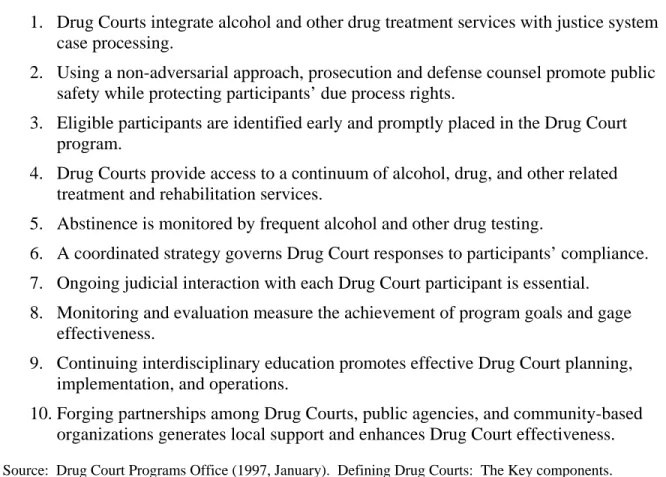
Adult Drug Court in Kentucky is grounded in the Key Components described in the publication Defining Drug Courts: The Key Components (Drug Court Programs Office, 1997). These Key Components were developed by the Drug Court Standards Committee to ensure that a core set of standards were defined for all Drug Court programs (see Table 1) to follow. In
exchange for successful completion of the Drug Court program, the Judge may choose to dismiss the participant’s original charge, reduce or set aside a sentence, offer a lesser penalty, or use a combination of these rewards. Drug Court transforms the roles of both criminal justice practitioners and Alcohol and Other Drug (AOD) treatment providers as they collaborate with each other in an attempt to help the offender to learn to live a drug-free, crime-free, prosocial life. A balance is struck between the need for intensive supervision (ensuring public safety and offender accountability) and focused treatment on the many treatment needs evident in adults who abuse drugs. Family therapy, substance abuse therapy, relapse prevention, anger
management, stress management, education, employment, life skills, structure, responsibility, accountability, and impulse control are only a few of the psychosocial areas that Adult Drug Court must address in order to have a favorable impact on the offender, and the community as a whole. The Judge is the central figure in the Drug Court, which is a team effort that focuses on participant sobriety and accountability as its primary goals. As the central authority figure for the team, the Judge acts as both an advocate and instructor. This fundamentally shifts the relationship between the judge and the participant from being an adversary and punisher, to being a mentor and socializing agent.
Table 1. Drug Court Key Components
1. Drug Courts integrate alcohol and other drug treatment services with justice system case processing.
2. Using a non-adversarial approach, prosecution and defense counsel promote public safety while protecting participants’ due process rights.
3. Eligible participants are identified early and promptly placed in the Drug Court program.
4. Drug Courts provide access to a continuum of alcohol, drug, and other related treatment and rehabilitation services.
5. Abstinence is monitored by frequent alcohol and other drug testing.
6. A coordinated strategy governs Drug Court responses to participants’ compliance. 7. Ongoing judicial interaction with each Drug Court participant is essential.
8. Monitoring and evaluation measure the achievement of program goals and gage effectiveness.
9. Continuing interdisciplinary education promotes effective Drug Court planning, implementation, and operations.
10.Forging partnerships among Drug Courts, public agencies, and community-based organizations generates local support and enhances Drug Court effectiveness. Source: Drug Court Programs Office (1997, January). Defining Drug Courts: The Key components.
History and Development of the Daviess County Drug Court Program
In Daviess County, during Fiscal Year 1999, 774 arrests were made for driving under the influence (DUI), 593 arrests were made for drunkenness, 525 arrests were made for narcotic drug law offenses, 88 arrests were made for liquor law offenses, and 530 arrests were made for other drug and alcohol related offenses. (Crime in Kentucky – Commonwealth of Kentucky 1999 Crime Report)
The Daviess County Drug Court Program is grounded in the Key Components described in the 1997 publication Defining Drug Courts: The Key Components. In order to ensure the primary goals are met, the Drug Court standards Committee developed key components for all Drug Court Programs (see table 1 for a list of the key components). The overall mission of Drug Courts is to stop the abuse of alcohol and other drugs and related criminal activity. In exchange for successful completion of the treatment program, the court may dismiss the original charge, reduce or set aside a sentence, offer some lesser penalty, or offer a combination of these. Drug Courts transform the roles of both criminal practitioners and Alcohol and other Drug (AOD) treatment providers. The Judge is the central figure in a team effort that focuses on sobriety and accountability as primary goals.
PROCESS EVALUATION METHODOLOGY Interviews
A set of interview instruments that collected both quantitative and qualitative data from key Drug Court stakeholders were used (see Logan, Lewis, Leukefeld, & Minton, 2000) including, (1) judges, (2) Drug Court administrators, (3) prosecutors, (4) defense attorneys, (5) law enforcement and corrections personnel, (6) treatment providers, and (7) Drug Court participants. The Drug Court Judge Interview assessed level of prior experience with the target population, the perceived potential impact of the Drug Court on the community and judicial system, who determined program eligibility, overall capacity, the consequences for failing the program, the services needed, the planned level of supervision, and the types of graduated sanctions and rewards used. The Drug Court Administrator Interview is a comprehensive questionnaire which was completed with a Drug Court administrator and detailed the specific operational characteristics of the Drug Court program. Specific sections highlight the target
population, program goals, program organization and function (e.g., recruitment, capacity, assessment, services), supervision practices, staff characteristics, and community organization involvement. The Drug Court Staff Interview gathered detailed data about the roles and treatment orientation of the Drug Court staff members. The Prosecution, Defense, and Law Enforcement/Corrections Interviews focused on perceived benefits, level of understanding of what the new program will include, level of commitment to help make it work, and perceived problems it might cause. The External Treatment Interview helped to pinpoint what types of treatment services were offered and through what avenues.
Court Observation
Two researchers from the University of Kentucky observed one Daviess County Drug Court session, providing two unique observations of the operations of this court. Data were coded using a protocol developed by Satel (1998) during a national study of 15 adult Drug Court programs. This allowed for a systematic description of the interactional (exchanges between the judge, court staff, and participants) and environmental (physical characteristics of the setting) variables of the Drug Court session. The method involved coding the session on 17 specific characteristics that focused upon the interaction between the Drug Court judge and participants (including eye contact, physical proximity of the judge to the participant, who the judge first addresses, whether each participant remains present in the court room throughout the entire session, and time spent with each participant) and the court room setting (including seating arrangements and ambient noise level). In addition, Drug Court staff was asked to rate how typical the observed session was for regular court operations. Findings suggested that these observed sessions were typical of court operations, with program staff indicating high level of
agreement that the court status hearing was typical. A copy of the observation code sheet is included in Appendix A.
Participant Records Review
Information resources used during the current evaluation included monthly statistical reports, observations of court sessions, and interviews with court and treatment staff. No personal identifiers were coded at any time during the course of this study, thus ensuring confidentiality and anonymity.
Monthly AOC Statistical Reports
The Daviess County Drug Court makes monthly reports to the Administrative Office of the Courts. These reports summarize the number of candidates referred, the number assessed, the number of individual drug screens, number of candidates eligible, and the number transferred from probation. Also reported are the number of participants receiving phase promotions or demotions; the number of court sessions; the number of participants identified as using an illicit substance based on urine drug screens; the number of individual sessions; the number of drug sessions; the number of family/support sessions; the number of participants referred to outside agencies; employment and educational status of participants; number of employment and housing verifications, amount paid toward court obligations; the number of sanctions, the number of participants rearrested for new charges; the number of terminations; and the total number of active participants in the preceding month. For the current evaluation, the monthly statistics reports covering July 2001 through June 2002 were reviewed and coded for data.
Program Documentation
Several sources of program documentation also were reviewed for the process evaluation. These included copies of the grant application submitted by each court for funding, handbooks provided by each Drug Court to its participants to outline the design and expectations of the program, and the policy and procedure manuals for each court. In addition to these, monthly administrative reports from the program to the Administrative Office of the Courts were reviewed. Each report summarized the monthly activities of each Drug Court, including caseflow, number of treatment sessions held, number of court sessions, and graduation and terminations from the program in the preceding month.
Focus Group and Logic Model
A focus group also was conducted during the process evaluation with Drug Court team members. The goal of the focus group session was be to synthesize a comprehensive description of program elements for this Drug Court using a “logic model” approach. A preformatted logic flow model (adapted from Harrell, 1996) was be completed during a researcher-led focus group to help Drug Court staff to articulate specificgoals, outputs, and activities for their Drug Court, with special emphasis placed on identifying links between specific program activities and their influence on the stated goals and objectives.
PROGRAM DESCRIPTION Drug Court Program Structure and Processes
Location. The Daviess County Drug Court Program serves Daviess County. Daviess County is located in the Western Coal Field region of the state. According to the
2000 Census Statistics the estimated population in Daviess County is 91,545 with 93.7% of the population Caucasian , 4.3% African American, 0.4% Asian, and 0.1% American
Indian and Alaskan Native persons (Census Bureau, 2000). Drug Court sessions are held in the Circuit Courthouse in Owensboro, Kentucky.
Capacity and caseflow. The Daviess Adult Drug Court has treatment availability for up to 30 participants. Currently the Daviess program has 24 active participants. Eleven of the participants are Caucasian males and one is an African American male. There are eleven Caucasian females and one African American female.Participants enter the program after being assessed as eligible for the Drug Court, and there currently is no waiting list. The review of the program found 43 participants who had been active in Drug Court during the time frame
examined by the current report. Monthly statistical reports were used to determine the monthly census for the Daviess County Drug Court between July 2001 and June 2002 (shown in figure 5). The average number of participants active per month was 22.75 (range 15 to 28).
Figure 1
Monthly Participant Census: July 2001 -- June 2002 21 17 23 15 22 22 21 26 25 26 27 28 0 5 10 15 20 25 30 Jul-0 1 Aug -01 Sep -01 Oc t-01 No v-01 Dec -01 Ja n-02 Feb -02 Mar-0 2 Apr-0 2 May -02 Ju n-02
Drug Court staff and team members. The Daviess County Drug Court employs one full time Drug Court coordinator, who began in November of 2000. The coordinator’s primary responsibility is to oversee the Drug Court program by conducting assessments by utilizing the
Kentucky ASI (Logan et al.), assuring quality treatment, updating each participant’s individual plan, providing random drug screens, scheduling family support sessions, and verifying
employment and housing stability. River Valley Behavioral Health is the primary treatment provider for the Drug Court. The Drug Court Judge volunteers his time to the Drug Court program, and he has been with the Daviess Drug Court since its inception. The Drug Court team also includes a probation/parole officer, public defenders, and a Commonwealth Attorney.
Referrals, eligibility and admission procedures. Participants may be referred to the program by public defenders, prosecutors, judges, word of mouth between inmates, and
brochures inviting arrestees/defendants to apply. When a potential participant is referred into the program, the Drug Court staff meets with them to prepare a report about their eligibility to participate in the Daviess County Drug Court program. To be eligible for the Daviess Drug Court, adults must be assessed on certain inclusionary and exclusionary criteria. Participants can enter the Drug Court program either through diversion or a probation track. Participants also must be substance abusing or dependent and be a resident of Daviess County. No violent offenders are allowed in the Daviess Drug Court program. Potential participants can not be on psychotropic medications that would result in a positive urine analysis. Once an adult offender is determined eligible for Drug Court, they are required to sign a written agreement of
participation. The Adult Severity Index is then administered by the treatment coordinator. This assessment is completed either in jail or in the Drug Court Office. The assessment is done within one week of the judge’s referral of a potential participant into Drug Court.
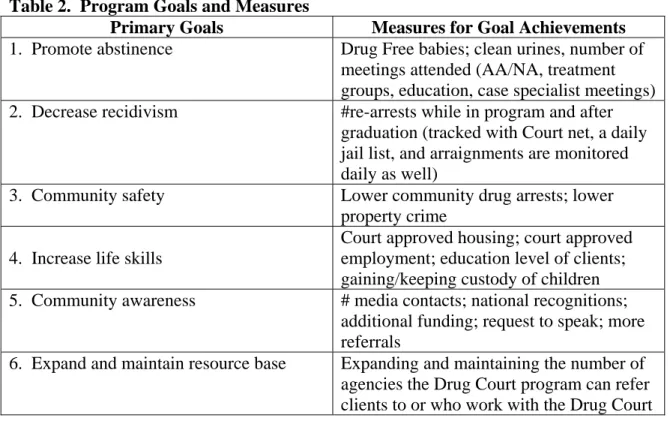
Program Goals. The primary goal of the Daviess Drug Court program is to promote the development of productive citizens. The measures for this goal are continued sobriety and employment, and renewed family relationships when appropriate. In addition to the primary
goal, the Daviess Drug Court reports to the Administrative Office of the Courts on the following goals and measures of goal achievement (Table 2):
Table 2. Program Goals and Measures
Primary Goals Measures for Goal Achievements
1. Promote abstinence Drug Free babies; clean urines, number of meetings attended (AA/NA, treatment groups, education, case specialist meetings) 2. Decrease recidivism #re-arrests while in program and after
graduation (tracked with Court net, a daily jail list, and arraignments are monitored daily as well)
3. Community safety Lower community drug arrests; lower property crime
4. Increase life skills
Court approved housing; court approved employment; education level of clients; gaining/keeping custody of children 5. Community awareness # media contacts; national recognitions;
additional funding; request to speak; more referrals
6. Expand and maintain resource base Expanding and maintaining the number of agencies the Drug Court program can refer clients to or who work with the Drug Court
Participant Goals . Participants will work on the following goals as provided in the program manual.
Table 3. Participant Goals
1. You will be able to use treatment as a means of changing lifestyle patterns.
2. We will identify your specific needs and help teach you better coping mechanisms. 3. We will promote your adjustment to a drug-free lifestyle.
4. We will work to encourage a non-criminal pattern of living.
5. We will help you develop employment skills through vocational training and educational pursuits.
6. We will help foster your involvement in support groups (NA and AA). 7. We will work to increase your social skills.
8. We will work to enhance your self-motivation.
9. We will teach warning signs of relapse and relapse prevention planning.
Participants must agree to these goals and sign an authorization for after having reviewed the program and program requirements with the treatment coordinator.
Phase structure. Like all Kentucky Drug Courts, the programming for the Daviess County Drug Court is divided into 3 distinct phases, each with a separate set of goals and procedures, and strategies for reaching these goals. A general overview of these 3 phases
(including Drug Court sessions, treatment activity, and supervision level) is presented in Table 4 (p. 12 ). The total minimum expected duration of the participants’ stay in Drug Court is 12 months, but many participants take much longer than this to finish the program. Generally, as the adults move through the three Drug Court phases, the number of court sessions that they are required to attend decreases, as does their level of supervision. Participants are required to attend their scheduled Drug Court sessions, and they are not permitted to miss sessions because of work or for other reasons. In Phase I, participants are under the most intensive supervision. During Phase II, the level of treatment is more intensive than treatment in Phase I. In Phase III, participants are under the least amount of supervision.
The number of support groups that participants are required to attend also is dependent on their treatment phase. During Phase I, II, and III all of the participants will attend three AA/NA meetings per week. During phase I they also are required to attend one educational group, and one group therapy group per week. In Phase II, they are required to attend one therapy group per week, and 2 educational groups per month. In Phase III, participants will complete their
educational group, and they are required to attend one therapy group per week. Individual and additional group session attendance is less systematic, and is provided as needed to each individual. In addition to treatment and urine supervision, other expectations include
participation in a 12-step group like Alcoholics Anonymous (AA) and/or Narcotics Anonymous (NA), and enrollment in school, or employment while completing their GED.
Table 4. Drug Court Program Phase Requirements
Phase I: Stabilizing Period (Minimum Requirements)
1. To attend one Drug Court session per week
2. To provide all assigned drug screens each week which reflect no use of drugs 3. To attend all assigned documented NA/AA meetings
4. To attend all assigned group, family, and/or in individual counseling sessions 5. To begin to make necessary arrangements for payment of Court obligations 6. To maintain Court-approved stable housing
To maintain Court-approved employment, training, and/or education referrals
7. To write seven daily journal assignments which are submitted to the Judge 8. To comply with any necessary medical referrals; and
9. To purchase a NA or AA text book, begin work on a 12-step recovery program, and obtain a sponsor.
Phase II: Educational Period (Minimum Requirements)
1. To attend one Drug Court session every other week;
2. To provide all assigned drug screens each week which reflect no use of drugs; 3. To attend all assigned documented NA/AA meetings;
4. To attend all assigned group, family, and/or individual counseling sessions; 5. To develop a payment plan to satisfy an restitution, court costs, etc, 6. To maintain Court-approved stable housing;
7. To maintain Court-approved employment, training, and/or education referrals; 8. To turn in daily journal assignments;
9. To read a book every two weeks and turn in a report to the Judge; 10. To maintain daily physical activity which is reported to the Judge;
11. To do at least one good deed every two weeks to be reported to the Judge; and 12. To maintain regular contact with sponsor and continue work on a 12-step program
Phase III: Self-Motivational Period (Minimum Requirements)
1. To attend one Drug court session every three weeks;
2. To provide all assigned drug screens each week which reflect no use of drugs; 3. To attend all assigned documented NA/AA meetings;
4. To attend all assigned group, family and/or individual counseling sessions; 5. To pay a substantial amount of restitution, court costs, etc.;
6. To maintain Court-approved stable housing;
7. To maintain Court-approved employment, training, and/or education referrals; 8. To turn in journal assignments;
9. To read a book and turn in a report to the Judge;
10. To maintain regular contact with sponsor and continue work on a 12-step program; 11. To do at least one good deed to be reported to the Judge;
12. To maintain regular contact with sponsor and continue work on a 12-step program; 13. To mentor a new Drug Court participant and/or group session; and
14. To complete an exit calendar, exit interview, and plan for aftercare.
Graduation. The Judge has the discretion to determine who should graduate or be terminated from the Drug Court, and his decisions are based upon input from the rest of the
team. Participants are recommended for graduation from the Drug Court after they have been in the program for at least 12 months; have actively participated in the program; have successfully completed all three program phases; have maintained stable living conditions, have maintained stable employment (unless the participant is in an educational program), and have provided clean urine screens. Graduation occurs when each participant has completed all of the requirements for graduation. Graduations are open to the public if the participants choose for them to be so. The participants are able to invite anyone they choose to their graduation. Family and friends are welcomed, as well as the press if the event is public. The major, Commonwealth Attorney, and the chief executive judge are also invited to graduations. The graduations are held in the courtroom and a speaker is invited. The Drug Court Judge gives a speech and the participants are also given the opportunity to address the audience. The participant is given a plaque, a T-shirt, and a certificate. After the graduation ceremony a reception is held with cake and finger foods. Once the participant graduates, the participants withdraw their original guilt plea and the judge files a motion for their charges to be expunged. The participant continues in aftercare for 6 months, which includes 12 bimonthly therapy sessions.
When a participant is noncompliant with the program rules, they may be terminated from the program. In these circumstances their probation is revoked, and hearing is held, and the former participant will be sentenced to serve a prison term. Violence, mistreatment of any of the Drug Court team member, consistent dirty drug screens, and new felony charges filed prompts termination.
Program rules and termination from Drug Court. Each new Drug Court participant is given a Daviess County Drug Court Handbook at program entry that details the operations of the program, policies and procedures, rules, and what each participant can expect from program
participation. Rules are viewed by the team as being important for many reasons. They impose a structure (often unfamiliar to participants) upon the lives of the participant; ensure the safety of the staff and participants; provide a model of the larger social order; and promote programmatic consistency and predictability, and fair treatment of all participants. Table 5 presents the
statement of the rules imposed on the participants when they enter Drug Court. Failure to follow rules can and frequently does result in the imposition of a disciplinary sanction and also can result in the expulsion of the participant from the program (for either serious infractions or for repeated rule-breaking).
Table 5. Program Rules
1. Appropriate clothing is expected at all times. Participants need to wear a shirt or blouse, pants (or shorts of reasonable length), and shoes. Sunglasses will not be worn inside the court or any other treatment facility unless medically approved by the Court. Clothing bearing drug or alcohol related themes, or promoting or advertising alcohol or drugs use are not allowed. No gang colors or clothing is to be worn.
2. Participants are expected to attend all groups, educational sessions, activities and individual sessions; arrive on time and not leave until a break occurs or the meeting is over. Participants who are late will not be allowed to attend and will be considered non-compliant.
3. The following actions will not be tolerated:
• No violence or threats of any kind will be tolerated
• Coming to any required meeting or facility under the influence of any drug or alcohol
• Possession of alcohol, drugs, weapons, etc.
• Participants displaying intoxicated or addicted behavior may be expelled 4. Inappropriate sexual behavior or harassment will not be tolerated
5. Attendance at self-help recovery groups is expected and non-compliance will be documented
6. Participants’ families or friends should not loiter. If friends or family members are providing transportation, they should simple drop off the participant and pick them up at the end of any scheduled session.
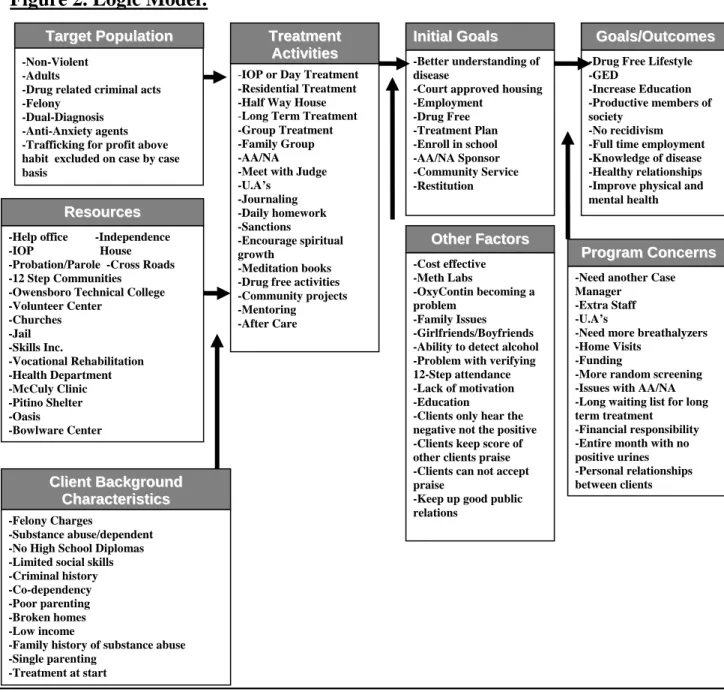
Figure 2. Logic Model:
Logic Model of the Drug Court program. A logic model is one method for describing a program in a standardized manner (Harrell, 1996). Data collected during a focus group with the Drug Court program team were used to complete the logic model of the Daviess County Drug Court shown in Figure 2, above. The target population for this program is substance abusing or dependent who have received a felony conviction. The staff members indicated that they do not accept adults with violent offenses or offenders who are trafficking for profit. They
G
Gooaallss//OOuuttccoommeess
N
-Non-Violent -Adults
-Drug related criminal acts -Felony
-Dual-Diagnosis -Anti-Anxiety agents -Trafficking for profit above habit excluded on case by case basis
T
TaarrggeettPPooppuullaattiioonn
-Help office -Independence -IOP House -Probation/Parole -Cross Roads -12 Step Communities
-Owensboro Technical College -Volunteer Center -Churches -Jail -Skills Inc. -Vocational Rehabilitation -Health Department -McCuly Clinic -Pitino Shelter -Oasis -Bowlware Center T Trreeaattmmeenntt A Accttiivviittiieess -Felony Charges -Substance abuse/dependent -No High School Diplomas -Limited social skills -Criminal history -Co-dependency -Poor parenting -Broken homes -Low income
-Family history of substance abuse -Single parenting -Treatment at start C ClliieennttBBaacckkggrroouunndd C Chhaarraacctteerriissttiiccss O OtthheerrFFaaccttoorrss P PrrooggrraammCCoonncceerrnnss
-IOP or Day Treatment -Residential Treatment -Half Way House
-Long Term Treatment -Group Treatment -Family Group -AA/NA -Meet with Judge -U.A’s -Journaling -Daily homework -Sanctions -Encourage spiritual growth -Meditation books -Drug free activities -Community projects -Mentoring -After Care I InniittiiaallGGooaallss -Better understanding of disease
-Drug Free Lifestyle -GED
-Court approved housing -Increase Education -Employment -Productive members of
society -Drug Free
-Treatment Plan -No recidivism -Enroll in school -Full time employment -AA/NA Sponsor -Knowledge of disease -Community Service -Healthy relationships -Improve physical and mental health -Restitution
R
Reessoouurrcceess
-Cost effective
-Need another Case Manager
-Meth Labs
-OxyContin becoming a
problem -Extra Staff -U.A’s -Family Issues
-Need more breathalyzers -Girlfriends/Boyfriends
-Home Visits -Ability to detect alcohol
-Funding -Problem with verifying
12-Step attendance -More random screening -Issues with AA/NA -Lack of motivation
-Long waiting list for long term treatment
-Education
-Clients only hear the
negative not the positive -Financial responsibility -Entire month with no positive urines -Clients keep score of
other clients praise
-Personal relationships between clients -Clients can not accept
praise
-Keep up good public relations
also exclude individuals who are prescribed anxiolytics and will not terminate pharmacological treatment.
The Daviess County Drug Court has access to a variety of available resources whose roles are to provide positive interventions for substance abusing or dependent adults. Currently the Drug Court uses River Valley Behavioral Health as their primary treatment provider. Probation and parole provides an educational group for the participants and assistance with drug screening. The Daviess County Drug Court also takes advantage of the local community college and Owensboro Technical College for GED classes. The Volunteer Center is an important resource for the Drug Court that refers participants to places who need volunteers for community services. The staff also described the local churches, Vocational Rehabilitation, health
department, Pitino Shelter, Independence House, Crossroads (shelter for males), Oasis and Bolware Center (shelters for abused women) as important resources they utilize in their program.
Staff identified many participant background characteristics of the Daviess County Drug Court participants. All the participants had prior felony convictions, and have a substance abuse or dependence problem. The staff also indicated that the participants have limited to no social skills and/or work skills. The majority of the participants also have a limited amount of
education. “I would say that 30% of our participants do not have high school diplomas”one staff member stated. The staff said that many of the participants have codependency problems, poor parenting skills, and a family history of drug abuse. The participants also often come from broken homes, a low income background, and are frequently single parents. According to the staff “many of the participants have been labeled as multiple treatment failures.” When asked to describe the characteristics of successful participation staff replied “they are the ones that get really involved in the 12-step communities, and who complete IOP in the beginning of the
program”. Staff said, “somewhere about 6-8 months into the program the participants get the AHA concept and they realize that the staff is not there to hurt or catch them, but to help and to be a support system for them”. The staff also indicated that the successful participants had only 1 or no positive drug screens throughout the program, and they are the participants who are “motivated to do the things that they are supposed to do.”
The Daviess County Drug Court utilizes a variety of treatment activities. The program uses day treatment, in-patient treatment facilities, IOP, and residential houses. The Drug Court also has educational and therapeutic groups in which the participants are required to participate. The therapy groups are gender-specific and there is no set agenda or plan the groups follow. The educational group is structured and discusses topics such as relapse prevention and substance abuse. The group also provides informal support to the participants. The staff indicated that the participants also have access to family therapy and AA/NA meetings. The staff said that they utilize random drug screening, daily journaling, and homework as a part of their treatment activities. Sanctions such as increased treatment and incarceration are also used as a treatment activity. “The Judge also encourages spiritual growth of each participant and gives praise when the participants attend church or begin meditating or any type of spiritual enhancement, staff reported.” The staff stated, “The Judge takes an interest with them (the participants); he actually interacts with them and has one on one interaction with them.”
The initial goals of the Daviess County Drug Court as reported by staff are for the participants to have a better understanding of the disease concept. Staff said that they initially want the participants to have and maintain court approved housing, have some type of full or part time job, remain drug free; and create a treatment plan. The staff also expects the participants to
enroll in school if needed, begin working towards their GED, obtain an AA/NA sponsor, and begin repaying restitution fees.
The Daviess County Drug Court team indicated other factors that influence their adult Drug Court. The staff said that they have problems in the community with methampetmine labs. One staff member expressed concern that Oxycontin is coming and becoming more and more popular among the substance abusers in the community. Staff said that many participants have family problems that cause concerns. The staff fears that they may not be that there are not identifying all of the drug and alcohol use among the participants. They also think that they are not able to accurately verify the participant’s AA/NA group attendance. Staff said, “There is a real lack of motivation in the participants to complete their education; they don’t see the benefits of education, and are simple attending the GED classes to avoid a sanction.” Staff indicated that another negative influence upon the participants’ Drug Court experiences is their inability to accept praise form the team, and a tendency to only hear negative comments or criticism of their progress and performance.
The long term outcomesor overall objectives of the Daviess County Drug Court include a desire for participants to lead drug free lifestyles. Another desirable outcome reported was for the participants to “further their education, and become productive members in the community.” The staff also said that they hope to have no recidivism and to have graduates who all have full time jobs, knowledge about their disease, and healthy relationships. Staff stated “We wish to improve physical and metal health within each participant in the program.”
The Daviess County Drug Court team expressed different concerns they had with their program. One of these program concerns was the need to hire additional staff. The staff said that they simple do not have enough staff to help treat the individual needs of all of the
participants. They want their program to grow, however they do not have the resources to accommodate additional participants. The staff indicated a concern with Exemplar performing the drug screening. “Since we have begun to use Exemplar (for the past month) we have not had one positive drug screen, which I think is very fishy”. The staff said that they think the urine analyses need to be more random, and the drug testers need additional training. However, staff states “Exemplar is a good first step in order to lighten the workload on the case manager, and we simple need to iron out all the little nicks.” The team said they also need other ways to drug test participants besides urine analysis, and they think they need to do more random
breathalyzers. The staff also expressed a concern regarding the long waiting lists for residential treatment. The team also has had problems with personal relationships between the participants. The Drug Court participants are usually forbidden to engage in relationships with one another; however, the appropriateness of such relationships it is determined on a case by case basis.
Drug Court Program Elements
Drug Courts generally include a set of components designed to engage participants in treatment while supervising their progress. Central to this effort, is the coordination of these major program components, which include Drug Court Sessions, treatment, supervision, and other types of resources. Through a team effort marshalling these aspects of the Drug Court program, the judge, Drug Court staff, and treatment and service providers can directly address the central goals of the program.
Court sessions. Court sessions are held every week at 11:30 am at the Daviess County Circuit courthouse. Prior to all sessions the staff meets for staffing. Staffing lasts for various amount of time depending on the caseload and severity of each case. During staffing the progress of each participant who will appear in court is discussed. The treatment coordinator
presents the progress notes to the judge, while the probation/parole officer provides additional information concerning each participant’s progress. In addition to the staffing meeting the Daviess County Drug Court also meets once a month with the entire Drug Court team to discuss each participant’s progress. During a staffing observed by UK researchers it was evident that the team and Judge worked closely together to make recommendations for particular participant cases, including when a participant will be ready to be promoted to the next phase, if and what type of sanction or reward should be used, unmet service needs, and clinical and professional opinions regarding strategies that could be used to help the participant to progress in their treatment goals.
A summary of the observations by researchers from the University of Kentucky is provided below to give a detailed picture of how a Drug Court session is organized and conducted: Participants entered the court room as a group and in no particular order. The ambient noise level was low throughout the Drug Court session. The two participants who came to court directly from jail were escorted into the courtroom by the bailiff; the other participants entered through the public entrance. Each participant remained throughout the entire Drug Court session. The judge always addressed the participant first, and the participant stood in front of the judge at a podium. The podium was located 7 feet from the judge’s bench. The judge remained seated on the bench throughout the session. The Drug Court administrator, probation/parole officer and the treatment representative sat on benches to the judge’s right. The participants sat in rows of benches that were located in the back of the courtroom. A microphone, which was turned on, was present at the podium where the participant stood. The judge sustained eye contact with the participants and throughout each case presentation. There was no physical contact between the judge and the participant, and the judge did not call the cases in any
particular order. The program has no fixed sanction algorithm, however the sanction are
consistent. During the court session observed there were no participants whose cases were heard prior to their scheduled session (review on short notice). After viewing one session, researchers witnessed a total of 28 participant case presentation. The average individual session length was 3 minutes. The mode was 2 and 3 minutes, with eight sessions lasting 2 minutes and eight lasting 3 minutes. The median individual session length was 3 minutes. Individual session lengths ranged in length from 1 to 7 minutes. The judge and participant addressed the gallery frequently throughout the Drug Court session.
Treatment. The first key element of Drug Courts, “…integrate alcohol and other drug treatment services with justice system case processing,” is implemented at the Daviess County Drug Court program to help adults to recover from their drug problems and to cease criminal behavior. The Daviess County Drug Court uses River Valley Behavioral Health as their primary treatment provider. River Valley Behavioral Health provides individual therapy as needed and four group therapy sessions a week which are gender specific. Probation/Parole conducts an educational group for the Drug Court participants. The main philosophy and or focus of the treatment is to change the thoughts, feelings, and actions regarding alcohol/drug use, abuse and addiction. The Drug Court places a strong emphasis on recovery and work toward participant lifestyle changes. Treatment goals also include the promotion of crime free productive and responsible that the participants have a change in lifestyle.
Data from the Monthly Statistics Reports suggest that Adult Drug Court participants are receiving fairly intensive treatment services. Analyses combining group and individual sessions (summarized in Figure 3) showed that the fewest number (n =95) of treatment sessions were provided in November of 2001, and the most sessions (n =181) were given in June of 2002.
Figure 3
Number of Counseling Sessions per Month: July 2001 -June 2002 89 120 174 160 170 134 145 120 97 106 120 127 7 6 8 8 7 7 7 6 9 8 10 9 166 178 128 95 181 141 152 127 106 114 129 137 0 20 40 60 80 100 120 140 160 180 200 Jul-0 1 A ug-01 Se p-01 Oct-0 1 N ov-01 D ec-01 Jan-0 2 Feb-0 2 M ar-02 Apr -02 Ma y-02 Jun -02 Individual Group Total Sessions
Supervision. Treatment and supervision are two of the essential features of the Adult Drug Court. The combination of these two aspects of Drug Court intervention has been repeatedly shown to be effective for offenders in criminal justice-based treatment (Nurco,
Hanlon, Bateman, & Kinlock, 1995). The offender supervision component of the Drug Courts is reflected in the fifth, “Abstinence is monitored by frequent alcohol and other drug testing” and seventh “Ongoing judicial interaction with each Drug Court participant is essential” Key
Components of Drug Courts described in Table 1 (see page 3). Observation of a court session by researchers from the University of Kentucky showed that the judge paid careful attention to urine drug test results, and reviewed these with participants during the court session. Data from the Monthly Statistical Reports showed that the adults in the Adult Drug Court appeared to be well-supervised. Urine screening supervision was frequently used, with a total of 4,344 urine samples collected (an average of 362 urine screens were conducted each month). As shown in Figure 4, the fewest (n = 135) urine samples were collected in July of 2001, and the most (n = 549) urines samples were collected in December 2001. While urine analyses are an informative way to look
at overall supervision level, it should be noted that urine-screening requirements decrease as participants are promoted to higher phases, and the participants’ phase were not considered in these analyses. Therefore, the number of urine screens per participant described in the graphs below underestimates the intensity of supervision provided.
Figure 4
Number of Urine Drug Tests Collected: July 2001 -- June 2002 320 549 511 459 340 135 158 141 343 432 462 494 0 100 200 300 400 500 600 Jul-0 1 Aug -01 Se p-01 Oc t-01 Nov -01 Dec -01 Jan-0 2 F eb-02 M ar-02 Apr-0 2 Ma y-0 2 Ju n-02 Figure 5
Average Number of Urine Drug Tests Collected per Client Each Month:
July 2001 -- June 2002 8.29 26.14 18.36 13.08 17.64 17.11 16.62 22.22 14.55 15.59 10.53 6.43 0 5 10 15 20 25 30 Jul-0 1 Aug -01 Sep -01 Oct-0 1 Nov -01 D ec-01 Jan-02 Feb -02 Mar -02 Apr -02 May -02 Jun-02
Sanctions and rewards. Sanctions are applied to participants on a case by case basis. The entire Drug Court team has input into sanctions; however the judge makes the final
determination of what type of sanction will be used. Dirty urine screens, missing work, not completing community service, not completing assignments, being late to Drug Court sessions, and noncompliance with the Drug Court program all prompt the use of a sanction. Sanctions available include jail time (which varies depending upon the severity of the infraction), phase demotion, additional drug screens, additional treatment, additional contact with NA/AA sponsor, and termination from the program.
Participants gain rewards by being compliant with the program rules and making significant progress towards identified treatment goals. Rewards are promoted by clean drug screens, good journals, attendance, and not violating one’s probation. Rewards that are typically earned for these accomplishments are used for the participants’ progress are phase promotion, reduced amount of contact with treatment coordinator, curfew extension, and acknowledgment and praise from the judge and the Drug Court team.
Community Service. Community service is used as a sanction in the Daviess County Drug Court program. The number of community service hours assigned as sanctions varies according to the severity of infraction. If a participant is unemployed, he or she will be required to do 40 hours of community service a week. A variety of agencies are available with which a participant can do community service. The Drug Court refers the participant to the Volunteer Center which has a list of the organizations in the community that currently need help. The majority of these organizations are non-profit work programs. Additionally, every year after the Daviess County Barbeque Festival it is mandatory for all Drug Court participants to help clean up the city as a community service or good deed to the city of Owensboro.
Good Deeds. Good deeds are another component of the Daviess Drug Court program. Good deeds are reported informally in Drug Court sessions, and the Judge will assign good deeds to participants randomly throughout the course of the Drug Court program.
Journal assignments. Journal assignments are required of all the participants. The participants are expected to write one journal entry daily. The journals are a unique component in the Daviess County Drug Court program. The participants write entries about their day to day life and their feelings. The journals of each participant develop as they progress through the Drug Court program and become a very valuable program element for the participants.
Participants present their journals to the Judge in court and the judge reviews the journals with the participants. Participants keep their own journals for their review and to track the progress of their treatment.
FINDINGS: DURING PROGRAM IMPACT AND OUCOMES
The primary emphasis of the Daviess Drug Court is to help its participants to learn to live drug-free and crime-free lives. Participants are held accountable for their maladaptive behaviors through therapeutic sanctions, and they are appropriately rewarded for success and
achievements. The Daviess Drug Court program assisted the participants involved during the time frame to maintain jobs, to stay drug-free and to stay offense free. Program compliance rates were assessed by examining how often participants received sanctions. Noncompliance implies poor participant performance, but should not necessarily be viewed as a negative outcome for the program, because Drug Court essentially functions as long-term intensive behavior modification programs which the goal of extinguishing maladaptive behavior and promoting prosocial
Retention in Drug Court
Keeping participants in the Drug Court program is an essential and crucial element. If the participant is removed from the program, the consequences are evident. They usually do not continue to receive treatment, thus reducing the likelihood of staying drug-free. Nevertheless, not everyone can be allowed to have indefinitely long stays in the program. Some participants need to be terminated to restore a therapeutic atmosphere, and to provide an example to the remaining participants that they are held accountable for any criminal and deviant behavior. During the time frame covered by the current report (July 2001-June 2002) 7 of the participants were terminated from the program. Three of these participants were terminated for failure to comply with Drug Court program rules, three were terminated for receiving new charges and one was transferred. During the same time frame 8 participants successfully graduated from the Daviess County Drug Court program. A large body of research in the substance abuse treatment field and in the Drug Courts literature indicates that program graduates perform significantly better than those who do not finish the Drug Court program.
Recidivism
Recidivism (often defined as rearrests) is a fundamental outcome indicator used to judge the effectiveness of criminal justice based programs. Therefore, one of the primary performance measures for the Daviess Drug Court is the number of participants who are arrested for new crimes while they are under the program’s supervision. Seven participants were rearrested for a new crime during the time frame of the report. Three of these participants were rearrested for a felony. Two of these participants were arrested for a driving while under the influence (DUI) and the other two were arrested for an alcohol intoxication (AI).
Drug Use
Many of the resources of Daviess County Drug Court are focused upon reducing the use of alcohol and other illicit drugs among its participants. Drug Court staff provide recovery oriented therapy to their participants and employ frequent urine testing for illicit drugs to
determine participant progress and reveal relapses. During the time frame covered by this report there were a total of 8 positive urine screens. A total of 4,344 urine analyses were conducted during the time frame of the report. Four of the urine analyses were positive for
methamphetamines, 1 for marijuana, 1 for benzodiazepines, 1 for amphetamines, and 1 for alcohol.
Education
The Daviess Drug Court program emphasizes the importance of an education, and requires that all the participants who have not completed high school to work toward GED completion. During the time frame of this report, two participants were attending college, and six participants were pursuing their GEDs.
Employment
Employment problems are a reliable predictor of early dropout from treatment among adults in community-based substance abuse treatment programs. Employment is required of every Drug Court participant unless they are a full time student. Data from the monthly statistics show that most participants have full-time jobs. Figure 6 summarizes participant employment data from the Monthly Statistical Reports.
Figure 6
Number of Participants Employed: July 2001 -- June 2002 13 17 19 5 6 12 9 8 11 11 9 3 21 16 16 13 22 11 12 14 15 10 5 6 6 6 5 4 5 19 9 10 7 7 6 10 0 5 10 15 20 25 Jul-01Au g-01 Sep -01 Oct-0 1 Nov -01 Dec -01 Jan-02 Feb-02 Mar-0 2 Ap r-02 Ma y-02 Jun-02 Total Full-Time Part-Time Sanctions
Sanctions imply that the participant has been noncompliant with program rules, and therefore needs correction. Review of program records indicated that sanctions were generally used in a consistent manner following specific behavioral incidents. The Daviess Drug Court program does not have follow a fixed sanction algorithm; sanctions are instead individualized to the circumstances presented and the involved participant. Incarceration was the most commonly received sanction, with 10 of the total sanctions given being jail that time varied in length. Commitment to residential treatment was given as a sanction four times during the time frame included in this evaluation.
Phase Promotions
Promotion to a higher phase indicates that the participant is performing successfully in the program. Therefore, examining the number of phase promotions is a valuable during-treatment performance measure that provides direct behavioral measures of participant
the monthly statistics showed that 34 phase promotions were given during the time frame covered by this report. Twenty promotions to phase II, and six promotions to phase III were given. Eight participants graduated from the Daviess Drug Court program throughout the indicated time.
Figure 7
Number of Phase Promotions: July 2001 -- June 2002 20 20 15 10 8 6 5 0
Promoted to Promoted to Graduated
SUMMARY AND CONCLUSION
The Daviess County Adult Drug Court is firmly grounded in the Ten Key Components that define effective Drug Courts nationwide. It provides recovery-oriented services and intensive supervision to adults with drug abuse problems. A dedicated team of professionals representing key stakeholders in the problems created by substance abuse and dependence work together closely to help individuals begin their recovery, improve social functioning, and cease drug related criminal activity. Daviess County Drug Court has matured beyond its planning phase, and is transitioning into a fully implemented cohesive program. The Daviess County Drug Court program is in compliance with The 10 Drug Court Key Components as shown below:
Key Component #1. Drug Courts integrate alcohol and other drug treatment services with justice system case processing.
Findings from the focus group and participant observation indicated that the Daviess Drug Court is a cohesive program which includes persons representing all aspects of the criminal justice system and the local treatment delivery system. The diverse representation of the team members on the Daviess Drug Court team serves to integrate treatment services with the goals of the criminal justice system. The Drug Court coordinator communicates with the treatment representative frequently inquiring about participants’ progress and positive efforts, as well as noncompliant behavior.
Key Component #2. Using a non-adversarial approach, prosecution and defense counsel promote public safety while protecting participants’ due process rights.
Results from the focus group and the participant observation showed that the Daviess Drug Court team members work together efficiently. The prosecutors and defense attorneys on the team communicate well with one another, which promotes program efficacy. The Drug
Court staff work together when making decisions about the participants, and all staff members’ opinions are heard and taken into consideration. The prosecutor’s and defense attorney’s opinions are highly regarded by the team, thus insuring that the program promotes public safety and protects the rights of each individual participant.
Key Component #3. Eligible participants are identified early and promptly placed in the Drug Court program.
Findings from the focus group and the participant observation indicated that the Daviess County Drug Court team strives to target, assess and place eligible participants into the program. The team has established certain inclusionary and exclusionary criteria with which to assess adults who may be eligible to participate in Drug Court. All participants are assessed with the Kentucky Severity Index (ASI, Logan et al.) as quickly as possible. Eligibility screening, referral and assessment are generally completed within one week.
Key Component #4. Drug Courts provide access to a continuum of alcohol, drug, and other related treatment and rehabilitation services.
Results from the focus group and staff/team interviews revealed that the Daviess Drug Court program has access to a variety of different counseling programs which they can offer to their participants. The Drug Court sends each participant upon entry into intensive outpatient treatment. River Valley Behavioral Health conducts individual and gender specific group therapy. Alcoholics Anonymous groups are conveniently located for participants to attend regularly. Long-term residential treatment is also available for the Daviess Drug Court program.
Key Component #5. Abstinence is monitored by frequent alcohol and other drug testing.
Findings from the focus group and the staff/team interviews showed that the Daviess Drug Court program administers urine analysis to each participant frequently and randomly throughout the program. As participants advance through the phases, drug testing is done less frequently. Drug testing is done at least three times a week during phase I, two times in phase II, and one time and randomly in phase III. During the observation of a court session by researchers from the University of Kentucky, the Judge paid careful attention to urine drug test results and reviewed these with participants during the court session. Data from the Monthly Statistical Reports indicated that adults in the Drug Court appeared to be well-supervised. Urine
supervision was frequently used, with a total of 4,344 urine samples collected (an average of 362 urine screens were conducted each month). As shown in Figure 3, the fewest (n = 135) urine screens were conducted in July of 2001, and the most (n = 549) urine screens were conducted in December 2001.
Key Component #6. A coordinated strategy governs Drug Court responses to participants’ compliance.
Findings from participant observation, records examination, and staff/team interviews showed that the Daviess Drug Court participants gain rewards throughout the program by being compliant with program rules and by making significant progress towards their treatment goals. Rewards are prompted by clean drug screens, good journals, attendance, and by not violating probation. Rewards that are typically used for the participants’ progress are phase promotion, reduced amount of contact with treatment coordinator, curfew extensions, and acknowledgment from the Judge and the Drug Court Team.