Shainin: A concept for problem
solving
Lecture at the Shainin conference
Amelior
2
qsconsult
Dorian Shainin (1914 – 2000)
•
Aeronautical engineer (MIT – 1936)
•
Design Engineer for United Aircraft Corporations
•
Mentored by his friend Joseph M. Juran
•
Reliability consultant for Grumman Aerospace (Lunar
Excursion Module)
•
Reliability consultant for Pratt&Whitney (RL-10 rocket engine)
•
Developed over 20 statistical engineering techniques for
problem solving and reliability
•
Started Shainin Consultants in 1984, his son Peter is current
CEO.
Dorian Shainin and ASQ
• 15th ASQ Honorary Member (1996)
• First person to win all four major ASQ
medals
• In 2004 ASQ created the Dorian Shainin
Medal
– For outstanding use of unique or creative
applications of statistical techniques in the
solving of problems related to the quality of a
product or service.
4
qsconsult
Dorian Shainin
• Not very well known outside USA
(compared to Deming, Juran)
• 1991: Publication of first edition of
“World Class Quality” by Keki Bothe
• 2000: Second edition (Keki and Adi Bothe)
• Books brought attention to Shainin
Problem Solving
• Focus is on variation reduction
LSL USL
Before
6 qsconsult
Problem Solving
• But also …
LSL Before AfterBasic Shainin assumption
• The pareto principle of vital few and trivial many.
• Only a few input variables are responsible for a
large part of the output behavior.
– Red X
TM– Pink X
TM– Pale Pink X
TM8
qsconsult
Shainin tools
•
Recipe like methods / statistics in the background
•
Comparing extremes allows easier detection of causes
– BOB
Best of Best– WOW
Worst of Worse•
Non parametrics with ranking tests in stead of calculations
with hypothesis tests
•
Graphical Methods
•
Working with small sample sizes
Preliminary activities
• Define the critical output variable(s) to be
improved (called problem Green Y
®)
• Determine the quality of the Measurement
System used to evaluate the Green Y
®– A bad measurement system can in itself be
responsible for excessive variation
– Improvements can only be seen if they can be
measured
10
qsconsult
Overview of Shainin tools
Components Search Multi-Vari chart Paired Comparisons Variables Search Full Factorials B vs C Scatter Plots Precontrol Product / Process Search RSM methods Positrol Process Certification Clue generating Formal Doe tools Validation Optimization Assurance Ongoing control Control 20 – 1000 variables
5 – 20 variables 4 or less variables
No interactions Interactions
General comments
• Gradually narrowing down the search
• Clear logic
– Analyzing
– Improving
– Controlling
• Not all tools are “Shainin” tools
• “What’s in a name?”
– Positrol versus Control Plan
12
qsconsult
Tool details
• Overview of methods
• More info on B vs C
TMand Scatter Plots in
workshops
• Some more detail on
– Multi-Vari chart
– Paired Comparison
TMand Product/Process
Search
Clue Generating / Multi-Vari Chart
Very useful tool and best applied before brainstorming causes on excess variation
Comments
Samples taken in production on current process Could be a big measurement investment
Sample Size
Divide total variation in categories
Search for causes of variation in the biggest category first
Principles
Problem type: excess variation Wide applicability
Application
Understand the pattern of variation
Define areas where not to look for problems Allow a more specific brainstorm
14
qsconsult
Multi-Vari Chart
• Breakdown of variation in 3 families:
– Positional (within piece, between cavities, …)
– Cyclical (consecutive units, batch-to-batch,
lot-to-lot)
Multi-vari Chart
• If one family of variation
contains a large part of
total variation, we can
concentrate on
investigating variables
related to this family of
variation.
16
qsconsult
Clue Generating / Component Search
TM
Disassembly / reassembly requirement limits application.
Comments
2 = 1 BOB and 1 WOW
Sample Size
Select BOB and WOW unit
Exchange components and observe behavior.
Components that change behavior are Red X comp
Principles
Problem type: assembly does not perform to spec Limitation: Disassembly / Reassembly must be possible without product change
Application
Find the component(s) of an assembly that is (are) responsible for bad behavior
Clue Generating / Paired Comparison
TM
Practical application of “let the parts talk”
Comments
5 to 6 pairs of 1 BOB and 1 WOW
Sample Size
Select pairs of BOB and WOW units Look for differences
Consistent differences to be investigated further
Principles
Problem type: occasional problems in production flow
Application
Find directions for further investigation
18
qsconsult
Paired Comparisons
TM
: method
• Step 1: take 1 good and 1 bad unit
– As close as possible in time
– Aim for BOB and WOW units
• Step 2: note the differences between these units
(visual, dimensional, mechanical, chemical, …). Let
the parts talk!
• Step 3: take a second pair of good and bad units.
Repeat step 2
Paired Comparisons
TM
: method
• Step 4: repeat this process with third, fourth, fith, …
pair until a pattern of differences becomes apparent.
• Step 5: don’t take inconsistent differences into
account. Generally after the fith or sixth pair the
consistent differences that cause the variation
become clear.
20
qsconsult
Clue Generating / Product/Process Search
Tukey test is alternative for t-test Widely applicable method
Problem: available data (process parameters)
Comments
8 BOB and 8 WOW units / batches
Sample Size
Select sets of BOB and WOW units – batches - .. Add product data / process parameters and rank Apply Tukey test to determine important parameters
Principles
Problem type: Various types of problems
Application
Preselection of variables out of a large group of potential variables
Product/Process Search: example
• Transmission assemblies rejected for noise.
• Components search shows idler shaft as
responsible component
• One of the parameters of idler shaft is “out of
round”
• 8 good / 8 bad units selected and measured
for “out of round”
22
qsconsult
Product/Process search: example
0.007 0.011 0.019 0.017 0.022 0.014 0.018 0.015
Out of round good units (mm) 0.017 0.021 0.023 0.024 0.023 0.016 0.018 0.019
Out of round bad units (mm)
Tukey test procedure
• Rank individual units by parameter and
indicate Good / Bad.
• Count number of “all good” or “all bad” from
one side and vice versa from other side.
• Make sum of both counts.
• Determine confidence level to evaluate
significance.
24
qsconsult
Tukey test confidence levels
99.9%
13
99%
10
95%
7
90%
6
Confidence
Total end count
Tukey test: example
0.023 0.023 0.024 0.016 0.017 0.018 0.019 0.021 0.017 0.018 0.019 0.022 0.007 0.011 0.014 0.015 Bad GoodTop end count (all good)
4
Bottom end count (all bad)
3
26
qsconsult
Tukey test: example
• Total end count = 4 + 3 = 7
• 95 % confidence that out-of-round idler
shaft is important in explaining the
Formal Doe tools / Variables Search
Alternative to fractional factorials on two levels Method comparable to components search
Comments
Number of tests is determined by number of variables and quality of ordering.
Sample Size
List variables in order of criticality (process knowledge) and indicate good / bad level.
Swap factor settings and observe behavior.
Factors that change behavior (and interactions) are red XTM, Pink XTM
Principles
Problem type: Various types of problems
After clue generating more then 4 potential variables left
Application
Determine Red XTM, Pink XTM including
quantification of their effect
28
qsconsult
Formal Doe tools / Full Factorials
Well established method
Comments
Number of tests is determined by number of variables k (2k test combinations)
Sample Size
Classical DOE with Full Factorials at two levels Main Effects and interactions are calculated
Principles
Problem type: Various types of problems After clue generating 4 or less variables left
Application
Determine Red XTM, Pink XTM including
quantification of their effect
Formal Doe tools / B(etter) vs C(urrent)
TMQuick validation that works well with big improvements
Comments
3 B and 3 C tests (each test can involve several units – test of variation reduction)
All 3B’s must be better than all 3C’s
Sample Size
Create new process using optimum settings
and compare optimum with current.
Principles
Problem type: Various types of problems
Application
Validation of Red XTM, Pink XTM
30
qsconsult
Optimization / Scatter Plots
Graphical method that could easily be transformed to a statistical method
Comments
30 tests for each critical variable
Sample Size
Do tests around optimum and use graphical
regression to set tolerance
Principles
Problem type: Variation Reduction and optimizing signal
Application
Fine tune best level and realistic tolerance for Red XTM, Pink XTM if no interactions are present
Optimization / Response Surface Methods
Method developed by George Box
Comments
Depends on variables and surface.
Sample Size
Evolutionary Operation (EVOP) to scan
response surface in direction of steepest
ascent
Principles
Problem type: Variation Reduction and optimizing signal
Application
Fine tune best level and realistic tolerance for Red XTM, Pink XTM if interactions are present
32
qsconsult
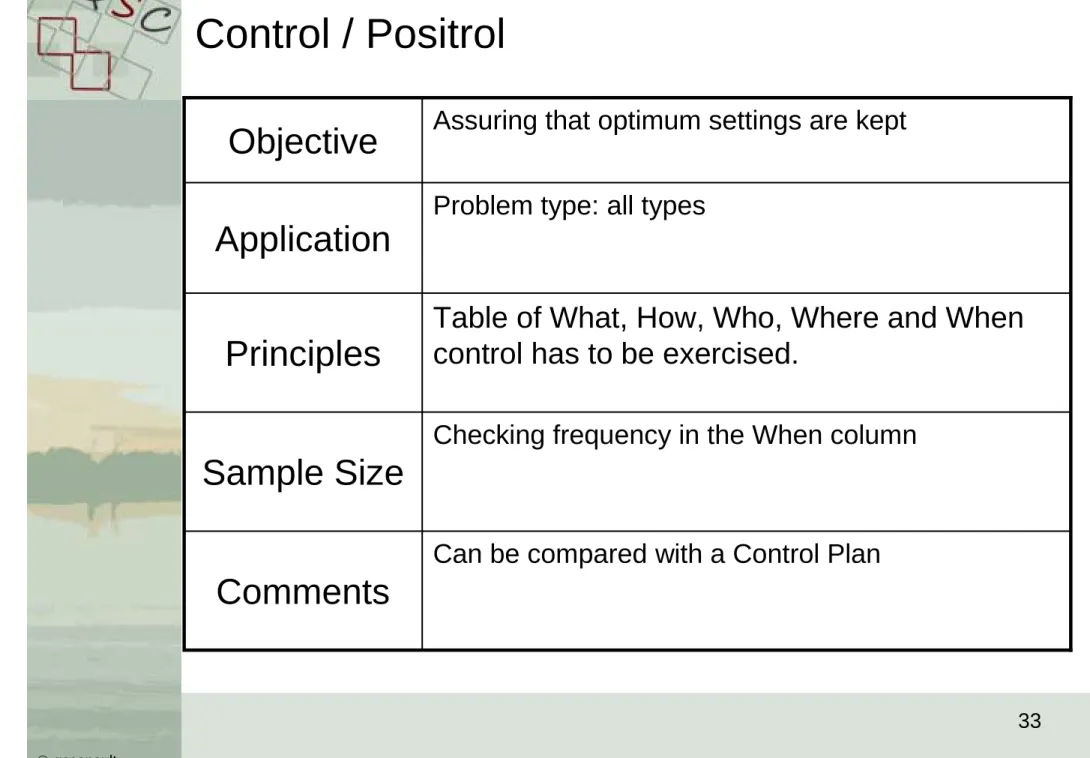
Control / Positrol
Can be compared with a Control Plan
Comments
Checking frequency in the When column
Sample Size
Table of What, How, Who, Where and When
control has to be exercised.
Principles
Problem type: all types
Application
Assuring that optimum settings are kept
34
qsconsult
Control / Process Certification
Mix of 5S, Poka-Yoke, instructions, ISO 9000, audits,…
Comments
Checking frequency to be determined
Sample Size
Make overview of things that could influence the process and install inspections, audits, …
Principles
Problem type: all types
Application
Eliminating peripheral causes of poor quality
Control / Pre Control
Alternative to classical SPC Traffic lights system
Very practical method
Comments
Checking frequency to be determined
Sample Size
Divide total tolerance in colored zones and use prescribed sampling and rules to control the process.
Principles
Problem type: control variation and setting of the process
Application
Continuous checking of the quality of the process output
36
qsconsult
Pre-Control: chart construction
USL
LSL
TARGET
½ TOL
Pre-control: use of chart
1. Start process: five consecutive units in
green needed as validation of set-up.
2. If not possible: improve process.
3. In production: 2 consecutive units
4. Frequency: time interval between two
stoppages (see action rules) / 6.
38
qsconsult
Pre-control: action rules
Stop and act 2 units in different yellow zone
Stop and act 1 unit in red zone
Correct 2 units in same yellow zone
Continue 1 unit in green and 1 unit in yellow
zone
Continue 2 units in green zone
Action Result of samples
qsconsult
www.qsconsult.be 40
Willy Vandenbrande Willy Vandenbrande, Master TQM
ASQ Fellow - Six Sigma Black Belt Montpellier 34 B - 8310 Brugge België - Belgium Tel + 32 (0)479 36 03 75 E-mail [email protected] Website www.qsconsult.be