Enterprise Architecture Application
Domain Roadmap
Technology Roadmaps
DOCUMENT CONTROL
Document Details
Document Owner Tony Bright Document Author Nick Morgalla Current Version 1.1
Issue Date 25th April 2008 Programme Reference Enterprise Architecture
Project Reference Enterprise Architecture Domain Template
Revision History
DATE VERSION CHANGE DETAILS
21st April 2008 1.0 Initial version
25th April 2008 1.1 Incorporate initial feedback
Distribution
DATE VERSION DISTRIBUTION
21st April 2008 1.0 Tony Bright, Kapila Munaweera, Phil Burnham and Terry Pyle 25th April 2008 1.1 Architecture Program Board
TABLE OF CONTENTS
Enterprise Architecture Application Domain Roadmap...1
1.0 Introduction ...5
1.1 Objectives...5
2.0 Executive Summary ...6
2.1 Developing the Enterprise-wide Application Strategy ...6
2.1.1 Complete FABS Rollout...7
2.1.2 Implement Global Application Standards ...7
2.1.3 Pilot Common Application Services...7
2.1.4 Develop Integration Framework ...8
2.2 Potential for Outsourcing...8
3.0 Application Domain Architecture Description ...8
3.1 British Council’s Enterprise Architecture Approach...9
3.1 Position of the Application Domain within the overall Enterprise Architecture 10 3.2 Capability Summary ...10
3.2.1 Customer Facing Services ...11
3.2.2 Integration and Common Application Services...13
Internal Services...14
4.0 Direction of Travel ...15
4.1 Business changes impacting the Application Domain ...15
4.1.1 Responding Effectively to the Business ...16
4.1.2 Transforming On-line Business ...16
4.1.3 Leveraging Our Information Assets ...16
4.1.4 Increasing Business and IT Efficiency...17
4.2 Technology opportunities ...17
4.2.1 Leveraging SAP capabilities...17
4.2.2 Leveraging Microsoft capabilities ...17
4.2.3 Integration Framework...18
4.2.4 Software as a Service and Service Oriented Architectures ...19
4.2.5 Web 2.0 (and Web 3.0) ...19
4.3 Exploring the Options ...20
4.3.1 Mapping Business Change to the Application Domain...20
4.3.2 Attributes Supporting the Key Business Requirements ...20
Mapping Technology Opportunities to the Application Domain...21
4.4 Overview of Change...23
4.4.1 Maximise SAP Benefit ...23
4.4.2 Simplify and Standardise Application Architecture ...23
4.4.3 Create Common Application Services...23
4.5 Summary of Benefits ...25
5.0 Detailed Description ...26
5.1 Business Capability / High-level Process Model ...26
5.2 Logical Domain Models ...28
5.2.1 Mapping Products to Application Services ...29
Page 3 of 38
5.2.3 Service governance Model ...31
6.0 Making it Happen ...34
6.1 Technology Choices...34
6.1.1 Technology decisions to be made ...34
6.2 Key Organisation Processes ...34
6.3 Resources and Skills...35
6.4 Provision Assumptions ...35
6.5 Milestones and Deadlines ...35
6.6 Domain Strategic Roadmap ...35
6.6.1 Step 1 - Complete FABS Rollout ...36
6.6.2 Step 2 - Implement Application Simplification / Standardisation ...36
6.6.3 Step 3 - Pilot Common Services...36
6.6.4 Step 4 - Implement Lightweight Application Integration Framework36 6.7 Domain Technical Roadmap ...36
7.0 Appendix 1 – Principles Guiding the Application Domain ...38
7.1 Business Principles ...38
7.2 Functional Principles ...38
7.3 Technical Principles ...38
7.4 Implementation Principles ...38
7.5 Governance Principles ...38
8.0 Appendix 2 – Application Domain Standards...38
TABLE OF FIGURES Figure 1 - British Council Enterprise Architecture Approach...9
Figure 2 - British Council Enterprise Architecture Domains...10
Figure 3 - Application Domain Service Model...11
Figure 4 - Customer Facing Service Model ...11
Figure 5 - Integration & Common Application Services Model ...13
Figure 6 - Internal Services Model ...14
Figure 7 - Point-to-Point Integration...18
Figure 8 - Hub Integration ...18
Figure 9 - Mapping Business Change to Domain Model ...20
Figure 10 - Mapping Technology Opportunities to Domain Model...21
Figure 11 - Enterprise Architecture Benefits Matrix – Application Domain ...25
Figure 12 - Logical Application Domain Model ...29
Figure 13 - Integration Framework Model...30
Figure 15 - Example Approval Process ...33 Figure 16 - Application Domain Strategic Roadmap...35 Figure 17 - Application Domain Product Roadmap...37
TABLE OF TABLES
Table 1 - Application Domain Strategic Approaches ...6 Table 2 - High-level Business Capability and Process Model...27 Table 3 - Mapping of Products to Application Services ...29
Page 5 of 38
1.0 Introduction
This document describes the target architecture roadmap for the Application Domain.
1.1 Objectives
The objectives of this document are:
• To provide a summary of the roadmap for the Application Domain
• To communicate an understanding of the Application Domain target architecture to stakeholders at an appropriate level of detail
• To position the Application Domain within the overall British Council enterprise architecture and describe the capabilities covered by this domain
• To describe how the business direction and technology opportunities have shaped the target domain architecture
• To explore the options available to British Council for this domain
• To identify the major deadlines and milestones for the delivery of the capabilities provided by this domain • To identify at a high level the resources and skills required to implement the capabilities
2.0 Executive Summary
The British Council’s enterprise architecture is currently organised into seven domains. These are data,
applications, collaboration, platform, networks, system management and security. This document focuses on the application domain.
Currently application architectures are decided by the different business departments and are often times passed to GIS to support and sustain. There is a potential for considerable benefit for the British Council if the enterprise-wide application architecture approach described in this document is adopted.
However, this represents a considerable step up in terms of enterprise architecture maturity and can only happen with the support of senior management. In the medium term therefore, it is recommended that the Council focus on one or two specific areas of the business, for example English & Exams and Marketing & Customer Services, though this will still need the specific buy-in and sponsorship of the senior managers within those areas.
2.1
Developing the Enterprise-wide Application Strategy
Based on current understanding, a strategy based on adopting the following approaches is suggested:
Priority Initiative When Key Benefits
High Complete the FABS rollout Implement financials MI within SAP
By end 2010 • Return on SAP investment
• Increase IT and business efficiency • Minimise operational risk
High Simplify and standardise the application architecture, specific areas of focus:
• Web Content Management1 • Relationship Management Agree architecture By end 2009 Implement as driven by business cases
• Reduce procurement costs • Improve customer experience • Improve use of corporate data assets • Reduced support costs
• Reduced operational risk High Pilot common application
services in 1 or 2 business areas (E&E, MCS), candidates include:
• Identity Management • Global Search
Pilot By end 2008 • Maximise use of corporate data assets • Improve customer experience
• Reduced operational risk
Medium Develop integration framework and implement common application services
By end 2011 • Reduced procurement costs over time • Reduced support costs
• Maximise use of corporate data assets • Improve customer experience
• Reduced operational risk
Table 1 - Application Domain Strategic Approaches
1
Note that general enterprise content management (ECM) is within the Collaboration Domain, though Web Content Management should be considered a subset in architectural terms
Page 7 of 38 2.1.1 Complete FABS Rollout
The British Council has made a considerable investment in SAP in the context of the FABS program. Completion of financials rollout is expected imminently and completion of Campus rollout by the end of 2010. During that time, it is recommended that the SAP architecture is kept relatively stable while the business adopts FABS in order to minimise operational risk. It is therefore not recommended that the scope of SAP be allowed to creep as this could threaten the FABS/SAP programme, FABS will have a considerable impact on the business and they need time to complete their change management processes before absorbing additional change.
2.1.2 Implement Global Application Standards
There is evidence of application architecture proliferation across the organisation. Two areas where this might happen are content management and relationship management. In the case of content management, E&E are exploring a different solution from MCS. In other cases, such as with relationship management, numerous local geographic solutions have been implemented.
This proliferation of solutions is compounded by the tangential Collaboration Domain, where many of the underlying horizontal tools are identical or similar to those required in the Application Domain.
Clearly, this is suboptimal for many reasons adding cost, risk and making it much more difficult to share and benefit from corporate information. Therefore, a priority is to establish strong governance, especially in this critical area, ensuring that the key stakeholders from the business are involved in the process.
In some cases, it may well be appropriate to have more than one system provided appropriate integration mechanisms exist. However, such decisions should be made in a global context, not driven by isolated business cases.
It is imperative that the enterprise architecture team within GIS is given the authority to govern the selection of solutions and products. This will require the support of senior management across the organisation.
It may take time to enable this globally, in which case it may be appropriate to begin by engaging with one or two business areas. Given the pressing need to establish standards for web content management this indicates working with E&E and MCS initially.
2.1.3 Pilot Common Application Services
Two major objectives of the business are to transform British Council’s on-line presence and maximise benefit from corporate data assets. Initial analysis suggests that developing a common mechanism to capture access and report customer information will benefit both objectives.
Currently very little customer information is captured other than for transaction contacts. In some cases it is impossible to identify from which country a contact was made (IP addresses are not accurate enough).
Providing a common identify service will enable the capture of customer information at various levels appropriate to the type of contact. Such an approach can also enable the integration of transaction information within SAP with the unstructured data that supports much of the on-line user interface with minimal impact on SAP (see 2.1.1 above).
It is recommended that the British Council initially focus on one area of the business where there is clear business benefit, for example E&E. However, it is also important to develop an overall understanding of requirements from across the businesses to increase the likelihood of the common service meeting the global need.
2.1.4 Develop Integration Framework
Currently integration of application components is point-to-point. This is appropriate where there are relatively few system components and the business environment is static. The increasing need to respond quickly to accelerating business change indicates that a better approach to integration will be required in the future. Because the needs of the Council are relatively modest, an integration framework can be lightweight and
developed over time. The starting point is to establish the overall architectural approach, set some key standards and implement strong governance to ensure that all emerging solutions are compliant.
2.2
Potential for Outsourcing
The recommended approach to outsourcing is as follows:
• Identify the services and processes that are unique to the British Council and give the Council its competitive advantage
• Ensure that the Council retains ownership of the architecture and potentially development and support for the systems supporting the services and processes unique to the Council (see bullet above)
• Identify current bespoke solutions that can be migrated to industry standard systems and develop migration plan
• Consider outsourcing the industry standard solutions to a 3rd party, e.g. SAP • Retain in-house ownership of the overall enterprise architecture
The above approaches are described in more detail in the following sections of this document.
3.0 Application Domain Architecture Description
The Application Domain consists of all the British Council business applications, excluding those that are a part of the collaboration domain or the platform domain.
In summary, these applications provide the following services: • Service Access:
o On-line access services (e.g. Web Content Management) o Face-to-face access services (.e.g. Teaching Productivity Tools) o Remote access services (e.g. B2B services such as payroll) • ERP Services
• Exams & Teaching Centre Services • Relationship Management Services • Function Support Services
• Corporate Performance Management Services (e.g. MI, Dashboards) • Integration and Common Application Services (e.g. Identity Management) The following services are not included in the application domain:
• Collaboration services (Collaboration domain)
• Generic Content Management (Collaboration Domain) • Workflow (Collaboration domain)
• Mail and messaging (Platform domain) • MS Office (Platform domain)
• Desktop productivity tools (Platform domain)
Page 9 of 38 However, it is unwise to ignore the application services that are not directly a part of the Application Domain when considering the overall applications architecture. This is because either now or in the future there may be a need for integration of components across the complete applications landscape. In addition, re-usable components can exist within each of the domains, so the Applications, Collaboration and Platform domains should be considered when exploring new potential solutions.
Therefore, in places this document includes references to those application components that are outside the defined scope of the domain.
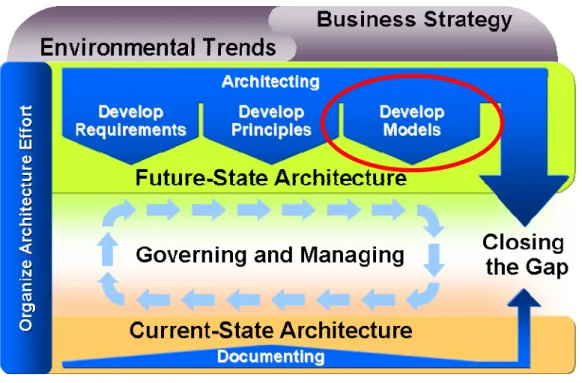
3.1 British Council’s Enterprise Architecture Approach
The Enterprise Architecture is a comprehensive framework used to manage and align an organisation's business processes, Information Technology (IT), software, hardware and information requirements with the organisation’s overall business strategy.
Figure 1 - British Council Enterprise Architecture Approach
The document focuses on defining the future state model for the Application Domain.
As part of the overall enterprise ‘architecting’ process, a number of guiding principles have been developed. Those principles that specifically affect the Application Domain can be found at the back of this document in Section 7.0 Appendix 1 – Principles Guiding the Application Domain.
3.1
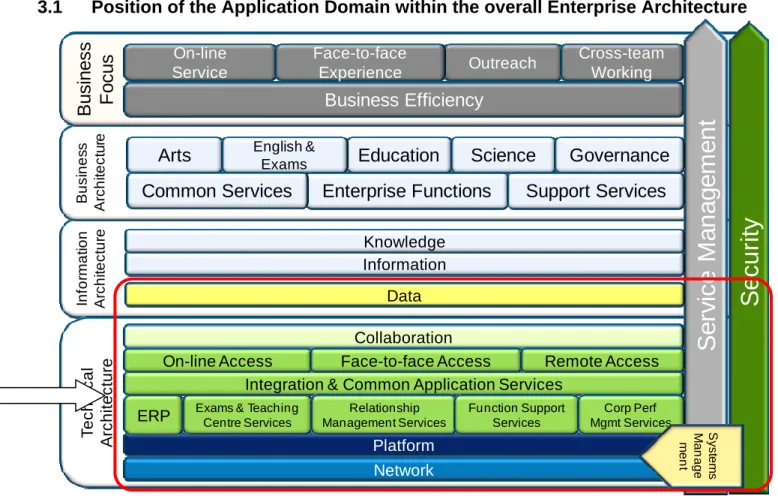
Position of the Application Domain within the overall Enterprise Architecture
In fo rm a tio n Ar c h it e c tu re Bu s in e s s Ar c h it e c tu re T e ch n ica it e c tu l Arc h reB
us
ines
s
Fo
c
u
s
Network Platform On-line ServiceBusiness Efficiency
Outreach ERP Face-to-face Experience Cross-team WorkingS
e
rv
ic
e
Ma
n
a
g
e
me
nt
English & ExamsArts
Education
Science
Governance
Common Services
Enterprise Functions
Support Services
Se
c
u
ri
ty
CollaborationExams & Teaching Centre Services
Data
Integration & Common Application Services
Relationship Management Services Function Support Services Corp Perf Mgmt Services
On-line Access Face-to-face Access
S yst e m s Ma n a g e me n t Remote Access Information Knowledge
Figure 2 - British Council Enterprise Architecture Domains
The Application Domain is one of seven enterprise architecture domains currently identified within the British Council. The ‘in-scope’ domains are shown within the red box in the picture above.
The application domain incorporates the main business applications and excludes application components that are part of the collaboration or platform domains (see introduction to this section above).
The capabilities of the Application Domain are listed in detail below.
3.2 Capability Summary
Application services fall into one of three areas:
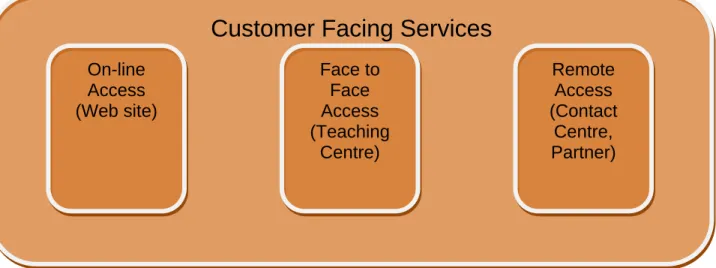
• Customer Facing Services – services directly accessed by British Council’s customer and partners
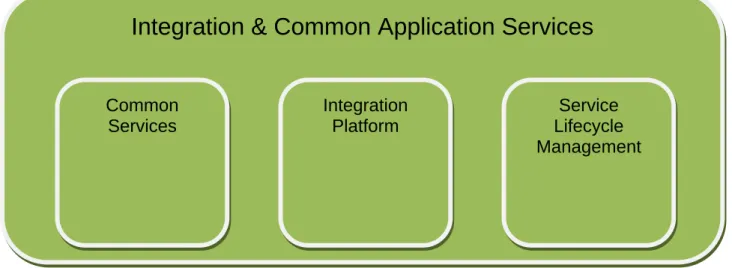
• Integration and Common Services – the mechanism for integrating services across different systems and providing consistent common services to systems
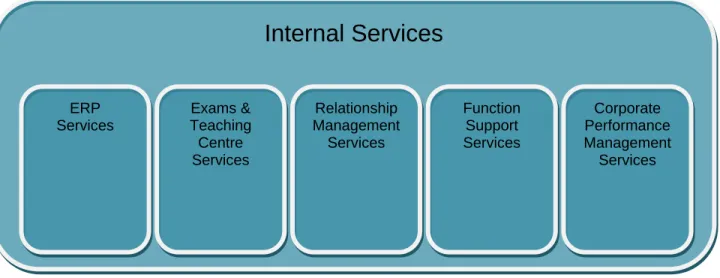
• Internal Services – services which enable the British Council to run its businesses but which are not directly accessible to its customers or partners
Page 11 of 38
Customer Facing Services
Figure 3 - Application Domain Service Model
3.2.1 Customer Facing Services
Figure 4 - Customer Facing Service Model 3.2.1.1 On-line access services
While a considerable amount of business still takes place face-to-face, there is an emerging trend to increase on-line activity. On-on-line activity can take a number of different forms.
Customer Facing Services
Integration &
Common
Services
Internal Services
On-line
Access
(Web site)
Face to
Face
Access
(Teaching
Centre)
Remote
Access
(Contact
Centre,
Partner)
Interaction Services
Interaction services are services that enable British Council’s customers to interact with each other as well as the Council, for example:
• Blogs
• Wikis
• Chat
• Emerging capabilities – still to be defined
Note that this is a fast moving area and new requirements and capabilities are expected to emerge on an ongoing basis.
These Interaction Services are a strong example of the tendency for service functionality to cross Domain boundaries; all of the above are candidate services in the Collaboration Domain and furthermore, interactions will often start as internal interaction (‘Collaboration’) before resulting in client-facing dialogue (‘Applications’), or vice versa.
Transactional Services • Registration • Order Capture • On-line Training
• On-line Exams (potential future requirement) • Enterprise Feedback
The recurrent need to ‘know who the customer is’ makes early registration and encouragement of sign-on a highly desired behaviour; the implementation of cross-platform behaviour (for client-facing, ‘Web’ applications) makes the proliferation of Web Content Management solutions of particular concern.
Web Content Delivery • Media streaming
Web Content Management • Content Authoring
• Content Lifecycle Management
• Performance Management (May be part of the Systems Management Domain)
Content Authoring and Lifecycle Management are activities that take place in the Collaboration Domain and frequently cross Domain boundaries; the implementation of services that do not have the ability to operate seamlessly across these boundaries will, at best, lead to cost multiplication and user inconvenience.
3.2.1.2 Face-to-face access services • Events Management
• Learning Productivity Tools
3.2.1.3 Remote access services • Order Capture Validation
Page 13 of 38 • Customer Support
• B2B Partners (e.g. The British Accreditation Council, Cambridge Assessment) • B2B Suppliers (e.g. Logica, Global Crossing, HP)
3.2.2 Integration and Common Application Services
Integration & Common Application Services
Common
Services
Integration
Platform
Service
Lifecycle
Management
Figure 5 - Integration & Common Application Services Model
3.2.2.1 Common Application Services • Identity and Authentication Services • Search Services
• Common Content Management Services • Web Analytics
Currently a small set of potential common application services has been identified, however more work needs to be done with the business units to identify which business services need to be common, and which can remain specific to point business solutions.
3.2.2.2 Integration Framework
• Security (access control) Services • Service Auditing • Service Orchestration2 • Service Instrumentation3 • Service Management o Availability Management o Performance Management 2
Combining two or more services together in a sequence to perform a business function
3
Incorporating functionality within a service to log and report performance and behaviour in business terms, for example to measure how often a user enters an invalid data item, or how long it takes to complete on on-line course booking
A good example of a service which should be made available through the integration framework is common identity management. Providing the service through the common framework will make it easier for service consumers to access the service in a simple and consistent manner. It will also provide the control and monitoring required to deliver the service effectively.
In the identity management example, the service would need to be used by multiple channels, including on-line systems, call centres and possibly even when registering face-to-face contacts. For line integration, the on-line system can call a simple web-service to capture the user identity and any security identifiers and provide a simple go/no-go response.
This same web-service could also be used by a simple stand-alone, or lightly integrated front-end that could be used in call centres. Such a (front-end) component could easily be developed and supported in-house. Over time, as the existing contact centre system is migrated to a common platform, a more robust integration would be implemented, but still using the same common identity service.
3.2.2.3 Service Lifecycle Management • Service Definition and Standards • Service Catalogue
• Service Publication & Discovery • Service Contract Management • Service Quality Assurance • Service Governance
Internal Services
Internal Services
ERP Exams &
Teaching Centre Services Relationship Management Services Function Support Services Corporate Performance Management Services Services
Page 15 of 38 3.2.2.4 ERP Services
• Purchase Order Accounting • Sales Order Processing • Accounts Receivable • Accounts Payable • Billing Invoicing • Contract Accounting • General Ledger • Financial Reporting • Travel & Expenses
• Sourcing Contract Reviews • Product Catalogue
• Order Management • Order Fulfilment • Stock Management
3.2.2.5 Exams & Teaching Centre Services • Course Registration
• Exam Registration
• Teaching Centre Management • Student Exchange Management
3.2.2.6 Relationship Management Services • Contact Management
• Call Centre Management • Strategic Partner Management
3.2.2.7 Function Support Services • Asset Management
• Human Resources
• Payroll
• Records Management • Library Management
• IT Service Management (may be part of the Systems Management Domain)
3.2.2.8 Corporate Performance Management Services • Corporate Performance Monitoring BI
• KPI Dashboard
4.0 Direction of Travel
4.1 Business changes impacting the Application Domain
4.1.1 Responding Effectively to the Business
The British Council is, like many organisations, experiencing a major shift from doing business face-to-face to on-line working. A feature of this change is that it is moving very quickly and subject to many short-lived fads and fashions.
Many of the British Council’s customers will be involved in this change and in order for the British Council to thrive and survive it must be able to compete and lead the field in terms of its on-line presence.
The dynamic nature of this environment means that IT has to be even more responsive to demands from the business otherwise the British Council is in danger of losing the race with its competitors.
In order to achieve such levels of responsiveness it is imperative that business solutions can be quickly built up from existing components or ‘services’ rather than having to acquire complete systems from scratch every time requirements change.
4.1.2 Transforming On-line Business
On-line transformation is fundamental to the future growth and success of British Council. As noted above, there is a significant move from face-to-face to on-line working. However, it is no longer enough just to have a web presence. If the British Council is to attract and keep customers it must provide a leading-edge on-line experience, otherwise it will quickly loose business to its competitors.
Emerging technologies such as Web 2.0 and eventually Web 3.0 are beginning to transform how we think about and use the Internet and other communication channels.
Access to the internet is becoming widespread, even in third world countries4. British Council’s target audience is rapidly becoming web ‘savvy’ and is attracted by these new technologies.
The growth of the high profile Social Networking sites, which take a significant percentage of many web users ‘mindshare’, may force organisations to ‘take their content to the user’; rather than to ask ‘how do we compete with (for instance) Facebook?’, it may be better to develop a strategy of being present on these sites.
It must be possible to integrate new and emerging technologies into existing solutions with minimal disruption. It is not enough just to ‘bolt on’ new functionality without integration since this will not provide the best user
experience nor make available the consistent valuable information required by the Council.
The business requirements for internal systems tend to be far more stable and much more likely to evolve slowly. A key challenge is to develop an architecture that will successfully mesh these two seemingly conflicting
requirements.
4.1.3 Leveraging Our Information Assets
Information is one of the British Council’s major assets. In the past, it has been challenging to leverage these information assets across the organisation partly because of the way the business is organised, but also because of the disparate applications architecture (it could be argued in turn that this is a result of the business
organisation).
The introduction of SAP via the FABS program has enabled considerable progress to be made in this area, especially in terms of financial data. However, there is still much information, especially relating to British Council’s customer, which is inconsistent, difficult to manage and reconcile.
4
Page 17 of 38 In some cases, valuable information is simply lost (for example, who is accessing a web site) because no mechanism is available to capture that data. Even where data is captured, it is challenging to reconcile it across process boundaries and this significantly reduces the value of the information.
While part of the solution to this is outside the scope of the application domain (because it sits within the Data Domain), it is the application that will collect process and deliver the information to maximise its use.
4.1.4 Increasing Business and IT Efficiency
Another key business objective is to optimise both business and IT efficiency. This involves balancing IT investment against business value, and ensuring that maximum value is obtained from existing IT assets. When applied to the British Council application architecture domain, this means leveraging as much value as possible from the SAP and Microsoft applications and infrastructure.
It also indicates that there is a need to simplify and standardise the application domain. This means that the British Council must ensure that as far as possible, solutions are designed for use and re-use across the whole organisation.
4.2 Technology opportunities
A number of technology opportunities can have an impact on the application domain. These include:
4.2.1 Leveraging SAP capabilities
The British Council has made a considerable investment in SAP in terms of both solutions and capability. Wherever possible and where it meets requirements, SAP should be used to provide functionality. This is most likely to be in the area of internal services where there is likely to be a close (enough) match between business requirements and application functionality. It is also generally easier, though not without its challenges, to change business processes internally to match SAP’s implemented processes.
However, SAP is less likely to provide the flexibility that is required, especially for on-line access other than in the area of transactional access. It may be better to expose SAP functionality thorough a common service interface, allowing the Council to develop user interfaces quickly and effectively.
Consideration also needs to be given to the cost and availability of SAP resources when implementing new functionality.
More investigation of the capabilities of SAP needs to take place before any hard and fast decisions are made in this area.
4.2.2 Leveraging Microsoft capabilities
As with SAP, the British Council has made considerable investment in Microsoft Infrastructure again both in terms of solutions and capability. In addition, the British Council’s status as an educational establishment means that it receives favourable licensing pricing for all Microsoft products.
Microsoft provides capabilities for implementing an integration framework based on .NET and BizTalk Server technologies (See 4.2.3 below). MOSS should also be included as a potential solution development platform.
4.2.3 Integration Framework
The requirement to be able to build solutions from components and to combine functionality and
information from a number of different systems strongly
indicates the need for integration. System A
System B
System C
System D
System E
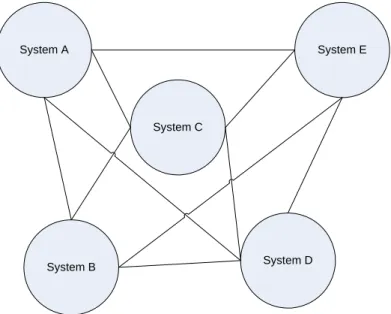
Traditionally integration has happened in an ad-hoc point-to-point manner. Such an approach rapidly reaches unmanageable proportions as the number of integration points increases.
An added complication in such an arrangement is that there can be a lack of standardisation between point-to-point integration mechanisms. This can make it increasingly difficult to support and over time this can lead to a critical situation where if becomes
exceedingly difficult to integrate any additional components.
Figure 7 - Point-to-Point Integration
A better approach is to implement a common integration framework that acts as a ‘hub’ System A
System B System C System D
System E
Integration Framework
When a system requires a service, it
communicates with the central framework rather than the service provider directly. The framework knows where to find the service because it keeps track of service providers.
In such an arrangement, the total number of integration points equals the total number of systems to be integrated. In addition, because every integration point uses a common standard, the solution is much easier to support.
Such an arrangement makes it very easy to change where a service is provided from in the future. For example, identity management may initially be provided in-house but in the future may be provided by a third party. This requires a simple parameter change within the framework.
Figure 8 - Hub Integration
Once the concept of an integration framework has been accepted, a natural progression is to move common ‘technical’ functionality, such as auditing, error handling and service instrumentation into the framework itself so that it does not have to be implemented repeatedly by each application.
An integration framework can provide a pre-defined set of standards, tools and common service components. Applying British Council’s architecture principles there are a number of candidates for the provision of an
integration framework, for example based on SAP using SAP’s Netweaver technologies, or alternatively based on Microsoft’s technologies such as .NET and MOSS.
Page 19 of 38 An integration framework does not have to be a huge investment, in fact, experience has shown that it is much better to start small and grow outwards. The starting point is to establish a set of standards and a governance process to ensure that all new solutions consider the use of the integration framework and the common services that it can support.
An example of a common service might be identity management which can help the British Council to gain a much better understanding of who they interact with, who is using on-line services and enable tracking customer engagement over time.
4.2.4 Software as a Service and Service Oriented Architectures
Software as a service (SaaS) is a software application delivery model where a software vendor develops a web-native software application and hosts and operates (either independently or through a third-party) the application for use by its customers over the Internet.
Customers do not pay for owning the software itself but rather for using it. They use it through an API accessible over the Web and often written using Web Services or REST. The term SaaS has become the industry preferred term, generally replacing the earlier terms Application Service Provider (ASP) and On-Demand.
Service Oriented Architecture (SOA) is a computer systems architectural style for creating and using business processes, packaged as services, throughout their lifecycle. SOA also defines and provisions the IT infrastructure to allow different applications to exchange data and participate in business processes. These functions are loosely coupled with the operating systems and programming languages underlying the applications. SOA separates functions into distinct units (services), which can be distributed over a network and can be combined and reused to create business applications.These services communicate with each other by passing data from one service to another, or by coordinating an activity between two or more services.
SOA concepts are often seen as built upon and evolving from older concepts of distributed computing and modular programming.
While the British Council’s current requirements do not suggest a wholesale move toward SOA architecture, adopting some of the SOA principles, applying a ‘light touch’ can be beneficial, especially when considering the provisioning of common application services. In some cases it may be possible and beneficial to provide such services, for example identity management, as SaaS, in which case SOA can be seen as an enabler.
4.2.5 Web 2.0 (and Web 3.0)
Web 2.0 is having a significant impact on how people perceive and use the Internet. Web 2.0 allows users much greater control over how content is created and accessed. It also potentially allows users to provide a much greater degree of customisation of their personal web experience.
A key question for British Council is how can the Web 2.0 capabilities be integrated into the overall architecture while maintaining the benefits of Web 2.0 and without adversely affecting the core BC systems.
However, Web 2.0 services are provisioned there is a need to define a set of common interfaces which will enable the British Council to maximise the overall benefits of these technologies.
4.3 Exploring the Options
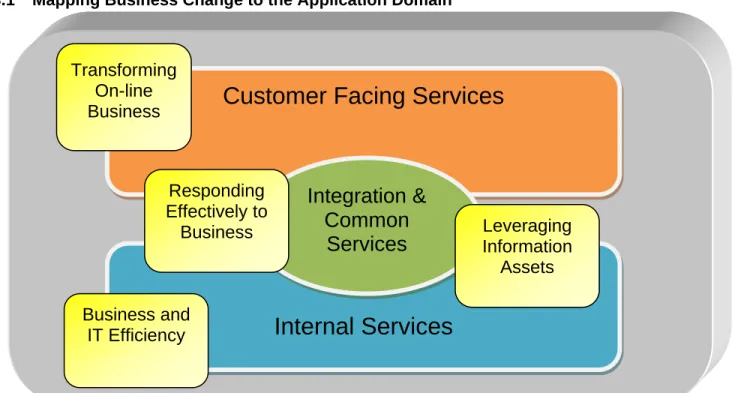
The next step is to begin to map the business changes and technology opportunities onto the application domain model to understand how they can affect the British Council’s target application architecture.
4.3.1 Mapping Business Change to the Application Domain
Customer Facing Services
Internal Services
Integration &
Common
Services
Responding
Effectively to
Business
Transforming
On-line
Business
Business and
IT Efficiency
Leveraging
Information
Assets
Figure 9 - Mapping Business Change to Domain Model
4.3.2 Attributes Supporting the Key Business Requirements
Considering the mapping of business change to the application domain, a number of characteristic emerge which begin to describe the architecture desired state.
4.3.2.1 Attributes - Responding Effectively to Business • Simplified • Reusable • Modular • Open standards • Easy to integrate • Strong governance
4.3.2.2 Attributes - Transforming on-line business • Consistent British Council branding, look and feel
• Compelling
• Functionality - ability to access services and information • Easy to use
Page 21 of 38 4.3.2.3 Attributes - Leveraging Information Assets
• Consistent data access mechanisms • Data quality and validation
• Data standards
• Taxonomy and metadata • Master data management
4.3.2.4 Attributes - Business & IT Efficiency • Business process standardisation • Leveraging IT assets
• Reuse
• Strong governance
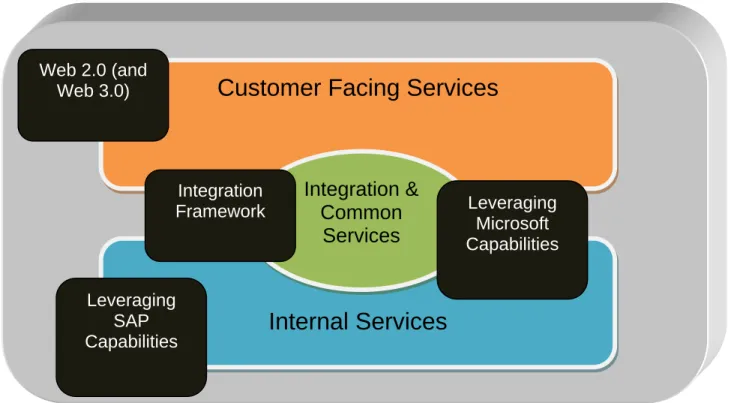
Mapping Technology Opportunities to the Application Domain
Customer Facing Services
Internal Services
Integration &
Common
Services
Leveraging
SAP
Capabilities
Leveraging
Microsoft
Capabilities
Integration
Framework
Web 2.0 (and
Web 3.0)
Figure 10 - Mapping Technology Opportunities to Domain Model
4.3.2.5 Technology Mapping - Leveraging SAP Capabilities
Where SAP is a good fit, which is primary in the financial management and transactional areas it should be used to meet future requirements.
In general, SAP sits most comfortably in the Internal Services area, however SAP can also be used to provide transactional interfaces which are customer facing. Consideration needs to be given to the ease and speed at which such interfaces can be changed, and whether interfaces support the look and feel of British Councils on-line presence.
SAP is currently being rolled out in the context of the FABS program. The financials functions rollout will be completed imminently, and the Campus functionality is due to complete in 2010. While this rollout is taking place it is important to minimise the impact and any risk to the SAP environment, which means limiting additional programs of work that involves SAP.
Potentially SAP could also be used to implement relationship management, although more work is needed to explore the requirements in the context of the overall enterprise architecture.
4.3.2.6 Leveraging Microsoft Capabilities / Integration Framework
As described in 4.2.2 and 4.2.3 above, Microsoft technologies appear to be a good fit to provide the integration layer that connects the customer facing to internal services and provides a consistent set of common services, such as identity management.
In particular, many organisations are recognising that MOSS provides not only a framework for Collaboration, internal Content Management and Web Content Management, but also the ability to expose ‘non-native’ content through a common metaphor supported by platform functionality and behaviours (e.g. Discussion, Wikis).
4.3.2.7 Web 2.0
The new and emerging Web technologies clearly will have most impact on customer facing services.
The underlying concept of Web 2.0 is that the Web becomes the ‘platform’ and that user’s gain control over their personal data and user experience.
This can be interpreted in a number of ways:
• Users contribute to content (e.g. Wiki’s Blogs)
• Users can create their own browsing experience (customised web sites) • Much richer end-user functionality (Web applications)
Exactly what this means to the British Council is still emerging, but the pragmatic approach is to ensure that Web 2.0 and other technologies that will come in the future can be integrated painlessly and effectively into solutions. Assuming the above is valid; this indicates that the British Council needs an architecture that has the following attributes:
• Based on open standards
• Integration framework to provide the underlying ‘plumbing’
• Strong governance to ensure that solutions comply with architecture and standards
Applying one of the principles of re-use, Technical Principle 2 - Maximising Microsoft Infrastructure Benefits, the British Council should investigate how to leverage capability from MOSS. Although MOSS is primarily used today to provide internal collaboration functionality, its capabilities go beyond that. More research needs to be done, based on a deeper understanding of the business requirements.
Page 23 of 38
4.4 Overview of Change
4.4.1 Maximise SAP Benefit
The British Council has made a significant investment in SAP. The initial FABS program is in the process of being rolled out to the businesses and this needs to be completed before any major new SAP programs are implemented. Completion of the FABS rollout is expected by 2010.
4.4.2 Simplify and Standardise Application Architecture
Currently individual businesses are responsible for choosing applications, and there is limited global governance to alter this behaviour, there is an ongoing risk of several systems being implemented which duplicate
functionality. This may happen for example in the case of relationship management or content management. Different business units or geographies are independently assessing software requirements and piloting solutions. The British Council could gain significant benefit by ensuring that all the relevant businesses work together with GIS enterprise architects to ensure that there is consistency and collaboration between systems.
Some potential advantages of a standardised approach:
• Reduced acquisition costs – greater buying power if focussed on smaller number of suppliers • Reduced development costs – develop the solution only once
• Reduced support costs – need to support less systems • Consistent user experience
• Makes it easier to share information within and across departments The areas that require the most urgent attention are:
• Web Content Management • Relationship Management
Over time, strong enterprise architecture governance should be implemented, but this will require the buy-in from the businesses. In the short term, GIS should engage more closely with the business areas that are exploring emerging requirements, such as content management to determine if it is possible to move toward a standardised solution.
4.4.3 Create Common Application Services
Even assuming that the application domain is simplified and standardised, there are still common functions and information that should be shared across applications.
Many on-line components will need to use a core set of functions, for example ‘search’, and ideally these should be provided once only in a consistent manner across the organisation.
In order to support the rapidly changing on-line world, on-line components will need to be created and integrated with existing systems quickly and efficiently. This is likely to be an increasing important requirement over time. While it is possible to provide common application services in a point-to-point integration architecture,
implementing ‘light touch’ integration framework can provide many significant benefits:
• An open, standards based framework into which components can be easily plugged and unplugged • Loose coupling of components, ensure that components do not become interdependent – this includes
both on-line and back-end components
• A core set of standard re-usable functions, for example identity management, search, auditing, provided as services with well defined service level agreements
• A simple published repository of re-usable components and services
• A lightweight mechanism to manage and govern components, services and solutions The benefits of adopting this approach are:
• Consistent end user experience when engaging across the organisation • Consistent customer information across the organisation
• Maximise re-use, optimum use of resources
• Leverage maximum capability from existing investments, including the Microsoft and SAP platform • Flexibility and agility, easy to make changes with minimum impact on existing services
Initial exploration indicates that the provision of a common identity would be a good place to start. An approach to this might be as follows:
1. Identify where identity services are currently used with the global business
2. Do deeper analysis of the data and processes involved with identity within one or two specific business areas, e.g. E&E
3. Create metadata model for customer, keep it simple initially
4. Validate model across business units, run simple scenarios to test validity 5. Implement architecture governance to apply the model5
6. Develop simple common identity service to support business specific requirements, working initially within one area of the business
7. Validate service against business process
8. Implement governance to implement common identity service
The development of such services should be underpinned by a good understanding of the business information and processes that define the requirement. An important activity is to identify the common areas of data, for example customer, and process for example user authentication and understand where these fit into the overall business model.
This will require an initial high level understanding across the business, together with a more detailed drill-down for one or two specific business areas, followed by validation across the rest of the organisation.
5
Page 25 of 38
4.5 Summary of Benefits
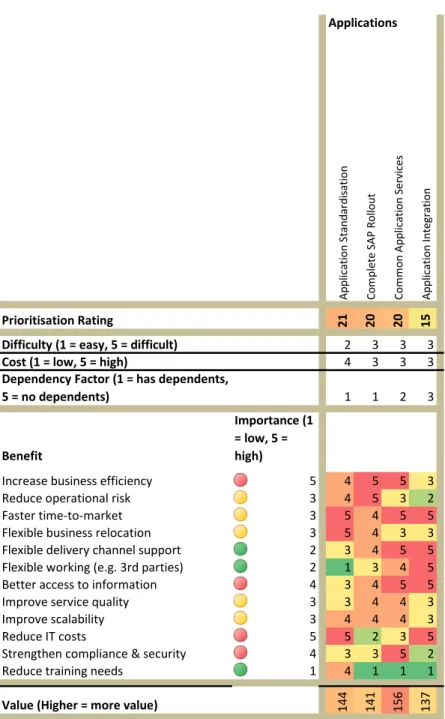
Applications A pplication St andardisation Co mp le te SAP Rollout Co mmo n A pplication Se rv ic es A pplication Int eg rat io n Prioritisation Rating 21 20 20 15 Difficulty (1 = easy, 5 = difficult) 2 3 3 3Cost (1 = low, 5 = high) 4 3 3 3
Dependency Factor (1 = has dependents,
5 = no dependents) 1 1 2 3
Benefit
Importance (1
= low, 5 =
high)
Increase business efficiency 5 4 5 5 3
Reduce operational risk 3 4 5 3 2
Faster time‐to‐market 3 5 4 5 5
Flexible business relocation 3 5 4 3 3
Flexible delivery channel support 2 3 4 5 5
Flexible working (e.g. 3rd parties) 2 1 3 4 5
Better access to information 4 3 4 5 5
Improve service quality 3 3 4 4 3
Improve scalability 3 4 4 4 3
Reduce IT costs 5 5 2 3 5
Strengthen compliance & security 4 3 3 5 2
Reduce training needs 1 4 1 1 1
Value (Higher = more value) 144 141 156 137
Figure 11 - Enterprise Architecture Benefits Matrix – Application Domain
Figure 11 above illustrates the relative benefits attributed to the initiatives described in this document. It can be seen that based on the above assessment, application standardisation has the highest priority, followed closely by completion of SAP rollout and common application services.
Implementing application integration is less compelling; however it is likely to become more important over time and should therefore still be given consideration.
5.0 Detailed Description
5.1 Business Capability / High-level Process Model
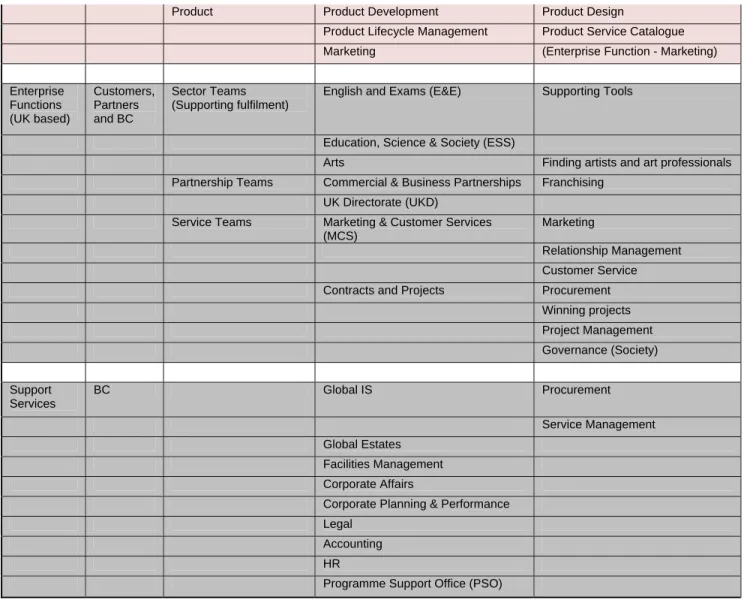
The starting point for developing the application architecture is the business process model. While currently the business architecture is outside the defined scope of enterprise architecture within the British council, it is included in conceptual form because of its critical importance.
This model needs to be validated and developed in conjunction with the business.
Sector or Service Category
Service
Consumer Service Primary Activity High Level Processes
Arts Customers Arts Art Promotion Registration (Event)
Events Management
Creative Economy
Education Customers Learning Teaching English Registration (Course)
Budget Planning
Course Management
Teaching
Scholarships Scholarship Management
Counselling Educational Counselling
Teaching Teacher Training
Accreditation
Teaching exchange Exchange Management (Teaching)
Exams Examinations Registration (Exam)
Exam Management
Examining
International Experience Youth Exchange Exchange Management (Youth) Training Exchange Exchange Management (Training)
Promotion Education Promotion
Science Customers Science Science & Technology Accessing UK Science
Library Library Management
Governance Customers Governance (Enterprise Function - ESS) Development Development Project Management (Enterprise Function - ESS)
English Customers (Enterprise Function - E&E)
Common Services
Customers Finance Billing Billing / Invoicing
Page 27 of 38
Product Product Development Product Design
Product Lifecycle Management Product Service Catalogue Marketing (Enterprise Function - Marketing)
Enterprise Functions (UK based) Customers, Partners and BC Sector Teams (Supporting fulfilment)
English and Exams (E&E) Supporting Tools
Education, Science & Society (ESS)
Arts Finding artists and art professionals
Partnership Teams Commercial & Business Partnerships Franchising
UK Directorate (UKD)
Service Teams Marketing & Customer Services (MCS)
Marketing
Relationship Management
Customer Service
Contracts and Projects Procurement
Winning projects Project Management Governance (Society) Support Services BC Global IS Procurement Service Management Global Estates Facilities Management Corporate Affairs
Corporate Planning & Performance
Legal
Accounting
HR
Programme Support Office (PSO)
Table 2 - High-level Business Capability and Process Model
Considerable work needs to be done in collaboration with the business to refine this model; however, it currently serves as a placeholder.
5.2 Logical Domain Models
.
Note, these capabilities are not contained within the Application Domain, but are included to show the overall applications landscape, and identify any dependencies and integration touch-points
.
Part of the Data domain, included here for completeness
Page 29 of 38 Figure 12 - Logical Application Domain Model
The logical application domain model represented in Figure 12 shows the domain organised into the major functional areas. To avoid over complicating the diagram, Integration and common application services are shown as internal services, though in reality they can be considered as sitting between customer facing and internal.
5.2.1 Mapping Products to Application Services
Category Group Service Product
Customer Facing Services On-line Access Interaction Services Web 2.0 components
Transactional Services SAP plus other GUI
Content Delivery
Web Content
Management
To be identified
Face-to-face access Events Management To be identified
Learning productivity tools Various
Remote Access Customer Support front
end
To be identified
B2B Access Integration Framework
Integration & Common Services
Integration Framework See 5.2.2 below Initial lightweight implementation may not require specific product, but could be ,NET or MOSS Common Services Identity Management To be identified, could be
DAP, directory based service
Search To be indentified
Metadata management MOSS
Internal Services ERP / Financials Package SAP
Exams & Teaching Centre Services
Campus SAP Relationship
Management Services
To be identified, potentially SAP or Microsoft or other product
Function Support Various Internal bespoke systems
Corporate Performance
Management
BI SAP
Dashboard To be identified
5.2.2 Integration Framework Model
Integration Framework
Run-time Capabilities Design-time Capabilities
Security Audit Service Performance & Availability Management Routing Orchestration
Error & Event Handling Service Repository / Catalogue Publication & Discovery Service Governance SAP CRM Bespoke Systems
Common Application Services On-line System 1 On-line System 2 Face 2 Face Remote System 3rdParty Integration
System
Identity
Management Search
Figure 13 - Integration Framework Model
Figure 13 above illustrates the typical capabilities of a mature integration framework. This model represents a potential desirable end-state; however, the initial requirements for the British Council are modest and it is not necessary to implement all of these capabilities in one go.
It is however important to ensure that there is an overall architecture vision which will lead to the target model if so desired.
The key requirements are:
• Clearly defined interface standards • Security
• Service catalogue, to drive re-use and enable governance
Page 31 of 38 Initial common application services might include:
• Identity management
• Search
• Content management – metadata
5.2.3 Service governance Model
Experience has shown that it is essential to establish effective governance from the very beginning when implementing common application services. Failure to do this will typically lead to poor implementation of standards leading to inconsistency across the organisation and reduced benefit of re-use existing components.
Figure 14 - Simple Service Governance Model
Figure 14 illustrates a model for service governance that could easily be implemented in part or whole by the Council.
The British Council does not need to implement heavyweight service governance, and at this stage, it is probably not appropriate to implement sophisticated tools to support this. The use of SharePoint as a repository for service governance artefacts is appropriate.
If over time, a significant volume of shared services are developed, it may be worth considering a service governance toolset.
5.2.3.1 Business Services
Ensure that the service is described clearly in business terms. This will enable prospective users of the service to determine if it is fit for their purposes.
5.2.3.2 Policies
Determine which rules and policies a service must be compliant with before it can be released into the production environment.
Policies may in turn contain specific assertions that can be thought of as specific tests to ensure a service conforms to architectural and business requirements.
5.2.3.3 Approval Process
How will the service be specified, designed, built, tested and finally released into production? Who is responsible for signing off each stage of the service lifecycle?
Figure 15 below represents an example of how a service approval process might look. The important elements are the gates that sit between each stage, and the release mechanisms that ensure that services are not released into the production environment unless they are compliant with standards and other requirements.
Page 33 of 38
Produce Service
Testing Stage Production Stage
Development Stage Service Owner Bus iness Anal ysis Architectu re Developer QA Ser v ice Governance New Service Required Review Service Requirements Develop Service Setup Compliance Requirements Develop Testing Requirements System Test Passed Record Service / SLO Requirements Implement Service (Production) Unit Test Passed Define Policies & Assertions Service Recorded In Repository, Functional Requirements & Service Level Objectives Compliance Passed Compliance Passed Release To Test Release To Production Execute Policies & Assertions For the Test
Environment Policies &Execute
Assertions For the Production Environment Service Lifecycle Gate Service Lifecycle Gate Review Business Requirements Publish Service Service Published To Consumers Service Recorded In Production Registry Implement Service (Test) Implement Service (Dev) Service Recorded In Development Registry Review Service Level Objectives Update Service In Systinet Repository, e.g. attach design documentation N N N N Y Y Y Y
Figure 15 above represents an example of how a service approval process might look. The important elements are the gates that sit between each stage, and the release mechanisms that ensure that services are not released into the production environment unless they are compliant with standards and other requirements.
6.0 Making it Happen
This section describes the consideration in order to implement the recommendations in this document for the Application Domain.
6.1 Technology Choices
Describe the principle technology choices that will enable delivery of the capabilities described above
• SAP o Financials o Campus o BI • Microsoft o Integration framework o Common services
o General content management6 • Web Content Management
o To be identified • Relationship Management
o To be identified
6.1.1 Technology decisions to be made
The key technology decisions that need to be made are: • Selecting corporate Web Content Management system • Selecting corporate relationship management system • Selecting integration framework technology
• Selecting identity management technology • Selecting search technology
6.2 Key Organisation Processes
The following processes are required to develop and implement the application domain: • Enterprise architecture governance
• Solution lifecycle:
o Business case development o Requirements analysis o Solution design
o Solution procurement or development o Solution Testing
o Solution implementation
6
General content management is part of the Collaboration Domain, but is included here because it may be related to web content management. The corporate content management solution is Microsoft MOSS.
Page 35 of 38
6.3 Resources and Skills
The key resources required to implement the application domain are: • Enterprise architecting
• Business requirements analysis • Solution design
6.4 Provision Assumptions
It is assumed that the British Council will want to retain control over the Enterprise and in some cases solution architectures; however detailed implementation work could be outsourced to third parties where this is
appropriate.
6.5 Milestones and Deadlines
The key milestones that impact the application domain are as follows: • Completion of SAP FABS rollout by 2010
• Implementation of Online Transformation – no specific timescale are currently available
• Retirement of Obtree, the current Web Content Management system, and the need for a replacement for E&E and OTP
6.6 Domain Strategic Roadmap
6.6.1 Step 1 - Complete FABS Rollout
The current FABS / SAP rollout, due to finish in 2010 should be completed. During this period, any impact on the SAP environment should be limited to reduce risk to the business.
See section 4.4.1 for more information.
6.6.2 Step 2 - Implement Application Simplification / Standardisation
There is currently evidence of proliferation of application systems, especially in the areas of web content management and relationship management. Work with the businesses needs to take place to ensure that this does not continue, and that any procurement decisions are aligned to the British Council’s enterprise architecture. See section 4.4.2 for more information.
6.6.3 Step 3 - Pilot Common Services
A small number of services have been identified that are required by a number of areas within the business. These include identity management and global search capabilities. It would be beneficial to implement these as common application services.
See section 4.4.3 for more information.
6.6.4 Step 4 - Implement Lightweight Application Integration Framework
Currently the British Council does not have a formalised integration mechanism with the consequence that integration takes place in an ad-hoc manner. There will be benefits over time of implementing a formalised framework for application integration, though this can initially be very lightweight.
6.7 Domain Technical Roadmap
The technical roadmap is based on current understanding of the domain architecture. As such, it represents an initial view, but should not be taken as the target roadmap until further work is done with the business to establish key technology decisions in 6.1.1.
Detail products roadmaps will be developed as specific enterprise architecture initiatives are identified and turned into projects.
Page 37 of 38
7.0 Appendix 1 – Principles Guiding the Application Domain
7.1
Business Principles
Business Principle 1 - Climate Change and Environmental Policy Business Principle 2 - Business Agility
Business Principle 3 - Maximising Efficiency Business Principle 5 - Security Strategy Business Principle 6 - On-line Working
7.2
Functional Principles
Functional Principle 1 - Common Functionality Functional Principle 2 - Modular Solutions
Functional Principle 3 - Scalability and performance
Functional Principle 4 - Legal and Regulatory Requirements
Functional Principle 5 - Confidentiality, Integrity and Availability of Data and Systems Functional Principle 6 - Security Policy
Functional Principle 8 - Business Continuity
7.3
Technical Principles
Technical Principle 1 - Business Applications and the British Council Technical Principle 2 - Maximising Microsoft Infrastructure Benefits Technical Principle 3 - Industry Standards
Technical Principle 4 - Buy not build Technical Principle 5 - Flexibility
Technical Principle 6 - Non-vendor specific solutions Technical Principle 7 - Security Standards
Technical Principle 10 - Solution Characteristics
7.4
Implementation Principles
Implementation Principle 1 - Health & SafetyImplementation Principle 2 - Strategic Suppliers and the British Council Implementation Principle 3 - Provision of Services
7.5
Governance Principles
Governance Principle 1 - Enterprise architecture is business driven Governance Principle 2 - Architectural values are to be publicised
Governance Principle 3 - Architecture efforts must be unified across the Enterprise