TECHNICAL UNIVERSITY OF CLUJ-NAPOCA
ACTA TECHNICA NAPOCENSIS
Series: Applied Mathematics, Mechanics, and Engineering Vol. 61, Issue Special, September, 2018
ARCHITECTURE OF THE INFORMATION SYSTEM IN THE
CYBERNETIC-PHYSICAL PRODUCTION SYSTEM
Marek FERTSCH
Abstract: The paper presents the problem of information system architecture in a cybernetic-physical production system. The problem is discussed on the example of a transformation of specific production system into a cybernetic-physical system. The procedure and the obtained results are discussed.
Key words: Information system, Cyber-physical production system, Industry 4.0
1. INTRODUCTION
The IT-supported information flow system is a subsystem of the cybernetic-physical production system. Introduction in the technical part of the production system of a range of measuring devices and sensors - generally, information delivery devices enable the transmission, storage and processing of this information. The availability of information creates new opportunities but also places new demands on production planning and control. Traditionally this process is based on norms - indicators that remain constant through each planning cycle. The availability of information about actual values of individual parameters of the production process creates the possibility of planning and controlling its course based on the real time values. The appearance of the concept of Internet of Things (or the Internet of Everything) and its dynamic development creates the need to redefine the two subsystems in the production system, namely the communication subsystem and the management subsystem. Traditional communication in production systems is characterized by a high degree of formalization and it is based on the standard documents (kanban cards or so-called “blue prints system"). This ensures the uniqueness of the message and its high
communicativeness , and therefore it allows to eliminate the redundancy. Achieving this state in terms of full interoperability - in which we allow the communication between machines, devices, products and services and people using the Internet can be a serious challenge. The management process according to the classical definition is realized "by people and for people". Its functioning is based on the existence of hierarchy. Under conditions of full interoperability there is a problem whether this hierarchy should be included and, if so, at which level, machines, products and services. There is a problem of enforcing compliance with such a "mixed" hierarchy [4]. There is a question, about the architecture of the information system in the cybernetic-physical production system. Will it be constant and replicable in case of each implementation, as it is the case of the ERP system? Maybe each time it will be built from a scratch? If so, then what will be the basic strategy of its construction - top down or bottom – up?.
2. 2 FORMULATION OF THE
PROBLEM
answer to the question about what will be its elementary object? The following answers are possible:
- a work station or a physical object corresponding to this gradation (a trolley in a transport system, a shelf or a location in a warehouse). One should consider the place and role of the employee – who executes directly the manipulative or supervisory activities. He can be treated as an independent (autonomous) element in the system. He can be included in the system as an equal object to others, and could be a subject to the same rules of operation as the others. It can also be assumed that a man in a cybernetic-physical system and in the information system that supports it, will be treated as a controlling and superior element, as it is source of commands and information controlling activities.
The most difficult option to implement is based on the assumption, that a human will be in equal relation to other elements of the system, on par with other elements of the system will be involved in the process of collecting, processing, storing information and making decisions.
- a production unit (1st level), which is distinguished in accordance with the production organization criteria or a physical object corresponding to this gradation (AGVS, warehouse, tool magazine in the processing machine in Flexible Manufacturing System). - a complex object, which is composed of elementary objects (workstations, 1st level production units) that integrates production, auxiliary and service processes. This object corresponds to the level of a production plant. - an object of the higher level complexity than a production plant, e.g. a multi-factory production, a holding, a supply chain, a distribution network .
- an abstract object, which might be distinguished based on the technological, economic, territorial or organizational (management) criteria. At present, it is difficult to give an example of such an object. In my opinion, such objects do not exist yet. However, one cannot rule out their appearance in the future. They may appear together with the expansion of the concept of cybernetic-physical system into other areas than
production, for example in urban logistics or military logistics.
3. STATE-OF-THE ART
If The proposals of information systems architecture that can be found in the literature come from the area of production. They refer to the level of a production plant. Focusing attention at this level seems to be rational. This level in the traditional model of production organization is characterized by the implementation of a specific production phase or a set of final products for the external recipients. It has economic independence, as it accounts for the economic effects of his actions, and it has an extensive internal structure.
The following approaches can be found in the literature:
- the Shop Floor Control model, which was result of the execution of the 1st Framework Programme of the European Union [1].
- model based on architecture offered by the ERP. Its starting point are technical dependencies (BoM, technological processes) but further it focuses mainly on the organizational dependencies. The evolution of this model - early variants based on modules - intuitively separate programs or sets of programs [5]. Currently, the most developed ERP systems are built from module blocks. In their case, it is difficult to indicate the criteria for the selection of modules for individual groups and the separation of groups of modules. A quick analysis suggests that these criteria have something to do with management.
- the CIM model (model Y) proposed by A.W. Scheera. It is based on the integration of the technical areas in manufacturing enterprise with the business aspects [8].
- two models of the intelligent production system proposed by C. Dagli. They have introduced a new dimension, namely the business environment. [2], [3].
- model of the cybernetic - physical system proposed by Lee [6]. This model assumes that the general (model) architecture of the information system consists of five levels: - smart connection level,
- data to information conversion level, - cyber level,
- cognition level, - configuration level.
4. PRESENTATION OF THE PROBLEM
The problem, which is discussed in this article concerns the case of a large machinery construction plant specializing in the production of bulk and complicated equipment. At some point in its history this plant found itself in serious problems:
- the company lost the key supplier of the large-size elements, which they used to manufacture its products,
- the company lost the key customers for its products.
The plant still had unique resources (machines and equipment, staff) and a significant potential to introduce innovations.
A group consisting of the representatives of science and the representatives of the company decided to seek a solution to the problem through implementation of an innovation based on the use of the modern information technologies. The proposed innovation aimed
to create an IT system, that would use the existing solutions at the factory and would enable the implementation of processes in the areas of the “Integrated Product Development" and the "Production Operations" in order to increase the efficiency and flexibility of the production system. As a starting point (model) of the future system, the Lee’s model was adopted [6]. The adoption of such assumption would create conditions for the future transformation of the existing production system into a cybernetic-physical system.
5. THE SOLUTION TO THE PROBLEM
The In order to solve such formulated problem, the following procedure was adopted:
a) Inventory of an existing information subsystem
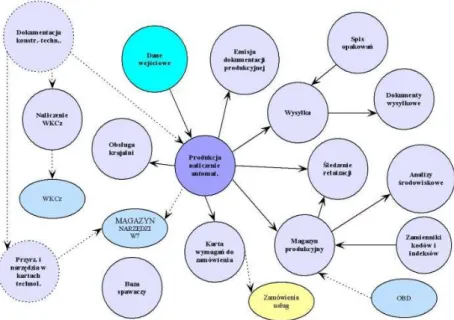
In the first the inventory of the information subsystem of the existing production system was made. It gave the following results:
- the operating IT system was based on the ERP concept,
- it showed gaps, i.e. not all modules and procedures of the standard ERP were existing and were used in the system,
- it consisted of many elements (subsystems), created in different periods and developed in different technologies,
- there were connections between individual subsystems resulting from the flow of
Fig 1. Results the inventory of existing system.
b) The extension of the structure of the information system with a data warehouse Due to the gaps, discontinuities and problems related to the cooperation of subsystems created in different periods, it was decided to
supplement the structure of systems with thematic data warehouses (data marts). The problem, at hand was how to determine the content of this warehouse. In order to solve it, a special procedure was developed.
c) The development of procedures which use the data warehouse content and support the areas of "Integrated Product Development" and "Production Operations" .
5.1 The procedure of extension of the structure of information system with a data warehouse
1. Arrange the starting set of elements 2. Select the starting element
3. Take the next element by the direction of information flow.
4. Are there many consecutive elements ? If „yes” - Pick up the item for which the difference in numbers is the minimum and add it to the set.
5. Calculate α = X / (k+1) X+5
6. Is another element in the set? If “yes” - α =
α +1 ,
7. Is another element in the set? If “no” – go to step 9.
8. Are there many consecutive elements? If „yes” - Pick up the item for which the difference in numbers is the minimum and add it to the set.
9. Select the set with α = min
10. Whether α is equal for several sets? If “yes” - Select the least numerous set among the identified sets.
11. Treat the selected set as one item. Give it a number corresponding to the lowest number among the elements forming it.
12. Calculate the ratio of excellence of the gained solution β = number of elements in the selected set/number of all elements.
13. Go to next step f iteration. k := k+1 . αpk := 0.1αmin
14. Take the next element by the direction of information flow.
15. Are there many consecutive elements? If „yes” - Pick up the item for which the difference in numbers is the minimum and add it to the set.
16. Add the set of extracted in the previous step to the selected set. Treat the new set as one item. Give it a number corresponding to the lowest number among the elements forming it.
17. Locate data warehouse between k-1 and k step or change the process here
the previous step/number of elements in the current step.
19. βk >βki ? If „no” - select the starting element and go back to step 3.
20. Were all possibilities considered? If “yes” – stop. If “no” – go back to step. 6
Where:
α – identifier of the set;
β - number of elements in the selected set/number of all elements;
K – number of iteration;
X – number of elements in the set.
6. CURRENT STATUS OF THE PROJECT
An inventory of the existing IT system was been carried out. The concept of a data warehouse was developed. This concept has been programmed and implemented. Due to worsening situation of the plant, further implementation of the project has been suspended. Studies on the development of agency-based in the areas „Integrated Product Development” and „Production Operations” are still ongoing.
Fig 2. Result of the using of the procedure.
7. SUMMARY
The answers to number of questions, which were formulated in Sections I and II of this article cannot be generalized. The case presented in this article concerns the attempt to transform an existing production system in a company into a cybernetic-physical system. This attempt has not been completed yet. Some limited tasks are still ongoing. In the analyzed case, the physical object with which the cybernetic-physical system was connected, as well as the related IT system were located at the production plant level. A stable system
structure based on the Lee’s model was adopted. A bottom-up strategy was implemented.
8. REFERENCES
1. Bauer A., Bowden R., Browne J., Dugan J., Lyons G., Shop Floor Control Systems. From Design to Implementation., Chapman & Hall, London, 1994.
2. Dagli C. H. (ed.), Artificial Neural
Networks for Intelligent
3. Dagli C. H., Meyyappan L., Swarm Based System of System Behavior
Simulation for Network Centric
Enterprise, Proceedings of 18th
International Conference on Production Research, Salerno, Italy, 2005.
4. Fertsch M., Stachowiak A., Design of
a Smart Production Cell, 24th
International Conference on Production Research (ICPR 2017), DEStech Transaction on Engineering and Technology Research..
5. Gray C.D., Landvater D.V., MRP II
Standard Systems, Oliver Wight
Limited Publications, Essex Junction, Vermont, 1989.
6. Lee Y., Bagheri B., Kao H., A Cyber – Physical Systems architecture for Industry 4.0 – based Manufacturing Systems., Manufacturing Letters 3 (2015).
7. Mayer R.J., Crump J.W., Fernandes R., Keen A., Painter M.K.,
Information Integration for Concurent Engineering. Compendium of Methods Report. Air Force Materiel Command, Wright – Paterson Air Force Base, Ohio, 1995.
8. Scheer A.-W., CIM: Computer Integrated Manufacturing: Toward the Factory of the Future, Springer – Verlag, Berlin – Heidelberg, 3th edition, 1994.
Arhitectura sistemului informațional în sistemul de producție cibernetic-fizică
Rezumat: Lucrarea prezintă problema arhitecturii sistemului informatic într-un sistem de producție cibernetic-fizică. Problema este discutată pe exemplul unei transformări a sistemului de producție specific într-un sistem cibernetic-fizic. Se discută procedura și rezultatele obținute.