INNOVATION IN
HEALTH INFORMATICS
The WHAAM application: a tool to support
the evidence-based practice in the
functional behaviour assessment
Gianluca Merlo
Istituto per le Tecnologie Didattiche, Consiglio Nazionale delle Ricerche, Italy
Giuseppe Chiazzese
Istituto per le Tecnologie Didattiche, Consiglio Nazionale delle Ricerche, Italy
Manuela Sanches-Ferreira
Unit of Support of the Inclusive School, School of Education of the Polytechnic of Porto Institute, Portugal
Antonella Chifari
Istituto per le Tecnologie Didattiche, Consiglio Nazionale delle Ricerche, Italy
Luciano Seta
Istituto per le Tecnologie Didattiche, Consiglio Nazionale delle Ricerche, Italy
Colin McGee
National Attention Deficit Disorder Information and Support Service, UK
Alberto Mirisola
Department of Psychological, Pedagogical and Educational Sciences, University of Palermo, Italy
Isabella Giammusso
Department of Psychological, Pedagogical and Educational Sciences, University of Palermo, Italy
ABSTRACT
Background The most recent computing technologies can promote the application of evidence-based practice (EBP) in the field of applied behaviour analysis (ABA).
Objective The study describes how the use of technology can simplify the appli-cation of EBPs in ABA.
Methods The Web Health Application for ADHD Monitoring (WHAAM) application demonstrates this in the following two case studies. We are monitoring dysfunc-tional behaviours, collecting behavioural data, performing systematic direct obser-vations, creating both visual baseline and intervention charts and evaluating the planned interventions using the TAU-U statistical index.
Results Significant positive changes of children’s problem behaviours are observed and recorded. Both the duration of the previously identified behaviour ‘to get out of bed in time’ (r = −0.79, TAU-U = −0.58, p < 0.05) and the frequency of the behaviour ‘interrupting others’ (r = −0.96, TAU-U = −0.82, p < 0.01) decreased. Conclusions The WHAAM application is an effective tool to support functional behaviour assessments and it is an example of how technology can support prac-titioners by facilitating the application of EBPs and increasing the communication among clinical, educational and family environments.
Keywords:ADHD, behavioural assessment, behavioural interventions, information processing, effect size, eHealth system
Research article
Cite this article: Merlo G, Chiazzese G, Sanches-Ferreira M, Chifari A, Seta L, McGee C,
Mirisola A, Giammusso I. The WHAAM application:
a tool to support the evidence-based practice in the
functional behaviour assessment. J Innov Health
Inform. 2018;25(2):63–70.
http://dx.doi.org/10.14236/jhi.v25i2.919
Copyright © 2018 The Author(s). Published by BCS, The Chartered Institute for IT under Creative Commons license http://creativecommons.org/licenses/by/4.0/
Author address for correspondence:
Gianluca Merlo
Consiglio Nazionale delle Ricerche Istituto per le Tecnologie Didattiche
90146 Palermo, Italy Email: [email protected]
INTRODUCTION
According to Baer et al.1 applied behaviour analysis (ABA)
is the process of systematically applying interventions based upon the principles of learning theory to improve socially significant behaviours to a meaningful degree and to dem -onstrate that the interventions employed are directly respon-sible for the improvement in behaviour. The systematic and rigorous data collection characterising ABA has been associ-ated with technologies in leading positions by facilitating the description and understanding of behaviour patterns and the planning and implementation of behavioural interventions.2
This paper uses the term ‘technology’ with the meaning of computing technologies devoted to assisting evidence-based practice (EBP) of ABA processes. Slocum et al.3 suggest
how the EBP of ABA defined as ‘a decision making pro -cess that integrates (a) the best available evidence with (b) clinical expertise and (c) client values and context’ (p. 44) could become a useful practice for making decision about targeted interventions on individuals. Therefore, the digital gathering of information is a strategic part of supporting the decision-making strategy of professionals in the conceptuali -sation, intervention and evaluation of a case. In this way, the exchanging and gathering of data through information com-munication technologies provides excellent opportunities in the research of ABA. By collecting a larger source of relevant data communications through technological support, it can enhance and improve the application of EBP. The technol-ogy then becomes an experimental tool for making decisions about interventions on individuals as well as an instrument for facilitating and supporting the monitoring of behaviour, the evaluation of the effectiveness of an intervention and the collaborative activities between all stakeholders (teachers, peers and caregivers). The systematic collection of behav-ioural data and the sharing of outcomes (both successes and failures) of the behavioural interventions, behavioural fea-tures and other valuable information delivers evidence for the entire clinical process. Database collection that provides wide access and the free availability of behavioural data also con-tributes to the categories of data as suggested by Ortega and Rodríguez4 as useful for supporting the behavioural clinical
psychology processes. Based on the potential use of technol-ogy to support ABA, this article describes the development and use of the Web Health Application for ADHD Monitoring (WHAAM) to facilitate the application of systematic behav-ioural interventions and the examination of its effectiveness. In particular, the theoretical background underlying the devel -opment of the application will be described as well as two case studies intended to demonstrate its use when support-ing effective behavioural interventions.
THE WHAAM APPLICATION
Theoretical background
The WHAAM application is based on the concepts and meth-ods of functional behavioural assessment (FBA). The FBA is strongly linked to the above-mentioned ABA, bearing in mind
that both are founded on the principle of Skinner’s operant conditioning.5,6 Unlike the first stimulus-response (S-R) pro
-posed by Watson7 at the beginning of behavioural analysis,
the operant conditioning studies the observed human behav-iour and considers the possibilities between antecedent, the behaviour itself, and its consequence. The old S-R model was therefore replaced by a stimulus, response, stimulus (S-R-S) model. According to this new perspective, the rea-sons that a behaviour is maintained can not only be derived from its external form or topography but also by discover-ing the conditions which trigger and maintain it. Carr,8 in a
renowned scientific paper about self-injurious behaviour, pro -posed three general classes of possible functions sustained by behaviour: positive reinforcement, negative reinforcement and sensory or automatic consequences of the behaviour. In the last few decades, these functions have been deeply investigated and some researchers thought to consider new additional functions, such as tangible,9 control10 or access to
stereotypy.11 FBA is defined by Gresham et al.12 as a
collec-tion of methods for gathering informacollec-tion about antecedents, behaviours and consequences in order to determine the rea -son (function) of the behaviour. It differs from experimental functional analysis because it is easily applied in natural set-tings (home, school, etc.), it needs less training to use it and it does not require direct manipulation of dependent variables to identify the main function sustained by a problem behav-iour. The FBA is therefore a descriptive assessment involv-ing indirect and direct observations and the measurement of the target behaviour.13 Questionnaires, rating scales and
interviews are examples of indirect methods because they do not require a direct observation of the target behaviour and third party people, such as relatives or teachers, can admin-ister them. The direct observation of behaviour is instead carried out in a natural setting by descriptive assessments and/or systematic recording. While descriptive methods like antecedent behaviour consequence (ABC) charts and nar -rative recording provide qualitative information about a tar -geted behaviour, identifying the variables that may trigger or maintain it,14 systematic direct observation of behaviour
provides quantitative information about frequency, intensity or duration of a targeted behaviour during a defined time interval. The WHAAM application15,16 is intended to promote
the application of FBA methods to reduce the occurrence of problem behaviours in relation to attention deficit hyperactiv -ity disorder (ADHD) or to replace them with positive ones. According to the Diagnostic and Statistical Manual of Mental Disorders-5,17 ADHD is a persistent pattern of inattention
and/or hyperactivity–impulsivity that interferes with function-ing or development, has symptoms presentfunction-ing in two or more settings, and negatively impacts directly on social, academic or occupational functioning. For instance, children with ADHD are often rejected by peers and few are popular with their peers18,19 and they are at greater risk of substance abuse,
school dropout, delinquency, academic problems and other psychological disorders.20 In the FBA context, the WHAAM
following section, the system’s functions will be described, a case study will be presented highlighting the statistical rel-evance of the behavioural interventions carried out and the satisfaction of the users of the technology will be evaluated.
Overview of the WHAAM application features
Starting from the theoretical background of the FBA, the WHAAM application21 features are inspired by the multimodaltreatment of ADHD. The most common approaches to man-age ADHD symptoms includes behavioural interventions, the involvement of people included in the major settings of life in psycho-educational activities and the analysis of the medical history of the patient. In particular, the WHAAM application provides users with features for creating a network of stake -holders (parents, teachers and caregivers) close to the child with ADHD. This is to promote their collaboration during the whole functional behaviour process using both the web and the mobile sides of the application. The website allows users to sign in using their personal identification to access the fol -lowing features:
• inclusion of data related to a patient (i.e. diagnosis, medical therapy, information about schools attended and crucial life events in his personal history); • invitation of caregivers to become members of the
child’s private network;
• use of instant messaging to promote collaboration and sharing data and information between the network’s member;
• identification and description of a child’s specific behavioural problem (target behaviour) which the network wants to change;
• planning the collection of baseline data; • creating a hypothesis about the main function
sustaining the target behaviour;
• creating an intervention plan, describing in detail the strategies to be applied and who will apply them within the network;
• the evaluation of the effect size of the intervention, applying statistical algorithms.
The mobile application is available for Android operating systems. It provides the following features:
• viewing the case data;
• viewing the target behaviour descriptions;
• access to the observation sessions assigned to the logged user;
• ongoing observation of the targeted behaviour through the recording of the behaviour frequencies or duration;
• collection of qualitative data about the target behaviour through ABC charts.
The WHAAM application supports the FBA process in six steps. The first step is the creation of a child’s record. In order to let the users choose what they want to disclose, the personal information of the child can be omitted, using only a nickname, gender and the date of birth as the required
information. Additional data such as diagnoses, medications, school information and other general events characterizing the child’s life can be added in the section of ‘case data’. This section provides health professionals with information intended to support the understanding of the child target behaviours. According to the Italian Personal Data Protection Code,22 data encryption of personal records and a credentials’
authentication system guarantee the personal data protec-tion from intrusive accesses. During the second step, people who have an important role in the life contexts of the child with ADHD can be invited to become a member of the child’s private networks. Thus, they will become active participants in all the phases of the FBA processes, putting into practice the tasks assigned to them, sharing knowledge and informa -tion. The third step is creating the accurate description of a target behaviour in order to start the functional assessment process. To help with the clarification of a target behaviour in a recognised, measurable way, the WHAAM application pro-vides users with a set of predefined common ADHD behav -iour definitions. It is however possible and helpful to write a specific behavioural definition in an operational, objective and concise way. It needs to be objective and concise because the reader has to have a very clear picture of the specific behaviour they are to observe. The description includes the place and the setting in which the target behaviour occurs. The fourth step is defining the settings for the data collec -tion phases. The WHAAM applica-tion supports an AB single case research design, allowing users to compare baseline and intervention data. AB single-case design generally starts with a baseline (phase A) in order to observe the dependent variable as it appears. Once the baseline is established, the observation continues while implementing the intervention (phase B) in order to compare the two time series and testing the hypothesised change. The fifth step is collecting quantita -tive and qualita-tive data using the WHAAM mobile app. The user, who plays the role of observer, gathers the frequency or the duration of a targeted behaviour according to the agreed data collection settings. Every member of the child’s network can contribute qualitative data of a behaviour by filling in ABC charts. Data collected during this step is available to the child’s network directly through the WHAAM web application. Health professionals analyse all the gathered observations to formulate a hypothesis about the main function that is sus-taining the target behaviour and then to create an intervention plan intended to reduce or eliminate the inappropriate behav-iour. The intervention plan consists of a set of behavioural strategies defined by health professionals and assigned to specific members of the child’s network. During the interven -tion phase, new data are collected for further comparisons. The final step is in the evaluation of intervention. Health pro -fessionals can produce a visual analysis of the gathered data accessing the scatter plots representing the observation ses-sions. Moreover, the Parker et al.23 TAU-U test is
between phases and the trend change in phase B. This effect is estimated controlling the natural trend of phase A. The use of Kendall TAU permits us to estimate the phases mono-tonicity without assuming any trend function (e.g. linear). TAU-U showed to be a robust statistic with autocorrelated data overcoming some limitations of other nonoverlap tech-niques. The formula r = sin (0.5 πτ) is used to convert TAU-U in Pearson’s r effect size index.24 Following Cohen,25
abso-lute value of r between 0 and 0.09, 0.10 and 0.29, 0.30 and 0.49 and greater or equal to 0.50 is evidence of a null, small, medium and large effect size, respectively.
The WHAAM application has been extensively tested in Italy, Portugal and United Kingdom during its development. The next section will describe the methodological constraints surrounding the use of the WHAAM application and two illus-trative case studies supported by it.
CASE STUDIES
Introducing the case: methodological
considerations
The development of the WHAAM application adopted a user-centred design process including the final users from the early stages of developing and prototyping to the real context use of the application in a pilot test across Europe. As men-tioned in the previous section, the WHAAM application involves many different user strategies in the management of unwanted behaviours of children with ADHD. In the process of manage-ment, each role has different duties and responsibilities and takes advantage of a subset of the features provided by the application. In order to get the best possible results in the FBA process using the new technology, users need to be aware of both the theoretical and methodological assumptions behind the FBA and the opportunities offered by the technology. For these reasons, the authors included a psycho educational content in the application and provides an integrated training course for teachers, health professionals and parents of chil-dren with ADHD. As underlined by Sanches-Ferreira et al.26
‘the integrated model of training aims to promote community-based interventions in which every element of the school-fam-ily system has a key role in the identification and management of pupils’ problematic behaviours’ (p. 22). The training courses focused on three main learning outcomes: the comprehension of the FBA principles, the understanding of a set of specific behavioural techniques and the use of the WHAAM applica -tion to support the behavioural assessment and interven-tion on children’s undesired behaviours. The cases of Matteo and Anthony, which are described in detail in the next paragraphs, were examined during training courses held in Italy and in Portugal. It is worth noting that the names of children and some identifying details have been changed to protect the privacy of individuals. The authors measured the trainees’ thoughts on the usefulness of training, the usability and the overall satisfac-tion associated to the use of the WHAAM applicasatisfac-tion during the training courses. In general, the course was considered substantial, while the application was seen as useful and easy to be use.27
Matteo’s case
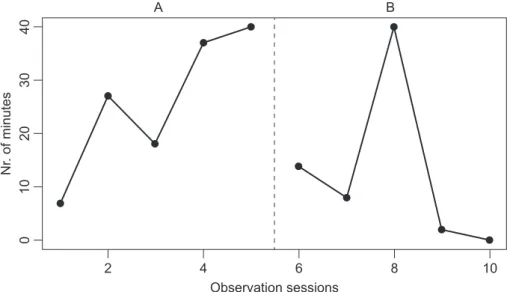
Matteo is 17 and lives with his family, has one brother aged 22 and one sister aged 23. He attends an Italian secondary school. His mother is employed in a financial loans agency and his father is an employee of the Ministry of the Interior. The fam-ily is characterised by high internal conflict and dynamics of manipulation by the father. Matteo received the first diagnosis of ADHD when he was 11 years old and he is currently being treated with methylphenidate. By the time he was diagnosed, he already had a history of serious scholastic difficulties due to being oppositional toward teachers. He often misses instruc-tions given by them and engages in significant off-task behav -iour for most subjects, except math and physical education – in which he excels. Parents are very worried because Matteo is struggling daily with his schoolwork: he is disorganised when planning activities and he usually goes to school unprepared and for this reason collects many negative marks. He appears to be having problems making and keeping friends, especially in the school context. This is because his classmates consider him a preferred student and they cannot stand the fact that the professors never question him as they have an understanding of his condition. Matteo will graduate next year and has never received special education help or an individualised education program. Matteo has never been allowed to fail an assess-ment, according to his parents who think that teachers prefer not to deal with Matteo’s negative behaviours. The behaviour analysed with the support of the WHAAM application is his dif-ficulty to get out of bed in time to go to school. His mother tries to wake up him initially at 06.50 am. Despite her many sub-sequent attempts, Matteo ignores her and continues to stay in bed. As a consequence of this, he is often so late that he skips the first hour of classes at school or the school day. In order to identify the function of Matteo’s behaviour, the health professional planned a ‘baseline phase’ in which quantitative data were gathered through five, 40-minute observation ses -sions taken by the mother using a duration recording system. In the baseline, the mean time needed by Matteo to get out of bed was 25.8 minutes [standard deviation (SD) = 13.62] with a range from 7 to 40 and a strong increasing trend (r = 0.95). After a clinical interview with the parents (indirect assessment) and from the analysis of collected baseline data, the health professional hypothesised that the primary function of the Matteo’s challenging behaviour was to escape school; sec -ond, it was gaining his mother’s attention. Starting from this assessment data, the intervention was aimed to help Matteo in overcoming his difficulty to get-out-of-bed. The intervention was outlined with parents using the following strategies:
• Negative reinforcement: an alarm clock was placed away from Matteo in order to train him to get out of bed. The clock rang every 5 minutes after the planned wake up time. In this procedure, the individual is motivated to exhibit a desired behaviour to avoid the aversive stimuli (the shrill sound of the alarm clock). • Extinction: being that Matteo’s behaviour is
invited the mother to eliminate the connection between the problem behaviour (get-out-of-bed) and the positive reinforcement (mother’s attention). • Plan a positive reinforcement program by means
of a token economy procedure: a paperboard football was given to Matteo every time he got out of bed by himself. Matteo’s participation in a football tournament was linked to the achievement of gaining 10 paperboard Footballs.
Once the intervention was defined, a new phase of sys -tematic observation started with the same modalities and observer of the baseline. Five new observation sessions were carried out. During the intervention, the mean time employed by Matteo to get out of bed was 12.8 minutes (SD = 16.16), with a range from 0 to 40 and a strong decreas -ing trend (r = −0.81). Based on the data obtained during both the baseline and the intervention (Figure 1), the treatment had a strong effect on the decrease of the duration of the behaviour (r = −0.79, TAU-U = −0.58, p < 0.05).
Matteo’s noncompliance and lack of independence in get -ting ready in the morning and going to school was tackled actively involving his own parents. According to the interven-tion approach suggested by Kearney et al.28 the key com
-ponents of the parent training were (a) restructuring parent commands to clearer, simpler and more direct ways of giving instructions, (b) establishing a set of routines for the early part of the day and throughout the day, (c) negotiate rewards for compliance and school attendance and punishments for noncompliance and school refusal behaviour and (d) forced the school attendance under certain condition.
Anthony’s case
Anthony is a 9-year-old boy and the only child of a two-parent family. He is enrolled in the third grade of a local elemen-tary school, in which he attends a special education program. Since the first grade, he has been identified as performing below expected academic achievements. Along with the diagnosis of ADHD, at the age of 7, he was referred to spe -cial education services in the second grade. The restrictions
of following the educational curriculum were mainly identi-fied as difficulties of concentrating his attention, understand -ing instructions and controll-ing his psychomotor activity. The inattentiveness and hyperactivity behaviours were also seen at home, not finishing the home chores and engaging in dan -gerous activities – engaging in excessively rough play. In the last assessment, it also showed him as having dyspraxia, having difficulties in planning complex sequence of move -ments. Currently, he is medicated with methylphenidate and improvements were reported in his concentration, his atten-tion and remaining in his seat during classes. Nevertheless, teachers and parents still had great concerns with his lack of social relationships. Peers start to reject him for not fol -lowing the rules of play – not waiting his turn – and seeking excessive physical contact (pushing and hugging tightly the others). At home, the interaction with his parents was also challenging, always seeking their attention by interrupting their conversations or tasks. Parents react differently to his problematic behaviour – the father strongly reprimands him and the mother makes light of his behaviour and gives him lots of attention – this is a source of constant conflict in the house. The problematic behaviour to be monitored by the par-ents using the WHAAM application was Anthony interrupting their conversation and making irrelevant and repetitive com -ments during a mealtime. When confronted with Anthony’s excessive and repetitive talk, parents ask him to stop and sometimes they leave the table. That behaviour tends to be even more noticeable when they have guests for dinner. As a consequence of this, there is often a lack of dialogue between parents during the mealtime (directing their full attention at Anthony) or a discussion between them on each other reac-tions to Anthony’s behaviour. Together with a health profes -sional, it was decided to collect a baseline of data, where the father registered the frequency of Anthony’s interruptions of their conversation or when he engages in repetitive and excessive talk at the dinner table. Observation sessions of 25 minutes were collected. Additionally, in order to gain a com-plete pattern of the problematic behaviour a brief description of the antecedent and consequent events was collected for
4 6
Observation sessions
8 10
2
01
02
0
Nr
. of minute
s 30
40
A B
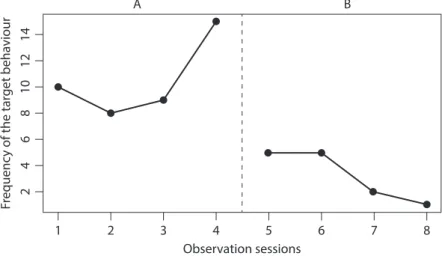
the application. The average of the occurrence of the target behaviour during the four baseline sessions was of 10.5 (SD = 3.10), with a range from 2 to 15 and a substantial increasing trend (r = 0.50, Figure 2). From the analysis of the frequen -cies graph of and the ABC descriptions, it was hypothesised that the main function of Anthony’s behaviour was to seek social attention. Using this interpretation, the intervention was outlined with parents using the following strategies:
• Establish rules: both before and during the dinner. Anthony was reminded that he should ask permission to talk. The use of a ‘talking object’ (an object to passes between each family member and is used as a way of identifying who has permission to talk at that moment).
• Reinforce appropriate behaviour: a period of time was identified to play family games such as board games and/or storytelling, every time Anthony followed the rules.
• Ignore inappropriate behaviour: when Anthony interrupts anybody that holds the talking object and/or makes repetitive comments, the parents were instructed to keep the conversation going without looking to Anthony.
Starting with the implementation of these parent strategies, they collected data relative to the intervention phase. Four new observations were executed. At this period, the aver-age of the occurrence of the target behaviour was of 3.25 (SD = 2.06), with a range from 1 to 5 and a strong decreasing trend (r = −0.97). As shown in Figure 2, there was a strong effect of the intervention successfully decreasing the fre-quency of the behaviour (r = −0.96, TAU-U = −0.82, p < 0.01).
LIMITATIONS
The WHAAM application is one of the first web-based sys -tems that aim to replicate digitally the complexity of the main processes related to the FBA. Many other systems for behavioural assessment were developed in the last few years.29 While these applications generally provide users
with just one feature such as counters, behavioural charts,
video recording, the WHAAM application has been designed to support the whole FBA process from the definition of the target behaviour to the evaluation of the efficacy of the behav -ioural interventions carried out. Moreover, the WHAAM appli-cation also includes features designed to bring together the child’s stakeholders and to promote their cooperative work. As can be easily imagined, being a pioneer, the WHAAM application still has important limitations. One of the most important is attributable to the possibility to implement only AB single case research designs. Starting from data gath-ered in the AB design, practitioners cannot draw conclusions about what happened to the target behaviour during the two observed phases relying solely on the data collected. What would be the natural trend of the behaviour over time? Has the treatment really modified the trend or are the observed changes related to some unknown environmental event? In the described cases of Matteo and Anthony, authors main-tained good relations with the children’s health professionals and caregivers so as to verify that the changes observed in the children were long lasting. Future releases of the appli-cation might explore the opportunity of implementing more powerful design than the AB such as ABA, ABAB, or multi-element designs. At this moment, the WHAAM application can be used to gather more data of a simple AB design, but the results are aggregated only for two phases at a time. A more general limitation application of single case designs is the difficulty to gather the necessary four to five data points in each phase to calculate the effect-size of the intervention. As observed by Hser et al.29 this is one of the reasons why
single-case experimental designs are still almost rare. The threshold to the calculation of the TAU-U in the WHAAM application is four observations per phase. But for ethical reasons, health professionals cannot wait long before taking action when they have to face, for instance, self-injurious or aggressive behaviours.
CONCLUSIONS
The use of FBA has been widely recognised as a best prac-tice approach in developing effective intervention plans for children with challenging behaviours, while identifying how
Figure 2 Comparison of the data gathered for the Anthony’s behaviour ‘interrupting others’ during the baseline (A) and intervention (B) phases
1
24
6
Fr
equenc
y of the target behaviour
81
01
21
4
2 3
A B
4
Observation sessions
the environment plays a determinant role in strengthening or weakening problematic behaviours,30 described as a symptom
of hyperactive–impulsive and distracted behaviours. These are triggered from negative reinforcing environmental stimuli and are maintained by a number of functions. The treatment of ADHD symptoms benefits from a multimodal approach. This includes behavioural interventions along with parent/teachers training programs. This can be used independently or in combi-nation with medications.31 Technology has been plays a
promi-nent role in enhancing the implementation of EBP, this paper offers the web application WHAAM as a tool that supports both a comprehensive approach in the assessment and interven-tion over challenging behaviours and the recording and moni-toring of child–environment interactions. Indeed, anchored in FBA principles, the WHAAM provides a set of potentialities that facilitate a successful implementation of behavioural interven-tions, supporting
• a systematic and rigorous data collection by allowing a real-time recording of the behaviour and the surrounding circumstances through the use of mobile devices;
• the identification of behavioural patterns, integrating data describing the behavioural definition
(including contextual and setting features), the rate of occurrence (frequency and/or duration) and environmental circumstances (antecedents and consequences);
• a consistent application of behavioural strategies, promoting better communication between people
who are significant to the ADHD child in different life contexts, and bringing together the key persons from family and school;
• an evaluation of the effectiveness of the applied treatments, by calculating the Parker et al.23 TAU-U
statistical indices on the behavioural data gathered by the child network members.
As such, the possibilities credited to the WHAAM appli-cation seem to deliver supportive factors for facilitating the praxis of FBA, and fosters collaborative relationships. However, it is important to note that as highlighted in previous studies,26 the accomplishment of the possibilities depends on
the continued existence of supportive factors. The training on FBA principles and the correct use of the WHAAM application are important. It uses active learning methodologies, built on both parents and teachers’ experiences and beliefs. This will play a central role on the effectiveness of the behavioural interventions using this innovative application. Tools such as WHAAM can promote the introduction of the EBP into natural settings such as school and family. The use of such tools for the child can also encourage stakeholders to increase their knowledge, skills and competences through a continuous lifelong learning process. Mobile devices and wearable tech-nology open new perspectives in the design of human behav-iour monitoring systems. They will be able to display personal data of individuals which could be helpful to facilitate the self-regulation of their behaviour. Finally, this kind of technology might have a crucial role in increasing the positive communi-cation among clinical, educommuni-cational and family contexts.
REFERENCES
1. Baer DM, Wolf MM and Risley TR. Some current dimensions of
applied behavior analysis 1. Journal of applied behavior analy-sis 1968;1(1):91–7. Available from: https://doi.org/10.1901/ jaba.1968.1-91. PMid: 16795165; PMCid: PMC1310980.
2. Cohen E and Rozenblat R. Applied, behavioral, analytic and. technological: a current literature review on the use of technolo-gies in behavior analysis. European Journal of Behavior Analysis 2015;16(2):178–87. Available from: https://doi.org/10.1080/1502 1149.2015.1085720.
3. Slocum TA, Detrich R, Wilczynski SM, Spencer TD, Lewis
T and Wolfe K. The evidence-based practice of applied behavior analysis. The Behavior Analyst 2014;37(1):41–56. Available from: https://doi.org/10.1007/s40614-014-0005-2. PMid: 27274958; PMCid: PMC4883454.
4. Ortega JV and Rodríguez RM. Guidelines for clinical case
reports in behavioral clinical psychology. International Journal of Clinical and Health Psychology 2008;8(3):765–77.
5. Skinner BF. Science and Human Behavior. New York: Simon and Schuster, 1953.
6. Skinner BF. Operant behavior. American Psychologist 1963; 18(8):503. Available from: https://doi.org/10.1037/h0045185.
7. Watson JB. Psychology as the behaviorist views it. Psychological Review 1913;20(2):158. Available from: https://doi.org/10.1037/ h0074428.
8. Carr EG. The motivation of self-injurious behavior: a review
of some hypotheses. Psychological Bulletin 1977;84(4):800. Available from: https://doi.org/10.1037/0033-2909.84.4.800. PMid: 331382.
9. Mace FC and West BJ. Analysis of demand conditions associ-ated with reluctant speech. Journal of Behavior Therapy and Experimental Psychiatry 1986;17(4):285–94. Available from: https://doi.org/10.1016/0005-7916(86)90065-0.
10. Bowman LG, Fisher WW, Thompson RH and Piazza CC. On the
relation of mands and the function of destructive behavior. Journal of Applied Behavior Analysis 1997;30(2):251–65. Available from: https://doi.org/10.1901/jaba.1997.30-251. PMid: 9210305; PMCid: PMC1284044.
11. Fisher WW, Lindauer SE, Alterson CJ and Thompson RH.
Assessment and treatment of destructive behavior maintained
12. Gresham FM, Watson TS and Skinner CH. Functional behav -ioral assessment: principles, procedures, and future direction.
School Psychology Review 2001;30(2):156.
13. Hanley GP. Functional assessment of problem behavior: dispel -ling myths, overcoming implementation obstacles, and develop-ing new lore. Behavior Analysis in Practice 2012;5(1):54–72. Available from: https://doi.org/10.1007/BF03391818. PMid: 23326630; PMCid: PMC3546636.
14. Bijou SW, Peterson RF and Ault MH. A method to integrate descriptive and experimental field studies at the level of
data and empirical concepts. Journal of Applied Behaviour Analysis 1968;1(2):175. Available from: https://doi.org/10.1901/ jaba.1968.1-175. PMid: 16795175; PMCid: PMC1310995.
15. Merlo G, Chiazzese G, Di Giuseppe O and Spachos D. Monitoring
behaviour at school and in the family: the WHAAM application.
TD Tecnologie Didattiche 2016;24(1):47–51.
16. Spachos D, Chifari A, Chiazzese G, Merlo G, Doherty G and Bamidis P. WHAAM: a mobile application for ubiquitous monitoring
of ADHD behaviors. 2014 International Conference onInteractive mobile communication technologies and learning (iMCL),
IEEE, 2014, 305–9. Available from: https://doi.org/10.1109/ IMCTL.2014.7011153.
17. American Psychiatric Association. Diagnostic and Statistical Manual of Mental Disorders (dSM-5), 5th edition. Washington, DC: Author, 2013.
18. Hoza B, Mrug S, Gerdes AC, Hinshaw SP, Bukowski WM, Gold JA, et al. What aspects of peer relationships are impaired in children
with attention-deficit/hyperactivity disorder? Journal of Consulting and Clinical Psychology 2005;73(3):411. Available from: https:// doi.org/10.1037/0022-006X.73.3.411. PMid: 15982139.
19. Pelham WE Jr and Fabiano GA. Evidence-based psychosocial treatments for attention-deficit/hyperactivity disorder. Journal of Clinical Child & Adolescent Psychology 2008;37(1):184–214. Available from: https://doi.org/10.1080/15374410701818681. PMid: 18444058.
20. Bagwell CL, Schmidt ME, Newcomb AF and Bukowski WM. Friendship and peer rejection as predictors of adult adjust -ment. New Directions for Child and Adolescent Development 2001;2001(91):25. Available from: https://doi.org/10.1002/cd.4. PMid: 11280012.
21. Alves S, Bamidis P, Bilbow A, Chiazzese G, Chifari A,
Denaro P, et al. In Chifari A (Ed.), WHAAM: A New Online Service Supporting Parents and Teachers of Children with ADHD. London, UK; Thessaloniki, Greece: ADDISS, 2015.
22. Data Protection Code – Legislative Decree no. 196/2003, 1 January 2004. Available from: http://194.242.234.211/docu
-ments/10160/2012405/Personal+Data+Protection+Code+-+Le gislat.+Decree+no.196+of+30+June+2003.pdf.
23. Parker RI, Vannest KJ, Davis JL and Sauber SB. Combining
nonoverlap and trend for single-case research: Tau-u.
Behavior Therapy 2011;42(2)284–99. Available from: https:// doi.org/10.1016/j.beth.2010.08.006. PMid: 21496513.
24. Walker DA. JMASM9: converting Kendall’s tau for correlational
or meta-analytic analyses. Journal of Modern Applied Statistical Methods 2003;2(2):26. Available from: https://doi.org/10.22237/ jmasm/1067646360.
25. Cohen J. Statistical Power Analysis for the Behavioral Sciences.
Hilsdale, NJ: Lawrence Earlbaum Associates, 1988. Available from: https://doi.org/10.1002/bs.3830330104.
26. Sanches-Ferreira M, Chifari A, Silveira-Maia M, Chiazzese G and
Santos M. A model for training parents and teachers of children with special needs. TD Tecnologie Didattiche 2016;24(1):20–8.
27. Kearney CA, LaSota MT, Lemos-Miller A and Vecchio J.
Parent training in the treatment of school refusal behavior. In: Briesmeister JM and Schaefer CE (Eds.), Handbook of Parent Training: Helping Parents Prevent and Solve Problem Behaviors, 3rd edition. Hoboken, NJ: John Wiley & Sons Inc, 2007, pp. 164–93.
28. Alves S, Bamidis P, Bilbow A, Callahan A, Chiazzese G,
Chifari A, et al. WHAAM Context Driven Framework. Palermo:
Istituto per le Tecnologie didattiche (CNR), 2014.
29. Hser Y-I, Shen H, Chou C-P, Messer SC and Anglin MD. Analytic approaches for assessing long-term treatment
effects examples of empirical applications and findings. Evaluation Review 2001;25(2):233–62. Available from: https:// doi.org/10.1177/0193841X0102500206. PMid: 11317718.
30. Pelham WE Jr, Fabiano GA and Massetti GM. Evidence-based assessment of attention deficit hyperactivity disorder in chil -dren and adolescents. Journal of Clinical Child and Adolescent Psychology 2005;34(3):449–76. Available from: https://doi. org/10.1207/s15374424jccp3403_5. PMid: 16026214.
31. Ferguson JH. National institutes of health consensus development
conference statement: diagnosis and treatment of attention-deficit/