ORIGINAL RESEARCH ARTICLE
Association of Partner Support and Partner Communication with
Provider
Prescribed
Contraceptive
Method
Use
among
Heterosexual Couples in Kisumu, Kenya
DOI: 10.29063/ajrh2020/v24i2.4
Virginia Mason
1*, Fredrick Otieno
2, Finch Odhiambo
2, Olivia R. Sappenfield
1, Supriya D.
Mehta
1University of Illinois at Chicago School of Public Health, Chicago, Illinois, USA1,; Nyanza Reproductive Health Society, Kisumu, Kenya2
*For Correspondence: Email: [email protected]; Phone: 312-413-7485
Abstract
We explored partner support and communication factors associated with provider prescribed contraceptive (PPC) use to inform contraception interventions among heterosexual couples in Kenya. From April 2014 through September 2016, 252 community recruited couples in Kisumu, Kenya, were enrolled. Men and women were surveyed separately and asked about communication regarding sexual/reproductive health and relationship characteristics. PPC use was defined as female reported use of pills, injection, implant, IUD, or tubal ligation. Multivariable Poisson regression with robust variance estimate was used to identify factors associated with PPC. In multivariable modeling, women who reported discussing the future of their relationship with their partner were 2.46 (95% CI: 1.13-5.36) times more likely, and men who reported discussing condom use were 0.83 (95% CI: 0.72-0.95) time less likely, to report PPC use. These findings call for greater attention to involving male partners, incorporating communication skills, and relationship characteristics into interventions in our and similar settings. (Afr J Reprod Health 2020; 24[2]: 40-47).
Keywords: Family planning, male involvement, reproductive health, agency, Africa
Résumé
Nous avons exploré le soutien des partenaires et les facteurs de communication associés à l'utilisation de contraceptifs pres crits par le fournisseur (PPC) pour informer les interventions de contraception auprès des couples hétérosexuels au Kenya. D'avril 2014 à septembre 2016, 252 couples recrutés par la communauté à Kisumu, au Kenya, étaient inscrits. Les hommes et les femmes ont été interrogés séparément et interrogés sur la communication concernant la santé sexuelle / reproductive et les caractéristiques des relations. L'utilisation du CPP a été définie comme l'utilisation déclarée par les femmes de pilules, d'injection, d'impl ant, de DIU ou de ligature des trompes. Une régression de Poisson multivariable avec une estimation de variance robuste a été utilisée pour identifier les facteurs associés au CPP. Dans la modélisation multivariable, les femmes qui ont déclaré discuter de l'avenir de leur relation avec leur partenaire étaient 2,46 (IC à 95%: 1,13-5,36) fois plus susceptibles, et les hommes qui ont déclaré discuter de l'utilisation du préservatif étaient 0,83 (IC à 95%: 0,72-0,95). Moins susceptibles de signaler l'utilisation du PPC. Ces résultats appellent à une plus grande attention à l'implication des partenaires masculins, à l'intégration des compétences en communication et des caractéristiques relationnelles dans les interventions dans notre environnement et dans des environnements similaires. (Afr J Reprod Health 2020; 24[2]:40-47).
Mots-clés: Planification familiale, implication masculine, santé reproductive, agence, Afrique
Introduction
Nationally, Kenya has increased the use of modern contraceptives to 59% as of 2018 and seeks to raise this to 66% by 20301. However, the use of modern contraceptives varies from 2% to 80% across
are partner support and partner communication regarding contraceptive methods and use2.
Several studies have shown that male partner support of contraceptive use increases the likelihood of a woman using contraception. Nii-Amoo Dodoo analyzed data from the Kenya Demographic and Health Surveys (DHS) from 1989 to 1993 to better understand the relationship between contraceptive use and male partner attitudes toward contraception3. Among over 2,000 couples, in both survey rounds (1989 and 1993), Dodoo observed that the odds of contraceptive use was more than 9 times greater when there was joint preference to stop having children (as compared to both wanting a child within two years)3. Further, evidencing the ―male advantage‖, if the woman wanted to stop having children but the husband wanted a child, contraceptive use was significantly less likely (odds ratio [OR]=0.15)3. In a cross-sectional study of nearly 2,500 pregnant Nigerian women and their male partners, male partner awareness of contraception was associated with three times greater odds of desire to use contraception by women4. Finally, in a cross-sectional survey of 869 married Ethiopian women, Mohammed et al. observed that if a husband approved of contraceptive use, a wife was three times more likely to use it5. These studies illustrate the effect partner support has on female partners‘ likelihood of using contraception.
Additionally, communication with male partners plays a role in women‘s contraceptive use. In a random sample of 1,825 reproductive aged Angolan women, current use of modern contraceptive methods was increased if the male partner approved of using family planning (OR= 2.93), and male partner approval was twice as likely among women who reported talking to their partner about family planning in the past year compared to those who reported never discussing family planning in the past year6. In a study by Mohammad et al., contraceptive use was 4.50 times more likely among couples who had discussed contraceptive use once and 7.32 times more likely if discussed more than three times compared to couples who had not discussed contraceptive use at all5. Yadav et al. argue that to improve validity of information obtained regarding family planning the woman and man must have
their responses collected separately7. The discordance from the couple‘s answers creates a need for separate collection and to analyze the level of discordance in respect to the level of influence of a man‘s perspective on a woman‘s actions8. By linking the partner data, a study may show the influence a partner has while also capturing the discordance in the answers.
A potential limitation of studies to date is that partner communication and partner support in relation to contraceptive use have not been assessed in the broader context of the relationship. The literature points out that both of these can play a key role, but data evaluating women‘s and male partner‘s reported communication and discordance on broader relationship topics and general partner support in relation to contraceptive use are sparse in the published literature. The objective of this study was to estimate the association between general partner support and partner communication related to multiple relationship aspects, in relation to provider prescribed contraceptive use among heterosexual couples in Kisumu, Kenya.
Methods
Setting and design
This study took place in Kisumu, Kenya. Kisumu is the third largest city in Kenya, located adjacent to Lake Victoria. According to the 2014 Kenya DHS, in Kisumu County over 200 healthcare facilities provide contraceptives9. The main provider prescribed contraceptives (PPC) used across Kenya are: injectable (47.9%), implants (18.2%), pill (14.1%), intrauterine device (IUD) (5.9%), and female sterilization (5.6%) 10.
sexual relationship for at least 6 months. Men were eligible if they were 18 to 35 years old, and women were eligible if they were aged 16 years or older. Each member of the couple received 400 Kenyan shillings (roughly 4 USD) for time and travel for the study visit. Ethical approval for this study was received from Maseno University Ethical Review Committee and University of Illinois at Chicago.
Data collected
After obtaining informed consent, each member of the couple was interviewed by a researcher of the same sex in a private room and was assured confidentiality that their answers to questions would not be shared with their partner. In addition to demographic information, each woman was asked a series of questions regarding her method of contraceptive use. Women were also asked if they were currently pregnant or trying to get pregnant. Additionally, to measure relationship communication more broadly, each participant was asked a series of questions regarding topics discussed with their current partner in the past 6 months, with response options of ―yes‖ and ―no‖. The list of items discussed included family planning, pregnancy prevention, and contraceptive use as separate topics.
We assessed partner support as a general measure of the relationship, through an eight question scale. The eight questions included: partner helps with chores, partner provides assistance, partner gives good advice, partner shows appreciation, partner fails to keep promises, partner cheers me, can confide in partner, partner gives unwanted criticism, and partner has let me down. Response categories for partner support were strongly agree/agree/ don‘t know/not sure, disagree/ or strongly disagree.
Pre specified outcomes
The outcome for this analysis was the use of PPC. Use of PPC was defined as woman‘s reported use of: birth control pills, injection, implant, intrauterine device (IUD), and tubal ligation (patch and ring were not reported by any participants). Non-use of PPC was defined as: use of condoms, abstinence, calendar/rhythm method, or no contraception use.
Sample size
The study recruited 252 heterosexual couples to achieve the sample size necessary for the primary analysis11. After removing women who reported being pregnant or trying to become pregnant (as these women would not be utilizing provider prescribed contraceptives); our sample for analysis included 163 couples.
Statistical analysis
We compared the distribution of categorical explanatory variables by whether the woman reported PPC with a chi-square test. None of the variables associated with PPC (p<0.10) were collinear. All variables that were statistically significant at the p<0.10 level were entered in the multivariable modeling. We conducted a Poisson regression with robust variance estimate to determine exposures and covariates associated with PPC. We performed a backward stepwise regression to determine the final model, retaining variables that had p<0.10. We chose p<0.10 for increased sensitivity to detection of potentially important variables, and report 95% confidence intervals (CI). Data analysis was conducted in SPSS version 24.
Patient and public involvement
We piloted the survey with several male and female community members followed by in-depth interviews to determine appropriate wording of questions, how well questions were understood, and whether modifications were needed11. Participants were recruited by peer recruiters11. Results of this analysis have been disseminated throughout the local Kenyan non-governmental organization leading the implementation and other local health care providers.
Results
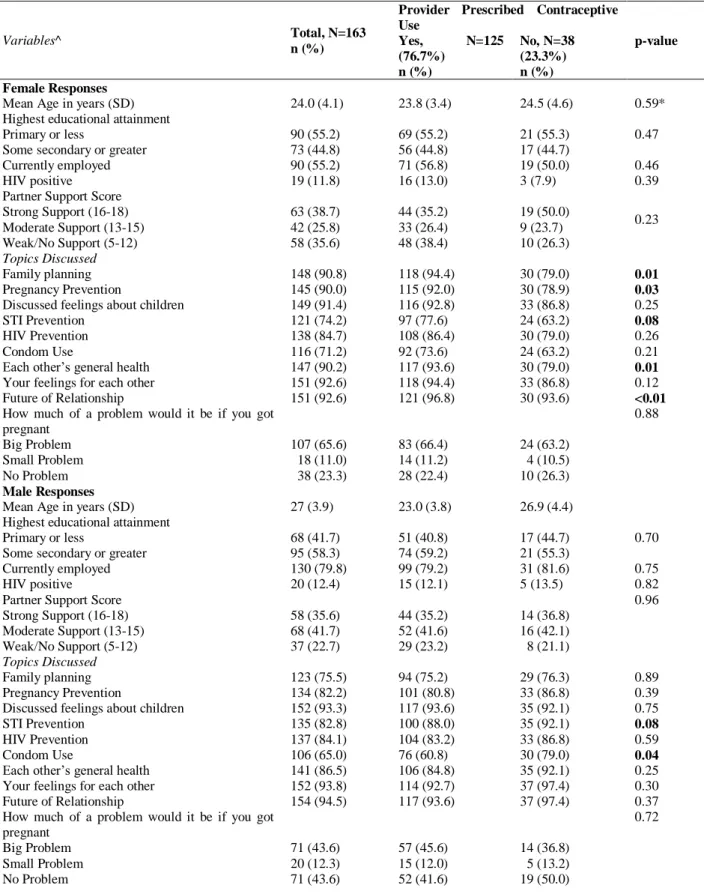
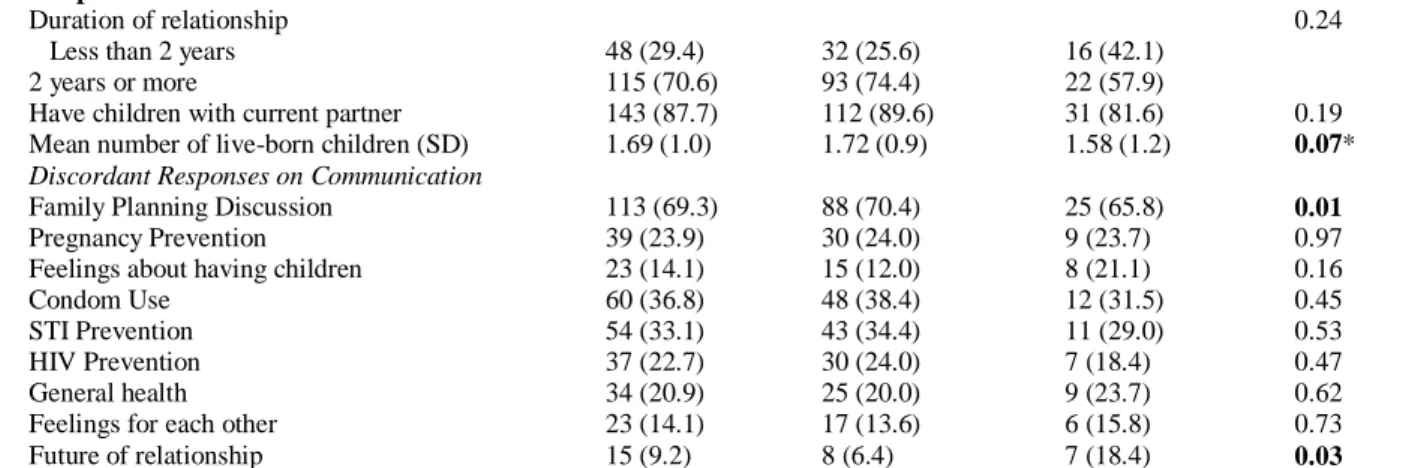
Table 1: Study Sample Characteristics, Compared by Women‘s Reported Use of Provider Prescribed Contraceptive Use
Variables^ Total, N=163
n (%)
Provider Prescribed Contraceptive Use
p-value Yes, N=125
(76.7%) n (%)
No, N=38 (23.3%) n (%) Female Responses
Mean Age in years (SD) 24.0 (4.1) 23.8 (3.4) 24.5 (4.6) 0.59*
Highest educational attainment Primary or less
Some secondary or greater
90 (55.2) 73 (44.8)
69 (55.2) 56 (44.8)
21 (55.3) 17 (44.7)
0.47
Currently employed 90 (55.2) 71 (56.8) 19 (50.0) 0.46
HIV positive 19 (11.8) 16 (13.0) 3 (7.9) 0.39
Partner Support Score Strong Support (16-18) Moderate Support (13-15) Weak/No Support (5-12)
63 (38.7) 42 (25.8) 58 (35.6)
44 (35.2) 33 (26.4) 48 (38.4)
19 (50.0) 9 (23.7) 10 (26.3)
0.23
Topics Discussed
Family planning 148 (90.8) 118 (94.4) 30 (79.0) 0.01
Pregnancy Prevention 145 (90.0) 115 (92.0) 30 (78.9) 0.03
Discussed feelings about children 149 (91.4) 116 (92.8) 33 (86.8) 0.25
STI Prevention 121 (74.2) 97 (77.6) 24 (63.2) 0.08
HIV Prevention 138 (84.7) 108 (86.4) 30 (79.0) 0.26
Condom Use 116 (71.2) 92 (73.6) 24 (63.2) 0.21
Each other‘s general health 147 (90.2) 117 (93.6) 30 (79.0) 0.01
Your feelings for each other 151 (92.6) 118 (94.4) 33 (86.8) 0.12
Future of Relationship 151 (92.6) 121 (96.8) 30 (93.6) <0.01
How much of a problem would it be if you got pregnant
0.88
Big Problem 107 (65.6) 83 (66.4) 24 (63.2)
Small Problem 18 (11.0) 14 (11.2) 4 (10.5)
No Problem 38 (23.3) 28 (22.4) 10 (26.3)
Male Responses
Mean Age in years (SD) 27 (3.9) 23.0 (3.8) 26.9 (4.4)
Highest educational attainment Primary or less
Some secondary or greater
68 (41.7) 95 (58.3)
51 (40.8) 74 (59.2)
17 (44.7) 21 (55.3)
0.70
Currently employed 130 (79.8) 99 (79.2) 31 (81.6) 0.75
HIV positive 20 (12.4) 15 (12.1) 5 (13.5) 0.82
Partner Support Score Strong Support (16-18) Moderate Support (13-15) Weak/No Support (5-12)
58 (35.6) 68 (41.7) 37 (22.7)
44 (35.2) 52 (41.6) 29 (23.2)
14 (36.8) 16 (42.1) 8 (21.1)
0.96
Topics Discussed
Family planning 123 (75.5) 94 (75.2) 29 (76.3) 0.89
Pregnancy Prevention 134 (82.2) 101 (80.8) 33 (86.8) 0.39
Discussed feelings about children 152 (93.3) 117 (93.6) 35 (92.1) 0.75
STI Prevention 135 (82.8) 100 (88.0) 35 (92.1) 0.08
HIV Prevention 137 (84.1) 104 (83.2) 33 (86.8) 0.59
Condom Use 106 (65.0) 76 (60.8) 30 (79.0) 0.04
Each other‘s general health 141 (86.5) 106 (84.8) 35 (92.1) 0.25
Your feelings for each other 152 (93.8) 114 (92.7) 37 (97.4) 0.30
Future of Relationship 154 (94.5) 117 (93.6) 37 (97.4) 0.37
How much of a problem would it be if you got pregnant
0.72
Big Problem 71 (43.6) 57 (45.6) 14 (36.8)
Small Problem 20 (12.3) 15 (12.0) 5 (13.2)
Couple Level Factors Duration of relationship Less than 2 years 2 years or more
48 (29.4) 115 (70.6)
32 (25.6) 93 (74.4)
16 (42.1) 22 (57.9)
0.24
Have children with current partner 143 (87.7) 112 (89.6) 31 (81.6) 0.19
Mean number of live-born children (SD) 1.69 (1.0) 1.72 (0.9) 1.58 (1.2) 0.07* Discordant Responses on Communication
Family Planning Discussion 113 (69.3) 88 (70.4) 25 (65.8) 0.01
Pregnancy Prevention 39 (23.9) 30 (24.0) 9 (23.7) 0.97
Feelings about having children 23 (14.1) 15 (12.0) 8 (21.1) 0.16
Condom Use 60 (36.8) 48 (38.4) 12 (31.5) 0.45
STI Prevention 54 (33.1) 43 (34.4) 11 (29.0) 0.53
HIV Prevention 37 (22.7) 30 (24.0) 7 (18.4) 0.47
General health 34 (20.9) 25 (20.0) 9 (23.7) 0.62
Feelings for each other 23 (14.1) 17 (13.6) 6 (15.8) 0.73
Future of relationship 15 (9.2) 8 (6.4) 7 (18.4) 0.03
^ No missing data for variables presented, except HIV status: 2 missing for women, and 2 missing for men; and Level of Proble m to Get Pregnant: 1 missing for men.
*Wilcoxon rank sum comparison
Table 2: Results of Poisson Regression with Robust Standard Error: Factors associated with women‘s reported use of provider prescribed contraceptives
Variables Crude
Risk Ratio (95% CI)
Adjusted Risk Ratio* (95% CI) N=163
Mean number of live born children 1.03 (0.94 – 1.14) 1.08 (0.99 – 1.17)
Female reported discussion of future of relationship 2.40 (1.08 – 5.37) 2.63 (1.17 – 5.89) Female reported discussion of family planning 1.71 (0.99 – 2.95) 1.56 (0.95 – 2.56) Male reported discussion of condom use 0.83 (0.71 – 0.98) 0.83 (0.72 – 0.96) Female reported discussion of pregnancy prevention 1.43 (0.94 – 2.18)
Female reported discussion of STI prevention 1.20 (0.95 – 1.52) Female reported discussion of general health 0.63 (0.38 – 1.03) Male reported discussion of STI prevention 0.83 (0.70 – 0.98) Discordant responses on discussing family planning 3.89 (0.67 – 22.50) Discordant responses on discussing future of relationship 0.67 (0.42 – 1.09)
CI = Confidence Interval
*Adjusted risk ratio is adjusted simultaneously for all variables presented
(1.6%), and tubal ligation (0.8%). No women reported patch or ring use. Among the 23% of women not using PPC, 26% (n=10) were using
condoms only, 26% (n=10) reported
calendar/rhythm method only, 1 reported condoms and calendar/rhythm, and 17 (45%) reported no birth control method.
Factors associated with provider prescribed
contraceptive use
As reported by women, discussion of several topics was associated with PPC use (p<0.10): family planning, pregnancy prevention, STI prevention, each other‘s general health, and the future of the relationship. As reported by men, discussion of STI
In multivariable modeling (Table 2), while adjusting for number of live born children, PPC use was more likely to be reported by women who reported having discussed the future of their relationship with their partner (IRR = 2.63; 95% CI: 1.17-5.89), women who reported having discussed family planning with their partner (IRR=1.56; 95% CI: 0.92-2.56). Women whose male partners reported having discussed condom use were 17% less likely (IRR=0.83; 95% CI: 0.72-0.96) to report PPC use. Other variables that were significant p<0.10 in crude analyses did not remain in the multivariable model. Our final model did not include any variables that were found to be confounders of effect modifiers in previous models.
Discussion
Our findings align with previous studies that partner communication, including discussion of family planning, can increase the use of PPC5, 6,8,12. While our study did not directly explore the cultural norms or gender roles, the results of our study could be affected by these factors. In various previous studies, researchers have acknowledged the link between gender roles and the determination of the use of contraceptives4-6, 12-17. In studies from Nigeria and Ghana, it was shown that men play a dominant role in reproductive and fertility decisions due to the cultural norms4, 15. Furthermore, Ugandan women specified ―that their male partners should decide on the [type of] contraceptive [used]‖ due to sociocultural perceptions13. Finally, among Angolan couples there is an acknowledgement that not only is ―husbands/partners…pivotal figures in the sexual and reproductive lives of woman‖ but they also ―contribute to the culture in which women live‖6
. The cultural norms framing gender roles can determine or strongly influence which member of the couple has greater agency to decide on the use of contraceptives and also the type of contraceptive to be used.
Age and education were not associated with PPC use. While other studies find that older age and greater education are associated with increased contraceptive use, in our study, over half of the women had only primary educational attainment and 90% of the women in our sample
were under age 30. Therefore, there may not have been sufficient variability in women‘s age and education to detect this potential association. The increasing number of live-born children had a positive association with PPC use (RR=1.08) which was similar to previous studies12. The association between reported discussion of condom use and PPC use (RR=0.83) was due to the correlation between discussing condom use and reporting using condoms for sex. Those using condoms instead of PPC may be more concerned with preventing STIs and HIV than pregnancy: compared to men who did not report discussing condoms, those who reported discussing condoms were more likely to report discussing STI prevention (94.3% vs. 61.4%, p<0.001) and HIV prevention (95.3% vs. 63.2%). Understanding why couples may be discussing and using condoms is important for optimizing PPC uptake.
Our study acknowledged the importance of the discordance of a couple‘s answers regarding communication to multiple relationship topics, as well as separately measuring communication on family planning, pregnancy prevention, and contraceptive use. Yadav et al. performed a cross-sectional study in Ballabgarh, India of 200 randomly selected married couples which showed that the only disagreement among the couples, related to contraceptive need, was when the wife reported an unmet need and the husband did not (11% of the sample), thus illustrating the integral role husbands play in the decision making for contraception use7.
Strengths of the Study
A main strength of our study is that the participants were recruited from the community and therefore supports generalizability of results for similar settings. Additionally, the survey was administered to female and male partners simultaneously but independently thus reducing influence or bias. Furthermore, the survey consisted of questions asking partners about numerous communication topics in order to provide context for the influence on decision making.
Limitations of the Study
Our study measured partner support general to the relationship but did not directly assess partner support of contraceptive use. Our sample size was relatively small, due to the study being designed for other purposes. Finally, although the types of PPC reported are similar to representative surveys in the area, contraceptive use is self-reported.
Implications for Future Research
The information gained from this study is important to consider when developing and implementing interventions to increase contraceptive uptake in Kisumu and similar settings. Our results support individual partner interviews, involving male partners in PPC uptake interventions, and evaluating broader relationship aspects in developing programming. Future research should collect narratives of male and female partners pertaining to contraception decision-making to more comprehensively understand relationship and cultural dynamics of contraceptive use. Finally, it would be worthwhile to evaluate the discordance between male and female partners thoughts on the perceived need, fit, relevance, and compatibility of reproductive and family planning programming with their social and cultural practices to increase the uptake of PCC and improve women‘s and family health.
Acknowledgements
This study was supported by grant number R01-AI110369 from the NIH, National Institute of
Allergy and Infectious Diseases, Division of Microbiology. The funders had no role in study design, data collection and analysis, decision to publish, or preparation of the manuscript.
Contribution of Authors
Virginia Mason: conceived and designed study, analyzed data, wrote and edited manuscript
Fredrick Otieno: collected data, edited manuscript Finch Odhiambo: collected data, edited manuscript Olivia R. Sappenfield: assisted in data analysis, edited manuscript
Supriya D. Mehta: obtained funding, conceived and designed study, collected and analyzed data, wrote and edited manuscript
All authors mentioned above approve the manuscript.
References
1. Kenya Exceeds Contraceptive Use Target | FIGO. n.d. Retrieved February 23, 2019, from
https://www.figo.org/news/kenya-exceeds-contraceptive-use-target
2. Olakunde BO, Sam-Agudu NA, Patel TY, Hunt AT, Buffington AM, Phebus TD, Onwasigwe E and Ezeanolue EE. Uptake of permanent contraception among women in sub-Saharan Africa: a literature review of barriers and facilitators. Contraception
2019; 99(4): 205-211. doi:
10.1016/j.contraception.2018.12.007 3. Nii-Amoo Dodoo F. Men Matter: Additive and
interactive gendered preferences and reproductive health behavior in Kenya. Demography 1998; 35(2), 229-242. https://doi.org/10.2307/3004054
4. Ezeanolue EE, Iwelunmor J, Asaolu I, Obiefune MC, Ezeanolue C, Osuji A, Ogidi A, Hunt A, Patel D, Yang W and Ehiri J. Impact of male partner‘s awareness and support for contraceptives on female intent to use contraceptives in southeast Nigeria. BMC Public Health 2015; 15(1), 879–884. https://doi-org.proxy.cc.uic.edu/10.1186/s12889-015-2216-1
5. Mohammed A, Woldeyohannes D, Feleke A and Megabiaw B. Determinants of modern contraceptive utilization among married women in reproductive age group in North Shoa Zone, Amhara Region, Ethiopia. Reproductive Health 2014; 11(13), doi: https://doi.org/10.1186/1742-4755-11-13
6. Prata N, Bell S, Fraser A, Carvalho A, Neves I and Nieto- Andrade B. Partner support for family planning and modern contraceptive use in Luanda, Angola. African Journal of Reproductive Health 2017; 21(2),
http://proxy.cc.uic.edu/login?url=https://search.proq uest.com/docview/1953850733?accountid=14552 7. Yadav K, Singh B and Goswami K. Agreement and
concordance regarding reproductive intentions and contraception between husbands and wives in rural Ballabgarh, India. Indian J Community Med 2010;
35(1), 19-23. Retrieved from
http://www.ijcm.org.in/article.asp?issn=0970-0218;year=2010;volume=35;issue=1;spage=19;epag e=23;aulast=Yadav
8. Tumlinson K, Speizer I, Davis J, Fotso JC, Kuria P and Archer L. Partner Communication, Discordant Fertility Goals, and Contraceptive Use in Urban Kenya. African Journal of Reproductive Health / La Revue Africaine De La Santé Reproductive 2013;
17(3), 79-90. Retrieved from
http://www.jstor.org/stable/23485715
9. World Contraception Day Celebration at Kisumu County – Global Reproductive Health at Duke. n.d.
Retrieved June 9, 2019, from
http://dukecenterforglobalreproductivehealth.org/20 18/10/10/world-contraception-day-celebration-at-kisumu-county/
10. Kenya Demographic and Health Survey (Rep.). 2015.
Retrieved from
https://dhsprogram.com/pubs/pdf/fr308/fr308.pdf 11. Mehta SD, Nordgren RK, Agingu W, Otieno F, Odongo
W, Odhiambo F and Bailey R. Sexual quality of life and association with HIV and STIs among a cohort of heterosexual couples in Kenya. Journal of Sexual Medicine 2018; 15(10), 1446–1455. https://doi.org/10.1016/j.jsxm.2018.08.007
12. Yue K, O‘Donnell C and Sparks P. The effect of spousal communication on contraceptive us in Central Terai, Nepal. Patient Education and Counseling 2010; 81
(3), 402-408.
https://doi.org/10.1016/j.pec.2010.07.018
13. Anguzu R., Twekeyo R, Sekandi J., Zalwango V, Muhumuza C, Tusiime S and Serwadda D. Knowledge and attitudes towards use of long acting reversible contraceptives among women of reproductive age in Lubaga division, Kampala district, Uganda. BMC Research Notes 2014; 7 (153), doi: https://doi.org/10.1186/1756-0500-7-153 14. Beson P, Appiah R and Adomah-Afari A. Modern
contraceptive use among reproductive-aged women in Ghana: Prevalence, predictors, and policy implications. BMC Women's Health 2018; 18(157). 6-8. doi: http://dx.doi.org/10.1186/s12905-018-0649-2
15. Frances Osei I, Harding Mayhew S, Biekro L,
Collumbien M and ECAF Team. Fertility Decisions and Contraceptive Use at Different Stages of Relationships: Windows of Risk Among Men and Women in Accra. International Perspective on Sexual Health 2014; 40 (3), 135-143. https://www.jstor.org/stable/10.1363/4013514 16. Shakya HB, Dasgupta A, Ghule M, Battala M, Saggurti
N, Donta B, Nair S and Raj A. Spousal discordance on reports of contraceptive communication, contraceptive use, and ideal family size in rural India: A cross-sectional study. BMC Women's
Health 2018; 18
doi:http://dx.doi.org.proxy.cc.uic.edu/10.1186/s1290 5-018-0636-7
17. Shattuck D, Kerner B, Gilles K, Hartmann M, Ng‘ombe T and Guest G. Encouraging Contraceptive Uptake by Motivating Men to Communicate About Family Planning: The Malawi Male Project. American Journal of Public Health 2011; 101 (6), 1089-95.
Retrieved from