UDC 811.111'243+(004.738.4:159.953):37.014 (65)
LEARNING ENGLISH FOR SPECIFIC PURPOSES CASE STUDY:
FIRST YEAR MASTER INFORMATICS STUDENTS
AT THE COMPUTER SCIENCE DEPARTMENT,
DJILALI LIABES UNIVERSITY
Baghli Asmaa
Department of English Language, Djilali Liabes Universiy, Sidi Bel Abbes, Algeria E-Mail: [email protected]
Abstract. The present paper is meant to provide an analysis of the English language learning situation at the Computer Science Department of Sidi Bel Abbess, Djilali Liabes University, Algeria. The principal goal is to examine the learning circumstances, then, to seek some appropriate and possible solutions for the problems met. For this purpose, a questionnaire is distributed for 20 students. The current study starts with a portrayal of the English language position and needs. Then, a clarification of the methodology is to be explained. At last, some solutions to the conundrums explored are recommended.
Key words: ESP, learning, students, classroom management
1.INTRODUCTION
The English language is spoken as a first native and second language by more than 375 million people in the world. Speakers of English as a second language will soon out-number those who speak it as a first language. Nearly 750 million people are believed to speak English as a foreign language. Among the Arab countries, Algeria has indeed recently become aware of the importance of English in the world. In order to become a force among the world‟s powers, especially in the scientific and technological domain, Algeria‟s first attempt is to make people, especially students at the Computer Science department, learn the language of this domain - that is English.
Undeniably, the Computer Science department seeks to benefit society by creating world-leading engineering knowledge that fosters sustainability, prosperity and flexibility. Teachers share their knowledge and transfer it through many ways; one of them is teaching the basics and the necessary English vocabulary hoping to reach the success needed.
The present study focuses on learning English for specific purposes in the Computer Science department. The following research targets the main problems encountered by students while learning the English language. Hence, this work is an attempt to deal with the details of such a situation. We will try to explain the main difficulties encountered by students and teachers. Then, we will endeavor to give propositions that may improve teaching and facilitate learning.
2.THE STATUS OF ENGLISH IN ALGERIA
The official Language in Algeria is Classical Arabic, whilst English is taught as a foreign language. According to Benmoussat (2003, 118), “English has no established functions in the country; officially it is considered to have equal status with the other foreign languages, namely Spanish and German”.
To put it clearly, almost all subjects are taught in Classical or colloquial Arabic at the university, except at faculties of medicine, biology and engineering, where courses are provided in the French language. Regarding the English language, it is included in the current university curriculum (Djilali Liabes, Sidi Bel Abbes, Algeria) as a compulsory subject. However, with the adoption of English as the international language for communication and its wide use all over the world, more universities put emphasis on running different kinds of English courses for their students to enable them to be competitive and competent enough in their future careers.
3.THE NEED FOR THE ENGLISH LANGUAGE COMPETENCES IN ALGERIA
Communication across global and multinational companies requires competence in particular skills, like for example, negotiations, team work, oral presentation, report writing, decision making and so forth. These aptitudes are of paramount importance in the real life situations. Unfortunately, most of Algerian students do not accomplish competency in such skills during their studies at the university because they have not been trained for that. To put it simple, once at a university level, students‟ English knowledge is general and does not include specific preparation for studying at university.
4.STATUS OF ESP IN ALGERIA
Today, the great economic and trade globalization and the continuing rise of international communication in several fields have given birth to the serious needs for teaching and learning English for Specific Purposes (ESP). Algeria, as one developing country, is seeking for not only General English (GE) training, but also scientific and technical English as well, in order to cope with pride and efficiency to these advancements. In addition, it is really necessary to help learners adapt to nowadays competitive society. One of the main universities‟ tasks is to design ESP syllabus for the purpose of preparing students for a better professional communication future. This signifies that the ESP curriculums should focus more on improving learners‟ communicative competences in a specific field. Other ESP programs would prepare students for work in fields such as medicine, engineering, etc.
5.SIMILARITIES IN TEACHING ENGLISH FOR DIFFERENT PURPOSES
is of a psychological one, i.e. learners‟ emotional side should also be taken into account since it plays a significant role in education.
6.LITERATURE REVIEW
The main goal of this part is to explain the term of ESP - English for specific purposes as a part of English language teaching. Then, it attempts to know what methodology or approach which is efficient in the case of ESP teaching.
6.1. Definition of ESP
English for Specific Purposes (ESP) arose as a term in the 1960s as it became ever more apparent that General English courses frequently did not meet learner‟s or employer‟s needs. Hence, ESP is centered on the language appropriate to learners‟ activities. That is, English for Specific Purposes means teaching or studying English for a particular career, like law, medicine or for business in general, i.e. there is a specific reason for which English is learned.
There are almost as many definitions of ESP as the number of scholars who have attempted to define it. Pauline. C. Robinson (1989) describes ESP as a type of English language teaching (ELT). To be more specific, ESP is a goal that tends towards language learning as argued by Pauline Robinson (1989, 39). That is to say, students have a specific objective to be reached.
Furthermore, Mackay and Mountford (1978) define ESP as the teaching of English for a clearly utilitarian purpose (p. 2). The purpose they refer to is clarified by the needs of learners, which could be academic, occupational, or scientific. In other words, ESP meets the needs of adult learners who need to learn English for use in their specific fields, such as science, technology, etc. ESP combines a subject matter and English language teaching, a combination that is highly motivating because students can apply what they learn in their English classes to their main field of study, whether it be accounting, business management, computer science or engineering. Being able to use the vocabulary and structures that they learn in a meaningful context reinforces what is taught and increases their motivation. So, most definitions of what ESP is concur with three key topics:
Nature of language to be taught and used
Learners
Settings
These three aspects of ESP are closely connected to each other, and can be combined to establish ESP which is said to be brief teaching of specific and unique English (specialized discourse) to learners (adults in their majority), who will use it in a particular setting (laboratory, hospital, etc.) in order to achieve their professional goal.
6.2. Learning methodology
a learner/learning-centered syllabus and methodology is bound to create contradictions that will negatively affect students‟ perceptions of the program. Content and teaching-learning procedures should take into account the interests and concerns of the learners.
A syllabus normally refers to “what is to be learnt with some indication of the order in which the items should be presented” and “the interpretations that it is put to” (Hutchinson and Waters, 1987: 81). The syllabus will incorporate aspects of the students‟ discipline of study which will reinforce their motivation and the usefulness of the language to be learnt. One very important issue in the context of ESP is the program assessment which involves an evaluation of the learners‟ ability to communicate effectively using the target language, as well as their ability to participate fully in the target discourse communities which have been initially defined as relevant to their needs. The formative purpose of such assessment is reflected in the possibility for the learners to use it as feedback on how they can improve their performance, and for the teacher on how s/he can adapt his/her teaching to better fit the needs of the learners.
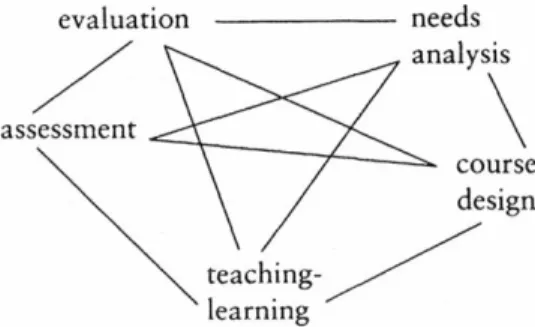
Fig. 1 Stages in the ESP Process (Dudley Evans and S. John,1998, 121)
7.RESEARCH METHODOLOGY
7.1. Inquiry methodology and tools of analysis
The focal point of this inquiry was to carefully examine the efficiency of the English teaching - learning situation in the Computer Science department. For this reason, it is relevant to clarify the different steps undertaken in this research and the several instruments used to gather data.
7.2. Selection of approach
7.3. Subjects of the study
The main population that is involved in this case study are students of 1st year Master Computer Science students (SIG- SIR- RSSI)1 . The general number of the population is about 180 students. Since it is difficult to work on such number of population, only twenty students (20) were chosen randomly. Randomization is a tactic used to ease the selection of each individual from the entire population.
7.4. Means of data collection
Different kinds of surveys are actually used in the following research study in which the aim is to gather more information about the specific ESP situations. The means to collect data are generally categorized into two main types: qualitative and quantitative data. Thus, a questionnaire was used for accumulating more information about ESP state in the Computer Science Department.
7.5. The questionnaire
The questionnaire is dedicated to the first year master Computer sciences students. This survey was used as a means of collecting more information about the ESP situation from a large sample. The survey is made up of three sections in which a mixture of the following six main types of questions are used: Yes/No questions, Open-ended questions, Close-ended questions, Multiple choice questions, Categorical questions, Likert Scale questions. The purpose throughout the questionnaire is to find out the various students‟ attitudes toward the English module, their needs and the problems they face when learning English. This is clearly explained on the top of the paper given to them. The questionnaire‟s anonymity and privacy were firmly respected providing students with great freedom to answer. The students‟ questionnaire is constructed of three main parts. Yet, we attempt first to know students‟ classification of the three languages (Arabic, French, English) by priority.
8.DATA ANALYSIS AND INTERPRETATION
The main and foremost focus of the current part is to make sense out of the questions raised in the research study. Thus, it is significant to analyze the feedback obtained from the questionnaire and the semi-structured interview; the examination of the information provided by both students and the teacher is required.
Question 01: How would you classify these three languages according to their importance to you? Number them from 1 - 4
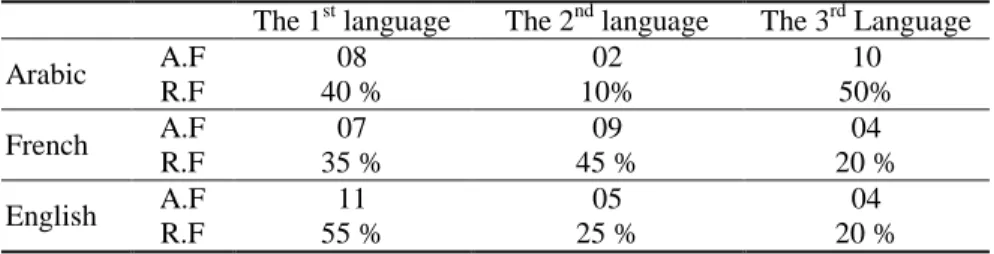
Our aim through this question is to have an idea about the students‟ interest in the three languages, and how they would classify each of them. The result obtained can be seen in the following table:
Table 1 Classification of languages in Computer Science Department
The 1st language The 2nd language The 3rd Language
Arabic A.F 08 02 10
R.F 40 % 10% 50%
French A.F 07 09 04
R.F 35 % 45 % 20 %
English A.F 11 05 04
R.F 55 % 25 % 20 %
According to the table above, three languages are present in the Computer Science Department; students have classified these languages according to the relevance of each language for them. The result obtained is explained in the next figure.
Fig. 2 Classification of the three languages in Computer Science Department
So, as it is seen in the figure, over 55% of students agreed that the English language is the most important language in the Computing and Science Department, 45% of them think that the French language is the second language used, while 50% find that the Arabic language is the third one in the list. By and large, we can assume that the English is the foremost language.
Question 02: Do you like the English language?
Question 03: Do you like learning English?
These two questions were asked in order to know whether students like the English language and learning English in general or not.
Table 2 Students‟ attitudes toward English
Absolute frequency Referential frequency
Do you like the English language? 20 100%
Do you like learning English? 20 100%
Question 04: Do you enjoy your English course?
Fig. 3 Learners‟ attitudes toward English lectures
The goal of the above question is to see if students enjoyed their English classes. So, as it can be seen in the figure, 55% of the population enjoy the English sessions, while 40% like it just a little bit. For the remaining respondents, 5% do not like it at all.
Question 05: Do you prefer to learn English in an amphitheatre?
This question enabled us to have an idea about students‟ preferences about learning English in an amphitheatre, i.e. if this place suits them or not.
Fig. 4 Students‟ English learning preferences
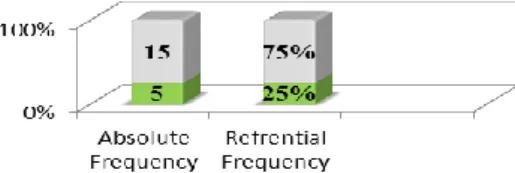
The above figure shows the amount of students who both agree and refuse learning English in an amphitheatre. So, 25% of the sample accepted to learn English in an amphitheatre. In contrast, 75% do not like learning English in an amphitheatre. Definitely, some of them believe that learning English as a foreign language should take place in classrooms rather than an amphitheatre because the latter is more crowded and noisy. They added that the unsuitable amphitheatre management prevents them from hearing what the teacher is saying, asking questions or participating in an open debate; and so the course is not understood and accessible for those who are set in his front only.
Question 06: Do you agree on the time allocated for the English module?
The goal of the following question is to determine the students‟ personal view on the time owed for the English module, i.e. to know whether it is really sufficient for them or not.
As seen in the above figure, on one hand, 75% of students consider that one hour and a half (1h30) is not sufficient; on the other hand, only 25% think that it is enough. According to the 75% students who agreed, the reasons were at variance. That is to say: the 75% of students hold a great interest and desire to learn the English language but 1h30 is not enough for them; it prevents them from ameliorating their English level. Besides, they estimate that it is likely to be impossible to understand the lecture in only one hour and a half.
Question 07: Why do you attend English lectures?
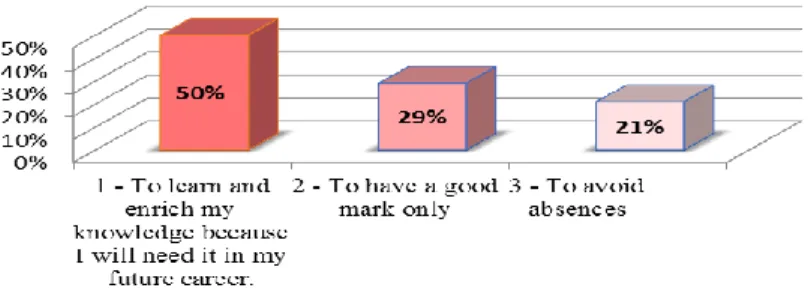
The objective behind this question is to define the reasons that drive the students to attend the English lectures. The result obtained was presented in the following table.
Table 3 Reasons behind students‟ presence in the English course
The number of responses The percentage 1. To learn and enrich my knowledge
because I will need it in my future career
14 50%
2. To have a good mark only 08 29%
3. To avoid absences 06 21%
The total 28 100%
The table above describes the three main reasons that push students to attend the English lectures. One thing is worth mentioning, students did not give only one answer from the options presented, but rather chose sometimes more than one answers. So, the results were presented in terms of the number of responses rather than the number of students. Accordingly, as it is clearly seen above, 50% of the sample said that the reason why they attended the English lectures was basically to learn and enrich their knowledge because they will need it in their future career. Whereas 29% are present just to have a good mark, 21% prefer to avoid absences by attending the English course.
Fig. 6 Reasons taxonomy
Question 08: Why do you need to learn English?
The purpose of this question is to discover the students‟ requirement for learning the English language.
Table 4 Students‟ needs for learning English
The percentage
1. To get good marks in English tests 9 18%
2. To be able to read scientific documents 12 24% 3. To be able to communicate freely in English with
people from different countries
16 31%
4. To carry on my studies in a foreign country 7 14%
5. To work with international societies 7 14%
The total 51 100%
Firstly, it is important to say that this is a multiple-choice question, and each student was totally free to pick up the number of the answers that suits him, and express evidently his point of view. For this reason, it seemed more appropriate to take into account the number of their responses in order to give a firm and precise analysis. This table in its turn was illustrated via the next figure.
Fig. 7 Students‟ needs for learning English
Question 09: Do you participate in class?
This question is meant to examine the extent to which students are involved in class, and the reasons that hinder them from participating during the lectures.
Fig. 8 Students‟ contribution in class
This figure describes the number of the students who participate in class versus those who do not, and the result is presented in forms of absolute and referential frequency. So, as it can be noticed above, only 5% do actually contribute in the course presentation; contrary to 95% who usually do not. These learners have selected a number of reasons that were given to them to illustrate the question, due to which most of them are unable to participate in the class. Then, the result gained was presented in the next figure.
Fig. 9 Reasons behind learners‟ low participation
As it is shown in the above figure, nearly half of the students - 40% do not participate during the lecture simply for their lack of motivation, while 30% of learners are unable to express themselves, and 30% of them do not like what they are doing.
Question 10: What are the main problems that you usually encounter when you learn English either at home or in class?
This question aims to look at the main difficulties that students are likely to encounter while learning English.
Table 5 Students‟ issues
The number of responses The percentage
1. Difficult vocabulary 0 0%
2. Speaking 13 41%
3. Listening 06 19%
4. Writing 03 9%
5. Reading and understanding 10 31%
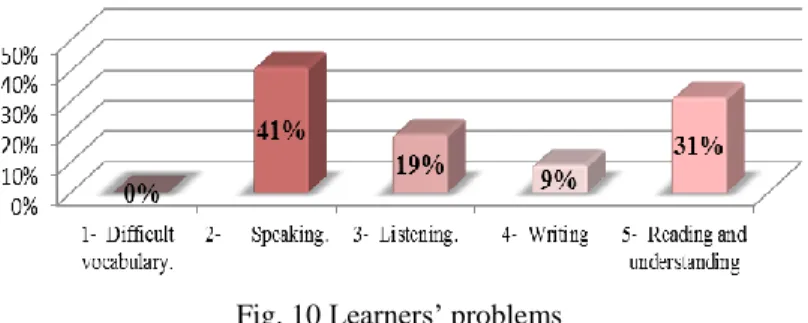
The table above includes some of the problems that learners usually face when learning English. As it can be observed, the number of responses (32) surpasses the number of students questioned (20), simply because students were free to choose more than one possibility that seems to be appropriate to their case. Hence, the results are presented in form of the number of responses, and are best examined in the following figure.
Fig. 10 Learners‟ problems
As it can be perceived in the figure, students rarely face difficult vocabulary (0%) and this seems positive. Yet, as obviously seen, speaking is the most troubling skill that 41% of students suffer from. The second problem is reading and understanding English documents and texts that have received the average of 31%. Listening is also tricky for students, 19% of them are unable to understand English when listening to it, while 9% of learners are unable to express themselves in writing.
Question 11: How can you describe your English level?
Our aim via this question is to give the students the opportunity to evaluate their English level.
Table 6 Learners‟ English level
Excellent Good Acceptable Bad Very bad
Absolute frequency 0 2 14 4 0
Referential frequency 0 10% 70% 20% 0%
As the table shows, there is a fairly constant result (0%), i.e. none of the students is either excellent in English or very bad. The most remarkable detail is that 70% of them have an acceptable English level, which means that their English learning progress is average, while only 10% consider themselves as being good and they learn English rapidly. Total of 20% believe that they have a bad English level.
Question 12: Do you think that the English module is: important/necessary/of little importance/useless?
Table 7 English module status
Absolute frequency Referential frequency
Important 7 35%
Necessary 10 50%
Of little importance 1 5%
Useless 2 10%
As the table reports, 50% of learners assume that the English module is necessary to them, while 35% say that it is really important. There are 10% who find that it is useless, and only 5% think that it is of a little importance.
Question 13: Do you make any efforts to learn English outside the classroom? The goal of this question is mainly to know if the students work hard in order to ameliorate their English level and how they do so.
Fig. 11 Students‟ endeavor to learn English
The figure above describes clearly the number of the students who do some efforts in order to learn English, versus those who do not. Consequently, 30% of them do nothing for learning the target language, in contrast, 70% work very hard to improve their English Level. These learners have given different ways and methods that they do usually adapt for reaching their goal.
Indeed, some of them prefer listening carefully either to the teacher during class, or, to English channels on the radio to advance their English level. Others favored taking English courses either in private schools or online. The remaining respondents contribute to websites in order to improve their English; some simply read books, watch films, or chat with people from other countries.
Question 14: After graduation, will your English knowledge be useful to you? This question is meant to see whether the English courses that the students have in class will be useful for them after graduating.
According to the figure, 90% of the students consider that their English understanding and comprehension will be functional after graduating from University, whereas only 10% do not think so because they find that what they are doing in class is not what they will encounter in their future life situations.
Question 15: What are the different materials used by your teacher in the lecture? Our objective through this question is chiefly to know the diverse instruments used by the instructors during the course.
Table 8 Course instruments
Instruments Absolute frequency Referential frequency Data Show
20 100%
Textbooks Dictionaries Computers
As noticed in the table, the whole sample questioned agreed on the same answers. They all argued that the teacher varies in the use of material when presenting his courses, from Data show and texts books to Dictionaries and Computers.
Question 16: Do you think the materials used by your teacher are useful for you? The aim of this question is to identify the usefulness of the instruments used by the tutor.
Fig. 13 Effectiveness of lessons materials
The figure reports both the agreement and the disagreement of students about the materials used by their teacher. Thus, as perceived above, 60% of them consider that the instruments utilized are really efficient, whereas 40% think that they are not helpful. Accordingly, 60% of Master Computer Science learners consider that because of the field they are studying (Informatics), it is important to use these instruments (such as: computers, dictionaries, texts books, data show). These latter, enable the students to better grasp the course. Thus, they consider that these technological means are the best way to present courses. In contrast to 40% of students who assumed that the course materials are not of a great help.
Question17: Do you prefer to have English audio–visual lectures?
Table 9 Students‟ agreement on audio-visual lectures
Yes No Total
Absolute frequency 19 1 20
Referential frequency 95% 5% 100%
The table above deduces the amount of learners‟ agreement of having audio visuals lectures for better learning English. The result obtained was that 95% of them welcomed the idea, believing that it is an excellent method for teaching English. It also helps improving students‟ speaking skill, particularly their pronunciation (chiefly those who have a desire to carry on their studies abroad). In contrast, only 5% of students denied the idea.
Question 18: Do you prefer to study English in classrooms rather than amphitheatre?
Our endeavor through this question is mainly to discover the appropriate place where students would like more to learn English.
Table 10 Learners‟ preferences
Yes No
Absolute frequency 16 4
Referential frequency 80% 20%
The table above reports that 80% of students prefer having English lessons in classrooms rather than amphitheatre, versus just 20% of them who do not want to. The majority of them, 80%, claimed that the class is better and would be more appropriate for learning English because mainly of the limited number of students. This fact makes the classes less crowded and noisy, and eases hearing the teacher. In addition to the position in which the teacher is put in, i.e. according to these students, the tutor would be put face to face in communication, and this would facilitate the students – instructors contact.
Question 19: Do you think that one hour and a half per week is enough to learn English?
This question attempts to discover if the students agree on the time allocated for the English module.
Table 11 English module timing
Yes No Total
Absolute frequency 3 17% 20
Referential frequency 15% 85% 100%
According to the table above, 85% find it inadequate, while only 15% think it is sufficient for them.
Fig. 14 Suggestions for English module timing
This question is set out in order to enable students to choose the most convenient answer from the suggested options. So, as the figures shows, nearly most of the students, 75%, would like to have 3 hours (that is the equivalent of two sessions per week) for learning English. The total of 15% agreed on only 1h 30‟ that they have, contrary to 10% who preferred to have 4 hours per week.
Question 21: According to you, which skill (s) do you really need in the English module?
The aim of this question is mainly to know which of the four English skills students really need to improve.
Fig. 15 Language skill(s) needs
The figure expresses the students‟ need for various English language skills. The learners‟ requirements for these skills vary from one to another, that is, every single learner was free to select the skill (s) that s/he needs. For this reason, the results obtained are presented in the form of the number of responses. Therefore, as the figure demonstrates, 16% of students have a big desire to improve their reading capacity, while 19% of them emphases on listening skill. The result is the greatest need for what is called “receptive skill2(s)”, contrary to some learners who mainly want to develop their oral and written production ability. Indeed, the speaking skill is the first capacity that is required by 52% of students, and 13% of them focus on the writing skill. The result was that 65% call for the improvement of the “productive skill (s)”.
Question 22: Would you classify these skills (s) according to their importance to you? Put numbers (1-4)
The purpose of this question is firstly to illustrate the previous question, and secondly to lead students to put their own classification of the English four skills according to the importance for them.
Fig. 16 Language skill(s) classification according to students
Through the language skill (s) classification figure, we can see that most students, 50%, consider that speaking is the first and the most important skill, while 40% prefer writing skill. As it is shown above, both listening and reading skills trends are nearly approximate. That is, 35% of learners assume that listening skill is the most important, while 30% of them consider reading as the foremost skill.
Question 23: As computing students, what are the different topics that you need to learn in the English module?
Through this question, we attempt to examine the students favored topics that they would like to deal with in the English module. The result varies; some students have a great attention for terminology teaching, that is, scientific terms in relation with computing science, in addition to their big desire to be involved in a scientific debate, in order to improve their communicative skills and to make their language knowledge more functional. Others are more fascinated by reading and writing skills, this means that they would like to learn how to read English documents correctly and to be trained with writing different researches and projects cohesively and coherently.
6.SUGGESTIONS AND RECOMMENDATIONS
This part represents the final step through which we could reach our objective that is fixing up both teacher‟s and students‟ problems. To go back briefly to the first chapter, we have hypothesized firstly that the English language teaching still requires efficiency. Secondly, we supposed that learners‟ dissatisfaction is due to their incapacity to perform the four skills; finally, we presumed that both students and teacher‟s face some problems that result in learners‟ demotivation. Therefore, on the basis of the data analysis and its interpretation, we will attempt to propose some ideas and solutions to the previously cited issues; some alterations should be done on the following areas: learners‟ needs, learners‟ outcomes, language skills, the classroom management, ESP teacher‟s role and approach.
6.1. Learners’ needs
unique, and brings to the learning situation his or her personal learning style, knowledge set, collection of past experiences, and self-motivation. Indeed, the current ESP teacher in Computer Science Department has supposed that his students‟ needs are all about technical terminology. Yet, the professor should reconsider his learners‟ needs. Subsequently, the best way to get this information in a very short of time is by asking the learners themselves.
Surveys are considered a good method to explore students‟ learning preferences, as for example: learning style, their prior experience, and their motivation to learn the subject matter (Davis, 2001). It is useful to conduct surveys before or at the beginning of a class in which the learners might have different skills. The process of collecting these data can raise the level of participant excitement about the learning experience.
6.2. Classroom management
Good classroom management usually results in the positive achievements of learning outcomes. Classroom management involves everything that a teacher should do to carry out his/her teaching objectives. It includes preparation of plans and materials, structuring of activities, directing teaching of skills and subject matter, learners involvement and motivation, and adequate control of learners behaviour. The appropriate classroom management should take into consideration the students‟ personal and psychological needs. The teacher should have a good relationship with his students. The first and foremost teacher‟s aim should be maximizing the participants number by creating a conductive learning environment. Learners in their turn ought to feel comfortable in their learning setting, and pleased with what they are learning.
6.3. ESP teacher’s roles and approaches
Describing the roles of an ESP teacher is a controversial issue (Hutchinson, & Waters, 1987). Dudley-Evans and St Jones (1998) stated that there are big differences between a general English teacher and an ESP Teacher. That is, the main tasks of the general English teacher are „acting as a facilitator and a provider of input and activities‟, i.e. controlling ongoing classroom activities, providing information about skills and language, organizing pair or group work, etc, and the ESP teacher fulfils these roles and others as Hutchinson and Waters said are “in theory nothing, in practice a great deal” (1987, p. 53) in answer to the question: What is the difference between the ESP and General English approach?
Additionally, Hutchinson and Waters make two important distinctions between general English teachers and ESP teachers. Firstly, they claim that: “in addition to the normal functions of a classroom teacher, the ESP teacher will have to deal with needs analysis, syllabus design, materials writing or adaptation and evaluation ... the majority of ESP teachers have not been trained as such.” (1987, p.157)
They mean that ESP teacher needs to obtain a more systematic knowledge of a specific field which they have not been qualified in and are not completely familiar with. So, the ESP teacher is likely to face threatening situations during the teaching process.
activity-based and learner-centred, and revolve around real-life tasks to ensure relevance. In addition to the correct use of materials, the teacher should select proper instruments that support his/her lecture and which suit and facilitate the learning process.
For that reason, we suggest that the cited objectives could be accomplished through two approaches: activity-based approach and learner-centred approach. As mentioned in the previous chapters, learner-centred is an approach to teaching that is increasingly being encouraged in higher education in recent years. This approach shifts the role of the instructors from givers of information to facilitators of student learning.
Hence, learner-centred teaching should be the approach used since it focuses on student learning; it puts emphasis on the person who is learning (Weimer, 2002). This approach usually results in the improvement of students‟ motivation. As far as the task- based approach is concerned, it is compatible with a learner-centred educational philosophy. The task-based teaching offers the opportunity for „natural‟ learning inside the classroom, and it is essentially motivating.
7.CONCLUSION
To summarize, learning English for specific purposes could be an enjoyable experiences for Algerian students. Throughout the present investigation, many problems faced by students were found. Thus, in order to fix them up, some proposals were provided, that are believed to be efficient means to foster the English language learning in the Computer Science department.
REFERENCES
Dudley, T and St John, J. (1998) Development in English for Specific Purposes: A Multi-
Disciplinary Approach, Cambridge: CUP.
Dudley, T. (1998) An Overview of ESP in the 1990s, pp. 5-9. Paper Presented at the Japan Conference On English for Specific Purposes, Fukushima.
Hutchinson, T. and Waters, A. (1987) English for Specific Purposes: learning Centered
Approach, Cambridge University Press: Glasgow.
Laurence, A. (1998) Defining English for Specific Purposes and the Role of ESP Practitioner. Okayama University, Japan.
Laurence, A. “English for Specific Purposes: What does it mean? Why is it Different?”, (1997), vol 05- 03: page 03, downloaded on: January, 15th, 2011 .
Mackay, R. and Mountford, A. (1978). English for Specific Purposes. London, Longman. Nunan, D. (2004) Task-Based Language Teaching. Cambridge, UK.
Oura, G. K. Authentic Task- Based Materials: Bringing the Real World into Classroom. Pages. pp.76- to 70.
Robinson, P, C. (1980). ESP (English for Specific Purposes): The Present Position. Simpson and Ure (1994) “Meeting Learners‟ Needs”. Available online at:
http://www.languageswithoutlimits.co.uk/sharedneeds.html