CELLULAR & MOLECULAR BIOLOGY LETTERS http://www.cmbl.org.pl
Received: 26 September 2007 Volume 13 (2008) pp 421-429 Revised form accepted: 23 January 2008 DOI: 10.2478/s11658-008-0010-0 Published online: 02 April 2008 © 2008 by the University of Wrocław, Poland
##Paper authored by participants of the international conference: International Workshop
on Ionic Channels, Szczyrk, Poland, May 27 - June 01, 2007. Publication cost was covered by the organisers of this meeting.
* Author for correspondence; e-mail: [email protected]
Short communication
KINETIC MODELS FOR STOCHASTICALLY MODIFIED IONIC CHANNELS ##
ALEKSANDER WOZINSKI* and JAN IWANISZEWSKI Institute of Physics, Nicolaus Copernicus University, Grudziądzka 5,
87-100 Toruń, Poland
Abstract: Ionic channels form pores in biomembranes. These pores are large macromolecular structures. Due to thermal fluctuations of countless degrees-of-freedom of the biomembrane material, the actual form of the pores is permanently subject to modification. Furthermore, the arrival of an ion at the binding site can change this form by repolarizing the surrounding aminoacids. In any case the variations of the pore structure are stochastic. In this paper, we discuss the effect of such modifications on the channel conductivity. Applying a simple kinetic description, we show that stochastic variations in channel properties can significantly alter the ionic current, even leading to its substantial increase or decrease for the specific matching of some time-scales of the system.
Key words: Ionic channel, Fluctuations, Kinetic model, Resonant activation
INTRODUCTION
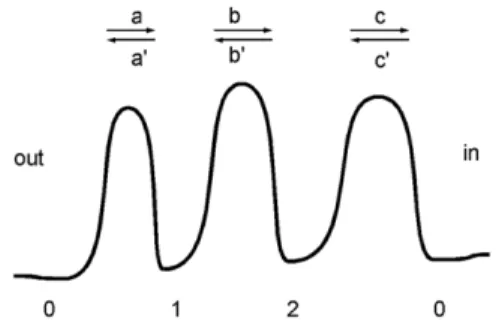
action and the sensitivity of the channels to any modification of the physical or chemical conditions of transport. The recently developed patch-fluorometry approach [2] provides a very promising tool to directly relate changes in channel structure to their effect on channel permeability. However, theoretical investigations of the whole problem involving all the atoms, ions and interactions by means of molecular dynamics simulations are still beyond current computational ability, so some simplifying models have to be used [3]. In this paper, we discuss the impact of channel wall fluctuations on the ionic current within a very simple kinetic model. Entering the pore, an ion moves in the field of electrostatic potential created by the channel proteins (Fig. 1). The potential minima represent the binding sites of the channel, and ionic transport is described as a series of fast jumps between them. The jumps are caused by thermal activation over potential barriers located between the binding sites, and the kinetics is represented by the rate constants. The fluctuations of the channel walls (electrostatic potential) are introduced by stochastically modifying these rate constants.
Fig. 1. Ion transport as a sequence of jumps between sites with the indicated transition rates. See the Methods section for a full description.
This model is definitely an oversimplified approach, neglecting many details of the internal structure of the channel. However, it provides a basic insight into many of the complex biophysical problems [4], enabling the expression of the essential concepts of the investigated problem in a tractable form, the ordering of empirical data or the anticipation of some new phenomena. The motivation for this study lies in our interest in noise-induced resonance-like phenomena, a subject that has been extensively investigated by physicists for some twenty years. It was found that under some conditions, potential fluctuations can lead to resonant activation [5-7], an effect in which the mean time to overcome a potential barrier may significantly decrease, provided the barrier height changes randomly with a characteristic time scale of the same order as the characteristic time scale tr of the intrawell processes [8]. Although resonant
some similar effects caused by potential fluctuations in transport through an ion channel in as simple a model as possible. Thus, although the diffusive Poisson-Nernst-Planck theory is currently considered more valuable, for our purposes, the kinetic model is sufficient.
METHODS
When considered in the context of a fluctuating energy profile, the kinetic description of transitions between potential wells is valid only if the mean lifetime of each configuration is significantly longer than tr. Otherwise, the form
of the potential during the very escape event is not well defined [11, 12]. The internal motions in proteins occur on time scales from several picoseconds to seconds or even minutes, while tr is estimated to be of the order of 1 ps. Thus, in
our case, the kinetic approximation seems reasonable.
For simplicity, we consider a channel with two binding sites – the channel potential has two wells (Fig. 1) separated from each other as well as from the external solution (out) and the cytoplasm (in) by energy barriers. By introducing transition rates over the barriers (a, a’, b, etc.), the kinetic description reduces the dynamics to jumps between four states only. For simplicity, we assume that only one of the binding sites can be simultaneously occupied, which leads to a three-state dynamic: either the left (1) or right (2) site is occupied, or both are empty (0), c.f. Fig. 1. We assume that there is stochastic switching between two possible forms of potential, denoted ‘+’ and ‘-’ , which means that the number of states doubles, so that, for example, the states ‘1+’ and ‘1-’ correspond to site 1. Accordingly, every transition rate over a particular barrier can take two values. Mathematically, configuration switching is realized in a similar way to hopping between wells: it consists of random jumps (e.g. from ‘1+’ to ‘1-’ or back) with a constant probability per unit time, expressed by the rate ν reflecting the pace of a given type of fluctuation. As specified in the next section, these rates can be either different or the same for both sites, depending on the case.
The rate equations for the occupation probabilities Pi± of the possible states of
the system (i = 0, 1, 2) can be written in a matrix form:
P P = M ⋅
dt
d (1)
where P = (P0+, P1+, P2+, P0-, P1-, P2-)T, and the evolution matrix M is built of
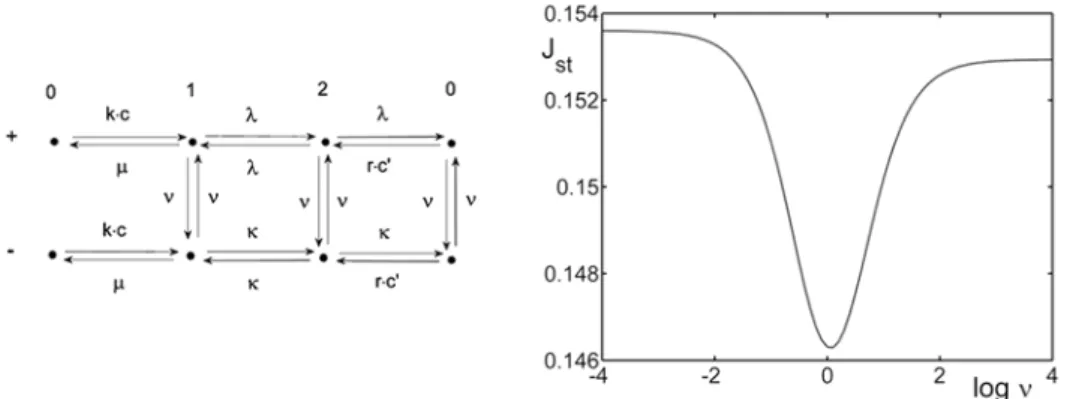
To illustrate the construction of the matrix M, here is Eq. 1. for the diagram in Fig. 2 (in other cases, it is constructed in an analogous way) :
. 2 ' 0 0 2 0 0 ' 0 0 0 0 2 ' 0 0 2 0 0 ' 2 1 0 2 1 0 2 1 0 2 1 0 ⎥ ⎥ ⎥ ⎥ ⎥ ⎥ ⎥ ⎥ ⎦ ⎤ ⎢ ⎢ ⎢ ⎢ ⎢ ⎢ ⎢ ⎢ ⎣ ⎡ ⎥ ⎥ ⎥ ⎥ ⎥ ⎥ ⎥ ⎥ ⎦ ⎤ ⎢ ⎢ ⎢ ⎢ ⎢ ⎢ ⎢ ⎢ ⎣ ⎡ − − − − − − − − − − − − − − = ⎥ ⎥ ⎥ ⎥ ⎥ ⎥ ⎥ ⎥ ⎦ ⎤ ⎢ ⎢ ⎢ ⎢ ⎢ ⎢ ⎢ ⎢ ⎣ ⎡ − − − + + + − − − + + + P P P P P P rc kc rc kc rc kc rc kc P P P P P P dt d ν κ κ ν κ ν κ ν κ κ ν ν ν ν λ λ ν λ ν λ ν λ λ ν (2)
The quantity of interest is the steady-state ionic current. It equals NZeJst,where
N is the total number of channels, and Ze is the ion charge, while Jstdenotes the
net flux of ions through any vertical “cross section” of the kinetic diagram in the stationary state. To calculate this, we set l.h.s. of Eq. 1 (or Eq. 2) equal to zero. This yields a singular system of equations for all the probabilities, which due to the probability conservation (the sum of all Pi± equals 1) can be uniquely solved
to obtain Pi±,st. Then, e.g. for the channel in Fig. 2, for the intersection between
the cell exterior and site 1, we have:
− −
+
+ − + −
= st st st st
st kcP P kcP P
J 0,
λ
1, 0,κ
1,(3)
Alternatively, we could consider transitions over any of the remaining two barriers. Again, the flux is calculated similarly for other models. Assuming that the voltage does not affect switching, the channel conductance should be proportional to Jst in the whole range of values of the parameters νcharacterizing
the mean switching rate in the next section, at least in thelinear response regime. Since the detailed dependence of the conductivity on voltage would additionally require further assumptions about the mechanisms of fluctuations and ionic transport, here we prefer to use only Jst to quantify the influence of the
fluctuation rate on ionic flow. We intend to find if and under what conditions thus defined current can be enhanced or supressed in some regions of the fluctuation rates.
RESULTS AND DISCUSSION
A simple investigation proves that in the archetypal one-site model of Läuger, [11], the dependence of the flux on the fluctuations’ transition rate is monotonic for both the cases of transitions between the potential conformations which are discussed below. Thus, searching for more complex behaviour, one should analyze channels with multiple binding sites. For instance, the existence of two main sites is often reported for Na channels [13, 14].
Ion-independent switching
jump rates are introduced over only one barrier, the flux always depends monotonically on the flipping frequency. If the switching modifies all the rates within the pore (but not the entrance from the bulk solution), the results are similar (Fig. 2). For “infinitely fast” fluctuations, the ion passes between sites with the averaged rates of two configurations, whereas slow fluctuations yield long sojourn times in the ‘+’ conformation with a small current. This gives a monotonic decrease of Jst with a decreasing rate νof the switching process (Fig. 2).
Fig. 2. Ion-independent switching between the highly (-) and weakly (+) conductive states. The kinetic scheme and current Jst vs. the switching rate ν. All the quantities are in arbitrary
units: κ = 2.2, λ = 0.1, kc = 3, rc’ = 0.5; c, c’ – external and internal concentrations.
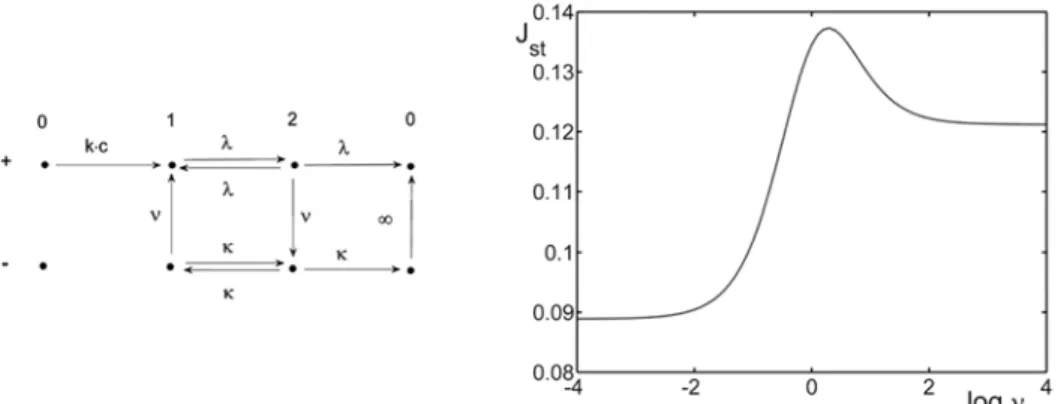
Fig. 3. As Fig. 2, but with the escape rate from site 1 to the outer solution unchanged. We set κ = 2.2, λ = 0.1, kc = 3, rc’ = 0.5, μ = 2.
effectively, and the backflow to the outer solution is maximal. Thus, a minimum of the ionic current appears. This might happen in some fluctuations’ frequency ranges, e.g. when there is a very small or even no physical barrier between the external solution and first chamber, so that the entrance (and exit) is diffusion-limited, and only then there is a sequence of barriers of variable height.
Occupancy-dependent transitions
Next, we consider a model with two configurations similar to the situation in Fig. 3, but with a different mechanism responsible for the transitions between them (Fig. 4). The potential change is induced by the presence of an ion at site 1, but when the ion leaves this site, the channel relaxes to its preceding form. Thus, potential variations are coupled to the ion’s position. Apparently, these transitions are irreversible; possible mechanisms of such processes are discussed in, e.g. [14, 15]. For simplicity, we assume the same rate for both processes; however, the effect described below can also appear for unequal rates. As a result, we obtain a well-pronounced maximum of the current (Fig. 4), a feature analogous to that of resonant activation. Detailed analysis reveals that, rather surprisingly, if all jump rates are kept constant, the resonance-like behaviour can be destroyed by high enough concentrations.
Fig. 4. The channel conductance increase (passage from the ‘+’ to ‘-’ state) induced by the ion presence in site 1 for kc = 0.8, λ = 0.3, κ = 3, μ = 0.5, and rc’ = 0.2.
The origin of the maximum can be better understood if one considers a slightly simplified version of this model (Fig. 5), in which the infinitely fast relaxation of an empty channel is assumed. Then Jst can be presented in a closed form:
(
)
[
]
(
2
)
(
2
9
)
(
3
)
.
2
2 2
2
kc
kc
kc
kc
kc
J
st+
+
+
+
+
+
+
+
+
+
=
λ
λ
κ
λκν
λ
κ
ν
κ
λ
κλ
κλ
ν
λ
κ
ν
κλ
(4)
ratio of first order polynomials. This allows for the existence of an extremum, which in this case indeed can be found (for κ > λ) to be located at:
(
2 3)
.2
max κ λ
κ κλ λ
λ ν
− + − +
=
(5)
The maximum is due to the fact that moderately fast transitions enable the ion to move relatively frequently along the path solely within the favourable ‘-’ configuration, whereas infinitely fast transitions force the entrance into the cell interior from site 2 through the ‘+’ configuration, and infinitely slow reorganization yields current flowing practically entirely in the ‘+’ configuration.
Fig. 5. A simplified model from Fig. 4, with infinitely fast relaxation of the empty channel, c’ = 0, and μ negligible. The remaining rates are kc = 0.8, λ = 0.3, and κ = 3.
The resonant-type shape of the Jst curve is also observed if the potential flips
when an ion occupies site 2 (Fig. 6). Here, a moderately fast transition allows for a faster exit from this site to the bulk solution.
CONCLUSIONS
Following some findings in diffusive systems (also in the context of biological pores, c.f. [16]) we studied the role of fluctuations in free energy profiles in ion permeation. We investigated a few simple kinetic models of ionic channels with randomly switched potentials, both independently of the ion position and as a result of the presence of an ion in a certain region. We showed that besides a significant difference between the slow and fast fluctuation cases, a resonant-like response to a perturbation is also possible for some sequences of barriers and wells, provided there is more than one main binding site in the channel. This means that the current which we observe does not necessarily have to be an approximate result of a flow through an effective (i.e. averaged over fluctuations) static mean field potential landscape nor a flux averaged over conformations, as would be the case for slow variations. In fact, our simple analysis proves that moderately fast fluctuations can induce a possibly biologically favourable scenario: a maximal current that is substantially larger than in both of the mentioned limiting cases. However, slowdown of transport is also possible.
The mean current that was evaluated is for the channel in the open state, and, in general, should be considered as an ensemble average. If one pore is referred to, then in a single record, sufficiently slow variations (say at least in the time scale of microseconds) may be resolved, possibly giving rise to experimentally observed substates with lower conductance; however, see [17] for another, also fluctuation-based hypothesis.
Our simple models neglect a number of important factors. Nevertheless, it is a simple task to include larger numbers of channel sites and potential conformations into our kinetic scheme. Also, our single-ion assumption can easily be removed, allowing for an investigation of the influence of ionic repulsion on the channel current. More detailed analyses should also consider the voltage and concentration dependence of the fluxes more carefully. Finally, in order to make the model truly predictive, the site kinetic rates and inter-conformation switching rates should correspond to the real channel energy profiles and conformation dynamics, respectively. Irrespective of the complexity of the analysed situation, the general conclusion is that for a given ionic channel, fluctuations of some frequencies might enhance or suppress the ionic flux, as happens in the resonant activation phenomenon.
REFERENCES
1. Cooper, A. Thermodynamic fluctuations in protein molecules. Proc. Natl. Acad. Sci. 73 (1976) 2740-2741.
2. Zheng, J. Patch Fluorometry: shedding new light on ion channels.
Physiology 21 (2006) 6-12.
3. Levitt, D.G. Modeling of ion channels. J. Gen. Physiol. 113 (1999) 789-794. 4. Hille, B. Ionic channels of excitable membranes, 2nd edition, Sinauer
Associates, 1992.
5. Doering, C.R. and Gadoua, J.C. Resonant activation over a fluctuating barrier. Phys. Rev. Lett. 69 (1992) 2318-2321.
6. Astumian, R.D. and Bier, M. Matching a diffusive and a kinetic approach for escape over a fluctuating barrier. Phys. Rev. Lett. 71 (1993) 1649- 1652. 7. Iwaniszewski, J. Escape over fluctuating barrier: limits of small and large
correlation time. Phys. Rev. E. 54 (1996) 3173-3184.
8. Iwaniszewski, J., Kaufman, I.K., McClintock, P.V.E. and McKane, A.J. Resonances while surmounting a fluctuating barrier. Phys. Rev. E. 61 (2000) 1170-1175.
9. Kramers, H.A. Brownian motion in the field of force and the diffusion model of chemical reactions. Physica 7 (1940) 284.
10. Brey, J.J. and Casado-Pascual, J. Resonant activation in a simple kinetic model. Phys. Rev. E 50 (1994) 116-120.
11. Läuger, P., Stephan, W. and Frehland, E. Fluctuations of barrier structure in ionic channels. Biochim.Biophys. Acta 602 (1980) 167-180.
12. Iwaniszewski, J. Mean escape time over a fluctuating barrier. Phys. Rev. E.
68 (2003) 027105.
13. French, R.J., Worley J.F.III, Wonderlin, W.F., Kularatna, A.S., Krueger, B.K. Ion permeation, divalent ion block, and chemical modification of single sodium channels. Description by single- and double- occupancy rate theory models. J. Gen. Physiol. 103 (1994) 447-470.
14. Kurata, Y., Sato, R., Hisatome, I. and Imanishi, S. Mechanisms of cation permeation in cardiac sodium channel: Description by dynamic pore model.
Biophys. J. 77 (1999) 1885-1904.
15. Mironov, S.L. Conformational model for ion permeation in membrane channels: A comparison with multi-ion models and applications to calcium channel permeability. Biophys. J. 63 (1992) 485-496.
16. Lee, K. and Sung, W. Effects of nonequilibrium fluctuations on ionic transport through biomembranes. Phys. Rev. E 60 (1999) 4681-4686.
17. Moss, G.W.J. and Moczydlowski, E. Rectifying conductance substates in large conductance Ca2+-activated K+ channel: Evidence for a fluctuating