Nano structural and optical properties of four-phase multi layer ZnS/TiO
2/glass
1
Hana Sajjadi,
2Haleh Kangarlou
1
Faculty of science, Islamic Azad University, Mahabad Branch, Mahabad, Iran
2Faculty of science, Islamic Azad University, Urmia Branch, Urmia, Iran
Abstract: Zns/ /glass multilayer in high vacuum condition and vertical accumulation angle has been determined prepared by resistance evaporated method with 50.3 nm thickness for layer and 71.2 nm thickness for ZnS layer. Accumulated temperature of Zns layer Accumulated temperature was100°c. The Atomic Force Microscopy (AFM), optical Spectroscopy and XRD analyses are perfectly accomplished for this multilayer. It has tried that the results of this research have a positive effect on nuclear energy.
Key words: AFM; XRD; spectrophotometer; nanostructure
INTRODUCTION
Titanium - dioxide injection has been developed as new environmental mitigation technology for BWRS. It utilizes a photoelectrical effect of irradiated to reduce ECP in the reactor water. Micro particles of are injected in to the reactor water to form a deposit on the surface of reactor internals ad recirculation piping. Cherenkov radiation in the reactor core region is the light source for photo –excitation of . Thus, injection is thought to be an effective mitigation technique for reactor internals and vessel penetrations without any hydrogen addition. (Bloss, W.H., et al., 1988; GOLD, R.E.,)
The addition of soluble zinc additives to PWR primary coolant leads to incorporation of zinc in the nickel substituted ferrite films and inner chromite layers that form on nickel based alloys exposed to primary water. The main goals of using zinc injection are: 1) reduction in plant radiation fields 2) mitigation of PWSCC. Initial studies indicated that zinc injection into primary water was successful in delaying PWSCC initiation and that the effect is related to the zinc injection concentration. Subsequent analysis has indicated that the effectiveness of zinc injection as a PWSCC inhibition agent is related to the integrated quantity of zinc that ends up in the corrosion films of PWSCC susceptible nickel based alloys and welds. The amount of zinc in the films is related to the average zinc concentration present in the coolant and the time present. As such, the integrated zinc concentration, as defined by the “PPB-mo” integrated exposure, is thought to be a good indication of the effectiveness of zinc for infiltrating the corrosion product film. (OKAMURA M., et al.,)
ZnS is an important II-VI group semiconductor material with a direct band gap between 3.4 to 3.70 ev depending up on composition. It is potentially important material to be used as an antireflection coating for hetero junction solar cells. (Chemistry of Nuclear Reactor Systems 2006)
It is an important device material for the detection , emission and modulation of visible and near ultra violet light. (Joji, I., et al., 2008; Marquerdt, E., et al., 1994)
In particular, zinc sulfide (zns) is believed to be one of the most promising materials for blue light emitting laser diodes, and thin film electroluminescent displays. (Hirabayashi, K., H. Koza, 1986)
Nano structural materials have attracted a great deal of attention in the last few years for their unique characteristics that cannot be obtained from conventional macroscopic materials .Owing to quantum size effects and surface effects , nano particles can display novel optical , electronic, chemical, magnetic and structural properties that might find many important technological applications.( Juotip, et al., 2008).
Extensive investigation of thin films are caused by actual perspectives of their applications in photo catalytical and biomedical materials due to a complex of their important properties such as high dielectric constant , photo catalytical activity , bioactivity (Nicolau, Y.F., et al., 1990; Heinrichs, J., et al., 2008)
Titanium dioxide ( ) is a well known material and it’s used in pigments, solar cells and sunscreens. Oil and gas. Which are at present the main sources of energy, will eventually exhaust after sometime, necessitating the search for newer energy resources .Nowadays we can use of Nuclear energy.
Experimental:
evaporating and complete memento layer near 50.3 nm, for the purpose of making Zns/ / glass multilayer, we put the white powder of zinc sulfide in a boat whose quality is molybdenum and install it in a required place and we use /glass substratum and once more install it by holder in a space of 45 cm of boat in a required place. Now we close the container and do the vacuum process to reach a higher vacuum and increase container temperature to 100 °c by heater. Now the evaporation of ZnS starts in which the thickness of stored Zinc Sulfide is 71.2 nm and the final thickness of built multilayer in the procedure is about 121.5 nm which is determined by crystal quartz device. AFM and XRD analysis were used for determination of nano structure and crystallographic direction of multi layer. Spectrophotometer device were used in visible light wave length range to obtain optical reflectivity.
The aim of this work is to produced 4 phase multilayer’s, and investigate about optical and structural properties of these layers and their communication.
RESULT AND DISCUSSION
The Atomic Force Microscopy (AFM), spectrophotometer and XRD analyses are perfectly accomplished for this multilayer and the results are mentioned in detail.
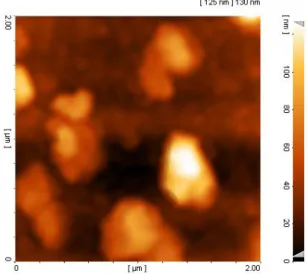
Fig. 1: in this article, the microscopic image shows atomic power of built Zns/glass multilayer. This multilayer high vacuum condition and vertical accumulation angle has been determined by crystal quartz device in 50.3 nm thickness for layer and in 71.2 nm thickness for Zns layer.
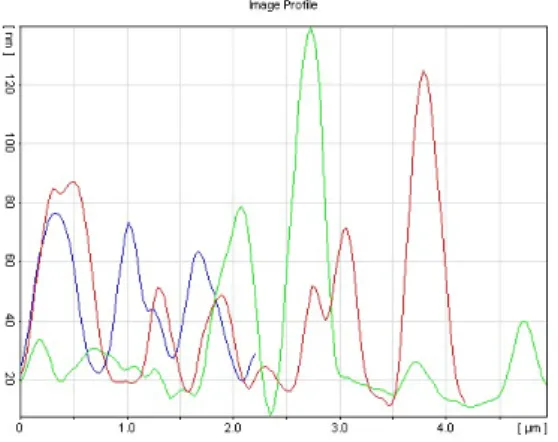
Fig. 3: shows image profile of ZnS/ /glass built multilayer in these article 1n three areas of ZnS/ /glass built models adjacent masses are determined by blue, red and green pointers.
Fig. 4: shows distribution function of adjacent masses in three blue, red and green areas. The masses determined by green pointer, in a space of 94.3 nm, their maximum height is about 2.5 pm and the masses determined by green or red pointer in a space of 77.4 nm, their maximum height is about 909 pm and the masses determined by blue pointer in a space of 74.5 nm their maximum height is about 374 pm.
Fig. 6: shows transmission diagram of ZnS/ /glass multilayer in the model according to productive radiance wave length. As it is determined, we have about 80% transition and transmission. Diagram is visibly different from accumulation of ZnS units that near 400nm a hollow is visible which is related to inherent features of zinc sulfide.
Fig. 7: shows diagram of X-ray diffraction of ZnS/ /glass multilayer .At first is shapeless and layer thickness especially with the presence of temperature. Crystal ZnS peaks show themselves in the direction of 200and 311 crystal manufacturing. Extended peak related to shapeless substratum of glass is visible in 20 to 30 and in addition, in general condition XRD is noisy. Accumulated ZnS layer shows itself properly.
Summery:
Four phase multilayer of ZnS/ TiO2/glass were prepared by resistance evaporated method under UHV conditions, morphology of multilayer showed big domed grains with high roughness and
Inhomogeneous surface, this layer was beginning to crystalline as we can see from XRD pattern. This multi layer has a good transmittance and there was a good agreement between nano structure and optical property of produced multi layer.
REFERENCES
Bloss, W.H., F. Pfisterer, H.W. Schock, 1988. ”Advances in solar energy , an Annual review of research &development “ 4: 275.
Chemistry of Nuclear Reactor Systems (Proc. Int. Conf. Jeju Island, Republic of Korea, 2006).
Conference - Contribution 1994. of Materials Investigation to the Resolution of Problems Encountered in
T
ran
sm
it
tan
ce
wave lenght (nm)
ZnS/TiO
In
te
n
s
ity
2theta
Marquerdt, E., B. Optiz, M. Scholl, M. Henker, 1994. J. Apple. Phys.,75: 8022. Nicolau, Y.F., M. Dupuy, M. Brunel, J. Eiectorochem, 1990. Soc., 137: 2915.
OKAMURA M., et al., “Corrosion mitigation of BWR structural materials by the photoelectric method with ,” Water