International Journal of Applied Linguistics & English Literature ISSN 2200-3592 (Print), ISSN 2200-3452 (Online) Vol. 2 No. 3; May 2013
Copyright © Australian International Academic Centre, Australia
From I to D: Pronominal Discourse Functions Across the
Sections of Research Articles
Mónica Chávez Muñoz
English Language Centre, Hong Kong Polytechnic University Room GH 258, Hong Kong, China
Tel: 852 3444 8438 E-mail: [email protected]
Received: 27-02-2013 Accepted: 04-04-2013 Published: 01-05-2013 doi:10.7575/aiac.ijalel.v.2n.3p.218 URL: http://dx.doi.org/10.7575/aiac.ijalel.v.2n.3p.218
Abstract
Academic writing has been recently defined as a social activity in disciplinary communities and cultures. As a result, there has been an increasing interest in the study of self as author, focusing on the way writers represent themselves in texts and how writers interact with readers. Additionally, authorial presence has been analysed across languages and across sections of the research article. This study explores the usage pattern of pronominal discourse functions across sections of 60 research articles in the fields of linguistics, psychology and educational research in English and Spanish. Drawing on a modified version of Tang and John’s (1999) taxonomy of pronouns, I explain the frequency and usage of pronouns in each section of the research articles. The analysis of items revealed some differences and similarities in terms of linguistic choices writers make in a specific section of the research article in both languages.
Keywords: research articles, text analysis, personal pronouns, metadiscourse, contrastive linguistics
1. Introduction
In the last four decades, the study of interaction in language has had an increasing focus on written texts (Coulthard, 1977; Nystrand, 1986, 1989; Widdowson, 1982; Bakhtin, 1981; McCarthy, 1993; McCarthy and Carter, 1994; Davies, 1994; Bolivar, 1986, 2001; Thompson and Thetela, 1995; Hoey, 2001). Drawing on this research, Hyland (2005b) has created one of the most complete models for the study of interaction in written texts: the metadiscourse model. This model includes a series of linguistic resources that are divided into two major categories: interactive and interactional. On the interactive side, metadiscourse signals include: transition markers, frame markers, endophoric markers, evidential and code glosses. On the interactional side, they include: hedges, boosters, attitude markers, self-mention,
and engagement markers (reader pronouns, personal asides, shared knowledge, directives and questions). This range of linguistic features has been researched in different genres, such as: popular science articles (Crismore and Farnsworth, 1990), textbooks (Hyland, 1998),student essays (Crismore et al, 1993; Intaraprawat and Steffensen, 1995; Shaw and Liu, 1998; Thompson, 2001; Hyland 2004, Hyland and Tse, 2004), project reports (Hyland, 2000; 2005c), and research articles (Hyland, 1999, 2005a; Hyland and Tse, 2005; Harwood, 2005a, 2005b, 2005c). According to Hyland (2001b), the study of pronominal signals in academic writing has received special attention from language analysts mainly because their proper use in academic genres is still unclear in terms of its use and frequency in the text (Hyland, 2001b). Hence, the existing literature on the analysis of writer and reader pronouns in academic writing has argued that these features could give an insight into the ways writers present their contributions and ideas and interact with other members of the discourse community (Tang and John, 1999; Hyland, 2001b, 2002), and has a self-promotional effect which markets the research carried out (Harwood, 2005a).
1.1Taxonomies of pronouns in academic writing
1.2 Hypotheses
In the light of this, the focus of this study is to analyse the sections of RAs in English and Spanish in the fields of Linguistics, Education and Psychology. According to Swales (1990), the RAs sections IMRD have different functions. The Introductory section of the RA emphasises the presence of the disciplinary community, and this is also where the author evaluates and addresses the expectations of the discourse community (Swales, 1990: 140). The Methodology section states the research process, writers list the procedures done in the laboratory in a way that is in principle intended to allow replication of the method (Swales, 1990: 121). Finally, the Results and Discussion are associated with a “cycle of inside-out direction” that states the results themselves, places these within the established literature and reviews their general significance to give closure to the study’s significance (Swales, 1990: 173). Based on this, my initial predictions about the occurrence, frequency, distribution and type of PDFs across sections in both ERAs and SRAs were as follow:
1. PDFs will occur in all sections in both languages
2. There will be a continuum of frequency of PDFs across sections in both ERAs and SRAs, from the highest to the lowest: Methodology, Discussion, Introduction, Results.
3. Specific PDFs are expected to occur in both ERAs and SRAs in specific sections as follows:
Introduction-Representative, Architect, Methodology-Recounter- Methods, Results-Recounter-Results, Discussion- Interpreter, Originator,
The roles of the Guide and Opinion holder were expected to occur in all sections.
An important point in my predictions was that regardless of culture specific rhetorical conventions, it was expected that PDFs would behave similarly in both languages. Thus, I predicted that PDFs would be mainly concentrated in the Methodology, as writers commonly list the procedures of the research process and appear as performers of such actions. The second highest concentration of items was expected to occur in the Discussion section where writers’ opinions, claims, contributions, and discussion and interpretation of the results are put forward, these being rhetorical acts of persuasion about the worth of the researchers’ work. The third section in the continuum of frequency would be the Introduction section, where writers use pronominal signals as they interact with the discourse community in stating goals and giving structure to the text. Finally, the Results section was expected to have the lowest concentration of PDFs, as it is here where writers mainly state their results and comment on them (Brett, 1994; Yang and Allison, 2003).
2. Methodology
2.1 Corpus
A total of 60 RAs in 3different disciplines (linguistics (LI), education (EDU), psychology (PSY) were collected for the analysis. The chosen disciplines belong to the soft fields (see Becher and Trowler (2001) for a classification of the academic disciplines into soft and hard fields). The criteria for the selection of texts were as follows:
1. The journals in both languages are from the same academic discipline.
2. The selected RAs from each journal are empirical studies and include the following sections: introduction, methodology, results and discussion/conclusion (IMRD).
3. The RAs were all published between 2005 and 2007.
4. All the texts were written by native speakers or near native speakers of the languages in question. It was not tested whether they were native speakers of English and Spanish; however the fact that the articles have been published in high quality journals suggests that the writers had a high command of the language.
5. The articles have been published in leading journals of each discipline, according to the Impact Factor made by the Thompson Institute of Scientific Information, for English articles; and to the Latindex (Scientific Serial Publications Latin American Index) and the Red de Revistas Científicas de América Latina y el Caribe, España y Portugal (Redalyc) for the Spanish articles. A sample list of the articles selected from each journal can be found in Appendix 1. Each text is referred to by abbreviation, that is LIE.RA or LIS.RA, EDUE.RA or EDUS.RA and PSYE.RA or PSYS.RA mean either linguistics, education or psychology Research Articles in English or Spanish, followed by a number (1-5).
2.2 Procedure for data collection
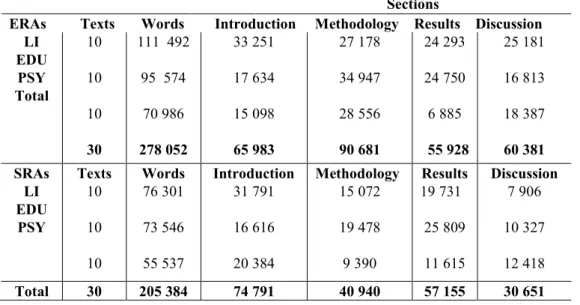
Table 1. Number of words in each section of the RAs
The data shows a similar number of words in each of the sections across languages, except in the Methodology and Discussion sections where the ERAs show a higher number of words compared to the SRAs. Normalisation of data had to be carried out per 10 000 words due to the difference of words in each corpus.
2.3 Analytical framework
The search for pronominal signals was made using a comprehensive list of pronominal signals in both languages (I, my, my, myself, me, mi, mi / mis, mio/-os/-a/-as, we, our, us, ourselves, nos, nuestro/-os a/-a/ we, our, us, ourselves, nos, nuestro/-os/- a/-as). For the case of subject pronouns in Spanish, the items had to be tagged by verb endings for the plural forms (nosotros *amos, *emos, *imos) . The quantitative search of items was made using WordSmith tools (Scott, 2008). The qualitative analysis was carried out with a modified version of Tang and John’s (1999) continumm of authorial presence that included a new role: I as the Interpreter. This new role in the taxonomy represents the writers’ interpretation of the final outcome of the research, where their expertise and contribution to the field is expressed. Writers provide meaning and build knowledge according to the results of their study. They bring out the significance of their contribution to the field.
Figure 1. A new continuum of authorial presence in academic writing
3. Results
3.1 Frequency of PDFs
Figure 2 shows the frequency of PDFs across sections in English and Spanish with the normalised data.
Figure 2. PDFs across sections per 10 000 words
Sections
ERAs Texts Words Introduction Methodology Results Discussion LI
EDU PSY Total
10
10
10
30
111 492
95 574
70 986
278 052
33 251
17 634
15 098
65 983
27 178
34 947
28 556
90 681
24 293
24 750
6 885
55 928
25 181
16 813
18 387
60 381 SRAs
LI EDU PSY
Texts
10
10
10
Words
76 301
73 546
55 537
Introduction
31 791
16 616
20 384
Methodology
15 072
19 478
9 390
Results
19 731
25 809
11 615
Discussion
7 906
10 327
12 418
Contrary to my second prediction, the Discussion shows the highest distribution of items in both English and Spanish. The highest distribution of items in the ERAs occurs in the Discussion section, followed by the Introduction, Methodology and finally Results. Similarly to the ERAs, the Discussion section shows the highest distribution of items in the SRAs. However, the Results section is second in the continuum of frequency, followed by Introduction and finally Methodology. Thus, whereas English writers make themselves more present in the text in the Discussion and Introduction, Spanish writers’ authorial presence is more frequent in the Discussion and Results section. The latter result partially confirms my initial prediction, that PDFs are the least frequent in the Results sections, at least in the ERAs. This also shows the writers’ tendency to be more persuasive at the start and at the close of the articles, and to be more persuasive (and perhaps also more self-promotional) at the start as suggested by Harwood (2005a). However, these results only apply to English, and only partially to Spanish. By heavily using PDFs in the closing section of the RA, writers might be announcing the novelty and value of their work, and it offers them a space to persuade about their work to the reader. One interesting finding is that Spanish writers do not make themselves present in the Methodology section as much as English writers, and in fact, the PDFs are least frequent in the Methodology section of the SRAs. This difference may be explained in terms of the use of passive formsby Spanish writers, who tend prefer to detach themselves from the research process.
As with the overall totals, normalisation of data was carried out in order to make the comparative analysis across sections. Table 2 shows the frequency and distribution of each pronominal discourse function across sections.
Table 2.Distribution of PDFs across sections with normalised data per 10 000 words
Introduction Methodology Results Discussion
ERAs SRAs ERAs SRAs ERAs SRAs ERAs SRAs
Representative Guide Architect Recounter Opinion holder Interpreter Originator 9.6 .15 14.3 19.7 4.8 0 3.9 5.0 .80 8.1 13.2 4.1 .13 1.4 2.4 .88 5.2 38.2 1.6 0 2.8 4.8 .97 3.6 14.4 1.7 .97 .97 3.5 2.6 6.6 23 2.3 1.6 4.4 8.8 2.7 12.6 10.6 2.1 3.2 4.9 20.7 5.4 6.9 34.4 0 4.8 13.2 12.1 4.3 4.0 15.1 5.7 9.4 3.0
3.2 PDFs in the sections of English and Spanish RAs
3.2.1 PDFs in the Introduction
Contrary to my initial prediction as indicated RRP is the most frequent role in both the ERAs (19.7 items per 10 000 words) and SRAs (13.2 items per 10 000 words).
(1) We decided to use diathesis alternations as an approach to characterizing verb behavior, and to use the following verb features to stepwise describe diathesis alternations: (1) syntactic structures, which are relevant for capturing argument functions; (2) prepositions, which are relevant to distinguish, for example, directions from locations; and (3) selectional preferences, which concern participant roles (LIE.RA2)
(2) Primero transcribimos las clases. Debido a que nuestro interés en esta observación está dirigido a las actividades y estrategias que potencia el maestro y no a los detalles del discurso… Utilizamos los signos de puntuación convencionales…(First, we transcribed the classes. Since our interest in this observation is directed to the activities and strategies triggered by the teacher and not by the details of the discourse…. We used the conventional punctuation
symbols. (EDUS.RA4)
Examples 1 and 2 occur at the end of the Introduction section before presenting the Methodology section. In both examples writers explain the procedure they followed in their research and announce their methodological procedures and their selected methodological choices, underscoring their work at the start of the RA.
In comparative terms, RRP shows a difference in frequency between the ERAs and SRAs (RRP-ERAs=19.7 > SRAs=13.2). Perhaps this difference in the use of RRP in the Introduction section could be explained if we analyse the small culture in which the genre is embedded. As suggested by Hirano (2009) “smaller discourse communities” in non English speaking contexts tend to be less competitive compared to highly competitive international discourse communities which aim to publish in high impact journals. Hence, the SRAs writers may not promote their methodological steps as often as ERAs writers who flag up their novel methodology in the Introduction more often.
R-5.0 items per 10 000 words). This suggests that the writers in both languages establish a relationship with the discourse community and that they show an awareness of the reader’s needs in terms of readability and organisation of the text. In comparative terms, R and AR are significantly different between the ERAs and SRAs. These two functions occur almost twice as frequently in the ERAs compared to the SRAs. The greater frequency of R suggests that English writers include the reader into the text as a persuasive strategy. This is more commonly found in the English data than the Spanish one. This may be explained in terms of the more competitive environment of international journals, in which gaining the agreement of other fellow members of one’s discourse community may be a more difficult task compared to a more “national” and less competitive discourse community.
Also, English writers state goals, signal the overall organisation and section organisation (prospective architect-73 items), more often than Spanish writers. This result contradicts Sheldon’s (2009) claims about Spanish having a higher frequency of explicit guidelines to the reader, and confirms Valero-Garces’s (1996) arguments about the effort readers have to make in order to comprehend a Spanish text due to its implicitness, that is it is the reader’s role, at least in this section of the SRAs, to understand the structure of the text. However, these results do not imply that Spanish writers do not signal the organisation of the text, since there is also the option of non reference to writers (Thompson, personal communication, August, 5, 2010 calls this surrogate sayer) to indicate the structure of the paper (Example 3)
(3) El propósito de este artículo es dar lineamientos para la implementación de un programa de lectura extensiva en la enseñanza del inglés como lengua extranjera. El objetivo es promover y mantener el hábito de la lectura por placer, con el fin de que la población estudiantil lea y escriba mejor, enriquezca su vocabulario y logre mejorar también su habilidad comunicativa. (The purpose of this article is to outline the implementation of an extensive reading programme in teaching English as a foreign language. The objective is to promote and maintain the habit of reading for pleasure, aiming to improve the students writing and reading, erich their vocabulary and achieve better communicative competence)
(EDUS.RA3)
Items such as example 3 are frequent in the SRAs to signal the organisation of the text. The writers detach themselves from the objective and emphasise the goal of the study itself instead of mentioning themselves as actors of the research process (our aim, our goal, our objective, or, more overtly, we aim to, we wish to etc.). In this way, they signal the overall organisation and content of the paper without overtly appearing in their text. This may be explained also in terms of the collectivistic tendency of Spanish speaking countries, where the representation of one’s self might be considered impolite (Hickey, 2005).
3.2.2PDFs in the Methodology
Due to the rhetorical function of the Methodology section it was expected that RRP would be the most frequently used function, and indeed this was the case in both the ERAs (38.2 items per 10 000 words) and SRAs (14.4 items per 10 000 words). The most frequently used sub-function within RRP was Methods (ERAs=305 items and SRAs=45 items). In comparative terms, RRP is significantly different when comparing the ERAs and SRAs corpus (RRP-ERAs=38.3 > SRAs=14.4). My results correlate with Mur-Duenas’ (2007) and Sheldon’s (2009) findings when comparing English and Spanish RAs in Business Management and Applied Linguistics and Language Teaching respectively. Both authors found that RRP was the most frequent role in the Methodology section, and also that ERAs showed a higher frequency of RRP than the SRAs. This result may suggest that English writers are more confident and active in their methodological choices, and claim more responsibility for these choices compared to Spanish writers. This difference may be explained in terms of the rhetorical conventions of Spanish academic discourse, where there might be a preference to create knowledge in a more detached fashion. See example 4.
(4) Para llevar a cabo la cuantificación de las SLS entre las variables textuales: palabras clave-resumen, palabras clave-contenido y resumen-contenido se determinó estadísticamente un corpus de investigación de 22 artículos de investigación científica: 12 de ciencias biológicas y 10 de ciencias sociales. (In order to carry out the quantification of the SLS between the textual variables: key words, key-content words and content-summary a corpus for investigation made up with 22 research articles was statistically determined: 12 from biological sciences and 10 from social science). (LIS.RA10)
We can see in example 4 the detachment Spanish writers present in the utterance by using se determinó (was determined) instead of the active use of a pronoun to signal the writers as performers of the research process, giving objectivity to their research.
The ERAs show AR as the second most frequently used function (5.2 items per 10 000 words), prospective current
writers also emphasise the organisation of the text in this section of the RA, making this “reader friendly”. In the SRAs,
R is the second most frequently used function (4.8 items per 10 000 words), representive researchers beingthe most frequent sub-function within R to signal the inclusion of the reader.
It is worth pointing out that R also varies in frequency between the ERAs and the SRAs (R-ERAs=2.4 < SRAs=4.8). Spanish writers make themselves present in the Methodology as representative researchers in the community more often, signaling an inclusion of fellow researchers in the research process. This might be explained in terms of the collectivistic tendency in Hispanic cultures of viewing people as interdependent, leading to an emphasis on group-oriented values (Markus and Kitayama, 1991) and construction of knowledge. See example 5.
(5) Si entendemos que, retomando a Fairclough y Wodak (2000), con el lenguaje se construyen identidades, representaciones y relaciones, queda claro que con el Manual de Carreño se modeló una forma de comportamiento interpersonal y grupal que debía ser interiorizada como norma que el personal Manual prácticamente canonizó. (If we understand that, taking Fairclough and Wodak (2000), language builds identities, representations and relationships, it is clear that with the Manual of Carreno a way of interpersonal and group behaviour was modelled, which should have been internalised as
a norm that the Manual canonised. (LIS.RA1)
In example 5 the writer assumes an understanding of field specific concepts from fellow researchers in the discourse community (si entendemos-ifwe understand), building knowledge collectively in this way.
3.2.3 PDFs in the Results
In this section RRP-Results was expected to be the most frequently used function. The analysis partly confirms my hypothesis, as RRP is the most frequently used function in the ERAs in this section; however RRP-Methods (92 items) is the most commonly occurring sub-function, not RRP-Results (15items only). See example 6.
(6) Because of the possible influence of depressive symptoms, comorbid axis I disorders and use of psychotropic drugs on treatment outcome, the regression analysis was repeated by controlling for these variables. We also included baseline BDI scores, comorbid diagnoses (no diagnosis = 0; present diagnosis = 1), and psychotropic drugs during treatment (no drugs = 0; concomitant drugs = 1) as independent variables in the egression analysis. (PSYE.RA8)
Writers in both data sets announce their methodological choices. They present themselves as reliable, careful researchers, whose results can therefore be trusted by claiming responsibility for specific procedures that led to novel results. RRP then emphasizes them as having the competence to select appropriate research methods. Contrary to my initial prediction, AR is the most frequent function in Results in the SRAs. Thus, the two corpora show different patterns of PDF use in this section. Within this main role currentarchitect (41 items) is the most frequently used sub-function. See example 7.
(7) En esta secuencia podemos ver un trabajo deliberado para que los niños apliquen técnicas de lectura para la solución de problemas. Se asegura de contextualizar el problema y que los niños activen esquemas que le permitan ubicar el problema y darle posibles soluciones; les da tiempo para que lean, analicen el problema y lo resuelvan.... Nos interesa aquí resaltar el trabajo que hace de lectura y comprensión de problemas de matemáticas. (In this sequence we can see a deliberate attempt for children to apply reading techniques to solve problems. She makes sure to contextualise the problem and that children activate schemata that allows her to contextualise the problem and give possible solutions; she gives time to read, analyse the problem and solve it…. We are interested here in highlighting the labour of reading and comprehension of mathematical
problems. (EDUS.RA)
Items such as example 7 are frequent in the Results section of the SRAs. These usually signal the organisation of the discourse as it unfolds, outlining and explaining the results to the reader. The data may suggest that Spanish writers prefer to use passive forms to signal the results of the research process and build knowledge, instead of the authors’ active presence as in English academic discourse, as illustrated in the typical example given below (8)
características reseñadas se definen como el origen de manifestaciones atinentes a diverso orden, como se observa en el ejemplo 2: ... (It is also observed 19.24% of occurrences are future absolute or categoric tense, specially in the construction of cause-effect relations: some of the characteristics are defined as the orgin of the manifestations related to a diverse order, as observed in example 2)... (LIS.RA5)
R, AR and RRP show significantly different frequency patterns between the ERAs and the SRAs. R and AR in the SRAs are twice as frequent as in ERAs (R-ERAs=3.5 < SRAs= 8.8; AR- ERAs=6.6 < SRAs=12.6). However, this differs for RRP (RRP-ERAs=23 > SRAs=10.6), as it is in the ERAs that this function is twice as frequent as in the SRAs. The latter result confirms Martinez’s (2005) findings, with regard to the much higher frequency of explaining a procedure (RRP) in native compared to non native academic writing in the Results section.
3.2.4 PDFs in the Discussion
Contrary to my initial belief, OR and IN are not the most frequently used PDFs in the Discussion, but again RRP is the most frequently used role in both ERAs and SRAs (34.4 and 15.1 items per 10 000 words respectively). In both ERAs and SRAs RRP-Methods is the most frequently used sub-function (118 items and 27 items respectively). See examples 9 and 10.
(9) The fact that giving consent did not depend on the occurrence of an event and that our sample represented the eligible population well speaks against this possibility as a major bias. Our cohort was 78% female and racially homogeneous (white employees), corresponding to Finnish municipal workers in general (39).(PSYE.RA3)
(10) Los menores que hemos entrevistado se ven obligados a trabajar para atender a sus necesidades económicas de subsistencia. Algunos, sobre todo los más pequeños, ayudan en la actividad familiar y no reciben directamente una remuneración, otros trabajan por su cuenta y con el dinero que obtienen ayudan a su familia. (The under-aged that we have interviewed have been forced to work in order to fulfil their survival economic needs. Some of them, especially the youngest, help in their family’s activity and do not receive their earnings directly, some other work on their own and with their earnings, they support their families) (EDUS.RA7)
This result might be related to the Discussion’s “cyclic nature” (Swales, 1990), where writers re-capitulate previous points from the research paper. In self-promotional terms writers continue stating their research steps in this section, perhaps to highlight the relationship between their competent methodological choices and their groundbreaking results and other particularities of their work (Harwood, 2005a).
The second most frequently used function in both the ERAs and SRAs is R (20.7 and 12.1 items per 10 000 words respectively). The most common sub-function in the ERAs is representative researchers (72 items), whereas the SRAs show representative everyone occurring more frequently (21 items). These results could correspond to Move
4-reference to previous research (Move 4-researchers representative) for the ERAs and Move 7-deduction (Move
7-everyone representative) for the SRAs. See examples 11 and 12.
(11) Admittedly, this study’s findings are limited because they are correlational. However, they fuel previous arguments (e.g., Adams, 1990) that home environment is likely to influence reading performance in various ways, and they extend our understanding of how far in development such effects may be observed. (EDUE.RA8)
One of the possible explanations for the high occurrence of R in both data sets is related to the section’s rhetorical function. In the Discussion section writers generally state results and situate these within the wider context in the discourse community and possibly refer back to previous work done in the field.
In comparative terms, RRP and R show a significant difference in frequency between the ERAs and the SRAs in the Discussion, as they are twice as frequently used in the ERAs (RRP-ERAs=34.4 > SRAs=15.1 and R-ERAs=20.7 > SRAs=12.1). Again, the difference between English and Spanish could be explained in terms of the Spanish writers’ preference to detach themselves from their propositions, or perhaps also the issue of “national” versus international communities, in which the latter one demands different rhetorical strategies to persuade the reader in competitive environments.
An interesting finding in this section was the comparative frequency of IN. This main role is the third most frequently used function in the SRAs (7.78), whereas the ERAs show a lower frequency of this function (IN-ERAs=6.1 < SRAs=9.4).
(13) …Como veremos a continuación, esto es algo que se repetía en el grupo de las mujeres del mismo nivel educativo, lo que nos hace suponer que la educación formal y los instrumentos que ésta privilegia favorecen la reflexión sobre la propia práctica. (... As we will see now, this is something that was repeated in the women group of the same educational level, which makes us suppose that formal education and the instruments that this privileges favour self reflection) (PSYS.RA10)
In item 13 writers interpret their propositions in an attempt to persuade the reader by generalising claims from their results (Move 8-hypothesis).
The most remarkable finding in comparative terms occurs in this section. The OR role is four times more frequent in the ERAs compared to the SRAs (OR-ERAs=13.2 > SRAs=3.0). (Example 14)
(14) Our results suggest that school is a powerful contextual tool in understanding reading achievement. Within this framework, the school a child attends is particularly important because of the influences of his peers, who have been affected by their own parents (EDUE.RA8).
This suggests that English writers are more confident when making claims about their outcomes directly by use of the
OR role. That is, they may market their work and claim responsibility for their novel contribution by presenting themselves as originators of knowledge. On the other hand, Spanish writers are less present and prefer to detach themselves when making claims about their contributions.
4. Discussion & Conclusion
As suggested by Bhatia (2004), genre analysis has now expanded to take account of the social dimension: genre is now envisaged as a strategic space for interaction among the members of a discourse community. This may be related to the high and general occurrence of the RRP role in the data set. We could see in the results an interesting pattern of agreement across sections and between corpora: RRP was the most frequent main role in all sections in both languages, except for the Results section in Spanish in which AR is the most frequent. Another issue is that most of the time the ERAs show a higher frequency of items. However this does not necessarily mean that Spanish writers do not state the steps in the research process (RRP), organise the text (AR) or show their contributions to the field, but the nature of Spanish academic discourse could be affecting the results. This again could represent the general politeness strategy of Spanish speaking cultures of being detached from propositions (Hickey, 2005), or perhaps the “national” culture in terms of competitiveness for publication has had also an effect on the rhetorical strategies Spanish writers use.
Acknowledgements
I am endlessly thankful and indebted to Geoff Thompson for his diligent supervision during my research. His knowledge and support have made the completion of this study possible. I am also grateful to the National Council for Science and Technology of Mexico for funding this study.
References
Atkinson, D. (2004). Contrasting rhetorics/contrasting cultures: Why contrastive rhetoric needs a better conceptualization of culture. Journal of English for Academic Purposes, 3, 277-289.
Bakhtin, M. (1981). The dialogic imagination: Four essays by M.M. Bakhtin. In M. Holquist, trans. by C. Emerson & M. Holquist. Austin and London: University of Texas Press.
Becher, T., & Trowler, P. (2001) Academic tribes and territories: Intellectual enquiry and theculture of disciplines. Buckingham: SHRE & Open University Press.
Bernhardt, S. A. (1985). The writer, the reader and the scientific text. Journal of Technical Writing and
Communication, 15, 163-174.
Bhatia, V.K. (2004). Worlds of written discourse: A genre-based view. London: Continuum.
Bolivar, A. (1986). Interaction through written text: a discourse analysis ofnewspaper editorials. Unpublished Ph.D. thesis, University of Birmingham.
Bolivar, A. (2001). The negotiation of evaluation in written text. In M. Scott & G. Thompson, (Eds.), Patterns oftext
(pp. 129–158). Amsterdam: John Benjamins.
Brett, P. (1994). A genre analysis of the results section of sociology articles. English forSpecific Purposes, 13, 47-59. Carciu, O.M. (2009). An intercultural study of first-person plural references in biomedical writing. Iberica, 18, 71-92 Coulthard, M. (1977). An introduction to discourse analysis. London: Longman
Crismore, A., & Farnsworth, R. (1990). Metadiscourse in popular and professional science discourse. In W. Nash (Ed.),
The writing scholar: Studies in academic discourse (pp. 118-136). Newbury Park, CA: Sage
Crismore, A., Markkanen, R., & Steffensen, M.S. (1993). Metadiscourse in persuasive writing. Written Communication,
10(1): 39-71.
Davies, F. (1994). From writer roles to elements of the text: Interactive, organisational and topical. In L. Barbara and M. Scott (Eds.), Reflections on language learning (pp. 170-183). Clevedon: Multilingual Matters.
Harwood, N. (2003). Person markers and interpersonal metadiscourse in academic writing: A multidisciplinary corpus based study of expert and student texts. Unpublished doctoral thesis, Canterbury Christ Church University College, Kent.
Harwood, N. (2005a). ‘Nowhere has anyone attempted… In this article I aim to do just that’. A corpus based study of self-promotional I and we in academic writing across four disciplines. Journal of Pragmatics, 37, 1207-1231.
Harwood, N. (2005b). ‘I hoped to counteract the memory problem, but I made no impact whatsoever’: Discussing methods in computing science using I. English for Specific Purposes, 24, 243-267.
Harwood, N. (2005c). ‘We do not seem to have a theory…. The theory I present here attempts to fill this gap’: Inclusive and exclusive pronouns in academic writing. Applied Linguistics, 26(3), 343-375.
Harwood, N. (2006). (In) appropiate personal pronoun use in political science: A qualitative study and a proposed heuristic for future research. Written Communication, 23, 324-350.
Heslot, J. (1982). Tense and other indexical markers in the typology of scientific texts in English. In Hoedt (Ed.),Pragmatics and LSP (pp. 83–103). Copenhagen: Copenhagen School of Economics.
Hickey, L. (2005). Politeness in Spain: Thanks but no thanks. In L. Hickey, & M. Stewart (Eds.), Politeness in Europe
(pp. 317-330), Clevedon: Multilingual Matters
Hirano, E. (2009). Research articles introductions in English for specific purposes: A comparison between Brazilian Portuguese and English. English for Specific Purposes, 28, 240-250.
Hopkins, A., & A. Dudley-Evans (1988). A genre-based investigation of the discussion sections in articles and dissertations. English for SpecificPurposes, 7, 113-22.
Hoey, M. (2001). Textual interaction: An introduction to written discourse analysis. London: Routledge.
Hyland, K. (1998). Persuasion and context: The pragmatics of academic metadiscourse. Journal of Pragmatics, 30(4), 437-455.
Hyland, K. (1999). Discliplinary discourses: Writer stance in research articles. In C .N. Candlin, & K. Hyland, (Eds.),
Writing: Texts, processes and practices (pp. 122–142). Malaysia: Longman
Hyland, K. (2001a). Bringing in the reader: addressee features in academic writing. Written Communication , 18, 549-574.
Hyland, K. (2001b). Humble servants of the discipline? Self-mention in research articles. English for Specific Purposes, 20, 207-226.
Hyland, K. (2002). Authority and invisibility: Authorial identity in academic writing. Journal of Pragmatics, 34, 1091-1112.
Hyland, K. (2004). Disciplinary interactions: Metadiscourse in L2 postgraduate writing. Journal of Second Language Writing, 13(2), 133-151.
Hyland, K. (2005a). Stance and engagement: A model of interaction in academic discourse. Discourse Studies, 7(2), 173-192.
Hyland, K. (2005b). Metadiscourse: Exploring interaction in writing. London: Continuum.
Hyland, K. (2005c). Representing readers in writing: Student and expert practices. Linguistics and Education, 16(4), 363-377.
Hyland, K., & Tse, P. (2004). Metadiscourse in academic writing: A reappraisal. Applied Linguistics, 25(2), 155-177. Hyland, K. & Tse, P. (2005). Evaluative that constructions. Signaling stance in research abstracts. Functions of Language, 12(1), 39-63.
Intaraprawat, P., & Steffensen M.S. (1995). The use of metadiscourse in good and poor ESL essays. Journal of Second Language Writing, 4 (3), 253-272
Ivanič, R. (1998). Writing and identity: The discoursal construction of identity in academic writing. Amsterdam: John Benjamins.
Kim, C. K. (2009). Personal pronouns in English and Korean texts: A corpus-based study in terms of textual interaction.
Journal of Pragmatics, 41, 2086-2099.
Kim, C. K. and Thompson, G. (2010). Obligation and reader involvement in English and Korean science popularizations: A corpus-based cross cultural text analysis. Text & Talk, 30, 53-73.
Kuo, C.H. (1999). The use of personal pronouns: Role relationships in scientific journal articles. English for Specific Purposes, 18, 121-38.
Lores Sanz, R. (2011). The construction of the author's voice in academic writing: The interplay of cultural and disciplinary factors. Text & Talk, 31, 173-819.
Lim, J.M.H. (2006). Methods sections of management research articles: A pedagogically motivated qualitative study.
English for Specific Purposes, 25, 282-309.
Markus, H.R., & Katayama, S. (1991). Cultures and the self: Implications for cognition, emotion, and motivation.
Psychological Review, 98, 224-253
Martinez, I. A. (2005). Native and non native writers’ use of first person pronouns in the different sections of biology research articles in English. Journal of Second Language Writing, 14, 174-190.
McCarthy, M. (1993). Spoken discourse markers in written text.. In J. M. Sinclair, M. Hoey, & G. Fox. (Eds.),
Techniques of Description (pp. 170–182). London: Routledge
McCarthy, M., & Carter, R. (1994). Language as discourse: Perspectives for language teaching. Harlow: Longman. Molino, A. (2010). Personal and impersonal authorial references: A contrastive study of English and Italian Linguistics research articles. Journal of English for Academic Purposes, 9, 86-101.
Mur-Dueñas, P. (2007). ‘I/we focus on’: A cross-cultural analysis of self-mentions in business management research articles. Journal of English for Academic Purposes,6, 143-162.
Nwogu, K.N. (1997). The medical research paper: structure and functions. English for Specific Purposes, 16, 119-138. Nystrand, M. (1986). The structure of written communication: Studies in reciprocity between writers and readers.
Orlando: Academic Press.
Nystrand, M. (1989). A social interactive model of writing. Written Communication, 6(1), 66-85. Scott, M. (2008). WordSmith Tools. Oxford: Oxford University Press.
Starfield, S. & Ravelli, L.J.(2006). ‘The writing of this thesis was a process that I could not explore with the positivistic detachment of the classical sociologist’: Self and structure in New Humanities research theses. Journal of English for Academic Purposes, 5, 222-243.
Shaw, P., & Liu, T.K. (1998). What develops in the development of second-language writing? Applied Linguistics,
19(2), 225-254.
Swales, J.M. (1990). Genre Analysis: English in academic and research settings. Cambridge: Cambridge University Press.
Tang, R., & John, S (1999). The I in identity: Exploring writer identity in student academic writing through first person pronoun. English for Specific Purposes, 18, 23-39
Tarone, E., Dwyer, S., Gillet, S., & Icke, V. (1998). On the use of the passive in two astrophysics journal papers.
English for Specific Purposes, 17, 123-140.
Thompson, G. (2001). Interaction in academic writing: learning to argue with the reader. Applied Linguistics, 22 (1): 58-78.
Thompson, G. & Thetela, P. (1995). The sound of one hand clapping: The management of interaction in written discourse. Text, 15(1): 103-127.
Valero-Garces, C. (1996). Contrastive ESP rhetoric: Metatext in Spanish-English Economic text. English for Specific Purposes, 15, 279-294
Vassileva, I. (1998). Who am I / who are we in academic writing? A contrastive analysis of authorial presence in English, German, French, Russian and Bulgarian. InternationalJournal of Applied Linguistics, 8, 163-90.
Widdowson, H. (1984). Explorations in applied linguistics 2. Oxford: Oxford University Press.
Yang, R. & Allison, D. (2003). Research articles in applied linguistics: moving from results to conclusions. English for Specific Purposes, 22, 365-385.
Appendix I- Sample list of research articles in the data Linguistics
English LIE .RA1
Ringlstetter, C. & Mihov, S. (2005). Orthographic errors in web pages: toward cleaner web corpora. Computational Linguistics, 28, 295-340.
LIE .RA2
Schutle im Walde, S. (2006). Experiments on the automatic induction of German semantic verb clauses. Computational Linguistics, 32, 159-194.
LIE.RA3
Fedorenko, E., Gibson, E., & Rohde, D. (2006). The nature of working memory capacity in sentence comprehension: evidence against domain specific working memory resources. Journal of Memoryand Language, 54, 541-553.
LIE.RA4
Engelhardt, P.E., Bailey, K., Ferreira, F. (2006).Do speakers and listeners observe the Gricean Maxim of quality?.
Journal of Memory and Language, 54, 554-573.
LIE.RA5
Jonsson, M. & Hampton, J. A. (2006). The inverse conjunction fallacy. Journal of Memory and Language, 55, 317-334.
Spanish LIS.RA1
Malaver, I.(2005). Estudio socio pragmático del Manual de Urbanidad y Buenas Maneras de Manuel Antonio Carreño.
Boletín de Lingüística, 24, 55-77.
LIS.RA2
Domínguez Mujica, C.M. (2005). Marcadores de (in)conclusión en el español hablado en Mérida Venezuela. Boletín de Lingüística, 23, 3-22.
LIS.RA3
Chumaceiro Arreaza, I. (2003). El discurso de Hugo Chavez: Bolivar como estrategia para dividir a los venezolanos.
Boletín de Lingüística, 20: 22-42.
LIS.RA4
Acosta, O. M. (2006). Análisis de introducciones de artículos de investigación publicados en la Revista Núcleo 1985-2003. Núcleo, 18, 9-30.
LIS.RA5
Education English EDUE .RA1
Zhu, E. (2006). Interaction and cognitive engagement: An analysis of four asynchronous online discussions.
Instructional Science, 34, 451-480.
EDUE .RA2
Ling Kohl, J. H.(2006). Motivating students of mixed efficacy profiles in technology skills classes: A case study.
Instructional Science, 34, 423-449.
EDUE .RA3
Levin, T. and Wagner, T. (2006).In their own words: Understanding student conceptions of writing through their spontaneous metaphors in the science classroom. Instructional Science, 34, 227-278.
EDUE .RA4
Lièvre, B., Depover, C., Dillenbourg, P. (2006). The relationship between tutoring mode and learners' use of help tools in distance education. Instructional Science, 34, 97-127.
EDUE .RA5
Lauer , P., Akiba, M., Wilkerson, S. B., Apthorp, H. S., Snow, D., Martin-Glenn, M. L. (2006).Out-of-school-time programs: A meta-analysis of effects for at-risk students. Review of Educational Research, 76, 275-313.
Spanish EDUS .RA1
Chacón Araya, Y. and Moncada Jiménez, J. (2006).Relación entre personalidad y creatividadenestudiantes de educación física. Actualidades Investigativas en Educación, 6, 1-19.
EDUS .RA2
Carmona Mendoza, R., Crawford Daniels, S. , Rivera Calvo, A.C., Zamora González, L. (2006). La aprobación de la lengua escrita en el ciclo de transición con base en la filosofía del lenguaje integral. Actualidades Investigativas en Educación, 6, 1-22.
EDUS .RA3
Hernández Herrero, A. (2007). La lectura extensiva: un medio para mejorar la habilidad lingüística de la población estudiantil. Actualidades Investigativas en Educación, 7, 1-34.
EDUS .RA4
Cárdenas, M.A., and Rivera, J.F. (2006). El análisis del discurso en el aula: una herramienta para la reflexión.
EDUCERE, 10, 43-48.
EDUS .RA5
MorLIEs, O.A., Rincón, A.G., Tona Romero, J. (2006). La promoción de la lectura en contextos no escolares y sus implicaciones pedagógicas: estudio exploratorio en Mérida, Venezuela. EDUCERE, 10, 283-292.
Psychology English PSYE.RA1
Jacobs, N., Rijsdikj, F., Derom, C., Vlietinck, R., Delespaul, P., Van Os, J., & Myin-Germeys, I. (2006). Genes making one feel blue in the flow of daily life: A momentary assessment study of gene-stress interaction. Psychosomatic
Medicine, 68, 201-206.
PSYE.RA2
Berlin, A. A., Kop, W.J., & Deuster , P.A. (2006). Depressive mood symptoms and fatigue after exercise withdrawal: The potential role of decreased fitness. Psychosomatic Medicine,68, 224-230.
PSYE.RA3
Vahtera, J., Kivimäki, M., Väänänen, A., Linna, A., Pentti, J., Helenius, H., & Elovainio M. (2006). Sex Differences in Health Effects of Family Death or Illness: Are Women More Vulnerable Than Men?. Psychosomatic Medicine,68, 283-291.
PSYE.RA4
Johnson-Laird, P. N., Mancini, F., & Gangemi, A. (2006). A hyper-emotion theory of psychological illnesses.
PSYE.RA5
Ruini,C., Belaise, C., BrombinC., Caffo, E., & Fava, G.(2006). Well-being therapy in school settings: A pilot study.
Psychotherapy and Psychosomatics, 75, 331-336.
Spanish PSYS.RA1
Robles Montijo, S. Piña López, J. A., & Moreno Rodríguez, D. (2006). Determinantes del uso inconsistente del condón en mujeres que tienen sexo vaginal, oral y anal. Anales de Psicología, 22, 200-204.
PSYS.RA2
López Durán, A. & Becoña Iglesias, E. (2006). El craving en personas dependientes de la cocaína. Anales de Psicología, 22, 205-211.
PSYS.RA3
Remor, E., Amoros, M., & Carroblies, J.A. El optimismo y la experiencia de ira en relación con el malestar físico.
Anales de Psicologia, 22, 37-44.
PSYS.RA4
Pardo, C.F. & Burbano Valente, J. (2006). Las trampas de la velocidad: Análisis de la lectura cultural de dos organizaciones. Universitas Psychological, 6, 131-142.
PSYS.RA5
Cárdenas, M. (2006). Escala de racismo moderno: Propiedades psicométricas y su relación con variables psicosociales.
Universitas Psychological, 6, 255-262.