DGE: Deep Generative Network Embedding Based on Commonality and
Individuality
Sheng Zhou
1,2,3, Xin Wang
4∗, Jiajun Bu
1,2,3†, Martin Ester
5, Pinggang Yu
1,2,
Jiawei Chen
1, Qihao Shi
1, Can Wang
11Zhejiang Provincial Key Laboratory of Service Robot, College of Computer Science, Zhejiang University, Hangzhou, China 2Alibaba-Zhejiang University Joint Institute of Frontier Technologies, Hangzhou, China
3Ningbo Research Institute, Zhejiang University, Ningbo 315100, China 4Tsinghua University, Beijing, China5Simon Fraser University,Canada
{zhousheng zju, bjj, pgyu, sleepyhunt, shiqihao321, wcan}@zju.edu.cn, xin [email protected], [email protected]
Abstract
Network embedding plays a crucial role in network analy-sis to provide effective representations for a variety of learn-ing tasks. Existlearn-ing attributed network embeddlearn-ing methods mainly focus on preserving the observed node attributes and network topology in the latent embedding space, with the as-sumption that nodes connected through edges will share sim-ilar attributes. However, our empirical analysis of real-world datasets shows that there exist bothcommonality and indi-vidualitybetween node attributes and network topology. On the one hand, similar nodes are expected to share similar at-tributes and have edges connecting them (commonality). On the other hand, each information source may maintain in-dividual differences as well (inin-dividuality). Simultaneously capturing commonality and individuality is very challenging due to their exclusive nature and existing work fail to do so. In this paper, we propose a deep generative embedding (DGE) framework which simultaneously captures common-ality and individucommon-ality between network topology and node attributes in a generative process. Stochastic gradient varia-tional Bayesian (SGVB) optimization is employed to infer model parameters as well as the node embeddings. Extensive experiments on four real-world datasets show the superiority of our proposed DGE framework in various tasks including node classification and link prediction.
Introduction
Networks are natural representations for a wide variety of real-life data, from social rating networks, author/paper ci-tation networks to gene interaction networks. As more and more information becomes available, nodes in real-world networks are often associated with attributes, which is re-ferred as attributed network (Wang et al. 2017b). Attributed network embedding is a powerful and increasingly popular approach to conduct comprehensive analysis on attributed networks. Tasks such as link prediction (Wang, Cui, and Zhu 2016) and node classification (Tang, Qu, and Mei 2015) all greatly benefit from effective latent node representations ob-tained by good network embedding approaches.
∗
Corresponding Author
†
Corresponding Author
Copyright c2020, Association for the Advancement of Artificial Intelligence (www.aaai.org). All rights reserved.
Most of existing attributed network embedding meth-ods (Huang, Li, and Hu 2017b; 2017a; Liao et al. 2018; Li et al. 2017b) project the observed data into the la-tent embedding space while preserving properties includ-ing first/second order proximity (Tang et al. 2015), attribute based similarity (Liao et al. 2018) and global structural role (Zhang et al. 2018) etc. Although network topology and node attributes are explicitly considered in existing methods, they simply assume that adjacent nodes in a given network tend to share similar attributes which is referred as common-ality, ignoring more complex relationships between network topology and node attributes. However, real-world network topology and node attributes may exhibit an opposite pattern where adjacent nodes have distinct attributes as well, which is referred asindividuality. Consider a social network whose edges reflect the social connections between users and node attributes reflect the preferences of users, due to the diffi-culty of collecting comprehensive data or the fact that enti-ties are not exposed to each other (Wang et al. 2016), users with similar preferences may be unknown to each other (i.e. unconnected). In bibliographic networks, similar phenom-ena can be observed. Although one paper will (intuitively) cite another paper with similar content, papers without ci-tation relationships can also be similar due to limici-tations in the scale of the corpus and the number of citations.
The above observations demonstrate that there indeed ex-ists individuality in addition to commonality in networks when depicting relationships among different nodes by net-work topology and node attributes. It is a challenging task to capture commonality and individuality simultaneously in latent embedding space since they are mutually exclusive and merging them by force may limit the capability of the learned representations. Some existing attributed network embedding methods take care of the commonality by con-catenating the embeddings from both information sources (Li et al. 2017a) or directly preserving the properties of both information sources in the objective function (Huang, Li, and Hu 2017a), ignoring the individuality in each informa-tion source. Other methods (Kipf and Welling 2016) learn node embeddings by transforming the input attributes to pre-serve the network topology, which ignores the commonality between node attributes and network topology.
Recently, deep generative models (Tolstikhin et al. 2017; Kingma and Welling 2013; Goodfellow et al. 2014) have be-come an efficient way to analyze and understand networks through capturing the inner probabilistic distribution which can generate unobserved samples. Many variants of deep generative model have been extensively studied and applied in various representation learning tasks on image (Radford, Metz, and Chintala 2015) and text data (Zhong and Ghosh 2005). Though deep generative models have also been ex-plored on network data, their applications in attributed net-work have received relatively less scrutiny.
Given the challenges in smoothly and losslessly merging the commonality and individuality into embedding space, we address this issue from an opposite perspective: instead of preserving node attributes and network topology in one single representation, we assume that node attributes and network topology can be generated from a latent represen-tation. Thus the commonality and individuality can then be captured by a generative process. Our basic assumptions are as follows: (1) There exists a low-dimensional hidden space where each node has a density distribution. Both node at-tributes and network topology can be generated from the latent representations. Node with similar latent representa-tions are expected to share similar attributes and have edges connecting them (commonality). (2) Node attributes and network topology are generated in an independent process with different probability distributions. The randomness in the probabilistic distributions and independent generation processes result in the existence of individual differences (individuality) within each of the two information sources.
We develop a stochastic gradient variational Bayesian op-timization framework to obtain the model parameters effi-ciently. In general, the contribution of this paper can be sum-marized as follows:
1. We present commonality and individuality, two relation-ships between node attributes and network topology in attributed network embedding, and prove their existence through an empirical analysis.
2. We propose a deep generative embedding framework ca-pable of simultaneously capturing commonality and indi-viduality relations through modeling the generative pro-cesses of node attributes and network topology.
3. We conduct extensive experiments on four real-world datasets to demonstrate the effectiveness of our proposed DGE framework in several learning tasks.
Related work
In this section, we will review the related studies in two ar-eas, namely network embedding and deep generative mod-els.
Network EmbeddingNetwork embedding aims at learn-ing low-dimensional vector representation to facilitate a bet-ter understanding of semantic relationships among nodes. Among them, DeepWalk (Perozzi, Al-Rfou, and Skiena 2014) and Node2Vec (Grover and Leskovec 2016) em-ploys truncated random walk to generate node sequences, which is treated as sentences in language models and fed into the skip-gram model to learn node embeddings. LINE
(Tang et al. 2015) is proposed for large scale network, which preserves both first-order and second-order proxim-ities. GraRep (Cao, Lu, and Xu 2015) can be regarded as an extension of LINE which considers high-order proxim-ity. SDNE (Wang, Cui, and Zhu 2016) incorporates graph structure into deep auto-encoder to preserve the highly non-linear first order and second order proximities.
All the above mentioned approaches, however, are lim-ited to dealing with non-attributed networks. Attributed work analysis is then put forward due to the fact that net-works are often associated with abundant content. For ex-ample, TADW (Yang et al. 2015) extends DeepWalk by as-suming that each node is associated with rich texts and in-corporate text features into the matrix factorization frame-work. AANE(Huang, Li, and Hu 2017a) is a distributed em-bedding approach that jointly learns node representations by decomposing attribute affinity matrix and penalizing the em-bedding difference between connected nodes with network lasso regularization. SNE (Yuan, Wu, and Xiang 2017) gen-erates embeddings by leveraging an end-to-end neural net-work model to capture the complex interrelations between network structure and node attribute information. Graph-SAGE (Hamilton, Ying, and Leskovec 2017) leverages node feature information and network topology to efficiently gen-erate node embeddings for previously unseen data. PRRE (Zhou et al. 2018) considers the partial correlation between node attributes and network topology and preserved the re-ordered similarity to learn embedding. However, none of the above methods capture commonality and individuality be-tween node attributes and network topology.
Deep Generative ModelsRecently, the deep generative models have attracted much attention and extended to the network embedding. Recent advances in Generative Ad-versarial Networks (GANs) (Goodfellow et al. 2014) have proven GANs as a powerful framework for learning complex data distributions. Some extensions have been proposed to apply GANs on network representation learning. In Graph-GAN (Wang et al. 2017a), generative methods and discrimi-native methods are unified via adversarial training in a mini-max game. GANE (Hong, Li, and Wang 2018), ANE (Dai et al. 2017) and ARVGA (Pan et al. 2018) also explore GANs on network representation by preserving network structure with adversarial learning.
Another type of generative methods are the Variational Auto-encoder(VAE). In VGAE (Kipf and Welling 2016), a graph convolutional network encoder and inner product de-coder is used to learn interpretable latent representations for undirected graphs, however, it only models the generation of network topology. In DVNE (Zhu et al. 2018), gaussian distributions are learned for each node to represent the un-certainty and similarity between distributions are measured in Wasserstein space so that transitivity of proximity in net-works can be well preserved. In RINAE (Li et al. 2017a), the node attributes and network structure are concatenated as the feature representation of nodes. A variational auto-encoder is employed to model the generative process of the concatenated features. In CAN(Meng et al. 2019), two inde-pendent embedding are learned to model the generation of node attributes and network topology. However, none of
ex-isting generative method can capture the commonality and individuality in a unified framework.
1 2 3 4 5 6 7 8 9 10
Shortest Path Length 0
0.05 0.1 0.15 0.2 0.25 0.3
Average Attribute Similarity
Cora Citeseer Pubmed
(a)Commonality
1 2 3 1 2 3 1 2 3 Shortest Path Length 0
0.2 0.4 0.6 0.8 1
Attribute Similarity
Cora Citeseer Pubmed
(b)Individuality
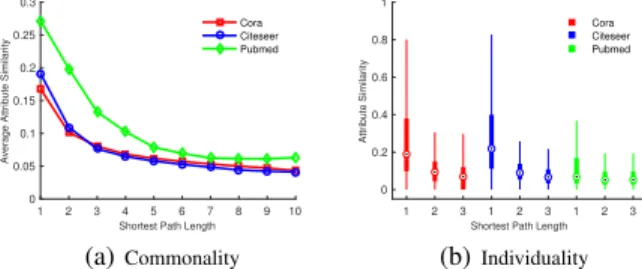
Figure 1: Commonality and individuality between node at-tributes and network topology.
Case Study of Commonality and Individuality
In this section, we report the results of an empirical anal-ysis of commonality and individuality between node at-tributes and network topology, using a Cora, a CiteSeer and a PubMed dataset.Figure 1 shows the results of our empirical analysis. The statistics of the three datasets are presented in table 1. The X axis denots the graph distance of the node pairs, the Y axis denotes the average attribute based similarity of the node pairs. In figure 2 (a), we can observe that with increas-ing graph distance (shortest-path length), the attribute based similarity decreases. In other words, nodes that are close in the network have higher average feature similarity than nodes far from each other in the network. This shows the commonality between two information source in describing the relationship between nodes. In figure 2 (b), each box rep-resents the distribution of the attribute similarity of a group of node pairs with the given graph distance (shortest-path length). The central mark is the median, the edges of the box are the 25th and 75th percentiles, two lines (the whiskers) extend to the most extreme data points not considered out-liers. We observe that there is a considerable number of pairs that are close to each other in the network but have relatively low attribute similarity. Comparing the adjacent bars in the figure, it can be seen that there are many node pairs that have smaller graph distance but smaller attribute similarity than other node pairs. This demonstrates the individuality between the two information sources in describing the rela-tionships between nodes. To conclude, both node attributes and network topology are describing the relationships tween nodes, there exists commonality and individuality be-tween them.
Deep Generative Network Embedding
In this section, we describe the proposed deep generative network embedding (DGE ) framework.Notations and problem definition
An attributed network is defined asG={V,E,X}, where
V = {v1, v2, ..., vN} denotes a set of nodes and N is the
number of the nodes. E is the set of edges between the
nodes,Eij = 1if there exists an edge between nodevi, vj,
M =|E|is the number of edges.X ∈ RN×D is the node
attributes matrix wherexidenotes the attributes of nodevi,
andDis the dimension of node attributes.
Definition 1 Generative Attributed Network Embedding
Given an attributed network G = {V,E,X}, generative attributed network embedding aims at modeling the gener-ation of node attributes and edges in the attributed network and represent each node vi ∈ V as a lower-dimensional
vectorhi ∈RLso that the relationship between nodes can
be represented in the vector space.Lis the embedding di-mension which satisfiesLN andLD.
The generation process
The generative framework is expected to uniformly model two aspects of the attributed network: (1) The observation including node attributes and network topology, (2) The commonality and individuality between node attributes and network topology.
In DGE framework, we consider both binary and contin-uous attributes. The attributes are assumed to be generated from Bernoulli distribution for binary attributes and Gaus-sian distribution for continuous attributes, the parameters of the probabilistic distribution are generated from node em-bedding with deep neural networks. We assume that edge is generated from a Bernoulli distribution parameterized by the similarity between embedding of the connected nodes. It is worth noting that the DGE framework can be expanded to weighted network and directed network by using different probabilistic distributions. We leave it in the future work. Above all, an observed attributed networkG={V,E,X} is assumed to be generated from the following process: 1. For each nodevi∈V, draw vectorzi∼ N(µ0, σ02I)
2. For node with binary attributes (a) Calculate expectation vectorµi
µi=f(zi;θ) (1)
(b) Draw attributesxi∼Ber(µi)
3. For node with continuous attributes (a) Calculate mean and variance
[µi, σi2] =f(zi;θ) (2)
(b) Draw attributesxi∼ N(µi, σi2I)
4. For node pairvi, vj, draw the edgeEij∼Ber(σ(zTizj))
wherezi is the embedding of node vi,N(µ, σ2I)is
mul-tivariate Gaussian distribution parameterized byµ, σ2,Iis an identity matrix.f(z;θ)is a mapping function with non-linear activation parameterized by θ. Ber(·) is multivari-ate Bernoulli distribution,σis the sigmoid function, respec-tively.
According to the generation process and the independent assumption, the joint probabilityp(X, E, Z)can be factor-ized as:
p(X, E, Z) =p(X|Z)p(E|Z)p(Z) (3) p(Z) =N(µ0, σ02I) (4)
p(X|Z) =Ber(X|µi)orN(X|µi, σ2µI) (5)
Model inference
Following the variational principle (Wainwright, Jordan, and others 2008), we derive a lower bound on the marginal like-lihood of the model which forms our objective function. Our purpose is to maximize the log-likelihood of the given net-work topology and node attributes, which can be written as:
log p(X, E)≥Eqφ[log p(X, E, Z)−log qφ(Z|X, E)]
=Eqφ[logpθ(X, E|Z)−KL(qφ(Z|X, E)||pθ(Z))]
=LELBO(X, E)
(7) whereLELBO(X, E)is the evidence lower bound (ELBO).
In DGE model, we use deep neural network with non-linear function to model the variational posteriorqφ(Z|X, E)and
infer the parameterθ, φto approximateLELBO(X, E). The
true posterior is assumed to take on am approximate Gaus-sian form with an approximately diagonal covariance. The variational posteriorqφ(Z|X, E)is assumed to be
multivari-ate Gaussian distribution with a diagonal covariance struc-ture.
logqφ(Z|X, E) =
X
i
logN(zi; ˜µi,σ˜2I) (8)
whereµ˜iand˜σ2are the mean and variance of the variational
posterior. The second term of ELBO can be rewrote with simply Gaussian transformation as:
KL(qφ(Z|X, E)||pθ(Z))
=1
2 X
i L
X
j=1
(1 + log(˜σij)2−(˜µji)2−(˜σij)2) (9)
Computation of the exact posterior distribution is in-tractable due to the nonlinear, non-conjugate dependencies between the random variables. We applyreparameterization trickwith Monte-Carlo sampling to infer the parameters. As we have discussed, DGE can be applied on both binary and continuous attributes. In the binary attribute situation, the first term can be written as:
Eq(Z|X,E)[logp(X, E|Z)]
'1
S
S
X
s=1
(X
i
logp(xi|zis) +
X
ij
logp(Eij|zis, z
s j))
=1
S
S
X
s=1 (
N
X
i D
X
d=1
xidlogµid+ (1−xid) log(1−µid).
+X
ij
Eij.logσ(zisTz s
j) + (1−Eij) log(1−σ(zisTz
s j)))
where zis= ˜µi+ ˜σis and s∼ N(0, I)
(10) whereS is the number of Monte-Carlo sampling,D is the dimension of node attributes. When the attribute is contin-uous, the first term of ELBO in Eq. (7) can be written as
:
Eq(Z|X,E)[logp(X, E|Z)]
≈1
S
S
X
s=1
(X
i D
X
d=1
−log(√2πσi,d) +
(xi,d−µi,d)2
2σ2
i,d
.
+X
ij
Eij.logσ(zsTi zjs) + (1−Eij) log(1−σ(zsTi zjs)))
(11) For binary attributes, the loss function can be written as:
Jr=−
1
S
S
X
s=1
(X
i D
X
d=1
xidlogµid+ (1−xid) log(1−
µid)+
X
ij
Eijlogσ(zisTz s
j) + (1−Eij) log(1−σ(zisT
zsj)))−1
2 X
i L
X
j=1
(1 + log(˜σij)2−(˜µij)2−(˜σij)2)
where zis= ˜µi+ ˜σis and s∼ N(0, I)
(12) Loss function for continuous attributes can be derived by replacing the corresponding term in Equation 12 with Equa-tion 11. The encoder and decoder are designed with simple multi-layered perceptrons (MLPs) and the detailed setting can be found in our open-sourced code.
Explanation of commonality and individuality
captured by DGE model
According to the generation process, both node attributes and network topology are generated from latent vectorz, the commonality is easy to understand as nodes with similar em-bedding has higher probability to form edges and share sim-ilar attributes. The individuality can be explained from the following aspects: First, node attributes and edges are gen-erated from probability distribution, which means for nodes with similar or even same latent embedding, they may also have different attributes or do not have edges between them. Second, the generation of node attributes and network topol-ogy are independent, which brings more inconsistency be-tween the generated results. We use the sum of the variance in the generation process to denote the individuality between node attributes and network topology.
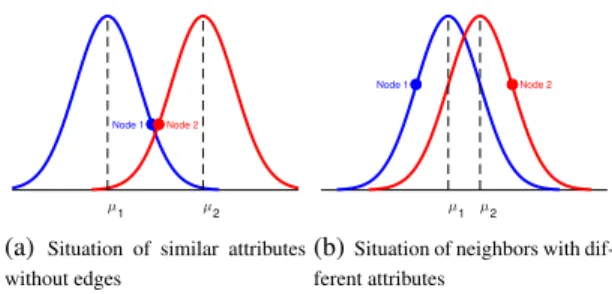
Fig 2 illustrates two cases that denotes the individuality between node attributes and network topology. Each curve denotes the Gaussian probability of observing continuous at-tributes and dots on the curve represents the attribute of an observed node, the mean of distribution is generated from the embedding. For nodes with similar mean and embed-ding, the probabilistic of generating edge is higher which denotes the commonality. In the first case(subfigure (a)), the mean of two distribution are different which means there may be no edge between the nodes, however, the attributes may be similar such as the blue and red dot. In the second case(subfigure (b)), the mean of two distribution are close which means there may exist edge with high possibility,
however, the attributed may be dissimilar such as the blue and red dot.
Node 1 Node 2
µ1 µ2
(a) Situation of similar attributes without edges
Node 1 Node 2
µ1 µ2
(b)Situation of neighbors with dif-ferent attributes
Figure 2: Example of individuality between node attributes and network topology.
Algorithm 1 Framework of deep generative network em-bedding.
Input: Attributed networkG={V,E,X}, embedding di-mensionL;
Output: Node embeddingH∈RN×L
1: Initialize the deep neural network parameters 2: whileDGE not convergeddo
3: Sample batch nodes for minibatch and extract their attributes and edges
4: Encode:z∈qφ(Z|X, E)and reparameterize
5: Decode: Generate node attributes and edges 6: Update θ, φ, pθ(X, E|Z), qφ(Z|X, E) via gradient
descent on the ELBO in Eq. (7) 7: end while
8: returnH
Complexity Analysis
The overall algorithmic complexity of a single joint update of the parameters {θ, φ} isC = M SCM LP where M is
the minibatch size, S is the number of samples of the ran-dom variate , and CM LP is the cost of an evaluation of
the MLPs in the conditional distributionspθ(X, E|Z)and
qφ(Z|X, E). The costCM LP is of the formO(KD2)where
K is the total number of layers and D is the average dimen-sion of the layers of the MLPs in the model. These com-plexities make this approach extremely appealing, since they are no more expensive than alternative approaches based on auto-encoder or neural models.
Experimental Evaluation
In this section, we conduct extensive experiments on real-world datasets to demonstrate the effectiveness of proposed DGE model on tasks including node classification and link prediction. We also prove DGE model can capture the indi-viduality between node attributes and network topology.
Datasets
We conduct experiments on three paper citation networks and one social network with different scale of nodes. Table 1 illustrates the details of datasets used in our experiment.
Citation datasets We select three datasets of biblio-graphic network namely Citeseer, Cora and Pubmed. Each dataset contains bibliographic network which included sci-entific publications classified into corresponding research area. Links represent citations among publications. Each publication in Cora and Citeseer dataset is described by a 0/1-valued word vector indicating the absence/presence of the corresponding word from a dictionary with unique words. The attributes in Pubmed dataset are bag-of-words representation of a document which is continuous valued.
Social networkBlogCatalog is a social network for users to publish blogs where users are classified based on blog cat-egory, edges represent the friendship connection. Each blog is associated with keywords for brief description which is treated as node attributes.
Table 1: Summary of the datasets used in our experiments. Dataset #Nodes #Features #Classes
Citeseer 3327 3703 6
Cora 2708 1433 7
BlogCatalog 5196 8189 6
Pubmed 19717 500 3
Baselines
We compare the DGE framework with several state-of-the-art (attributed) network embedding methods, which can be divided into the following groups.
Attribute Only. This group of algorithms only consider node attributes and transform the attribute vectors to low dimensional representations. We select SVM (Hearst et al. 1998) and AutoEncoder in this group.
Network Only. This group of algorithms leverage net-work topology information while ignores node attributes. Representative works include DeepWalk (Perozzi, Al-Rfou, and Skiena 2014) and LINE (Tang et al. 2015), which use truncated random walks to generate node sequences and em-ploy skip-gram model for node representation learning.
Attribute and Network. This group of algorithms con-sider both node attributes and network topology together in learning node embedding. We select AANE (Yang et al. 2015), SNE (Yuan, Wu, and Xiang 2017), GraphSAGE (Hamilton, Ying, and Leskovec 2017), TADW (Yang et al. 2015), PRRE(Zhou et al. 2018), CAN(Meng et al. 2019), VGAE(Kipf and Welling 2016) and RIANE(Li et al. 2017a). The source code and detailed settings of DGE model can be found in https://github.com/zhoushengisnoob/DGE
Node classification
Node classification has been widely used in literature to evaluate network embedding. In this subsection, we report the experimental results of node classification on labeled datasets. Following the experimental procedure of existing works (Perozzi, Al-Rfou, and Skiena 2014), we first train models on the training sets to obtain node representations. Then we randomly sample 30% labeled nodes to train a SVM classifier and the rest of the nodes are used to test the
Table 2: Experimental results of node classification on four datasets.
Group Algorithm Citeseer Cora Blogcatalog Pubmed
Micro-F1 Macro-F1 Micro-F1 Macro-F1 Micro-F1 Macro-F1 Micro-F1 Macro-F1 Attribute
Only
SVM 0.670 0.635 0.700 0.673 0.865 0.863 0.807 0.798
AutoEncoder 0.651 0.616 0.659 0.630 0.859 0.856 0.787 0.776 Network
Only
DeepWalk 0.556 0.511 0.775 0.761 0.613 0.606 0.743 0.716
LINE 0.560 0.531 0.777 0.770 0.667 0.663 0.727 0.703
Attribute + Network
AANE 0.579 0.541 0.751 0.715 0.856 0.855 0.820 0.813
SNE 0.631 0.596 0.802 0.783 0.814 0.812 0.822 0.802
GraphSAGE 0.622 0.587 0.792 0.778 0.829 0.820 0.814 0.804
TADW 0.720 0.656 0.830 0.816 0.887 0.884 0.833 0.819
PRRE 0.725 0.665 0.852 0.828 0.918 0.917 0.840 0.823
CAN 0.691 0.640 0.839 0.830 0.742 0.718 0.821 0.818
RINAE 0.562 0.516 0.581 0.532 0.771 0.765 0.753 0.752
VGAE 0.705 0.661 0.854 0.851 0.792 0.788 0.818 0.810
DGE variants
DGE -A 0.712 0.606 0.739 0.702 0.809 0.802 0.806 0.796
DGE -N 0.555 0.498 0.693 0.682 0.649 0.644 0.767 0.759
DGE 0.727 0.668 0.858 0.853 0.931 0.929 0.846 0.846
(a)Citeseer (b)Cora (c)BlogCatalog (d)Pubmed
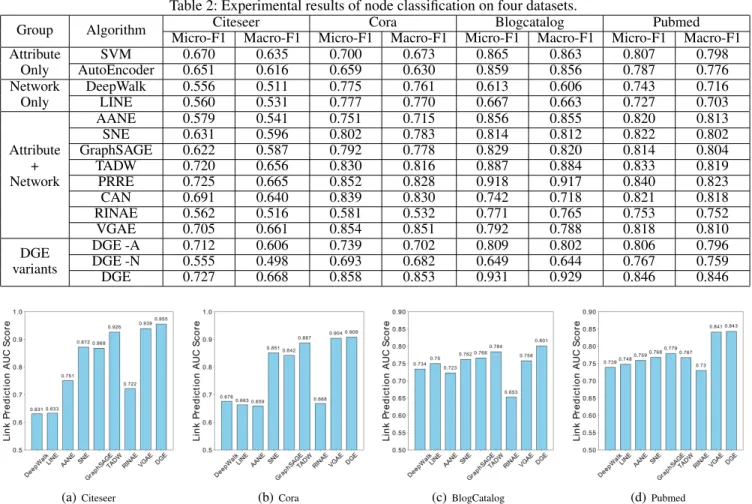
Figure 3: Link prediction results on four real world datasets.
model. We repeat this process 10 times and report the aver-age performance in terms of both Micro-F1 and Macro-F1 score. The detailed results are shown in Table 2. To summa-rize, we have the following observations:
(1) The basic observation is that our proposed DGE framework achieves better results on four datasets compared with baseline methods and variants. This shows the effec-tiveness of our proposed DGE framework in modeling node attributes and network topology. By comparing DGE with the variants, we can further infer the advantage of capturing the commonality and individuality between node attributes and network topology.
(2) Compared with the attributed only group methods, we can find that DGE-A achieves similar performance. However, compared with the network only group meth-ods, we find that the variant DGE-N achieves worse per-formance. This is explainable since only modeling the first-order neighborhood will limit the information captured by the model and ignore the relationship with node attributes.
(3) Compared with VGAE, CAN and RINAE, we can find that DGE achieves better performance. Although they all use variational auto-encoder structure, VGAE only pre-serves the network topology while ignores the
reconstruc-tion of node attributes, it can not capture either commonal-ity or individualcommonal-ity. CAN learns two independent embedding for each node and can not capture the commonality. RINAE directly concatenates the attributes and adjacent vectors as feature representation of nodes. Such concatenation ignore the fact that node attributes and network topology are het-erogeneous information. The improvement over these vari-ational auto-encoder based methods indicates the advantage of modeling both network topology and node attributes in a unified framework while capturing the commonality and individuality.
Network Reconstruction
The most primal objective for network embedding is to re-construct the given network, as a good network embedding method should ensure that the learned embedding can pre-serve the original network structure (Zhu et al. 2018). Fol-lowing the same experimental procedure in many exiting works (Grover and Leskovec 2016; Yang et al. 2015), we randomly hold out50%of the existing links as positive in-stances in test set and randomly sample the same amount of non-existing links as negative instances. The residual net-work is used to train the netnet-work embedding models. After
obtaining the latent representations of each node, we evalu-ate link prediction in the labeled edge dataset. Specifically, we rank both positive and negative instances according to the cosine similarity function. To judge the ranking quality, we employ the Area Under Curve (AUC) score to evaluate the ranking list and a higher value indicates a better perfor-mance. Figure 3 illustrates the results of link prediction on four real-world datasets. Based on the experimental results, we have the following observations:
(1) The basic observation is that DGE model achieve bet-ter performance compared with baseline methods in four real world datasets. This further indicates the superior of DGE framework in capturing the similarity between nodes by embedding nodes into low dimensional space.
(2) In citeseer and cora dataset, algorithms in network only group achieve poor performance compared with meth-ods considering both node attributes and network topology. In Blogcatalog and pubmed dataset, the two group of al-gorithms achieve similar performance. This is explainable since the network of citeseer and cora is more sparse than BlogCatalog and Pubmed. This further indicates the nec-essary of combining node attributes and network topology when network is sparse.
(3) Among the four datasets, the RINAE method gets poor performance. We analysis the results and find that in large scale network, the adjacent vector is usually sparse, directly concatenating node attributes and adjacent may miss the in-dividuality of each information source.
-4 -3.5 -3 -2.5 -2 -1.5 Variance 0.5
1 1.5
Feature similarity ratio
Pubmed
-0.2 0 0.2 0.4 0.6 Variance 0.4
0.6 0.8 1 1.2
Cora
0.1 0.2 0.3 0.4 0.5 0.6 Variance 0.4
0.6 0.8 1 1.2 1.4
Citeseer
Figure 4: Relationship between the feature similarity ratio and variance.
Commonality and individuality captured by DGE
In this section, we conduct experiments to prove that DGE model can actually capture the commonality and individu-ality. We calculate two average feature similarity: between nodes and its neighborhoods as well as between nodes and all the other nodes in the network. Higher ratio between two average feature similarity denotes nodes close in network are more similar in attributes than other nodes, which refers to higher commonality and lower individuality. As we have discussed, DGE model captures the individuality by the vari-ance of probabilistic distribution in the generative process. We use the logarithmic form of variance to denote how much individuality DGE model captured.
Figure 4 illustrates the results of feature similarity ratio w.r.t. variance in DGE model. Each blue dot denotes a node and the red line is the straight line fitting of the blue dots. We can observe obvious inverse relationship between variance
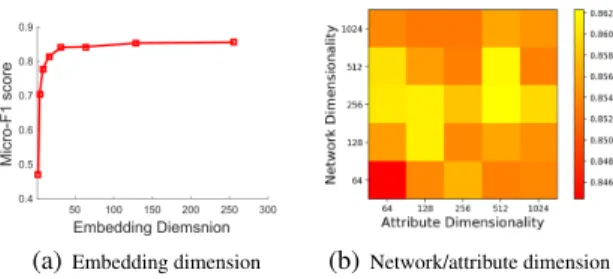
(a)Embedding dimension (b)Network/attribute dimension Figure 5: Parameter tuning of DGE in Cora dataset.
and feature similarity ratio, nodes with lower ratio(higher individuality) will have larger variance. This shows the vari-ance in DGE model can actually capture the individuality between node attributes and network topology.
Hyper Parameter Tuning For network embedding meth-ods, an important parameter to tune is the dimension of learned embedding. Also, in DGE model, another important parameter is the dimension of embedding based on single input feature and adjacent vectors. We vary the dimension from 2 to 256 and examine how the performance changes with respect to the dimensions. We present the tuning of di-mension of network embedding in Figure 5-(a) and dimen-sion of signle input based embedding in Figure 5-(b).
Figure 5(b) illustrates the performance w.r.t. the dimen-sionality LA of attribute based embedding andLN of
net-work based embedding. The basic observation is that the performance is not sensitive to the dimensionality as the F1-score changes a little with the change of dimensionality of both network topology based embedding and node attribute based embedding.
Conclusion
In this paper, we have proposed the DGE framework to uti-lize the deep generative framework to model the common-ality and individucommon-ality between node attributes and network structure. Based on the statistic analysis on real world at-tributed network, we use a deep generative model to capture such relationships and learn node embedding. Meanwhile, extensive experiments are conducted on real-world datasets which shows the superior of the proposed DGE framework.
Acknowledgement
This work is supported by Alibaba-Zhejiang University Joint Institute of Frontier Technologies, The National Key R&D Program of China (No. 2018YFC2002603, 2018YFB 1403202), Zhejiang Provincial Natural Science Foundation of China (No. LZ13F020001), the National Natural Science Foundation of China (No. 61972349, 61173185, 61173186) and the National Key Technology R&D Program of China (No. 2012BAI34B01, 2014BAK15B02). National Natural Science Foundation of China (Grant No: U1866602) and National Key Research and Development Project (Grant No: 2018AAA0101503). China Postdoctoral Science Founda-tion No. BX201700136.
References
Cao, S.; Lu, W.; and Xu, Q. 2015. Grarep: Learning graph representations with global structural information. In Pro-ceedings of the 24th ACM international on conference on information and knowledge management.
Dai, Q.; Li, Q.; Tang, J.; and Wang, D. 2017. Adversarial network embedding.arXiv preprint arXiv:1711.07838. Goodfellow, I.; Pouget-Abadie, J.; Mirza, M.; Xu, B.; Warde-Farley, D.; Ozair, S.; Courville, A.; and Bengio, Y. 2014. Generative adversarial nets. InAdvances in neural information processing systems.
Grover, A., and Leskovec, J. 2016. node2vec: Scalable fea-ture learning for networks. InProceedings of the 22nd ACM SIGKDD international conference on Knowledge discovery and data mining.
Hamilton, W.; Ying, Z.; and Leskovec, J. 2017. Inductive representation learning on large graphs. InAdvances in Neu-ral Information Processing Systems.
Hearst, M. A.; Dumais, S. T.; Osuna, E.; Platt, J.; and Scholkopf, B. 1998. Support vector machines. IEEE In-telligent Systems and their applications.
Hong, H.; Li, X.; and Wang, M. 2018. Gane: A gen-erative adversarial network embedding. arXiv preprint arXiv:1805.07324.
Huang, X.; Li, J.; and Hu, X. 2017a. Accelerated attributed network embedding. InProceedings of the 2017 SIAM In-ternational Conference on Data Mining.
Huang, X.; Li, J.; and Hu, X. 2017b. Label informed at-tributed network embedding. In Proceedings of the Tenth ACM International Conference on Web Search and Data Mining.
Kingma, D. P., and Welling, M. 2013. Auto-encoding vari-ational bayes. arXiv preprint arXiv:1312.6114.
Kipf, T. N., and Welling, M. 2016. Variational graph auto-encoders.arXiv preprint arXiv:1611.07308.
Li, H.; Wang, H.; Yang, Z.; and Liu, H. 2017a. Effective representing of information network by variational autoen-coder. InIJCAI.
Li, J.; Dani, H.; Hu, X.; Tang, J.; Chang, Y.; and Liu, H. 2017b. Attributed network embedding for learning in a dy-namic environment. In Proceedings of the 2017 ACM on Conference on Information and Knowledge Management. Liao, L.; He, X.; Zhang, H.; and Chua, T.-S. 2018. At-tributed social network embedding. IEEE Transactions on Knowledge and Data Engineering.
Meng, Z.; Liang, S.; Bao, H.; and Zhang, X. 2019. Co-embedding attributed networks. In Proceedings of the Twelfth ACM International Conference on Web Search and Data Mining.
Pan, S.; Hu, R.; Long, G.; Jiang, J.; Yao, L.; and Zhang, C. 2018. Adversarially regularized graph autoencoder for graph embedding.arXiv preprint arXiv:1802.04407. Perozzi, B.; Al-Rfou, R.; and Skiena, S. 2014. Deepwalk: Online learning of social representations. InProceedings of
the 20th ACM SIGKDD international conference on Knowl-edge discovery and data mining.
Radford, A.; Metz, L.; and Chintala, S. 2015. Unsupervised representation learning with deep convolutional generative adversarial networks. arXiv preprint arXiv:1511.06434. Tang, J.; Qu, M.; Wang, M.; Zhang, M.; Yan, J.; and Mei, Q. 2015. Line: Large-scale information network embedding. In
Proceedings of the 24th International Conference on World Wide Web.
Tang, J.; Qu, M.; and Mei, Q. 2015. Pte: Predictive text em-bedding through large-scale heterogeneous text networks. In
SIGKDD.
Tolstikhin, I.; Bousquet, O.; Gelly, S.; and Schoelkopf, B. 2017. Wasserstein auto-encoders. arXiv preprint arXiv:1711.01558.
Wainwright, M. J.; Jordan, M. I.; et al. 2008. Graphical mod-els, exponential families, and variational inference. Founda-tions and TrendsR in Machine Learning.
Wang, X.; Lu, W.; Ester, M.; Wang, C.; and Chen, C. 2016. Social recommendation with strong and weak ties. Proceed-ings of the 25th ACM International on Conference on Infor-mation and Knowledge Management.
Wang, H.; Wang, J.; Wang, J.; Zhao, M.; Zhang, W.; Zhang, F.; Xie, X.; and Guo, M. 2017a. Graphgan: Graph repre-sentation learning with generative adversarial nets. arXiv preprint arXiv:1711.08267.
Wang, S.; Aggarwal, C.; Tang, J.; and Liu, H. 2017b. At-tributed signed network embedding. InProceedings of the 2017 ACM on Conference on Information and Knowledge Management.
Wang, D.; Cui, P.; and Zhu, W. 2016. Structural deep net-work embedding. InProceedings of the 22nd ACM SIGKDD international conference on Knowledge discovery and data mining.
Yang, C.; Liu, Z.; Zhao, D.; Sun, M.; and Chang, E. Y. 2015. Network representation learning with rich text information. InIJCAI.
Yuan, S.; Wu, X.; and Xiang, Y. 2017. Sne: signed net-work embedding. InPacific-Asia conference on knowledge discovery and data mining.
Zhang, Z.; Cui, P.; Wang, X.; Pei, J.; Yao, X.; and Zhu, W. 2018. Arbitrary-order proximity preserved network embed-ding. InSIGKDD.
Zhong, S., and Ghosh, J. 2005. Generative model-based document clustering: a comparative study. Knowledge and Information Systems.
Zhou, S.; Yang, H.; Wang, X.; Bu, J.; Ester, M.; Yu, P.; Zhang, J.; and Wang, C. 2018. Prre: Personalized relation ranking embedding for attributed networks. InProceedings of the 27th ACM International Conference on Information and Knowledge Management.
Zhu, D.; Cui, P.; Wang, D.; and Zhu, W. 2018. Deep variational network embedding in wasserstein space. In