Equal Access Participatory Monitoring and Evaluation toolkit
The Most Significant Change technique
A manual for M&E staff and others at Equal Access
Developed by June Lennie
February 2011
2
Contents
Acknowledgements 4
Acronyms 5
Section 1: Introduction 6
Background and aims of this manual 6
Other MSC resources 6
What is the MSC technique? 7
How can MSC help development organisations? 8
Successful use of MSC 8
Some limitations and issues with MSC 9
Section 2:Overview of the ten steps to implementing MSC 9
Step 1: Raising interest 9
Step 2: Deciding on domains of change 10
Step 3: Deciding on the reporting period 11
Step 4: Collecting stories 11
Step 5: Selecting the most significant stories 12
Step 6: Feeding back results to key people 12
Step 7: Verification of stories 12
Step 8: Quantification of stories 12
Step 9: Secondary analysis and meta-monitoring 12
Step 10: Evaluating and revising the system 13
Section 3: Collecting MSC stories 13
Who should be involved in collecting MSC stories 13
Who to collect the stories from 13
How many stories to collect 14
Ways of collecting stories 14
Before you collect the stories 15
Using a questionnaire about listening history 15
The MSC question 15
Using the story collection guide 16
Getting more in-depth information 17
Section 4: Recording MSC stories 17
How to write the story 17
Basic structure of the story 18
Section 5: Selecting stories 22
Overview of the story selection process 22
Possible structure of the story selection process 22
Who should be involved in selecting stories? 23
3 Methods used to decide which stories to select 25
Section 6: Feeding back results of the selection process 27
The importance of providing feedback 27
Possible ways of providing feedback 27
Section 7: Verification of stories 28
Why verify stories? 28
When verification may not be necessary 28
Who should verify the stories? 28
Which verification method should be used and when? 28
What aspects of stories should be verified? 29
Section 8: Quantification of stories 29
Section 9: Secondary analysis and meta-monitoring 29
Section 10:Evaluating and revising the system 30
Appendices
Appendix 1: Examples of well written and constructed MSC stories 32 Appendix 2: Sample guide for collecting stories about significant changes by individual interview
35 Appendix 3: Sample guide for collecting stories about significant changes by group discussion
41
Appendix 4: MSC story collection consent form 43
Appendix 5: Sample facilitation guide for story selection 44 Appendix 6: Example of a process used to develop domains of change 46
Tips and examples
Examples of broad domains of change for two radio programs 10
Tips for collecting stories 18
Story example 1: ‘Encouraged to study harder’ 20
Story example 2: ‘No longer discriminates against lower castes’ 21 Story selection process used in the program: ‘Community Driven
Approaches to Address the Feminisation of HIV/AIDS in India’
25 Tips and other information for story selection 26
Figures
Figure 1: Proposed structure of the story selection process in Equal Access Nepal
4
Acknowledgements
This manual is part of the Equal Access Participatory Monitoring and Evaluation toolkit. This was a major outcome of the Assessing Communication for Social Change (AC4SC) project which was conducted from 2007 – 2011. This project was a collaboration between Equal Access Nepal (EAN), Equal Access International, Queensland University of Technology and the University of Adelaide. The Chief Investigators for this project were Professor Jo Tacchi, Dr Andrew Skuse and Dr Michael Wilmore. Dr June Lennie was a Senior Research Associate with the project. Funding for this project was provided by the Australian Research Council through their Linkage Project Scheme (LP0775252), and Equal Access. Extensive in-kind support was provided by EAN. This manual was made possible through support provided by USAID/Nepal, U.S. Agency for International Development, under the terms of Award No. 367-A-00-04-00171-00. The opinions expressed herein are those of the author and do not necessarily reflect the views of the U.S. Agency for International Development.
Thanks go to Sanju Joshi, Bikash Koirala, Shirisha Amatya and other members of the M&E team at EAN and all of the community researchers who provided feedback and input that was taken into account in developing this manual. The input and support of Jo Tacchi, Mike Wilmore and Andrew Skuse is also acknowledged.
The two story examples from the AC4SC project were adapted from stories that were originally collected by community researcher Lila Devkota from the Dang district of Nepal.
Large sections of this manual have been taken or adapted from The 'Most Significant Change' (MSC) Technique. A Guide to its Use by Rick Davies and Jess Dart (2005) http://www.mande.co.uk/docs/MSCGuide.pdf It also draws on materials provided at an MSC workshop by Jess Dart and from the following reports:
Bhattacharya, N. (2007). Stories of Significance: Redefining Change. An Assortment of Community Voices and Articulations. A report based on an evaluation of the program ‘Community Driven Approaches to Address the Feminisation of HIV/AIDS in India’ by means of the ‘Most Significant Change’ Technique. The India HIV/AIDS Alliance: New Delhi. http://www.aidsallianceindia.net/?q=node/40&pid=191
Jallov, B. (2007). Impact assessment of East African Community Media Project 2000-2006. Report from Radio Mang’elete, Kenya, and selected communities. Birgitte Jallov Communication Partners, Swedish International Development Cooperation Agency: Stockholm http://webzone.k3.mah.se/projects/comdev/_comdev_PDF_doc/scp08_sem2_Impact_Assess ment_RM.pdf
Wilmore, M. (2008). Most Significant Change and the AC4SC project. Applying the MSC Technique to Equal Access’s M&E System. Notes from a meeting held at Equal Access Nepal, Kathmandu on 19 November 2008.
Wrigley, R. (2006). Learning from Capacity Building Practice: Adapting the ‘Most Significant Change’ Approach to Evaluate Capacity Building Provision by CABUNGO in Malawi. Praxis Paper No. 12, INTRAC: Oxford. http://www.intrac.org/resources.php?action=resource&id=408
5
Acronyms
AC4SC Assessing Communication for Social Change research project
CRs Community researchers
DoCs Domains of change
EA Equal Access
EAN Equal Access Nepal
M&E Monitoring & evaluation
MSC Most Significant Change technique or story
NN Naya Nepal (New Nepal) radio program
6
Section 1: Introduction
The Most Significant Change (MSC) technique is a tool for collecting, discussing and selecting stories about the significant changes that people experience as a result of your programs. It involves people at different levels of an organisation discussing the stories and then selecting the stories they consider most significant. This process aims to promote ongoing dialogue and learning about programs and how they can be improved to better meet their aims. It also helps program staff and stakeholders to explore the unexpected or negative changes that may have happened as a result of e program.
MSC is not meant to be used as a stand-alone methodology. However, MSC combines well with other evaluation methods such as short surveys and focus group discussions
Background and aims of this manual
This manual is based on the MSC manual that was developed for Monitoring and Evaluation (M&E) staff at Equal Access Nepal (EAN) as part of the Assessing Communication for Social Change (AC4SC) research project. MSC was used in this project to help assess the impacts of two radio programs: Saathi Sanga Manka Khura (SSMK) (Chatting with my best friend) and Naya Nepal (New Nepal).
This manual provides information about the main steps of the MSC technique for M&E and other staff in Equal Access (EA) who would like to use this technique and/or want to train others in MSC. It is aimed at staff who may already have some knowledge of MSC and those who are new to the technique. The main aims of this manual are:
To provide an introduction to the MSC technique.
To provide an understanding of each step in the whole MSC technique and some of the strengths and limitations of MSC.
To provide specific information and examples for training others to effectively collect, document and select MSC stories.
Other MSC resources
More details about MSC, including issues such as developing capacity in MSC, uses of MSC within programs, how MSC compares with other M&E approaches, and the theory and history of MSC can be found in the MSC guide by Davies and Dart (2005) (see http://www.mande.co.uk/docs/MSCGuide.pdf). This guidebook also discusses a number of problems and concerns that participants and others have experienced with using MSC (see pages 46 – 53).
You can find several other MSC resources in the Useful resources, information and tools
7
What is the MSC technique?
MSC is a participatory approach to M&E that involves assessing the changes and impacts that have happened as a result of a program from the perspective of program participants. The process is participatory because program participants and stakeholders are involved in deciding what sort of change should be recorded, and in analysing the data (stories) that are collected. The MSC process can happen throughout the program cycle and provides monitoring information that can help staff to improve the program. It also contributes to evaluation by providing information about the impacts and outcomes of a program that can be used to assess how well the program as a whole is working.
The ten steps to implementing MSC are: Step 1: Raising interest
Step 2: Deciding on domains of change Step 3: Deciding on the reporting period Step 4: Collecting social change stories Step 5: Selecting the most significant stories Step 6: Feeding back results to key people Step 7: Verification of stories
Step 8: Quantification of stories
Step 9: Secondary analysis and monitoring Step 10: Evaluating and revising the system
MSC involves participants sharing personal stories of change that are collected and interpreted at regular intervals of time. The stories are then analysed and filtered through various levels of an organisation until the stories that represent the most significant or important changes are selected. These stories are the ones that best represent the type of outcomes that your organisation and others are looking for.
Outcomes of the story selection process and criteria for selecting stories are recorded and fed back to participants before to the next round of story collection begins. MSC aims to encourage continuous dialogue up and down the various levels of an organisation, from field level to senior staff and then back again. When this process works well, it can be a powerful tool for ongoing evaluation and learning.
8 Each story is accompanied by the storyteller’s interpretation about why the story was significant to them. After the review, the stories are also accompanied by the reviewers’ interpretation about why the story was selected.
More details about each these steps are provided in this manual.
How can MSC help development organisations?
MSC has been successfully used in many different types of programs, and in many different countries around the world, for about 15 years. It has been used in a wide range of development projects, such as:
The evaluation of the program ‘Community Driven Approaches to Address the Feminisation of HIV/AIDS in India’.
Assessing the impact and sustainability of three community radio stations in East Africa.
An evaluation of capacity building services in Malawi, Africa.
Stories about significant change can provide a rich picture of the impact of development programs. The technique also helps to direct the outcomes of programs towards the directions that are most highly valued, such as increasing the empowerment of women and girls or encouraging greater involvement of disadvantaged groups in dialogue about social and political issues.
As well as being valuable for participatory monitoring and evaluation, MSC can help to:
Foster a more shared vision of a program.
Build staff and community capacity in monitoring and evaluation.
Develop indicators of program impacts.
Develop ownership of the research and evaluation process.
Provide material for publicity and communications.
Provide material for training staff and others.
Successful use of MSC
MSC is well suited to evaluating the impacts of programs that are focussed on social change, take a participatory approach, and involve regular contact between field staff and participants. It is therefore very well suited to the general approach adopted by EA programs. MSC is particularly useful when the evaluation is focussed on learning rather than just accountability to donors. The successful use of MSC requires:
A culture within your organisation where it is acceptable to discuss things that have gone wrong as well as success.
People with good facilitation skills who can promote the use of MSC.
Time to run several MSC cycles and then revise the technique as necessary.
Communication systems that can enable regular feedback of results to stakeholders and participants.
9
Commitment to the approach by senior managers within your organisation.
Some limitations and issues with MSC
Like all research methods, MSC has certain limitations and issues that need to be taken into account. Biases that have been associated with MSC include:
Biases towards stories of success – this can be overcome by creating a specific domain to capture negative stories.
Biases towards the views of those who are good at telling stories. This is a good reason for not using MSC as a stand-alone tool for M&E.
Subjectivity in the story selection process. This process tends to reflect the values of the people on the selection panels. However, recording the reasons for selecting stories helps to strengthen the process.
Bias towards popular views. Concerns have been raised that harsh criticism or unpopular views in the selection process could be silenced by the majority vote. However, it has been found that the MSC process encourages very open and honest discussion, making this less likely to happen.
MSC also raises the important issue of voice and power associated with who participates in the story selection process. This can be overcome by ensuring that the people on the selection panels represent a wide range of backgrounds and values. There are also potential issues with anonymity and confidentiality of data and ethical concerns with obtaining informed consent for the use and distribution of the stories collected. The people from whom stories are collected therefore need to be made fully aware of the possible uses that may be made of their stories, and formally give their consent to using their stories in these ways.
Section 2:
Overview of the ten steps to implementing MSC
Step 1: Raising interest
This step involves introducing a range of program staff and stakeholders to MSC and generating interest and commitment to taking part in the various MSC steps. This is a vital part of the process because MSC requires the cooperation and participation of many different people within your organisation and from program stakeholders such as Content Advisory group members. Here are some tips and suggestions for creating interest in MSC:
Before you begin raising interest you need to be very clear about the purpose of MSC, what role it will play in your M&E activities, and how you will combine MSC with other activities.
Hold a meeting with relevant staff to explain the technique and show some MSC reports and stories gathered by other programs – you could use some of the examples in this manual. Explain that once the initial planning has been completed and people have been trained, MSC is quite simple and straightforward to implement.
Identify the people who are most excited about the methodology and are willing to help you raise interest in using MSC in your organisation.
10
Start by implementing a small, simple MSC pilot to find out what works and what does not work well in your organisation. Try to begin by involving the people who are most enthusiastic and interested about the potential of MSC.
Step 2: Deciding on domains of change
Domains are broad and often relatively fuzzy categories of possible areas of change, such as ‘change in the quality of people’s lives’ or ‘changes in people’s participation’. They are used in an evaluation to help
Define the areas of change that are important to program stakeholders.
Track whether progress is being made towards the stated objectives of programs or organisations.
Provide some guidance to those collecting stories about what kind of change they are searching for.
Group a large number of stories into more manageable lots that can then be analysed.
Some organisations include a domain for negative stories, in order to balance the tendency for MSC stories to be focussed on positive change, and also to gather suggestions for improvement.
Domains of change (DoCs) are not indicators, which should be defined so that everyone interprets them in the same way. In contrast, DoCs are deliberately fuzzy to allow people to have different interpretations of what constitutes the change that they think is important. To be most useful in fulfilling donor requirements for impact assessment and program monitoring, the DoCs you develop will need to relate to the broad social change objectives for your radio programs.
Domains are not essential, however, and it can be useful to begin the process without specifying domains. This is the way that EAN initially conducted the process. Once a number of stories have been collected they can then be divided into appropriate domains. The process of identifying DoCs can be a top-down or bottom-up process or a wider process that includes other stakeholders. An example of the process used to develop DoCs for the SSMK and Naya Nepal radio programs is described in Appendix 6.
Examples of broad domains of change for two radio programs
The following broad domains of change were developed to gather and select stories about the changes brought about by listening to the SSMK and Naya Nepal radio programs, produced by Equal Access Nepal: Changes in knowledge or awareness Changes in personal development Changes in attitude and behaviour
11
Step 3: Deciding on the reporting period
This step involves deciding how often the process of monitoring the changes that are taking place should happen. MSC has mostly been used as a form of monitoring. The frequency of monitoring varies across programs and organisations and the same applies to this use of MSC. The frequency of story collection can vary from fortnightly to yearly. The most common frequency has been three-monthly, coinciding with the prevalence of quarterly reporting in many organisations.
The advantage of higher frequency reporting is that all of the participants in the MSC process are likely to learn more quickly about how to best use the process. However, frequent reporting soon leads to the exhaustion of known cases of longer-term significant change and a focus on the shorter-term significant changes that can be identified. Members of your organisations will have to make their own decision about the most appropriate reporting period, balancing the costs and benefits involved, and taking into account the reporting gaps that any existing M&E systems may be ignoring. Davies and Dart (2005) found that organisations tend to start MSC with more regular reporting and then decrease the frequency as the process continues.
Step 4: Collecting stories
Stories about significant change are collected from those who are directly involved in a program, such as participants and field staff. They are collected using an open question, such as: ‘During the past six months, what do you think was the most significant change in the quality of people’s lives as a result of taking part in this project?’.
MSC stories can be captured in a variety of ways, including by interviewing participants, by sharing stories during group discussions, by fieldworkers writing down stories that they have heard, and by participants writing down their own stories. As far as possible the story should be written as a simple first person narrative that describes the sequence of events. An important part of MSC is to ask storytellers to explain the significance of the story from their point of view.
12
Step 5: Selecting the most significant stories
Once the stories are collected, they are then analysed and filtered through the levels of authority in an organisation or program. Groups of selected people at each level review the series of stories that have been sent to them by those at the level below and then select the single most significant account of change within each domain of change (however, sometimes more than one story is selected). The criteria used to select the stories are also written down and sent to all relevant stakeholders. This process helps to reduce the large number of locally important stories down to a small number of more widely valued stories. The process of discussing the stories can help to uncover the values of an organisation and open them up to discussion and change.
Step 6: Feeding back results to key people
After MSC has been used for a period of time (say a year), a document is produced that includes all the stories selected at the highest level over that period of time in each domain of change. The reasons for selecting the stories are attached to each story. Donors can then be asked to assess the stories in this document and to select those that best represent the kind of outcomes they want to fund. They also document the reasons for their choice. This information is fed back to program managers and those who provided the stories, using various methods such as verbal feedback, newsletters or formal reports. Knowing that a particular type of change is valued can lead to further searches for similar changes in that area (for example, ‘participation of women in community dialogue’).
Step 7: Verification of stories
It can be useful to check that a reported change reflects what actually happened. This is because some people may exaggerate the significance of events or not give a very accurate account of what happened. Also, some reported changes may be even more important than is initially evident from the way the change was documented. Knowing that there are procedures for verifying stories can also help to improve the quality of the stories. However, this process must be handled very carefully.
Step 8: Quantification of stories
Various methods can be used to collect and analyse quantitative (numerical) information about MSC stories, such as the number of people involved, how many activities took place, and the number of times a particular change is recorded.
Step 9: Secondary analysis and meta-monitoring
Secondary analysis involves analysing the themes across a complete set of MSC stories, while meta-monitoring focuses more on the attributes of the stories themselves (such as who participated, who selected the stories, what happened to the stories, and how the different
13 changes were reported). This is not a critical step but can strengthen the MSC process. This step is usually done by members of an M&E team.
Step 10: Evaluating and revising the system
This step involves reviewing the design of the MSC system and then making any changes to the system that will make it work better, based on what has been learned as a result of using the MSC technique. Most organisations change the implementation of MSC in some way. This is a good sign as it indicates that learning is taking place.
More details about Steps 4 – 10 are now provided.
Section 3: Collecting MSC stories
Who may be involved in collecting MSC stories
Following appropriate training, MSC stories could be collected by the following people involved in EA programs:
Staff who are involved in M&E
Members of content production teams who go on field visits
Community reporters
Youth leaders
Listener club facilitators
Having a wide range of people involved in collecting stories will help to increase the number and variety of stories that are collected, and to increase the quality of the stories. It will also help to foster interest in and understanding and ownership of the MSC process.
Who to collect the stories from
You will need to consider which groups are the most appropriate to focus on in collecting MSC stories about changes associated with your radio programs or associated listener club activities. For example, they could be collected from:
Community members who have been regular listeners to the programs during the previous six months or longer. They should be individuals or small groups who are in the target groups for the programs you are researching.
Community members who were previously regular listeners to your programs, but have stopped being regular listeners within the past year.
Parents of young people who are regular listeners to your youth-oriented radio programs, and are able to talk about the impacts of listening to the programs on their children.
14
Listener club facilitators, community reporters, hub staff, community workers, or others who have first-hand knowledge about the impacts of your programs on listener club members, and other relevant community groups.
Members of civil society organisations who you are working in partnership with and are members of the above groups.
The aim should be to collect stories from as wide a range of people as you can in terms of gender, age, ethnic group, education and other relevant differences. Most of the stories should be collected from people who are currently regular listeners to the programs.
Important note: If a story collector has collected an interesting story from someone but the story is lacking in detail or depth, they should be asked to go back to that person to record a more detailed story.
How many stories to collect
During the phase before the initial story selection process has begun, story collectors should be encouraged to collect at as many stories as possible from individual in-depth interviews and small group discussions. This will provide good practice in story collection and help you to assess what improvements may be needed to the process. The number of stories that you are aiming to collect over a particular period of time should be decided on when you are developing your M&E plans and realistic targets set and agreed to.
Ways of collecting stories
There are several ways in which MSC stories can be collected. They include:
Individual interviews with listeners and others. A guide for collecting stories by individual in-depth interview can be found in Appendix 2. Details about using this guide are provided later in this manual.
During group discussions with listeners. Instead of conducting individual interviews, a group of listeners can be asked to share their significant change stories. It has been found that participants will often respond to a story with one of their own. This can be a very useful and enjoyable way to collect stories. These stories will probably be shorter and less detailed than those captured by individual interview. However, story collectors should make sure that all the important details have been captured so that the stories can be understood by those selecting them later on. A short guide for capturing stories this way is provided in Appendix 3.
People such as community reporters, M&E staff, outreach staff, and content production staff writing down unsolicited stories that they have heard during field work in a community.
Listeners, listener club facilitators, hub staff, or community reporters writing down their own stories and then bringing them along to meetings to share with others.
15
Before you collect the stories
Before staff and others begin collecting MSC stories it is very important that they explain to the individual story teller or group that the story may be used for a number of purposes including:
For reporting to our donors and stakeholders about the significant changes that have happened to community members and groups as a result of listening to your programs.
To help us understand what listeners and others think is working well and not so well with these programs.
To make improvements to these programs.
For publicity purposes.
The story collectors should always do the following:
Ask the storyteller if he or she is happy for their story to be used in these ways.
Ask if they would like their name included in information about the story.
The storyteller should then be asked to sign and date the form that includes this information (this is shown in Appendix 4). In addition, they should ask any other people mentioned in the story if they are happy for their name to be mentioned in the story.
Using a questionnaire about listening history
Before an MSC story is collected, you will probably find it very helpful if the story collector asks the interviewee or group members to complete a questionnaire about their listening history (see example in Appendix 2). This should happen before the interview or group meeting begins. If the interviewee cannot read and write, the story collector, or another group member, should complete this questionnaire for the interviewee. They should be asked them to write their responses clearly.
The main aims of this questionnaire are to:
Gather useful (and consistent) information about the interviewee’s listening history, mode of listening, and their possible membership of and involvement in a listener club.
To screen people who may not fit the criteria for suitable interviewees.
To know whether to ask questions about changes associated with particular programs. Story collectors should be provided with copies of this questionnaire.
The MSC question
The MSC process begins by searching for the answer to a simple question, like this one:
From your point of view, can you describe the most significant change in your personal development that has resulted from listening to the SSMK program?
16 This question has six parts:
1. ‘From your point of view...’ - this asks the storyteller to make their own judgement. 2. ‘...can you describe...’ – this asks the storyteller to tell a detailed story.
3. ‘...the most significant...’ - this asks the storyteller to focus on one particular thing, rather than to comment on many different things.
4. ‘...change...’ - this asks the storyteller to be more selective and to talk about a change rather than something that was already happening.
5. ‘... in your personal development..’ - this asks the storyteller to talk about a specific type of change that they think has happened to them, rather than to other people.
6. ‘... that has resulted from listening to the SSMK program...’ – this provides some further boundaries.
The answer to this question will provide a story about change, or part of a story about several domains of change. One of the best ways to collect stories is to conduct an individual interview but other methods should also be used, such as collecting stories at group meetings.
Using the story collection guide
A sample interview guide is provided in Appendix 2.This should be adapted as necessary for the interviews that your organisation conducts. In some cases, the storyteller will be relating a story about the changes that happened to others rather than themselves.
If interviewees are unsure what the DoCs in the questions you have developed mean, they can be given some further explanation by referring to a list of examples of these DoCs. These examples can be taken from your analysis of the initial stories and other M&E data. If the interviewee says that they have not experienced any changes in a particular domain, the interviewer should be record this and then move on to the next question about changes. The sample story collection guide in Appendix 2 also includes a specific question about negative impacts that the interviewee may have experienced as a result of listening to the programs. This has been included to counteract the tendency for MSC stories to focus only on positive changes.
Important note
It is important to understand that the changes that people talk about may be positive or negative, expected or unexpected. The term ‘most significant’ does not mean that Equal Access is only interested in the ‘best’ stories in terms of how well they met the objectives of the radio programs. An MSC story is not the same as a ‘success story’.
17
It is very important to for interviewees to ask the story teller to explain the significance of the story from their point of view. This is a key part of the MSC process which helps those who are reading and discussing the story to understand why the story was significant to the storyteller.
Getting more in-depth information
Our review of the initial stories collected by community researchers employed by EAN found that many stories did not contain enough details. During MSC training story collectors should be encouraged to keep probing for more in-depth information during interviews or group discussions. Tips for getting more detailed information during MSC research include:
Take plenty of time. It may be necessary to spend a longer time on each interview or group discussion in order to get more detailed data. Taking more time gives everyone the chance to speak, for all their comments to be written down, and to discuss whether what was written down is correct or not. Story collectors should be encouraged to take as much time as they need to. The outcomes will be always be better if interviewers are relaxed and not rushing the process.
Keep asking more questions. To get more detailed information and concrete evidence of changes that can be connected to listening to your programs, interviewers may need to keep on probing participants. To do this, they need to ask questions such as:
Why did that happen?
Why do you say that?
What effect did this have?
Can you give me good example of the type of change you’re talking about?
Describe clear examples of change. After some clear evidence of changes that can be connected to listening to your programs has been gathered, story collectors should write a few sentences that clearly describes specific, concrete examples of change or impacts that have happened. These details should be included in the stories and how these changes came about and why explained.
Section 4: Recording MSC stories
How to write the story
Story collectors should document the following information:
1. Information about who collected the story, who told the story, and when the events in the story occurred.
2. A detailed description of the story itself – what actually happened. 3. The significance to the story teller of the events described in the story.
The MSC story should be written down as it is told (ie by consistently using the first person if the story is about a change that happened to the storyteller. For example: ‘I started listening to the SSMK program regularly as I felt that the drama in SSMK was very closely related to me,
18 my friends and my community’). The description of the change that is identified as most significant should include factual information that makes it very clear who was involved, what happened, where, and when. It should be written as far as possible as a simple narrative that describes the sequence of events that happened.
It is also useful to give the story a headline or title which is similar to what might be used in a newspaper article. This can help the story writer to communicate the essence of what happened.
The story should contain enough details to make the story believable and able to be verified by others. It should include sufficient background information about the storyteller, the changes that happened, and the reason why that MSC was selected. There should also be a clear connection in the story between listening to the radio program or taking part in listener club activities and the changes that were experienced.
Basic structure of the story
The completed story should have the following sort of structure (some of this information will have already been collected via the listening history questionnaire):
Beginning (the situation before the change)
Tips for collecting stories
People will tell their stories well if they are happy to talk with you, so only use this method if they have enough time and want to talk. Give people time and space to take things at their own pace. Take time to build a connection with the storyteller before you begin.
Listen 100% - show the storyteller that you are really listening. Keep your body relaxed and open.
Write the story down exactly as the person says it. This is very important.
You must usually ask more questions to get the whole story. However, it is best if you do not speak too much and interrupt the story.
Do not give people clues about what you may want to hear. The story should be about their ideas about change not your ideas. Try to avoid producing ‘expected’ accounts of change.
Read your notes about the story back to the storyteller to check that you understood it correctly and to confirm that it is an accurate and complete account.
19
What was their life like before they started listening to the program and the change happened?
How did they begin listening to the program?
How did they come to join the listener club?
Middle (what happened):
What happened after they started listening to the program or became involved in the listener club?
What things did they learn about from listening to the program?
End (the situation after the change):
What difference did listening to the program make to their life or the lives of others in their community?
What was the one most important change in their knowledge, attitude, participation in activities etc (as per the questions related to the domains of change in the interview guide) as a result of listening to the program?
Why is this significant?
Why did they choose these changes in particular?
Why are they important to them?
What were the main things that enabled this change to happen?
End the story with their responses to the question about any negative impacts of listening to the program and how the program could be improved.
The responses to the questions about change should be described in the form of a story (ie. a fairly detailed but simple description of what happened to them). The completed story should be about one page long (but could be longer or shorter than this, depending on what length is most appropriate for EAN’s M&E purposes). Note: while the story should be written exactly as the interviewee tells it, it may be necessary to re-structure or edit the story so that the final version is in the above format and flows well.
The following is an example of a story about the positive changes in understanding, knowledge and personal development that happened to a 14 year old girl from the Dang district of Nepal as a result of listening to the Naya Nepal radio program (Note: this is based on a real story which has been changed to better illustrate the type of story structure and level of detail that is needed).
20
Story example 1: ‘Encouraged to study harder’
I have a father, mother and two brothers living at home. We always have lots of visitors at home due to my father’s work as a contractor. The radio would be on from 6 in the morning to almost 9 or 10 in the evening. One thing that I found strange was that in our neighbour’s house the band is tuned to whichever radio station is playing music, but in my house it was always tuned to news and information programs. We had visitors who were drivers, labourers and contractors and I used to listen them talk. Mostly they talked about politics. I used to find it difficult to understand their discussion, but I didn’t have any friends of my own age then so I didn’t have any choice but to be with my father most of the time.
Two years ago, when I was in class 8, two of my male friends used to discuss the situation of the country with our teachers. I also used to participate in these discussions but was not able to critically discuss the issues. My teacher used to praise me for my knowledge of current political issues, which encouraged me to learn and understand more about these issues. When I was in class 9, I started regularly listening to the Naya Nepal program at night. I liked the lively and interesting way that Laure spoke about things and I started
listening to the program more to listen to him talk. I also started asking my Dad lots of questions about things I didn’t understand. I realised that even to ask questions you need to have a little knowledge about big issues like the Constituent Assembly (CA). In this way I started listening to the program regularly. But because I’m preparing for my class 10 board exam just now, I have not been regularly listening to it.
After listening to the Naya Nepal program I was able to make my friends understand about the CA. One interesting thing is that my father and mother voted for the different parties in an election after reading their manifesto. But I think it’s important to know that person as well. After they came back to the house we discussed about why we gave importance to only the manifesto of the party and not to the person. This discussion made an impact on me. I told my parents “You’re able to understand these things because of listening to Laure Dai’s Tea Shop”, the drama segment of NN.
Listening to the NN radio program brought various changes in me:
I was able to better understand politics and current social and political issues in Nepal.
People like my teacher and parents started praising me for my knowledge about current issues which encouraged me to do better in my studies.
I started having more interest in extra curriculum activities and issues.
I became much better at debating and discussing current issues with my teachers, my friends and my family.
I think the most significant change of them all is that people started praising me for my knowledge about current political issues like federalism. This has encouraged me to continue studying harder and get better marks. Besides reading books outside of the syllabus, I was able to discuss and understand social and political issues more clearly. When people asked me questions I was able to help solve their problems. This also encouraged me to study harder so that I could gain more knowledge. Earlier I used to be fifth in my class, but now I stand second in my class. This makes me and my parents very happy and proud of my achievements. If I can keep on doing well with my studies, I hope to become a teacher one day.
As I mentioned, I really like the drama segment of NN and I think the language and presentation of Laure Dai’s Tea Shop is very good. But to make the program more interesting to young people, I think it should give more information about the roles of youth in the political development of Nepal. Also, it is better for school students if the program is broadcast in the evening instead of in the morning.
21 The next story was collected from a 21 year old male from the Dang district of Nepal (it has also been changed to illustrate the level of detail that is needed). In it, he talks about the impact of listening to the SSMK radio program on his understanding of caste discrimination and the changes in his behaviour towards lower caste people.
Some other examples of well written and interesting MSC stories, collected from individuals and group discussions, are provided in Appendix 1.
Story example 2: ‘No longer discriminates against lower castes’
At home, I have father, mother and myself. Three of my sisters are already married. In 2005, we migrated from the Rolpa district to Narayanpur, Dang. We migrated due to the Maoist conflict. The economic situation in my home is weak. We rent other people’s land and use it for our earnings. I’m currently waiting for my class 12 exam result. When I was in Rolpa, I used to play with my Dalit friend, which my parent did not appreciate. Later, when I was in class 6 and 7, one of my friends Prakash used to listen to SSMK and liked it. I also wanted to listen to the radio because of him, but at home the radio was always with my father, so I used to go to Prakash’s place to listen to it as his father was away working in India. Later we started listening to the radio at our own home whenever we could. I now listen to SSMK every week.
Before I started listening to SSMK I used to feel scared of talking to other people and used to believe in social traditions. After listening to SSMK for a while lots changes happened to me:
I became more confident at speaking to other people I came to understand about caste discrimination I learned about the issue of changes during adolescence
I developed the habit of looking for solutions to my problems and those of my friends I learnt a lot about life skills.
I think the most significant change in me is getting a better understanding of the issue of caste discrimination. This is because when I was in Rolpa I used to believe whatever my father used to tell me about caste. But after listening to SSMK I began understanding the discrimination towards lower caste people like Dalits and I realised that this is the result of manmade cultures. I also learnt a lot about the struggle of the Dalits for their rights.
Today I don’t discriminate among any castes. For example, about a year ago I developed a close friendship with a Dalit boy in Narayanpur who also listens to SSMK when he gets time. I visit his house regularly and we talk about some of the things we heard about on SSMK. His father is involved in the Dalit rights movement and I’ve learned a lot from him about the problem with Dalits being scared to struggle for their rights and to come together to address their issues.
Because of my parent’s negative attitudes to Dalits I can’t invite him to my house, which makes me unhappy. But even if I can’t tell my parents to change, I can change myself. What I want to say is caste discrimination is part of our social culture and it will take a long time to change. I think that radio programs like SSMK are important because they can help people understand this issue and gradually change their attitudes and culture.
22
Section 5: Selecting stories
Overview of the story selection process
The process of selecting MSC stories involves a group of people discussing the stories within a local area where stories have been collected or at a lower level within the organisation. The aim is to reduce the pile of stories to one story for each domain of change (however, some projects or organisations prefer to select more than one story). They then submit the most significant of these stories to the level above them in the organisation. The people at this level then select the most significant of all the stories submitted by those at a lower level and pass them on to those at the next level of the organisation. The stories that are selected should best represent the type of outcomes that your organisation and others are looking for.
The results of this selection process are then fed back to those who provided the stories. An important reason for doing this is that information about which social change stories were selected can help with searches for social changes in the next reporting period. Feedback can also challenge participants’ views about what is significant and completes the feedback loop between different levels of participation in an organisation, thereby creating an ongoing dialogue about what is significant change.
Possible structure of the story selection process
The story selection process can be structured in different ways. One way is to make it correspond with the existing structure of an organisation or program. Another way is to set up a specific structure for selecting MSC stories. However, since EA already has a hierarchical structure that includes field staff such as community reporters, content production and M&E staff, and senior management, it makes good sense to use this existing structure. MSC stories can also be reviewed and selected during meetings which have already been regularly scheduled rather than having to set up special meetings. This will also help to ensure that all the key staff (and stakeholders) at the different levels of EA are involved in analysing MSC stories. However, this process should be trialled in a small way before the organisation-wide structure is designed and implemented.
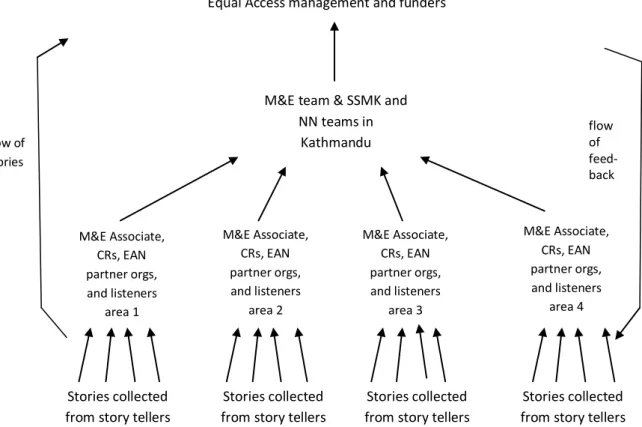
Figure 1 sets out the proposed structure for selecting the stories collected about the SSMK and Naya Nepal programs and feeding back the outcomes of this process:
23 Equal Access management and funders
Figure 1: Proposed structure of the story selection process in EAN
Who should be involved in selecting stories?
It is very important to identify the most appropriate people for the story selection panels. They should ideally represent a variety of different backgrounds and values.
People with direct responsibility for those who have forwarded the MSC stories should be involved in the selection process. Those who will make use of the information coming from those who forwarded the stories should also be included. The highest selection level should ideally involve donors and other stakeholder representatives.
While there are many reasons to include program participants in the selection and feedback process, there are also some risks that need to be considered. This includes the fact that participants’ time is not usually paid for in the same way as EA staff. The selection of stories is usually easier when it does not involve those who wrote the stories themselves.
The people who are likely to be involved in the various selection levels for stories about your programs are:
Level 1: M&E field staff, community reporters, members of local EA partner organisations or relevant civil society organisations, and senior listener club members.
Level 2: M&E staff, selected members of content production teams, and Content Advisory Group members.
Level 3: Senior management staff, relevant program stakeholders, and funders (if possible). M&E team & SSMK and
NN teams in Kathmandu M&E Associate, CRs, EAN partner orgs, and listeners area 1 Stories collected from story tellers
M&E Associate, CRs, EAN partner orgs, and listeners area 2 M&E Associate, CRs, EAN partner orgs, and listeners area 3 M&E Associate, CRs, EAN partner orgs, and listeners area 4 Stories collected from story tellers
Stories collected from story tellers
Stories collected from story tellers
flow of stories flow of feed-back
24
Possible methods for selecting the stories
Story selection usually involves a group of people sitting down together with a pile of documented stories that may or may not be grouped into domains of change. The task is to reduce the pile of stories into one story per domain (the group may decide to select more than one story). This story is the one that the group believes represents the most significant change of all. If the stories have not yet been grouped into domains, this is one of the first things the group needs to do. Once the stories have been grouped in this way, all the stories from one domain are considered together.
Various methods can be used to select stories but the main steps are:
Everyone in the group reads the stories, preferably aloud or individually (reading the stories aloud can be better as it brings the stories to life).
The group holds an in-depth conversation about which stories should be chosen.
The group decides which stories are thought to be most significant, with the aim of trying to reflect the views of everyone in the group.
The reasons for the group’s choice are written down.
Selecting the stories involves asking a similar question to that used in the story collection process:
From among all these significant changes, what doe you think was the most significant change of all?
AND
25
Methods used to decide which stories to select
It usually works better to decide on the criteria for selecting stories after the stories have been read and discussed by the group. Allowing the criteria to emerge through discussion enables the process to be more open to new ideas and experiences and can help organisational learning more.
Various methods can be used to reach a decision about which stories to select, such as:
Majority rules: Read the stories, make sure everyone understands them, and then vote by a show of hands. The main risk with this method is that a choice will be made without enough discussion first.
Iterative voting: After the first vote, the group discusses why they voted as they did. This is followed by a second and third vote, ideally with some progress towards common agreement. The views of people who disagreed can be recorded so that this is taken into account. If the vote is evenly split, two stories may need to be selected. This process can be time consuming but its value is that it fosters good quality judgements.
Scoring: Instead of voting, participants can rate the value of the story (for example from a score of 1: not at all valuable, to a score of 10: extremely valuable). Ratings for each story are then added up and the story with the highest rating is selected as the most significant. People can explain their ratings at the same time as they give their ratings. It is particularly important for people to explain their rating when a person rates a story much higher or lower than other people. The disadvantage of this method is the limited opportunity for discussion about the stories.
Pre-scoring then a group vote: This method is good when the group does not have enough time to meet. Before the meeting, participants read the stories and rate their significance. The ratings are summarised in a table then presented at the meeting. Participants then discuss the scores and cast their votes. The disadvantage of this method is that all the stories must be sent to participants some time before the meeting.
Secret ballot: Each person writes their choice of story on a small piece of paper then the total votes are presented to the group. This is followed by an open discussion about the reasons for
Story selection process using in the program: ‘Community Driven Approaches to
Address the Feminisation of HIV/AIDS in India’
Except in Amritsar, in all other places, the stories were selected using a facilitated process. The titles of the stories were written on flip charts under the respective domains. When all the stories had been read out, all the stories within one domain were considered. The facilitator asked a series of questions to prompt discussion before moving on to a vote by show of hands. When the vote was done, if there was no consensus, then further discussion was facilitated until an agreement had been reached as to which story should be selected. In AIRTDS, Guntur in one domain no agreement could be reached, therefore two stories were selected for review at the final level of selection. As well as selecting a story, the selectors were also asked to state why the story had been selected above the others. Much of the discussion revolved around explanations of why they thought one story was particularly valuable or particularly misleading.
26 the choices made. This method is particularly useful if there are inequalities of power in the group or if people are initially reluctant to cast their votes publicly.
You should try out different selection methods to find the method that seems to work best with the various groups involved in the process. Different methods can be used by the groups at different levels in the selection process, as appropriate.
The use of a meeting facilitator can speed up the selection process and ensures that group members participate equally. However, in small, informal groups this may not be necessary. Good facilitation of larger groups is essential to an effective story selection process. A sample guide to facilitating the story selection process is included in Appendix 5. The documentation attached to the most significant story should include details of the process used to select the story.
Once the selection process is completed, it is useful to reflect on what the stories tell you:
Are there any issues we should be concerned about?
What do we need to keep doing?
What do we need to drop?
What do we need to create?
The stories that are filtered out should not be thrown away, but kept on file so that they are accessible to others who are using MSC in the organisation. They can be used for content analysis of the full set of MSC stories and other purposes.
You can find an example of a story selection process used by EAN in Module 3 of this toolkit.
Tips and other information for story selection
Women’s stories can be compared with men’s stories to break down power dynamics.
Stories that seem ‘made up’ or ‘too good’ don’t get selected.
The factual content of the stories is not all that critical but people generally won’t select stories that are factually incorrect.
Which story is chosen is not important.
Discussions about stories often lead to a dialogue about values. This can be valuable in directing program outcomes towards the most explicitly valued directions and making ongoing improvements to programs.
The selection can be done as part of normal meetings. The process usually takes about one and a half hours, depending on the number of domains of change and the selection process that is used.
The selection process involves discussing the facts first then giving opinions. This process is often based on a structured focus group method.
It is best to try out different selection methods to find one that best suits your cultural and organisational context.
27
Section 6: Feeding back results of the selection process
The importance of providing feedback
Feedback is important in all M&E systems, especially those which are focussed on learning and program improvement. The results of the story selection process must therefore be fed back to those who provided the MSC stories. At the very least, this feedback should explain which significant change stories were selected as most significant and why. Some information about the process used to select the stories should also be provided.
After MSC has been used for a certain time (for example, one year), a document may be produced that includes all the stories selected at the highest level over that period of time in each domain of change. The reasons for selecting the stories are attached to each story. Donors can then be asked to assess the stories in this document and to select those that best represent the kind of outcomes they want to fund.
This type of feedback is useful because:
Information about which stories were selected can help searches for significant changes in the next reporting period. The focus of the search can move to where it seems most needed.
It shows that others have read and engaged with the stories, rather than just filed them away.
Feedback about why a selection was made can expand or challenge a participant’s views about what is significant.
Feedback about the selection process can help participants to assess the quality of the collective judgements that were made.
Feedback about the whole process can complete the communication loop between different levels of an organisation. This can help to create an ongoing dialogue about programs and what people see as being significant change.
Possible ways of providing feedback
Feedback can be given in various ways such as verbally during meetings, or via email, newsletters or formal reports. The selected stories and the reasons for their choice could also be published in community newsletters that are circulated to all participants.
28 There are a number of benefits of giving feedback to the community participants involved in a program. Feedback can motivate the people who read stories of success to change or take action, and can provide people with ideas about how they can reach their goals, and those of their community. Feedback can also lift the morale of staff and participants by providing a form of celebration for what has been achieved. It can also help to make the MSC process more transparent and open. Feedback processes should be regularly reviewed and revisions made as necessary.
Section 7: Verification of stories
Why verify stories?
Verification can be very useful in some situations. It can help you to check that a reported change reflects what actually happened. There is always a risk that some people may exaggerate the significance of events or not give a very accurate account of what happened. Also, some reported changes may be even more important than is initially evident from the way the change was documented. Knowing that there are procedures for verifying stories can also help to improve the quality of the stories. However, this process must be handled very carefully, since it could have negative effects on participants. They may think that they are not trusted or may be discouraged from reporting anything other than what they think is expected. It can be better to describe the process as an ‘exploration’ or a ‘quality check’.
When verification may not be necessary
In a situation where most of the people who are selecting the stories have some background knowledge of the events described in the stories, it may be sufficient to accept their ‘vetting’ for accuracy as a form of verification.
Who should verify the stories?
The people who select a significant change story as the most significant should feel confident with the accuracy of both the story and the interpretations that were made of it. Their judgements should usually be included in the documentation of the story.
In some organisations, M&E staff have carried out field visits every three months to follow up on the stories selected by staff in the organisation’s headquarters. In another case, an external evaluator was contracted to assess the stories and the process that generated them.
Which verification method should be used and when?
Random checks are not recommended as a method of verification. The best method is to check the changes that have been selected as most significant at all levels: at the field level, and at the middle and senior management level. Verification could be given a high priority at the following points in the MSC process:
When a story is first accepted into the organisation, such as when a fieldworker documents a change that has been reported to him or her.
29
When a story is communicated beyond the organisation, such as to donors or the general community.
Where a story is used as the basis for recommending important changes to a program or an organisation’s policies.
What aspects of stories should be verified?
It can be useful to verify both the description and interpretation aspects of MSC stories. With the description part of a story, it is useful to consider if any information is missing and to ask how accurate the facts are. You should consider whether there is enough information to allow an independent person to find out what happened, when, where and who was involved. It is likely that most MSC stories will contain some factual errors. What needs to be considered is the extent to which these errors affect the significance given to the events by the people involved or by the person who is reporting the event.
With the interpretative part of a story, you should ask if the interpretations given to the events are reasonable. Are there any contradictions in the story or other accounts of the same thing?
Section 8: Quantification of stories
Various methods can be used to collect and analyse quantitative information about MSC stories, such as the number of people involved, how many activities took place, and the number of times a particular change is recorded. You may find that quantification is useful in summary reports, especially for donors. The quantification of MSC stories can also assist with monitoring and meta-evaluation and can enable some comparison with other M&E data such as in-depth interviews and listener letters.
Section 9: Secondary analysis and meta-monitoring
Secondary analysis involves analysing the themes across a complete set of MSC stories, while meta-monitoring focuses more on the attributes of the stories themselves (such as who participated, who selected the stories, what happened to the stories, and how the different changes were reported). This is not a critical step but can strengthen the MSC process. This step is usually done by members of the M&E team.
Here are some ideas and key questions for undertaking secondary analysis and meta-monitoring of your MSC stories:
The story selection process is part of the meta analysis: Why do we see these stories as more significant than the others? What is most significant about the stories we selected?
Reporting should include comparative analysis of the stories selected and those that were not. What are the differences between these stories?
Secondary analysis also begins with similar questions. What differences are there between the stories selected from different sites? What differences are there between the stories told by different community members and groups?