Eindhoven University of Technology
Department of Mathematics and Computing Science
MASTER’S THESIS
On Collisions for MD5
ByM.M.J. Stevens
Supervisor:
Prof. dr. ir. H.C.A. van Tilborg
Advisors:
Dr. B.M.M. de Weger
Drs. G. Schmitz
1
Acknowledgements
I would like to express my gratitude to some people who were involved in this project. First of all, I owe thanks to Henk van Tilborg for being my overall supervisor and arranging this project and previous projects. I would like to thank Benne de Weger, who was especially involved in my work, for all his help, advice, comments, discussions, our joint work and his patience. The NBV deserve thanks for facilitating this project and I would like to thank Gido Schmitz especially for being my supervisor in the NBV. My gratitude goes out to Arjen Lenstra for comments, discussions, our joint work and my previous and future visits at EPFL. Thanks is due to Johan Lukkien for being on my committee.
This work benefited greatly from suggestions by Xiaoyun Wang. I am grateful for comments and assistance received from the anonymous Eurocrypt 2007 reviewers, Stuart Haber, Paul Hoff-man, Pascal Junod, Vlastimil Klima, Bart Preneel, Eric Verheul, and Yiqun Lisa Yin. Further-more, thanks go out to Jan Hoogma at LogicaCMG for technical discussions and sharing his BOINC knowledge and Bas van der Linden at TU/e for allowing us to use the Elegast cluster. Finally, thanks go out to hundreds of BOINC enthousiasts all over the world who donated an impressive amount of cpu-cycles to the HashClash project.
Contents
Acknowledgements 1
Contents 2
1 Introduction 4
1.1 Cryptographic hash functions . . . 4
1.2 Collisions for MD5 . . . 4
1.3 Our Contributions . . . 5
1.4 Overview . . . 6
2 Preliminaries 7 3 Definition of MD5 8 3.1 MD5 Message Preprocessing . . . 8
3.2 MD5 compression function . . . 8
4 MD5 Collisions by Wang et al. 10 4.1 Differential analysis . . . 10
4.2 Two Message Block Collision . . . 11
4.3 Differential paths . . . 11
4.4 Sufficient conditions . . . 12
4.5 Collision Finding . . . 12
5 Collision Finding Improvements 14 5.1 Sufficient Conditions to control rotations . . . 14
5.1.1 Conditions onQtfor block 1 . . . 15
5.1.2 Conditions onQtfor block 2 . . . 17
5.1.3 DerivingQt conditions . . . 18
5.2 Conditions on the Initial Value for the attack . . . 18
5.3 Additional Differential Paths . . . 19
5.4 Tunnels . . . 20
5.4.1 Example: Q9-tunnel . . . 20
5.4.2 Notation for tunnels . . . 21
5.5 Collision Finding Algorithm . . . 22
6 Differential Path Construction Method 26 6.1 Bitconditions . . . 26
6.2 Differential path construction overview . . . 27
6.3 Extending partial differential paths . . . 28
6.3.1 Carry propagation . . . 28
6.3.2 Boolean function . . . 28
6.3.3 Bitwise rotation . . . 29
6.4 Extending backward . . . 30
6.5 Constructing full differential paths . . . 30
7 Chosen-Prefix Collisions 32 7.1 Near-collisions . . . 32
7.2 Birthday Attack . . . 33
7.3 Iteratively ReducingIHV-differences . . . 33
7.4 Improved Birthday Search . . . 34
7.5 Colliding Certificates with Different Identities . . . 35
7.5.1 To-be-signed parts . . . 36
CONTENTS 3
7.5.3 Attack Scenarios . . . 38
7.6 Other Applications . . . 38
7.6.1 Colliding Documents . . . 38
7.6.2 Misleading Integrity Checking . . . 39
7.6.3 Nostradamus Attack . . . 39
7.7 Remarks on Complexity . . . 40
8 Project HashClash using the BOINC framework 41 9 Conclusion 42 References 43 A MD5 Constants and Message Block Expansion 46 B Differential Paths for Two Block Collisions 48 B.1 Wang et al.’s Differential Paths . . . 48
B.2 Modified Sufficient Conditions for Wang’s Differential Paths . . . 50
B.3 New First Block Differential Path . . . 52
B.4 New Second Block Differential Paths . . . 54
B.4.1 New Second Block Differential Path nr. 1 . . . 54
B.4.2 New Second Block Differential Path nr. 2 . . . 56
B.4.3 New Second Block Differential Path nr. 3 . . . 58
B.4.4 New Second Block Differential Path nr. 4 . . . 60
C Boolean Function Bitconditions 62 C.1 Bitconditions applied to boolean function F . . . 62
C.2 Bitconditions applied to boolean function G . . . 63
C.3 Bitconditions applied to boolean function H . . . 64
C.4 Bitconditions applied to boolean function I . . . 65
D Chosen-Prefix Collision Example - Colliding Certificates 66 D.1 Chosen Prefixes . . . 66
D.2 Birthday attack . . . 67
D.3 Differential Paths . . . 70
D.3.1 Block 1 of 8 . . . 70
D.3.2 Block 2 of 8 . . . 72
D.3.3 Block 3 of 8 . . . 74
D.3.4 Block 4 of 8 . . . 76
D.3.5 Block 5 of 8 . . . 78
D.3.6 Block 6 of 8 . . . 80
D.3.7 Block 7 of 8 . . . 82
D.3.8 Block 8 of 8 . . . 84
1
Introduction
This report is the result of my graduation project in completion of Applied Mathematics at the Eindhoven University of Technology (TU/e). It has been written in order to obtain the degree of Master of Science. The project has been carried out at the Nationaal Bureau Verbindings-beveiliging (NBV), which is part of the Algemene Inlichtingen en Veiligheids Dienst (AIVD) in Leidschendam.
1.1
Cryptographic hash functions
Hash functions are one-way functions with as input a string of arbitrary length (the message) and as output a fixed length string (the hash value). The hash value is a kind of signature for that message. One-way functions work in one direction, meaning that it is easy to compute the hash value from a given message and hard to compute a message that hashes to a given hash value.
They are used in a wide variety of security applications such as authentication, commitments, message integrity checking, digital certificates, digital signatures and pseudo-random generators. The security of these applications depend on the cryptographic strength of the underlying hash function. Therefore some security properties are required to make a hash functionH suitable for such cryptographic uses:
P1. Pre-image resistance: Given a hash valuehit should be hard to find any message m such that h=H(m).
P2. Second pre-image resistance: Given a messagem1it should be hard to find another message
m26=m1 such thatH(m1) =H(m2).
P3. Collision resistance: It should be hard to find different messagesm1,m2such thatH(m1) =
H(m2).
A hash collision is a pair of different messagesm16=m2having the same hash valueH(m1) =
H(m2). Therefore second pre-image resistance and collision resistance are also known as weak and strong collision resistance, respectively. Since the domain of a hash function is much larger (can even be infinite) than its range, it follows from the pigeonhole principle that many collisions must exist. A brute force attack can find a pre-image or second pre-image for a general hash function withn-bit hashes in approximately 2n hash operations. Because of the birthday paradox a brute force approach to generate collisions will succeed in approximately 2(n/2) hash operations. Any attack that requires less hash operations than the brute force attack is formally considered a break of a cryptographical hash function.
Nowadays there are two widely used hash functions: MD5[17] and SHA-1[16]. Both are iterative hash functions based on the Merkle-Damg˚ard[13, 1] construction and using a compression function. The compression function requires two fixed size inputs, namely ak-bit message block and an-bit Intermediate Hash Value (internal state between message blocks denoted as IHV), and outputs the updated Intermediate Hash Value. In the Merkle-Damg˚ard construction any message is first padded such that it has bitlength equal to a multiple ofkand such that the last bits represent the original message length. The hash function then starts with a fixedIHV called the initial value and then updatesIHV by applying the compression function with consecutivek-bit blocks, after which theIHV is returned as then-bit hash value.
1.2
Collisions for MD5
MD5 (Message Digest algorithm 5) was designed by Ronald Rivest in 1991 as a strengthened version of MD4 with a hash size of 128 bits and a message block size of 512 bits. It is mainly based on 32-bit integers with addition and bitwise operations such as XOR, OR, AND and bitwise rotation. As an Internet standard, MD5 has been deployed in a wide variety of security applications and is also commonly used to check the integrity of files. In 1993, B. den Boer and A. Bosselaers[3] showed a weakness in MD5 by finding a ”pseudo collision” for MD5 consisting of the same message
1.3 Our Contributions 5
with different initial values. H. Dobbertin[4] published in 1996 a semi free-start collision which consisted of two different 512-bit messages with a chosen initial value. This attack does not produce collisions for the full MD5, however it reveals that in MD5, differences in the higher order bits of the working state do not diffuse fast enough.
MD5 returns a hash value of 128 bits, which is small enough for a brute force birthday attack of order 264. Such a brute force attack was attempted by the distributed computing project MD5CRK which started in March 2004. However the project ended in August 2004 when Wang et al. [24] published their collisions for MD4, MD5, HAVAL-128 and RIPEMD, it is unknown to us how far the project was at that time. Later, Xiaoyun Wang and Hongbo Yu presented in [25] the underlying method to construct collisions using differential paths, which are a precise description how differences propagate through the MD5 compression function. However, they did so after Hawkes et al. [6] described in great detail a derivation of all necessary bitconditions on the working state of MD5 to satisfy the same differential paths.
The complexity of the original attack was estimated at 239calls to the compression function of MD5 and could be mounted in 15 minutes up to an hour on an IBM P690. Early improvements [26], [18], [12], [9] were able to find collisions in several hours on a single pc, the fastest being [9] which could find collisions for MD5 in about 233 compressions.
Several results were published on how to abuse such collisions in the real world. The first were based only on the first published collision. In [7] it was shown how to achieve colliding archives, from which different contents are extracted using a special program. Similarly, in [14] a method was presented to construct two colliding files, both containing the same encrypted code, however only one file allows the possibly malicious code to be decrypted and executed by a helper program. More complex applications use Wang’s attack to find collisions starting and ending with some content, identical for both messages in the collision, specifically tailored to achieve a malicious goal. The most illustrative application is given by Daum and Lucks in [2] where they construct two colliding PostScript documents, each showing a different content. For other document formats, similar results can be achieved [5]. Also, the setting of digital certificates is not entirely safe as Lenstra and de Weger[11] presented two colliding X.509 certificates with different public keys, but with identical signatures from a Certificate Authority. Although as they contain the same identity there is no realistic abuse scenario.
1.3
Our Contributions
The contributions of this thesis are split into three main topics: speeding up collision finding, constructing differential paths and chosen-prefix collisions.
First we will show several improvements to speed up Wang’s attack. All implementations of Wang’s attack use bitconditions on the working state of MD5’s compression function to find a message block which satisfies the differential path. We show how to find bitconditions on the working state such that differences are correctly rotated in the execution of the compression function, which was often neglected in collision finding algorithms and led to loss of efficiency. Also, in an analysis we show that the value of the IHV at the beginning of the attack has an impact on the complexity of collision finding. We give a recommendation to two bitconditions on this IHV to prevent a worst case complexity. Furthermore, we presented in [21], together with the above results, two new collision finding algorithms based on [9] which together allowed us to find collisions in about 226.3 compressions for recommendedIHV’s. We were the first to present a method to find collisions in the order of one minute on a single pc, rather than hours. Later, Klima [10] gave another such method using a technique called Tunnels which was slightly faster, which we incorporated in our latest collision finding algorithm presented here. Currently, using also part of our second main result discussed below, we are able to find collisions for MD5 in about 224.1compressions for recommendedIHV’s which takes approx. 6 seconds on a 2.6Ghz Pentium4. Parts of our paper [21] were used in a book on applied cryptanalysis [20].
Wang’s collision attack is based on two differential paths for the compression function which are to be used for consecutive message blocks where the first introduces differences in theIHV and the second eliminates these differences again. These two differential paths have been constructed
by hand using great skill and intuition. However, an often posed question was how to construct differential paths in an automated way. In this thesis we present the first method to construct differential paths for the compression function of MD5. To show the practicality of our method we have constructed several new differential paths which can be found in the Appendix. Five of these differential paths were used to speedup Wang’s attack as mentioned before. Our method even allows one to optimize the efficiency of the found differential paths for collision finding.
Our third contribution is the joint work with Arjen Lenstra and Benne de Weger in which we present a new collision attack on MD5, namely chosen-prefix collisions. A chosen-prefix collision consists of two arbitrarily chosen prefixesM andM0 for which we can construct using our method two suffixesS andS0, such thatM extended withS andM0 extended withS0 collide under MD5:
M D5(MkS) =M D5(M0kS0). Such chosen-prefix collisions allow more advanced abuse scenarios than the collisions based on Wang’s attack. Using our method we have constructed an example consisting of two colliding X.509 certificates which (unlike in [11]) have different identities, but still receive the same signature from a Certification Authority. Although there is no realistic attack using our colliding certificates, this does constitute a breach of PKI principles. We discuss several other applications of chosen-prefix collisions which might be more realistic. This joint work [22] was accepted at EuroCrypt 2007 and has been chosen by the program committee to be one of the three notable papers which were invited to submit their work to the Journal of Cryptology.
1.4
Overview
In the following sections 2 and 3 we will fix some notation and give a definition of MD5 which we shall use throughout this thesis. Then we will describe the original attack on MD5 of Wang et al. in section 4. Our several improvements to speed up Wang’s attack are presented in section 5. In section 6 we will discuss our method to construct differential paths for the compression function of MD5. Our joint work with Arjen Lenstra and Benne de Weger on chosen-prefix collisions and colliding certificates with different identities is presented in section 7. In section 8, we describe our use of the distributed computing framework BOINC in our project HashClash. Finally, we make some concluding remarks in section 9.
2 Preliminaries 7
2
Preliminaries
MD5 operates on 32-bit unsigned integers called words, where we will number the bits from 0 (least significant bit) up to 31 (most significant bit). We use the following notation:
• Integers are denoted in hexadecimal together with a subscript 16, e.g.12ef16, and in binary together with a subscript 2, e.g.00010010111011112,
where the most significant digit is placed left;
• For wordsX andY, additionX+Y and substractionX−Y are implicitly modulo 232; • X[i] is thei-th bit of the wordX;
• The cyclic left and right rotation of the wordX bynbitpositions are denoted asRL(X, n) andRR(X, n), respectively:
RL(111100001111001001111010100111002,5) = 000111100100111101010011100111102
= RR(111100001111001001111010100111002,27); • X∧Y is the bitwise AND of wordsX,Y or bitsX,Y;
• X∨Y is the bitwise OR of wordsX,Y or bitsX,Y; • X⊕Y is the bitwise XOR of words X,Y or bits X,Y; • X is the bitwise complement of the word or bitX;
Abinary signed digit representation (BSDR) of a wordX is a sequenceY = (ki)31i=0, often simply denoted asY = (ki), of 32 digitski∈ {−1,0,+1} for 0≤i≤31, where
X ≡
31
X
i=0
ki2i mod 232, e.g. fc00f00016≡(−1·212) + (+1·216) + (−1·226).
Since there are 332 possible BSDR’s and only 232possible words, many BSDR’s may exist for any given wordX. For convenience, we will write BSDR’s as a (unordered) sum of positive or negative powers of2, instead of as a sequence, e.g.−212+216−226. This should not cause confusion, since it will always be clear from the context whether such a sum is a BSDR or a word.
Theweight w(Y) of a BSDRY = (ki) is defined as the number of non-zero ki’s:
w(Y) = 31
X
i=0
|ki|, Y = (ki);
We use the following notation for BSDR’s: • Y ≡X for a BSDRY of the wordX;
• Y ≡Y0 for two BSDR’s Y andY0 of the same word; • YJiKis thei-th signed bit of a BSDRY;
• Cyclic left and right rotation by n positions of a BSDR Y is denoted as RL(Y, n) and
RR(Y, n), respectively:
RL(−231+222−210+20,5) =−24+227−215+25.
A particularly useful BSDR of a wordX which always exists is the Non-Adjacent Form (NAF), where no two non-zeroki’s are adjacent. The NAF is not unique since we work modulo 232(making
k31 =−1 equivalent to k31 = +1), however we will enforce uniqueness of the NAF by choosing
3
Definition of MD5
A sequence of bits will be interpreted in a natural manner as a sequence of bytes, where every group of 8 consecutive bits is considered as one byte, with the leftmost bit being the most significant bit.
E.g. 01010011 11110000=010100112 111100002=5316 f016
However, MD5 works on bytes usingLittle Endian, which means that in a sequence of bytes, the first byte is the least significant byte. E.g. when combining 4 bytes into a word, the sequenceef16, cd16,ab16,8916will result in the word89abcdef16.
3.1
MD5 Message Preprocessing
MD5 can be split up into these parts:1. Padding:
Pad the message with: first the ‘1’-bit, next as many ‘0’ bits until the resulting bitlength equals 448 mod 512, and finally the bitlength of the original message as a 64-bit little-endian integer. The total bitlength of the padded message is 512N for a positive integerN. 2. Partitioning:
The padded message is partitioned intoN consecutive 512-bit blocksM1, M2, . . . , MN. 3. Processing:
MD5 goes through N+ 1 statesIHVi, for 0≤i≤N, called theintermediate hash values. Each intermediate hash valueIHViconsists of four 32-bit wordsai, bi, ci, di. Fori= 0 these are initialized to fixed public values:
IHV0= (a0, b0, c0, d0) = (6745230116,EFCDAB8916,98BADCFE16,1032547616), and fori= 1,2, . . . Nintermediate hash valueIHViis computed using the MD5compression
function described in detail below:
IHVi = MD5Compress(IHVi−1, Mi). 4. Output:
The resulting hash value is the last intermediate hash valueIHVN, expressed as the concate-nation of the sequence of bytes, each usually shown in 2 digit hexadecimal representation, given by the four words aN, bN, cN, dN using Little-Endian. E.g. in this mannerIHV0 will be expressed as the hexadecimal string
0123456789ABCDEFFEDCBA9876543210
3.2
MD5 compression function
The input for the compression function MD5Compress(IHV, B) is an intermediate hash value
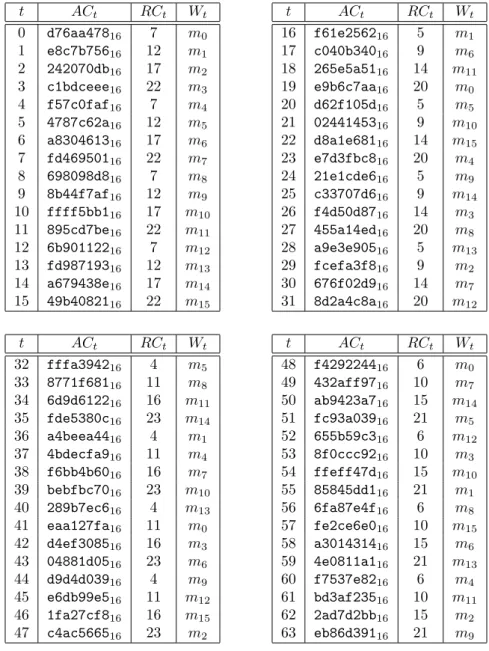
IHV = (a, b, c, d) and a 512-bit message blockB. There are 64steps(numbered 0 up to 63), split into four consecutiverounds of 16 steps each. Each step uses a modular addition, a left rotation, and a non-linear function. Depending on the step t, an Addition Constant ACt and a Rotation
Constant RCtare defined as follows, where we refer to Table A-1 for an overview of these values:
ACt=232|sin(t+ 1)| , 0≤t <64,
(RCt, RCt+1, RCt+2, RCt+3) =
(7,12,17,22) fort= 0,4,8,12,
(5,9,14,20) fort= 16,20,24,28,
(4,11,16,23) fort= 32,36,40,44,
3.2 MD5 compression function 9
The non-linear functionftdepends on the round:
ft(X, Y, Z) =
F(X, Y, Z) = (X∧Y)⊕( ¯X∧Z) for 0≤t <16, G(X, Y, Z) = (Z∧X)⊕( ¯Z∧Y) for 16≤t <32, H(X, Y, Z) =X⊕Y ⊕Z for 32≤t <48, I(X, Y, Z) =Y ⊕(X∨Z¯) for 48≤t <64.
The message blockB is partitioned into sixteen consecutive 32-bit wordsm0, m1, . . . , m15 (using Little Endian byte ordering), and expanded to 64 words (Wt)63t=0 for each step using the following relations, see Table A-1 for an overview:
Wt=
mt for 0≤t <16,
m(1+5t) mod 16 for 16≤t <32,
m(5+3t) mod 16 for 32≤t <48,
m(7t) mod 16 for 48≤t <64.
We follow the description of the MD5 compression function from [6] because its ‘unrolling’ of the cyclic state facilitates the analysis. For t = 0,1, . . . ,63, the compression function algorithm maintains a working register with 4 state words Qt,Qt−1,Qt−2 and Qt−3. These are initialized as (Q0, Q−1, Q−2, Q−3) = (b, c, d, a) and, fort= 0,1, . . . ,63 in succession, updated as follows:
Ft = ft(Qt, Qt−1, Qt−2),
Tt = Ft+Qt−3+ACt+Wt,
Rt = RL(Tt, RCt),
Qt+1 = Qt+Rt.
After all steps are computed, the resulting state words are added to the intermediate hash value and returned as output:
4
MD5 Collisions by Wang et al.
X. Wang and H. Yu [25] revealed in 2005 their new powerful attack on MD5 which allowed them to find the collisions presented in 2004 [24] efficiently. A collision of MD5 consists of two messages and we will use the convention that, for an (intermediate) variable X associated with the first message of a collision, the related variable which is associated with the second message will be denoted byX0.
Their attack is based on a combined additive and XOR differential method. Using this dif-ferential they have constructed 2 differential paths for the compression function of MD5 which are to be used consecutively to generate a collision of MD5 itself. Their constructed differential paths describe precisely how differences between the two pairs (IHV, B) and (IHV0, B0), of an intermediate hash value and an accompanying message block, propagate through the compression function. They describe the integer difference (−1, 0 or +1) in every bit of the intermediate working statesQtand even specific values for some bits.
Using a collision finding algorithm they search for a collision consisting of two consecutive pairs of blocks (B0, B00) and (B1, B01), satisfying the 2 differential paths which starts from arbitrary
ˆ
IHV =IHVˆ 0. Therefore the attack can be used to create two messagesM andM0 with the same
hash that only differ slightly in two subsequent blocks as shown in the following outline where ˆ
IHV =IHVk for somek:
IHV0 →
M1
· · · → Mk
IHVk →
B0 IHVk+1 B1→ IHVk+2 M→k+3
· · · → MN
IHVN
= = 6= = =
IHV0 →
M1
· · · → Mk
IHVk →
B0 0
IHVk+10 → B0
1
IHVk+20 → Mk+3
· · · → MN
IHVN We will use this outline throughout this work with respect to this type of collisions. Note that all blocksMi =Mi0 can be chosen arbitrarily and that onlyB0, B00, B1, B10 are generated by the collision finding algorithm.
This property was used in [11] to create two X.509 certificates where the blocksB0, B00, B1, B10 are embedded in different public keys. In [2] it was shown how to create two PostScript files with the same hash which showed two different but arbitrary contents.
The original attack finds MD5 collisions in about 15 minutes up to an hour on a IBM P690 with a cost of about 239compressions. Since then many improvements were made [18, 12, 26, 9, 21, 10]. Currently collisions for MD5 based on these differential paths can be found in several seconds on a single powerful pc using techniques based ontunnels[10], controlling rotations in the first round [21] and additional differential paths which we will present here.
4.1
Differential analysis
In [25] a combination of both integer modular substraction and XOR is used as differences, since the combination of both kinds of differences gives more information than each by themselves. So instead of only the integer modular difference between two related words X and X0, this combination gives the integer differences (−1, 0 or +1) between each pair of bits X[i] andX0[i]
for 0≤i≤31. We will denote this difference as ∆X and represent it in a natural manner using BSDR’s as follows
∆X = (ki), ki=X0[i]−X[i] for 0≤i≤31.
We will denote the regular modular difference as the wordδX=X0−X and clearlyδX≡∆X. As an example, suppose the integer modular difference isδX=X0−X= 26, then more than one XOR difference is possible:
• A one-bit difference in bit 6 (X0⊕X =0000004016) which means thatX0[6] = 1, X[6] = 0 and ∆X = +26.
• Two-bit difference in bits 6 and 7 caused by a carry. This happens whenX0[6] = 0,X[6] = 1,
4.2 Two Message Block Collision 11
• n-bit difference in bits 6 up to 6 +n−1 caused byn−1 carries. This happens whenX0[i] = 0 and X[i] = 1 fori = 6, . . . ,6 +n−2 andX0[6 +n−1] = 1 and X[6 +n−1] = 0. In this case ∆X =−26−27· · · −26+n−2+26+n−1.
• A 26-bit difference in bits 6 up to 31 caused by 26 carries (instead of 25 as in the previous case). This happens whenX0[i] = 0 andX[i] = 1 fori= 6, . . . ,31.
We extend the notation of δX and ∆X for a wordX to any tuple of words coordinatewise. E.g. ∆IHV = (∆a,∆b,∆c,∆d) andδB= (δmi)15i=0.
4.2
Two Message Block Collision
Wang’s attack consists of two differential paths for two subsequent message blocks, which we will refer to as the first and second differential path. AlthoughB0 andB1 are not necessarily the the first blocks of the messagesM and M0, we will refer toB0 and B1 as the first and second block, respectively. The first differential path starts with any given IHVk = IHVk0 and introduces a difference between IHVk+1 andIHVk+10 which will be canceled again by the second differential path:
δIHVk+1= (δa, δb, δc, δd) = (231,231+ 225,231+ 225,231+ 225). The first differential path is based on the following differences in the message block:
δm4= 231, δm11= 215, δm14= 231, δmi= 0, i6∈ {4,11,14} The second differential path is based on thenegated message block differences:
δm4=−231, δm11=−215, δm14=−231, δmi= 0, i6∈ {4,11,14} Note that−231= 231in words, so in factδm
4 andδm14 are not changed by the negation. These are very specific message block differences and were selected to ensure a low complexity for the collision finding algorithm as will be shown later.
4.3
Differential paths
The differential paths for both blocks (Tables B-1, B-2, see the Appendix) were constructed specifically to create a collision in this manner. The differential paths describe precisely for each of the 64 steps of MD5 what the differences are in the working state and how these differences pass through the boolean function and the rotation. More precisely, a differential path is defined through the sequences (δmt)15t=0, (∆Qt)64t=−3 and (δTt)64t=0 of differences.
The first differential path starts without differences in the IHV, however differences will be introduced in stept= 4 byδm4. The second differential path starts with the givenδIHVk+1. In both, all differences in the working state will be canceled at stept= 25 byδm14. And from step
t = 34 both paths use the same differential steps, although with opposite signs. This structure can easily be seen in the Tables B-1 and B-2.
Below we show a fraction of the first differential path:
t ∆Qt δFt δwt δTt RCt
13 −224+225+231 −213+231 − −212 12 14 +231 218+231 231 218−230 17
15 +23−213+231 225+231 − −27−213+225 22 16 −229+231 231 − 224 5
17 +231 231 − − 9
18 +231 231 215 23 14 19 +217+231 231 − −229 20
The two differential paths were made by hand with great skill and intuition. It has been an open question for some time how to construct differential paths methodically. In section 6 we will present the first method to construct differential paths for MD5. Using our method we have constructed several differential paths for MD5. We use 5 differential paths in section 5 to speedup the attack by Wang et al. and 8 others were used in section 7 for a new collision attack on MD5.
4.4
Sufficient conditions
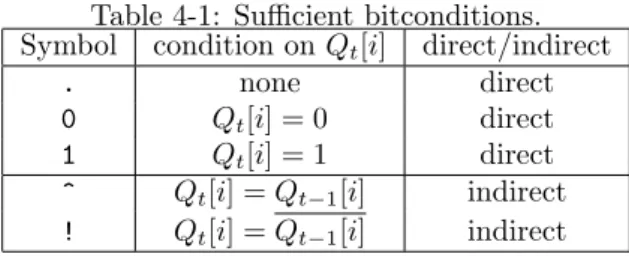
Wang et al. usesufficient conditions(modified versions are shown in Tables B-3,B-4) to efficiently search for message blocks for which these differential paths hold. These sufficient conditions guaranteed that the necessary carries and correct boolean function differences happen. Each condition gives the value of a bit Qt[i] of the working state either directly or indirectly as shown in Table 4-1. Later on we will generalize and extend these conditions to also include the value of the related bitQ0t[i].
Table 4-1: Sufficient bitconditions. Symbol condition onQt[i] direct/indirect
. none direct
0 Qt[i] = 0 direct
1 Qt[i] = 1 direct
^ Qt[i] =Qt−1[i] indirect ! Qt[i] =Qt−1[i] indirect
These conditions are only to find a block B on which the message differences will be applied to findB0 and should guarantee that the differential path happens. They can be derived for any differential path and there can be many different possible sets of sufficient conditions.
However, it should be noted that their sufficient conditions are not sufficient at all, as they do not guarantee that in each step the differences are rotated correctly. In fact as we will show later on, one does not want sufficient conditions for the full differential path as this increases the collision finding complexity significantly. On the other hand, sufficient conditions over the first round and necessary conditions for the other rounds will decrease the complexity. This can be seen as in the first round one can still choose the working state and one explicitly needs to verify the rotations, whereas in the other rounds the working state is calculated and verification can be done on the fly.
4.5
Collision Finding
Using these sufficient conditions one can efficiently search for a blockB. Basically one can choose a random blockBthat meets all the sufficient conditions in the first round. The remaining sufficient conditions have to be fulfilled probabilistically and directly result in the complexity of this collision finding algorithm. Wang et al. used several improvements over this basic algorithm:
1. Early abortion:
Abort at the step where the first sufficient condition fails. 2. Multi-Message Modification:
When a certain condition in the second round fails, one can use multi-message modification. This is a substitution formula specially made for this condition on the message block B, such that after the substitution that condition will now hold without interfering with other previous conditions.
An example of multi-message modification is the following. When searching a block for the first differential path using Table B-3, suppose Q17[31] = 1 instead of 0. This can be corrected by modifyingm1, m2, m3, m4, m5 as follows:
4.5 Collision Finding 13
1. Substitute mc1←(m1+ 226), this results in a differentQc2.
2. Substitute mc2←(RR(Q3−Qc2,17)−Q−1−F(Qc2, Q1, Q0)−AC2). 3. Substitute mc3←(RR(Q4−Q3,22)−Q0−F(Q3,Qc2, Q1)−AC3). 4. Substitute mc4←(RR(Q5−Q4,7)−Q1−F(Q4, Q3,Qc2)−AC4). 5. Substitute mc5←(RR(Q6−Q5,12)−Qc2−F(Q5, Q4, Q3)−AC5).
The first line is the most important, herem1 is changed such thatQd17[31] = 0, assumingQ13 up toQ16 remain unaltered. The added difference +226 inm1 results in an added difference of +231 inQ17[31], henceQd17[31] = 0. The four other lines simply changem2, m3, m4, m5such thatQ3up to Q16 remain unaltered by the change inm1. Since there are no conditions onQ2, all previous conditions are left intact.
Wang et al. constructed several of such multi-message modifications which for largertbecome more complex. Klima presented in [9] two collision finding algorithms, one for each block, which are much easier and more efficient than these multi-message modifications. Furthermore, Klima’s algorithms work for arbitrary differential paths, while multi-message modifications have to be derived specifically for each differential path.
5
Collision Finding Improvements
In [6] a thorough analysis of the collisions presented by Wang et al. is presented. Not only a set of ‘sufficient’ conditions on Qt, similarly as those presented in [25], is derived but also a set of necessary restrictions onTtfor the differential to be realized. These restrictions are necessary to correctly rotate the add-difference δTt to δRt. Collision finding can be done more efficiently by also satisfying the necessary restrictions onTt used in combination with early abortion.
Fast collision finding algorithms as presented in [9] can choose message blocksBwhich satisfy the conditions forQ1, . . . , Q16. As one can simply choose values ofQ1, . . . , Q16fulfilling conditions and then calculatemt fort= 0, . . . ,15 using
mt=RR(Qt+1−Qt, RCt)−ft(Qt, Qt−1, Qt−2)−Qt−3−ACt.
Message modification techniques are used to change a blockB such thatQ1, . . . , Q16are changed slightly maintaining their conditions and thatQ17up to someQk do not change at all. Naturally, we wantkto be as large as possible.
Although conditions forQ1, . . . , Q16can easily be fulfilled, this does not hold for the restrictions onTt which still have to be fulfilled probabilistically. Our first collision finding improvement we present here is a technique to satisfy those restrictions onTtusing conditions onQtwhich can be satisfied when choosing a message blockB.
The first block has to fulfill conditions of its differential path, however there are also conditions due to the start of the differential path of the second block. Although not immediately clear, the latter conditions have a probability to be fulfilled that depends on IHVk, the intermediate hash value used to compress the first block. We will show this dependency and present two conditions that prevent a worst-case probability. The need for these two conditions can also be relieved with our following result.
Another improvement is the use of additional differential paths we have constructed using the techniques we will present in section 6. We present one differential path for the first block and 4 additional differential paths for the second block. The use of these will relax some conditions imposed on the first block due to the start of the differential path for the second block. As each of the now five differential paths for the second block has different conditions imposed on the first block, only one of those has to be satisfied to continue with the second block.
We were the first to present in [21] a collision finding algorithm which was able to find collisions for MD5 in the order of minutes on a single pc, based on Klima’s algorithm in [9]. Shortly after, Klima presented in [10] a new algorithm which was slightly faster than ours using a technique calledtunneling. We will explain this tunneling technique and present an improved version of our algorithm in [21] using this technique. These improvements in collision finding were crucial to our chosen-prefix construction, as the differential paths for chosen-prefix collisions usually have significantly more conditions than Wang’s differential paths. Hence, the complexity to find collision blocks satisfying these differential paths is significantly higher (about 242vs. 224.1 compressions). Currently using these three improvements we are able to find collisions for MD5 in several seconds on a single pc (approx. 6 seconds on a 2.6Ghz Pentium4 pc). Source code and a windows executable can be downloaded fromhttp://www.win.tue.nl/hashclash/.
5.1
Sufficient Conditions to control rotations
The first technique presented here allows to fulfill the restrictions onTtby using extra conditions onQt+1 andQtsuch as those in Table 4-1. By using the relationQt+1−Qt=Rt=RL(Tt, RCt) we can control specific bits inTt. In our analysis of Wang’s differential paths, we searched for those restrictions onTtwith a significant probability that they are not fulfilled. For each such restriction onTt, fort= 0, . . . ,19, we have found bitconditions onQt+1 andQtwhich were sufficient for the restriction to hold. For higher steps it is more efficient to directly verify the restriction instead of using conditions onQt.
All these restrictions can be found in [6] with a description why they are necessary for the differential path. The resulting conditions together with the original conditions can be found in
5.1 Sufficient Conditions to control rotations 15
Table B-3. Below we will show the original set of sufficient conditions in [25] in black and our added conditions will be underlined and in blue.
5.1.1 Conditions onQt for block 1 1. Restriction: ∆T4=−231.
This restriction is necessary to guarantee that δR4 = −26 instead of +26. The condition
T4[31] = 1 is necessary and sufficient for ∆T4 =−231 to happen. Bit 31 of T4 is equal to bit 6 of R4, since T4 is equal to RR(R4,7). By adding the conditions Q4[4] = Q4[5] = 1 and Q5[4] = 0 to the conditions Q4[6] =Q5[6] = 0 and Q5[5] = 1, it is guaranteed that
R4[6] =T4[31] = 1. Satisfying otherQtconditions, this also implies thatQ6[4] =Q5[4] = 0.
Q5[6−4] 010 · · ·
Q4[6−4] 011 · · · −
R4[6−4] 11. · · · =
This table shows the bits 4,5 and 6 of the wordsQ5,Q4andR4with the most significant bit placed left, this is notated byQ5[6−4] extending the default notation for a single bitQ5[6]. 2. Restriction: add-difference −214 in δT
6 must propagate to at least bit 15 on T6. This restriction implies thatT6[14] must be zero to force a carry. SinceT6[14] =R6[31], the condition T6[14] = 0 is guaranteed by the added conditions Q6[30−28,26] = 0. This also implies thatQ5[30−28,26] = 0 because of other conditions onQt.
Q7[31−23] 000000111 · · ·
Q6[31−23] 0000001.0 · · · −
R6[31−23] 0000000.. · · · = Note: in [26] these conditions were also found by statistical means. 3. Restriction: add-difference +213 in δT
10 must not propagate past bit 14 on T10. The restriction is satisfied by the conditionT10[13] =R10[30] = 0. The conditionsQ11[29− 28] =Q10[29] = 0 andQ10[28] = 1 are sufficient.
Q11[31−28] 0010 · · ·
Q10[31−28] 0111 · · · −
R10[31−28] 101. · · · = 4. Restriction: add-difference −28 in δT
11 must not propagate past bit 9 on T11. This restriction can be satisfied by the condition T11[8] = R11[30] = 1. With the above added conditionQ11[29] = 1 we only need the extra condition Q12[29] = 0.
Q12[31−29] 000 · · ·
Q11[31−29] 001 · · · −
R11[31−29] 11. · · · = 5. Restriction: add-difference −230 in δT
14 must not propagate past bit 31 on T14. For T14 the add difference −230 must not propagate past bit 31, this is satisfied by either
T14[30] =R14[15] = 1 orT14[31] =R14[16] = 1. This always happens whenQ15[16] = 0 and can be shown for the case if no carry from the lower order bits happens as well as the case if a negative carry does happen. A positive carry is not possible since we are subtracting.
no carry negative carry from lower bits
Q15[16−15] 01 · · ·
Q14[16−15] 11 · · · −
R14[16−15] 10 · · · =
Q15[16−15] 01 · · ·
Q14[16−15] 11 · · · −
6. Restriction: add-difference −27 in δT
15 must not propagate past bit 9 on T15. This can be satisfied by the added condition Q16[30] =Q15[30]. Since then either T15[7] =
R15[29] = 1, T15[8] = 1 or T15[9] = 1 holds. This can be shown if we distinguish between
Q15[30] = 0 andQ15[30] = 1 and also distinguish whether or not a negative carry from the lower order bits happens.
no carry negative carry from lower bits
Q16[31−29] 001 · · ·
Q15[31−29] 011 · · · −
R15[31−29] 110 · · · =
Q16[31−29] 001 · · ·
Q15[31−29] 011 · · · −
R15[31−29] 101 · · · = no carry negative carry from lower bits
Q16[31−29] 011 · · ·
Q15[31−29] 001 · · · −
R15[31−29] 010 · · · =
Q16[31−29] 011 · · ·
Q15[31−29] 001 · · · −
R15[31−29] 001 · · · =
7. Restriction: add-difference +225 in δT15 must not propagate past bit 31 on T15. This is satisfied by the added condition Q16[17] = Q15[17]. Since then either T15[25] =
R15[15] = 0,T15[26] = 0 orT15[27] = 0 holds. We compactly describe all cases by mentioning which values were assumed for each result:
no carry
Q16[17−15] !.. · · ·
Q15[17−15] .01 · · · −
R15[17−15] 011 · · · = (Q16[17−15] =.00) 100 · · · (Q16[17−15] =.01) 101 · · · (Q16[17−15] =.10) 110 · · · (Q16[17−15] =.11) negative carry from lower bits
Q16[17−15] !.. · · ·
Q15[17−15] .01 · · · −
R15[17−15] 010 · · · = (Q16[17−15] =.00) 011 · · · (Q16[17−15] =.01) 100 · · · (Q16[17−15] =.10) 101 · · · (Q16[17−15] =.11) 8. Restriction: add-difference +224 in δT
16 must not propagate past bit 26 on T16. This can be achieved with the added condition Q17[30] =Q16[30], since then always either
T16[24] =R16[29] = 0 orT16[25] =R16[30] = 0. no carry
Q17[30−29] !. · · ·
Q16[30−29] .1 · · · −
R16[30−29] 01 · · · = (Q17[30−29] =00) 10 · · · (Q17[30−29] =01) 01 · · · (Q17[30−29] =10) 10 · · · (Q17[30−29] =11) negative carry from lower bits
Q17[30−29] !. · · ·
Q16[30−29] .1 · · · −
R16[30−29] 00 · · · = (Q17[30−29] =00) 01 · · · (Q17[30−29] =01) 00 · · · (Q17[30−29] =10) 01 · · · (Q17[30−29] =11)
5.1 Sufficient Conditions to control rotations 17
9. Restriction: add-difference −229 in δT
19 must not propagate past bit 31 on T19. This can be achieved with the added condition Q20[18] =Q19[18], since then always either
T19[29] = 1 orT19[30] = 1.
no carry
Q20[18−17] !. · · ·
Q19[18−17] .0 · · · −
R19[18−17] 10 · · · = (Q20[18−17] =00) 11 · · · (Q20[18−17] =01) 10 · · · (Q20[18−17] =10) 11 · · · (Q20[18−17] =11) negative carry from lower bits
Q20[18−17] !. · · ·
Q19[18−17] .0 · · · −
R19[18−17] 01 · · · = (Q20[18−17] =00) 10 · · · (Q20[18−17] =01) 01 · · · (Q20[18−17] =10) 10 · · · (Q20[18−17] =11)
10. Restriction: add-difference +217 in δT22 must not propagate past bit 17 on T22. It is possible to satisfy this restriction with two Qtconditions. However T22 will always be calculated in the algorithm we used, therefore it is better to verify directly thatT22[17] = 0. This restriction holds for both block 1 and 2.
11. Restriction: add-difference +215 in δT
34 must not propagate past bit 15 on T34. This restriction also holds for both block 1 and 2 and it should be verified withT34[15] = 0. 5.1.2 Conditions onQt for block 2
Using the same technique as in the previous subsection we found 17 Qt-conditions satisfying 12
Ttrestrictions for block 2. An overview of all conditions for block 2 is included in Table B-4. 1. Restriction: ∆T2J31K= +1.
Conditions: Q1[16] =Q2[16] =Q3[15] = 0 andQ2[15] = 1. 2. Restriction: ∆T6J31K= +1.
Conditions: Q6[14] = 1 andQ7[14] = 0. 3. Restriction: ∆T8J31K= +1.
Conditions: Q8[5] = 1 and Q9[5] = 0. 4. Restriction: add-difference−227 inδT
10 must not propagate past bit 31 onT10. Conditions: Q10[11] = 1 andQ11[11] = 0.
5. Restriction: add-difference−212 inδT
13 must not propagate past bit 19 onT13. Conditions: Q13[23] = 0 andQ14[23] = 1.
6. Restriction: add-difference +230 inδT14 must not propagate past bit 31 onT14. Conditions: Q15[14] = 0.
7. Restriction: add-difference−225 inδT
15 must not propagate past bit 31 onT15. Conditions: Q16[17] =Q15[17].
8. Restriction: add-difference−27 inδT
15 must not propagate past bit 9 onT15. Conditions: Q16[28] = 0.
9. Restriction: add-difference +224 inδT
16 must not propagate past bit 26 onT16. Conditions: Q17[30] =Q16[30].
10. Restriction: add-difference−229 inδT
19 must not propagate past bit 31 onT19. Conditions: Q20[18] =Q19[18].
11. Restriction: add-difference +217 inδT22 must not propagate past bit 17 onT22. See previous item 10.
12. Restriction: add-difference +215 inδT34 must not propagate past bit 15 onT34. See previous item 11.
5.1.3 DerivingQt conditions
Deriving these conditions onQtto satisfyTtrestrictions can usually be done with a bit of intuition and naturally for stept one almost always has to look near bits 31 andRCt ofQt andQt+1. An useful aid is a program which, given conditions for Q1, . . . , Qk+1, determines the probabilities of the correct rotations for each stept= 1, . . . , kand the joint probability that for stepst= 1, . . . , k
all rotations are correct. The latter is important since the rotations affect each other.
Such a program could also determine extra conditions which would increase this joint probabil-ity. One can then look in the direction of the extra condition(s) that increases the joint probability the most. However deriving such conditions is not easily fully automated as the following two problems arise:
• Conditions guaranteeing the correct rotation ofδTttoδRtmay obstruct the correct rotation of δTt+1 to δRt+1. Or even other δTt+k for k > 0 if these conditions affect the values of
Qt+k and/orQt+k+1 through indirect conditions.
• It is possible that to guarantee the correct rotation of some δTtthere are several solutions each consisting of multiple conditions. In such a case it might be that there is no single extra condition that would increase the joint probability significantly.
5.2
Conditions on the Initial Value for the attack
The intermediate hash value,IHVk in the outline in section 4, used for compressing the first block of the attack, is called the initial valueIV for the attack. This does not necessarily have to be the MD5 initial value, it could also result from compressing leading blocks. Although not completely obvious, the expected complexity and thus running time of the attack does depend on this initial valueIV.
The intermediate value IHVk+1 = (ak+1, bk+1, ck+1, dk+1) resulting from the compression of the first block is used for compressing the second block and has the necessary conditionsck+1[25] = 1 and dk+1[25] = 0 for the second differential path to happen. The IHVk+1 depends on the
IV = (a, b, c, d) for the attack andQ61, . . . , Q64of the compression of the first block:
IHVk+1= (ak+1, bk+1, ck+1, dk+1) = (a+Q61, b+Q64, c+Q63, d+Q62).
In [6] the sufficient conditions Q62[25] = 0 and Q63[25] = 0 are given. These conditions on
ck+1[25] andQ63[25] can only be satisfied at the same time when
• either c[25] = 1 and there is no carry from bits 0-24 to bit 25 in the additionc+Q63; • or c[25] = 0 and there is a carry from bits 0-24 to bit 25 in the additionc+Q63. The conditions ondk+1[25] and Q62[25] can only be satisfied at the same time when
• either d[25] = 0 and there is no carry from bits 0-24 to bit 25 in the additiond+Q62; • or d[25] = 1 and there is a carry from bits 0-24 to bit 25 in the additiond+Q62.
5.3 Additional Differential Paths 19
Satisfying all these conditions at the same time can even be impossible if for instancec[25−0] = 0, ord[25] = 1∧d[24−0] = 0, since the necessary carry can never happen.
Luckily this doesn’t mean the attack cannot be done for those IV’s, since the conditions
Q62[25] = 0 andQ63[25] = 0 are only sufficient. They allow the most probable differential path at those steps to happen, however there are other (less probable) differential paths that are also valid. If this normally most probable differential path cannot happen or happens with low probability (depending on the carry) then the average complexity of the attack depends on the probability that other differential paths happen. Experiments clearly indicated that the average runtime for this situation is significantly larger than the average runtime in the situation where the most probable differential path happens with high probability.
Therefore we relaxed all conditions on bit 25 of Q60, . . . , Q63 to allow those other differential paths to happen. We also give a recommendation for the following two IV conditions to avoid this worst case:
c[25] =c[24]∧d[25] =d[24] for IV = (a, b, c, d)
5.3
Additional Differential Paths
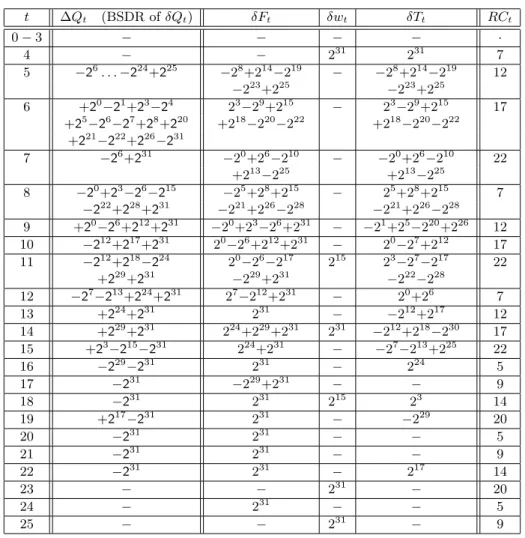
Furthermore, we have constructed new differential paths and conditions using the techniques we will present in section 6. We have constructed one differential path for the first block, which can be used as a replacement of the original first differential path.
We also have constructed four differential paths for the second block, each having different sets of conditions imposed on the first block. The first block only has to satisfy one of those sets of conditions. Then one can continue with the differential path for the second block that is associated with the satisfied set of conditions. Hence, together the five differential paths for the second block allow more freedom and improved collision finding for the first block.
Our differential paths for the first and second block were constructed using the exact same message block differences and IHV differences as the original first and second differential path, respectively. Also in step t = 26, ours and Wang’s original differential paths have the same differences in the working state (δQ26, δQ25, δQ24, δQ23) = (0,0,0,0). Hence, also in later steps
t= 26, . . . ,63 our differential paths and conditions are equal to the respective original differential path and conditions.
Therefore we will omit stepst= 26, . . . ,63 of our differential paths. We also applied conditions to control rotations using our technique in subsection 5.1. Our differential path for the first block is shown in Table B-5 and below, its conditions are shown in Table B-6. Our differential paths for the second block are shown in Table B-7, Table B-9, Table B-11 and Table B-13. The respective conditions are listed in Table B-8, Table B-10, Table B-12 and Table B-14.
Table 5-1: New first block differential path
t ∆Qt (BSDR ofδQt) δFt δwt δTt RCt
0−3 − − − − ·
4 − − 231 231 7
5 −26. . .−224+225 −28+214−219 − −28+214−219 12
−223+225 −223+225
6 +20−21+23−24 23−29+215 − 23−29+215 17 +25−26−27+28+220 +218−220−222 +218−220−222
+221−222+226−231
7 −26+231 −20+26−210 − −20+26−210 22 +213−225 +213−225
8 −20+23−26−215 −25+28+215 − 25+28+215 7
−222+228+231 −221+226−228 −221+226−228
9 +20−26+212+231 −20+23−26+231 − −21+25−220+226 12 10 −212+217+231 20−26+212+231 − 20−27+212 17 11 −212+218−224 20−26−217 215 23−27−217 22
+229+231 −229+231 −222−228
12 −27−213+224+231 27−212+231 − 20+26 7 13 +224+231 231 − −212+217 12 14 +229+231 224+229+231 231 −212+218−230 17 15 +23−215−231 224+231 − −27−213+225 22
16 −229−231 231 − 224 5
17 −231 −229+231 − − 9
18 −231 231 215 23 14
19 +217−231 231 − −229 20
20 −231 231 − − 5
21 −231 231 − − 9
22 −231 231 − 217 14
23 − − 231 − 20
24 − 231 − − 5
25 − − 231 − 9
5.4
Tunnels
In [10], Klima presented a new collision finding technique called tunneling. A tunnel allows one to make controlled changes in the message block B such that in Q1 up to a certain Qk, wherek depends on the tunnel used, only small changes occur and all conditions remain unaffected. In fact, the effect of a tunnel is best shown using changes in a certain Qm as we will show in the following example withm= 9 which is called theQ9-tunnel.
5.4.1 Example: Q9-tunnel
Assume that we have found a block B0 that meets all first block conditions in Table B-3 up to
Q24. The conditions forQ9,Q10and Q11 are:
t Conditions onQt: b31. . . b0 9 11111011 ...10000 0.1^1111 00111101 10 0111.... 0..11111 1101...0 01....00 11 0010.... ....0001 1100...0 11....10
As this table shows, there are four bits in Q9 that can be chosen freely, namely Q9[14], Q9[21],
5.4 Tunnels 21
Q10, . . . , Q16 then only the following message block words are changed:
m8 = W8 = RR(Q9−Q8,7) − f8(Q8, Q7, Q6) − Q5 − AC8
m9 = W9 = RR(Q10−Q9,12) − f9(Q9, Q8, Q7) − Q6 − AC9
m10 = W10 = RR(Q11−Q19,17) − f10(Q10,Q9, Q8) − Q7 − AC10
m11 = W11 = RR(Q12−Q11,22) − f11(Q11, Q10,Q9) − Q8 − AC11
m12 = W12 = RR(Q13−Q12,7) − f12(Q12, Q11, Q10) − Q9 − AC12 Hence, all conditions in the first round remain satisfied. In the second roundQ17andQ18do not change, as stepst= 16,17 do not depend onm8, . . . , m12 as shown below:
Stept 16 17 18 19 20 21 22 23 24 25 26
Message blockWt m1 m6 m11 m0 m5 m10 m15 m4 m9 m14 m3 AffectedQt+1 Q17 Q18 Q19 Q20 Q21 Q22 Q23 Q24 Q25 Q26 Q27 On the other hand, a differentm11may lead to a differentQ19.
Suppose thatQ11[22] = 1 then
F11[22] =f11(Q11[22], Q10[22], Q9[22]) = (Q11[22]∧Q10[22])⊕(Q11[22]∧Q9[22]) =Q10[22]. HenceF11and thus alsom11do not change. In this case, actuallyQ17up toQ21remain unaffected by the change inQ9[22].
Furthermore, if we suppose that Q10[22] = 0 then
F10[22] =f10(Q10[22], Q9[22], Q8[22]) = (Q10[22]∧Q9[22])⊕(Q10[22]∧Q8[22]) =Q8[22] and alsom10 does not change. In this case we have achieved that a change in a single bitQ9[22] actually leaves Q17 up to Q24 unchanged and therefore all conditions in Q1 up to Q24 remain satisfied.
In general, over multiple bitsQ9[i1], . . . , Q9[in] withQ10[i1] =. . .=Q10[in] = 0 andQ11[i1] =
. . .=Q11[in] = 1, we find that changing those bits leads to a total of 2n different message blocks, including the one we started with. And all those message blocks meet all conditions forQ1 up to
Q24.
In the case of the first block conditions in Table B-3 we find that only bitsQ9[21],Q9[22] and
Q9[23] can be part of the Q9-tunnel as Q10[14] = 1 instead of 0. We need the extra conditions
Q10[21] =Q10[22] = 0 andQ11[21] =Q11[22] =Q11[23] = 1 to make use of this tunnel, as shown below in green and underlined.
t Conditions onQt: b31. . . b0 9 11111011 xxx10000 0.1^1111 00111101 10 0111.... 00011111 1101...0 01....00 11 0010.... 111.0001 1100...0 11....10
Initially the bits xxxshould be set to 000 in a collision finding algorithm and when a message blockB0 is found that meets all conditions forQ1up toQ24 then we expand thisB0into a set of 8 different message blocks using the 8 different values for these bits xxx. Q25 is the first affected
Qtfor which we have to check if conditions are met, and is called thepoint of verification or POV. The number of bits that can be changed in a tunnel, in this case 3, is called thestrength of the tunnel.
5.4.2 Notation for tunnels
We will use the notationT(Qi, mj) for the tunnel consisting of those bits ofQithat do not change
W16, . . . , Wk but do change Wk+1 = mj. In other words those bits of Qi that we can change such thatQ17, . . . , Qk+1 remain unaffected while Qk+2 does change. Naturally all such possible tunnels are disjoint as each bit ofQichanges an unique first message wordWk+1. E.g. the example
tunnel above consisting of the bitsQ9[21], Q9[22] andQ9[23] and changingW24=m9is notated as T(Q9, m9). Also sinceQ10[14] = 1 the bit Q9[14] changes m10, the bit Q9[14] is part of the tunnelT(Q9, m10). Furthermore, the strength of a tunnel is the number of bits it consists of and is denoted asSi,j=|T(Qi, mj)|.
The tunnels that we will use in our results are:
Table 5-2: Tunnels for collision finding
Tunnel Required bitconditions First affectedQt,t >16 T(Q9, m9) Q10[i] = 0∧Q11[i] = 1 Q25
T(Q4, m4) Q5[i] = 0∧Q6[i] = 1 Q24 T(Q9, m10) Q10[i] = 1∧Q11[i] = 1 Q22 T(Q10, m10) Q11[i] = 0 Q22 T(Q4, m5) Q5[i] = 1∧Q6[i] = 1 Q21 T(Q5, m5) Q6[i] = 0 Q21
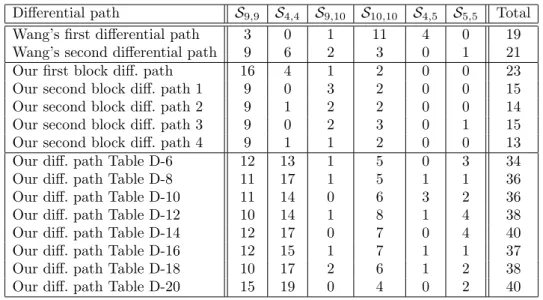
It should be noted that the tunnels and their required bitconditions above depend only on the bits of Qt and not on the bits of Q0t. Below we show the different tunnel strengths for all differential paths in the Appendix:
Table 5-3: Tunnel strengths for known differential paths
Differential path S9,9 S4,4 S9,10 S10,10 S4,5 S5,5 Total
Wang’s first differential path 3 0 1 11 4 0 19
Wang’s second differential path 9 6 2 3 0 1 21
Our first block diff. path 16 4 1 2 0 0 23
Our second block diff. path 1 9 0 3 2 0 0 15
Our second block diff. path 2 9 1 2 2 0 0 14
Our second block diff. path 3 9 0 2 3 0 1 15
Our second block diff. path 4 9 1 1 2 0 0 13
Our diff. path Table D-6 12 13 1 5 0 3 34
Our diff. path Table D-8 11 17 1 5 1 1 36
Our diff. path Table D-10 11 14 0 6 3 2 36
Our diff. path Table D-12 10 14 1 8 1 4 38
Our diff. path Table D-14 12 17 0 7 0 4 40
Our diff. path Table D-16 12 15 1 7 1 1 37
Our diff. path Table D-18 10 17 2 6 1 2 38
Our diff. path Table D-20 15 19 0 4 0 2 40
Especially in the last 8 differential paths above, one can see that we are able to optimize the tunnel strength when constructing differential paths.
5.5
Collision Finding Algorithm
In this section we will present our near-collision block search algorithm. It is an extension of our collision finding algorithms [21] shown here as Algorithm 5.1 and 5.2 which were again based on Klima’s algorithms [9]. For each of the two collision blocks we used a separate collision finding algorithm. Using these two collision finding algorithms we were the first to be able to find collisions for MD5 in the order of minutes. Currently with our three improvements (conditions for the rotations, additional differential paths and the algorithms shown here) we are able to find collisions for MD5 in several seconds on a single pc.
5.5 Collision Finding Algorithm 23
These algorithms depend on the fact that given t, the message block wordWt=mk for some
kcan be calculated fromQt+1,Qt,Qt−1,Qt−2,Qt−3 using the formula
mk=Wt=RR(Qt+1−Qt, RCt)−ft(Qt, Qt−1, Qt−2)−Qt−3−ACt.
Hence, we can choose the working states for the first round satisfying their bitconditions and then determine the corresponding message block.
We extended these two collision finding algorithms using the tunnels in subsubsection 5.4.2. Furthermore we joined them into one near-collision block search algorithm in Algorithm 5.3 which also is suited for our differential paths we use later on (e.g. Table D-6). As these differential paths have a lot more bitconditions than the differential paths by Wang et al., we tried to maximize the number of choices at each step. During the construction of the differential paths themselves we also tried to maximize their total tunnel strength.
Using these optimizations we were able to efficiently find collision blocks for the differential paths we use later on (e.g. Table D-6) in chosen-prefix collisions using in the order of 242 com-pressions, whereas using the basic algorithm in subsection 4.5 this would be infeasible. As these differential paths have a lot more bitconditions than e.g. the ones used in Wang’s attack, the basic algorithm would need in the order of 2100 compressions to find a collision block, which is even harder than a brute-force collision search of approx. 264 compressions.
Algorithm 5.1Block 1 search algorithm
Note: conditions are listed in Table B-3. See subsection 5.1 for the conditions onT22 andT34. 1. ChooseQ1, Q3, . . . , Q16 fulfilling conditions;
2. Calculatem0, m6, . . . , m15;
3. Loop until Q17, . . . , Q21 are fulfilling conditions: (a) ChooseQ17 fulfilling conditions;
(b) Calculatem1at t= 16;
(c) CalculateQ2 andm2, m3, m4, m5; (d) CalculateQ18, . . . , Q21;
4. Loop over all possibleQ9, Q10 satisfying conditions such thatm11 does not change: (Use tunnelsT(Q9, m10),T(Q9, m9) andT(Q10, m10))
(a) Calculatem8, m9, m10, m12, m13; (b) CalculateQ22, . . . , Q64;
(c) Verify conditions onQ22, . . . , Q64, T22, T34and theIHV-conditions for the next block. Stop searching if all conditions are satisfied and a near-collision is verified.
Algorithm 5.2Block 2 search algorithm
Note: conditions are listed in Table B-4. See subsection 5.1 for the conditions onT22 andT34. 1. ChooseQ2, . . . , Q16 fulfilling conditions;
2. Calculatem5, . . . , m15;
3. Loop until Q17, . . . , Q21 are fulfilling conditions: (a) ChooseQ1 fulfilling conditions;
(b) Calculatem0, . . . , m4; (c) CalculateQ17, . . . , Q21;
4. Loop over all possibleQ9, Q10 satisfying conditions such thatm11 does not change: (Use tunnelsT(Q9, m10),T(Q9, m9) andT(Q10, m10))
(a) Calculatem8, m9, m10, m12, m13; (b) CalculateQ22, . . . , Q64;
(c) Verify conditions onQ22, . . . , Q64, T22, T34.
Stop searching if all conditions are satisfied and a near-collision is verified. 5. Start again at step 1.
In our near-collision block search algorithm below in 5.3, one should keep the bits of tunnels T(Q4, m4), T(Q4, m5), T(Q5, m5), T(Q9, m9), T(Q9, m10) and T(Q10, m10) zero-valued. Only at the step where one uses the tunnel we will use the different values for the bits involved. It is more efficient to fix these tunnels before starting the collision search by applying their required conditions and making use of precomputed tables. However it is also possible to determine these tunnels at the step they are used. Furthermore, when e.g. using Wang’s first block differential path one should not actually build the setM0 as all values ofm0 will do and 232 words would require 16GB of memory. In general one should not build this set if it would require more memory than some large memory bound, and simply use random valuesm0 at step 11. and then verify if
Q1and Q2 satisfy their conditions.
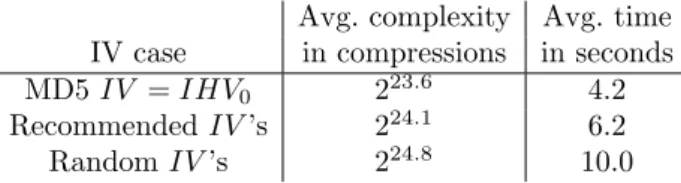
We have done a complexity analysis using our latest implementation of Wang’s attack where we distinguish between three cases for the IV: the MD5 initial valueIHV0, recommendedIV’s as in subsection 5.2 and arbitraryIV’s. Table 5-4 below shows the collision finding complexity as the cost equivalent to computing the stated number of compressions and the amount of time it takes on a 2.6Ghz Pentium4 pc.
Table 5-4: Collision finding complexity Avg. complexity Avg. time IV case in compressions in seconds
MD5IV =IHV0 223.6 4.2
RecommendedIV’s 224.1 6.2
5.5 Collision Finding Algorithm 25
Algorithm 5.3Near-collision block search algorithm
1. Choose randomQ3, . . . , Q6andQ13, . . . , Q17 fulfilling conditions; 2. Calculatem1 at stept= 16;
3. Build a set M0of valuesm0 such thatQ1 andQ2 resulting fromm0 andm1 fulfill their conditions; 4. For all values ofQ7 that fulfill conditions do:
5. Calculate m6at stept= 6 andQ18 at stept= 17; 6. IfQ18does not satisfy conditions continue at step 4.; 7. For all values ofQ8, . . . , Q12fulfilling conditions do: 8. Calculatem11 at stept= 11 andQ19 at stept= 18; 9. IfQ19does not satisfy conditions continue at step 7.; 10. For allm0∈ M0 do:
11. CalculateQ1,Q2 andQ20 at stepst= 0,1,19 respectively; 12. IfQ20 does not satisfy conditions continue at step 10.; 13. Use tunnelsT(Q4, m5) andT(Q5, m5) and do: 14. Calculate m5 at stept= 5 andQ21 at stept= 20; 15. IfQ21 does not satisfy conditions continue at step 13.; 16. Use tunnelsT(Q9, m10) andT(Q10, m10) and do: 17. Calculate m10at stept= 10 andQ22 at stept= 21; 18. Calculate m15at stept= 15 andQ23 at stept= 22;
19. IfQ22 orQ23does not satisfy conditions continue at step 16.; 20. Use tunnelT(Q4, m4), do:
21. Calculatem4 at stept= 4 andQ24at stept= 23; 22. IfQ24does not satisfy conditions continue at step 20.; 23. Use tunnelT(Q9, m9), do:
24. Calculate remainingmi att=i∈ {0, . . . ,15}; 25. CalculateQ25, . . . , Q64;
26. Verify near-collision and returnB= (mi)15i=0 if so;
27. od; (step 23.)
28. od; (step 20.) 29. od; (step 16.) 30. od; (step 13.) 31. od; (step 10.) 32. od; (step 7.) 33. od; (step 4.)
6
Differential Path Construction Method
Assume MD5Compress is applied to pairs of inputs for both intermediate hash value and message block, i.e., to (IHV, B) and (IHV0, B0). We will assume that bothδIHV andδB= (δmi)15i=0 are given and possibly evenIHV andIHV0or bits thereof. Note the slight abuse of notation here as
we use only differences such asδmi without specifying the valuesmi andm0i. We will continue to do so in our differential analysis.
A differential path for MD5Compress is a precise description of the propagation of differences through the 64 steps caused byδIHV andδB:
δFt = ft(Q0t, Q
0
t−1, Q
0
t−2)−ft(Qt, Qt−1, Qt−2);
δTt = δFt+δQt−3+δWt;
δRt = RL(Tt0, RCt)−RL(Tt, RCt);
δQt+1 = δQt+δRt.
Note thatδFtis not uniquely determined byδQt, δQt−1 andδQt−2, so it is necessary to describe the value ofδFtand how it can result from theQi, Q0i in such a way that it does not conflict with other steps. SimilarlyδRt is not uniquely determined byδTt and RCt, so also the value ofδRt has to be described.
6.1
Bitconditions
We will use bitconditions on (Qt, Q0t) to describe differential paths, where a single bitcondition specifies directly or indirectly the values of the bitsQt[i] andQ0t[i]. Therefore, a differential path can be seen as a matrix of bitconditions with 68 rows (for the possible indicest=−3,−2, . . . ,64 in Qt, Q0t) and 32 columns (one for each bit). A direct bitcondition on (Qt[i], Q0t[i]) does not involve other bits Qj[k] or Q0j[k], whereas an indirect bitcondition does, and specifically one of
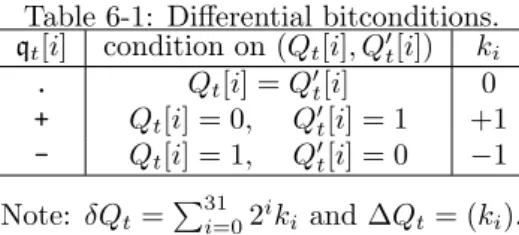
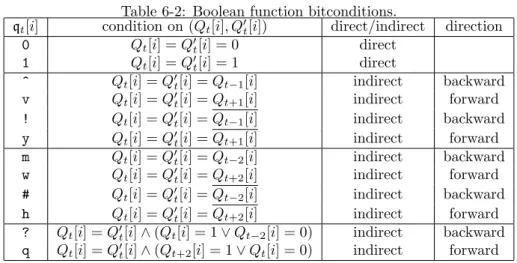
Qt−2[i], Qt−1[i], Qt+1[i] or Qt+2[i]. Using only bitconditions on (Qt, Q0t) we can specify all the values ofδQt,δFtand thusδTtandδRt=δQt+1−δQtby the relations above. A bitcondition on (Qt[i], Q0t[i]) is denoted byqt[i], and symbols like0,1,+,-,^, . . .are used forqt[i], as defined below. The 32 bitconditions (qt[i])31i=0 are denoted byqt. We discern betweendifferential bitconditions and boolean function bitconditions. The former, shown in Table 6-1, are direct, and specify the
Table 6-1: Differential bitconditions.
qt[i] condition on (Qt[i], Q0t[i]) ki . Qt[i] =Q0t[i] 0 + Qt[i] = 0, Q0t[i] = 1 +1 - Qt[i] = 1, Q0t[i] = 0 −1 Note: δQt=P
31 i=02
ik
i and ∆Qt= (ki).
valueki =Q0t[i]−Qt[i] which together specifyδQt=P2iki by how each bit changes. Note that ∆Qt= (ki) is actually a BSDR ofδQt. The boolean function bitconditions, shown in Table 6-2, are used to resolve any ambiguity in
∆FtJiK=ft(Q
0
t[i], Q
0
t−1[i], Q
0
t−2[i])−ft(Qt[i], Qt−1[i], Qt−2[i])∈ {−1,0,+1} caused by different possible values forQj[i], Q0j[i] for given bitconditions.
As an example, for t = 0 and bitconditions (qt[i],qt−1[i],qt−2[i]) = (.,+,-) there are two different possible values for the tuple (Qt[i], Q0t[i], Qt−1[i], Qt0−1[i], Qt−2[i], Q0t−2[i]) satisfying these bitconditions. As each case leads to a different boolean function difference, there is an ambiguity:
ifQt[i] =Q0t[i] = 0 then ∆FtJiK =ft(0,1,0)−ft(0,0,1) =−1, but ifQt[i] =Qt0[i] = 1 then ∆FtJiK =ft(1,1,0)−ft(1,0,1) = +1.