10.1177/0022487103255985
ARTICLE
Journal of Teacher Education, Vol. 54, No. 4, September/October 2003 Journal of Teacher Education, Vol. 54, No. 4, September/October 2003
EXAMINING TEACHER TECHNOLOGY USE
IMPLICATIONS FOR PRESERVICE AND INSERVICE TEACHER PREPARATION
Michael Russell Damian Bebell Laura O’Dwyer Kathleen O’Connor
Technology and Assessment Study Collaborative Boston College
As access to computer-based technology in schools and classrooms increases, greater emphasis has been placed on preparing teachers to use technology for instructional purposes. Survey data collected from 2,894 teachers in 22 Massachusetts districts were analyzed to examine the extent to which tech-nology is used in and out of the classroom for instructional purposes. In addition to defining six spe-cific categories of instructional use of technology, this study provides evidence that teachers generally use technology more for preparation and communication than for delivering instruction or assigning learning activities that require the use of technology. Important differences, however, were found among teachers who were new to the field compared with their more experienced colleagues. Although new teachers reported higher levels of comfort with technology and use it more for prepara-tion, more experienced teachers report using technology more often in the classroom when delivering instruction or having students engage in learning activities.
Keywords: educational technology; computers; instructional practices; teacher preparation During the past decade, expenditures on, access
to, and use of computer-based technologies by teachers and students have increased sharply. Between 1995 and 2001, federal expenditures on educational technology increased from $21 to $729 million, with the student-to-computer ra-tio decreasing from 9:1 to 4:1 nara-tionally (Glennan & Melmed, 1996; Market Data Re-trieval, 1999, 2001). In 2001, the U.S. Census Bureau’s (2002) current population survey re-ported that American children between ages 9 and 17 use computers more than do any other reported subgroup of the American population (92.6%). In addition, data from 1998 indicate
that more than 80% of teachers use computers at home or in their schools (Ravitz, Wong, & Becker, 1999).
Despite these large expenditures, increased access, and nearly universal use by school-age children and their teachers, several observers have questioned the extent to which technology is affecting teaching and learning. For example, Stoll (1999) and Healy (1998) have criticized investments in educational technologies, argu-ing that there is little evidence they affect teach-ing and learnteach-ing in a positive way. They, in fact, asserted that computer use may be harming children and their learning. More recently,
ACKNOWLEDGEMENTS
Supported under the Field Initiated Study Grant Program, PR/Award No. R305T010065, as administered by the Office of Educational Research and Improvement, U.S. Department of Education.
Journal of Teacher Education, Vol. 54, No. 4, September/October 2003, 297-310 DOI: 10.1177/0022487103255985
Cuban (2001) argued that computers have been oversold as a vehicle for reforming educational practices and are generally underused as an instructional tool by teachers at all levels of edu-cation. Specifically, Cuban argued that despite widespread use of computers by teachers out-side of the classroom, instructional practices and school culture have not incorporated com-puter-based technologies into regular instruc-tional practices. From Cuban’s perspective, the problem is twofold. First, teachers lack an understanding of how technology can be inte-grated into regular classroom instructional practices. This notion is supported by a 1999 U.S. Department of Education (2000) survey in which only one third of teachers reported feel-ing either well prepared or very well prepared to use computers and the Internet for classroom instruction. Second, school systems have not been restructured to fully support the integra-tion of technology during instrucintegra-tion. As a result, computer use during class time is often treated as a special event or an add-on to the tra-ditional curriculum.
In response to the first problem, some observ-ers have noted that as new teachobserv-ers who have grown up in a technology-rich environment enter the profession, their comfort and skill with technology will lead to increased use of com-puters for instruction (U.S. Department of Edu-cation, 2000). However, the Milken Exchange on Education Technology and the International Society for Technology in Education portray a different picture and argue that “in general, teacher-training programs do not provide future teachers with the kinds of experiences necessary to prepare them to use technology effectively in their classrooms” (Milken Ex-change on Education Technology, 1999, p. i). Specifically, these organizations believe that new teachers must be exposed to ways of teach-ing with technology durteach-ing formal teacher preparation programs. One recent federal gov-ernment initiative to further prepare new teach-ers to use technology is the Preparing Tomor-row’s Teachers to Use Technology program. Since 1999, the Preparing Tomorrow’s Teachers to Use Technology program has invested $337.5 million to help transform teacher preparation programs so teachers can make more effective
use of technology as an instructional tool (U.S. Department of Education, 2002).
Similarly, several observers have emphasized the need to provide in-service teachers with bet-ter preparation on how to integrate technology into their teaching practices. In a 2000 report, the U. S. Department of Education stated that “teachers’ preparation and training to use edu-cation technology is a key factor to consider when examining their use of computers and the Internet for instructional purposes” (p. iii). In response to this need, the No Child Left Behind Act of 2001 (Pub. Law No. 107-110) requires recipients of technology grants to invest a mini-mum of 25% of the awarded funds in profes-sional development related to instructional uses of technology.
Recognizing the importance of preparing preservice and in-service teachers to use com-puter-based technologies, throughout this arti-cle, we employ data collected as part of the Use, Support, and Effect of Instructional Technology (USEIT) Study to explore three issues related to enhancing teachers’ ability to use technology in the classroom. These issues include (a) identify-ing the ways in which teachers use technology for professional purposes; (b) examining the relationships between teachers’ comfort with technology, beliefs about technology, and pro-fessional uses of technology; and (c) examining the extent to which teachers who have recently entered the teaching profession are comfortable with technology and use technology for profes-sional purposes. Based on these findings, impli-cations for preservice and in-service teacher preparation will be explored. Before examining these issues, we provide a brief overview of the USEIT study and the data used to examine these three issues.
THE USEIT STUDY
Working with 22 school districts located throughout Massachusetts, the USEIT study was designed to provide information to better understand how educational technologies are being used by teachers and students, what fac-tors influence these uses, and how these uses affect student learning. The 3-year study began during the spring of 2001 and was divided into
two phases. During the first phase (the 2001-2002 school year), information about district technology programs, teacher and student use of technology in and out of the classroom, and factors that influence these uses were collected through site visits, interviews, and surveys. In total, survey responses were obtained from 120 district-level administrators, 122 principals, 4,400 teachers, and 14,200 students. In addition, more than 300 interviews with district and school leaders, technology support specialists, and library and media specialists were con-ducted. During the second phase (the 2002-2003 school year), case studies that focus on specific issues related to technology support and use are being conducted as well as research that focuses on the relationship between student use of tech-nology and academic performance.
Specifically, across the 22 districts participat-ing in the USEIT study, all teachers in each of the schools were asked to complete the teacher sur-vey. The analyses presented in this article are based on survey responses from the K-12 math-ematics, English-language arts, science, social studies, and elementary classroom teachers, yielding a total of 2,894 surveys. A brief sum-mary of the descriptive characteristics of this USEIT teacher sample (including the teachers’ grade levels taught, subject areas taught, and the number of years taught at their schools and throughout their careers) follows.
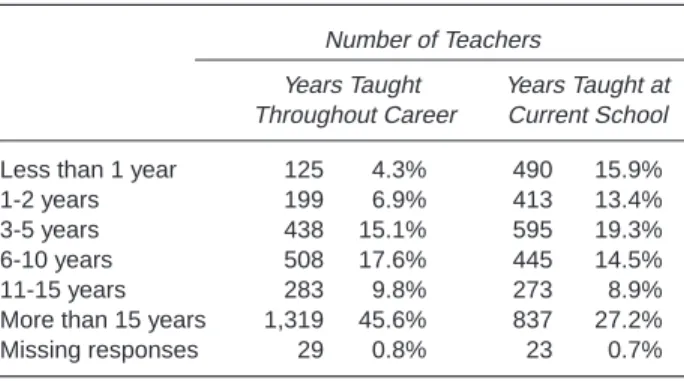
In Table 1, both the number of years teachers have been at their current schools and the num-ber of years teachers have taught throughout their careers are reported. Table 1 shows first and foremost how willing the participating
teachers were to share information on the sur-vey, with less than 1% of the sample not responding. It is also clear from Table 1 that the USEIT teacher sample represents a range of experience. In Massachusetts, as across the nation, there has been much concern recently over the number of retirement-age teachers (Darling-Hammond, 1997). Thus, it is interest-ing to note that 45% of the sample has taught for more than 15 years throughout their careers. Conversely, about 26% of teachers are relatively new to the field (with 5 or less years of experience).
Table 2 shows that the sample includes a broad range of teachers across grade levels, with kindergarten through 12th grade each rep-resented by at least 225 teachers.
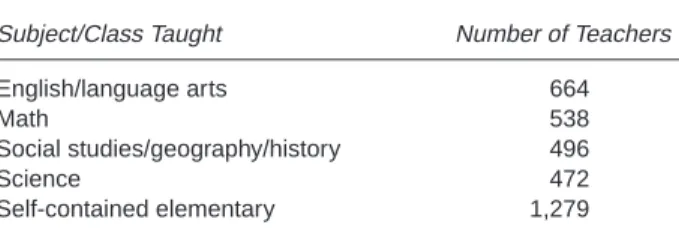
Recall that only data on K-12 mathematics, English or language arts, science, social studies, and self-contained elementary classroom teach-ers are used in the following analyses pre-sented. Table 3 shows the subject areas currently being taught by the 2,894 teachers who com-prise the USEIT sample. Specifically, Table 3 shows that the teacher sample is spread across the subject areas, with no single area having fewer than 470 teachers.
The USEIT study was designed to focus on a broad range of issues related to teacher and stu-dent use of technology and included several survey items and site visit questions that focus TABLE 1: Number of Years Teaching for Teachers in the
USEIT Study
Number of Teachers
Years Taught Years Taught at Throughout Career Current School
Less than 1 year 125 4.3% 490 15.9% 1-2 years 199 6.9% 413 13.4% 3-5 years 438 15.1% 595 19.3% 6-10 years 508 17.6% 445 14.5% 11-15 years 283 9.8% 273 8.9% More than 15 years 1,319 45.6% 837 27.2% Missing responses 29 0.8% 23 0.7%
TABLE 2: Grade Level Currently Being Taught by Teachers in the USEIT Study
Grade Level Number of Teachers
Kindergarten 230
1stGrade 306
2ndGrade 315
3rdGrade 333
4thGrade 325
5thGrade 291
6thGrade 262
7thGrade 229
8thGrade 239
9thGrade 473
10thGrade 545
11thGrade 584
12thGrade 537
NOTE: The USEIT survey instrument allowed teachers to select all grades they were currently teaching, therefore teachers may be represented at more than one grade level with the total number of teachers in this table exceeding that of the total sample of teachers.
specifically on the ways in which teachers are currently using technology and the factors that influence these uses. It is this subset of survey items and site visit questions that provides insight into issues related to teacher prepared-ness (both preservice and in-service) to use tech-nology for instructional practices.
DEFINING TEACHER USE
During the past two decades, a substantial body of research has focused on teachers’ use of computer-based technology. Across this body of research, what is meant by “technology use” varies widely. In some cases, technology use is specific to the use of computer-based technolo-gies to deliver instruction. For example, a teacher may use graphical software on a com-puter connected to a liquid-crystal display pro-jector to demonstrate the principles of geometry to the class. In other cases, teachers require stu-dents to use technology to develop products or to facilitate learning. A teacher might ask stu-dents to use Microsoft PowerPoint to create a presentation or to use the Internet to conduct research. In still other cases, teacher technology use includes e-mailing, preparing lessons, and maintaining records as well as personal use. Although several studies have focused on one specific use of technology, conversations about use of technology in schools often employ a more general or generic conception of teachers’ technology use.
This problem was identified in the 1995 Of-fice of Technology Assessment report Teachers and Technology: Making the Connection, which noted that previous efforts to examine teachers’
use of technology employed various categoriza-tions and definicategoriza-tions of what constitutes technology use in the classroom. For example, a 1992 International Association for the Evalua-tion of EducaEvalua-tional Achievement survey de-fined a “computer-using teacher” as someone who “sometimes” used computers with stu-dents. Becker (1994) constructed a more compli-cated classification system 2 years later to iden-tify computer-using teachers. In his approach, at least 90% of teachers’ students needed to be using a computer in the class in any way or amount in order for the teachers to be consid-ered computer using. Thus, the International Association for the Evaluation of Educational Achievement defined teachers’ use of technol-ogy in terms of their use of technoltechnol-ogy for instructional delivery, whereas Becker defined use in terms of the use of technology by teach-ers’ students. It is not surprising that using these two very different definitions of a “computer-using teacher” yielded very different results: The International Association for the Evalua-tion of EducaEvalua-tional Achievement reported that 75% of U.S. teachers could be classified as “com-puter-using teachers,” whereas 2 years later, Becker’s criteria yielded about one third as many (approximately 25%) (Office of Technol-ogy Assessment, 1995). This confusion and inconsistency led the Office of Technology Assessment (1995) to remark that “the percent-age of teachers classified as computer-using teachers is quite variable and becomes smaller as definitions of use become more stringent” (p. 103).
With so many different types of technology uses emerging, defining teacher technology use has become even more complex. For example, Windows/graphic user interface operating sys-tems have made many software programs eas-ier to use, and programs such as Microsoft PowerPoint, spreadsheets, and educational CD-ROMs have opened new avenues for technol-ogy use in the classroom. Liquid-crystal display projectors offer teachers an alternative for instructional delivery. Expansion of the Internet makes it possible for teachers to research and access lessons and resources, and e-mail has emerged as an effective tool for teachers to com-TABLE 3: Subject Area Currently Being Taught by
Teachers in the USEIT Study
Subject/Class Taught Number of Teachers
English/language arts 664
Math 538
Social studies/geography/history 496
Science 472
Self-contained elementary 1,279 NOTE: The USEIT survey instrument allowed teachers to select all subjects they were currently teaching, therefore teachers may be represented in more than one subject area with the total num-ber of teachers in this table exceeding that of the total sample of teachers.
municate with people in and out of school (Becker, 1999; Lerman, 1998). Advances in computer-based technologies have allowed teachers to use technology to support their teaching in an increasing variety of ways. Yet among many school leaders and educational organizations, teachers’ use of technology is of-ten discussed as a generic and one-dimensional practice.
To examine whether the many different tech-nology uses reported by teachers are one dimensional, Bebell, Russell, and O’Dwyer (in press) performed a factor analysis of 44 USEIT teacher survey items, each of which focused on a specific use of technology. In some cases, the survey items focused on teachers’ use of a spe-cific type of technology such as using a liquid-crystal display projector or e-mail. Other items focused on specific ways in which teachers ask students to use technology, such as for writing papers, conducting research, using spread-sheets, or creating Web pages. In still other cases, items focused on teacher use of technol-ogy for specific purposes such as creating quiz-zes and tests, preparing lessons, or accommo-dating lessons. If the individual uses together represent a single category of generic technol-ogy use, then it would be expected that the ini-tial factor analysis would identify one major fac-tor that united a substantial number of these items into a single construct. This turned out to not be the case.
Instead, analyses yielded six distinct factors (or categories) of teacher technology use. For each category, a separate measure of technology use was formed. These categories include the following:
1. Teacher use of technology for preparation 2. Teacher use of technology for delivery 3. Teacher-directed student use of technology
4. Teacher use of technology for special education and accommodation
5. Teacher use of e-mail
6. Teacher use of technology for recording grades
By identifying six separate categories of teacher technology use, we are not inferring that each individual category is unrelated to the other technology use categories. Indeed, as Table 4 indicates, there is a positive correlation between each of the six technology categories. These positive correlations suggest that teach-ers who use technology for one purpose are, on average, likely to use technology for other pur-poses. It is important to note that the majority of correlations are below 0.30 and that the median correlation among these six categories is 0.26. This suggests that the relationships are gener-ally weak and provides evidence that separate aspects of technology use are being measured.
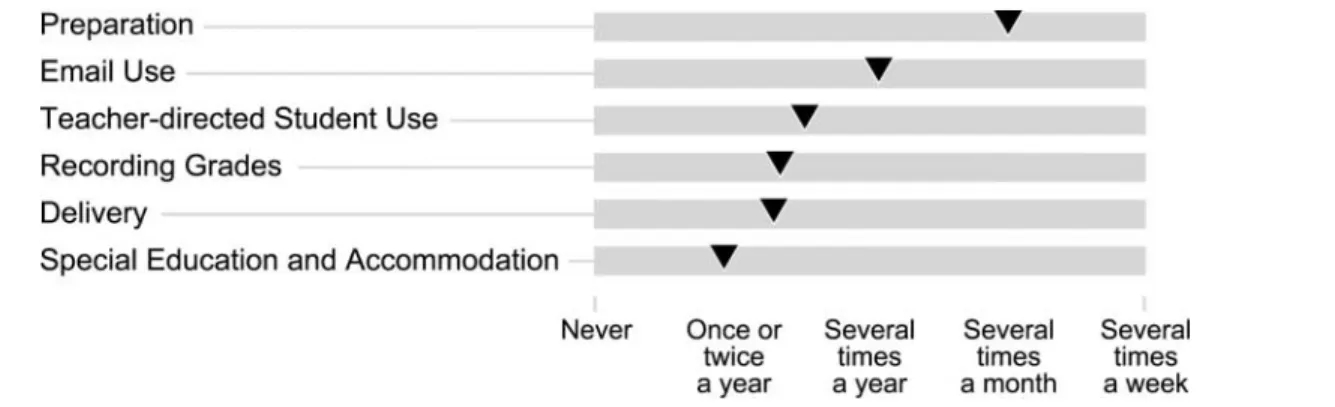
To provide a sense of how frequently teachers employ each of these six categories of technol-ogy use, a mean scale score was calculated for each category of technology use. Because the items comprising the technology use measures all employed the same response options, the mean scale score was calculated by finding the mean response for the items comprising each measure (Bebell et al., in press). As seen in Fig-ure 1, teachers use technology for preparation and work-related e-mailing most often. In addi-tion, teachers more often direct students to use technology than they use technology them-selves to deliver instruction.
The aim of examining teacher technology use in such detail is twofold. First, when consider-ing teacher use of technology, whether from the perspective of teacher preparation or research, it is important to recognize that there are many different types of technology use related to instruction. Clearly, teachers in the USEIT sam-TABLE 4: Correlation Among Categories of Teacher Technology Use
Accommodation Delivery E-Mail Preparation Student Use Grading
Accommodation 1.00
Delivery 0.26 1.00
E-mail 0.26 0.25 1.00
Preparation 0.27 0.26 0.35 1.00
Student use 0.32 0.47 0.22 0.27 1.00
ple use technology regularly for preparation and e-mail but less frequently for instructional purposes in the classroom (either by the teacher or by the student). Thus, when attempting to examine technology use or to influence teach-ers’ technology use, it is important to address each specific type of use rather than simply focusing on teachers’ use of technology in general.
Second, the extent to which teachers use tech-nology varies widely across the categories of use. Supporting Cuban’s (2001) argument, these data show that teachers infrequently use tech-nology in the classroom. Yet, a substantial amount of use occurs outside of the class-room, particularly for preparation and profes-sional communication via e-mail. Based on this pattern, it seems that the skills teachers have developed—whether through their own experi-ences, professional development, or preservice training—may be leading to substantial use of technology outside of the classroom but have had smaller effects on instructional uses in the classroom.
BELIEFS ABOUT TECHNOLOGY AND USE OF TECHNOLOGY
To develop a better understanding of the variables that influence each category of tech-nology use, Bebell et al. (in press) used regres-sion techniques to identify those variables that combine to best predict each category of tech-nology use. Briefly, a unique model was devel-oped for each of the separate six categories of teacher technology uses. When developing these models, a large number of variables
believed to influence use were initially em-ployed to predict use. These predictors included variables such as grade level, number of years teaching, access to technology, availability of professional development, perceived need for professional development, pressure to use tech-nology, level of technology support available, pedagogical beliefs, comfort with technology, and beliefs about technology.1
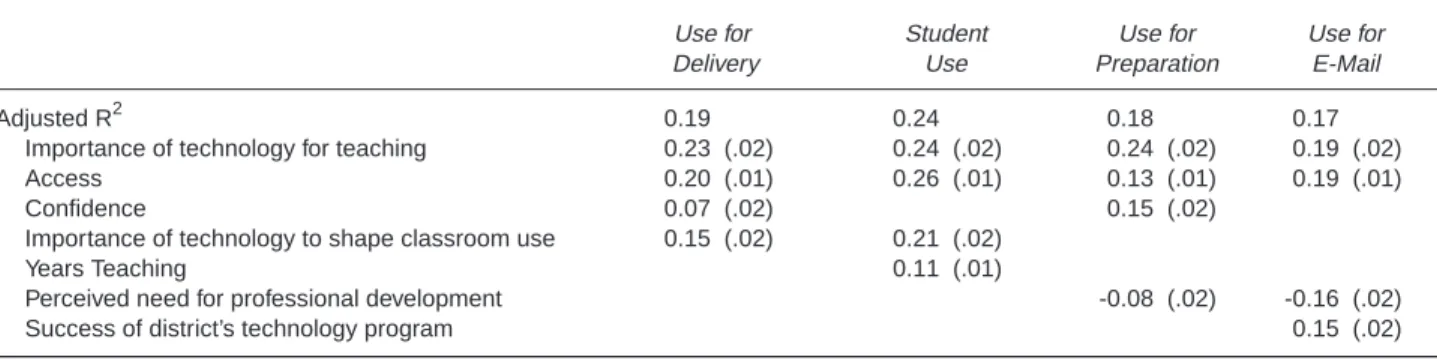
Table 5 presents the standardized regression coefficients for the variables that combine to produce the best prediction model for each of the following four categories of teachers’ tech-nology use: delivery, e-mail, preparation, and student use. Grading and accommodation will not be discussed here in part due to space con-straints but also because grading was influ-enced by school-level policies and accommoda-tions were performed most frequently by special education teachers who were not included in the current analyses. Across three of the four categories of use, teacher beliefs about the importance of technology for teaching was the strongest predictor of the frequency with which technology is used for a given purpose. Similarly, access to technology was an impor-tant predictor for all four uses. In addition, teacher beliefs about the importance of technol-ogy for shaping classroom instruction were also an important predictor for delivery and teacher-directed student use. It is interesting that confi-dence with technology was only a predictor for two categories of technology use: delivery and preparation.
In terms of the predictor variables that appear to influence the four categories of teachers’ use of technology, beliefs about technology are con-FIGURE 1: Frequency of Teacher Technology Uses
sistently and strongly related to use. Clearly, confidence with technology is a variable that also influences some categories of use, but its influence appears much smaller than that of beliefs. Belief about the importance of technol-ogy for teaching is the strongest predictor of delivery in the classroom and teacher-directed student use.
Assuming this pattern holds for teachers not included in the USEIT study, a key step in increasing teachers’ uses of technology may be changing their beliefs about the importance of technology. In both preservice preparation and professional development, perhaps efforts to change beliefs about technology before asking teachers to use the technology may result in higher levels of use.
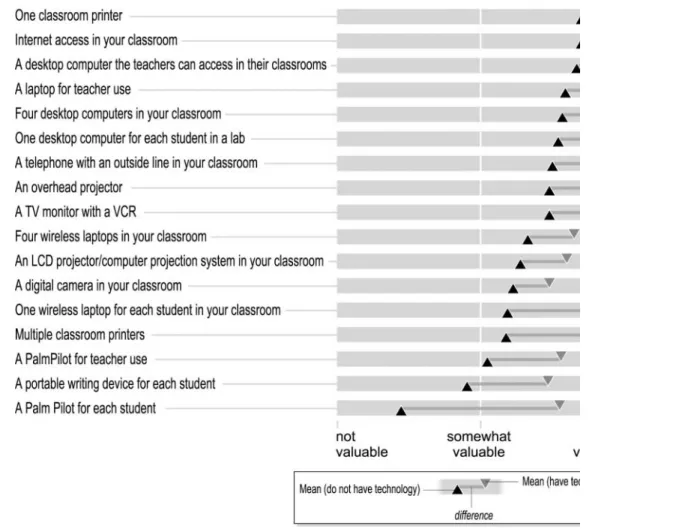
To provide a sense of how exposure to a spe-cific technology can have a positive impact on beliefs about the value of those technologies, a series of items asked teachers about the extent to which they valued specific types of technolo-gies. Teachers were also asked whether they currently have access to each of these technolo-gies. For each technology, teachers were placed into one of two groups, those who have the tech-nology and those who do not. The extent to which teachers valued each technology was then compared between the two groups. Figure 2 presents the results of this comparison.
As seen in Figure 2, for every technology tool or scenario, teachers who actually have access to a specific technology more strongly value that technology than do teachers who do not have access. It is interesting that the difference in val-ues is largest for newer technologies, such as Palm Pilots, wireless laptops, and portable
writ-ing devices, and for technologies given directly to students. As one example, on average, teach-ers who have a portable writing device for each student believe this is much more valuable com-pared with teachers who do not have one of these devices for each of their students. This pattern suggests that teachers’ beliefs about the value of a technology increases as they gain exposure to particular technologies, particu-larly for newer technologies and when technol-ogy is used directly by students. If this finding generalizes beyond the USEIT sample, it sug-gests that teacher training and professional development programs may be able to shift teachers’ beliefs about the value of specific tech-nologies by providing them with opportunities to actually work with these technologies. This pattern also suggests that attempts to target resource acquisition or professional develop-ment to teachers’ needs by querying teachers about their needs may underestimate the per-ceived value of new technologies or technolo-gies placed directly in the hands of students.
Together, the relationship between beliefs and use and the relationship between exposure and beliefs suggest that shifting teacher beliefs by exposing them to uses of technologies should be an important component of teacher training programs that aim to enhance instruc-tional uses of technology.
NEW TEACHERS
AND USES OF TECHNOLOGY
As mentioned earlier, the report by the U.S. Department of Education (2000) suggests some observers believe that the comfort and skills TABLE 5: Predictor Models for Each Category of Technology Use
Use for Student Use for Use for Delivery Use Preparation E-Mail
Adjusted R2 0.19 0.240.18 0.17
Importance of technology for teaching 0.23 (.02) 0.24(.02) 0.24(.02) 0.19 (.02)
Access 0.20 (.01) 0.26 (.01) 0.13 (.01) 0.19 (.01)
Confidence 0.07 (.02) 0.15 (.02)
Importance of technology to shape classroom use 0.15 (.02) 0.21 (.02)
Years Teaching 0.11 (.01)
Perceived need for professional development -0.08 (.02) -0.16 (.02)
Success of district’s technology program 0.15 (.02)
new teachers develop while growing up with computers will help transform their instruc-tional practices as teachers. To examine the extent to which this assumption holds, teachers responding to the USEIT survey were catego-rized into one of three groups according to their number of years teaching. Group A includes teachers who have taught for 1 to 5 years, Group B includes teachers who have taught for 6 to 15 years, and Group C includes teachers who have taught for more than 15 years.
As described in greater detail in Russell, Bebell, and O’Dwyer (in press), several survey items were combined through factor analyses to form individual scales that measure teachers’ responses on the following dimensions:
• Confidence with technology (confidence)
• Beliefs about the positive impact of technology on
students (positive impact)
• Beliefs about the negative impact of technology on
students (negative impact)
• Beliefs about teacher-directed instructional practices
(teacher directed)
• Beliefs about student-centered instructional
prac-tices (student centered)
Once again, the following four categories of teacher use of technology are examined: teacher use of technology for delivery (delivery), teacher use of e-mail (e-mail), teacher use of technol-ogy for preparation (preparation), and teacher-directed student use of technology (student use).
For each of the belief and use scales, the factor scores were standardized to have a mean of zero and a standard deviation of one. For all vari-ables, a higher scale value represents stronger levels of confidence, belief, and use. Group means were calculated for each measure, and an FIGURE 2: Comparison of Teachers’ Values of Various Technologies or Technology Scenarios by Their Access to the Technol-ogy or TechnolTechnol-ogy Scenario
analysis of variance was conducted to test whether mean scale scores differed among the three groups of teachers. Because multiple com-parisons were made, the Dunn approach to multiple comparisons was used to adjust the alpha level such that a simple .01 level for a sin-gle comparison becomes .001 for nine compari-sons (Glass & Hopkins, 1984). We use this alpha level in discussing the statistical significance of each analysis of variance. For each analysis of variance, the Dunn method was also used to adjust the alpha level for the three planned group comparisons for each variable.
As seen in Table 6, teachers with 5 or less years experience are significantly more confi-dent using technology than are teachers who entered the profession 6 to 15 years ago or more than 15 years ago. Similarly, teachers who entered the profession 6 to 15 years ago are also significantly more confident with technology than are teachers who entered more than 15 years ago. Thus, with respect to teachers’ confi-dence working with technology, the USEIT sur-vey data provide evidence that newer teachers are more confident than are teachers who have been in the profession for 6 or more years.
It is interesting that beliefs about positive impacts of technology on student learning do not differ between teachers who are new to the profession and those who have been teaching for 6 or more years. Even more surprising, new teachers have significantly stronger beliefs about the negative impacts of technology on student learning. That is, new teachers are more likely to believe that use of technology harms specific aspects of student learning. These neg-ative impacts include making students more lazy, decreasing research skills, and decreasing the quality of student writing. This pattern
appears to be counterintuitive because it is these newer teachers who have grown up with tech-nology, are confident working with techtech-nology, and yet believe more strongly that the use of technology can have negative impacts on stu-dent learning. One might speculate that because these teachers used technology as students, it is their past experiences learning with technology that have instilled these more negative beliefs. However, a survey of 4th-, 8th-, and 11th-grade students conducted as part of the USEIT study indicates that today’s students have strong be-liefs about the positive rather than negative effects of technology on their learning (Russell, O’Brien, Bebell, & O’Dwyer, 2003). Unless the ways in which students use technology has changed since these teachers were in school, it is likely that some other experiences are instilling these negative beliefs. In light of the significant investments made in educational technology during the past decade and efforts to better pre-pare teachers to use technology made since 1998, it is particularly puzzling that these new teachers are developing significantly more neg-ative beliefs about the impacts of technology than are more experienced teachers.
Through the analysis of a national survey of teachers conducted in 1998, Becker and his col-leagues identified teachers’ pedagogical beliefs as an important variable that influences teach-ers’ use of technology in the classroom (Ravitz, Becker, & Wong, 2000). Specifically, they found that teachers with constructivist beliefs were more likely to use technology in the classroom than were teachers with more traditional peda-gogical beliefs. Given this relationship, the USEIT survey data were used to examine differ-ences in pedagogical beliefs based on the length of time a teacher has been in the profession. Spe-TABLE 6: Confidence Using Technology and Beliefs About the Impacts of Technology on Students
Confidence1 Positive Impacts Negative Impacts1
Mean SD Mean SD Mean SD
1-5 yrs (A) 0.37 0.99 0.00 0.95 0.21 1.02
6-15 yrs (B) 0.08* 0.97 -0.07 1.03 -0.07* 0.99
+15 yrs (C) -0.20†‡ 0.97 0.05 1.01 -0.08† 0.98
1
Indicates ANOVA was statistically significant at the .01 level.
* Indicates a significant difference at the .01 level between group A and group B.
†
Indicates a significant difference at the .01 level between group A and group C.
‡
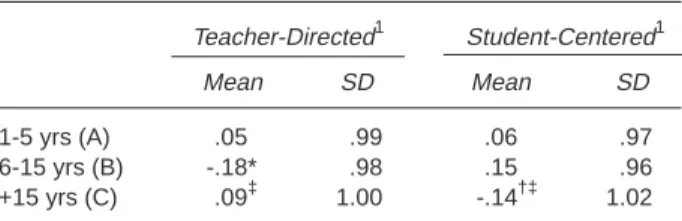
cifically, the three groups were compared on two variables, one that measures the extent to which they agreed with teacher-directed peda-gogical practices and one that measures the extent to which they agreed with student-cen-tered pedagogical practices. As seen in Table 7, there are significant differences among the three groups for both types of pedagogical beliefs. With respect to teacher-directed beliefs, teach-ers who have entered the profession most recently and teachers who entered the profes-sion more than 15 years ago have stronger teacher-directed beliefs than do teachers who have been in the profession for 6 to 15 years. That is, both newer and well-tenured teachers agree more strongly with teacher-directed prac-tices compared with teachers who have been teaching for 6 to 15 years.
The pattern differs, however, for student-centered beliefs, with both new teachers and teachers who have been teaching for 6 to 15 years agreeing more strongly with student-centered practices compared with more veteran teachers. Given the emphasis placed on stu-dent-centered pedagogy in many preservice teacher preparation programs, it is interesting that new teachers have similar beliefs about stu-dent-centered practices compared with teach-ers who have been in the profession 6 to 15 years yet have stronger beliefs about teacher-directed practices. Although we do not have any data that provide insight into this pattern, it may reflect the combined effect of emphasis placed on student-centered practices by teacher prepa-ration programs and past experiences as
stu-dents in classrooms that employed teacher-directed practices.
Table 8 presents comparisons among the three groups of teachers across the following four categories of technology use: preparation, communication via e-mail, delivery of instruc-tion, and teacher-directed student use. The results show that newer teachers communicate via e-mail significantly more than do teachers who have been in the profession for more than 15 years. As some observers had predicted, teachers who have entered the profession dur-ing the past 5 years use technology significantly more for preparation than do teachers who have taught for 15 or more years, but when it comes to technology use during instruction, new teach-ers require students to use technology during class time significantly less than do teachers who have taught for 6 or more years. It is inter-esting that there are no significant differences among the three groups in terms of technology use to deliver instruction.
In summary, teachers who have entered the profession during the past 5 years are signifi-cantly more confident with technology, use it more for professional purposes outside of the classroom, but require their students to use technology significantly less than do more expe-rienced teachers. It is interesting that the beliefs of new teachers regarding teacher-directed instruction appear more similar to teachers who have been teaching for more than 15 years than they do to teachers who have taught for 6 to 15 years. Finally, the new teachers have stronger beliefs about the negative impacts of computers on students than do teachers who have been teaching for more than 5 years. Thus, whereas new teachers are more comfortable with com-puters and use them more outside of the class-room, the assumption that this higher level of comfort translates to increased instructional use in the classroom does not hold.
DISCUSSION
During the past decade, schools have in-vested heavily in acquiring computer-based technologies. As critics and proponents of edu-cational technology have noted, the potential educational benefits of this investment cannot TABLE 7: Pedagogical Beliefs About Teacher-Directed and
Student-Centered Instructional Practices Teacher-Directed1 Student-Centered1
Mean SD Mean SD
1-5 yrs (A) .05 .99 .06 .97
6-15 yrs (B) -.18* .98 .15 .96 +15 yrs (C) .09‡ 1.00 -.14†‡ 1.02
1
Indicates ANOVA was statistically significant at the .01 level. * Indicates a significant difference at the .01 level between group A and group B.
†
Indicates a significant difference at the .01 level between group A and group C.
‡
Indicates a significant difference at the .01 level between group B and group C.
be realized unless teachers are prepared to use computers for instructional purposes. Al-though the USEIT study was not designed to examine research questions focused on teacher preparation, the teacher survey, interview, and site visit data collected as part of this study pro-vide valuable insight into some of the issues related to preparing preservice and in-service teachers to use technology. First, the findings of the USEIT teacher analysis suggest that teacher technology use is a multifaceted and complex behavior. For this reason, it is important to con-ceive of technology use in terms of specific and unique categories of use rather than as a single, generic dimension. The findings highlight the importance of clearly articulating these specific types of technology use in which teachers en-gage. These categories include uses of tech-nology to deliver instruction, to prepare for instruction, to accommodate instruction, to communicate with others in and out of the school, and to direct students to use technology for specific instructional purposes. As educa-tional technology use in and out of the class-room increases, so must our ability to clearly dif-ferentiate among the ways teachers can use technology. Preservice and in-service teacher education programs may be encouraged to expose teachers to each of the six teacher tech-nology use categories—emphasizing the differ-ent uses, available applications, possibilities, and practices for using diverse technologies to support and enhance various aspects of teach-ing and learnteach-ing.
With such a wide variety of technology appli-cations available, it seems prudent to focus teacher preparation on specific types of uses rather than on familiarizing them with
technol-ogy in general. It is interesting that this practice also applies to principals and district adminis-trators. Through interviews with principals and district leaders, it became clear that the vast majority of school leaders do not have a good sense of the many ways in which teachers are using technology and how to evaluate these uses of technology. As an example, when asked what criteria they would apply when evaluat-ing teachers’ use of technology for instructional purposes, less than 8% of principals inter-viewed were able to respond with specific crite-ria. Clearly, teacher and school leadership traing programs, whether they are preservice or in-service, would benefit from a more nuanced approach to preparing educators to use technol-ogy in and out of the classroom for professional purposes.
Second, analysis of the teacher survey data reiterates the importance of teachers’ beliefs and attitudes as important predictors of nearly all types of technology uses (Ravitz et al., 1999). Specifically, this analysis suggests that teachers’ attitudes and beliefs toward technology are of great importance in their decisions to adopt and frequently use technology in the classroom. Quite simply, changing teachers’ use of technol-ogy requires changing their beliefs about tech-nology. It is not surprising then that the analyses suggest one way to strengthen beliefs is to pro-vide opportunities for teachers to acquire famil-iarity with technology. This may be particularly true during preservice training when teachers can be exposed to a wide variety of technologies and ways to use these technologies to support instructional goals, specifically addressing the use of technology in the classroom for instruc-TABLE 8: Technology Use for Preparation, Communication via E-Mail, Delivery of Instruction, and Teacher-Directed Student
Use of Technology
Preparation Use1 Email Use1 Delivery Use Teacher-Directed Student Use1
Mean SD Mean SD Mean SD Mean SD
1-5 yrs (A) .29 .80 .041.02 -.06 .98 -.12 .95
6-15 yrs (B) .14* .92 .13 1.01 .01 .97 .03* .99
+15 yrs (C) -.27†‡ 1.08 -.11†‡ .98 .02 1.01 .06† 1.03
1
Indicates ANOVA was statistically significant at the .01 level.
* Indicates a significant difference at the .01 level between group A and group B.
†
Indicates a significant difference at the .01 level between group A and group C.
‡
tional delivery and teacher-directed student use of technology.
Thus, teacher preparation may be enhanced by creating opportunities for teachers in train-ing to see and experience the positive effects of technology on teaching and learning. We feel it is of great importance to supplement efforts to teach the mechanics of technology with expos-ing teachers to examples of technology inte-grated into the curriculum and classroom. To this end, classrooms in which technology is being used effectively for instructional pur-poses, either as a delivery tool by the teachers or as a learning tool by the students, need to be identified and the practices shared with other teachers. That is, in addition to focusing on how to use a specific technology to create products such as Web pages or PowerPoint presenta-tions, efforts to model how these products can be used to support instructional objectives may result in stronger beliefs about the value of tech-nology for teaching and learning. In turn, these stronger beliefs are more likely to translate into more frequent use of technology once a preservice teacher enters the profession.
Third, as some observers have predicted, there are important differences between the comfort level, beliefs, and practices with tech-nology between new and more veteran teach-ers. However, the differences found in the USEIT sample are not always consistent with the predictions. It is clear that most of the cur-rent generation of teachers have been more exposed to technology than have their prede-cessors. This exposure results in higher confi-dence levels with technology but does not trans-late into higher levels of use of technology in the classroom. The assumption that technology use in classrooms will increase simply because a teacher grew up in a technology-rich world appears false.
Although teachers who have recently entered the profession report more confidence using computers, their beliefs about the negative effects of computers on students are stronger than those of teachers who have been in the pro-fession for 6 or more years. Although the newer teachers use technology more outside of the classroom for preparation and communication,
they direct their students to use technology in the classroom significantly less than do more experienced teachers. New teachers may be more comfortable with the technology itself, but they require further training on the value and uses of technology as an instructional tool. This finding was reaffirmed by numerous principals and district-level school administrators during site visit interviews.
During these interviews, conducted as part of the USEIT study, principals identified two issues that impede the use of technology for instruction in the classroom during the first few years of teachers’ careers. First, although newer teachers are generally familiar and comfortable with working with technology, they have not been exposed to applications of technology in the classroom. In most cases, the schools these teachers attended as K-12 students were not yet equipped with a substantial amount of technol-ogy or the technoltechnol-ogy was not regularly inte-grated into the curriculum by their teachers. Thus, their models of teaching based on their own experiences as students do not include the integration of technology into instruction. In addition, these teachers have more recently completed teacher education programs, many of which focus on how to use technology rather than on how to teach with technology and inte-grate it into everyday teaching. This focus on familiarizing preservice teachers with specific technologies rather than on how to integrate these technologies into instruction may further add to their comfort with technology but does not present them with instructional models they can emulate once they enter the profession.
Second, principals suggested that because the first few years of teaching are so challenging— with teachers having to develop behavior man-agement techniques, become familiar with the curriculum, adapt to the school culture, and be-come familiar with assessment systems—they do not have time to explore ways to integrate the technology available to them. It is theorized that only after teachers have become comfortable with curriculums, schools, and other aspects of teaching that they have the time and energy to invest in exploring ways to use technology in their classrooms.
Without question, the large influx of new teachers projected to occur during the next 10 years offers a unique opportunity to shape our nation’s educational system. This notion is especially promising for the transformation of our classrooms into the 21st-century, technol-ogy-enriched learning centers envisioned by educational theorists, policy makers, and school leaders (Lemke & Coughlin, 1998; Papert, 1992, 1996). Indeed, the current generation of teachers entering the field is more comfortable and confi-dent with technology than any previous genera-tion. This confidence, however, is not enough to reform education. Teachers entering the profes-sion need to develop positive beliefs about tech-nology and skills to use techtech-nology in a wide variety of ways. Based on the data presented, one approach to preparing teachers to teach with technology is to move away from focusing on teaching technology and instead focus on teaching with technology—rather than intro-ducing technology as an available yet periph-eral tool, emphasizing technology as an integral tool with diverse uses and inherent potential to enhance teaching and learning beyond what the traditional methods allow. Through interviews with principals, it is apparent that teachers and school leaders would benefit from exposure to new models of teaching that capitalize on spe-cific instructional uses of technology. The extent to which these uses can be linked to positive effects on students and their learning will likely bolster positive beliefs about the impacts of technology use. Although it may not be possible to pair every preservice teacher with an experi-enced and sophisticated technology-using teacher, efforts to bring the practices employed by these teachers into the vision of teaching preservice teachers has the potential to enhance beliefs about and increase instructional uses of technology.
NOTE
1. For a full description of these variables, see Russell, Bebell, and O’Dwyer (in press). For a full description of the methods used to develop the regression models, see Bebell, Russell, and O’Dwyer (in press).
REFERENCES
Bebell, D., Russell, M., & O’Dwyer, L. (in press).
Under-standing and measuring teacher technology use. Boston: Technology and Assessment Study Collaborative, Boston College.
Becker, H. (1994). Analysis and trends of school use of new
information technologies. Washington, DC: Office of Technology Assessment.
Becker, H. (1999).Internet use by teachers: Conditions of
pro-fessional use and teacher-directed student use. Irvine, CA: Center for Research on Information Technology and Organizations.
Cuban, L. (2001).Oversold & underused: Computers in the
classroom. Cambridge, MA: Harvard University Press.
Darling-Hammond, L. (1997). Doing what matters most:
Investing in quality teaching. New York: National Com-mission on Teaching and America’s Future.
Glass, G. V., & Hopkins, K. D. (1984).Statistical methods in
education and psychology. Boston: Allyn & Bacon.
Glennan, T. K., & Melmed, A. (1996).Fostering the use of
edu-cational technology: Elements of a national strategy. Santa Monica, CA: RAND.
Healy, J. M. (1998).Failure to connect: How computers affect
our children’s minds—and what we can do about it. New York: Touchstone.
Lemke, C., & Coughlin, E. (1998).Technology in American
schools: Seven dimensions for gauging progress. Santa Monica, CA: Milken-Exchange on Technology/Milken Family Foundation.
Lerman, J. (1998).You’ve got mail: 10 nifty ways teachers can
use e-mail to extend kids’ learning. Retrieved January 10, 2003, from http://www.electronic-school.com/ 0398f5.html
Market Data Retrieval. (1999).Technology in education 1999.
Shelton, CT: Author.
Market Data Retrieval. (2001).Technology in education 2001.
Shelton, CT: Author.
Milken Exchange on Education Technology. (1999).Will
new teachers be prepared to teach in a digital age? A national survey on information technology in teacher education. Santa Monica, CA: Author. Retrieved March 28, 2003, from http://www.mff.org.publications
Office of Technology Assessment. (1995).Teachers and
tech-nology: Making the connection(OTA-EHR-616). Washing-ton, DC: Government Printing Office.
Papert, S(1992). The children’s machine. New York:
HarperCollins.
Papert, S. (1996).The connected family: Building the digital
generation gap. Atlanta, GA: Longstreet.
Ravitz, J., Becker, H., & Wong, Y. (2000).
Constructivist-com-patible beliefs and practices among U.S. teachers. Irvine, CA: Center for Research on Information Technology and Organizations.
Ravitz, J., Wong, Y., & Becker, H. (1999).Report to
partici-pants. Irvine, CA: Center for Research on Information Technology and Organizations. Retrieved April 7, 2002,
from: http://www.crito.uci.edu/tlc/findings/spe-cial_report/index.htm
Russell, M., Bebell, D., & O’Dwyer, L. (in press).The USEIT
study technical report. Boston: Technology and Assess-ment Study Collaborative, Boston College.
Russell, M., O’Brien, E., Bebell, D., & O’Dwyer, L. (2003)
Students’ beliefs, access, and use of computers in school and at home. Boston: Technology and Assessment Study Collaborative, Boston College.
Stoll, C. (1999). High-tech heretic. New York: Random
House.
U.S. Census Bureau. (2002).A nation on-line: How Americans
are expanding their use of the Internet. Washington, DC: Author.
U.S. Department of Education. (2002).Preparing tomorrow’s
teachers to use technology (PT3). Retrieved March 27, 2002, from: http://www.ed.gov/teachtech/
U.S. Department of Education, National Center for
Educa-tion Statistics. (2000).Teachers’ tools for the 21st century. A
report on teachers’ use of technology. Washington, DC: Author. Retrieved January 10, 2003, from http:// nces.ed.gov/spider/webspider/2000102.shtml (Eric Document Reproduction Service No. ED444599)
Michael Russell is a director of the Technology & Assessment Study Collaborative (inTASC) at Boston Col-lege, a senior associate at the Center for the Study of Testing, Evaluation, and Educational Policy, and an assis-tant professor in the Lynch School of Education at Boston College. He received his Ph.D. in educational research, measurement, and evaluation at Boston College. His research interests lie at the intersection of technology,
learning, and assessment and include applications of tech-nology to testing and impacts of techtech-nology on students and their learning.
Damian Bebellis a research associate at the Technol-ogy & Assessment Study Collaborative at Boston College. He received his Ph.D. in educational research, measure-ment, and evaluation at Boston College. His current inter-ests include student achievement, educational technology, alternative assessments, and rural education.
Laura O’Dwyeris a senior research associate at the Technology & Assessment Study Collaborative at Boston College where she received her Ph.D. in educational research, measurement, and evaluation. Her general research interests include multilevel modeling techniques, international comparative studies of educational achieve-ment, simulation methods, and imputation procedures.
Kathleen O’Connoris a research associate at the Tech-nology & Assessment Study Collaborative at Boston Col-lege. She received her master’s degrees in the Division of Curriculum and Instruction at Boston College with a degree in elementary education and a degree in special education. Her research agenda includes studying the effects of technology integration in the elementary school classroom, instruction and assessment in elementary and special education, international comparative education, teacher education, and achieving equity through educa-tion policy.