skills training programme
L E A R N E R G U I D E L I N E S A N D LO G B O O K
Integrating Municipal Financial
Management Qualification (NQF Level 6)
into workplace learning activities
Integrating Municipal Financial
Management Qualification (NQF Level 6)
Learner guideLines and Logbook
Municipal finance
management skills
training
programme
Integrating Municipal Financial
Management Qualification (NQF Level 6)
The Municipal Finance Management Act (MFMA) aims to modernise financial management practices in the local government sphere by placing municipal finances on a sustainable footing in order for municipalities to deliver basic services. It creates a sound financial governance framework by clarifying roles and responsibilities of political office bearers and municipal officials.
Being mindful of capacity constraints, National Treasury has since 2003 supported municipalities through a number of initiatives, to build sufficient strategic management capacity at the local government sphere. Two such initiatives included the Municipal Finance Management Internship Programme and, in partnership with the Local Government Sector Training Authority, the development and subsequent registration of the Municipal Finance Management unit standards.
The unit standards registered on the National Qualifications Framework (NQF) by the South African Qualifications Authority are designed to address municipal finance management competencies identified within prescribed competency areas such as strategic leadership and management, strategic financial and performance management, operational financial management, and supply chain management. Corresponding learner guidelines have been developed to provide guidance to learners working towards the NQF-registered municipal finance qualification on how they should go about integrating training outcomes into workplace training to comply with skills development legislation and principles of outcome based training. In addition, a comprehensive logbook has been included for the purpose of recording workplace learning experiences.
The Municipal Finance Management Internship Programme was designed to provide learners holding higher education qualifications in finance and accounting with a logical training sequence founded on prescribed competencies and skills learning programmes outlined in these guidelines. It is envisaged that through workplace interaction with municipal officials and coaching by experienced municipal managers, learners will integrate formal training with workplace service-oriented activities.
Municipalities are mandated to utilise funding available at the Local Government Sector Training Authority to ensure the proper implementation of relevant credit bearing skills learning programmes. National Treasury and the Local Government Sector Training Authority consider municipalities to be a suitable environment within which skills in municipal financial management can be transferred to learners working toward higher education qualifications in municipal finance management. This requires a suitable workplace training environment, which consists of:
well documented policies for the recruitment and development of learners
the appointment of an official to take on the responsibility for the management of the learners at the workplace the use of an accredited (registered) education and training provider for the provision of the theoretical and practical components of the programme
the evaluation of a learner’s progress during and at the end of each skills learning programme
Being mindful of capacity constraints and past skills training practices, these learner guidelines are aimed at facilitating the •
• • •
ASB
Accounting Standards Board
BEE
black economic empowerment
CCFOs
Critical Cross Field Outcomes
CFO
Chief Financial Officer
DORA
Division of Revenue Act
ERP
enterprise resource planning
ETP
educational training programme
ETQA
Education Training Quality Assurance
GRAP
Generally Recognised Accounting Practice
IDP
integrated development plan
IGFR
InterGovernmental Fiscal Relations
IS
information systems
IT
information technology
LGSETA
Local Government Sector Education and Training
Authority
MFMA
Local Government: Municipal Finance Managment Act
(Act No . 56 of 2003)
MFMIP
Municipal Finance Management Internship Programme
1 Introduction . . . . 2
2 Importance of a workplace coach . . . . 4
3 Outline of the skills training programme . . . . 7
4 The learner logbook . . . . 40
5 The workplace rotation plan . . . . 47
6 The assessment strategy . . . . 54
7 Evaluation of a learner’s technical and professional skills . . . . 56
8 The role of a coach in the skills training programme . . . . 69
9 Self-assessment checklist . . . . 72
T
he skills training programme is based on one of the modules aligned to the NQF (National Qualification Framework) Level 6 Certificate in Municipal Financial Management. The relevant modules are outlined in Chapter 3 of this document. A skills training programme offered on the basis of one of the modules, seeks to provide learners with an effective way of developing their career in municipal financial management.Learners who pursue this skills training programme diligently, with
discipline and commitment, should find it a good way of fast-tracking
their career in the local government sphere.
The skills training programme is designed to be flexible and learner-centred. It should enable the learner to use a mix of recognition of prior learning, workplace (on the job) learning, and formal training provided by various parties involved with capacity building.
The programme’s flexibility requires the learner to be diligent and disciplined for the programme to be successful. These guidelines provide the learner with support and tools.
It is expected that the workplace coach will provide the learner with hands-on assistance. The coach is essentially a “catalyst” who facilitates and speeds up the learning process.
The effectiveness of the coach will be partially influenced by a learner with attributes such as:
Passion – shows high energy levels and eagerness to learn and enquire.
Attitude – has a positive attitude and desire to learn, as well as willingness to accept negative feedback.
Pro-activity – is able to take charge of the learning process and initiate steps.
Openness – suspends judgement, and does not have pre-conceived ideas that would impede learning.
Sense of humour – is able to enjoy the process of learning.
Introduction
od
uc
ti
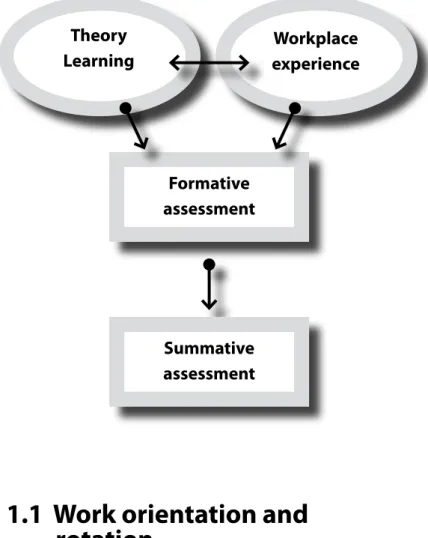
Workplace
experience
Chapter 2 highlights the importance of the coaching process and how success, in many spheres of life and not just in sport, is better ensured with coaching. The role of a coach in this skills training programme is discussed in Chapter 8. In Chapter 3, you will find the outline of modules that can be used to inform the learning activities for each skills learning programme, the recommended time allocation for a module, and suggested hours for theory and workplace training. The chapter provides the information on the suggested formative assessment and the assignments the learner is required to complete during the practical work. The learner and the coach can vary the suggested, formative assessment activities, and assessments.
In Chapter 4 the learner will find an outline that can be used to document formative assessment assignments attributed to the relevant learning units. The completion of formative assignments should be understood in the context of the workplace rotation plan reflected in Chapter 5.
In Chapter 6 the general assessment strategy is explained. After each learning unit, the learner has to undergo a formative assessment with the workplace assessor or workplace coach. The formative assessment should reflect the learning process as a whole. For this reason, Chapter 7 provides a framework for the evaluation of the technical and professional skills of the learners. The results of this evaluation will form part of a learner’s portfolio of evidence. The learner will be required to complete a self-assessment checklist for this skills training programme (STP) as shown in Chapter 9.
The skills training programme outline is orientated toward the learning units, and provides information about the duration, the type of formative assessment, and the desired workplace learning activities. The outline is broad and can be customised according to the situation in the department. The learner must ensure that after each learning unit, evidence is generated to serve as a basis for formative assessment of the knowledge and competency acquired.
In Chapter 10 the requirements for the preparation of a portfolio of evidence are explained. The learner is required to develop a portfolio of evidence to demonstrate the relevant competencies addressed by this skills training programme to the assessor.
1.1 Work orientation and
rotation
Through participation in the skills training programme, the learner should contribute to the day-to-day work of the department or project, if possible. This requires an informed workplace rotation plan that integrates specific learning outcomes drawn from the relevant unit standards.
1.2 Infrastructure
The learner must experience that he or she is part of a department. This also requires that at least basic infrastructure be provided, such as a desk, a chair, stationery, etc. Added to this, access to computers and the Internet might be required to fulfil certain tasks or to prepare for the formative or summative assessment.
Theory
Learning
Formative
assessment
Summative
assessment
Importance of a workplace coach
kp
la
ce
c
oa
ch
W
e live in a world where skills are developed through the support of coaches. In the workplace, opportunities abound for effective coaching by supervisors and managers.In skills development, all successful people recall how indebted they are to coaches and mentors who invested time and care to see to their growth.
Without coaches, there will be no stars. To be appointed a coach is an honour,
and despite the stresses of life, when the job is satisfactorily performed, a
coach gets ample rewards.
2.1 Coaching vs mentoring
In ordinary conversation, coaching and mentoring may be used interchangeably, but coaching complements mentoring; the two are not the same.
A coach trains and develops the employee to achieve required results. Coaching helps employees perform in the short term over a narrow range of attributes. Coaching is on the job and is focused on training.
A mentor seeks the continual development of an employee in a sustained manner over the long term, over a broad range of expertise. Mentoring may be off the job and is focused on the overall development of a learner.
For a more detailed discussion on coaching and mentoring, we strongly recommend the coach read the book by Marius Meyer and Leon Fourie (2004). Mentoring and Coaching – Tools and techniques for implementation
(Randburg: Knowres Publishing (Pty) Limited).
2.2 Attributes of coaching
According to Meyer and Fourie (2004), coaching has the following attributes: Systematic and planned process of skills transfer
2.3 Benefits of coaching
While most people appointed to coach are motivated by selfless service, coaching also offers great benefits to the coach.
Some examples of the benefits to the coach are:
provision of extra avenues to exercise supervisory and leadership skills
satisfaction in seeing the learner perform satisfactorily learning from the learners
developing and building deeper relationships
extra opportunity to use and appreciate own experience and expertise
senior management and peers tend to respect a coach.
2.4 Coaching tools
To guide the coaching process, several tools are needed and these will have to be agreed between the learner and the coach. In addition to the workplace rotation plan (Chapter 5), the self-assessment checklist (Chapter 9), and portfolio of evidence (Chapter 10), below we list a few tools that may be used to improve the learning experience:
Skills gap analysis
It is important for the learner and coach to monitor any skills gap, for both the technical and critical cross-field outcomes. These gaps should be highlighted in the regular performance evaluation meetings required to complete the technical skills assessment (Chapter 7) and action steps designed to resolve the skills gap. Both the learner and the workplace coach must sign the assessment.
Personal skills development plan
Before enrolling for this skills training programme, a learner must design a personal skills development plan which details the action steps required to meet the skills gap, target dates, and resources required. Both the coach and learner must sign these plans.
• • • • • •
Communication tools
The learner and coach may consider the following tools of communication:
Regular meetings E-mail
Preparation of training-related reports
Contact log – records meetings held and points that were raised
Feedback sessions.
Assessment questionnaires
The assessment questionnaires provided by Meyer and Fourie (2004) may be found useful by coaches and learners, for example:
coaching talents inventory
learner potential and talents inventory organisational readiness inventory
learner performance self-assessment form. The learner and coach need to ensure the following:
Agree upfront the principles guiding the training and coaching
Agree on performance objectives, performance standards, action plans and target dates (these must be incorporated in the performance contracts of the coach.)
Define the mechanics for communication, such as, structure and regularity, time and place of meetings Identify formal and informal means of providing feedback and assessment
Define ways in which the critical cross-field outcomes will be learned and evaluated.
Coach development
The coach needs to be trained and supported to succeed in the work of being a coach. It is recommended that he/she undergo formal training. Such training could include attending a mentorship workshop that addresses elements such as coaching philosophies and principles, skills development facilitation, dealing with coaching challenges and problems, assessment principles, and coaching across gender and
• • • • • • • • • • • • • •
workplace coach
Supervisors or managers in municipalities
have important coaching responsibilities
in the workplace: to help learners acquire
the skills required for the implementation
of the financial management reforms
required by the Municipal Finance
Management Act.
The success of the relationship hinges on the existence of confidentiality, openness and trust. This coaching relationship may be one where workplace performance limitations, personal problems affecting work performance, or career progress are addressed, and solutions sought.
The most important role that the coach can play in the relationship is to assist the learner in identifying issues and exploring potential options and solutions, without taking responsibility for the problems of the learner. In this way, the role of the manager or supervisor as a coach will be viewed as a dynamic and reciprocal relationship in a work environment where a capable learner is supported to develop some specified capacity.
The learner must understand that for a coaching experience to be successful, the coach must, preferably:
be a subject matter expert
have sound interpersonal attributes, such as patience
a sense of humour
assertiveness, without being patronising •
• • • •
Examples of the roles that are played by the coach are to: support the learner at the workplace on an ongoing basis
provide the learner with information and practical advice put tasks into the context of the skills training programme
explain tasks in easy-to-understand terms with reference to the workplace rotation plan included in the learner log book and module outline
give constructive feedback and follow-up for motivation and confidence
provide guidance to enable the learner to fulfil the requirements for the formative or summative assessment. (This should be based on the skills training outline shown in Chapter 3.)
communicate with the key role-players in cases of problems, which cannot be resolved directly with the learner
communicate with the workplace assessor
scrutinise the self-assessment checklist (Chapter 9)
prepared by the learner for completeness to inform the technical skills assessment process required by
Chapter 7
know the skills training programme outline and what is expected at the workplace.
• • • • • • • • • •
Outline of the skills training
ST
P
ou
tl
in
e
T
his outline of the skills training programme has been developed utilising a combination of learning outcomes drawn from more than one unit standard to form the basis for one module of a skills learning programme. Each module is divided into learning units. The use of learning units is attributed to the fact that municipalities and education training providers prefer a block release approach to formal off the job training, to carry out an integrated assessment at the end of each module.The learning units, forming part of a skills training programme, are designed to address the specific outcomes of the relevant unit standards. Therefore, it should be taken that the learning objectives of each module are based on the specific outcomes of the relevant unit standards. The module outline underlying each skills training programme also provides what practitioners should include in their workplace rotation activities. The outline does not provide detailed timetables, recommended readings, or the detailed subject matter. These are to be provided by the facilitating education and training provider.
A module outline provides a guideline for training providers to prepare
learning support material. In addition, the description and outline provide
guidance to workplace coaches to help them design an informed workplace
rotation plan for learners.
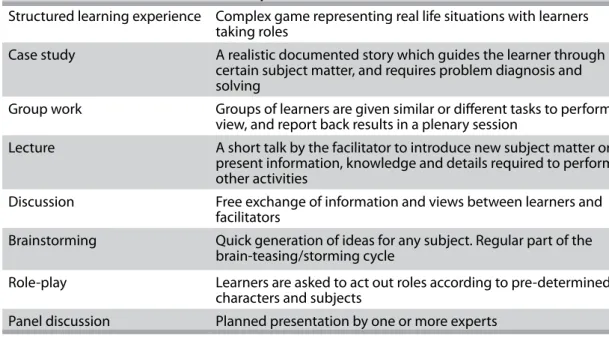
Each learning unit of a skills training programme contains a section on formative assessment. Given that the NQF Level 6 unit standards are designed to address learning outcomes within the higher education band, the training offered on the basis of this skills training programme will include a variety of the following teaching and learning approaches.
Method Description
Structured learning experience Complex game representing real life situations with learners taking roles
Case study A realistic documented story which guides the learner through certain subject matter, and requires problem diagnosis and solving
Group work Groups of learners are given similar or different tasks to perform, view, and report back results in a plenary session
Lecture A short talk by the facilitator to introduce new subject matter or to present information, knowledge and details required to perform other activities
Discussion Free exchange of information and views between learners and facilitators
Brainstorming Quick generation of ideas for any subject . Regular part of the brain-teasing/storming cycle
Role-play Learners are asked to act out roles according to pre-determined
The approaches listed in Table 1 on the previous page will use self-research, self-study of pre-training materials, group work, and practical assignments accompanied by use of information technology to promote sound teaching and learning. In this regard, the critical crossfield outcomes will be integrated in learning activities before the summative assessment can be conducted.
Possible formative assessment activities, which are guided by the requirements of the relevant unit standards, are included in the module outline, as well as descriptions to assist practitioners in the planning and implementation of the required assessment.
The module outlines are based on the NQF Level 6 Certificate in Municipal Financial Management (SAQA ID No. 48965). Learners who wish to obtain this qualification must acquire a total of 166 credit values. A skills training programme, which is based on one learning module out of 10 modules, does not result in the award of a complete certificate.
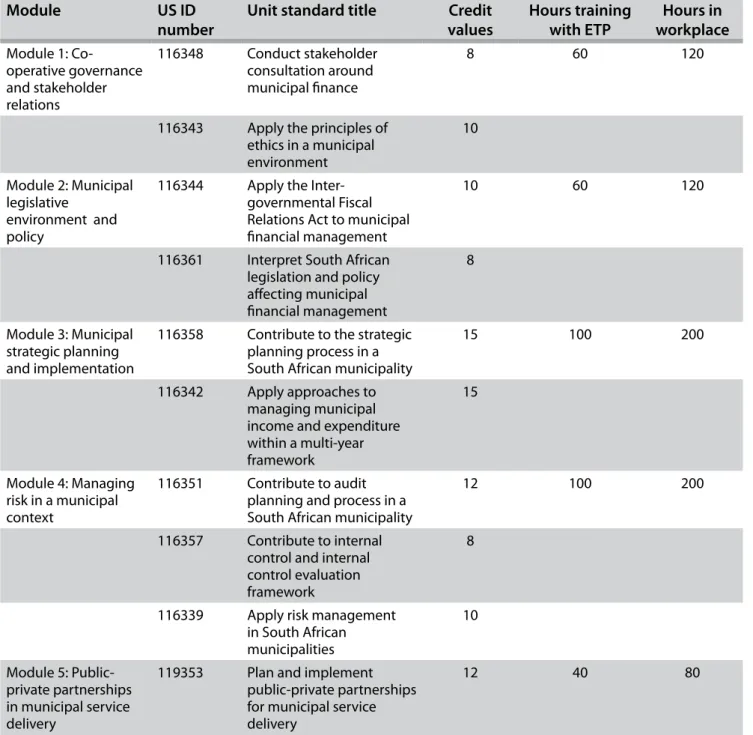
Below is an overview of the 10 modules and related unit standards leading to the award of a full NQF Level 6 Certificate in Municipal Financial Management.
Module US ID
number Unit standard title valuesCredit Hours training with ETP workplace Hours in
Module 1: Co-operative governance and stakeholder relations 116348 Conduct stakeholder consultation around municipal finance 8 60 120
116343 Apply the principles of ethics in a municipal environment 10 Module 2: Municipal legislative environment and policy
116344 Apply the Inter-governmental Fiscal Relations Act to municipal financial management
10 60 120
116361 Interpret South African legislation and policy affecting municipal financial management 8 Module 3: Municipal strategic planning and implementation
116358 Contribute to the strategic planning process in a South African municipality
15 100 200
116342 Apply approaches to managing municipal income and expenditure within a multi-year framework
15
Module 4: Managing
risk in a municipal 116351 Contribute to audit planning and process in a 12 100 200
Module US ID
number Unit standard title valuesCredit Hours training with ETP workplaceHours in
Module 6: Municipal budgeting and implementation
116345 Apply the principles of budgeting within a municipality
15 80 160
116364 Plan a municipal budgeting
and reporting cycle 8
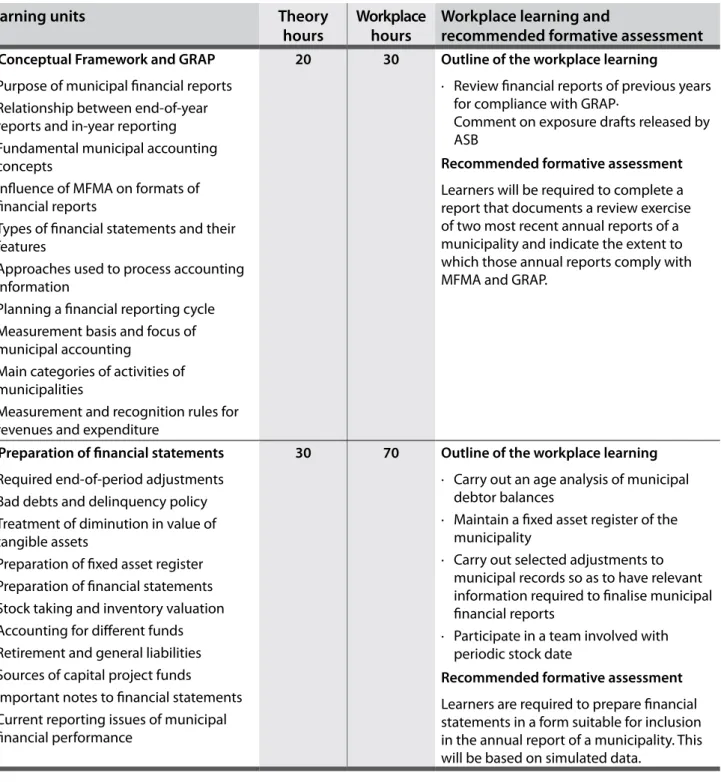
Module 7 : Municipal financial reporting and performance management
116363 Prepare and analyse
municipal financial reports 12 80 160
116341 Conduct performance management in a South African municipal environment
12
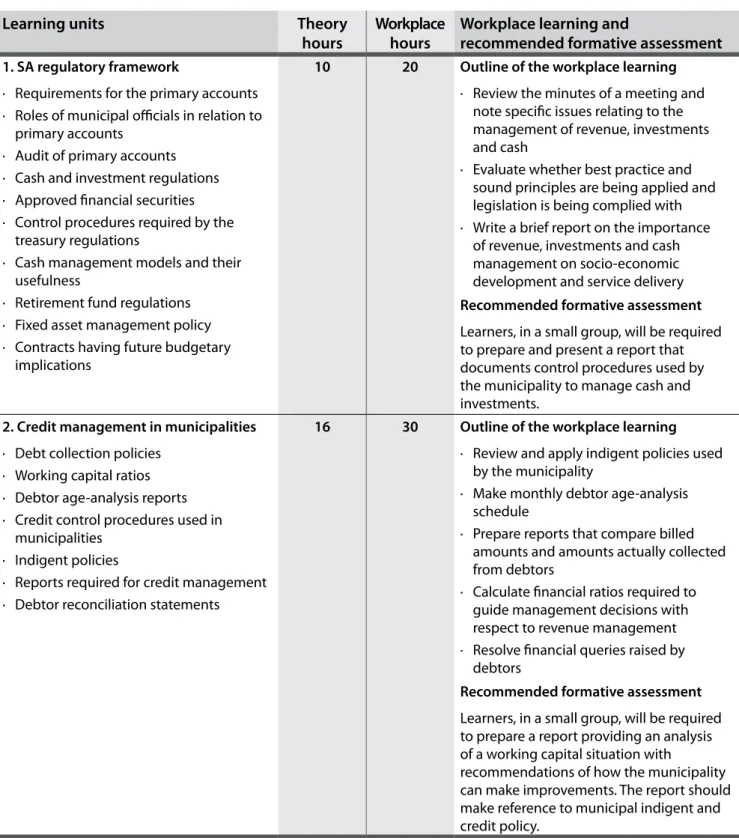
Module 8: Management of municipal assets and liabilities
116346 Apply techniques and South African statutes to cash and investment management in a municipal environment
10 74 136
116362 Manage a municipality’s
assets and liabilities 11 Module 9: Cost
management and capital planning
116347 Contribute to capital
planning and financing 15 130 240
116340 Apply costing principles to municipal operational and service-based costing 11 116360 Manage information technology resources in a municipal finance environment 11 Module 10: Municipal supply chain management
116353 Participate in the design and implementation of municipal supply chain management
The skills training programme number 1 is based on:
Co-operative governance and stakeholder relations
Unit standards covered
This module addresses learning outcomes specified in the following unit standards:
US ID No . 116348: Conduct stakeholder consultation around municipal finance US ID No . 116343: Apply the principles of ethics in a municipal environment
Purpose and key interrelationships
The conduct of business in the public sector in South Africa is governed by the principles underlined in the Batho Pele White Paper (1997). To effectively live by these principles and grow one’s career in the modern work environment, it is imperative to manage oneself effectively and ethically, and communicate effectively to maximise human resource performance. This module lies not only at the core of the certificate, but is important for the fulfilment and success of one’s work on a daily basis.
The legislative framework governing municipal finance management and administration is strategy-focused. As a result, the three spheres of government in South Africa are required to engage in certain events and processes that include effective stakeholder consultation and human resource capital development.
This module recognises the importance
of communication and the development
of human capital as essential ingredients
of a developmental public sector.
The Municipal Finance Management Act is based on the principle of developmental local government which takes place through a consultative process. The legislative framework governing municipal finance management in strategy-focused developmental organisations is new, and municipalities are required to engage in certain events and strategic planning sub-processes, which include stakeholder consultation. In order for municipalities to deliver on their legislative mandate, officials and councillors must consider inputs from various stakeholders to enable them to implement the strategic planning and budgeting processes effectively. There are particular links between co-operative governance and stakeholder relations and other areas of competency in the qualification. Budget preparation and the annual review of the IDP are closely interrelated processes, and need to be well integrated on the municipal calendar through a well-informed consultative process. Also, performance management is a module on the qualification. The strategic planning process leads to programme planning and implementation of strategic objectives. Such programmes and strategic objectives must be communicated to stakeholders.
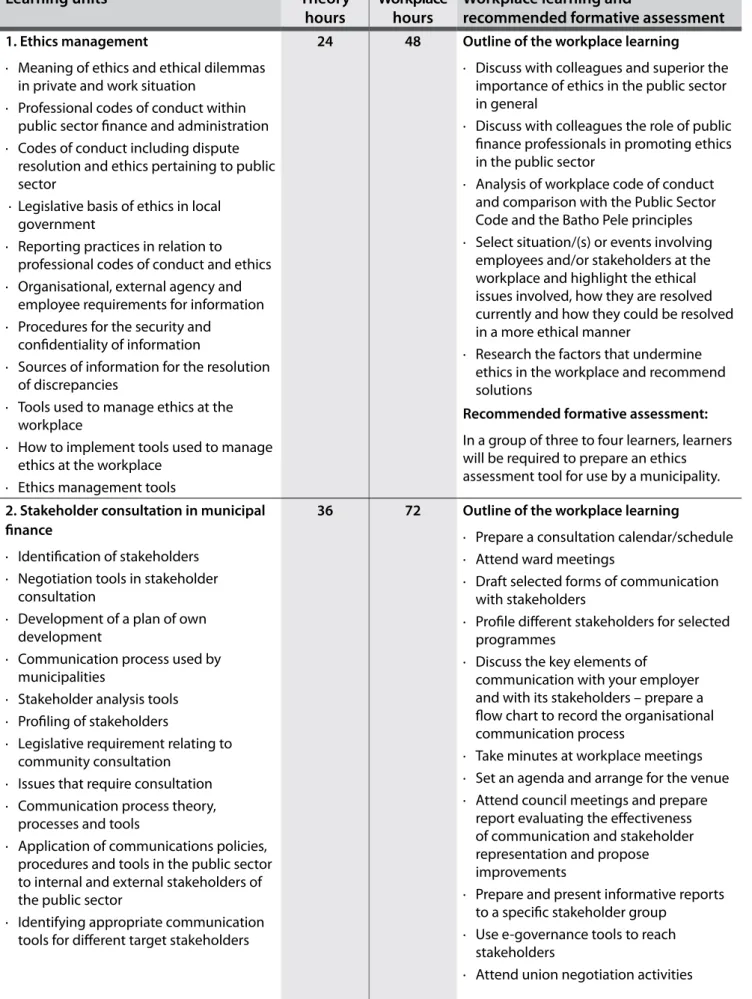
Learning units Theory
hours Workplace hours Workplace learning and recommended formative assessment
1. Ethics management
· Meaning of ethics and ethical dilemmas in private and work situation
· Professional codes of conduct within public sector finance and administration · Codes of conduct including dispute
resolution and ethics pertaining to public sector
· Legislative basis of ethics in local government
· Reporting practices in relation to professional codes of conduct and ethics · Organisational, external agency and
employee requirements for information · Procedures for the security and
confidentiality of information
· Sources of information for the resolution of discrepancies
· Tools used to manage ethics at the workplace
· How to implement tools used to manage ethics at the workplace
· Ethics management tools
24 48 Outline of the workplace learning
· Discuss with colleagues and superior the importance of ethics in the public sector in general
· Discuss with colleagues the role of public finance professionals in promoting ethics in the public sector
· Analysis of workplace code of conduct and comparison with the Public Sector Code and the Batho Pele principles · Select situation/(s) or events involving
employees and/or stakeholders at the workplace and highlight the ethical issues involved, how they are resolved currently and how they could be resolved in a more ethical manner
· Research the factors that undermine ethics in the workplace and recommend solutions
Recommended formative assessment:
In a group of three to four learners, learners will be required to prepare an ethics assessment tool for use by a municipality .
2. Stakeholder consultation in municipal finance
· Identification of stakeholders · Negotiation tools in stakeholder
consultation
· Development of a plan of own development
· Communication process used by municipalities
· Stakeholder analysis tools · Profiling of stakeholders
· Legislative requirement relating to community consultation
· Issues that require consultation · Communication process theory,
processes and tools
· Application of communications policies, procedures and tools in the public sector to internal and external stakeholders of the public sector
· Identifying appropriate communication tools for different target stakeholders
36 72 Outline of the workplace learning
· Prepare a consultation calendar/schedule · Attend ward meetings
· Draft selected forms of communication with stakeholders
· Profile different stakeholders for selected programmes
· Discuss the key elements of
communication with your employer and with its stakeholders – prepare a flow chart to record the organisational communication process
· Take minutes at workplace meetings · Set an agenda and arrange for the venue · Attend council meetings and prepare
report evaluating the effectiveness of communication and stakeholder representation and propose improvements
· Prepare and present informative reports to a specific stakeholder group
· Use e-governance tools to reach
Learning units Theory
hours Workplace hours Workplace learning and recommended formative assessment
2. Stakeholder consultation in municipal finance (continued)
· Utilise information technology programmes and systems to enhance communication with stakeholders · Barriers to communication and how to
overcome them · Writing for stakeholders
· Strategies for conflict management and overcoming barriers to effective communication
· Communicating changes to stakeholders
36 72 Recommended formative assessment
A small group of learners will be required to provide a record of discussions with community members within the context of issues arising out of local government finance . The record of discussions with community members should reflect information inputs obtained through the use of appropriate consultation tools .
The skills training programme number 2 is based on:
Municipal legislative environment and policy
Unit standards covered
This module addresses learning outcomes specified in the following unit standards:
US ID No . 116344: Apply the Inter-governmental Fiscal Relations Act to municipal financial management US ID No . 116361: Interpret South African legislation and policy affecting municipal financial management
Purpose and key interrelationships
This module deals with the legislative
issues that underpin municipal finance
management and administration.
The legislative requirements of municipal finance management are based on South Africa’s Constitution, which outlines key democratic principles. For this reason, the module develops an understanding of the nature and significance of selected legislative instruments on municipal finance policy as an external and internal influence on the management of municipal finance and service delivery. Learners will therefore develop an appreciation of key institutions and legislative principles that regulate financial management in a contemporary context. For instance, there is a close interrelationship between revenue raising and spending powers of different spheres of government. Such revenue raising and spending powers impact directly on economic decisions taken by municipal finance managers and the accountancy practice.
Democracy operates within the framework of legislation. The purpose of this module is to highlight the key legislation that impacts on the exercise of the functions of financial management and administration in the local government sphere.
Different legislative and policy instruments affect financial management in South Africa. The Municipal Structures Act identifies the responsibilities for performance management in municipalities. The Municipal Finance Management Act complements the Municipal Structures Act and the
performance in municipalities. The existing legislative framework and related policy instruments emphasise the need for efficiency and effectiveness and the economic use of resources. The understanding of existing legislative and policy frameworks affecting the effective and efficient use of resources in the implementation of integrated development plans and budgets, is required for implementing specific service delivery plans.
This module directly underpins the work to be undertaken in the municipal risk management, and co-operative governance modules. It also links closely to the municipal strategic planning and implementation module.
The Municipal Finance Management Act requires senior municipal officials to command a sound working knowledge of strategic decision-making processes and role-players in the public sector in order to make sense of their working environment and to work effectively within it. Learners who will be working in municipalities need a close understanding of how different legislation and policy frameworks impact on the ever-changing governance structures in the South African government.
In preparing municipal budgets, accounting officers are required by the legislative framework to provide financial and non-financial performance measures and indicators. Therefore, those involved in budgeting and financial reporting should understand the impact of different legislative and policy instruments on performance management, annual financial reporting, and expenditure and revenue management so that the monitoring and evaluation of such activities is objective, efficient and
Learning units Theory
hours Workplace hours Workplace learning and recommended formative assessment
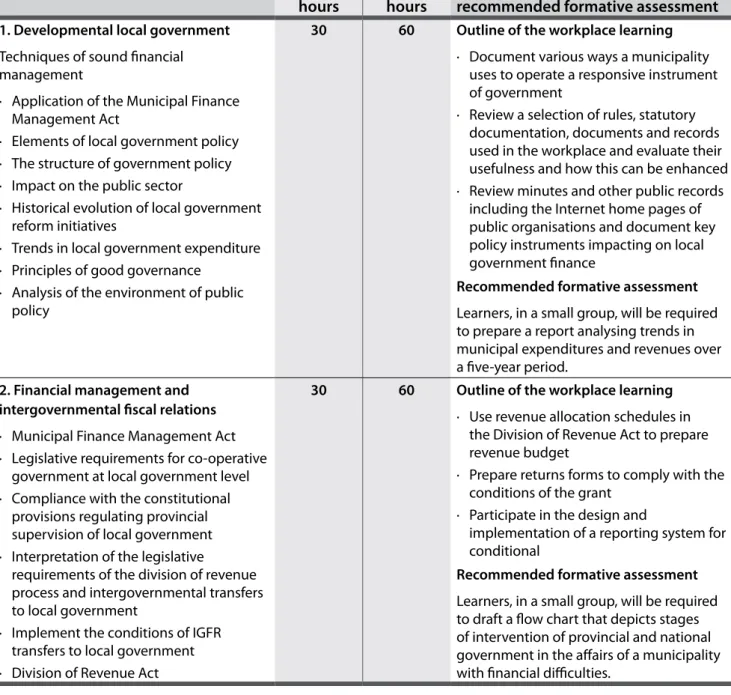
1. Developmental local government
Techniques of sound financial management
· Application of the Municipal Finance Management Act
· Elements of local government policy · The structure of government policy · Impact on the public sector
· Historical evolution of local government reform initiatives
· Trends in local government expenditure · Principles of good governance
· Analysis of the environment of public policy
30 60 Outline of the workplace learning
· Document various ways a municipality uses to operate a responsive instrument of government
· Review a selection of rules, statutory documentation, documents and records used in the workplace and evaluate their usefulness and how this can be enhanced · Review minutes and other public records
including the Internet home pages of public organisations and document key policy instruments impacting on local government finance
Recommended formative assessment
Learners, in a small group, will be required to prepare a report analysing trends in municipal expenditures and revenues over a five-year period .
2. Financial management and intergovernmental fiscal relations
· Municipal Finance Management Act · Legislative requirements for co-operative
government at local government level · Compliance with the constitutional
provisions regulating provincial supervision of local government · Interpretation of the legislative
requirements of the division of revenue process and intergovernmental transfers to local government
· Implement the conditions of IGFR transfers to local government · Division of Revenue Act
30 60 Outline of the workplace learning
· Use revenue allocation schedules in the Division of Revenue Act to prepare revenue budget
· Prepare returns forms to comply with the conditions of the grant
· Participate in the design and
implementation of a reporting system for conditional
Recommended formative assessment
Learners, in a small group, will be required to draft a flow chart that depicts stages of intervention of provincial and national government in the affairs of a municipality with financial difficulties .
The skills training programme number 3 is based on:
Municipal strategic planning and implementation
Unit standards covered
This module addresses learning outcomes specified in the following unit standards:
US ID No .116358: Contribute to the strategic planning process in a South African municipality
US ID No . 116342: Apply approaches to managing municipal income and expenditure within a multi-year framework
Purpose and key interrelationships
This module addresses the aspects
of developing and implementing
the vision, mission, and strategic
objectives and plans.
Learners will develop strategic plans and engage constructively in strategic management in a municipal environment.
This module will improve a learner’s ability to understand and reason through strategic organisational issues, and provide skills that are considered necessary for a municipal finance management practitioner.
The module critically examines and applies the assumptions, concepts and tools of the new approaches to municipal management that are being applied around the world. It presents a broad analytical approach to the problems that managers face and aims at the development of integrated strategies for improving performance in solving serious problems in the local government sphere. Important strategic issues that will be dealt with in the module include: formulating and articulating a mission and vision; developing mechanisms of accountability and legitimacy; using performance management; understanding and making good use of new tools for government including privatisation and contracting; restructuring and re-engineering organisations; and shaping organisational culture.
The module should complement specialised courses that focus in more detail on the particular tools that managers use, and should help learners integrate the knowledge they have gained from their experience and previous coursework.
It is important to note the following:
Leaders of public organisations mobilise resources, both within their own agencies and from outside networks, to meet the needs of the people they serve. In the public sector, these decisions must be made in the context of complicated internal and external environments, and with due regard for the demands of democratic accountability.
Municipal budgeting and implementation is a module of the qualification. Forecasting budget expenditure items and revenue allocations is dependent on the ability of the municipality to plan and manage revenue collection and expenditure over the medium term. Municipal financial reporting and performance management is a module of the qualification. How well a municipality collects revenue and manages its expenditure will influence the outcomes of performance management processes. In addition, performance management will be applied to the income and expenditure in a municipality.
•
•
Legislation and policy development is a module of the qualification. The policies developed and the success of these policies is largely dependent on the municipality’s ability to implement its strategic plans and successfully manage their resources over a medium term period.
• Cost management and capital planning is a learning
module of the municipal finance qualification. Successful capital planning and cost management are designed to support implementation of strategic plans. In addition, reliance is placed on intelligent revenue and expenditure management over the medium term, especially for the successful raising of long-term loans.
•
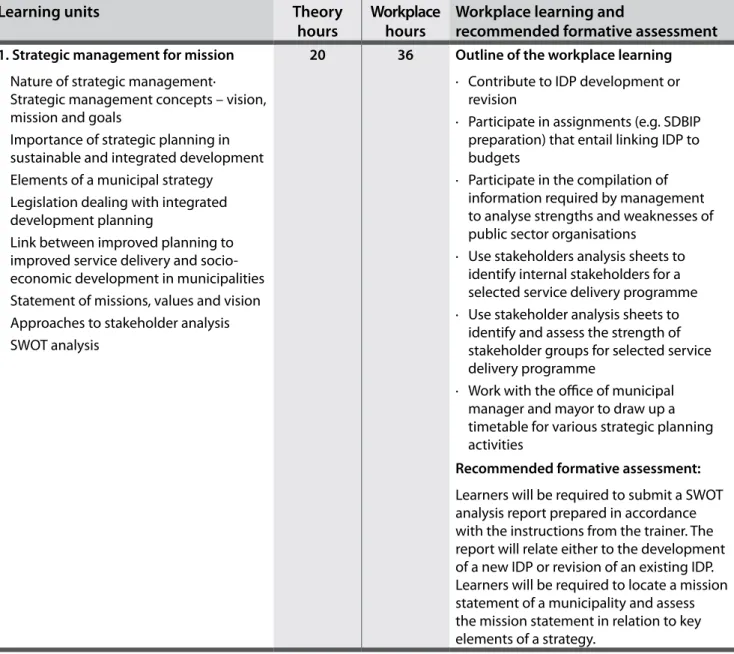
Table 5 Module 3: Municipal strategic planning and implementation
Learning units Theory
hours Workplace hours Workplace learning and recommended formative assessment
1. Strategic management for mission
· Nature of strategic management·
Strategic management concepts – vision, mission and goals
· Importance of strategic planning in sustainable and integrated development · Elements of a municipal strategy
· Legislation dealing with integrated development planning
· Link between improved planning to improved service delivery and socio-economic development in municipalities · Statement of missions, values and vision · Approaches to stakeholder analysis · SWOT analysis
20 36 Outline of the workplace learning
· Contribute to IDP development or revision
· Participate in assignments (e .g . SDBIP preparation) that entail linking IDP to budgets
· Participate in the compilation of information required by management to analyse strengths and weaknesses of public sector organisations
· Use stakeholders analysis sheets to identify internal stakeholders for a selected service delivery programme · Use stakeholder analysis sheets to
identify and assess the strength of stakeholder groups for selected service delivery programme
· Work with the office of municipal manager and mayor to draw up a timetable for various strategic planning activities
Recommended formative assessment:
Learners will be required to submit a SWOT analysis report prepared in accordance with the instructions from the trainer . The report will relate either to the development of a new IDP or revision of an existing IDP .
Learning units Theory
hours Workplace hours Workplace learning and recommended formative assessment
2. Strategy formulation and implementation
· Operating goals and strategies · Action steps and public involvement · Service delivery and budget
implementation plans · Measurement of outcomes · Budget-IDP link
· Performance indicators · Institutional strategies
· Prioritisation of the use of limited resources
· Formulation of programmes and monitoring methods
20 34 Outline of the workplace learning
Conduct analysis of strategic assets of the municipality
Recommended formative assessment
Learners are required to carry out an analysis of benefits and costs associated with a project in the area of youth unemployment to assess the benefits arising from such a project .
3. Strategy implementation and measuring performance
· Key performance areas for institutional strategies
· Opportunities and challenges presented by performance management
· Managing strategic change
· Preparation of service delivery budget implementation plans
· Designing strategic performance management system
· Using information to improve strategic performance
· Programme formulation to implement strategy
· Strategy implementation tools
20 30 Outline of workplace learning
· Participate in the formulation of service specific programmes to support strategy · Contribute to the formulation of a SDBIP · Compile schedules with performance
measurement indicators
· Construct operating procedures specific to a selected service delivery programme
Recommended formative assessment
Learners will be required to complete, in groups of three, a concept paper focusing on the institutional context of services delivered by a municipality to its residents . The paper will focus on municipal strategic planning process or implementation issues . The concept paper requires learners to take one or two concepts developed for the class and provide a critical analysis of that concept in relation to service delivery challenges faced by the municipalities in South Africa . The remaining segments should focus on the application of the concept to public strategic planning and management .
Learning units Theory
hours Workplace hours Workplace learning and recommended formative assessment
4. Revenue management
· Revenue forecasting · Tax and user charges
· Debt management and indigent policy · Subsidy framework for municipalities · Intergovernmental fiscal relations · Maintaining and improving the revenue
control system
· Using technology to enhance revenue management practices
20 50 Outline of the workplace learning
· Prepare a list of indigent residents and apply a subsidy framework used by a municipality
· Compile information required to complete invoices
· Prepare revenue forecasts for different municipal services using reliable data and sound statistical techniques
Recommended formative assessment
Learners, in a small group, will be required to prepare a report to analyse drivers of revenue for different municipal services and to propose ways of sustaining selected municipal revenue sources .
5. Expenditure management
· Linking capital expenditure to specific sources
· Expenditure forecasting tools · Managing funds
· Calculation and interpretation of expenditure variance
· Assess expenditure trends to identify warning signs
· Measurable outcomes of the budget · Performance reports that highlight the
variances in municipal budget · Determine the priority of expenditure
items
· Control mechanisms used to evaluate budget performance
20 50 Outline of the workplace learning
· Identify the expenditure outcomes of a municipal budget
· Prepare a performance report that highlights the variances in a municipal budget
· Determine the priority of expenditure items on a municipal budget
· Document control mechanisms that evaluate budget performance with reference to SDBIPs
Recommended formative assessment
A learner will be required to prepare an expenditure variance report, including operationally informed comments, in a form suitable for consideration by management .
The skills training programme number 4 is based on:
Managing risk in a municipal financial management
context
Unit standards covered
This module addresses learning outcomes specified in the following unit standards:
US ID No . 116351: Contribute to audit planning and in a South Africa municipality
US ID No . 116357: Contribute to internal control and internal control evaluation framework US ID No . 116339: Apply risk management in South African municipalities
Purpose and key interrelationships
This module deals with aspects of
risk management and audit planning
activities in municipalities.
It introduces auditing as an essential component of financial risk management that ensures controls are working in favour of improved service delivery. In the process, the module covers regulatory and standard setting procedures, professional ethics governing auditing work, the rights and duties of the auditor covered by the statute, the responsibilities and legal liability of the auditor, the audit process and audit objectives, and financial statement assertions. Procedures used to obtain, assess and manage risk include: internal control, internal control; evaluation; risk assessment; scope of internal auditing; internal auditing standards; types of internal audits; audit findings; and audit reports for internal and external auditors.
Managing risk in a municipal finance context has certain links to the following:
Risk management involves an appraisal of financial accounting statements and systems used to manage municipal resources. Therefore, prior learning of the requirements of financial accounting at the NQF Level 5, is important.
•
Both internal and external auditors review financial management controls, so there is a need to understand what the main objectives of financial management are. The relevant prior learning is included in the fundamentals of accounting, communication skills and computer literacy modules offered at NQF levels 4 and 5.
Risk management has application throughout the municipal financial management process, such as supply chain management and service delivery through public-private partnerships.
•
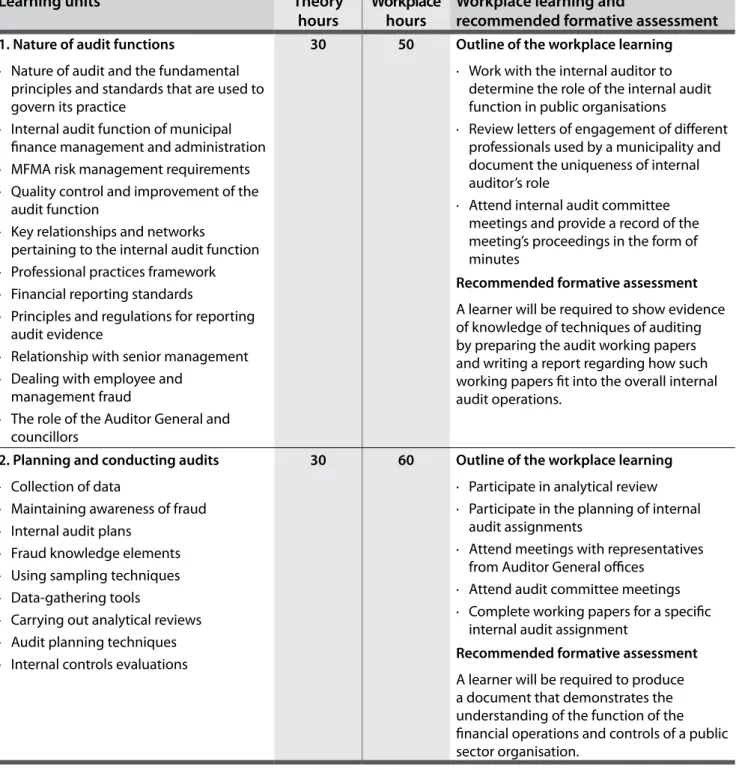
Learning units Theory
hours Workplace hours Workplace learning and recommended formative assessment
1. Nature of audit functions
· Nature of audit and the fundamental principles and standards that are used to govern its practice
· Internal audit function of municipal finance management and administration · MFMA risk management requirements · Quality control and improvement of the
audit function
· Key relationships and networks
pertaining to the internal audit function · Professional practices framework · Financial reporting standards
· Principles and regulations for reporting audit evidence
· Relationship with senior management · Dealing with employee and
management fraud
· The role of the Auditor General and councillors
30 50 Outline of the workplace learning
· Work with the internal auditor to determine the role of the internal audit function in public organisations
· Review letters of engagement of different professionals used by a municipality and document the uniqueness of internal auditor’s role
· Attend internal audit committee meetings and provide a record of the meeting’s proceedings in the form of minutes
Recommended formative assessment
A learner will be required to show evidence of knowledge of techniques of auditing by preparing the audit working papers and writing a report regarding how such working papers fit into the overall internal audit operations .
2. Planning and conducting audits
· Collection of data
· Maintaining awareness of fraud · Internal audit plans
· Fraud knowledge elements · Using sampling techniques · Data-gathering tools
· Carrying out analytical reviews · Audit planning techniques · Internal controls evaluations
30 60 Outline of the workplace learning
· Participate in analytical review · Participate in the planning of internal
audit assignments
· Attend meetings with representatives from Auditor General offices
· Attend audit committee meetings · Complete working papers for a specific
internal audit assignment
Recommended formative assessment
A learner will be required to produce a document that demonstrates the understanding of the function of the financial operations and controls of a public sector organisation .
Learning units Theory
hours Workplace hours Workplace learning and recommended formative assessment
3. Specific internal audit engagements
· Risk and control self-assessment · Quality audit with respect to services · Performance audits
· Security audit assignments · Operational audit assignments · Compliance audits
· Report writing
· Internal audit and information technology resources
· Limitations of working papers
30 60 Outline of the workplace learning
· Work with the internal auditors to carry out an assessment of financial and operating risks associated with a specific internal audit engagement
· Contribute to reports prepared for management’s use in cases of special audit engagements
Recommended formative assessment
Learners will be required to produce an audit plan for a specific internal audit engagement .
4. Risk evaluation and reports
· Audit reports
· Effectiveness of internal control frameworks
· Formulation of risk management plans · Insurance policies for insurable risks · Importance of statistical tools in risk
evaluation
· Evaluation and documentation of physical risks
16 32 Outline of the workplace learning
· Prepare risk identification checklists · Use risk rating tools to rate physical and
financial risks
· Estimate resource requirements needed to mitigate risks
Recommended formative assessment
Learners, in a small group, will be required to prepare a risk mitigation plan for a selected operational area of a municipality .
The skills training programme number 5 is based on:
Public-private partnerships in municipal service
delivery
Unit standards covered
This module addresses learning outcomes specified in the following unit standards:
US ID No . 119353: Plan and implement public-private partnerships for municipal service delivery
Purpose and key interrelationships
In this module, learners will learn
about how valuable public-private
partnerships are in municipal service
delivery.
The module will examine some of the critical success factors of public-private partnerships (PPPs) and offer a suggested approach to establishing, evaluating and managing PPPs. Learners will be exposed to important issues (legal, regulatory, procurement, public policy) associated with the establishment of PPPs. In addition, the module will provide real-life examples of both successful and unsuccessful attempts at partnerships in the area of service delivery.
PPPs have application in municipal financial management. Consequently, PPPs are linked to most parts of the curriculum for the Certificate in Municipal Financial Management. In particular, they are linked to supply chain management, municipal financial and performance reporting, municipal strategic planning and implementation,
and municipal risk management. However, there are particular links to the following:
PPPs involves collaboration between public bodies and private companies and their establishment entails an appraisal process that relies on financial, economic, and legal/regulatory considerations. PPPs calls for different financing arrangements. For this reason, a municipality’s assets and liabilities are bound to change whenever a PPP project is undertaken. Also, the risk profiles of the municipality operations are altered through the adoption of a variety of PPP options.
Both management and auditors review financial management risks and need to understand what the main objectives of a particular PPP project are. Information technology resources affect the way management information is generated and disseminated. This raises certain important challenges for managers to consider when planning •
•
•
Table 7 Module 5: Public-private partnerships in municipal service delivery
Learning units Theory
hours Workplace hours Workplace learning and recommended formative assessment
1. Principles and procedures
· Challenges of service delivery and different options open to municipalities to ensure innovative service delivery · Reasons for PPP establishment
· MFMA, Municipal Systems Act, Municipal Structures Act, PFMA
· Treasury Regulation No 16 as amended by the Standard Practice Notes
· Codes of good practice in BEE in PPPs
16 32 Outline of the workplace learning
· Review the minutes and other records for evidence of municipal service delivery challenges
· Compare PPP opportunities and compare the different options being used
Recommended formative assessment
Learners, in a small group, will be required to write a project proposal comparing/ evaluating existing performance of PPPs, public entities and/or municipal departments and recommend enhancements .
2. Establishing and managing PPPs
· PPP feasibility study and ensuring value for money to the public
· Entrenching PPP processes within local government
· Managing the PPP agreement · Role of the transaction advisor
· Apply legal principles in the design and implementation of the PPP’s operational frameworks and contracts
· Basic contractual arrangements
12 24 Outline of the workplace learning
· Constitute a list of institutional assets · Assist with writing the work programme · Specify institutional outputs
Recommended formative assessment
Learners, in a small group, will be required to submit a due diligence report required to assist management in making a decision on whether conventional public sector procurement or a PPP arrangement is the preferred choice for the proposed service delivery project .
3. Monitoring compliance of PPP projects
· Ensuring compliance of PPPs with BEE legislation and the Preferential Procurement Policy Framework Act · Insurance and risk management · Managing the PPP agreement · Financial reporting and audit of PPPs
12 22 Outline of the workplace learning
· Participate in the identification of effective mechanisms to manage the implementation of the PPP contract · Draw up documentation needed to
make PPP procurement pre-qualification, request for proposals
· Record proceedings of PPP negotiations and financial closure
Recommended formative assessment
Learners, in a small group, will be required to prepare and submit a document needed to invite the public to prepare proposals to procure services through the PPP arrangement .
The skills training programme number 6 is based on:
Municipal budgeting and implementation
Unit standards covered
This module addresses learning outcomes specified in the following unit standards:
US ID No . 116345: Apply the principles of budgeting within a municipality US ID No . 116364: Plan a municipal budgeting and reporting cycle
Purpose and key interrelationships
This is an introduction to the theoretical
and practical foundations of municipal
finance and budgeting in South Africa.
Learners are expected to show an understanding of the legal and economic factors influencing budgets and budget preparation in municipalities to be able to explain the technical nature of budgeting, which includes budget cycles, timetable and process. The budgeting process is incomplete without using cost management information systems to guide the compilation of expenditure schedules needed to finalise the budget. The module also deals with major steps in implementing and administering a budget through the operation of financial management and human resource information systems. Reference is made to the principles and concepts of municipal budgeting, and the learner will be expected to understand the limitations, if any, of budgets prepared by municipalities and other municipal entities in attempting to meet management needs. An awareness of in-year and end-of-year reportingpolicy priorities in an efficient manner
Planning for the budgeting and financial reporting processes.
There are particular links between municipal budgeting and implementation and other areas of core competency in the municipal finance management qualification. Municipalities are required to produce budgeted statements of financial performance, financial position, changes in net assets and cash flows. These statements must be prepared according to GRAP. Competent finance specialists should be well equipped to understand the fundamentals of preparing such budgeted statements and the links among them. Understanding of the links ensures accuracy of the budgeted statements. (See the specimen financial statements prepared according to GRAP with MFMA Circular No. 18 at www.treasury.gov.za/mfma.)
Municipal officials involved in strategic planning processes must recognise budget constraints when developing strategic plans and identifying strategic •
assets and liabilities. The application of sound budgeting principles can improve the productivity of municipal assets and manage the risk associated with liabilities.
Managing the capital assets of a municipality is an important part of ensuring sustainable financial management. Officials involved in budgeting must be able to contribute to capital planning and financing of a municipality.
Municipalities are required by legislation to submit their budgets in a prescribed format. This format must set out indicative revenue per revenue source and projected expenditure by vote for the two financial years following the budget year. The development of a medium-term revenue and expenditure framework at municipal level will improve the allocation of resources •
•
in the future.
A budget is only as effective as the cost estimates upon which it is based. Municipal officials involved in budgeting must be able to use data prepared through the application of costing principles to municipal operations.
Municipal officials involved with budgeting must have an understanding of revenue management in a municipal context. Municipal officials must understand and apply local government legislation regarding revenue management to produce budgets that adhere to the principles of sound revenue management of a municipality.
•
•
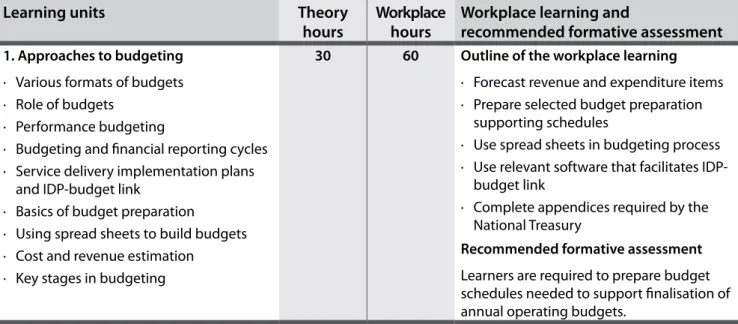
Table 8 Module 6: Municipal budgeting and implementation
Learning units Theory
hours Workplace hours Workplace learning and recommended formative assessment
1. Approaches to budgeting
· Various formats of budgets · Role of budgets
· Performance budgeting
· Budgeting and financial reporting cycles · Service delivery implementation plans
and IDP-budget link
· Basics of budget preparation
· Using spread sheets to build budgets · Cost and revenue estimation
· Key stages in budgeting
30 60 Outline of the workplace learning
· Forecast revenue and expenditure items · Prepare selected budget preparation
supporting schedules
· Use spread sheets in budgeting process · Use relevant software that facilitates
IDP-budget link
· Complete appendices required by the National Treasury
Recommended formative assessment
Learners are required to prepare budget schedules needed to support finalisation of annual operating budgets .
Learning units Theory
hours Workplace hours Workplace learning and recommended formative assessment
2. Budgetary administration and management
· Responsibilities of different municipal officials
· Standard chart of accounts and codes · Financial management information
systems
· Human resources information system · Analysis of fiscal health
· Financial administration legislation · Different budget formats
· Defining budget outcomes · Planning a municipal calendar · Roles and responsibilities of officials · Preparation of budget documentation · Municipal delegations and budget
preparation
25 50 Outline of the workplace learning
· Create new accounts within the current chart of accounts
· Use computerised systems to support administration of an approved budget · Participate in the preparation of a
municipal budgeting and reporting calendar
· Participate in the preparation of
supporting schedules needed to finalise operating budget
· Contribute to the preparation of a service delivery budget implementation plan · Formulate municipal delegation letters
that can be used to delegate specific responsibilities to senior municipal managers
Recommended formative assessment
Learners, in a small group, will be required to prepare a municipal budgeting and reporting calendar of activities as required by the MFMA .
3. Budgets and related controls
· Expenditure management basics · Service cost concepts
· Cost information in income statement · Cost and revenue variances
· Decision support systems
· Different costs for different decisions
25 50 Outline of the workplace learning
· Review major expenditure classifications used by the municipality
· Analyse selected service delivery activities and their impact on costs of services
· Use spread sheets or other relevant software to prepare cost information reports for management use
· Compute selected cost variances for different service costs
Recommended formative assessment
Learner is required to prepare a flexible budget and responsibility report that clearly shows controllable and non-controllable costs for a given manager .
The skills training programme number 7 is based on:
Municipal financial reporting and performance
management
Unit standards covered
This module addresses learning outcomes specified in the following unit standards:
US ID No . 116363: Prepare and analyse municipal financial reports
US ID No . 116341: Conduct performance management in a South African municipal environment
Purpose and key interrelationships
Financial reporting is required in South African municipalities by the existing legislative framework. The Municipal Finance Management Act (2003) requires municipalities and their municipal entities to prepare annual financial statements which fairly presents: the state of affairs of the municipality; its performance against its budget; its management of revenue, expenditure, liabilities and assets; its business activities; its financial results; and its financial position at the end of the financial year. The legislative framework emphasises the need for efficiency and effectiveness and the economic use of resources. Without financial reporting and standards, the effective measurement of how efficiently and effectively resources are used in the implementation of the integrated development plan and budget, is unlikely to be achieved. There are particular links between topics covered by this module and other areas of competence in the qualification. For instance, municipal budgets are required by the legislative framework to be submitted with performance measures and indicators. Those involved in budgeting processes should understand financial reporting and analysis issues while planning municipal expenditures and revenues so that the monitoring and evaluation of such activities is objective, efficient and effective.
This module forms a core part of
the curriculum for the certificate in
municipal financial management
qualification.
Municipalities are required to submit annual reports containing sections that review performance against the municipality’s IDP and budget. This module develops the skills that enable officials to report on and analyse the municipality’s fiscal performance.
This module is a major contributor to
the areas of competence in National
Treasury’s competency prescription,
such as strategic planning, expenditure
management
and
performance
management.
Other key modules contributing to these areas are cash and investment management and municipal budgeting and implementation.
This module makes an important contribution to management of municipal assets and liabilities, municipal risk management, co-operative governance and stakeholder relations, and municipal strategic planning and implementation.