Research Article
Smart City Moving Target Tracking Algorithm Based on Quantum
Genetic and Particle Filter
Zhigang Liu, Jin Shang
, and Xufen Hua
Control Technology Institute, Wuxi Institute of Technology, Wuxi 214121, China
Correspondence should be addressed to Jin Shang; [email protected]
Received 28 March 2020; Revised 19 May 2020; Accepted 25 May 2020; Published 20 June 2020 Academic Editor: Bingxian Lu
Copyright © 2020 Zhigang Liu et al. This is an open access article distributed under the Creative Commons Attribution License, which permits unrestricted use, distribution, and reproduction in any medium, provided the original work is properly cited. In the application of moving target tracking in smart city, particlefilter technology has the advantages of dealing with nonlinear and non-Gaussian problems, but when the standard particlefilter uses resampling method to solve the degradation phenomenon, simply copying the particles will cause local optimization difficulties, resulting in unstablefiltering accuracy. In this paper, a particlefilter algorithm combined with quantum genetic algorithm (QGA) is proposed to solve the above problems. Aiming at the problem of particle exhaustion in particlefilter, the algorithm adopts the method of combining evolutionary algorithm. Each particle in particlefilter is regarded as a chromosome in genetic algorithm, and thefitness of each chromosome corresponds to the weight of particle. For each particle state with weight, the particle is first binary coded with qubit and quantum superposition state, and then quantum rotation gate is used for selection, crossing, mutation, and other operations, after a set number of iterations, thefinal particle set with accuracy and better diversity. In this paper, thefilter state estimation and RMSF ofN= 50 andN= 100for nonlinear target tracking and the comparison of real state and state estimation trajectory in time-constant model under nonlinear target tracking are given. It can be seen that in nonlinear state, the quantum genetic and particlefilter (QGPF) algorithm can achieve a higher accuracy of state estimation, and thefiltering error of QGPF algorithm at each time is relatively uniform, which shows that the algorithm in this paper has better algorithm stability. Under the time-constant model, the algorithmfits the real state and realizes stable and accurate tracking.
1. Introduction
Target tracking is widely used in manyfields of smart city. Tasks such as video surveillance, human-computer interac-tion, automatic vehicle control, and human behavior analysis make great use of target tracking [1]. The moving state of the target is usually a nonlinear, non-Gaussian problem with mobility. The development of target tracking algorithm can be divided into four categories: the first category is mainly based on particlefilter correlation algorithm; the second cat-egory is based on sparse representation theory; and the third category is based on correlation filter tracking algorithm. With the outstanding performance of deep-learning method in feature modeling, the fourth category is mainly based on deep-learning tracking method. Particlefilter is a sequential Monte Carlo method proposed by Ulam. The main idea of this method is to fit the distribution of actual samples as much as possible by using the method of weighted sampling
in a sequence, so as to calculate the state distribution proba-bility of the target at the current time through the previous sequence state distribution, and take the state corresponding to the maximum probability value as the result of the target state prediction [2, 3]. Particle filter is widely used in the actual target tracking because it does not need to assume the linear and Gaussian state transfer equation and observa-tion equaobserva-tion. In the process of practical applicaobserva-tion, particle
filter has the problem of particle weight degradation. In order to solve this problem, resampling technology is introduced into the particlefilter. The purpose of particle resampling is to solve the degradation of particles in the classical Monte Carlo method. The main idea is to resample the probability density function of particles and their corresponding weights. It is realized by increasing the particles with larger weight and reducing the particles with smaller weight. But directly copy-ing high weight particles and discardcopy-ing low weight particles will lead to particle dilution. On the other hand, in order to Volume 2020, Article ID 8865298, 9 pages
achieve high-precision state estimation, more particles are usually needed to participate, and the number of particles affects the efficiency of the algorithm. In view of the above problems, scholars at home and abroad have conducted a lot of research. The extended Kalman filter [4] and the unscented Kalmanfilter [5] integrate the latest observation information to provide the density function for particlefilter. Although the accuracy of particlefilter is improved to a cer-tain extent, the amount of calculation is also greatly increased. The adaptive partial resampling method, which only resamples a part of the particle set, makes a moderate compromise between the weight degradation and particle dilution [6]. The sensitive resampling algorithm keeps the particles with the largest weight and propagates them by the quasi-Monte Carlo method, which restrains the lack of samples but increases the calculation time [7]. The determin-istic resampling algorithm should consider both the particle weight and the particle state value when sampling, avoiding the nondetection discard of low weight particles and avoiding the sample dilution to some extent [8]. After the resampling of the PF algorithm by using the GA algorithm, Kao and Zahara updated the particles by cross-mutation to alleviate sample degradation, which improved the accuracy of PF algorithm to a certain extent, but made the calculation effi -ciency of PF algorithm lower [9]. In reference [10], a robust regularization particle filtering (RPF) method is proposed to reduce multimodal loss by mixing local RPF. In reference [11], an improved method of spherical simple unscented par-ticle diversity (ssupf) is proposed and applied to high-precision astronomical navigation in deep-space environ-ment. It is worth noting that the number of sampled particles has a great impact on PF performance. Reference [12] shows that too few sampling particles will lead to divergence, while too many particles will increase the computational burden and limit the real-time performance of navigation. In order to improve the efficiency of PF, a novel adaptive PF method based on the Kullback Leibler distance (KLD) is proposed in [13, 14] and applied to mobile robot positioning. In refer-ence [15], many PF techniques for adaptive sampling particle number are reviewed. The above research shows that it is fea-sible to control the number of particles to ensure the estima-tion quality and reduce the calculaestima-tion cost. In reference [16], a resampling step is introduced, and an algorithm of sam-pling importance resamsam-pling (SIR) is proposed. The particles with high weight are resampled, and the particles with low weight are discarded, and then a new set of particles is gener-ated by state space model and measurement model. Li et al. proposed a lightweight particle filter tracking method [17], introduced the response graph of correlationfilter into the calculation of particle weight, and used fewer particles to reduce the calculation burden in the sampling process. Fir-ouznia et al. introduced the chaos theory into the particlefi l-ter framework, effectively reducing the number of particles and search space [18]. Jenkins et al. introduced the multibag subspace recovery mechanism to solve the problem of updat-ing the appearance model in particlefilter tracking and reset-ting in case of tracking drift, so as to improve the robustness of the model [19]. Although the tracking algorithm based on particle filter framework is constantly improving [20–22],
there are still some problems in the existing algorithm, such as poor universality in complex scenes, and the tracking accuracy needs to be further improved. In [23], based on the PF algorithm, the principle of the mean-shift algorithm is integrated to realize the target tracking model of the fusion algorithm. This kind of algorithm can improve the calcula-tion efficiency and real-time performance of the PF algo-rithm, but how to choose the appropriate fusion strategy of the mean-shift algorithm is also one of the difficulties; In addition, how to prevent tracking drift should be considered in this algorithm. In [24], the relevant knowledge expressed by sparse theory is applied to the PF algorithm to solve the target tracking task. The experiment shows that the improved method can improve the accuracy of the target tracking model to a certain extent, but the real-time perfor-mance of the algorithm is usually affected by too much calculation when solving the problem. With the rapid devel-opment of depth learning technology and the outstanding performance of depth model in image feature representation, the fusion target tracking algorithm based on depth learning method has been proposed one after another. In [25, 26], the combination of the depth model algorithm and PF principle is applied to the target tracking task, which has achieved quite good results. However, the depth learning model usu-ally needs a large number of training samples with supervi-sion information to train the model, so how to design a suitable structure to improve the calculation speed to meet the real-time requirements of the algorithm is also an urgent problem to be solved [27–29]. In this paper, a particlefilter method combined with quantum genetic algorithm is pro-posed to solve the above problems. Aiming at the problem of particle exhaustion in particlefilter, the algorithm adopts the method of combining evolutionary algorithm to carry out cross and mutation operation on particles. The particles with high posterior probability have high adaptability, so as to improve the accuracy offilter results. Compared with the classical genetic algorithm, the advantage of quantum genetic algorithm lies in the selection of population coding mode and evolution strategy. The core of the population coding method of quantum genetic algorithm is to code individuals by using qubits and quantum superposition states, so that each indi-vidual can represent information of multiple states, which greatly enriches the diversity of the population; at the same time, the population is updated by using quantum rotation gate, and the individual adaptability is improved to guide evolution. In the iterative process, the superposition state of each qubit will collapse to a certain state, which tends to be stable and converge, and finally achieve the purpose of optimization. Because of the unique coding and updating method, the quantum genetic algorithm has more diversity, faster convergence speed, and higher convergence accuracy than the classical genetic algorithm. The genetic mechanism can not only select excellent individuals by selection operator but also generate new individuals by cross operator and mutation operator. Therefore, properly adjusting the selec-tion probability, crossover probability and mutaselec-tion proba-bility can ensure the effectiveness of particles and take into account the diversity of particles. The specific combination process of quantum genetic algorithm and particlefilter is
as follows: each particle of the particlefilter is regarded as the chromosome in genetic algorithm, and the fitness of each chromosome corresponds to the weight of particle; for each particle state with weight,firstly, the particle is binary coded with qubit and quantum superposition state, and then it is selected, crossed, and selected by quantum revolving gate After the set number of iterations, the final particle set is more accurate and diverse. In this paper, the QGPF algo-rithm is proposed by combining QGA with PF; the algoalgo-rithm synthesizes the local search ability and calculation efficiency of QGA and the nonlinearfiltering principle of PF algorithm. The simulation experiments of nonlinear target tracking model and time-constant model show that the algorithm has high precision and good numerical stability and can complete the accurate tracking of smart city moving targets.
2. Particle Filter Algorithm
Particlefilter is a kind offilter algorithm based on the Bayes-ian theory and Monte Carlo simulation. Its core idea is to use a group of random samples to approximate the posterior conditional probability density of state variables. It is assumed that the nonlinear dynamic process is expressed as follows:
xk=f xð k−1,vk−1Þ zk=h xð k,wkÞ, (
ð1Þ
in which,x is the state value of the system,fð⋅Þis the state transfer equation,zis the state observation value,hð⋅Þis the system observation equation,wis the system noise, andvis the observation noise.
The recursive Bayesianfiltering includes two processes: prediction and update.
Prediction process: the posterior probability density p
ðxk−1jz1:k−1Þ of k−1 time is used to predict the predicted
probability density pðxjz1:k−1Þ of k time.
p xð kjz1:k−1Þ= ð
p xð kjxk−1Þp xð k−1jz1:k−1Þdxk−1: ð2Þ
Update process: update the posterior probability den-sity pðxkjz1:kÞ of k time by the observation information zk of k time. p xð kjz1:kÞ= p zð kjxkÞp xð kjz1:k−1Þ Ð p zð kjxkÞp xð kjz1:k−1Þdxk : ð3Þ
Because of the integral operation in the Bayesianfi lter-ing algorithm, it is difficult to obtain closed analytical solutions for the nonlinear and non-Gaussian systems. By using the Monte Carlo method, the integral operation is transformed into the sample weighted sum operation. The posterior probability density can be approximated by the sample particle xik and its weight wik.
p xð kjzkÞ= 〠 N i=1w i kδ xk−xik , ð4Þ
in which δð⋅Þis the Dirac function.
However, it is very difficult to get samples from the pos-terior probability density under normal circumstances. In this paper, an importance distribution function qðx0:kjz1:kÞ,
which is easy to sample, is introduced. In order to simplify the calculation and make the weight calculation of particles recursive, the importance distribution function satisfies the following decomposition:
q xð 0:kjz1:kÞ=q xð 0:kjx0:k−1,z1:kÞq xð 0:k−1jz1:k−1Þ: ð5Þ
Then, the weight update formula is
wik=wik−1p zk x i k p xi kxik−1 q x kixi0:k−1,z1:k : ð6Þ
The status output is
xk=〠 N i=1
wikxik: ð7Þ
Particlefilter initializes the sample at the initial time and extracts the initialization state from the prior distribution. At the next moment, the particles transfer state according to the transfer equation and assign the weight of particles according to the actual system observation. Finally, all particles are weighted sum to get the state estimation at this time. After resampling the particles, the filtering process of the next period is continued [30, 31].
3. Quantum Genetic Algorithm
QGA is a newly developed probability evolution algorithm based on the quantum computing principle. It uses the con-cept and theory of quantum computing to integrate the char-acteristics of genetic algorithm (GA) which can maintain good population diversity. It applies the probability ampli-tude representation of quantum bits to chromosome coding, so that a chromosome can express the superposition of mul-tiple states and use quantum rotation gate and quantum non-gate to realize chromosome update operation, so as to achieve population optimization.
The population of QGA consists of quantum chromo-somes encoded by quantum bits. Quantum bit is the smallest information unit in QGA, which is different from the classi-cal bit in that can not only be in state 0 or 1 but also represent any superposition state of the two, so QGA has more
diver-sity than GA. The population with N individuals and M
-length quantum chromosome is expressed as P tð Þ= pt1,p2t,pt3,⋯ptn ,ptj= αt 1 βt 1 αt 2 βt 2 ⋯ ⋯ αt m βt m ðj= 1, 2, 3,⋯,nÞ ð8Þ
wherept
j is an individual of thetgeneration,αi and βi are
complex numbers, which are called probability amplitude pairs, satisfying the normalization condition α2+β2= 1, andtis genetic algebra.
Quantum gate is the executive mechanism of QGA to realize evolutionary operation. One of the key points of quantum genetic algorithm is to construct a proper quantum gate. According to the characteristics of QGA, it is more suit-able to choose quantum revolving gate. The update of quan-tum bit is realized by quanquan-tum rotating gate as follows:
αi′ βi′ " # = cosθi −sinθi sinθi cosθi " # αi βi " # , ð9Þ
in which the quantum revolving gate is
Ui= cosθi −sinθi sinθi cosθi " # , ðαi,βiÞT αi′, βi′ T ð10Þ
are theith quantum bit in the chromosome before and after renewal, andθiis the rotation angle of the quantum gate.
4. The Particle Filter Algorithm Combined with
the Quantum Genetic Algorithm
The particle at a certain time is regarded as a possible state of the target’s position, and the weight of the particle represents its possibility. The particle set can be regarded as the popula-tion of quantum genetic algorithm at a certain time, that is, each particle at that time is regarded as an individual in the population. A nondegenerate particle filter algorithm is implemented by combining quantum genetic algorithm and particlefilter algorithm. The whole algorithm is divided into three stages: presampling, genetic operation, and particle individual selection: In the presampling stage, the pre-sampled particle set at timeK is extracted from the particle set at timeK−1through the importance distribution, and its weight is determined by measuring its consistency with the road sign observation. The weight of the particle repre-sents the likelihood of the particle representing the environ-ment, which can also be regarded as thefitness of the particle. Thefitness function is related to the function to be real-ized. In this paper, we study the tracking of moving objects in smart city and make the particles correspond to the candi-date solutions of tracking objects. Thefitness function is used to evaluate the quality of the candidate solutions (particles) given.zkrepresents the observed output. The larger the
prob-ability of observingzkis, the better the particle can represent
the real position of the object, namely
fitness xik =P zkxik
, ð11Þ
in whichfitnessðxikÞrepresents thefitness ofiparticles atK
time,zkrepresents the observation result of the target at K
time, and PðzkjxikÞ represents the probability of observing zk at the position of i particles at K time. Therefore, the
higher the probability is, the more representative the particle is of the real position of the target, and the greater its weight. Quantum genetics is applied to the resampling stage of particles to expand the diversity of particle sets. In the initial-ization stage of genetic algorithm, in order to set more genetic opportunities for particles with high fitness, the weights of all particles are sorted and normalized. In the stage of genetic generation of new particles, the quantum cross-mutation operation is used to generate new particles, and the algorithm is set to achieve high degree of freedom parti-cles that have a higher probability to continue the offspring particles. This setting can effectively avoid particle degrada-tion, because the cross-operation increases the diversity of particles, and the distribution of these new particles is wider than that before the cross, which is conducive to the improvement of particle positioning ability. In order to avoid too much error caused by particle dispersion, the project plans to carry out mutation operation according to the weight of particles: for particles whose weight is less than the average level, we can generate new particles with greater weight through mutation operation, while larger particles with better performance need to avoid the impact of muta-tion on them. After mutamuta-tion, the particle set can be trans-ferred to the real distribution of state.
The specificflowchart is shown in Figure 1. The input of theflowchart is the state of particles atK‐1time (each parti-cle represents the position of the target), and the output is the state of particles atKtime. Firstly, according to the state of particles and the visual perception information of the target at K‐1time, the state of each particle is initialized and the weight is updated, and the particles with high weight are inherited preferentially through the weight sequencing. Secondly, in the process of resampling, combined with the quantum genetic algorithm, we set the number of genetic iterations (expressed byK). In each generation, the quantum bits and superposition states are used to encode the particles, and then the quantum rotating gate is used to carry out genetic and mutation operations on the particles in the pop-ulation, so as to get the new generation of particles. If the set number of times has been reached, the iteration is over. If not, a new cycle will be carried out, andfinally, the diverse particles after crossing and mutation will be obtained, which can effectively solve the problem of particle depletion caused by the long-term running of the target.
5. Simulation Experiment and Result Analysis
In order to detect the performance of QGPF tracking algo-rithm, the standard particlefilter algorithm (PF), the particle swarm optimizationfilter algorithm (PSOPF), and the algo-rithm in this paper (QGPF) are simulated and compared. The three algorithms are simulated and tested by two kinds of target models: nonlinear target tracking model and time-constant value model.
5.1. Nonlinear Target Tracking Model. Next, a nonlinear, non-Gaussian target tracking problem is simulated, and the
motion state equation and measurement equation of the sys-tem are as follows:
x kð Þ= 1 + sin 0ð :03πkÞ+ 0:5x kð −1Þ+w kð −1Þ y kð Þ= 0:2x 2ð Þk +νð Þk ,k≤30 −2 + 0:4x kð Þ+νð Þk ,k> 30: ( 8 > > < > > : ð12Þ
The output results are represented by the mean value of the particle set of each particlefilter algorithm:
xk ∧ =1 S〠 S i=1x i k: ð13Þ
The evaluation standard offiltering error is
RMSE = ffiffiffiffiffiffiffiffiffiffiffiffiffiffiffiffiffiffiffiffiffiffiffiffiffiffiffiffiffiffiffiffi 1 T〠 T k=1 xk− xk ∧ 2 v u u t , ð14Þ
in whichwðk−1ÞandνðkÞ, the system noise and measure-ment noise, are all zero mean Gaussian white noise. The choice of population size requires a trade-offbetween accu-racy, stability, and running time, sometimes taking into account the dimensions of the problem. Generally speaking,
if we focus on reducing operation time, the population size can be set at about 40; if we prefer high precision and high stability, it can be set at 50 to 80. When the population size is greater than 100, the improvement of its precision is not obvious [32, 33]. Therefore, in terms of population size, we choose 50 and 100.
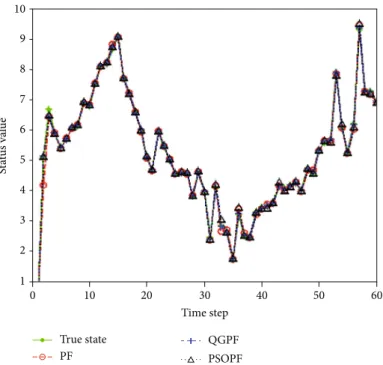
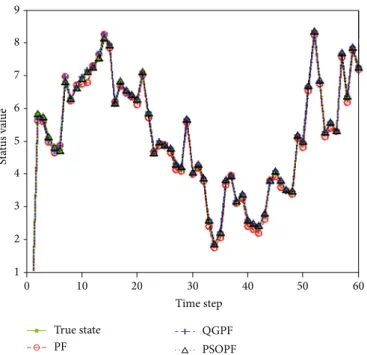
Figures 2–5 shows thefiltering state estimation andfi lter-ing error statistics when the number offiltering particles is 50 and 100, respectively.
It can be seen from Figures 2–5 that compared with the standard PF and PSOPF algorithm, the QGPF algo-rithm proposed in this paper can achieve higher precision state estimation, and the filtering error of QGPF algorithm at each time is relatively uniform, which shows that the algorithm in this paper has better algorithm stability. This is because the QGP algorithm applies quantum genetics to the resampling phase of particles, expands the diversity of particle set, uses quantum cross-mutation operation to generate new particles, and sets a higher probability to realize the high degree of freedom particles in the algo-rithm to continue the offspring particles, effectively avoid-ing particle degradation. At the same time, in order to avoid excessive error caused by particle dispersion, it advances according to the weight of particles, line muta-tion operamuta-tion, so that the particles set to the real distribu-tion of the state around the transfer.
QGA is integrated into PF, and the particles are binary coded with quantum bits and quantum superposition states.
Particle state initialization
Reach set algebra
Resampling particles with quantum genetic algorithm
At the end, get the particles with diversity at k time Particle sampling and
weight updating
Initialize the population. Each individual in the population represents a particle
The individuals in the population are sorted by weight, and the particles with high weight have higher genetic probability
From the first generation (T= 1)
Each individual in the population is measured by qubit and binary coded
Crossover and mutation of individuals in population by quantum rotation gate
No
Yes
The stability and accuracy of the algorithm are guaranteed by selecting the appropriate selection probability, crossover probability, and mutation probability. In the results of Figures 2–5, this conclusion has been verified.
5.2. Time-Constant Model.The traditional PF algorithm has insufficient tracking ability due to sample degradation, espe-cially in the time-constant model. Next, the improved parti-clefilter algorithm is simulated in the time-constant model
to test its tracking ability. The system state equation and observation equation of the time-constant model are shown in formula (15). x kð Þ= 5 k≤30 10 30 < k≤60 ( y kð Þ=x kð Þ+νð Þk: 8 > > < > > : ð15Þ 10 True state PF QGPF PSOPF 9 8 7 6 5 4 St at us val ue 3 2 1 0 10 20 30 Time step 40 50 60
Figure2: Filter state estimation (N= 50).
0.9 1 PF QGPF PSOPF 0.8 0.7 0.6 0.5 0.4 0.3 RMS E 0.2 0.1 0 0 10 20 30 Time step 40 50 60
Figure 6 shows the comparison of real state and state esti-mation trajectory. The results show that the optimization of PF with QG can keep the diversity of particles, prevent the degradation of particles, and achieve stable and accurate tar-get tracking.
PF algorithm has good performance in dealing with the system state problems of nonlinear and non-Gaussian distri-bution, but the effect of conventional particlefilter algorithm is not robust under complex conditions, mainly including how to design and select the importance sampling density function and how to solve the problem of particle
degrada-tion along with the iteradegrada-tion process and the increase of the calculation amount caused by a large number of particle sam-pling. The simulation results show that the algorithm pro-posed in this paper has solved the above problems well and has satisfactory stability and accuracy.
6. Conclusion
Particlefilter, which is commonly used in target tracking, is a method to realize the posterior probability density estimation of target state through the prediction and update of particle state and weight. Particle degradation is an inevitable prob-lem in standard particle filter. After updating the particle state, in order to solve the problem of particle degradation,
True state PF QGPF PSOPF 9 8 7 6 5 4 St at us val ue 3 2 1 0 10 20 30 Time step 40 50 60
Figure4: Filter state estimation (N= 100). 0.25 PF QGPF PSOPF 0.2 0.15 0.1 RMS E 0.05 0 0 10 20 30 Time step 40 50 60
Figure5: RMSF mean curve (N= 50).
12 11 10 9 7 8 6 5 St at us val ue 4 3 2 0 10 20 30 Time step 40 50 60 QGPF
it is necessary to resample the particle set to remove the unimportant particles. However, such removal often makes the particle set lose its diversity, and quantum genetic algo-rithm can well maintain the diversity of the population. Therefore, the introduction of quantum genetic algorithm into particlefilter can better solve the problem of particlefi l-ter degradation. At the same time, the quantum parallel oper-ation also improves the real-time tracking. In the process of target tracking, complex background, partial or total occlu-sion of target and illumination change will affect the tracking accuracy and real-time performance. In this paper, the parti-cle filtering algorithm combined with the quantum genetic algorithm (QGA) uses binary coding and feature fusion of particles through qubits and quantum superposition states to reduce the degradation of particles and improve the track-ing accuracy and real-time performance.
Data Availability
We are not supposed to share the data due to project privacy policy.
Conflicts of Interest
The authors declare that they have no conflicts of interest.
Acknowledgments
This research is supported by the“cyan and blue project”of Jiangsu Higher Education Institutions of China.
References
[1] M. Nieto, A. Cortés, O. Otaegui, J. Arróspide, and L. Salgado,
“Real-time lane tracking using Rao-Blackwellized particlefi l-ter,” Journal of Real-Time Image Processing, vol. 11, no. 1, pp. 179–191, 2016.
[2] P. M. Djuric, J. H. Kotecha, J. Zhang et al.,“Particlefiltering,”
IEEE Signal Processing Magazine, vol. 20, no. 5, pp. 19–38, 2003.
[3] F. S. Wang, M. Y. Lu, Q. J. Zhao, and Z. J. Yuan,“Particlefi l-tering algorithm,” Chinese Journal of Computers, vol. 37, no. 8, pp. 1679–1694, 2014.
[4] A. Doucet, S. Godsill, and C. Andrieu,“On sequential Monte Carlo sampling methods for Bayesianfiltering,”Statistics and computing, vol. 10, no. 3, pp. 197–208, 2000.
[5] R. Van Der Merwe, A. Doucet, N. De Freitas, and E. A. Wan,
“The unscented particlefilter,”Advances in neural information processing systems, pp. 584–590, 2001.
[6] J. Y. Zuo, Y. Z. Zhang, and Y. Liang,“Particlefilter based on adaptive part resampling,” Acta Automatica Sinica, vol. 38, no. 4, pp. 647–651, 2012.
[7] X. Fu and Y. Jia,“An improvement on resampling algorithm of particle filters,” IEEE Transactions on Signal Processing, vol. 58, no. 10, pp. 5414–5420, 2010.
[8] T. Li, T. P. Sattar, and S. Sun,“Deterministic resampling: unbi-ased sampling to avoid sample impoverishment in particlefi l-ters,”Signal Processing, vol. 92, no. 7, pp. 1637–1645, 2012.
[9] Y. Kao and E. A. Zahara,“A Hybrid genetic algorithm and par-ticle swarm optimization for multimodal functions,”Applied Soft Computing, vol. 8, no. 2, pp. 849–857, 2008.
[10] L. Zhou, X. H. Cheng, and Y. X. Zhu,“Terrain aided naviga-tion for autonomous underwater vehicles with coarse maps,”
Measurement Science and Technology, vol. 27, no. 9, pp. 1–9, 2016.
[11] F. Zhao, S. S. Ge, J. Zhang, and W. He,“Celestial navigation in deep space exploration using spherical simplex unscented par-ticlefilter,”IET Signal Processing, vol. 12, no. 4, pp. 463–470, 2018.
[12] B. Claus and R. Bachmayer,“Terrain-aided navigation for an underwater glider,” Journal of Field Robotics, vol. 32, no. 7, pp. 935–951, 2015.
[13] W. Wei, Q. Xu, L. Wang et al.,“GI/Geom/1 queue based on communication model for mesh networks,” International Journal of Communication Systems, vol. 27, no. 11, pp. 3013– 3029, 2013.
[14] C. Kwok, D. Fox, and M. Meila,“Adaptive real-time particle filters for robot localization,”inProceedings of IEEE Interna-tional Conference on Robotics and Automation, pp. 2836– 2841, Washington D. C., USA, 2009.
[15] O. Straka and M.Ŝimandl,“A survey of sample size adaptation techniques for particle filters,” IFAC Proceedings Volumes, vol. 42, no. 10, pp. 1358–1363, 2009.
[16] T. Li, S. Sun, T. P. Sattar, and J. M. Corchado,“Fight sample degeneracy and impoverishment in particle filters: a review of intelligent approaches,” Expert Systems with Applications, vol. 41, no. 8, pp. 3944–3954, 2014.
[17] S. Li, S. Zhao, B. Cheng, E. Zhao, and J. Chen,“Lightweight particlefilter for robust visual tracking,”IEEE Access, vol. 6, pp. 32310–32320, 2018.
[18] M. Firouznia, K. Faez, H. Amindavar, and J. A. Koupaei,“ Cha-otic particlefilter for visual object tracking,”Journal of Visual Communication and Image Representation, vol. 53, pp. 1–12, 2018.
[19] M. D. Jenkins, P. Barrie, T. Buggy, and G. Morison,“Selective sampling importance resampling particlefilter tracking with multibag subspace restoration,”IEEE Transactions on Cyber-netics, vol. 48, no. 1, pp. 264–276, 2018.
[20] L. Jia-qiang, Z. Rong-hua, Z. Yan-ping, C. Jin-li, and Z. Chun-yan, “Target tracking algorithm based on adaptive strong tracking particlefilter,”IET Science, Measurement & Technol-ogy, vol. 10, no. 7, pp. 704–710, 2016.
[21] R. H. Zhang, Z. C. He, H. W. Wang, F. You, and K. N. Li,
“Study on self-tuning tyre friction control for developing main-servo loop integrated chassis control system,” IEEE Access, vol. 5, pp. 6649–6660, 2017.
[22] R. Ma, L. Zhang, G. Li, S. X. Du Jiang, and D. Chen,“Grasping force prediction based on sEMG signals,” Alexandria Engi-neering Journal, vol. 59, 2020.
[23] D. Tang and Y. J. Zhang, “Combining mean-shift tracking algorithm based on multi-feature fusion,” inProceedings of the 33rd Chinese Control Conference, 2014.
[24] S. Yi, Z. He, X. You, and Y.-M. Cheung, “Single object tracking via robust combination of particlefilter and sparse representation,” Signal Processing, vol. 110, pp. 178–187, 2015.
[25] Y. F. Cai et al.,“Visual vehicle tracking based on deep repre-sentation and semisupervised learning,” Journal of Sensors, vol. 2017, Article ID 6471250, 6 pages, 2017.
[26] J. Xin, X. Du, and J. Zhang,“Deep learning for robust outdoor vehicle visual tracking,” 2017 IEEE International Conference on Multimedia and Expo (ICME), 2017, Hong Kong, China, 2017.
[27] W. Cheng, Y. Sun, G. Li, G. Jiang, and H. Liu,“Jointly network: a network based on CNN and RBM for gesture recognition,”
Neural Computing and Applications, vol. 31, Supplement 1, pp. 309–323, 2019.
[28] Z. H. Huang, X. Xu, H. H. Zhu, and M. C. Zhou,“An efficient group recommendation model with multiattention-based neu-ral networks,”inIEEE Transactions on Neural Networks and Learning Systems, pp. 1–14, 2020.
[29] Y. He, G. Li, Y. Liao et al.,“Gesture recognition based on an improved local sparse representation classification algorithm,”
Cluster Computing, vol. 22, Supplement 5, pp. 10935–10946, 2019.
[30] L. Dong, Q. Guo, and W. Wu,“Speech corpora subset selection based on time-continuous utterances features,” Journal of Combinatorial Optimization, vol. 37, no. 4, pp. 1237–1248, 2019.
[31] Y. Sun, C. Xu, G. Li et al.,“Intelligent human computer inter-action based on non redundant EMG signal,”Alexandria Engi-neering Journal, vol. 59, 2020.
[32] W. Wei, H. Song, W. Li, P. Shen, and A. Vasilakos,“ Gradient-driven parking navigation using a continuous information potentialfield based on wireless sensor network,”Information Sciences, vol. 408, no. 2, pp. 100–114, 2017.
[33] X. Sun, H. Zhang, W. Meng, R. Zhang, K. Li, and T. Peng,“ Pri-mary resonance analysis and vibration suppression for the harmonically excited nonlinear suspension system using a pair of symmetric viscoelastic buffers,” Nonlinear Dynamics, vol. 94, no. 2, pp. 1243–1265, 2018.