How to use this pack
This pack is aimed at students studying for both Intermediate 2 and Higher Product Design. Students of other subjects might find it useful, and a Curriculum Map has been included to help show the cross-curricular relevance of this subject area.
The pack is intended to be used as a class activity, with students being given an introductory lesson, followed by individual internet-based study. Videos and/or class visits to Rapid Prototyping machines will obviously significantly help the learning and understanding of the processes involved.
There are currently seven methods of Rapid Prototyping (RP), with four being relatively common. The field is developing rapidly, following Parker’s Law, and there is therefore a strong probability that the range of methods will increase in the near future. Internet-based study should ensure that students are aware of major developments.
Rapid prototyping in schools
Rapid Prototyping is a rapidly expanding field of technology. The technology can be quite simple, depending on the quality of model required by the customer, and individual models can be quite affordable. The machines themselves are very costly, and most schools cannot afford the outlay on a machine that may be idle for a significant
proportion of the academic year. However, costs are dropping at the lower end of the market, whilst at the higher end they remain static but performance increases exponentially. Schools may be able to operate joint ventures within regions or with local companies, colleges or universities to have access to RP machinery. Indeed, as costs continue to drop, schools may soon be able to afford a basic machine.
waste from a solid block of material until the desired form is obtained. This is not true Rapid Prototyping, because the router is subtractive. It takes away the waste to create the desired outcome, and because of the constraints of machine geometry it cannot produce all required
overhangs and hollows. However, machines such as these are used extensively by companies working in the RP business because of their advantages, and can account for a significant portion of the business’s, turnover.
A Rapid Prototyping machine by contrast adds material in a layering process, to create the desired form, thus enabling complex forms to be manufactured in one piece that would otherwise be impossible. The manner in which the layers are laid down, and the materials used to do so vary from method to method. This pack is intended to help the reader to develop a fuller understanding of the topic by looking at the most common methods and materials. The whole subject area of RP is sometimes referred to as 3-D printing, but in fact that term refers to a specific form of machine which is the fastest of all RP methods currently available.
Curriculum map
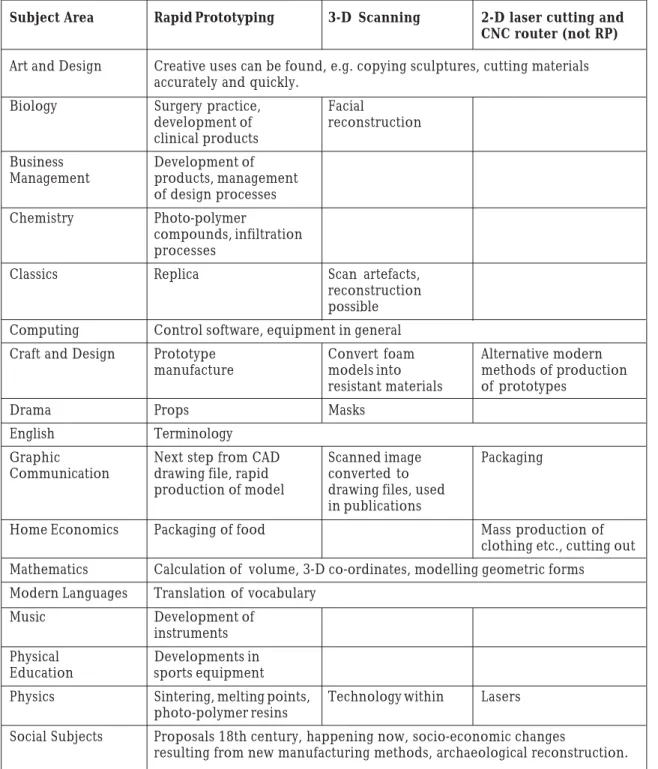
Rapid prototyping (RP) is most obviously relevant to the subjects taught in Technology Departments within secondary schools. However, this topic is also relevant to a range of other subjects which may find the worksheets of use, even if the topic is not included in their current syllabi.
Subject Area Rapid Prototyping 3-D Scanning 2-D laser cutting and CNC router (not RP)
Art and Design Creative uses can be found, e.g. copying sculptures, cutting materials accurately and quickly.
Biology Surgery practice, Facial
development of reconstruction clinical products
Business Development of Management products, management
of design processes Chemistry Photo-polymer
compounds, infiltration processes
Classics Replica Scan artefacts,
reconstruction possible Computing Control software, equipment in general
Craft and Design Prototype Convert foam Alternative modern manufacture models into methods of production
resistant materials of prototypes
Drama Props Masks
English Terminology
Graphic Next step from CAD Scanned image Packaging Communication drawing file, rapid converted to
production of model drawing files, used in publications
Home Economics Packaging of food Mass production of
clothing etc., cutting out Mathematics Calculation of volume, 3-D co-ordinates, modelling geometric forms Modern Languages Translation of vocabulary
Music Development of
instruments Physical Developments in
Worksheet 1
Introduction to Rapid Prototyping
Imagine a computer printer that instead of printing in two dimensions with ink, prints with a substance that builds up layers vertically, thus making a physical model. Rapid Prototyping (RP) is an additive process, unlike all other familiar workshop machine methods that cut away at the materials until the desired shape is achieved, which are called
subtractive processes.
What are the advantages of RP?
RP enables exceptionally accurate models to be made from Computer Aided Drawing (CAD) files (in .stl format) in a much shorter time than conventional methods would permit.
The process itself reduces waste, as unused materials can be recycled. Depending on the type of RP process employed, the end product can be used as a master for production of injection moulding dies.
How much does it cost?
The prices listed below are only a rough indicator of costs, from a range of suppliers for varying standards of equipment.
Machines: 3-D scanners £900–6,000 CNC milling machines/routers £1,600–15,000 Laser cutters £9,000–17,000
RP machines £25,000–350,000
Cost per model from a commercial operator depends on size and
complexity, but is in the range of £150–400 for objects that fit within the standard envelope of most common machines.
Who uses RP systems?
Reconstruction of Egyptian mummy, and detergent bottle made by 3-D printer.
• Design consultancies and specialist model-making companies contracted by other consultancies and companies for product models.
• Large corporations may deem it affordable to have one in the Research and Development (R+D) department, although there are none in Scotland at present within this category.
• Colleges and universities product design departments.
• Surgeons, orthotics and prosthetics specialists, to practise treatments on accurate models and test fit to patients.
• Archaeologists, police forces use models for reconstruction purposes, etc.
How rapid is it?
Not really as fast as you might imagine, but getting faster. Typically, models take 24–48 hours to produce in one continuous process. To produce a model of comparable accuracy using conventional subtractive methods would take considerably longer however, and therefore it is an economic method. A high-speed RP machine can build up layers at a rate of approximately 50 mm per hour.
Architectural model made by 3-D printer Classification of types of RP process
There are four families of machines at present. The table below shows the families which are defined by the manner in which the material that builds up the model is delivered.
Model formation method Machine type
Liquid to solid Stereo-Lithography Apparatus (SLA) Bonding powders Selective Laser Sintering (SLS)
3-D printing
Extrusion Fused Deposition Modelling (FDM) Laser Engineered Net Shaping (LENS) Stacking of layers Thermojet (aka Multi-Jet Modelling)
Laminated Object Modelling (LOM)
Activity
Visit this website:
Worksheet 2
Stereo-Lithography Apparatus (SLA) How it works
A computer controlled laser fires its beam into a tank containing a special form of plastic resin (called a Photo-polymer). When the beam hits the plastic resin it makes the resin set into a solid. The beam travels in two dimensions across the surface of the resin (x axis and y axis), and ‘draws’ a layer of the model. The first layer is formed on the surface of a table within the tank. The table can be lowered (z axis), allowing
another layer of resin to be formed above it. The adjacent layers bond to each other in the setting process, thus beginning the creation of a solid object.
Upon completion of the formation of the model, it is fully submerged in the tank, and so the table must be raised up. The model must then be cleaned of the uncured resin that its surface is wet with. It is then ready for use, although some machining may be necessary.
Material: Cured photo-polymer resin
Envelope: 500 x 500 x 550 mm
Example
A prototype pressure vessel lid with valve housing made by SLA process
Speed
Relatively slow.
Surface finish and accuracy
Usually very good, but sometimes stepping visible on curves and ramped sections.
Practicality and durability of model
Good, but tends to be brittle.
Uses
Detailed models well down the design process, which may then be used to manufacture patterns.
Costs
Typically in the region of £200,000–£300,000.
Activity
Visit the following websites:
www.acucast.com/rapid_prototyping.htm www.acucast.com/video.htm
www.3d-cam.com/services/sla.asp
Worksheet 3
Fused Deposition Modelling (FDM) How it works
This process bears some resemblance to decorating a cake with icing. The piping bag when squeezed extrudes a line of icing, which then sets, allowing a further layer to be added later. In FDM the machine’s nozzle is heated and it extrudes a fine filament of ABS plastic, which then sets after it has bonded on to the layer beneath. The nozzle moves in the X–Y axis and the table which the model is built on moves down in the Z axis.
Material: ABS
Envelope: 250 x 250 x 400 mm
Example
The FDM machine situated in the RDM Centre, Strathclyde University
Speed
Practicality and durability of model
Strength is good assuming design is correct. ABS is a commonly used plastic, which is chosen for its impact and scratch resistant properties.
Uses
Models are functional and can be tested fully for evaluation purposes. Possible to use it for one-offs as end product is made in a suitable material.
Costs
Machines: £80,000 to £120,000. Models, per item: commonly £400 to £500.
Activity
Visit the following websites: www.fdm-modelling.com/ www.imcuk.org/rapid/fdm.html
www.mec.cf.ac.uk/services/index.php?view=fdm&style=plain (Check the harp at this site.)
Worksheet 4
Thermojet How it works
Imagine an inkjet printer that sprays wax instead of ink. The method is similar in operation to Fused Deposition Modelling (FDM), except that after each layer has been deposited, a milling head travels over the model and flattens the surface to finely toleranced dimensional
accuracy. The machine then sprays out the next layer. The wax can be coloured and so realistic looking models can be made.
This type of machine may be a single head inkjet, or a wide area inkjet, where more than 100 jets might be in use. The more inkjets the faster the production, but the higher the cost.
Material: wax
Envelope: 250 x 200 x 200 mm
Speed
Wide area inkjet: high speed. Single inkjet: slow speed.
Surface finish and accuracy
Good surface finish and highly accurate.
Practicality and durability of model
Wax is relatively soft and weak. It can become softened and damaged by manual handling, and is not suitable for painting.
The milling process between each layer is noisy and therefore these machines are not popular within office/ practical areas.
Uses
Restricted to concept models to test forms, as cannot be painted and too soft to use as a master.
Costs
Activity
Visit these websites:
www.3dsystems.com/products/multijet/index.asp
Worksheet 5
Three-Dimensional Printing (3-D Printing) How it works
A layer of powder is spread over a table which moves in the Z axis. A printer-type inkjet then passes over the powder spraying a water-based adhesive. This bonds the powder together in the desired shape of that layer. Another layer of powder is then deposited and the process repeats itself until the desired model is built. Overhangs are supported by the unbonded powder beneath. Upon completion the unused powder is removed by vacuum cleaning, leaving the model.
The models are porous at this stage, and must be infiltrated to give them more strength.
Material: plaster or corn-starch
Infiltration required: wax, polyurethane, cyanoacrylate (superglue)
Envelope: 210 x 210 x 300 mm. Nesting is possible, where more than one model is made in the same operation within the envelope of the machine.
Example
The 3-D printing machine situated at Plaster model used by surgeons for
Speed
The world’s fastest method, with the capability of building layers at 50 mm vertical per hour.
Surface finish and accuracy
Depend on powder form used. Corn-starch produces a rough surface finish, and the accuracy of this and plaster is in the region of 0.5 mm.
Practicality and durability of model
Corn-starch models are weak and not very durable. If infiltrated with wax then they cannot be painted. However, the same machine can use plaster powder, and the end result is of significantly higher quality, though still weak compared to FDM. Most up-to-date machines are capable of producing their output in colour, adding further realism to the model.
Uses
Good for concept models, and development work, but unsuitable for pre-production work.
Costs
Machine: £55,000 for colour, £25,000 for basic machine. Model costs are around £150, depending on size. Unused powder can be re-used, thus reducing waste.
Activity
Visit this website:
Worksheet 6
Selective Laser Sintering (SLS) How it works
A layer of metal powder is spread on the machine’s table. The laser then fires in the X–Y axes and bonds the powder together in the desired shape for that layer. The process repeats until the desired outcome is reached.
The end product can be porous, and therefore may require infiltration to give strength and improve surface finish.
Material: metal
Envelope: 380 x 330 x 450 mm (x,y,z axes)
Speed
Medium level of performance.
Surface finish and accuracy
Surface finish is rough, but accuracy is good.
Practicality and durability of model
Output can be porous.
Uses
Models made in metal are realistic and may be strong enough to be used for evaluative tests.
Costs
Machines: £200,000 to £300,000.
Activity
Visit these websites:
www.acucast.com/rapid_prototyping_SLS.htm www.3d-cam.com/services/sls.asp
Worksheet 7
Laminated Object Manufacturing (LOM) How it works
A special type of paper with an adhesive backing is laid down on the machine’s table. A heated roller passes over the paper and the adhesive bonds it to the surface beneath. The laser head then traces the outline of the required layer. Waste areas are cross-hatched, and then the table drops by the thickness of the paper. Another layer is laid down, rolled and cut and so on until the model is complete. The cross-hatched areas can be easily broken off afterwards, and the surface smoothed down. The laser cutting process produces smoke, and the models are not especially accurate.
Material: paper
Envelope: 800 x 550 x 500 mm (largest available at present.)
Speed
Relatively fast, especially considering possible size of model.
Surface finish and accuracy
Because it is in effect a built up piece of wood, it is accurate to the thickness of the layers, and stepping is visible.
Practicality and durability of model
The models are strong and easily worked on afterwards. They can easily be painted, and are durable.
Uses
Suitable for use as patterns for production of castings.
Costs
Material costs for the paper that builds up the layers is very low. Machines cost £80,000 to £160,000.
Worksheet 8
Laser Engineered Net Shaping (LENS) How it works
This process is in the early stages of development and is not widely available yet. The process uses metal powder, and works by feeding the powder to a nozzle where it is melted by a laser. The process is similar to building layer upon layer of weld, only much more accurate. The metal powders can be varied and even mixed in ways that are not possible using conventional processes, and as well as being used for making prototypes, the process can also be used to repair parts.
Material: metal powders, for example: aluminium, stainless steel, copper, titanium
Speed
Reasonably fast.
Surface finish and accuracy
Very good finish and accuracy. Objects may need some machining but do not require infiltration.
Practicality and durability of model
Very good.
Uses
Production of metal prototypes that are strong and accurate. Can be used for tooling up.
Activity
Visit these websites:
www.optomec.com/html/lens.htm
Glossary
The most common abbreviations, acronyms and terminology in this subject:
Additive Process
A manufacturing method where material is added in small quantities until desired form is obtained.
CAD
Computer Aided Drawing. Engineering drawings made using computer software packages.
CNC
Machine controlled by computer rather than manual operator.
FDM
Fused Deposition Modelling.
FFF
Free form fabrication: another name used to describe the whole topic of Rapid Prototyping.
Infiltration
The process in which a porous and weak model is strengthened by impregnating with a glue-like substance.
LENS
Laser Engineered Net Shaping. RP method where metal powder is bonded by laser, in a spray-like action.
LOM
Laminated Object Manufacturing. RP method where layers of paper are built up and cut to shape by laser.
Porous
Containing air gaps which weaken the structure. These gaps should be filled by infiltration.
Rapid Prototyping (RP)
Method of making models for design evaluation, or tooling up patterns.
SFF
Solid free form fabrication. Another variation on the FFF name.
SLA
Stereo-Lithography Apparatus. The most common method of Rapid Prototyping.
SLS
Selective Laser Sintering. Bonding metal powder together with a laser to make a solid piece.
STL
File type that RP machines recognise. CAD drawings are saved in this format and downloaded to RP machine.
Subtractive Process
Manufacturing method where material is removed from a larger piece to create the desired form, like carving wood.
Thermojet
RP method using a wax-like spray to form a model.
Three-Dimensional Printing
RP method that bonds powder together to form a model. Fastest method available.
Links
Castle Island’s World Guide to RP http://home.att.net/castleisland/
Manufacturers and Suppliers
Unimatic www.edu-cam.com Rishton www.hme-tech.com Hobart Lasers www.hobarts.com
Acknowledgements
RDM Centre, Strathclyde University CA Models, Stirling.