Fact Sheet: OATSIH Web-Based Reporting
Introduction The Australian Government through the Office for Aboriginal and
Torres Strait Islander Health (OATSIH) is funding the development of a
new web‐based reporting system (known as OCHREStreams – Online
Community Health Reporting Environment). In addition to providing a
secure mechanism for submitting data for reports to governments,
OCHREStreams will also enable better service provision by helping
providers in their quality improvement processes. Organisations will
be able to initiate cycles of data analysis and verification at frequent
intervals between despatches of data to OATSIH to meet reporting
obligations.
The new web‐based reporting system encompasses the
administrative, legislative and policy arrangements required to
support the end‐to‐end flow of health service data from the point of
capture, through the web‐based reporting system to the Australian
Institute of Health and Welfare (AIHW) for analysis and reporting.
Central to the new system is the online portal OCHREStreams that
enables the electronic reporting of the health service data required by
governments under funding agreements. The tools being developed
to do this will also enable health services to view their submitted data
and, with explicit permission, view data from other health services
that use the system.
Will
OCHREStreams reduce the burden of reporting?
Yes. OATSIH is building the web‐based reporting system in such a way
that it combines and simplifies a range of currently separate collection
arrangements. It is expected to:
• Include the functions of the OATSIH Services Collection
Analysis Reporting system (OSCAR) currently used by
organisations that report Healthy for Life data and make these
available to a broader range of health programs and system
users.
• Streamline and replace other processes, often paper‐based,
that are currently used to collect service activity and program
performance data from OATSIH funded organisations.
• Advise services of useful program and service management
information
How will
OCHREStreams reduce reporting for health
services?
The new web‐based reporting system will reduce reporting burdens,
not only by cutting the amount of data transcribed by hand, but also
by reducing the duplication of data between collections. This will
happen for health services because the new web‐based reporting
system will:
• Ask for as little manual data input as possible;
• Not ask for duplicate
• information across programs covered by the web‐based
reporting system;
• Upload automatically and securely data that has been
extracted from patient clinical data systems;
• Be able to generate regular and ad hoc reports on demand to
support continuous quality improvement (CQI) and
management planning; and
• Provide training and support for health service staff prior to its
introduction.
Why is this work being
undertaken?
This work is one of the initiatives funded through the Indigenous
Chronic Disease Package (ICDP), an important part of the Australian
Government’s response to closing the gap in Indigenous health
outcomes. The package aims to reduce the burden of disease that
Aboriginal and Torres Strait Islander peoples experience by providing
additional support to the health sector and improved access to health
care for Aboriginal and Torres Strait Islanders. The new web‐based
system will be used to report national key performance indicator data
required by the Council of Australian Governments (COAG). The
national Key Performance Indicators will assist in measuring progress
by Commonwealth and State/Territory Indigenous‐specific primary
health care services towards meeting COAG’s two health related
targets:
• to close the gap in life expectancy within a generation (2031);
and
• to halve the gap in mortality rates for Aboriginal and/or Torres
Strait Islander Health children under five within a decade
(2018).
How will this work? The system will essentially be used in two main data management
processes:
• extraction of data, using a data extraction tool within the
health service ‐ this can be done as often as needed without
triggering a data transmission to OATSIH; and
• transmission of extracted data through a web‐based data
processing and management tool to the Australian Institute of
Health and Welfare (AIHW) and, when the necessary validation
checks are complete, to OATSIH.
Diagram 1 provides an overview of the web‐based reporting system.
Diagram
1:
Web
‐
based
Reporting
System
Overview
Local quality & planning activities
OATSIH Web Based Reporting Solution overview
Training Support
LOCAL DATA TOOLS ‐KEY FEATURES
Data extraction from service PIRS Service review & authorisation point Secure electronic submission
Powerful data tool for services’ own internal
quality & planning use
SECURE TRANSMISSION
Uses eHealth Secure Messaging standard
TRAINING & SUPPORT
Training provided to support progressive
rollout
Ongoing support available to services to
maximise participation & value back to
the service
WEB BASED TOOL ‐KEY FEATURES
Service data securely stored
Services view their own (& benchmark) data
in a variety of ways
Services can agree to share data with other
services, with affiliates or with research
organisations
Services can use & control a wide range of
notifications
AIHW Improvement Foundation
OCHREStreams portal www.ochrestreams.org.au
De-identification & aggregation
SERVICE SUMMARY DATA/ NKPIs
Secure AIHW access for data protection &
management
Secure AIHW access for quality checking &
data analysis
Secure online distribution of AIHW service
reports
QUALITY DATA
Secure IF access for data
protection & management
CAT* data tool
*CAT: Pen Computer Systems Clinical Audit Tool
How
will
it
happen?
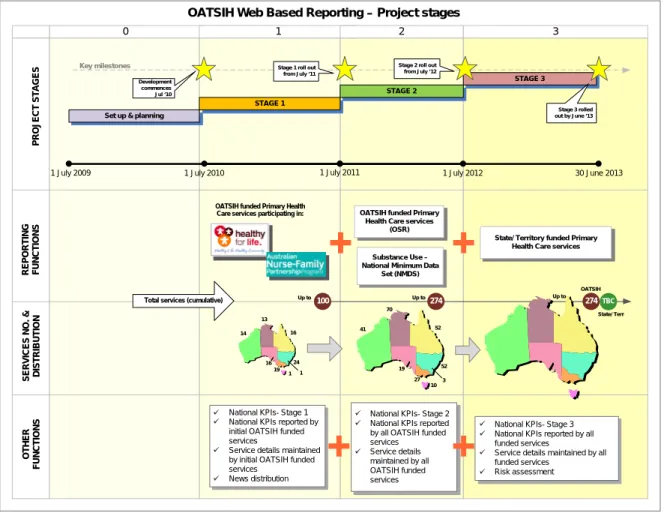
The Improvement Foundation is developing the web‐based reporting system. Diagram 2
demonstrates the staged implementation approach that is aligned with reporting periods
and requirements.
• From July 2011, the new system will be progressively rolled out and organisations
that review and report Healthy for Life data will do so using the new system. It will
also be used to collect Australian Nurse‐Family Partnership Program data and start to
be used for national key performance indicator data.
• From July 2012, OATSIH Service Reporting and national key performance indicator
data will be reported this way by OATSIH‐funded organisations.
• From June 2013 the new system will also be used to collect national key performance
indicator data from State and Territory government funded Indigenous‐specific
primary health care organisations.
Organisations will be contacted directly by OATSIH with details relevant to their particular
reporting needs closer to these dates.
The AIHW will continue to be the custodian of the health data that services provide to
governments. The AIHW record of protecting the security of the data they hold on the health
and welfare of Australians is exemplary. A Data Management and Governance Framework is
being developed in consultation with the Aboriginal Community Controlled sector and will be
published shortly. It will provide information on the arrangements underpinning the new
web‐based reporting system.
The Improvement Foundation conducted a pilot of the new system in May 2011. The pilot
included some of the services that currently use OSCAR and provided valuable information
about system support mechanisms such as help screens, helpdesk and other support
strategies.
Diagram
2:
Web
‐
based
Reporting
System
Implementation
OTHE R FUNC TIONS SE RV IC ES N O . & DIS T RIBUTI O N RE PORTING FU
NCTIONS Substance Use –
National Minimum Data Set (NMDS)
State/ Territory funded Primary Health Care services
National KPIs- Stage 1 National KPIs reported by initial OATSIH funded services
Service details maintained by initial OATSIH funded services
News distribution
National KPIs- Stage 2 National KPIs reported by all OATSIH funded services Service details maintained by all OATSIH funded services
National KPIs- Stage 3 National KPIs reported by all funded services
Service details maintained by all funded services Risk assessment PR OJ EC T STA G E S
OATSIH Web Based Reporting – Project stages
14 13 16 24 16 1 1 19 OATSIH
0 1 2 3
Set up & planning
STAGE 1
STAGE 2
STAGE 3
Stage 2 roll out from July ‘12
Stage 3 rolled out by June ‘13 Development
commences Jul ‘10
Stage 1 roll out from July ‘11
Key milestones
1 July 2009 1 July 2010 1 July 2011 1 July 2012 30 June 2013
OATSIH funded Primary Health Care services
(OSR) OATSIH funded Primary Health
Care services participating in:
Total services (cumulative) Up to 100 Up to274 274
41 70 52 52 3 10 27 19 State/ Terr TBC Up to
How
much
data
will
be
collected?
OCHREStreams will extract the bulk of the data used for reporting automatically from the
service’s clinical information system, minimising the need for manual entry. This will be
further supported by asking for the minimum of data to be entered manually in the first
instance, by pre‐populating forms and asking services to check the information for accuracy.
Work will be undertaken with service providers to improve their Patient Information Recall
System infrastructure to ensure that the bulk of the data used for reporting will be
extracted from the service’s patient clinical data system with minimal manual entry
required.
Will
services
be
able
to
view
qualitative
data
they
have
submitted
for
the
current
or
past
years?
The services will be able to view the qualitative data in their submissions from their
desktops. Services that are currently using OSCAR for their Healthy for Life activities will
have their key data item information from previous years migrated into the new system and
continue to have access to it. This will allow services and the AIHW to continue to do time
Can
it
be
used
for
CQI?
How?
OCHREStreams will provide services with an opportunity to pursue quality data
improvement initiatives by making it easier to analyse the quality, completeness and
integrity of their own data. By introducing a stepped approach to increasing the quality of
service data at a local level a health service will be able to implement clinical improvements.
To assist with continuous quality improvement (CQI) during implementation of the web‐
based reporting system, voluntary CQI indicators may be accessed to assist services in their
CQI activities.
Will
there
be
training
and
support
for
users
of
the
web
‐
based
reporting
system?
With the introduction of the new system, health service users will need to develop the
capacity to use it proficiently and to a level consistent with their various roles. A
progressive training schedule will commence from September 2011 for all users in the
Healthy for Life and Australian Nurse‐Family Partnership Program services. They will get to
know how to use the web‐based reporting system to extract data from their clinical records,
send it to the AIHW through the portal and prepare local reports.
Health service providers can expect:
• Assistance with installing the local data extraction tools and connecting with the
OCHREStreams portal.
• Guidance for registering people who will use the system, and documentation of their
roles in managing data for the service.
• Guidance for extracting, viewing and transmitting data.
• Access to CQI support.
Where
can
I
get
more
information
and
updates
on
the
project?
Detailed information about the new web‐based reporting system will continue to be made
available to services as the new system rolls out. If services have any questions please
contact [email protected]