Data Sheet
Cisco Secure Access Control System 5.5
Cisco
®
Secure Access Control System (ACS) ties together an enterprise’s network
access policy and identity strategy. Cisco Secure ACS is the world’s most trusted
policy-based enterprise access and network device administration control platform,
deployed by about 80 percent of Fortune 500 companies.
Cisco Secure ACS, a core component of the Cisco TrustSec
®solution, is a highly sophisticated policy platform
providing RADIUS and TACACS+ services. It supports the increasingly complex policies needed to meet today's
demands for access control management and compliance. Cisco Secure ACS provides central management of
access policies for device administration and for wireless, wired 802.1x, and remote (VPN) network access
scenarios. Figure 1 shows the Cisco SNS 3415 Secure appliance, based on the Cisco UCS
®C220 M3 platform.
Cisco Secure ACS 5.5 software can run on the Cisco SNS 3415 and 3495
*servers as well as on the legacy 1120
and 1121 Secure ACS appliances, which have reached their end-of-sale dates.
Figure 1. Cisco Secure Network Server 3415 Appliance for Secure Access Control System 5.5 Software
Product Overview
With the ever-increasing reliance on enterprise networks to perform daily job routines and the increasing number
of methods available to access today’s networks, security breaches and uncontrolled user access are primary
concerns for enterprises. Network security officers and administrators need solutions that support flexible
authentication and authorization policies that are tied not only to a user’s identity but also to context such as the
network access type, time of day the access is requested, and the security of the machine used to access the
network. Further, there is a stronger need to effectively audit the use of network devices, monitor the activities of
device administrators for corporate compliance, and provide broader visibility and control over device access
policies across the network.
Cisco Secure ACS is a highly scalable, high-performance access policy system that centralizes device
administration, authentication, and user access policy while reducing the management and support burden for
these functions.
Features and Benefits
Cisco Secure ACS 5.5 serves as a Policy Administration Point (PAP) and Policy Decision Point (PDP) for
policy-based network device access control, offering a large set of identity management capabilities, including:
●
Unique, flexible, and granular device administration in IPv4 and IPv6 networks with full auditing and
reporting capabilities as required for standards compliance
●
A powerful, attribute-driven rules-based policy model that addresses complex policy needs in a flexible
manner
●
A lightweight, web-based graphical user interface (GUI) with intuitive navigation and workflow accessible
from both IPv4 and IPv6 clients
●
Integrated advanced monitoring, reporting, and troubleshooting capabilities for maximum control and
visibility
●
Integration with external identity and policy databases, including Windows Active Directory and Lightweight
Directory Access Protocol (LDAP)-accessible databases, simplifying policy configuration and maintenance
●
A distributed deployment model that enables large-scale deployments and provides a highly available
solution
The Cisco Secure ACS 5.5 rules-based policy model supports the application of different authorization rules under
different conditions; thus, policy is contextual and not limited to authorization determined by a single group
membership. New integration capabilities allow information in external databases to be directly referenced in
access policy rules, and attributes can be used both in policy conditions and in authorization rules.
Cisco Secure ACS 5.5 features the centralized collection and reporting of activity and system health information
for full manageability of distributed deployments. It supports proactive operations such as monitoring and
diagnostics, and reactive operations such as reporting and troubleshooting. Advanced features include a
deployment-wide session monitor, threshold-based notifications, entitlement reports, and diagnostic tools.
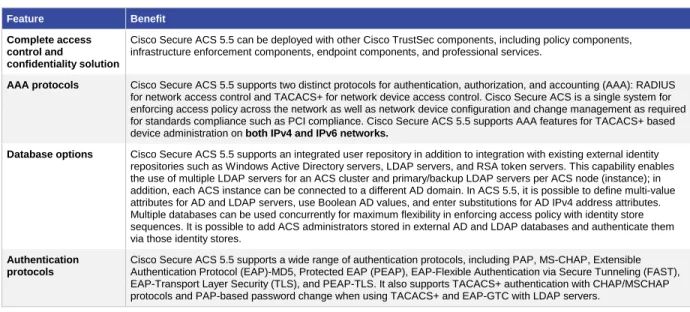
Table 1 lists the key features and benefits of Cisco Secure ACS 5.5.
Table 1.
Key Features and Benefits of Cisco Secure ACS 5.5
Feature Benefit
Complete access control and
confidentiality solution
Cisco Secure ACS 5.5 can be deployed with other Cisco TrustSec components, including policy components, infrastructure enforcement components, endpoint components, and professional services.
AAA protocols Cisco Secure ACS 5.5 supports two distinct protocols for authentication, authorization, and accounting (AAA): RADIUS for network access control and TACACS+ for network device access control. Cisco Secure ACS is a single system for enforcing access policy across the network as well as network device configuration and change management as required for standards compliance such as PCI compliance. Cisco Secure ACS 5.5 supports AAA features for TACACS+ based device administration on both IPv4 and IPv6 networks.
Database options Cisco Secure ACS 5.5 supports an integrated user repository in addition to integration with existing external identity repositories such as Windows Active Directory servers, LDAP servers, and RSA token servers. This capability enables the use of multiple LDAP servers for an ACS cluster and primary/backup LDAP servers per ACS node (instance); in addition, each ACS instance can be connected to a different AD domain. In ACS 5.5, it is possible to define multi-value attributes for AD and LDAP servers, use Boolean AD values, and enter substitutions for AD IPv4 address attributes. Multiple databases can be used concurrently for maximum flexibility in enforcing access policy with identity store sequences. It is possible to add ACS administrators stored in external AD and LDAP databases and authenticate them via those identity stores.
Authentication protocols
Cisco Secure ACS 5.5 supports a wide range of authentication protocols, including PAP, MS-CHAP, Extensible Authentication Protocol (EAP)-MD5, Protected EAP (PEAP), EAP-Flexible Authentication via Secure Tunneling (FAST), EAP-Transport Layer Security (TLS), and PEAP-TLS. It also supports TACACS+ authentication with CHAP/MSCHAP protocols and PAP-based password change when using TACACS+ and EAP-GTC with LDAP servers.
Feature Benefit
Access policies Cisco Secure ACS 5.5 supports a rules-based, attribute-driven policy model that provides greatly increased power and flexibility for access control policies that may include authentication protocol requirements, device restrictions, time-of-day restrictions, and other access requirements. Cisco Secure ACS may apply downloadable access control lists (dACLs), VLAN assignments, and other authorization parameters. Version 5.5 can also disable user accounts within the internal database based on the expiration of a user or group. Furthermore, it allows comparison between the values of
any two attributes that are available to Cisco Secure ACS to be used in identity, group-mapping, and authorization policy
rules. Centralized
management
Cisco Secure ACS 5.5 supports a completely redesigned lightweight, web-based GUI that is easy to use. An efficient, incremental replication scheme quickly propagates changes from primary to secondary systems, providing centralized control over distributed deployments. Software upgrades are also managed through the GUI and can be distributed by the primary system to secondary instances.
Usability enhancements
Cisco Secure ACS 5.5 adds support for the following enhancements:
● Import of vendor-specific attributes from comma-separated values (CSV) files
● Auto-refresh at user-defined intervals for pages that have a refresh button
● NIC bonding (a virtual IP address shared by all enabled Ethernet interfaces)
● Reuse of the current RSA token cached by ACS
● Option to allow any ACS administrator to be disabled or deleted, including a predefined “acsadmin” account
● Reinstallation of the Base license from the ACS GUI without having to reset ACS Support for high
availability in larger ACS deployments
Cisco Secure ACS 5.5 supports up to 22 instances in a single ACS cluster: 1 primary and 21 secondary, one of which can work as a hot (active) standby that can be manually promoted to primary in case of primary failure.
Programmatic interface
Cisco Secure ACS 5.5 supports a programmatic interface for Create/Read/Update/Delete operations on users and identity groups, network devices, and hosts (endpoints) within the internal database. It also adds the capability to export the list of ACS administrators and their roles via the same Web Services API.
Monitoring, reporting, and troubleshooting
Cisco Secure ACS 5.5 includes an integrated monitoring, reporting, and troubleshooting component that is accessible through the web-based GUI. This tool provides maximum visibility into configured policies and authentication and authorization activities across the network. Logs are viewable and exportable for use in other systems as well. ACS 5.5 supports generating reports for longer periods of time, sending scheduled (automated) reports via email, and generating reports for policy configuration changes between two specified times, and supports secure syslogs, logs/alarms for replication failures, and SNMP traps for ACS health status. Other distributed system monitoring enhancements are added in ACS 5.5 as well.
Security enhancements
Cisco Secure ACS 5.5 adds code to prevent ACS administrator management spoofing, supports an option to secure the ACS backup with a custom password provided by the ACS administrator, and supports downloading CRLs over HTTPS in addition to HTTP.
Proxy services Cisco Secure ACS 5.5 can function as a RADIUS or TACACS+ proxy for an external AAA server by forwarding incoming AAA requests from a network access device (NAD) to the external server and forwarding responses from that server back to the NAD initiating such requests. ACS 5.5 also adds the capability to add and/or overwrite RADIUS attributes within proxied AAA requests sent to the external AAA server as well as within the responses sent from the external AAA server.
Platform options Cisco Secure ACS 5.5 is available as a closed and hardened Linux-based SNS 3415/3495* appliance or as a software operating system image for VMware ESX/ESXi 5.0/5.1. It is also supported on the legacy 1120 and 1121 Secure ACS appliances, which have reached their end-of-sale dates.
Certifications Version 5.5 will be certified for FIPS 140-2 Level 1 as required by U.S. federal customers.
*
The SNS 3495 platform with ACS 5.5 software is scheduled to be available in December 2013.
System Requirements
Cisco Secure ACS 5.5 is available as a one-rack-unit (1 RU), security-hardened, Linux-based appliance with
preinstalled Cisco Secure ACS software on the Cisco SNS 3415 and 3495
*appliances as well as the legacy Cisco
1120 and 1121 Secure ACS appliances. It is also available as a software operating system image for installation in
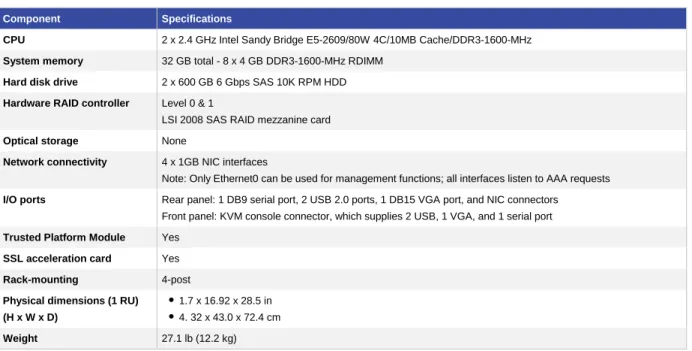
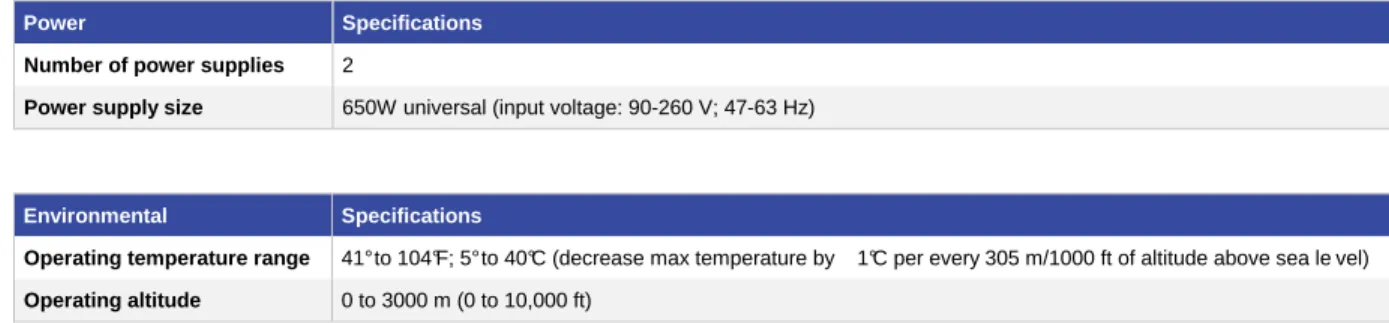
a virtual machine on VMware ESX/ESXi 5.0/5.1. Table 2 and Table 3 list the system specifications for the Cisco
SNS 3415 and 3495 appliances, respectively. For VMware ESX system requirements, please review Table 4.
Table 2.
Cisco SNS 3415 Appliance Specifications
Component Specifications
CPU 2.4 GHz Intel Sandy Bridge E5-2609/80W 4C/10MB Cache/DDR3-1600-MHz System memory 16 GB total - 4 x 4 GB DDR3-1600-MHz RDIMM
Hard disk drive 600 GB 6 Gbps SAS 10K RPM HDD Software RAID controller Not used by ACS application software Optical storage None
Network connectivity 4 x 1GB NIC interfaces
Note: Only Ethernet0 can be used for management functions; all interfaces listen to AAA requests. I/O ports Rear panel: 1 DB9 serial port, 2 USB 2.0 ports, 1 DB15 VGA port, and NIC connectors
Front panel: KVM console connector, which supplies 2 USB, 1 VGA, and 1 serial port Trusted Platform Module Yes
SSL acceleration card No Rack-mounting 4-post Physical dimensions (1 RU)
(H x W x D)
● 1.7 x 16.92 x 28.5 in
● 4.32 x 43.0 x 72.4 x cm Weight 27.1 lb (12.2 kg)
Power Specifications
Number of power supplies 1
Power supply size 650W universal (input voltage: 90-260 V; 47-63 Hz)
Environmental Specifications
Operating temperature range 41° to 104°F; 5° to 40°C (decrease max temperature by 1°C per every 305 m/1000 ft of altitude above sea leve l) Operating altitude 0 to 3000 m (0 to 10,000 ft)
Table 3.
Cisco SNS 3495 Appliance Specifications
*Component Specifications
CPU 2 x 2.4 GHz Intel Sandy Bridge E5-2609/80W 4C/10MB Cache/DDR3-1600-MHz System memory 32 GB total - 8 x 4 GB DDR3-1600-MHz RDIMM
Hard disk drive 2 x 600 GB 6 Gbps SAS 10K RPM HDD Hardware RAID controller Level 0 & 1
LSI 2008 SAS RAID mezzanine card Optical storage None
Network connectivity 4 x 1GB NIC interfaces
Note: Only Ethernet0 can be used for management functions; all interfaces listen to AAA requests I/O ports Rear panel: 1 DB9 serial port, 2 USB 2.0 ports, 1 DB15 VGA port, and NIC connectors
Front panel: KVM console connector, which supplies 2 USB, 1 VGA, and 1 serial port Trusted Platform Module Yes
SSL acceleration card Yes Rack-mounting 4-post Physical dimensions (1 RU)
(H x W x D)
● 1.7 x 16.92 x 28.5 in
● 4. 32 x 43.0 x 72.4 cm Weight 27.1 lb (12.2 kg)
Power Specifications Number of power supplies 2
Power supply size 650W universal (input voltage: 90-260 V; 47-63 Hz)
Environmental Specifications
Operating temperature range 41° to 104°F; 5° to 40°C (decrease max temperature by 1°C per every 305 m/1000 ft of altitude above sea le vel) Operating altitude 0 to 3000 m (0 to 10,000 ft)
*
SNS 3495 platform with ACS 5.5 software is scheduled to be available in December 2013.
Table 4.
Cisco Secure ACS 5.5 VMware Requirements
Component Specifications VMware version ESX/ESXi 5.0 and 5.1
CPU 2 CPUs (dual CPU, Xeon, Core2 Duo, or 2 single CPUs) System memory 4 GB RAM
Hard disk requirement User-configurable between 60 GB and 750 GB (minimum 150 GB is recommended) NIC Network NIC (1 Gbps) available for ACS application use