Scholarship at UWindsor
Scholarship at UWindsor
Electronic Theses and Dissertations Theses, Dissertations, and Major Papers 2008
The hydrolysis behaviour of magnides, aluminides and sodides
The hydrolysis behaviour of magnides, aluminides and sodides
and its application to production of nanoparticles
and its application to production of nanoparticles
Huabin Wang University of Windsor
Follow this and additional works at: https://scholar.uwindsor.ca/etd
Recommended Citation Recommended Citation
Wang, Huabin, "The hydrolysis behaviour of magnides, aluminides and sodides and its application to production of nanoparticles" (2008). Electronic Theses and Dissertations. 8190.
https://scholar.uwindsor.ca/etd/8190
This reproduction is the best copy available.
®
ALUMINIDES AND SODIDES AND ITS
APPLICATION TO PRODUCTION OF
NANOPARTICLES
by
Huabin Wang
A Dissertation
Submitted to the Faculty of Graduate Studies
through Engineering Materials
in Partial Fulfillment of the Requirements for
the Degree of Doctor of Philosophy at the
University of Windsor
Windsor, Ontario, Canada
2008
Published Heritage Branch
395 Wellington Street Ottawa ON K1A0N4 Canada
Direction du
Patrimoine de I'edition
395, rue Wellington Ottawa ON K1A0N4 Canada
Your file Votre reference ISBN: 978-0-494-47103-6 Our file Notre reference ISBN: 978-0-494-47103-6
NOTICE:
The author has granted a non-exclusive license allowing Library and Archives Canada to reproduce, publish, archive, preserve, conserve, communicate to the public by
telecommunication or on the Internet, loan, distribute and sell theses
worldwide, for commercial or non-commercial purposes, in microform, paper, electronic and/or any other formats.
AVIS:
L'auteur a accorde une licence non exclusive permettant a la Bibliotheque et Archives Canada de reproduire, publier, archiver,
sauvegarder, conserver, transmettre au public par telecommunication ou par Plntemet, prefer, distribuer et vendre des theses partout dans le monde, a des fins commerciales ou autres, sur support microforme, papier, electronique et/ou autres formats.
The author retains copyright ownership and moral rights in this thesis. Neither the thesis nor substantial extracts from it may be printed or otherwise reproduced without the author's permission.
L'auteur conserve la propriete du droit d'auteur et des droits moraux qui protege cette these. Ni la these ni des extraits substantiels de celle-ci ne doivent etre imprimes ou autrement reproduits sans son autorisation.
In compliance with the Canadian Privacy Act some supporting forms may have been removed from this thesis.
Conformement a la loi canadienne sur la protection de la vie privee, quelques formulaires secondaires ont ete enleves de cette these.
While these forms may be included in the document page count,
their removal does not represent any loss of content from the thesis.
Bien que ces formulaires
I hereby certify that I am the sole author of this dissertation and that no part of this dissertation has been published or submitted for publication.
I certify that, to the best of my knowledge, my dissertation does not infringe upon anyone's copyright nor violate any proprietary rights and that any ideas, techniques, quotations, or any other material from the work of other people included in my dissertation, published or otherwise, are fully acknowledged in accordance with the standard referencing practices. Furthermore, to the extent that I have included copyrighted material that surpasses the bounds of fair dealing within the meaning of the Canada Copyright Act, I certify that I have obtained a written permission from the copyright owner(s) to include such material(s) in my dissertation and have included copies of such copyright clearances to my appendix.
I declare that this is a true copy of my dissertation, including any final revisions, as approved by my dissertation committee and the Graduate Studies office, and that this dissertation has not been submitted for a higher degree to any other University of Institution.
The hydrolysis phenomenon of transition metal (including Si and Ge) magnides,
aluminides and sodides has been investigated in this study, and has been successfully
developed to produce both transition metal and semiconductor element nanoparticles.
Both in-situ synthesized Mg2Ni and as-cast Mg2Ni exhibited a close to zero
discharge capacity due to hydrolysis of Mg2Ni and Mg2NiH4. The hydrolysis
characteristics of Mg2Ni and Mg2NiH4 suggest that they are not suitable for use as
electrodes in rechargeable batteries.
The hydrolysis byproduct of transition metal and semiconductor element magnides,
Mg(OH)2, can be easily removed by a dilute acid. After removal of Mg(OH)2 from
the hydrolysis product of Mg2Ni, Ni nanoparticles were obtained. Besides Ni
nanoparticles, Cu, Au and Ag nanoparticles have been successfully prepared by this
method. The hydrolysis byproduct of magnides, Mg(OH)2, has a very small
solubility in water, and thus the newly-formed Mg(OH)2 precipitates from water in
the vicinity of the Mg dissolution sites. The existence of the Mg(OH)2 particles, and
the low mobility of transition metal atoms at room temperature, give rise to the
formation of very fine transition metal nanoparticles. Therefore, the particle size of
these transition metal nanoparticles prepared by this method was not sensitive to the
concentration of the initial materials in aqueous solution.
Al(OH)3, Ni nanoparticles and hydrogen in distilled water at room temperature. Due
to chemical characteristics of Al(OH)3 including its low acidity, chemically active
transition metal nanoparticles, such as Fe, Co, and Ni, can not be produced by using
dilute hydrochloric acid to remove Al(OH)3. However, chemically inert transition
metal nanoparticles such as Au and Ag could be prepared by this method.
The transition metal-sodium intermetallic compounds, i.e. sodides, undergo severe
hydrolysis in water at room temperature. The reaction byproduct, NaOH, has a high
solubility and is easier to remove than Mg(OH)2, the hydrolysis byproduct of
magnides. This method, therefore, offers a simpler method of preparing transition
metal nanoparticles. The drawback of this method is the difficulty in controlling the
reaction rate.
To My Parents
And
My Wife
First and foremost, I would like to thank my advisor, Professor Derek O. Northwood for his excellent guidance, encouragement, and thoughtful support throughout my entire graduate career. I greatly appreciated the freedom he gave me to pursue my own ideas. I will benefit for my whole life from his encouraging words (Jan Zwicky's poem) "Those who think metaphorically are enabled to think truly because the shape of their thinking echoes the shape of the world.". I am also very grateful for many rewarding academic, research, professional, and career-related experiences that he has given to me. These experiences have truly enriched my graduate school experience and helped prepare me for my future career.
I would like to thank my parents, my wife and my little sweet-heart. I would not have started on this path, let alone thought of finishing it without your care, understanding and support.
I would like to especially thank Dr. Henry Hu, Dr. Xueyuan Nie and Dr. Holger Eichhorn for use of their various instruments and their critical insights.
I would especially like to thank my friends, Lihong Han, Xin Hu, Zheng Zhong, Yan Wang and Dr. Andrea Demenev for their assistance with experimentation and subsequent discussions.
Last, but not least, to all those who gave me help and were not mentioned by name above, believe me, I am grateful for all your support and I thank you.
-AUTHOR'S DECLARATION OF ORIGINALITY iii
ABSTRACT iv
DEDICATION vi
ACKNOWLEDGEMENTS vii
LIST OF TABLES xiii
LIST OF FIGURES xiv
SYMBOLS xx
I. INTRODUCTION
1.1 Characteristics of nanoparticles 1
1.2 Properties of nanoparticles 1
1.3 Synthesis of transition metal and semiconductor nanoparticles 2
1.4 Focus of this study 3
1.4.1 Discovery of hydrolysis behavior of Mg2Ni 3
1.4.2 Preparation of magnides, aluminides and sodides 4
1.4.3 Investigation of hydrolysis of magnides 5
1.4.4 Oxidation behaviour and mechanism of nanoparticles in an aqueous
solution 5
1.4.5 Effect of hydrolysis temperature on Si and Ge nanoparticles 6
1.4.6 Investigation of hydrolysis of aluminides and sodides 6
II. REVIEW OF LITERATURE
2.1 Introduction 8
2.2 General aspects of nanoparticles 8
2.2.1 Surface atoms and structure 9
2.2.2 Electronic properties 11
2.3 Size-dependent properties 13
2.3.3 Magnetism of Fe, Co andNi nanoparticles 17
2.3.4 Melting point 18
2.4 Applications of nanoparticles 19
2.4.1 Catalysts 19
2.4.1.1 Ni nanoparticles 20
2.4.1.2 Cu nanoparticles 21
2.4.1.3 Au nanoparticles 22
2.4.1.4 Photochemistry on metal nanoparticles 24
2.4.2 Magnetic Fluids 25
2.4.3 Memories 27
2.4.4 Displays 29
2.4.5 Sensors 32
2.4.6 Nano-inks 34
2.5 Preparation methods 38
2.5.1 Chemical methods 38
2.5.1.1 Chemical reduction 38
2.5.1.2 Micro-emulsion 42
2.5.1.3 Electrochemical methods 45
2.5.1.4 Rapid expansion of supercritical fluid solutions 45
2.5.1.5 Thermal decomposition 48
2.5.2 Physical methods 50
2.5.2.1 Thermal evaporation 50
2.5.2.2 Magnetron sputtering 51
2.5.2.3 Laser ablation 51
2.5.2.4 Sonication 53
2.6 Comparison of preparation methods 53
2.6 Summary 56
3.2 Material preparation 57
3.2.1 Ball-milling 57
3.2.2 In-situ reaction synthesis of Mg2Ni 58
3.2.3 In-situ reaction synthesis of Mg2NH4 58
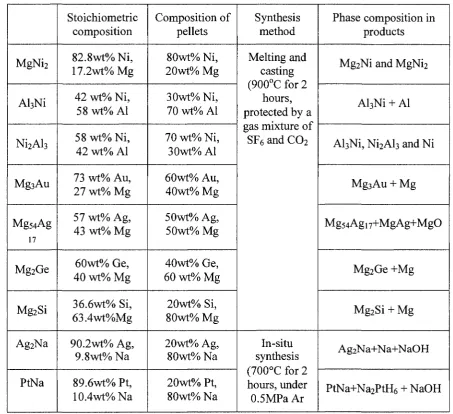
3.2.4 Preparation of MgNi2, Ni3Al, Ni2Al3, Mg3Au, Mg54Agi7, Mg2Ge, Mg2Si,
Ag2Na and PtNa 59
3.2.5 Synthesis of nanoparticles by a hydrolysis method 61
3.3 Materials characterization 61
3.3.1 Morphology and structure 61
3.3.2 Charge/discharge capacity of Mg2Ni 63
3.3.3 Hydrogen absorption/desorption capacity of Mg2Ni 64
3.3.4 The specific surface area 66
3.3.5 The particle size 66
IV. THE HYDROGEN STORAGE PROPERTIES OF Mg2Ni AND DISCOVERY
OF ITS HYDROLYSIS BEHAVIOR
4.1. Introduction 68
4.2 In-situ synthesized Mg2Ni 69
4.2.1 Preparation procedures 71
4.2.2 Characteristics of the In-situ synthesized product 71
4.2.3 Hydrogen storage property 74
4.2.4 Electrochemical properties 80
4.3 Electrochemical properties of as-cast Mg2Ni 82
4.4 In-situ synthesized MgNiH4 83
4.4.1 Preparation of Mg2NiH4 84
4.4.2 Electrochemical properties 85
4.5 Hydrolysis behavior of the as-cast Mg2Ni 86
4.6 Hydrolysis behavior of the in-situ synthesized Mg2NiH4 95
V. HYDROLYSIS BEHAVIOUR OF Ni MAGNIDES AND ITS APPLICATION TO THE SYNTHESIS OF Ni NANOPARTICLES
5.1 Introduction 100
5.2 Synthesis of Ni nanoparticles by hydrolysis of Mg2Ni 101
5.3 Hydrolysis of MgNi2 109
5.4 Synthesis of Ni nanoparticles by hydrolysis of MgNi2 114
5.5 Summary 119
VI: APPLICATIONS OF THE HYDROLYSIS BEHAVIOUR OF MAGNIDES IN SYNTHESIS OF NANOPARTICLES
6.1 Introduction 122
6.2 Synthesis of Cu nanoparticles by hydrolysis of Mg2Cu 122
6.3 Synthesis of Au nanoparticles by hydrolysis of Mg3Au 131
6.4 Synthesis of Ag nanoparticles by hydrolysis of Mg-Ag intermetallics 137
6.5 Study on hydrolysis behavior of Mg2Ge 144
6.6 Study on hydrolysis behavior of Mg2Si 154
6.7 Summary 159
VII: STUDY ON THE HYDROLYSIS BEHAVIOUR OF ALUMINIDES AND SODIDES
7.1 Introduction 160
7.2 Hydrolysis of Ni aluminides 160
7.2.1 Hydrolysis of Al3Ni 161
7.2.2 Hydrolysis of Al3Ni2 162
7.3 Hydrolysis of sodides 165
7.3.1 Hydrolysis of Ag2Na 165
7.3.2 Hydrolysis of PtNa 171
7.4Summary 176
REFERENCES 190
PUBLICATIONS DERIVED FROM THIS DISSERTATION 214
VITA AUCTORIS 218
Chapter II
2.1 Potential applications of Ni, Cu, Ag, Au, Pt, Si and Genanoparticles 37
2.2 Comparison of the critical constants for commonly used fluids 47
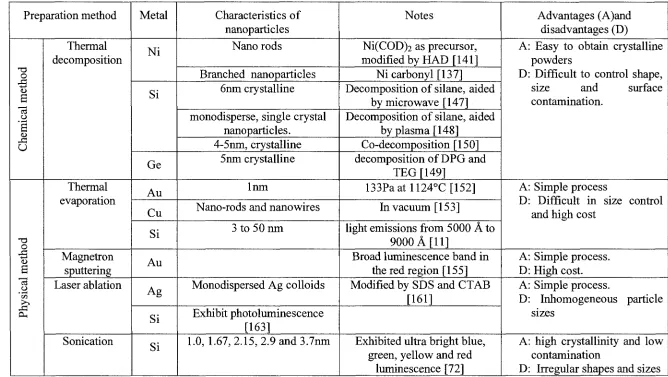
2.3 Preparation methods, characteristics and application of Ni, Cu, Au, Ag, Pt,
Si and Ge nanoparticles 54
Chapter III
3.1 Chemical composition of the arc-melted Mg2Ni and Mg2Cu pellets 57
3.2 Synthesis of MgNi2, Al 3Ni, Ni2Al3, Mg3Au, Mg54Agi7, Mg2Ge, Mg2Si, Ag2Na and
PtNa 60
Chapter VIII
8.1 Comparison of nanoparticle synthesis by hydrolysis of magnides, aluminides and
sodides 183
Chapter II
2.1 Formation of a band structure from (a) a molecular state, (b) a nanoparticle
with broadened energy states, and (c) bulk materials 11
2.2 Formation of a zero-dimensional (OD) quantum dot by the formal reduction of dimensions, correlating with the continuing discretization
of the energy states 12
2.3 Blue shift of the band-gap energy AE as a function of particle radius R 15
2.4 Nanocrystalline Si to emit red light by stimulating it with an argon-ion
laser beam 16
2.5 Relation between the size of gold particles and their melting point 18
2.6 Statistics of the number of journal publications per year during the past
decade in the area of catalysis with nanoparticles 19 2.7 Schematic illustrations of a magnetic fluid seal 26 2.8 A schematic diagram of a nanocrystal memory device with nanocrystals formed in a
2D layer, (a) Si nanocrystals, and (b) Metal nanoparticles 29
2.9 Emission from blue, green, and red colloidal crystals segregated according to magic sizes and emission of colloids of under excitation using a
commercial low intensity UV source with an average wave
length of 365nm 30
2.10 A monochromatic 32-by-64-pixel prototype quantum dot LED 31
2.11 A schematic illustration of Si nanocrystal laser 32
2.12 Preparation of "nanocrystal molecules" consisting of two or three DNA
modified Au particles attached to a complementary DNA template 34 2.13 The fine patterns with a line width of 3um printed on a substrate using
nano-inks 35
2.17 Phase diagram and critical constants for carbon dioxide and water 47
2.18 Schematic illustration of the laser ablation process 52
Chapter III
3.1 Scanning electron microscope (JEOL Model JSM-5800LV) 61
3.2 JEOL 2010 Transmission Electron Microscope with an Energy Dispersive X-ray
Spectrometer (EDX) 61
3.3 The electrochemical measurement system (Soltron 1285) used in this study 64
Chapter IV
4.1 Mg-Ni binary phase diagram[ 180] 70
4.2 SEM images of the initial mixture, the ball-milled mixture and the
in-situ reaction product 72
4.3 XRD pattern of the initial mixture with a 2:1 atomic ratio of Mg:Ni 73
4.4 XRD pattern of the in-situ synthesized Mg2Ni 73
4.5 Hydrogen absorption/desorption curves of the in-situ synthesized
Mg2Ni at 280°C 76
4.6 Hydrogen absorption/desorption curves of the in-situ synthesized
Mg2Ni at 300°C 77
4.7 Possible hydrogen atom sites in the antifluorite metal lattice structure of Mg2NiH478
4.8 The initial charge/discharge curves of the in-situ synthesized Mg2Ni at
galvanostatic conditions 81
4.9 The initial charge/discharge curves of the as-cast Mg2Ni at
galvanostatic conditions 83
4.10 XRD powder diffraction patterns for a) the as-cast Mg2Ni alloy, b) the in-situ
in 6M KOH solution. 88
4.12 TEM images of the hydrolysis product of Mg2Ni 92
4.13 HRTEM image of the hydrolysis product of Mg2Ni (membranes) 93
4.14 EDS spectrum of the hydrolysis product of Mg2Ni (membranes) 94
4.15 XRD powder diffraction patterns for a) the hydrolysis product of the synthetic Mg2NiH4 particles in distilled water, b) the hydrolysis product of the synthetic
Mg2NiH4 particles in 6M KOH solution 96
Chapter V
5.1 XRD powder diffraction patterns for the Ni nanoparticles prepared by hydrolysis of
Mg2Ni 101
5.2 TEM images of the Ni nanoparticles produced by hydrolysis of Mg2Ni 102
5.3 HRTEM image of individual Ni nanopartilces produced by hydrolysis of Mg2Ni 104 5.4 HRTEM image of individual Ni nanopartilce produced by hydrolysis of Mg2N
(corresponding Inverse FFT image at the upper-right corner) 105
5.5 EDS spectrum of Ni nanoparticles produced by hydrolysis of Mg2Ni 106
5.6 Particle size of the Ni nanoparticles produced by hydrolysis of Mg2Ni 106
5.7 Nitrogen adsorption (•) and desorption (V) curves of Ni nanoparticles 107
5.8 Powder XRD patterns for a) as-cast MgNi2 alloy, b) its hydrolysis product in distilled water for 120h, c) the final product (Ni
nanoparticles) 109
5.9 TEM image of the hydrolysis product of MgNi2 112
5.10 High resolution TEM images of a) Mg(OH)2, and b) Ni nanoparticles in the
hydrolyzed product of MgNi2 113
5.11 EDS spectrum of the hydrolysis product of MgNi2 (membranes) 114
5.12 TEM images of the Ni nanoparticles prepared by the hydrolysis of MgNi2, a)
a cluster of Ni nanoparticles, b) discrete Ni
5.14 EDS spectrum of the cluster of Ni nanoparticles prepared by the
hydrolysis of MgNi2 118
5.15 Particle size distribution of the Ni nanoparticles prepared by
hydrolysis of MgNi2 119
Chapter VI
6.1 XRD powder diffraction patterns for a) ball-milled Mg2Cu particles, b) hydrolysis product of the ball-milled Mg2Cu particles, c) the final product (Cu nanoparticles)
125
6.2 TEM images of Cu nanoparticles produced by hydrolysis of Mg2Cu 127
6.3 High-resolution TEM image of an individual CU2O nanoparticle produced by
hydrolysis of Mg2Cu 128
6.4 Particle size of the Cu nanoparticles produced by hydrolysis of Mg2Cu 130
6.5 Nitrogen adsorption and desorption curves for the Cu nanoparticles produced by
hydrolysis of Mg2Cu 130
6.6 XRD Powder diffraction pattern of as-cast Mg3Au pellets 133
6.7 XRD diffraction powder pattern of the Au nanoparticles produced by hydrolysis of
Mg3Au 133
6.8 TEM images for the Au nanopartilces produced by hydrolysis of Mg3Au 134
6.9 High-resolution TEM image of individual Au nanoparticles produced by hydrolysis
ofMg3Au 135
6.10 Particle size of Au nanoparticles produced by hydrolysis of Mg3Au 136
6.11 EDS spectrum for Au nanoparticles produced by hydrolysis of Mg3Au 136
6.12 XRD powder diffraction pattern of as-cast Ag-Mg pellets 138
6.13 XRD powder diffraction pattern of Ag nanoparticles produced by hydrolysis of
Mg-Ag intermetallics 139
6.16 Particle size distribution of Ag nanoparticles produced by hydrolysis of Mg-Ag
intermetallics 143
6.17 EDS pattern of Ag nanoparticles produced by hydrolysis of MgAg intermetallics 143
6.18 XRD powder diffraction pattern of the ball-milled Mg2Ge powders 144
6.19 XRD powder diffraction pattern of hydrolysis product of the ball-milled Mg2Ge
powders 145
6.20 XRD powder diffraction pattern of the Ge nanocrystals derived from
hydrolysis and acid rinsing of Mg2Ge at room temperature 147
6.21 TEM image for the newly formed Ge produced from hydrolysis of Mg2Ge at room
temperature 151
6.22 EDS spectrum for for the newly formed Ge produced from hydrolysis of Mg2Ge at
room temperature 152
6.23 XRD powder diffraction pattern f the product after hydrolyszing and acid rinsing at
80°Cfor24h 154
6.24 XRD patterns for: a) the ball-milled Mg2Si particles, b) the hydrolysis product of the ball-milled Mg2Ni particles at room temperature, c) the final product hydrolyzed at room temperature, d) the final product
hydrolyzed at 60°C, e) the final product hydrolyzed at 80°C 155
6.25 TEM images of the product of after hydrolyzing and acid rinsing at room
temperature 158
6.26 The EDS spectrum for the membrane in Fig 6.25 158
Chapter VII
7.1 XRD powder diffraction patterns for a) as-cast AI3M alloy, b) its
hydrolysis product in distilled water for 120h 161
7.2 XRD powder diffraction patterns for a) as-cast AI3M2 alloy, b) its
hydrolysis product in distilled water for 720h 163
7.3 XRD powder diffraction pattern of the Ag2Na pellets prepared at
600°C for 2 hours 166
7.6 Particle size distribution of the Ag nanoparticles prepared by
hydrolysis of Ag2Na 170
7.7 EDS pattern of the Ag nanoparticles prepared by hydrolysis of Ag2Na 170
7.8 XRD powder diffraction pattern of the PtNa pellets prepared at 600°C
for 2 hours 172 7.9 XRD powder diffraction pattern of the Pt nanoparticles prepared by
hydrolysis of PtNa 173
7.10 Morphology of the Pt nanoparticles prepared by hydrolysis of PtNa, a) TEM image,
b)HRTEM image 176
7.11 Particle size distribution of the Pt nanoparticles prepared by hydrolysis
of PtNa 176
7.12 EDS pattern of the Pt nanoparticles prepared by hydrolysis of PtNa 176
Chapter VII
8.1 A comparison of particle size distribution of Au, Ag, Cu and Ni nanoparticles prepared by hydrolysis of Mg2Ni, MgNi2, Mg2Cu, Mg45Agi7 and Mg3Au,
NOMENCLATURE
Ag Al Au C CI Co Cu DC EDS FCC Fe Ge H HCP K LCD LEDs LTWGS MOS MOSFET Na NC Ni 0 Silver Aluminum Gold Carbon Chlorine Cobalt Copper Direct currentEnergy dispersive spectroscopy
Face centered cubic
Iron
Germanium
Hydrogen
Hexagonally close-packed
Potassium
Liquid crystal display
Light-emitting diodes
Low-temperature water-gas shift reaction
Metal oxide semiconductor
Metal oxide semiconductor field effect transistor
Sodium
Nano crystals
Nickel
Pt PTFE SEM SFC02 Si TEM TCE Ti UV WGS XRD Platinum Polytetrafluoroethylene
Scanning electron microscope
Supercritical carbon dioxide
Silicon
Transmission electron microscope
Trichloroethylene Titanium Ultraviolet Water-gas shift X-ray diffraction Symbols A D E AE e-h eV g AG AH / R s AS T Ampere Dimension Electric potential Band-gap energy Electrohole Electron volt Gas
Gibbs free energy
a Solid solution phase
CHAPTER ONE: INTRODUCTION
1.1 Characteristics of nanoparticles
The transition from microparticles to nanoparticles can lead to a number of changes in
physical properties due to an increase in the ratio of surface area to volume and the size of
particles moving into the realm where the quantum effects predominate [1].
As a particle becomes extremely small, the physical and chemical properties of the
particles may be dominated by the properties of the surface atoms. In addition, valence
electrons in a crystalline solid occupy continuous energy bands. However, the valence
electrons in very small particles (below 10-20nm) occupy discrete, but broadened
electronic densities. The occupation, width and separation of these bands determine most
of the fundamental electrical, optical and magnetic properties of the solid. Thus, transition
metal nanoparticles exhibit many unique properties that are different from those of bulk
metals when their particle sizes are as small as nanometer size (10"9m) [2].
1.2 Properties of nanoparticles
As the particle size is reduced, more atoms are on the surface, which makes small
nanoparticles, especially metallic ones, highly reactive catalysts. In general, the high
surface area of nanoparticles is a critical factor in the performance of catalysts for gaseous
Transition metal nanoparticles, in particular, Au, Ag, and Pt, exhibit optical activity in the
visible range of the spectrum. Si and Ge nanocrystals under the quantum confinement
effect, exhibit photoluminescence.
The magnetic domains of the magnetic material nanoparticles may change from multiple
to single due to the quantum effects. For example, it was reported that Ni nanoparticles
exhibited a superparamagnetic behaviour above the blocking temperature [2].
1.3 Synthesis methods for transition metal or semiconductor nanoparticles
Various methods have been developed to synthesize transition metal or semiconductor
nanoparticles. These methods essentially fall into two categories: chemical and physical
methods. Among the chemical synthesis method, transition metal or semiconductor
nanoparticles have been conventionally prepared by micro-emulsion, chemical reduction
of metal-salts, thermal decomposition, electrochemical methods, and the rapid expansion
of supercritical fluid solutions. Of these methods, chemical synthesis in solution is
favoured for fabricating nanoparticles because it allows the tailored design of materials at
the molecular level, and also because it offers a cost-effective method of producing
nanoparticles in large quantities. In addition, colloidal chemistry offers a possible route
for the synthesis of a uniform dispersion of fine metallic particles by stabilizing the
particles in the presence of a surfactant.
Although these synthesis methods of nanoparticles are, in certain ways, reaching maturity,
1.4 Focus of this study
1.4.1 Discovery of hydrolysis behaviour of Mg2Ni
Rechargeable nickel metal hydride (NiMH) batteries have many advantages for use as
power sources in electric and hybrid vehicles such as higher power densities and
environmental friendliness. When compared with conventional AB5 alloys, Mg2Ni
exhibits a good hydrogen storage capacity (3.6wt%) and lower specific gravity. The
theoretical discharge capacity of Mg2Ni is as high as 999mAh/g [3]. However,
polycrystalline Mg2Ni shows a very low electrochemical discharge capacity (less than
lOmAh/g). It has been reported that the electrochemical discharge capacity can be
improved through the use of nano-crystalline Mg2Ni. A very high discharge capacity of
1082mAh/g (exceeding the theoretically calculated value) has even been reported [4].
Therefore, Mg2Ni is thus expected to be amongst the next generation of electrode
materials.
In general, the hydrogen storage capacity of the alloys prepared by the melting and
casting method is higher than that of the materials synthesized by the mechanical alloying
method. However, mechanical alloying can significantly improve both the activation and
the reaction kinetics of hydrogen storage alloys. Contamination is a major drawback of
mechanical alloying. No contamination is introduced by in-situ reaction synthesis (or
combustion synthesis). Its products are porous, and have a high purity and large surface
areas of "fresh" surface, which results in easy activation of the combustion synthesis
product.
During an investigation into the charge/discharge capacity of the in-situ reaction
hydrolysis reactions of both in-situ reaction synthesized Mg2Ni and Mg2NiH4 were
examined in detail from the viewpoint of thermodynamics. The analysis results indicated
that the hydrolysis reactions of both Mg2Ni and Mg2NiH4 were spontaneous in both
distilled water and a 6M KOH solution, and formed Mg(OH)2, Ni and hydrogen. The
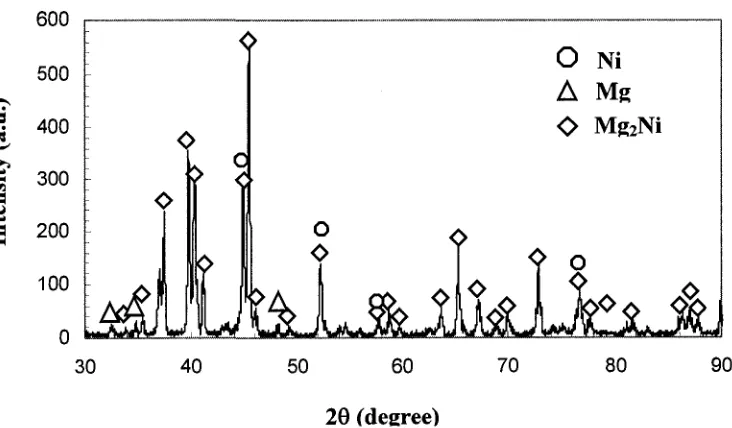
XRD results showed that the width of the Ni diffraction peaks was fairly broad, which
reflected the fact that the crystallite size of Ni was extremely small. In addition, the
hydrolysis byproduct, Mg(OH)2, can be easily removed by dilute acids. Hence, the
hydrolysis of Mg2Ni had the potential to be developed to produce Ni nanoparticles [5].
The initial materials used in this method could easily be produced by a conventional
melting and casting method or a reaction-synthesis method. The hydrolysis processing of
the metal and the magnesium intermetallic compounds and the removal of Mg(OH)2
could potentially be carried out on a large scale. Therefore, compared with conventional
preparation methods for Ni nanoparticles, the method has a great potential to
economically produce Ni nanoparticles on a large scale [5].
1.4.2 Preparation of magnides, aluminides and sodides
Of all the magnides, aluminides and sodides used in this research only Mg2Ni and Mg2Cu
are commercially available. Production of other magnides, aluminides and sodides was
done in our laboratory. Due to differences in chemical characteristics (reactivity) of
magnesium, aluminum and sodium, magnides and aluminides were fabricated under a
protective atmosphere (a mixture gas of sulphur hexafluoride and 0.5% carbon dioxide)
by a conventional melting and casting method, and the sodides were fabricated under a
1.4.3 Investigation of hydrolysis of magnides
Besides Mg2Ni, MgNi2 is also formed in the binary Mg-Ni system. The hydrolysis
reaction of MgNi2 was analyzed from a thermodynamics point of view. The analysis
results also indicated that the hydrolysis reaction of MgNi2 was spontaneous, which was
then confirmed by actual hydrolysis experiments.
Hydrolysis of Mg2Cu, Mg3Au, Mg2Cu, Mg54Agn, MgAg, Mg2Ge, and Mg2Si were then
investigated. The results showed that all these magnides exhibited hydrolysis behaviour.
This suggested that hydrolysis is a common phenomenon. The corresponding transition
metal and semiconductor element nanoparticles were produced by using this phenomenon.
The size of the nanoparticles prepared by the hydrolysis method was around lOnm.
1.4.4 Oxidation behaviour of nanoparticles in an aqueous solution
The oxidation behaviour of their nanoparticles in water was investigated in detail. Due to
the differences in chemical affinities of the transition metals to oxygen, transition metal
nanoparticles exhibited different oxidation behaviour in an aqueous solution. For the
relatively highly chemically active elements, such as Ni and Si, their nanoparticles were
oxidized into the corresponding hydroxides by the dissolved oxygen in the solution
during hydrolysis and removal of Mg(OH)2 by using dilute acid. For the relatively low
chemically active elements, such as Cu and Ge, their nanoparticles were first oxidized
into the corresponding hydroxides by the dissolved oxygen in the solution during
hydrolysis and removal of Mg(OH)2 by using dilute acid, and then these hydroxides
nanoparticles). For the chemically inert elements, such as Au and Ag, their nanoparticles
were not oxidized by the dissolved oxygen in the solution during hydrolysis, or during
removal of Mg(OH)2 using a dilute acid.
1.4.5 Effect of hydrolysis temperatures on formation of Si and Ge nanoparticles
A general trend for the formation of crystalline Si and Ge is that the more covalent the
element, the higher is its crystallization temperature. At low temperatures, amorphous
phases become more common as the material becomes more covalent. Hence, the effects
of the hydrolysis temperature on the formation of Si and Ge nanoparticles were
investigated in detail.
1.4.6 Investigation of the hydrolysis of aluminides and sodides
There are many intermetallic compounds that have similar chemical characteristics to
magnides, for example, aluminides and sodides. Therefore, an investigation of the
hydrolysis of aluminides and sodides would help us better understand the hydrolysis
behaviour of intermetallic compounds.
Among the Ni aluminides, AljNi spontaneously underwent hydrolysis in water at room
temperature, and formed Al(OH)3, Ni and hydrogen. Although from thermodynamic
considerations, the negative standard free energy change for the hydrolysis reaction of
Al3Ni is much larger than that for Mg2Ni, and from a crystal structure point of view, more
Al atoms surround a Ni atom in M3AI than Mg atoms surround a Ni atom in Mg2Ni, the
hydrolysis of AI3M seemed to be much easier than that of Mg2Ni. In addition, AI3M2
and AIM3 in the Ni-Al binary system would be much slower than for AI3M2 due to
thermodynamic and kinetics factors including crystal structure. Due to the low acidity of
Al(OH)3, using dilute hydrochloric acid to remove Al(OH)3 would lead to a fairly low
PH value of solution. As a result, the chemically active transition metals such as Fe, Co,
Ni, or even Cu nanoparticles will be difficult to produce by this method, in particular,
when they are exposed to air.
The hydrolysis reactions of sodides were very fast, and were accompanied by small
explosions or combustion due to the high chemical activity of sodium. A colloid
containing the transition metal nanoparticles was formed almost instantaneously. The
reaction byproduct, NaOH, had a high solubility and was easier to remove than Mg(OH)2,
the hydrolysis byproduct of magnides. This method offers a simpler method for preparing
transition metal nanoparticles. The drawback of this method is the difficulty in controlling
CHAPTER TWO: LITERATURE REVIEW:
CHARACTERISTICS, PROPERTIES, APPLICATIONS
AND PREPARATION OF TRANSITION METAL, Si AND
Ge NANOPARTICLES
2.1 Introduction
This chapter describes general characteristics of nanoparticles, their physical properties,
application and methods of preparation. Particular emphasis is given to transition metal
and semiconductor nanoparticles (Si and Ge) in this dissertation due to their potential
application as catalysts, memories and displays.
2.2 General aspects of nanoparticles
It is generally known that nanoparticles exhibit properties that are different from those of
bulk metals when their particle sizes are as small as the nanometer size (l(Fm). The
transition from microparticles to nanoparticles can lead to a number of changes in
physical properties. Two of the major factors contributing to this change in physical
properties are the increase in the ratio of surface area to volume, and the size of particles
preparation of transition metal, Si and Ge nanoparticles
2.2.1 Surface atoms and structure
The first, very important property of nanoparticles is the large surface-to-volume ratio
which makes them distinct from larger particles. If a 1cm cube of metal is broken into
small cubes of lOnm edge length, the overall surface will increase 106 times, although the
amount of matter remains the same. In general, nanoparticles have a specific surface area
of 102-103m2/g. From a purely geometrical consideration, in crystalline particles smaller
than 1 Onm size, the amount of atoms at the surface becomes relevant as it is comparable
to that of atoms in the interior of the particle. The ratio of surface atoms to volume atoms
is inversely proportional to the size of the particle [1].
The surface is generally considered to take up a thickness of 3 atomic spacings. For a
lOnm metallic particle, 10% of the atoms are surface atoms; and for a lnm particle, more
than half of them are surface atoms. Thus, the volume of this surface layer becomes
significant in nanoparticles [1]. It is known that the composition, or the crystal structure,
is modified at the free surface of a material. The composition or the crystal structure at
the surface layer of nanoparticles could be different from those of the particle core. The
clean surface of crystalline materials relaxes and reconstructs in order to minimize the
total Gibbs energy, given the new chemical environment of the semi-infinite crystal.
In metallic nanoparticles, for example, the surface tends to smooth out the electronic
charge distribution and the atoms on the surface layer respond by reconstruction. Most
clean surfaces of metallic nanoparticles either contract or expand and in some cases they
reconstruct. However, there construction is limited by the ability of the atom that
hybridizes and adapts their bond lengths and angles to the new configuration. These are
Selected examples of these surface effects are the surface contraction in palladium
nanoparticles and the crystal lattice distortion for other metal nanoparticles [2]. Nickel is
a notable example; while the bulk crystal has the face centered cubic (FCC) structure,
nanoparticles smaller than 4nm are hexagonal close-packed (HCP) [2].
While the atoms lying in the core volume of nanoparticles are surrounded by a specific
number of atoms (which is called the coordination number), on the surface layer their
coordination number is reduced. Thus, as a particle becomes extremely small, the
physical properties of the particles may be dominated by the properties of the surface
atoms.
The chemistry of the surface can also change owing to environmental conditions.
Molecules can be adsorbed from the environment. It must be taken into account that
nanoparticles are always exposed to some kind of atmosphere both during and after their
production, and during their different applications. The adsorbed molecules may react
with the surface atoms (chemisorption) to form a new phase [2].
The large surface area also results in some interactions between the different components
in nanocomposites, leading to special properties such as increased strength and/or
increased chemical/heat resistance. Pure metal nanoparticles can be induced to merge into
a solid without melting (a process called sintering) at lower temperatures than larger
particles, leading to improved and "easier-to-create" coatings, particularly in electronics
preparation of transition metal, Si and Ge nanoparticles
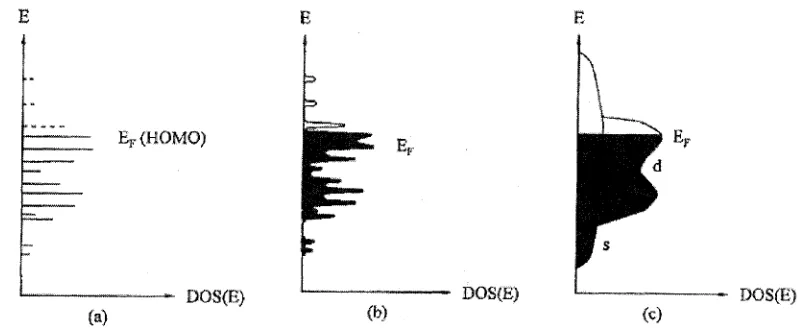
2.2.2 Electronic propertiesFor individual atoms and molecules, the electronic density of state is discrete, resulting in
intrinsically sharp spectral line widths (see Fig.2.1a) [2]. In a crystalline solid, valence
electrons occupy continuous energy bands and the occupation, width and separation of
these bands determines most of the fundamental electrical, optical and magnetic
properties of the solid (see Fig.2.1c).The electronic structure of a nanocluster or a
nanocrystal might fall somewhere between these two extremes. The increasing presence
of the surface tends to perturb the periodicity of the "infinite" lattice of a regular crystal.
The electronic configurations in tiny particles (below 10-20nm) are similar to those of the
particle-in-a-box, exhibiting discrete, but broadened electronic densities (see Fig.2.1b).
BfCHOMO)
(a)
DOS(E)
Er
<b)
DOS{E) - DOS(E)
Fig. 2.1 Formation of a band structure from (a) a molecular state, (b) a nanoparticle with
broadened energy states, and (c) bulk materials (HOMO: Highest Occupied Molecular
orbital; DOS: the electronic density of states) [2].
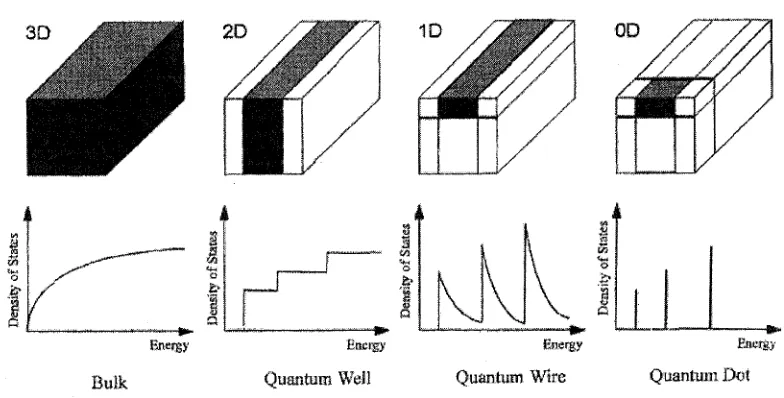
If a piece of metal is reduced by making it thinner and thinner until the electrons can only
will be obtained, which is called a quantum well. Further reduction in dimensionality will
generate a quantum wire (ID). Reducing dimensions will finally end in a quantum dot
(OD). The energy states in the bulk, a quantum well, a quantum wire and a quantum dot
are shown in Fig. 2.2 [4].
Bnetg>< £«rg>' iaiergy Energy
Bulk Quantum Well Quantum Wire Quantum Dot
Fig. 2.2 Formation of a zero-dimensional (OD) quantum dot by the formal reduction of
dimensions, correlating with the continuing discretization of the energy states [4].
In the case of metals, the electrical properties are determined by the electron mean free
path, which typically ranges from 5 to 50nm for most metals. If the crystal becomes
comparable in size to the electron mean free path, the electrons are then also scattered at
the surface, which increases the electronic resistance of the nanoparticles. One of the
most important consequences of the size confinement is therefore the extremely small
capacitance of isolated nanoclusters and nanocrystals. This can give rise to an appreciable
charging energy when a single electron is transferred to the cluster. The very small
preparation of transition metal, Si and Ge nanoparticles
effects. For these reasons metallic nanoparticles and nanowires are promising unit
elements in building nanoscopic circuits with tunnelling junctions involving jumps of
single electrons.
Electronic devices based on nanoparticles (e.g. metal and semiconductor nanoparticles)
will not function analogously to their macroscopic counterparts. Thus, a conventional
MOSFET (metal oxide semiconductor field effect transistor) will no longer be able to
control the flow of electrons as its size reaches the sub-50nm regime. At this dimensions,
electron transport in n- and p- doped contacts is affected by the quantum mechanical
probability that electrons will simply tunnel through the interface. These tunnelling
processes will begin to dominate in the nanometer size regime, causing errors in
electronic data storage and manipulation [2].
2.3 Size-dependent properties
2.3.1 Catalysis
With an increase in the ratio of surface area to volume, the behaviour of atoms on the
surface of a particle will gradually dominate those in the interior of the particle. This
affects both the properties of the particle in isolation, and its interaction with other
materials [1].
The high surface area of nanoparticles is a critical factor in the performance of catalysts
for gaseous reactions in the chemical industry and structures such as electrodes, since the
efficiency of a particular reaction is proportional to the area of the available surface. In a
catalytic activity, a material is able to speed up a particular chemical reaction without
changing itself and its properties. As the particle size is reduced, more atoms are on the
catalysts, as the surface atoms are the active centers for catalytic elementary processes
that can be used for chemical synthesis, reducing pollutants from domestic environment
and car exhaust systems [1].
For particles smaller than the electron mean free path, the electronic band structure may
significantly change with particle size and materials such as gold, which are usually
chemically quite inert, become catalytically active [5]. It has been found that gold
nanoparticles, supported on a silicate substrate, catalyze the production of propylene
oxide with a high selectivity of more than 90%. Since the only byproduct of this reaction
is water, application of gold nanoparticle catalysts is expected to be a clean process for
partial oxidation. The selective oxidation processes that are used to make compounds
contained in agrochemicals, pharmaceuticals and other chemical products can be
accomplished more cleanly and more efficiently with nanoparticle catalysts [5].
2.3.2 Optical properties of Au, Ag, Pt, Ge and Si nanoparticles
The modified electronic configuration of a confined crystal has a great effect on the
optical transitions between different energy levels. Furthermore, the scattering of light
from tiny particles is affected by the modified electron cloud which influences the
dielectric function of the material [6].
Transition metal nanoparticles e.g., Au, Ag, and Pt, are optically active in the visible
range of the spectrum. A colloidal solution of noble-metal nanoclusters has an intense
color. When the crystal size becomes smaller than the wavelength of the visible light,
these metal nanoparticles partially transmit the light. A strong optical absorption in the
preparation of transition metal, Si and Ge nanoparticles
of the nanocluster size gives rise to a significant increase in the surface plasmon
resonance band width, and results in a shift in the resonance position as known as a
red-shift. For example, the smaller Au nanoparticles exhibit abroad surface plasma absorption
between the green and yellow wave lengths, and allow only red light to be transmitted. As
a result, the smaller Au nanoparticles show a red color [4].
I&periiifeht ally-observed
Eklue s h i f t
Transition Region
"Exciton Confinraent
0,001
RCA)
]00i)
Fig.2.3 Blue shift of the band-gap energy AE as a function of particle radius R [6].
Where, the Ee+h is the independent confinements of the electrons and holes; EEX is the
Bulk Si and Ge are indirect bandgap semiconductors and poor emitters of light. However,
surface effects, as well as quantum confinement effects are considerably enhanced in Si
and Ge nanocrystals, which control the photoluminescence. A quantum mechanical
treatment shows that the eigen-state of particles confined to a small potential well become
discrete and move up from the bottom of the well, which result in the increase in apparent
bandgap energy of the semiconductor (blue shift of the bandgap) [6-11]. If the Radius of
the quantum well R is greater than the exciton Bohr radius a^. the exciton as
quasi-particles are confined to the well; if a& is larger than R, the exitons are no more stable in
the well [6].
The extent of the blue shift as function of particle radius for Si is illustrated in Fig.2.3 [6].
o
It is found that the transition from exciton confinement occurs at a radius of around 100 A.
Visible light emission from Si particles should only occur in particles with a radius less
20 A. The particle size in this range is already at the dividing criterion between untrafine
particles and clusters.
Fig.2.4 Nanocrystalline Si to emit red light by stimulating it with an argon-ion laser beam
preparation of transition metal, Si and Ge nanoparticles
The photoluminescence from Si nanocrystals (see Fig.2.4) was first discovered by
Canham [8]. Silicon nanocrystals emit light from near IR to visible to ultraviolet due to
the quantum confinement effect as the size of silicon decrease exciton Bohr radius (4.9
nm). This also allows for an increase in internal quantum efficiency from 10-20% to 60%.
2.3.3 Magnetism of Fe, Co and Ni nanoparticles
The magnetic properties of nanoparticles are different from those of bulk materials. The
magnetic properties of transition metals such as Fe and Co differ significantly from the
bulk and depend strongly on the particle size [12]. The experimental results on small
magnetic clusters in the gas phase have shown that the total magnetic moment depends on
the size of the clusters, in particular, it is a function of the number of atoms. Both orbital
and spin moments on the surface of tiny magnetic nanoparticles are strongly enhanced.
The spin moment then decreases to the bulk value as the size of the particle exceeds a few
nanometers. This is a consequence of the fact that a high number of atoms with lower
coordination number sit on the surface and therefore exhibit uncompensated distributions
of magnetic moments (spins). This effect is very strong only for tiny clusters of less than
1000 atoms, but in some case it is still present for larger particles.
As the particle diameter of such magnetic materials as iron and nickel approaches the
nano range, their magnetic domains are changed from multiple to single due to the
quantum effects, and their magnetic properties also change. It is highly desirable to use
particles that are magnetically separated from each other, and where the particle size is
such that each individual particle can be considered as an elementary magnet [12]. Ni
[13,14]. The coercivity of the Ni nanowires increases with decreasing wire diameter due
to the tendency toward single domain nature [15,16].
2.3.4 Melting point
Q
o
OS 12
1100- 1000-900' 800 700- 600- 500-400' 300-200f 100-1 00 3 4 6 7 8
I" >' »
10 11
Particle Radius [nm]
Fig.2.5 Relation between the size of gold particles and their melting point [17].
The majority of metals have a hexagonal or a cubic close-packed structure with a
coordination number of 12. The surface atoms only have a coordination number of 9 or
smaller. It is typical for bulk materials that the surface atoms form a negligible part of the
total number of atoms. A spherical particle of lOnm in diameter has around 10% of
surface atoms, so that the surface atoms cannot be neglected for the smaller particles.
These surface atoms with a coordination number of 9 or smaller are more easily
preparation of transition metal, Si and Ge nanoparticles
average coordination number of surface atoms leads to a weaker cohesive energy. As a
consequence, the melting temperature is reduced. According to the calculation by the
method of Rosenberger, there is a dramatic decrease of melting point for particles smaller
than 3-4nm (see Fig.2.5) [17].
2.4 Applications of nanoparticles
2.4.1 Catalysts
• # • • • • • i i
0 1
[ I I I I | * M • I • I t t | f * • ' > | I ' i • ' » | f 9 I I H I
00 200 300 400 500 600 700
Number of Pyblications
Fig.2.6 Statistics of the number of journal publications per year during the past decade in
Since nano-metals have a large surface-to-volume ratio compared to bulk materials, they
are attractive to use as catalysts in fuel cells and organic chemical synthesis. The field of
nanocatalysis (the use of nanoparticles to catalyze reactions) has undergone an explosive
growth during the past decade. The number of journal publications that have been
published in the area of catalysis with nanoparticles for each year in the past decade are
listed in Fig.2.6 [18], which shows that catalysis with nanoparticles is a growing field of
research.
2.4.1.1 Ni nanoparticles
Nano-nickel has very high catalytic activity, and is physically and chemically robust.
There is a large potential market for nano-nickel in the chemical processing industry.
Nickel catalysts, in general, are active for the hydrogenolysis of carbonyl and
carbon-carbon bonds [19].
Ni nanoparticles have been used as Raney catalysts for unsaturated vegetable oils to
margarine and other food products for more than 80 years [1]. The main constituents of
these vegetable oils are glycerol ester of various un-saturated fatty acids, especially Ci6
and Ci8 acids. The main process requirement is the hydrogenation of some olefinic bonds,
not all, together with some isomerization and olefinic bond migration along the carbon
chain. Batch processes at 150-200°C with 10-70 bar hydrogen are widely used. The
necessary selectivity is achieved by high surface area (50-100m2g_1) nickel catalysts
(unsupported or on a silica support) and appropriate process control.
Methane as the major component of natural gas is being widely used as an energy source
preparation of transition metal, Si and Ge nanoparticles
CH4 dissociation [20]. The dissociation of CH4 can be further used to prepare highly pure
hydrogen, carbon nanotubes and carbon fibers with special properties [20].
Several companies are experimenting with the material in fuel-cell catalytic membranes,
using particle sizes of 10-15nm diameter. Because nickel atoms are about a third of a
nanometre across, these near-spherical particles are about 30atoms across and contain
about 3500 atoms — a remarkably low number. This provides very high catalytic activity,
and is sufficient for most applications. Nano-nickel could replace a significant portion of
the platinum catalyst market, and sales were expected to be $500m-$lbn in five years
[21-24].
Ni nanoparticles with a high surface area can also be used as catalysts for ketone and
aldehyde reduction [25], ethylene cracking [26], steam reforming of methanol [27],
hydrothermal gasification of organic compounds [28], emission control in diesel vehicles
[29], and for the thermal decomposition of ammonium perchlorate (AP) in composite
propellants [30].
2.4.1.2 Cu nanoparticles
The water-gas shift (WGS) process at high temperatures (Reaction 2-1) is used for the
conversion of carbon monoxide to hydrogen in ammonia synthesis plants.
CO + H20 <=> C02 + H2 (2-1)
The process is usually followed by a second stage of low-temperature water-gas shift
reaction (LTWGS). The LTWGS process is typically operated at 200-230°C. The catalyst
for the second, low-temperature stage (LTWGS) is nanosize copper, usually supported by
Nano-copper catalysts are highly effective catalysts for methanol synthesis [31-33]. The
methanol synthesis reaction is written as follows
C02 + 3H2 « - CH3OH + H20 (2-2)
Nano-copper catalysts are also being used as a catalyst for the synthesis of dimethyl
carbonate((CH30)2CO) [34]. Dimethyl carbonate is an important chemical in the current
chemical industry because it can substitute for highly toxic compounds such as phosgene
and dimethyl sulfate in many reactions. The by-product when dimethyl carbonate is used
is methanol or carbon dioxide, which is easily separated from the product and leads to
less pollution.
4CH3OH + 2CO + 02 <=> 2(CH30)2CO + 2H20 (2-3)
Cu nanoparticles have been also widely used as catalysts for the synthesis of symmetrical
and unsymmetrical biaryls and polyaryls [35] and for the higher alcohol synthesis from
syngas [36].
2.4.1,3 Au nanoparticles
Gold, one of the most stable metals, is typically chemically inert including a resistance to
oxidation. However, Au nanoparticles, in particular supported on very active oxides such
as C03O4, Fe203, and Ti02, exhibit a significant catalysis for various reactions [37-39].
The gold clusters impregnated by Mn, Fe, Co, Ni, Cu, or Cu hydroxides have been found
to have a catalytic activity in CO oxidation at sub ambient temperatures (below 0°C and
even at -70°C) [40-42]. It has been suggested that a synergistic mechanism occurs at the
Au nanopartilces/metal oxide interface, with the oxide support being part of the catalytic
preparation of transition metal, Si and Ge nanoparticles
metal oxide site occupied by an adsorbed O2 molecule. The reaction would involve an
intermediate carbonate-like species decomposing to CO2 upon desorption from the
surface. Alkanethiolate-Au nanoparticles, precipitated onto a glassy carbon electrode by
cross-linking the Au nanoparticles with 9-nonanedithiol and leading to a 3D network thin
film, exhibited pronounced catalysis in the electro-oxidation of CO [43] and CH3OH
[44-46].
CO + 20H" - 2e" <^ H20 + C02 (C032" in alkaline medium) (2-4)
CH3OH + 60H" - 6e" o 5H20 + C02 (C032' in alkaline medium) (2-5)
Gold nanoparticles are one of the most effective catalysts yet identified for remediation of
one of the nation's most pervasive and troublesome groundwater pollutants,
trichloroethylene (TCE). TCE, which is commonly used as a solvent to degrease metals
and electronic parts, is one of the most common and poisonous organic pollutants in
groundwater. It is found at 60 percent of the contaminated waste sites on the US
Superfund National Priorities List, is considered one of the most hazardous chemicals at
these sites because of its prevalence and its toxicity [47]. Human exposure to TCE has
been linked to liver damage, impaired pregnancies and cancer. The catalyst containing Au
and Pd converts TCE directly into non-toxic ethane. By contrast, breaking down TCE
with more common catalysts, like iron, produces intermediate chemicals, such as vinyl
chloride, that is more toxic than TCE [47-48].
Au nanoparticles under high dispersion are highly active catalysts for NO reduction [49],
water-gas shift reaction [50], and C02 hydrogenation [51].
Besides Ni, Cu, Au nanoparticles, Ag nanoparticles can also be used as catalysts for
nanoparticles can be used as catalysts for formation of water at room temperature [54],
and in fuel cell [55,56].
2.4.1.4 Photochemistry on metal nanoparticles
It is well known that a well-defined Fermi edge develops in transition metal or
semiconductor nanoparticles containing several thousands of atoms, which separates
occupied and unoccupied electronic states (see Section 2.1.2). Thus, the electrons below
the Fermi level of a metal nanoparticle can be exited by absorption of photons and form
electron-hole (e-h) pairs. A transient thermal e-h distribution develops rapidly by
electron-electron scattering. A quasithermal distribution describable by a distinct electron
temperature is reached, which is much higher than the lattice temperature. Then, the
resultant thermal hot electron distribution cools down further by electron-phonon
interactions. The dynamics depends on the excitation density. The dynamics of the hot
electrons photo-generated in the metal nanoparticles, play a crucial role in determining
the dynamics of chemical reactions on their surfaces if these hot electrons trigger the
chemical processes in the adsorbents [57,58].
In addition, metal nanoparticles strongly exhibit the size- and shape-dependent collective
electronic excitation called Mie plasmon, which leads to strong field enhancement around
the particles. As a result, a large increase of absorption is generated in all photo-induced
effects [58].
To induce photochemistry, i.e., to convert electronic excitation energy into energy of
nuclear motion, an optical excitation has to bring the molecule concerned to a
preparation of transition metal, Si and Ge nanoparticles
adsorbate or a fragment of it; in a photochemical reaction this may be the starting step.
On metal and semiconductor surfaces electronically excited adsorbents are deexcited very
rapidly, which strongly modifies the desorption probability compared to dissociation of a
similar free molecule. The bond to be broken can be that between the adsorbate and the
substrate or an internal bond of the adsorbed molecule; neutral or charged molecular and
atomic fragments can then leave the surface, and fragments can also stay adsorbed [53].
Methane physisorbed on Pt (111), Pd (111), and Cu (111) surfaces is readily dissociated
into methyl and hydrogen by irradiation with a 193 nm (6.42eV) Ar laser. On Cu (111),
methane photo dissociation leads to ethylene formation. These observations are surprising
because light absorption in gaseous methane does not occur at wave lengths above 145nm
(8.55eV). The peculiarity of the methane/transition-metal systems consists of the fact that
methane on these surfaces is excited by a direct electronic transition localized within the
adsorbate-substrate complex [59, 60].
The excited state responsible for dissociation to CH3+H is formed from mixing of an
antibonding Rydberg state of methane, localized 1 OeV above the HOMO of gas phase
methane, and unoccupied states of the metal. The excitation energy depends strongly on
the cluster size because electron redistribution over the metal cluster plays an important
role in stabilizing this charge transfer state [61, 62].
2.4.2 Magnetic Fluids
Magnetic fluids, or ferrofluids, are stable suspensions of colloidal ferromagnetic particles
(e.g. magnetite) in suitable, non-magnetic carrier liquids. The materials used are Fe, Co,
Ni, and Fe304 with particle sizes of around lOnm. The colloidal particles are covered with
to their small size, the colloidal particles can be considered as ferromagnetic
mono-domain particles [63]. Since the colloidal particles contain several 1.000 atomic magnetic
moments, the magnetic fluids, are often referred to as superparamagnets. Ni nanoparticles
exhibited a superparamagnetic behaviour above the blocking temperature as mentioned in
Section 2.2.3.
Fig.2.7 Schematic diagram of a magnetic fluid seal [63].
Conventional ferrofluid applications use DC magnetic fields from permanent magnets for
use as a liquid O-ring in rotary (see Fig.2.7) and exclusion seals; almost every computer
disk drive uses a magnetic fluid rotary seal for contaminant exclusion and the
preparation of transition metal, Si and Ge nanoparticles
shaft seals. In addition, magnetic fluid can be used as dampers in stepper motors and
shock absorbers, and for heat transfer in loud speakers [63].
2.4.3 Memories
A flash cell in memories is a floating gate metal oxide semiconductor (MOS) transistor
where charge from the channel can be injected or extracted. This requires isolation of the
floating gate by thin dielectrics that allow the charge to travel in and out the floating gate
through suitable polarization of the MOS device electrodes. The dielectric that isolates
the floating gate from the channel is usually SiC^. It has a thickness of 7 - lOnm and it is
called a tunnel oxide since Fowler-Nordheim tunnelling occurs through it. However,
further scaling of the memory is limited by the device structure because of storage node
capacitive coupling and tunnelling oxide scaling limitation [64, 65].
A conventional MOSFET (metal oxide semiconductor field effect transistor) will no
longer be able to control the flow of the electrons as its size reaches the sub-50nm regime.
The quantum mechanical probability will gradually dominate in the nanometer size
regime and cause errors in electronic data storage and manipulation as mentioned in
Section 2.1.2.
As an alternative of the conductive floating gate node, the conventional polysilicon
floating gate is replaced by a dense array of silicon nanocrystals embedded in the gate
oxide as shown in Fig.2.8a, where, CO represents the control oxide (oxide between
nanocrystal layer and gate), and TO represents the tunnelling oxide (oxide between
nanocrystal layer and channel). Because of the discontinuous nature of the floating gate
these approaches allow for thinner tunnel oxide and consequently more aggressive scaling
surface and the extremely small capacitance of isolated nanoclusters or nanocrystals due
to the size confinement can give rise to an appreciable charging energy when a single
electron is transferred to the cluster [66].
In nanocrystal memories, a localized single leakage path due to a defect in the tunnelling
oxide can only discharge one nanocrystal or a small number of nanocrystals thus allowing
for the use of thinner insulators. Performance benefits expected from this change in the
floating gate structure include improved retention times and improved radiation hardness
due to decreased sensitivity to localized oxide leakage paths as well as improved
prospects for CMOS integration due to reduce device aspect ratios [67-70].
Ge has a higher electron affinity than Si. Thus, the minimum of the conduction band of
Ge nanocrystals is lower than the minimum of the conduction band of the Si channel of
the MOS memory device. This allows for the same programming voltages but for better
retention characteristics for Ge nanocrystals since the back tunnelling probability from
the NC to the channel is considerably reduced. Therefore, Ge nanocrystals are more
attractive that Si nanocrystals [71].
In principle, the memories built upon metal nanoparticles (see Fig.2.8b) should present
advantages over silicon nanocrystal memories. The higher electron affinity of metals as
compared with Si allows for engineering the potential well of the storage nodes in order
to create an asymmetric barrier between the Si channel and the storage nodes. This form
of the barrier makes the write operation easier creating a higher energy barrier to the other
preparation of transition metal, Si and Ge nanoparticles
Fig.2.8 A schematic diagram of a nanocrystal memory device with nanocrystals formed in
a 2D layer, (a) Si nanocrystals [66], and (b) Metal nanoparticles [71].
2.4.4 Displays
In general, silicon is an inefficient light emitter, but the nanocrystalline silicon particles
emit high intensity visible light. Depending on the size of the nanocrystalline particles,
the nanocrystalline silicon particles emit different light colors such as red, green, or blue
by the electron confinement. Fig.2.9 shows emission from blue, green, and red colloidal
crystals in top row according to magic sizes of 1.0, 1.67, and 2.9nm diameters when these
crystals are illuminated by light from a mercury lamp. The background is due to a weak
bright field. The colloids of the magic family 1.0, 1.67, 2.15, and 2.9nm in diameter from
right to left in bottom row exhibit different colours under excitation using a commercial
Fig.2.9 Emission from blue, green, and red colloidal crystals segregated according to
magic sizes of 1.0, 1.67, and 2.9nm diameters (Top row) and emission of colloids of four
members of the magic family 1.0, 1.67, 2.15, and 2.9nm in diameter under excitation
using a commercial low intensity UV source with an average wave length of 365nm
preparation of transition metal, Si and Ge nanoparticles
Electrically driven emission of light from semiconductors is the basis of tiny
light-emitting diodes (see Fig.2.10) and lasers (see Fig.2.11). Traditional semiconductor LEDs
are formed from p-type and n-type semiconductors, which donate positively charged
'holes' and negatively charged electrons, respectively, when a voltage is applied across
the structure. Recombination of an electron and hole, within the semiconductor, produces
a photon and leads to the emission of light. If the efficiency of light emission is high
enough and the whole structure is placed between two highly reflective mirrors, the LED
can be turned into a miniature laser. Pavesi, et al [72],have demonstrated good optical
emission from a layer of silicon nanocrystals stimulated by pulses of ultraviolet light (not
electrons). Now the challenge is to electrically stimulate these nanocrystals into
producing LED or a beam of laser light [73].
In addition, the "light bulbs" built by Si nanocrystals, are expected to last 100 times
longer than current incandescent light bulbs, and be 10 times more efficient.
Fig.2.11 A schematic illustration of Si nanocrystal laser [8].
2.4.5 Sensors
A variety of biosensors for detection, diagnosis and monitoring diseases, drug discovery,
proteomics, and environment pollutants are being developed. A biosensor derives from
the coupling of a ligand-receptor binding reaction to a signal transducer, which could be
preparation of transition metal, Si and Ge nanoparticles
Metal nanoparticles have excellent conductivity and catalytic properties, which make
them suitable for acting as "electronic wires" to enhance the electron transfer between
redox centers in proteins and electrode surfaces, and as catalysts to increase
electrochemical reactions. Many kinds of transition metal nanoparticles and their oxide
nanoparticles have been widely used in electro-chemical sensors and biosensors [75-77].
Among the nanoparticles, gold nanoparticles are probably the most frequently used.
Conjugates of Au nanoparticles-oligonucleotides have been applied to biosensors for the
programmability of DNA base-pairing to organize nanocrystals in space and the multiple
ways of providing a signature for the detection of precise DNA sequences, which have
many potential applications in the fields of biosensors, disease diagnosis, and gene
expression [78]. The principle is shown in Fig.2.12
Biosensors for immunoassays in human serum using Au nanoparticles have been
developed, in which the recognition of proteins for diagnostics is based on the interaction
between Au nanoparticles-antibody conjugates and their antigens. This classic type of
immunoassay allows the evaluation of Au nanoparticle tags in a standard mode of antigen
![Fig. 2.14 Schematic illustration of the microemulsion process [118].](https://thumb-us.123doks.com/thumbv2/123dok_us/1502908.1183968/68.614.105.536.125.320/fig-schematic-illustration-microemulsion-process.webp)
![Fig. 2.18 Schematic illustration of the laser ablation process [157].](https://thumb-us.123doks.com/thumbv2/123dok_us/1502908.1183968/77.615.165.457.189.402/fig-schematic-illustration-laser-ablation-process.webp)

![Fig. 4.1 Mg-Ni binary phase diagram [180].](https://thumb-us.123doks.com/thumbv2/123dok_us/1502908.1183968/95.616.105.539.278.615/fig-mg-ni-binary-phase-diagram.webp)