
Parameters Influencing Dynamic Soil Properties: A
Review Treatise
Shiv Shankar Kumar1, A. Murali Krishna2, Arindam Dey3
Research Scholar, Dept. of Civil Engg, IIT Guwahati1
Assistant Professor, Dept. of Civil Engg, IIT Guwahati2, 3
Abstract — Determination of dynamic soil properties is a critical task but an extremely important aspect in
geotechnical earthquake engineering problems.
Dynamic soil properties include shear modulus, modulus reduction and damping variations with cyclic strains. Field evaluation of dynamic soil properties predominantly aids in the estimation of the shear modulus/shear wave velocity at low strain level. Laboratory based evaluations helps in the estimation of a realistic range of dynamic soil properties (e.g. experiments carried out in a specific strain-controlled environment) at varying strain levels. Factually, the cyclic triaxial method has been the most widely used to measure the strength, deformation and dynamic characteristics of soils. Such experiments can also help to simulate and comprehend the liquefaction characteristics and evaluate the liquefaction potential of the concerned medium. Various parameters like: relative density, confining pressure, soil plasticity, strain amplitude, frequency and magnitude of cyclic loading influence dynamic soil properties. This paper presents a review on the dynamic soil properties and their influencing parameters. Earlier studies on dynamic soil properties are presented systematically to highlight the importance of the each influencing parameter. Subjected to similar testing conditions, a significant difference in the dynamic soil properties for characteristically different soils have been observed by earlier researchers. It has been observed that the dynamic soil properties are affected by many factors like: method of sample preparation in the
laboratory (whether intact and reconstituted
samples), relative density, confining pressure, methods of loading, overconsolidation ratio, loading
frequency, soil plasticity, percentage of fines and soil type.
Keywords— Shear modulus, Damping ratio,
Liquefaction potential, Cyclic triaxial
I. INTRODUCTION
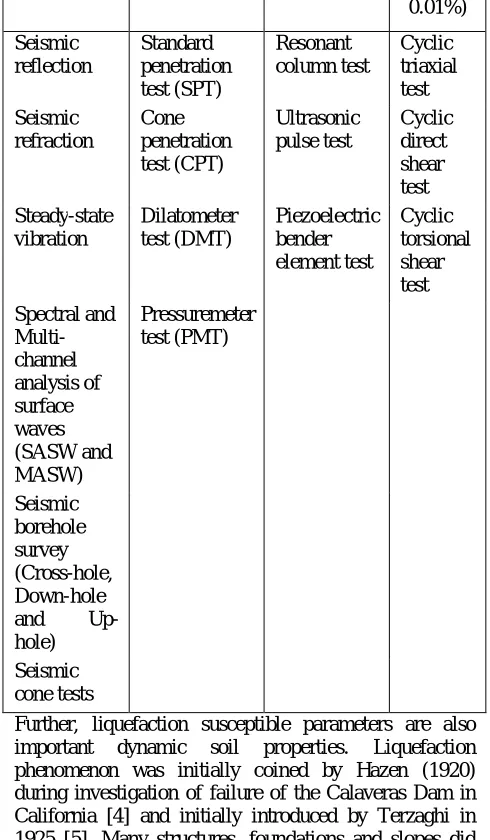
parameters such as the state of stress, void ratio, confining stress and water content, stress history, strain levels, and drainage condition to name a few. Apart from the influence of the above-mentioned parameters, dynamic soil properties are significantly influenced by the dynamic amplitude and frequency of the applied load. Hence, determination/estimation of the dynamic soil properties requires the consideration of all the above-mentioned influencing parameters. Dynamic soil properties can be determined from different field and/or laboratory tests as shown in Table 1 [1]. They can also be evaluated using suitable empirical correlations established from earlier standard field and laboratory investigations carried on a particular type of soil ([1]– [3]). One of the important aspect commonly looked into, is the behavior of cyclically loaded soil subjected to different strain levels. At low strain levels (< 0.001%), the soil portrays higher stiffness and lower damping ratio, with the stress-strain behavior being relatively linear. However, at higher strain levels, more nonlinearity effect is displayed along with the portrayal of higher damping ratio. Under such condition, the influence of the rate of loading and number of loading cycles on shear strength and volume change characteristics of the soil are extremely important. Basically, when a soil is subjected to earthquake or cyclic loading, the shear modulus and damping ratio of the soil are influenced by many factors like soil type, plasticity index, cyclic strain amplitude, relative density, frequency of loading cycle, effective confining pressure, overconsolidation ratio, and number of loading cycles [1]. Thus stiffness and damping properties are generally characterized by shear modulus (represented by modulus reduction curve) and damping ratio (represented by damping curve) of soil which decreases and increases with the strain respectively [1].
TABLE 1
FIELD AND LABORATORY TESTS EMPLOYED FOR DYNAMIC INVESTIGATION OF SOIL
Field tests Laboratory tests
Low strain (< 0.001%) High strain (> 0.01%) Low strain (< 0.001%) High strain (> 0.01%) Seismic reflection Standard penetration test (SPT) Resonant column test Cyclic triaxial test Seismic refraction Cone penetration test (CPT) Ultrasonic pulse test Cyclic direct shear test Steady-state vibration Dilatometer test (DMT) Piezoelectric bender element test Cyclic torsional shear test Spectral and Multi-channel analysis of surface waves (SASW and MASW) Pressuremeter test (PMT) Seismic borehole survey (Cross-hole, Down-hole and Up-hole) Seismic cone tests
This paper presents a review on the dynamic soil properties and their influencing parameters. Earlier studies on dynamic soil properties are reported here systematically to highlight the importance of the each influencing parameter. Subjected to similar testing conditions, a significant difference in the dynamic soil properties for characteristically different soils have been observed by earlier researchers.
II. DYNAMIC SOIL PROPERTIES
Dynamic response of soil subjected to dynamic loads will be governed by the dynamic soil properties. The responses obtained for different dynamic loadings needs to be back analysed to determine the dynamic soil properties. A typical soil subjected to cyclic loading exhibits hysteresis response. This hysteresis behaviour/response is idealised as a simple hysteresis loop as shown in Fig. 1. The loop can be described by the path of the loop itself or by two parameters that describe its general shape (slope and breadth of loop). Slope of the loop is represented as secant shear modulus (Gsec) and breadth of the loop is represented in terms of
damping. As the strain amplitude of cyclic loading is varied, different size of loops will be developed and the locus of the points corresponding to the tips of these loops is called the backbone curve (or skeleton) as shown in Fig. 2(a). As the cyclic strain increases, the secant shear modulus will decrease. Variation of shear modulus with cyclic strains is being represented as shear modulus degradation with cyclic strain, by means of the modulus reduction curve [Fig. 2(b)]. From the modulus reduction curve, normalization of the shear modulus (G) is carried out with respect to the maximum shear modulus (Gmax),
which is commonly referred to as the modulus ratio. Gmax
is the shear modulus at very low strain levels (<10-3 %) which can also be determined from geophysical tests. The shear modulus in that range remains constant and is commonly used as an elastic parameter.
When soil deposits are subjected to dynamic loading, energy is dissipated and that amount of dissipated energy is generally represented by the hysteresis loop of shear stress-shear strain response curve. Energy dissipation phenomenon of soils, generally defined by damping, affects the soil-structure interaction and ground response significantly during cyclic loading/earthquakes. Many researchers have found that the damping ratio increases
with increasing strain amplitude and decreasing effective stresses, while it is not much significantly affected by void ratio and number of cycles. Damping is often expressed as the damping ratio, which is defined as the damping coefficient (c) divided by the critical damping coefficient (cc) of the system. This is obtained from the
hysteresis loop by dividing the area of the loop by the triangle defined by the secant modulus and the maximum strain (energy dissipated in one cycle by the peak energy during a cycle). Damping ratio represents the ability of a material to dissipate dynamic load or dampen the system. It should be noted that many factors contribute to the damping ratio of soils during cyclic loading, such as, plasticity index, relative density, mean principal effective stress, over consolidation ratio, number of cycles and void ratio.
In the lab/in-situ tests, the magnitude of excess pore pressure build up to initiate liquefaction depends on the amplitude and duration of the cyclic loading, the number of cycles, the type of tests and soil type. There are two most common approaches to evaluate the liquefaction potential, one is cyclic stress approach and other is cyclic strain approach, in which earthquake induced loading expressed in terms of cyclic shear stress and cyclic shear strain respectively [1]. Several researchers have reported that the cyclic stress ratio and pore pressure generation are liquefaction parameters and experimentally investigated that loose soil liquefy in few cycles if large cyclic shear stress is applied; however, dense soils require large number of cyclic shear stress or cyclic stress ratio as shown in Figs. 3 and 4.
Fig. 2 (a) Stress-strain curve with variation of shear modulus (b) Modulus reduction curve [1]
Fig. 3 Undrained cyclic triaxial test on dense (Dr = 78%)
Sacramento river sand [6]
Fig. 4 Undrained cyclic triaxial test on loose (Dr = 38%)
Sacramento river sand [6]
III. CRITICAL FACTORS INFLUENCING THE DYNAMIC
PROPERTIES OF SOIL
The effects of testing procedures and material characteristics on the cyclic strength and dynamic properties of different soils were reviewed and it has been observed that these properties are affected by many factors such as method of sample preparation in laboratory (whether intact and reconstituted samples), relative density, confining pressure, methods of loading, overconsolidation ratio, loading frequency, soil plasticity, percentage of fines and soil type.
A. Methods of Sample Preparation
also been reported that the methods of sample preparation ([20], [21]) and methods of testing [22] also affect the strength of soil. Mulilis et al. [19] have observed that the variation of sample diameters does not significantly affect the cyclic strength. However, Wong et al. [23] compared the effects of size considering 70 mm and 300 mm (2.8 in. and 12 in.) diameter specimens with similar height-to-diameter ratios and showed that the 300 mm (12 in.) diameter specimen was approximately 10% weaker than the 70 mm (2.8 in.) diameter specimen (Fig. 6). Ishihara et al. [20] reported that the cyclic strength of the undisturbed specimens was about 15% greater than that of the reconstituted specimens. Silver and Ishihara [24] have also reported that the strength ratio of undisturbed and reconstituted samples ranged between 1.14 – 1.22. Shear modulus obtained from cyclic triaxial stress-controlled tests were slightly higher than cyclic triaxial strain-controlled tests at a given shear strain level, due to the influence of the method of sample preparation ([5], [25]); however, in some cases methods of sample preparation did not affect significantly [26]. Damping ratios were not significantly affected by methods of sample preparation while the effect on the shear modulus was vivid as shown in Figs. 7 and 8. Undisturbed sample depicted almost double the shear modulus than the disturbed sample as depicted in Fig. 7 [27].
Fig. 5 Cyclic stress ratio versus number of cycles for different compaction procedures [adapted from 19]
Fig. 6 Effect of specimen size on cyclic stresses causing initial liquefaction of Monterey sand [adapted
from 23]
Fig. 8 Comparison of damping ratio of dense sand of undisturbed and disturbed samples [27]
B. Effects of Confining Pressure
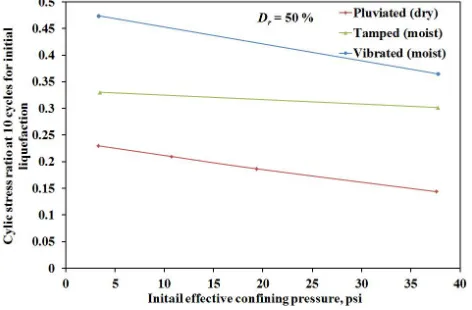
Shear modulus, damping ratio and liquefaction are significantly affected by confining pressure. As the confining pressure increases, the shear modulus increases and damping ratios decreases because of the densification/compactness of soil sample (Figs. 9 and 10). Densification causes an increase in the relative density which further results in the increment of shear modulus and number of cycles required to initiate liquefaction. A series of different tests have been performed on soils to observe the effect of confining pressure over its strain-dependent dynamic properties. In the range of shear strains tested, it has been observed and reported that as the confining pressure increases, the shear modulus increases significantly and the damping ratio decreases ([5], [25], [26], [28]–[34]). For a given deviatoric stress, many researchers ([4], [6], [7], [20], [22], [35], [36]) have also reported that the number of cycles, to cause initial liquefaction and failure, increased with increase in confining pressure. Mulilis [37] reported that liquefaction is also influenced by the methods of sample preparation and effective confining pressure as shown in Fig. 11.
Fig. 9 Variation of shear modulus ratio and shear strain for dense sand with different confining pressures [30]
Fig. 11 Cyclic stress ratio at 10 Hz for initial liquefaction versus initial effective confining stress
[adapted from 37]
C. Effects of Void Ratio
Void ratio is one of the mechanical properties of soil which is mainly influenced by the static/dynamic actions of loading. As the void ratio becomes lesser under the application of load, soil particles come closer to each other resulting in densification of soil sample. Densification or reduction in void ratio of soils due to confining pressure and method of sample preparation are the main causes increasing the cyclic strength. Kokusho [30] performed a series of cyclic triaxial tests on isotropically consolidated saturated Toyoura sand (void ratios: 0.64 – 0.80) subjected to specified effective confining stress (19.6 kPa - 294 kPa) and frequency (0.02 Hz - 0.1 Hz) and reported about the influence of void ratio on the strain dependent shear modulus and damping ratio (Fig. 12). It was observed that shear modulus decreases with increase of void ratio. Dash and Sitharam ([38], [39]) performed tests at constant gross void ratio approach, constant sand skeleton void ratio approach, and constant interfine void ratio approach to study the effect of non-plastic fines on pore pressure response of sand–silt mixtures. At a constant gross void ratio, the rate of generation of excess pore water pressure increased drastically with the increase in silt content [till a limiting silt content (≈ 15%)], since the relative density of a specimen decreases with increase in silt content till the limiting value and thereafter, it increases.
Fig. 12 Shear modulus versus shear strain for σ'c = 98
kN/m2 with different void ratios [30]
D. Effects of Method of Loading
Different cyclic loading waveforms like sinusoidal, rectangular and triangular waves are used to evaluate the dynamic properties of soil and the cyclic strength as well. Seed and Chan [40] and Thiers [41] have investigated that the triangular loading waveform gives 5 – 20% higher strength than the rectangular loading. Generally, sine wave is used for cyclic loading which gives approximately 30% higher cyclic strength than the rectangular or triangular wave forms as represented in Fig. 13 [42].
Fig. 13 Effect of loading waveform on cycles to initial liquefaction for moist tamped specimens [adapted from
E. Effects of Overconsolidation Ratio
The overconsolidation ratio (OCR) is a geotechnical parameter, which represents the historical changes in state of stress in the subsoil. The stress history, as indicated by the profile of OCR, of a soil deposit is one of the most dominant factors that influence the engineering behaviour of the soil [43]. Ishihara et al. [20] performed a series of cyclic triaxial tests on reconstituted and undisturbed sandy soil containing fines in the range of 0-100% as represented in Fig. 14. The reconstituted specimen was overconsolidated to OCR range of 1.0-2.0. The rate of gain in cyclic strength due to overconsolidation increases with an increase in fines content or a decrease in mean grain size of the soil specimens.
Fig. 14 Relationship between cyclic strength and content of fines in soils [20]
F. Effects of Excitation Frequency
Based on the experimentation for a wide range of excitation frequency, Hardin [44] had reported that the damping behaviour of dry sand is independent of the frequency. This concept has been widely accepted and applied in the ground response analysis in frequency domain. However, if the soil damping becomes frequency dependent, the analysis in frequency domain is not valid, and it will be very complicated to analyse the ground response and soil-structure interaction accounting for frequency effect of soil damping. Lee and Fitton [45]
reported that the lower loading frequency produced slightly lower strength. However, Wong et al. [23] and Wang [46] reported that the slower loading frequency gives slightly higher strength, which is in contrast to the above-mentioned finding. Based on the both resonant column and cyclic torsional shear tests performed by Lin et al.[31, 47] (Figs. 15 and 16) and cyclic triaxial tests by GovindaRaju [5] (Figs. 17 and 18), it has been observed that the shear modulus is not significantly affected while damping ratios are significantly affected by the excitation frequency. Dash and Sitharam [40, 41] have identified that the rate of excess pore pressure generation increased with the increase in frequency and magnitude of loading. At shear strain amplitude of 0.4 %, GovindaRaju [5] studied the effect of loading frequency on pore pressure generation with number of loading cycles on Assam sands, which demonstrated that the difference between the amounts of pore water pressures at any given cycle is not much pronounced in the range of frequencies 0.2 - 3.0 Hz.
Fig. 16 Variation of damping ratio with frequency of Ottawa sand [adapted from 31]
Fig. 17 Variation of normalized modulus ratio with shear strain for different frequencies [5]
Fig. 18 Variation of damping ratio with shear strain for different frequencies [5]
G. Effects of Soil Plasticity
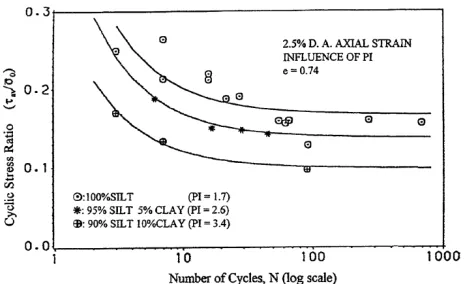
Vucetic and Dobry [48] studied the influence of the plasticity index (PI) on the cyclic stress-strain parameters over normally consolidated and overconsolidated (OCR = 1–15) clay (Figs. 19 and 20) and reported that, compared to the soils with a lower PI, soils with higher plasticity tend to have a more linear cyclic stress-strain response at smaller strains and degrades less at larger shear strain (γc). Puri [49] and Prakash and Puri [50]
Fig. 19 Correlations between G/Gmax and Plasticity Index
(PI) for normally and overconsolidated soils [49]
Fig. 20 Correlations between damping ratio and Plasticity Index (PI) for normally and overconsolidated
soils [49]
Fig. 21 Cyclic stress ratio versus number of cycles for reconstituted saturated samples for different PI values at
5% D. A. axial strain [50]
Fig. 22 Cyclic stress ratio versus number of cycles for low plasticity silts at 15 psi effective confining pressure;
PI = 1.7, 2.6, and 3.4, for density 97.2 – 99.8 pcf [51]
H. Effects of Percentage Fines
deformational characteristics of silty sands which is quite different from that of clean sands. Seed et al. [52] have reported that the liquefaction resistance of sand is not influenced by fines unless the fines comprise more than 5% of the soil. Ishihara and Koseki [53] have also observed that the low plastic fines (PI<4) does not influence the liquefaction potential. Hanumantharao and Ramana [54] performed stress and strain controlled undrained cyclic triaxial tests on remoulded sand and sandy slit (silt content: 0 – 100%) specimens of 70 mm diameter and 140 mm height under a sinusoidal loading at 1 Hz frequency for evaluating the modulus reduction and damping curves (Figs. 23 and 24) and reported that the shear modulus is not significantly affected, although with the increase in silt content, the damping ratio was observed to decrease.
Fig. 23 Normalized shear modulus (G/Gmax) versus shear
strain [54]
Palito and Martin [55] have conducted undrained cyclic triaxial tests on Yatesville and Monterey No. 0/30 sand with non-plastic silt to evaluate the effects of non-plastic fines on the liquefaction susceptibility of sands. It was observed that the liquefaction resistance increases with increasing silt content for a given value of the sand skeleton void ratio for Yatesville sand, however, the similar trend was not observed for Monterey sand (Fig. 25). Zlender and Lenart [56] have reported that the liquefaction resistance of lacustrine carbonate silt is higher than that of clan sand.
Fig. 24 Damping ratio versus shear strain [54]
Fig. 25 Variations in cyclic resistance with silt content at constant sand skeleton void ratio for Yatesville sand and
Monterey sand [adapted from 55]
IV. CONCLUSIONS
The weakest (loose) specimens were formed by air-pluviation technique, while strongest (dense) formed moist-vibration technique. Unlike shear modulus, damping ratios were not significantly affected by methods of sample preparation. Intact specimens are found to be stronger (higher shear modulus) than the reconstituted specimens, their strength being governed by the reconstitution methods adopted.
Shear modulus, damping ratio and liquefaction are significantly influenced by confining pressure. As the confining pressure increases, the shear modulus increases and damping ratio decreases. Subjected to higher confining pressure, the number of loading cycles required for liquefaction increases.
Densification or reduction in void ratio of soils due to confining pressure and method of sample preparation lead to increase cyclic strength. Cyclic loading or excitation waveform affects
the dynamic response of the specimen. Sinusoidal waveform loading gives approximately 30% higher cyclic strength than the rectangular or triangular waveforms. The rate of gain in cyclic strength due to
overconsolidation increases with an increase in fines or a decrease in mean grain size of the soil specimens.
Frequency of cyclic loading does not significantly affect the shear modulus, although there is a significant influence on the damping ratio.
Shear modulus, damping ratio and liquefaction parameters are also significantly affected by the quantity of plastic and non-plastic fines/silts present in the specimen.
Few contradictory observations related primarily to the effect of sample preparation and excitation/loading frequency on the dynamic properties of soil were also reported in the literature. For a better comprehension of the subject, further investigations on dynamic properties of soil are required to critically identify the influence of different parameters, so that the outcome of the
understanding can be used more fruitfully for further research and practical application.
REFERENCES
[1] Kramer, S.L. (1996). Geotechnical Earthquake Engineering,
Prentice Hall, New Jersey (NJ), 653.
[2] Hardin, B.O. and Black, W.L. (1969). Vibration Modulus of
Normally Consolidated Clay, Journal of the Soil Mechanics and Foundations Division. ASCE, 95 (SM6), 1531–1537.
[3] Hardin, B.O. (1978). The nature of stress-strain behaviour of
soils. Proc. of Earthquake Engineering and Soil Dynamics, ASCE, Pasadena, California. Vol. 1, 3–89.
[4] Kramer, S.L. and Seed, H.B. (1988). Initiation of soil liquefaction
under static loading conditions, Journal of Geotechnical Engineering, ASCE, Vol. 114, No. 4, 412–430.
[5] GovindaRaju, L. (2005). PhD Thesis, Indian Institute of Science,
Bangalore.
[6] Seed, H.B. and Lee, K.L. (1966). Liquefaction of saturated sands
during cyclic loading, Journal of the Soil Mechanics and Foundations Division, ASCE, Vol. 92, No. SM6, pp. 105–134.
[7] Lee, K.L. and Seed, H.B. (1967). Cyclic stress conditions causing
liquefaction of sand, Journal of the Soil Mechanics and Foundation Engineering Division, ASCE, Vol. 93, no. SM1, 47– 70.
[8] Seed, H.B. (1986). Design problems in soil liquefaction, Journal of Geotechnical Engineering Division, ASCE, Vol. 113, No.8, pp. 827–845.
[9] Seed, H.B. and Idriss, I.M. (1971). Soil moduli and damping
factors for dynamic response analyses, Report EERC 70-10, Earthquake Engineering Research Centre, University of California, Berkeley.
[10] Seed, H.B. and Peacock W.H. (1971). Test procedures for
measuring soil liquefaction characteristics, Journal of the Soil Mechanics and Foundations Division, ASCE, Vol. 101, No. GT6, pp. 551 – 569.
[11] Castro, G. (1975). Liquefaction and cyclic mobility of saturated sand, Journal of Geotechnical Engineering Division, ASCE, Vol. 113, No.8, pp. 827–845.
[12] Youd, T. L., and Hoose, S. N. (1977). Liquefaction susceptibility
and geologic setting. Proceeding 6th World Conference on Earthquake Engineering., Vol. 3, Prentice-Hall, Englewood Cliffs, N.J., 2189–2194
[13] Seed, H.B., Mort, K. and Chan, C.K. (1975). Influence of seismic
history on the liquefaction characteristics of sands, Report EERC 75-25, Earthquake Engineering Research Centre, University of California, Berkeley, 21 pp.
[14] Seed, H.B. and Idriss, I.M. (1981). Evaluation of liquefaction potential of sand deposits based on observation of performance in previous earthquakes, In-situ testing of evaluate liquefaction susceptibility, ASCE, St. Louis.
[15] Peck, R.B. (1979). Liquefaction potential: Science versus
practice, Journal of Geotechnical Engineering Division, ASCE, Vol. 105(GT5), pp. 553 – 562.
[16] Tatsuoka, F., Yasuda, S., Iwasaki, T. and Tokida, K. (1980).
cyclic and random loading, Soil and Foundations, Vol. 20, No. 3, pp. 1- 16.
[17] Ishihara, K. and Li, S. (1972). Liquefaction of saturated sand in triaxial torsion shear test, Soils and Foundations, Vol. 12, 19-39.
[18] Luna, R. and Jadi, H. (2000). Determination of dynamic soil
properties using geophysical methods, Proceedings of the first international conference on the application of geophysical and NDT methodologies to transportation facilities and infrastructure, St. Louis.
[19] Mulilis, J.P., Seed, H.B., Chan, C.K., Mitchell, J.K. and
Arulanandan, K., (1977). Effects of sample preparation on sand liquefaction, Journal of Geotechnical Engineering Division, ASCE, Vol.103, No.GT2, pp. 91–108.
[20] Ishihara, K., Sodekawa, M. and Tanaka, Y. (1978). Effects of
over consolidation on liquefaction characteristics of sands containing fines, Dynamic Geotechnical Testing, ASTM STP 654, 246–264.
[21] Tatsuoka, F., Muramatsu, M. and Sakaki, T. (1982). Cyclic
undrained stress-strain behaviour of dense sand by torsional simple shear tests, Soil and Foundation, Japanese society of soil mechanics and foundation engineering, Vol. 22, No. 2, 55–70.
[22] Silver, M.L., Tatsuoka, F., Phukunhaphan, A. and Avramidis,
A.S. (1980). Cyclic undrained strength of sand by triaxial test and
simple shear test, Proceedings of 7th World Conference on
Earthquake Engineering, Istanbul, Vol. 3, 281–288.
[23] Wong, R.T., Seed, H.B. and Chan, C.K., (1975). Cyclic loading liquefaction of gravelly soils. Journal of Geotechnical Engineering, ASCE, Vol.101, No.GT6, pp. 571–583.
[24] Silver, M.L. and Ishihara, K., (1977). Comparison between the
strength of undisturbed and reconstituted sands from Niigata, Japan, Contract Report, U.S. Army Engineer waterways experiment station, Corps of Engineers, Vicksburg, Miss.
[25] Sitharam, T.G., GovindaRaju, L. and Murthy, B.R.S. (2004).
Evaluation of liquefaction potential and dynamic properties of silty sand using cyclic triaxial testing. Geotechnical Testing Journal, Vol. 27, No. 5, Paper ID GTJ11894.
[26] Tatsuoka, F., Iwasaki, T. and Takagi, Y. (1978). Hysteretic
damping of sands under cyclic loading and its relation to shear modulus. Soils and Foundations, Vol. 18(2), 25–30.
[27] Katayama, I., Fukui, F., Satoh, M., Makihara, Y. and Tokimatsu,
K. (1986). Comparison of dynamic soil properties between undisturbed and disturbed dense sand samples, Proc. 21st Annual Conf. of JSSMFE, 583–584.
[28] Iwasaki, T. and Tatsuoka, F. (1977). Effects of grain size and grading on dynamic shear moduli of sands, Soils and Foundations, Vol.17, No.3, 19–35.
[29] Iwasaki, T., Tatsuoka, F. and Takagi, Y. (1978). Shear modulus of sands under torsional shear loading, Soils and Foundations, Vol. 18, No. 1, 39–56.
[30] Kokusho, T. (1980). Cyclic triaxial test of dynamic soil properties
for wide strain range, Soils and Foundations, Vol. 20, No.2, 45-60.
[31] Lin, M.L., Huang, T.W. and You, J.C. (1996). The effects of
frequency on damping properties of sand, Soil Dynamics and Earthquake Engineering, Vol. 15, 269–278.
[32] Vucetic, M., Lanzo, G. and Doroudian, M. (1998). Damping at
small strains in cyclic simple shear test. Journal of Geotechnical Engineering, ASCE, Vol.124, No.7, 585–594.
[33] Feng, Z.Y. and Sutter, K.G. (2000). Dynamic properties of
granulated rubber/sand mixtures. Geotechnical Testing Journal, ASTM, Vol. 23, No. 3, 338–344.
[34] Mohtar, C.S.E., Denevich, V.P. Santagata, M. and Bobet, A.
(2013). Combined resonant column and cyclic triaxial tests for measuring undrained shear modulus reduction of sand with plastic fines, Geotechnical Testing Journal, ASTM, Vol. 36(4), 1–9. [35] Hosri, M.S.E., Biarez, J. and Hicher, P.Y. (1984). Liquefaction
characteristic of silty clay, Proceedings of the 8th World Conference on Earthquake Engineering, Prentice-Hall, Inc., Englewood Cliffs, New Jersey, Vol. 3, 277–284.
[36] Choudhary, S.S., Maheshwari, B.K. and Kaynia, A.M. (2010).
Liquefaction resistance of Solani sands under cyclic loads. Indian Geotechnical Conference, GEOtrendz, 115 – 118.
[37] Mulilis, J.P. (1975). The Effects of Method of Sample Preparation
on the Cyclic Stress Strain behaviour of Sands, EERC Report 75-18, College of Engineering, University of California ,Berkeley.
[38] Dash, H.K. and Sitharam, T.G. (2009). Undrained cyclic pore
pressure response of sand–silt mixtures: effect of non-plastic fines and other parameters, Journal of Geotechnical Geological Engineering, Vol. 27, 501–517.
[39] Dash, H.K. and Sitharam, T.G. (2011). Undrained cyclic and
monotonic strength of sand-silt mixtures, Journal of Geotechnical Geological Engineering, Vol. 29, 555–570.
[40] Seed, H.B. and Chan, C.K. (1964). Pulsating load tests on
samples of clay and silt from anchorage, Alaska. Report on Anchorage Area Soil Studies to U.S. Army Engineer District, Anchorage, Alaska, Shannon & Wilson, Inc., Seattle, Wash.
[41] Thiers, G.R. (1965). The behaviour of saturated clay under
seismic loading conditions, Ph.D. Thesis, Department of Civil Engineers, University of California, Berkeley.
[42] Mulilis, J.P., Townsend, F.C. and Horz, R.C. (1978). Triaxial
testing techniques and sand liquefaction, Dynamic Geotechnical testing, ASTM STP 654, 265–279.
[43] Chang, M.F. (1991). Interpretation of overconsolidation ratio
from in situ tests in recent clay deposits in Singapore and Malaysia, Canadian Geotechnical Journal, 28 (2), 210–225, 10.1139/t91–028.
[44] Hardin, B.O. (1965). The nature of damping in sands. Journal of
Soil Mechanics and Foundation Division, ASCE, 91(SM1), 63– 97.
[45] Lee, K.L. and Fitton, J.A (1969). Factors affecting the cyclic loading strength of soil. In: vibration Effects of Earthquakes on Soils and Foundations, ASTM, STP 450, 71-95.
[46] Wang, M.S., (1972). Liquefaction of triaxial sand samples under
different frequencies of cyclic loading, ME Thesis, University of Western Ontario.
[47] Lin, M.L., Ni, S.H., Wright, S.G. and Stokoe, K.H. (1988).
Characterization of material damping in soil. The 9th WCEE, III,
5-10.
[48] Vucetic, M. and Dobry, R. (1991). Effect of soil plasticity on cyclic response. Journal of Geotechnical Engineering, ASCE, Vol. 117, No. 1, 89–107.
[49] Puri, V.K. (1984). Liquefaction behaviour and dynamic properties
of loessial (silty) soils, Ph.D. Thesis, University of Missouri, Rolla, Missouri.
[50] Prakash, S. and Puri, V.K. (1982). Liquefaction of loessial Soils,
[51] Prakash, S., and Sandoval, J.A. (1992). Liquefaction of low plasticity Silts, Journal of Soil Dynamics and Earthquake Engineering, 71(7), 373-397.
[52] Seed, H.B., Tokimatsu, K., Harder, L.F., and Chung, R.M.
(1985). Influence of SPT procedures in soil liquefaction resistance evaluations, Journal of Geotechnical Engineering, Vol. III, No. 12, pp.l425-1445.
[53] Ishihara, K. and Koseki, J. (1989). Cyclic shear strength of fines containing sands, Earthquake and Geotechnical Engineering, Japanese Society of Soil Mechanics and Foundation Engineering, Tokyo, 101–106.
[54] Hanumantharao, C. and Ramana, G.V. (2008). Dynamic soil
properties for microzonation of Delhi, India, Journal of Earth System and Science, Vol. 117, S2, 719–730.
[55] Palito, C.P. and Martin, J.R. (2001). Effects of non-plastic fines on the liquefaction resistance of sands, Journal of Geotechnical and Geo-environmental Engineering, Vol. 127, No. 5, 408–415.
[56] Zlender, B. and Lenart, S. (2005). Cyclic liquefaction potential of
![Fig. 1 Hysteresis loop showing secant and tangent shear modulus [18]](https://thumb-us.123doks.com/thumbv2/123dok_us/1537055.1188523/3.612.377.499.577.693/fig-hysteresis-loop-showing-secant-tangent-shear-modulus.webp)
![Fig. 4 Undrained cyclic triaxial test on loose (Dr = 38%) Sacramento river sand [6]](https://thumb-us.123doks.com/thumbv2/123dok_us/1537055.1188523/4.612.65.283.331.507/fig-undrained-cyclic-triaxial-test-loose-sacramento-river.webp)
![Fig. 7 Comparison of shear modulus of dense sand of undisturbed and disturbed samples [27]](https://thumb-us.123doks.com/thumbv2/123dok_us/1537055.1188523/5.612.61.294.523.689/fig-comparison-shear-modulus-dense-undisturbed-disturbed-samples.webp)
![Fig. 9 Variation of shear modulus ratio and shear strain for dense sand with different confining pressures [30]](https://thumb-us.123doks.com/thumbv2/123dok_us/1537055.1188523/6.612.364.511.392.569/variation-shear-modulus-ratio-strain-different-confining-pressures.webp)
![Fig. 14 Relationship between cyclic strength and content of fines in soils [20]](https://thumb-us.123doks.com/thumbv2/123dok_us/1537055.1188523/8.612.57.287.387.553/fig-relationship-cyclic-strength-content-fines-soils.webp)
![Fig. 18 Variation of damping ratio with shear strain for different frequencies [5]](https://thumb-us.123doks.com/thumbv2/123dok_us/1537055.1188523/9.612.60.293.201.357/fig-variation-damping-ratio-shear-strain-different-frequencies.webp)
![Fig. 24 Damping ratio versus shear strain [54]](https://thumb-us.123doks.com/thumbv2/123dok_us/1537055.1188523/11.612.61.296.396.547/fig-damping-ratio-versus-shear-strain.webp)
