5S Implementation Studies in Biomass
Processing Unit
K.Ramesh
1, V.R.Muruganantham
2, N.R.Arunkumar
31
P.G Student, Department Of Mechanical Engineering, Kumaraguru College Of Technology, Coimbatore, India
2
Senior Grade Assistant Professor, Department Of Mechanical Engineering, Kumaraguru College Of Technology, Coimbatore, India
3
P.G Student, Department Of Mechanical Engineering, Kumaraguru College Of Technology, Coimbatore, India
Abstract: This paper presents an application of 5S in technology in a Bio-mass processing unit. Due to increased demand, high product variety, and a push production system, the plant has suffered from excessive wastes, unorganized workstations, and unhealthy work environment. This has translated into increased production cost, frequent delays, and low workers morale. Under such conditions, it has become difficult, if not impossible, to implement effective continuous improvement studies. Improving plant layout, and organizing workstations. 5S lean technology is utilized for achieving project diagnosing the production process, streamlining the workflow, removing/reducing process waste, cleaning the production environment. The work was a combination of both culture changes and tangible/physical changes on the shop floor. The “5S” technique represents a fundamental technique which allows the enhancement of efficiency and productivity, while ensuring a pleasant organizational climate. The project has drastically changed the plant and developed the infrastructure for a successful implementation of continuous improvement as well as other best practices and quality initiatives.
.Keywords: 5S Techniques, Work Standards.
1.0 INTRODUCTION
IN a highly competitive global marketplace of decreasing profit margins, waste reduction has become an essential element in companies' effort to thrive and in some cases to just survive. Waste has a broad meaning that ranges from the unnecessary or excessive use of materials, space, and production resources to any incurred costs that add no value to the product such as overproduction, inventory, set-up, transportation, delay, and rework .It is any effort or cost beyond delivering the right product to the right customer at the right time and at the right price. The hidden cost of such wastes significantly contributes to increased production cost, reduced profit margin, and loss of competitiveness. Reducing process waste is the primary mission of lean manufacturing which was started by the Japanese industry, mainly Toyota, inthe1950s. Toyota production system and lean manufacturing in general are focused on pinpointing waste sources and using tools of proven effectiveness to eliminate or reduce waste.Lean defines the major types of waste as: overproduction, over processing, defects, inventory, transportation, motion, underutilization, and delay.
1.1. 5S TECHNOLOGY
ISSN (Online) : 2319 - 8753
ISSN (Print) : 2347 - 6710
I
nternationalJ
ournal ofI
nnovativeR
esearch inS
cience,E
ngineering andT
echnologyAn ISO 3297: 2007 Certified Organization, Volume 3, Special Issue 2, April 2014
Second National Conference on Trends in Automotive Parts Systems and Applications (TAPSA-2014) On 21st & 22nd March, Organized by
Sri Krishna College of Engineering & Technology, Kuniamuthur, Coimbatore-641008, Tamilnadu, India
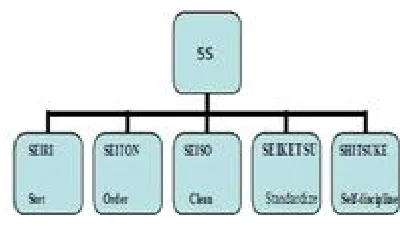
Copyright to IJIRSET www.ijirset.com 311 The 5S components include Sort (Seiri), Set in Order (Seiton), Shine (Seiso), Standardize (Seiketsu), and Sustain (Shitsuke). Together, they provide a methodology for organizing, cleaning, developing, and sustaining a productive work environment.
The 5S lean technique includes:
1. Sort: Removing wastes and clearing the work area
2. Set in Order: Designating and labeling locations of work tools 3. Shine: Cleaning and improving the appearance of the workplace
4. Standardize: Documenting the work method, using standard tools, and populating the best practices 5. Sustain: Maintaining improvement, controlling work methods, and integrating the 5S's into the culture
The 5S's lead to improved processes in terms of many aspects including:
Transparent process flow
Clean workplace
Reduced set-up times
Reduced cycle times
Increased floor space
Lower safety incident/accident rate
Less wasted labour time
Better equipment reliability
Fig. 1: 5S TECHNOLOGY
1.1.1. Project Objectives
The Hari Bio-Mass Processing Unit is keen on increasing the effectiveness of their manufacturing and assembly operations through a better workflow and an enhanced layout of the workplace. This is essential step in the company's effort toward attaining excellence at all aspects and activities. Hence, this project aims to study the current workflow at Hari Bio-Mass Processing Unit, pinpoint existing flow issues, and analyze the overall impact on the effectiveness of the production system. From a managerial perspective, the project will work on developing a flexible layout for a streamlined production flow and reduce layout changes and setup costs leading to easier plant management and better floor control. They were less worried about optimizing process parameters (resources, layout, sequence, cycle time, etc.). From a shop floor perspective, this project will organize the workplace and create a better work environment for line workers to improve morale and facilitate the execution of work orders and improve floor communication.
2.0. Methodology
A simple yet effective methodology is followed for attaining project objectives. Project scope is defined after touring the facility and tracking the production process along with discussions with plant management, engineers, supervisors and general labour. The project need was obvious to all parties and the project value was found to be significant to the company. The difficult part was how to carry out floor changes and make a tangible difference in the process flow. To this end, this project followed a simple yet practical approach to stir a change on the shop floor, clean the flow, and start a momentum for continuous improvement. The methodology can be summarized in the following:
Observe floor operations at the facility and diagnose current workflow and work organization problems.
Identify and develop a structure of the current manufacturing process
Investigate workplace organization problems from shop floor observations, labour, and line supervisors.
Use 5S techniques to improve existing workflow and process configuration.
Discuss improvement measures with plant management.
Document analyses and results in formal report and present to plant management.
The main expected project outcome is to improve the overall process effectiveness at the plant. Other benefits include a better organization of workplace and work activities to streamline operations, simplify floor control, and improve workers morale. Implications on the Hari Bio-Mass Processing Unit bottom lines include increasing effectiveness, reducing excessive flow, reducing setup time and cost, and improving the utilization of expensive assets and resources. This is also tied with the employee incentive program to further improve productivity and profitability. The project has started by defining process layout and dividing the plant into 10 production areas. This step was essential to identify layout, define flow areas, and prepare for 5S application at all plant areas. This was followed by conducting a lean and 5S awareness at the facility through meetings and seminars held for plantengineers, supervisors, and workers. Once all are familiar with the project objectives, lean technology, and the project timeframe and work plan, a cleaning campaign has started inside and outside the plant. Cleaning the plant floor and backyard was necessary to clear the aisles, improve the environment, and make a visible change in the work place to both workers and visitors. These three steps made it easy to start the application of 5S approach at the defined areas in the plant. Each area took an average of a week to make a tangible difference. Several meetings were held with plant management to discuss progress and exchange ideas. Special 5S forms were developed to assure sustainability. All project actions were documented and a final report is issued to plant management.
3.0 5S APPLICATION
It is often simple to talk about how lean approaches work and about 5S in particular. However, the implementation of lean tools on the floor is totally different. This is because 5S is not just a methodology; it is a culture change that involves all parties to drive the organization towards effectiveness and continuous improvement. Thus, we had to first make it clear to all project parties why we are adopting the 5S lean technology. The diagnostic study conducted at the Hari Bio-Mass Processing Unit plant revealed the following issues that collectively call for 5S application in the plant to identify process and improve layout and flow:
Space is crowded with parts and tools
Unneeded items are stacked between workers
Excess inventory on the floor
Excess items and machines make it difficult to improve process flow
Equipment is dirty and a collection point for miscellaneous materials
Needed equipment such as tools are difficult to find
Based on the diagnostic study, the 5S lean technique is adopted for process identification and workflow improvement at the Hari Bio-Mass Processing Unit factory for the following reasons:
5S provides the infrastructure necessary for plant-wide improvement
5S is essential for streamlined process flow and layout redesign
5S is essential for worker motivation and increased loyalty
5S is the key for clean production environment
5S is essential to deploy safety measures and reducing accidents
ISSN (Online) : 2319 - 8753
ISSN (Print) : 2347 - 6710
I
nternationalJ
ournal ofI
nnovativeR
esearch inS
cience,E
ngineering andT
echnologyAn ISO 3297: 2007 Certified Organization, Volume 3, Special Issue 2, April 2014
Second National Conference on Trends in Automotive Parts Systems and Applications (TAPSA-2014) On 21st & 22nd March, Organized by
Sri Krishna College of Engineering & Technology, Kuniamuthur, Coimbatore-641008, Tamilnadu, India
Copyright to IJIRSET www.ijirset.com 313
Minimizing waste and reusing waste materials
Minimizing effort and time wasted in searching
Removing excess material and inventory
It is also worth mentioning that 5S is not a list of action items that has to be reviewed at some interval of time. Instead, it has to be practiced consistently in all times. Thus, a practical step-by-step approach should be followed to make 5S attain a successful implementation. The followed project steps are summarized in the following
Process structure and identification (layout and flow)
Awareness and training on 5S approach
Overall plant inside and outside cleanup
Utilizing checklists for 5S implementation and auditing
Waste reduction (less waste and reused materials)
Space utilization (clearing main aisle, providing space for reused items, clearing plant floor, providing space for material handling)
Cleaner and safer work environment
Setting a basis for labour incentives
Initially, there were no clear boundaries to plant areas. It was also difficult to move materials from one area to another. A crane is used to transfer heavy materials and parts from one area to another. Final office structures are assembled in an area outside the plant. Workstations were unclean and flooded with excess inventory, rework, and scrap. The improved layout shows cleared main aisle, no flow obstacles, marked in/out areas, and more space for reusing items and material handling. These plant areas are organized and the main plant aisle is cleared and marked.
After identifying and cleaning the process flow, the 5S was then implemented at the industry. An action plan was set and followed as a practical guide for translating 5S method and principles into specific actions that stations operators can take and sustain. This work element presented a great challenge to project team. The team has to work with general labour and stations operators on a cultural change. They have to believe in the actions taken in 5S application in order to make tangible and sustainable changes on the floor. To this end, the team focused the 5S implementation effort on one plant area (woodworks) to create labour awareness in the 5S method and to provide tangible evidence that can convince labour to cooperate with the changes and believe more in the 5S value and benefits.
Copyright to IJIRSET www.ijirset.com 314 Every working method has particular type of order. Identify and filter it. Use lean thinking to make things faster.
• Reduce preparation time for tool setting.
• Reduce waiting time for parts, materials, papers and files
• Reducing processing time and cycle time by improving the plant layout of work area. • Time and strength spent on looking for jigs, fixture tools etc.
• Run down for parts in stores.
• Searching for files and information in computers. • Labels are attached so that items can be recognized. • At a glance and clear.
The advantages from implementing 5S rules: 1S:
Process development by cost reduction
Stock confinement
Better usage of work place
Prevention of losing tools 2S:
Process growth
Increasing efficiency
Shortening of time required for searching necessary things
3S:
Improvised working conditions for workers.
The number of customers has been increased after maintaining a clean and neat layout.
Machine maintenance cost has been reduced. 4S:
The standards of the company came to next level.
Improvement in safety has supported in reducing the injuries of workers.
Slips and falls of the material have been reduced.
Travel time of materials is reduced which led to reduction of work hazards. 5S:
It gives a scope for Workers participation in the work area design and maintenance.
Workers absenteeism has been lowered down.
The team started the work on station sorting, ordering, and cleaning while operators watching.We explained to workers that this work is simply to clean and organize their workplace, it is not part of any company certification program, and keeping the station clean and organized will be rewarded through an incentive system. as a result, workers start to help in 5S changes at the first work area (woodworks). and Area operators were trained on what exactly need to be done to keep the area clean organizedThe 5S procedure was put on a form and posted at the work area.
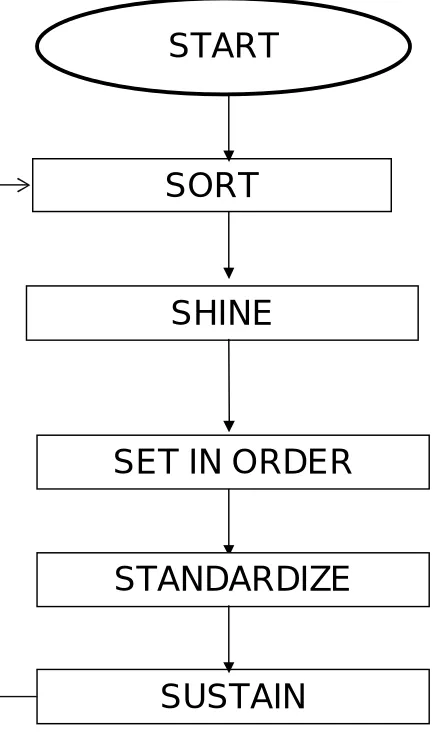
Figure 3 shows the layout of woodworks area and Figure 4 shows a picture that reflects the results of 5S application to the woodworks area. It is clear from the layout and the actual status of the workstation that the 5S application has resulted in a clean and organized work area. Flow input/output is improved and a cellular layout is adopted to facilitate machines control and supervision. Aisle passes through the area is cleared to allow for easy access of material handling trucks.
ISSN (Online) : 2319 - 8753
ISSN (Print) : 2347 - 6710
I
nternationalJ
ournal ofI
nnovativeR
esearch inS
cience,E
ngineering andT
echnologyAn ISO 3297: 2007 Certified Organization, Volume 3, Special Issue 2, April 2014
Second National Conference on Trends in Automotive Parts Systems and Applications (TAPSA-2014) On 21st & 22nd March, Organized by
Sri Krishna College of Engineering & Technology, Kuniamuthur, Coimbatore-641008, Tamilnadu, India
Copyright to IJIRSET www.ijirset.com 315 with a drastic clean up of plant floor and plant outside, the picture starts to be clear one month later. The plant significantly looked different. Some said it is like another plant.
In 5S application at Hari Bio-Mass Processing Unit facility, it was necessary to develop a 5S checklist based on the 5S practical guide discussed earlier. The check list helps identifying opportunities and techniques for 5S successful and comprehensive application.
The project deliverables to each area in the plant is summarized in a 5S table as summarized in the forms developed for each area and a detailed layout is developed for each area. Results collectively revealed a better process flow, a transparent production process, and a cleaner work environment. Specific actions on the floor were taken to save space, create and label storage areas, mark aisles and increase safety, and streamline the flow of production operations.
Fig. 1I: 5S APPLICATION AREA
SORT
SHINE
SUSTAIN
SSS
START
SET IN ORDER
Copyright to IJIRSET www.ijirset.com 316
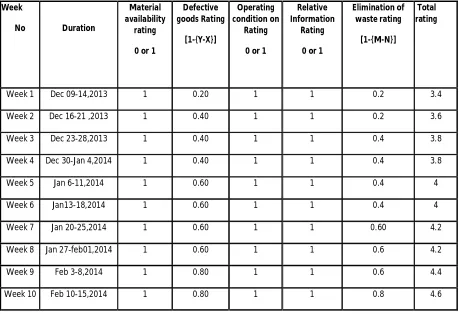
TABLE - 5S RATING
Week
No Duration
Material availability
rating
0 or 1
Defective goods Rating
[1-{Y-X}]
Operating condition on
Rating
0 or 1
Relative Information
Rating
0 or 1
Elimination of waste rating
[1-{M-N}]
Total rating
Week 1 Dec 09-14,2013 1 0.20 1 1 0.2 3.4
Week 2 Dec 16-21 ,2013 1 0.40 1 1 0.2 3.6
Week 3 Dec 23-28,2013 1 0.40 1 1 0.4 3.8
Week 4 Dec 30-Jan 4,2014 1 0.40 1 1 0.4 3.8
Week 5 Jan 6-11,2014 1 0.60 1 1 0.4 4
Week 6 Jan13-18,2014 1 0.60 1 1 0.4 4
Week 7 Jan 20-25,2014 1 0.60 1 1 0.60 4.2
Week 8 Jan 27-feb01,2014 1 0.60 1 1 0.6 4.2
Week 9 Feb 3-8,2014 1 0.80 1 1 0.6 4.4
ISSN (Online) : 2319 - 8753
ISSN (Print) : 2347 - 6710
I
nternationalJ
ournal ofI
nnovativeR
esearch inS
cience,E
ngineering andT
echnologyAn ISO 3297: 2007 Certified Organization, Volume 3, Special Issue 2, April 2014
Second National Conference on Trends in Automotive Parts Systems and Applications (TAPSA-2014) On 21st & 22nd March, Organized by
Sri Krishna College of Engineering & Technology, Kuniamuthur, Coimbatore-641008, Tamilnadu, India
Copyright to IJIRSET www.ijirset.com 317 S1-SEIRI-Sort
Red labels have been applied to all marks which were not necessary during the activity within the tin service shop;
All useless things have been sorted and eliminated
Approximately 700 kg of scantlings have been thrown away;
The causes that led to the scantling accumulation have been analyzed;
Rules specific to this activity have been stated and are to be implemented.
S2-SEITON-Order
All objects which were placed inappropriately have been taken inventory of;
The locations of all objects necessary in the workshop have been defined and marked
Colors have been used to mark the different areas;
The arranging way has been set according to destination and degree of usage.
The location of all objects necessary in the activity within the sales area have been defined;
Visual standards of arrangement and order have been set
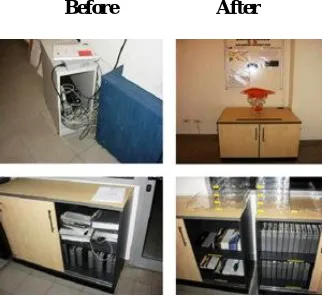
S3-SEISO-Cleaning and disturbance detection
All floors in the areas have been washed;
All walls have been cleaned;
The electrical wiring on the control panel of the elevator has been rewired;
The supply wiring of the plug used for the blowpipes has been rewired;
All storing shelves have been cleaned;
All machines and tools have been washed and cleaned;
Before After
Fig. III: 5S SEISO APPLICATION AREA
S4- SEIKETSU - Standardizing
Sri Krishna College of Engineering & Technology, Kuniamuthur, Coimbatore-641008, Tamilnadu, India
Fig.IV: 5S SEIKETSU APPLICATION AREA
S5- SHITSUKE – Disciplining
Maintaining improvement, controlling work methods, and integrating the 5S's into the culture.
A project is, therefore, aimed at cleaning, identifying, and streamlining the process. 5S lean technology is utilized to develop an infrastructure for continuous process improvement. A practical 5S methodology is implemented to 10 areas in the plant during the project period of 3 months to clean up the process and improve overall plant operations. At each area, a thorough clan up process is started, a new layout is developed, and all 5S’s are implemented using clear forms and procedures. Results showed tangible changes on the plant floor along with improved worker morale and increased productivity. The approach can be adapted to other types of manufacturing processes as well as offices and service processes.
4.0. CONCLUSION
This paper has presented an industry application of 5S lean technology at a Hari Bio-Mass Processing Unit. Several plant conditions have called for the improvement of the manufacturing process (a combination of job shop and assembly operations). The process flow at the Hari Bio-Mass Processing Unit is not streamlined due to the wide variety in product specifications, the growing demand, the push production policy, and the nature of heavy metal and woodwork operations. As a result, the plant has turned into a jungle of dirty machines and excess materials, scrap, and rework spread all over plant floor creating a plenty of flow complications and causing space and production issues.
REFERENCES
[1] Adnan Maroof Khan and Mazedul Islam, (2013) “ Application of 5S System in the Sample Section of an Apparel Industry for Smooth Sample Dispatch”, Research Journal of Management Sciences, Vol.2(7), pp.28-32
[2] P.M.Rojasra, M.N Qureshi (2013) “ Performance Improvement through 5S in Small Scale Industry: A case study” International Journal of Modern Research, Vol. 3, pp.1654–1660
[3] Harsha Lingareddy, G.Sahitya Reddy, K Jagadeshwar, (2013) “ 5S As a Tool and Strategy for Improvising the Work Place”, International Journal of Advanced Engineering Technology, Vol. 4(2), pp. 28-30.
[4] Ramkumar N, Nivethitha S, (2013) “Efficient Resource Utilization Algorithm (ERUA) for Service Request Scheduling in Cloud”, International Journal of Engineering Technology, Vol. 5 (2), pp. 1321-1327.
[5] Arash Ghodrati, Norzima Zulkifi, (2013) “ The Impact of 5S Implementation Organizations Performance” International Journal of Buissness and Management Invention, Vol. 2 (3), pp. 43-49.
[6] Alain Tchana, Giang Son Tran, Laurent Broto, Noel DePalma, Daniel Hagimont ,(2013) “Two Levels Atonomic Resource Management in Virtualized LaaS”, Future Generation Computer Systems, Vol. 29, pp. .1319 -1332.
[7] Rahim Jamian, Mohd Nizam Ab Rahman, Baba Md Deros, Nik Zainuddin Nik Ismail, (2012) “A Conceptual Model Towards Sustainable Management System Based Upon 5S Practice For Manufacturing SMEs”, Asia Pacific Journal of Operations Management, Vol. 1 (1), pp. 19-31. [8] Peruma Puvanasvaran, Mazritha Binti Nezam Mudeen, Miza Farahana Yop Zain, Zaid Ahmed Al Hayali,(2012) “Workshop Store Room Improvement With 5S: A Case Study”, International Conference on Design and Concurrent Engineering, pp.231-238
[9] S.B Khedkar, R.D. Thakre, Y.V. Mahantare, Ravi Gondne, (2012) “Study of Implement 5S Techniques in Plastic Moulding”, International Journal Modern Engineering Research, Vol. 2, pp. 3653-3656.