Department of CIVIL, CSE, ECE, EEE, MECHNICAL Engg. and S&H of Muthayammal College of Engineering, Rasipuram, Tamilnadu, India
Vehicle Speed Estimation Using Headlight
Trajectory Information in Night Time
Cindia V Anand
1, V. Janani
2Dept of Computer Science & Engineering, Adhiyamaan College of engineering, Krishnagiri, Tamil nadu, India1, 2
Abstract—Traffic surveillance plays an important role in computer vision and intelligent transportation systems. However most of the methods concentrate on the day time traffic monitoring. This paper gets a night time traffic surveillance image as its input. The night time traffic surveillance system consists of headlight detection, headlight tracking and pairing, and camera calibration and vehicle speed estimation. First, the headlight detection is done by extracting two features reflection intensity map and reflection suppressed map based on the analysis of light attenuation model. Second, the headlight is tacked and paired using yet effective bidirectional reasoning algorithm. Finally, the trajectory of vehicles headlight is employed to calibrate the surveillance camera and computes the vehicle’s speed. The proposed method can robustly detect and pair the vehicles headlight in night scene and the speed of the vehicle can also be calibrated.
Keywords—Calibration, reflection intensity map, reflection suppressed map.
I. INTRODUCTION
In this technical world, vision based traffic surveillance system extract useful and accurate traffic information for traffic flow control such as vehicle count, vehicle speed and vehicle classification. In traffic roads, government takes extra effort in installing cameras for finding various data like number of vehicles passing through the road, number of pedestrians walking along the road etc. However, most of the state-of-art methods concentrate on traffic monitoring in the daytime and few works address the issue of night time traffic monitoring.
The daytime traffic monitoring system exploits the greyscale, color and motion information so that the vehicles are commonly detected and analyzed. But under the night time traffic environment, these informations become invalid and the vehicles can only
be observed by its headlight and rear light. Furthermore, there are strong reflections on the roads surface which complicate the problem. This paper is a night time traffic monitoring system which concentrates on the night time traffic. Here we are mainly focusing on vehicles headlight because vehicles headlight possesses high intensity during night time. The headlight can correctly be discriminated from reflection on the road surface by using the proposed reflection intensity map and reflection suppressed map. The headlights are tracked and paired and the speed of the vehicle can be calculated.
The proposed system is a novel approach for vehicle headlight detection, tracking and pairing in night time traffic surveillance camera. The two features for vehicle headlight detection are reflection intensity map and reflection suppressed map based on the light attenuation model. The headlight is then tracked and paired using effective bidirectional reasoning algorithm by incorporating the size, position vanishing point and motion information. Finally, the trajectory of vehicles headlight is employed to calibrate the surveillance camera and estimates the vehicle‟s speed.
II. RELATED WORK
Many works have been put forward in the literature for night time traffic surveillance.
Department of CIVIL, CSE, ECE, EEE, MECHNICAL Engg. and S&H of Muthayammal College of Engineering, Rasipuram, Tamilnadu, India
Yen-Lin Chen et al.[6] proposed night-time vehicle detection and tracking system for identifying and classifying moving vehicles for traffic surveillance. Here, Multilevel Thresholding is used to extract the bright objects (lightening) from greyscale images. Vehicle and non-vehicle illuminating objects are separated by Spatial Classification. Tracking of a vehicle can be done with the motion relation of vehicle components in succeeding frames by analyzing their spatial and temporal features. Identification of a vehicle can be done by assuming a group of lightening components. The disadvantage of this system is it can identify only car and motorbikes. It fails to detect and track other vehicles.
Ronan O‟Malley et al.[1] proposed a system to detect and track vehicle rear-lamp pairs in forward-facing color video. A standard low-cost camera with a complementary metal–oxide semiconductor (CMOS) sensor and Bayer red–green–blue (RGB) color filter is used and could be utilized for full-color image display or other color image processing applications. Rear-facing lamps are segmented from low-exposure forward-facing color video using a red-color threshold. Lamps are paired using color cross-correlation symmetry analysis and tracked using Kalman filtering. The drawback of this system is it fails to detect target vehicles that were greater than 50 m away due to lack of intensity or insufficient resolution of vehicles.
Rita Cucchiara et al.[2] proposed a system to detect vehicles in urban traffic scenes by means of rule-based reasoning on visual data. It extracts the visual data under various illumination conditions. The image-processing modules used here is to extract the visual data from the scene by spatiotemporal analysis during daytime, and by morphological analysis of headlights at night. A moving object is classified and labeled as a vehicle if its size (in pixels) is in accordance with an initial scene calibration. It can perform tracking over 24 hours in the daytime by using spatiotemporal analysis of moving templates is performed, while at night, morphological analysis of headlight pairs is used to identify vehicles.
Jien Kato et al[3] a car tracker based on a hidden Markov model/Markov random field (HMM/MRF) based segmentation method that is capable of classifying each small region of an image into three different categories: vehicles, shadows of vehicles, and background from a traffic-monitoring movie. The temporal continuity of the different categories for one
small region location is modeled as a single HMM along the time axis, independently of the neighboring regions. The disadvantage of this system is in an illumination conditions or traffic density change a lot, the HMM parameters need to be updated to fit into the new situation.
III. PROPOSED SCHEME
Proposed system is to compute the speed of the vehicle during nighttime by detecting its headlight, tracking and pairing of headlight, and vehicle speed estimation. To detect the vehicle‟s headlight, the reflection intensity map and the reflection suppressed map must be obtained. The reflection intensity map is obtained by analyzing the light attenuation model in the neighboring region, whereas the reflection suppressed map is obtained by using a Laplacian of Gaussian (LoG) filter. By incorporating the grayscale intensity, the reflection intensity map, and the reflection suppressed map into a Markov random field (MRF) framework, which is optimized using the iterated conditional mode (ICM) algorithm the headlight of the vehicle can be detected. The headlight is tracked and paired using a bidirectional reasoning algorithm by incorporating the size, position, vanishing points, and motion information. Finally, the trajectory of the vehicle‟s headlight is employed to compute the vehicle‟s speed.
A. PREPROCESSING
Department of CIVIL, CSE, ECE, EEE, MECHNICAL Engg. and S&H of Muthayammal College of Engineering, Rasipuram, Tamilnadu, India
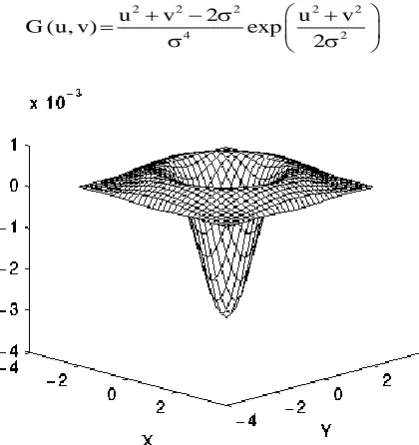
normally takes a single gray level image as input and produces another gray level image as output. Figure 1 shows the 2-D Laplacian of Gaussian function. The 2-D LoG function centered on zero and with Gaussian standard deviation σ has the form:
2 2 2 2 2
4 2
u v 2 u v
G (u, v) exp
2
Figure 1: The 2-D Laplacian of Gaussian (LoG) function. The x and y axes are marked in standard deviations (σ).
B. HEADLIGHT DETECTION
A vehicle headlight is detected using a Reflection Intensity (RI) map and a Reflection Suppressed (RS) map and it is incorporated in Markov Random Field (MRF) based on the analysis of the light attenuation model. Light from the headlight involves color at each pixel. So, each pixel intensity value has to be calculated.
RI is obtained by analyzing the attenuation model in the neighbouring region.
e e e
x,y x,y x,v
RI (x, y) | MI MA . (x, y).exp ( ) |
Reflection suppressed map can be find out by using a LoG(Laplacian of Gaussian) filter is used to obtain the reflection suppressed map.
RS is obtained from Laplacian of Gaussian (LoG) filter
2 24 2 2 2 2
2σ v u exp σ
2σ v u v) (u, G
where σ is the standard deviation. G is normalized to obtain a unity maximum value, and let the results be G = G/Max (G). According to the atmospheric scattering model the intensity of the light source decreases in an exponential manner, by the intensity along the diameter of the light source. When the LoG filter is applied on the image, a high value can be obtained in the exponentially decreasing regions around the headlight, whereas a negative value can be obtained in the light source region because of the negative value in the center of the LoG filter. Figure 3.4 shows the flow chart for headlight detection.
Vehicle‟s headlight can be detected by incorporating the RI, RS, and I into the MRF framework to detect the vehicle headlight, and the MRF is optimized by using the ICM algorithm.
2 k
k k 2
f ) 1
P(f | ) exp
2 2
a) Ω is initialized as a random label.
b) The label for each pixel in Ωk is updated by the
value that maximizes
P(f |
k
k) p(
k).
c) For the every iteration of ICM, parameters,
,
,
are updated as follows.k k k k
M (f | ); M(f | );
k k k k
D (f |
);
D(f |
);
Department of CIVIL, CSE, ECE, EEE, MECHNICAL Engg. and S&H of Muthayammal College of Engineering, Rasipuram, Tamilnadu, India
curve is tightening. If the vanishing point moves away from you or comes to center, the curve is straightening. It can be detected by using Hough Transform. Let the centroid and size of the headlight be Hn be (Ci,x, C i,y)
and An,i , respectively. Hni and Hn− 1,j are considered as
the same headlight object if the following condition is satisfied:
|Ai-Aj|< νA,1 n-1,j < νC,1
n-1,j = [(Ci,x, C j,x)2 + (Ci,y, C j,y)2
]
where νA,1 controls the area difference, and νC,1
controls the centroid distance. A trajectory image is maintained by connecting the centroid of headlights that are tracked. We exploit Hough transform to extract the straight lines in the resultant, and the vanishing point along lane is computed as the intersection of these straight lines. Let it be (ξ1, η1).
The Hough transform is a feature extraction technique used in analysis, computer, and digital image processing. The purpose of the technique is to find imperfect instances of objects within a certain class of shapes by a voting procedure. It can be detected by computing the centroid distance and the area difference between the two headlights. As one vehicle commonly has two headlights, therefore, it is necessary to pair each headlight with other headlights in the same frame. The symmetry of the headlights may not be valid because of the detection accuracy. The two headlights Hn i and Hn j
are paired as belonging to the same vehicle based on their size and centroid distance if the following conditions are satisfied:
|Ai-Aj|< νA,2 n-1,j < νC,3 n-1,j = [(Ci,x, C j,x)
2
+ (Ci,y, C j,y
)
2
]
where νA,2 controls the area difference between the paired headlights, and νC,3 controls the centroi distance between them. For each headlight pair, we can obtain a straight line.
Since short lines may produce a large error, therefore, the straight lines whose lengths are more than l are selected, and the intersection of the entire detected headlight pairs are computed as the vanishing point vertical to the lane; let it be (ξ2, η2). Calculate the intersection for both lines. Now consider the centroid
distance, the area change, and the vanishing point deviation to track headlights and apply in bidirectional reasoning algorithm. For the area change between headlight Hn,i and Hn−1,j , we define their area ratio
i n
j n
, , 1
as
ni j
n
, , 1
= ( ) ) (
Aj Ai Max
Aj Ai Min
The vanishing point deviation is defined as the distance between the centroid of Hn−1,j and the line connecting
(ξ1, η1) and the centroid of Hi. Let it be Θ[(ξ1,
η1)/(Ci,x,Ci,y),(Cj,x,C j,y)]. Now apply a bidirectional
manner and associate Hn i and Hn−1, j as the same
headlight if they both have the minimum distance to each other, i.e.,
D i,j = Min (Di,1,Di,2, . . . , Di,k−1)
D i,j = Min (D1,j,D2,j, . . . , Dk−1,j)
For the two headlights of the same vehicle, the distance between their centroid should not be too large or too small with respect to the headlight‟s area Ani.
D. VEHICLE SPEED ESTIMATION
Department of CIVIL, CSE, ECE, EEE, MECHNICAL Engg. and S&H of Muthayammal College of Engineering, Rasipuram, Tamilnadu, India
Figure 2: Trajection of the Headlight
Speed of the vehicle is computed by exploiting the trajectories of the headlight pairs. Under perspective projection, a 3-D point X in space is projected to an image point m via a rank-3 projection matrix as follows:
s1m = PX = K[R, t]X IV. CONCLUSION
The proposed night time traffic surveillance system consists of headlight detection, headlight tracking and pairing, and vehicle speed estimation. First, vehicle headlight is detected by using reflection intensity map and reflection suppressed map based on the analysis of light attenuation model. Second, the headlight is tracked and paired by utilizing the bidirectional reasoning algorithm. Third, the trajectory of the vehicle‟s headlight is employed to calibrate the surveillance camera, and the vehicles‟ speed is subsequently estimated. Experimental results on typical scenes show the effectiveness of the proposed method on headlight detection, tracking, and pairing. In comparison with state-of-the-art methods, the proposed method is simple and can detect the vehicle headlight robustly in the presence of strong reflection. Furthermore, the problem of headlight tracking and pairing and speed computing are combined and jointly considered in the proposed method.
REFERENCES
(1) Rita Cucchiara, Massimo Piccardi, and Paola Mello (2000) „Image Analysis and Rule-Based Reasoning for a Traffic Monitoring System‟ IEEE Transactions on Intelligent Transportation Systems, Vol. 1, No. 2 pp.119 130.
(2) Ronan O‟Malley, Edward Jones and Martin Glavin (2010) „Rear-Lamp Vehicle Detection and Tracking in Low - Exposure Color Video for Night Conditions‟ IEEE Transactions on Intelligent Transportation Systems Vol. 11 No. 2 pp.453-462.
(3) Robert.K (2009) „A Robust Framework for Multi-vehicle Detection, Classification and Tracking‟, IEEE Conf. Adv. Video Signal Based Surveillance pp. 1-6.
(4) Jien Kato, Toyohide Watanabe, Sébastien Joga, Ying Liu, and Hiroyuki Hase (2004) “An HMM/MRF-Based Stochastic Framework for Robust Vehicle Tracking” IEEE Transactions on Intelligent Transportation Systems, Vol. 5, No. 3 pp.142-154. (5) Wei Zhang, Q. M. J. Wu, Guanghui Wang, and Xinge
Yu,(2012), „Tracking and Pairing Vehicle Headlight in Night Scenes‟, IEEE Transactions on Intelligent Transportation Systems vol. 13, no. 1.