University of Windsor University of Windsor
Scholarship at UWindsor
Scholarship at UWindsor
Electronic Theses and Dissertations Theses, Dissertations, and Major Papers
2010
Non-destructive investigation of thermal diffusivity in a layered
Non-destructive investigation of thermal diffusivity in a layered
material using finite difference modeling
material using finite difference modeling
Ghazal Ghodsi
University of Windsor
Follow this and additional works at: https://scholar.uwindsor.ca/etd
Recommended Citation Recommended Citation
Ghodsi, Ghazal, "Non-destructive investigation of thermal diffusivity in a layered material using finite difference modeling" (2010). Electronic Theses and Dissertations. 8245.
https://scholar.uwindsor.ca/etd/8245
This online database contains the full-text of PhD dissertations and Masters’ theses of University of Windsor students from 1954 forward. These documents are made available for personal study and research purposes only, in accordance with the Canadian Copyright Act and the Creative Commons license—CC BY-NC-ND (Attribution, Non-Commercial, No Derivative Works). Under this license, works must always be attributed to the copyright holder (original author), cannot be used for any commercial purposes, and may not be altered. Any other use would require the permission of the copyright holder. Students may inquire about withdrawing their dissertation and/or thesis from this database. For additional inquiries, please contact the repository administrator via email
Non-destructive Investigation of Thermal Diffusivity
in a Layered Material Using Finite Difference
Modeling
By
Ghazal Ghodsi
A Thesis
Submitted to the Faculty of Graduate Studies
Through the Department of Physics
in Partial Fulfillment of the Requirements for
the Degree of Master of Science at the
University of Windsor
Windsor, Ontario, Canada
2010
1*1
Library and Archives CanadaPublished Heritage Branch
395 Wellington Street OttawaONK1A0N4 Canada
Bibliotheque et Archives Canada
Direction du
Patrimoine de I'edition
395, rue Wellington Ottawa ON K1A 0N4 Canada
Your file Votre reference ISBN: 978-0-494-62713-6 Our file Notre reference ISBN: 978-0-494-62713-6
NOTICE: AVIS:
The author has granted a
non-exclusive license allowing Library and Archives Canada to reproduce, publish, archive, preserve, conserve, communicate to the public by
telecommunication or on the Internet, loan, distribute and sell theses
worldwide, for commercial or non-commercial purposes, in microform, paper, electronic and/or any other formats.
L'auteur a accorde une licence non exclusive permettant a la Bibliotheque et Archives Canada de reproduire, publier, archiver, sauvegarder, conserver, transmettre au public par telecommunication ou par I'lnternet, prefer, distribuer et vendre des theses partout dans le monde, a des fins commerciales ou autres, sur support microforme, papier, electronique et/ou autres formats.
The author retains copyright ownership and moral rights in this thesis. Neither the thesis nor substantial extracts from it may be printed or otherwise reproduced without the author's permission.
L'auteur conserve la propriete du droit d'auteur et des droits moraux qui protege cette these. Ni la these ni des extraits substantiels de celle-ci ne doivent etre imprimes ou autrement
reproduits sans son autorisation.
In compliance with the Canadian Privacy Act some supporting forms may have been removed from this thesis.
Conformement a la loi canadienne sur la protection de la vie privee, quelques
formulaires secondaires ont ete enleves de cette these.
While these forms may be included in the document page count, their removal does not represent any loss of content from the thesis.
Bien que ces formulaires aient inclus dans la pagination, il n'y aura aucun contenu manquant.
• + •
Author's Declaration of Originality
I hereby certify that I am the sole author of this thesis and that no part of this thesis has been
published or submitted for publication.
I certify that, to the best of my knowledge, my thesis does not infringe upon anyone's copyright
nor violate any proprietary rights and that any ideas, techniques, quotations, or any other material from
the work of other people included in my thesis, published or otherwise, are fully acknowledged in
accordance with the standard referencing practices. Furthermore, to the extent that I have included
copyrighted material that surpasses the bounds of fair dealing within the meaning of the Canada
Copyright Act, I certify that I have obtained a written permission from the copyright owner(s) to
include such material(s) in my thesis and have included copies of such copyright clearances to my
appendix.
I declare that this is a true copy of my thesis, including any final revisions, as approved by my
thesis committee and the Graduate Studies office, and that this thesis has not been submitted for a
higher degree to any other University or Institution.
ABSTRACT
A finite-difference model for simulations of thermal wave propagation in a layered
material is discussed. The method is based on the implicit scheme in solving the partial
differential heat equation. According to the conventional implicit methods of solving the heat
equation, a large set of equations must be solved to find the temperature distribution of the object
at any time. This will cause a serious problem when working with large samples or experiments
of long duration as well as generalizing the method to two and three dimensions. To avoid this
complication, the concept of sparse matrices is successfully utilized to accelerate the solution of
a large system of equations while simulating each time step, as well as reducing the computer
memory consumption.
Parker's method of evaluating the thermal diffusivity of a material is tested by this approach. The
model proves to give reliable results for thermal diffusivity measurement in ID and 2D Cartesian
To my one and only: Kiyan
ACKNOWLEDGEMENTS
[ want to express my sincere thanks to the people who gave me direct or indirect support during
my graduate study and research at the University of Windsor.
My sincere appreciation first goes to Dr. Roman Maev for his constant and continued support
which brought me the peace of mind to freely think, study and research. His guidance both with
respect to the science behind this project and academic pursuit as a whole has been indispensable.
I would also like to thank Dimitry Gavrilo, who kept me in the right direction during my studies
with his great help and cooperation.
Furthermore, the role of Dr. Sokolowski, Dr. Reddish and Dr. Baylis as my committee members
is also greatly appreciated.
As well, I would like to thank Sarah Beneteau and Marrie Jeannette for many times they have
come to my aid.
This work was supported by the University of Windsor which its role was also of great
importance in conducting this study.
And finally. I would like to thank my wonderful husband for his endless support at each and
TABLE OF CONTENTS
AUTHOR'S DECLARATION OF ORIGINALITY iii
ABSTRACT iv
DEDICATION v
ACKNOWLEDGEMENTS vi
LIST OF TABLES xi
LIST OF FIGURES xii
SYMBOLS AND DESCRIPTIONS xv
1 Historical Background 1
1.1 Discovery of Infrared Radiation 1
1.2 Thermography as a NDT Tool 1
1.3 Advantages and Limitations 2
1.4 Fundamentals of Infrared Thermography 3
1.4.1 Emission 6
1.4.2 Absorption 7
1.4.3 Reflection 7
1.4.4 Transmission 8
1.4.5 Energy balance and Krichhoff s law 9
1.5 Different Approaches: active, passive 10
1.5.1 The passive approach 11
1.5.2 The active approach 12
1.6 Instrumentation for Infrared Thermography: 20
1.6.1 Detectors 20
1.6.2 Infrared Imaging Instrumentation 22
1.7 Summery 22
Chapter 2 23
2 Thermography Techniques 23
2.1 The Heat Equation 23
2.2 Pulse Thermography (PT) 23
2.2.1 Data Acquisition in Pulse Thermography 24
2.2.2 Defect Characterization 25
2.3 Lock-in Thermography 27
2.3.1 Data Acquisition in LT 28
2.3.2 Establishing Phase and Amplitude Information 29
2.4 Pulse Phase Thermography 32
2.4.1 Theory 32
2.4.2 Data Acquisition in PPT ! 34
2.4.3 Defect Characterization in PPT Using Depth Inversion 36
2.5 Thermal Diffusivity 37
2.5.1 Diffusivity Measurement 37
2.5.2 Flash method 39
2.6 Summary 41
Chapter3 42
3 Numerical Methods in Heat Transfer 42
3.1 Introduction 42
3.2 Finite Difference Method 42
3.3 Discrete Approximation of Derivatives 44
3.3.1 Finite Difference Approximation of First Derivative 44
3.3.2 Finite Difference Approximation of Second Derivative 47
3.4 Employing Finite Difference Approximation in Heat Equation 48
3.4.1 Types of Partial Differential Equations 48
3.4.2 Finite difference schemes in one dimensional parabolic system 49
3.5 How precise are numerical methods? 55
3.5.1 Stability 55
3.5.2 Fourier Method of Stability Analysis for Implicit scheme 56
Chapter 4 59
4 Implementation of Numerical Methods and Results 59
4.1 Employing Explicit Scheme in One Dimension 59
4.1.1 Set Temperature at the Boundaries 60
4.1.2 Boundaries Subjected to Convection 62
4.1.3 Boundaries Subjected to a Prescribed Flux 65
4.1.4 Explicit Scheme with Lock-in Thermography 67
4.2 Simple Explicit Method in 2-D Diffusion 68
4.3 Implicit Scheme in 1-D 73
4.3.1 Implementing the defect in a sample 79
4.3.2 Results and conclusion 83
4.3.3 Error Analysis in Thermal Diffusivity by Flash Method 84
4.3.4 Experimental evaluation of Flash method 85
4.3.4.1 Instrumentation 85
4.3.4.1 Results and Error Analysis 88
4.4 Implicit Method, Two Dimensions 90
4.4.1 Theory 90
4.4.2 Consideration on boundary condition 92
4.4.2.1 Heating the surface from the top 92
4.4.2.2 Heating the surface from the left side 92
4.4.2.3 Heating the surface from the right side 92
4.4.3 Problems with Implementing the Implicit Scheme and the Solution 94
4.4.4 Simulation, Implicit Method, 2-D 97
4.4.4.1 The coefficient matrix 97
4.4.4.2 Heater Location 100
4.4.4.3 Implementing Defects in a Sample 102
4.4.4.4 Heat propagation in 3Layers 104
4.5 Conclusion 106
Chapter5 107
5.1 Conclusion and Discussion 107
Appendix A 109
Appendix B 118
References 129
LIST OF TABLES
Table 4-1 Thermal Diffusivity (Flash Method) 83
Table 4-2 Experimental evaluation of thermal diffusivity by Flash method 88
Table 4-3 Thermal diffusivity from the simulated heat propagation using Flash
method 98
LIST OF FIGURES
Figure 1-1 Electromagnetic Spectrum 3
Figure 1-2 Radiation emitted by a surface (a) Directional distribution (b) Spectral
distribution. (Adopted from Maldague, 2001) 4
Figure 1-3 Features of a blackbody cavity (a) absorption, (b) emission from an aperture
(Adopted from Maldague, 2001) 5
Figure 1-4 Comparision of a blackbody and real surface distribution of radiance 6
Figure 1-5 Reflection (a) isotropically diffuse, (b) perfectly specular
(Adopted from Maldague, 2001) 8
Figure 1-6 Transmission process illustrated as a directional irradiance 9
Figure 1-7 Flux exchange in a semi-transparent medium 10
Figure 1 -8 Pulse thermography vs. Lock-in thermography (experimental configuration) 18
Figure 2-1 Experimental setup for active (optical) thermography by Transmission or
Reflection mode, source: http://www.visiooimage.com 24
Figure 2-2 (a) Temperature on the time domain 25
Figure 2-3 Temperature evolution curve after absorption a rectangular heat pulse: (1)
plate made of homogeneous material; (2) same plate containing a subsurface flaw (From
Maldague, 1993) : 26
Figure 2-4 Contrast evolution over subsurface defect (From Maldague 1993) 26
Figure 2-5 Input/ output modulated wave in lock-in thermography 27
Figure 2-7 Computation of phase, amplitude and thermographic images in LT. During
each heating cycle, the infrared camera takes four images (Top) local thermal waves are
reconstructed for any pixel (Busse, 1994) 30
Figure 2-8 Reconstructing the thermal wave in LT from 1024 data points (Wu. 1996). 31
Figure 2-9 Lock-in thermography apparatus 31
Figure 2-10 Time frequency duality (a) an ideal temporal pulse of zero duration and
infinite amplitude and (b) its frequency spectrum 32
Figure 2-11 Time frequency duality: (a) square pulse of 1 second duration centered at
Figure 2-12 Temperature evolution of pixel (i,j) through N thermograms 34
Figure 2-13 (a) Temperature (b) Amplitude and (c) Phase profiles for a pixel on the
frequency domain 35
Figure 2-14 Depth evaluation with phase contrast and blind frequency 36
Figure 2-15 Shapes of photothermal excitations useful for thermal diffusivity
measurements: (a) large area heating (b) line-heating (c) small spot heating (d) grating
heating and (e) circular heating 38
Figure 2-16 Plot of the back surface temperature during time 40
Figure 3-1 Mesh representing a one dimensional rod through several time steps 43
Figure 3-2 The finite Difference nodes associated with the simple explicit method 51
Figure 3-3 The finite Difference nodes associated with the simple implicit method 54
Figure 4-1 The 2-D finite difference nodes associated with the simple explicit
scheme 69
Figure 4-2 The GUI screenshot 78
Figure 4-3 Flash Method. Temperature vs. Time at the rear surface.
Heater Temperature: 373 (K), Thermal diffusivity: 10e-8(m2/s)
Figure 4-4 Thermal Diffusivity from Flash Method vs. Thickness, (red: a/;black: ec?) 81
Figure 4-5.a Thermal diffusivity vs. Pulse duration (red: a.\, black: 012) 82
Figure 4-5.b Thermal diffusivity vs. Pulse duration for the half time method 82
Figure 4-6 Experimental instrumentation 85
Figure 4-7 The relav system (Left), The Epoxy+T^o samples (Right)
86
Figure 4-8 The snapshot of the infrared camera record 87
Figure 4-9 The spot on the sample defined for temperature analysis and the plot of
its temperature evaluation vs. time
o /
Figure 4-10 Schematic presentation of converting a 2-D matrix to a 1-D
array q.
Figure 4-11 Schematic representation of the coefficient matrix (A) in implicit
method, heating from the top Q9
Figure 4-12 Schematic representation of the initial matrix (B) in implicit method, 93 heating from the left side bar
Figure 4-13 Schematic representation of the initial matrix (B) in implicit method,
heating from the right side bar 94
Figure 4-14 Implicit method in 2-D, the coefficient matrix for a sample of
< A 9 6
5 x 6
Figure 4-15 The coefficient matrix representation 97
Figure 4-16 Heat propagation in a sample 98
99 Figure 4-17 Finding thermal diffusivity in fig 4-16 using Flash method
Figure 4-18 Simulation of heat propagation in a sample with the heater at the middle
of the top side
Figure 4-19 Simulation of the heat propagation with the heater at the corner 101
Figure 4-20 Heat propagation simulation for a sample with a single defect inside
Figure 4-21 (up) Heat propagation simulation for a sample with a multiple defects
inside,(down) Flash method of finding thermal diffusivity for the same . „.,
sample
Figure 4-22 Heat propagation in a 3 layered sample, the middle layer is more heat
, t. 104
conductive
Figure 4-23Heat propagation in a 3 layered sample, the middle layer is less heat
Symbols and Descriptions
Symbol Page # Description
E
h
f
c
X
L , ,b:
k
T
Mh
a
£tt,TJ
M(TS)
Mh(T)
a
(Pa
<P,
pa.0.<t>.e',(/)')
<? , ,
4>>, 3 3 3 3 3 5 5 6 6 6 6 6 6 7 7 7 7 7 7 Electromagnetic energy Planck constant Frequency
Speed of light
Wavelength
Radiance
Boltzmann constant
Temperature
Emissive power •
Stefan's constant
Emissivity
Emissive power
Emissive power of a blackbody
T( A.&,</>)
t,
p a Tc,
TsL
A
r 2 D* M CO t S(x) <p(x{)A(xt)
f(f)
Ar AlrK
h
L D (',. 8 9 9 9 9 13 13 13 13 13 15 27 27 27 29 29 29 33 33 33 34 37 39 39 39 Transmittance Transmitted flux Reflection Absorbance Transmittance Thermal contrastTemperature of sound area
Temperature of defected area
Detectablity of thermal contrast
Depth
Defect visibility
Diffusion length
Angular frequency
time
Amplitude of the signal
Phase
Amplitude
Fourier transform of frequency
Amplitude of a square pulse
Duration of a square pulse
Fourier transform
Blind frequency
Sample's thickness
Density
T(U)
<Kx.)
r At
AY
£
40
44
51
51
51
56
Temperature at L, t
Temperature at Xj
Thermal diffusivity
Time interval
Space interval
Error in computational method
Chapter 1
1 Historical Background
1.1 Discovery of Infrared Radiation
Infrared discovery goes back to 1800 when Sir William Herschel (1738-1822),
German-born British Astronomer who is famous for discovering Uranus on March 13, 1773. He
discovered Infrared or as he phrased it, "Invisible rays" while reproducing Newton's
experience using a prism to pass sunlight through and separate white light into colors. He
measured the temperature of each color and noticed that temperature progressively
increased from the violet end to the red end of the visible spectrum. But it came to his
surprise that temperature increased further when he positioned the thermometer beyond
the red end. Further experimentation led to Herschel's conclusion that there must be an
invisible form of light beyond the visible spectrum [1].
1.2 Thermography as a NDT Tool
In many applications; from the production lines, where in situ inspection speeds up the
process, to the characterization of antique art treasures and cultural heritages, there is an
increasing demand for safety[2]. Destructive evaluations can be useful during the design
stages, but Non-Destructive Testing and Evaluation techniques (NDT&E) are helpful
inspection tools, since they allow to examine materials or components in ways that do not
impair future usefulness [3]. NDT inspection techniques though, are required to be
reliable, economical, sensitive, user friendly and fast. Moreover, the materials and
processes are constantly evolving; hence the inspection technique should be adaptable as
well [4].
Infrared Thermography (IT), among the various NDT techniques used nowadays, is
known as an attractive tool for non-contact inspections. Different thermal properties of
disbonds. etc.) are detected as thermal contrast assuming emissivity variations, reflections
from the environment and atmosphere attenuations are negligible.
Soon after its discovery, Infrared Thermography was used as a NDT tool. From the
earliest applications of Infrared NDT, was a patent in 1935 by J. T. Nicholas [5]. He used
a radiometer to verify the uniformity at which steel slabs are reheated in a steel-rolling
mill. In 1948 R. C. Parker and P. R. Marshall [6] investigated experimentally the
temperatures generated at sliding surfaces, especially between railroad wheels and the
brake blocks. The current flow in an electric power transmission line was studied by
Leslie and J. R. Wait in 1986 [7]. Infrared radiometry also made it possible to detect the
overheated components on circuit boards in 1961 [8].
In the mid 1960s when commercial infrared cameras became available, a wide range of
applications were developed continually for this non-contact, non-intrusive technique in
military, industrial, civil engineering, environmental and medical fields.
1.3 Advantages and Limitations
A thermographic survey is totally non-destructive and unlike X-rays and ultraviolet,
infrared is harmless to living bodies. It provides fast inspections (up to a few m2 at a
time) with minimal access requirements. Measurements in inaccessible areas which are
hazardous for other test methods may be done by this method. The system under study in
this method needs not to be shut down for inspection, and this not only cuts on the
expenses but also real time images enable immediate interpretation by a skilled
practitioner [9-11].
It is also important to mention some limitations to this method.
For applying this method to a large surface, a quick and uniform thermal stimulation is
difficult to achieve. For outdoor surveys, factors such as high winds, rain, standing water
on the roof. etc. may lead to thermal loss and surface cooling, thus affecting the reliability
of the interpretation. Cracks and disbands large enough to result in measurable change oi'
thermal properties are detectable in this method. Expensive tools and experience are
required to obtain and interpret the thermal images [9-11].
1.4 Fundamentals of Infrared Thermography
It is known that all bodies at a temperature above absolute zero (-273 C) emit
electromagnetic radiation regardless of their state. The energy and wavelength of the
emitted EM wave are related through the well known relation:
E = hf = ^ (1.1)
Hence the electromagnetic spectrum would look like figure (1-1).
Increasing Frequency (v)
i<>14 io22 ioM IO1* io'6 io14 in'2 IO1" lo8 IO*1 in4 io2 io° v(Hz)
I i I . I . I i i i i i i i i
y rays
400
Xrays UV JR
1
Microwave
i
i
FM Rad io w
i
AM ives
Long radio waves
io-"1 i o_ u io- 1 2 ur1 0 ip"8 I ;i(r* ur" i c1 io° io2 in4 io* ms X(m)
, . . - - - - " " " " ~ ~ ~ - - - - _ _ Increasing W a v e l e n g t h (?v) - »
Visible spectrum
500 600 Increasing Wavelength (K) in nm -»
700
Figure 1-1 Electromagnetic Spectrum [1]
While the visible light wavelength lies between 0.4 to 0.7 urn, thermal radiation falls into
This radiation is usually emitted from a small portion of the surface and includes a
variety of wavelengths and a distribution of energy. (Figure 1-2)
11
s
l
SPECTRAL DISTRIBUTION
DIRECTIONAL DISTRIBUTION
Wavelength
(a) (b)
Figure 1-2 Radiation emitted by a surface (a) Spectral distribution (b) Directional distribution. (Adopted from Maldague, 2001) | 3 |
As an important concept in radiometry, blackbody is explained as a perfect radiator. A
hlackbody is defined by Gustav Robert Kirchhoff (1824-1887) to be a surface that
absorbs all incident radiation of different wavelengths and directions without reflecting or
transmitting it. It also re emits this energy evenly in all directions until it is in equilibrium
with the environment. (Figure 1-3)
(a) (b)
Figure 1-3 Features of a blackbody cavity (a) absorption, (b) emission from an aperture (Adopted from Maldague, 2001) |3|
According to Planck's law, the spectral radiance of a blackbody in thermal equilibrium is
given by [12].
2hcl A'[exp(hc/AKT)-\]
^>.M^T) = —r ,7 , ! , , ^ „ W r a > - 'f f- ' (1.2)
L would be the power of the Blackbody (b) per unit surface area and per unit of solid
angel, h and K represent the Planck's constant (6.63 x 10"34 Js) and the Boltzmann's
constant (1.381 * 1023 J/K), c is the light's speed (3 x 1 0 s m/s) and T is the blackbody
temperature in Kelvin.
This equation predicts the energy radiated as a function of wavelength at temperature T.
integrating Planck's law over all wavelengths ranging from 0 to QO, the total radiant
M
h=
af
(1.3)known as Stefan-Boltzmann expression [12]. 0 = 5.6697 * 10"8 W/m2 K4)
1.4.1 Emission
Unlike a Blackbody, a rea/ surface does not absorb the incident radiation completely.
Emissivity is the relative amount of a real surface's thermal radiation to that of a
Blackbody under the same conditions of temperature (7^) and direction [12].
s{A.,Ts) =
M{Ts)
Mh(Ts)
(1.4)
Emissivity of a surface is a unit less parameter that changes between 0 for a whitebody
(perfect reflector) and 1 for a blackbody (perfect emitter). Figure (1-4) shows the spectral
distribution of a real surface in comparison with a blackbody.
Blackbody, T -Real s u r f a c e , T
Figure 1-4 Comparision of a blackbody and real surface distribution of radiance | 3 |
1.4.2 Absorption
The traction of the incident flux absorbed by the surface is called absorbance.
«'%>• (1.5)
Same as emissivity, absorbance is also dependent on the incident wavelength and
direction; however it is not affected by the temperature of the surface.
1.4.3 Reflection
Reflection is defined as the ratio of the incident radiation reflected by the surface and is
affected by the direction of both incident and reflected flux [12].
P(A,ej,e',<t>') = ^L±L (i.6)
This formula is not very convenient to work with, since for a given incident radiation, the
reflection in all directions should be considered. Hence in practice surfaces are
considered either to be isotropically diffuse or perfectly specular. As is depicted in figure
(1-5), an isotropically diffuse surface reflects the incident radiation uniformly in all
directions regardless of the incident radiation and a perfectly specular surface reflects the
Incident ray Radiation of uniform i - - ^ radiance
e = e i
Incident ray j Reflected ray
ia) JbL
Figure 1-5 Reflection (a) isotropically diffuse, (b) perfectly specular (Adopted from Makiague, 2001) |3|
1.4.4 Transmission
To define transmission for a semitransparent object, the possible scattering and
absorption by the particles inside should also be taken into account. That's why it is not a
simple problem. However on a macroscopic scale, transmittance is defined as the ratio of
the transmits flux in all directions to the directly incident flux [12].
T(A,0,t) = d<t>i,t (1.7)
It is also possible to integrate transmittance over all possible wavelengths (/: 0—+oo), and
that would be called the total directional hemispheric transmittance. (Figure 1-6)
Incident Rav 0
Semitransparent Medium
Transmitted flux
Figure 1-6 Transmission process illustrated as a directional irradiance
1.4.5 Energy Balance and Krichhoff s Law
Incident radiation on a semitransparent material is partly reflected by the surface and the
rest is either transmitted through the object or absorbed by it. However, as shown in
figure (1-7), the net flux should remain unchanged.
# • = £ + & + & (1.8)
Integrating equation (1.8) over all possible wavelengths and similar directional
conditions, properties expressed previously will be related as:
p + a + T = 1 (1.9)
For opaque objects (t = 0). (1.9) becomes:
Krichhoffs law relates absorption and emission for a blackbody [12].
s (k, 9', cp') = a (X, 0. <p) (1.11)
Although equation (1.11) only applies to a blackbody, it can still be used for a diffuse
surface for which emission and absorption are independent of spectral and directional
conditions [12]. For thermography inspections black painting is used to increase
emissivity and also to prevent reflections from environment.
Incident Reflection 4>i <«>r
Figure 1-7 Flux exchange in a semi-transparent medium
1.5 Differ en t Approaches: A dive, Passive
In order to investigate a structure with Infrared Thermography, there are two approaches
that can be used, passive and active. In the passive approach, the specimen and the
ambient are naturally at different temperatures (usually the specimen is at higher
temperature). While in the active approach, an external excitation source, such as heating
or cooling system needs to supply the thermal contrast between different parts of the
sample.
1.5.1 The Passive Approach
The passive approach is commonly used for civil engineering structures inspection,
maintenance, medicine and property evaluation. The material under investigation is
usually examined for abnormal temperature profile indicating an irregularity or possible
defect, void, etc.
In passive thermography, the key word is the temperature difference with respect to the
surrounding, often referred to as the "delta-T" or the "hot spot." A delta-T of 1 to 2 °C is
generally found suspicious while a 4°C value is a strong evidence of abnormal behavior
[10]. however there have been more sophisticated applications of this approach rather
than only qualitatively pin down the anomalies. These investigations are more
complicated and need thermal modeling.
For instance in a reported application [15], a numerical method was developed to
simulate the heating process of needles used to sew fabrics in the automobile industry.
(Seat cushions and backs, airbags, etc.) The friction between the needle and the fabric
(usually synthetic) in high speed sewing generates heat which will cause worn or broken
thread and damages the thread as well as burns the fabric and weakens the needle itself.
Experiments on the plant floor have shown the temperature raise of up to 100-300°C with
the sewing speed of 1000 to 3000 rpm.
The model uses different factors such as needle design, thread fabric properties and
sewing speed to predict the temperature distribution in the needle during the sewing
process as well as the time needed to reach a steady state. By understanding the heating
process, they can reach the optimized operation through changes in needle geometry,
1.5.2 The Active Approach
Unlike the passive approach, in the active infrared thermography the characteristics of the
stimulus is known and that makes it possible to get quantitative results such as the depth
of a possible defect, hence it's widely used in NDT&E. Depending on the different
methods of data acquisition and data processing, various active thermography approaches
has been developed.
1.5.2.1 Pulsed Thermography (PT)
In Pulse Thermography, the object surface is being stimulated by a heating pulse and the
data acquisition is performed by monitoring the temperature evolution of the surface after
it starts to cool down. Lamps, flash lamps, scanning lasers or hot air jets are the most
popular heating tools and Infrared cameras are used to monitor the signal in the transient
area. There are two possible modes of data acquisition in PT. Reflection mode and
Transmission mode. In the Reflection mode, the heat source and the Infrared camera are
both placed on the same side of the specimen while in the transmission mode, the camera
faces the back surface of the sample. Reflection mode is preferred in cases where the
defect is closer to the heated surface or the rear surface is not accessible. The signal
received by the IR camera (Thermograms) is then being processed to estimate the
characteristics of the subsurface defect such as size, depth and thermal resistance.
Cielo in 1984 was the first who came up with the idea of pulsed approach [16]. He
applied this technique on the aluminum coating plasma sprayed on aluminum substrates
with artificial defects between the coating and the substrate. The parameters of interest
were the thickness, adhesive and cohesive strength. In order to interpret the experimental
results, he developed a numerical model based on the inversion procedure and got
encouraging results.
In ll)85. for the first time Balageas et al. developed an analytical model using finite
difference method to study the thermal decay in a coated substrate [17]. Given the
thermal properties and the thickness of the substrate, the model could evaluate the
thermal properties and the thickness of the coating and the thermal contact resistance of
the interface. Cielo and Krapez used this technique to remotely measure the thickness of
oil film on water. They could evaluate the oil thickness up to 1 mm with the error range
of 0.1 mm [18]. However, there are some practical limitations in adopting this method for
open-air environmental applications. The problems could rise by the energy absorption of
the laser pulse by the atmospheric aerosols or the oil film immerging into water.
One of the problems with thermal images developed by PT was the blurring. It was
assumed that loss of information during the data acquisition was the cause of blurring,
however in 1992, Favro et al [19] could remove the blurring by developing an algorithm
which performs a mathematical inversion of the scattering process to the experimental
data. As proved by Vavilov (1992) [20], the reverse method will predict more than one
combination of defect characteristics for a single thermogram. Thus, it was suggested that
the iterative calculation should be done knowing some of the defect's parameters, a priori
beforehand [21]. However, these methods turned out to be time consuming and only
applicable to some specific cases.
The difference between the thermal properties of the defected and non-defected (sound)
areas causes the thermal contrast which is measured and evaluated in PT.
The larger the thermal contrast, the more detectable the damaged area. Cr not only
changes by different atmospheric conditions and the device precision, but also is affected
by the size and depth of the defect. Smaller defects and deeper-located ones will result in
lower thermal contrast, hence harder to evaluate. It is understood that the loss in Cp is
proportional to the cube of depth:
Maldague (2002) [22] suggested to use a rule of thumb that says the radius of the smallest
detectable defect should be at least one to two times larger than its depth under the
surface.
To study the limits in defect evaluation by infrared thermography, Meola et al ran a
thorough experiment on composite specimens with external material as defects [23].
Results proved the key role of the thickness in defect visibility, meaning that a thin large
defect is more difficult to detect than a thick small one at the same depth.
However, there are a few drawbacks in these computational approaches leading to some
inaccuracies. One of such was the fact that not always a priori parameter of the defect
was available. Also the sound area was assumed to have evenly distributed temperature
over the surface.
In 2002, Pilla et al [24] solved the one dimensional Fourier equation assuming a Dirac
pulse applied to a homogeneous semi-finite plate:
AT = -T£=~ (1.14)
•sjnpCk y/t
In this equation, Q is the total energy absorbed and yjpCk is called thermal effusivity
(e). This equation defines the temperature of sound area locally as a function of time.
Hence the variation of effusivity with time is studies to evaluate the depth and thermal
resistance of the defect zone.
This approach brought some distinctive advantages to PT by introducing the New
Absolute Contrast (NAC) based on the reconstruction of the temperature in the sound
area [24].
Since thermal contrast is evaluated based on the total energy (Q) and Q is affected by
non-uniform heating and convection, Peng and Almond (1998) [25] proposed to replace
it with defect visibility.
The subscripts d and s represent the surfaces above the center of the defect and the sound
area.
Although pulse thermography is the sufficient choice in many applications, it is affected
by the local variation of the emissivity coefficient and non-uniform heating that can mask
the defect visibility. The emissivity problem may be solved by painting the surface, but
this could be a solution only for parts where this surface finish is allowable [21].
Various methods based on different stimulating or processing techniques are being
reviewed in the following sections.
1.5.2.2 Lock-In Thermography (LT)
Heat injection during the short time of a pulse (e.g. typically 10 ms for a powerful flash
lamp) may cause initially high temperature on the surface. Another surface heating
method is by modulated heat deposition in which energy is distributed over a longer
period of time. Therefore it reduces the thermal load of the inspected component to a
power density which is typically below the one of sunshine at noon in summer [26].
The basic idea in modulated or Lock-in thermography (LT) is submitting the specimen
under study to a periodic (sinusoidal) temperature stimulant. In this case, highly
attenuated and dispersive waves will form inside the sample and they are known as
"thermal waves" [10]. Like all other waves, thermal waves reflect from the boundaries
and phase of the sinusoidal wave pattern at each point which can be used to evaluate the
temperature variation. The phase image can be used to directly specify not only the size
but also the depth and thermal resistance of any kind of imperfection in a sample.
Carlomagno and Berardi came up with the idea of modulated thermography in 1976 [27].
Further investigation to utilize NDT of materials with this method was done by Beaudoin
et al (1985) and Kue et al (1992) [28, 29]. In 1994, Busse et al used LT for depth
profiling of fiber orientation in composite laminates [30]. Since then LT has been used
for defect detection in veneered wood (Wu 1994) [31], measure thickness, density and
porosity of ceramic coatings (Wu et al 1996a, Rantala et al 1996) [32, 33] and inspection
of aircraft components (Wu et al 1996b 1998) [26, 34].
Meola and his group (2002, 2003, 2004) [35-40] at the University of Naples investigated
in the capability of this method to deal with other applications such as measurements of
material thermal diffusivity, evaluation of assembly ways like adhesive bond joints, as
well as control of bonding improvements after surface plasma treatment.
For a thermal wave modulated at frequency co, the thermal diffusion length is given by
this relationship:
M = M (1-16)
Where a is the thermal diffusivity of the material and the wave frequency is / = (O/2TI.
While u is the maximum depth range in amplitude image, the maximum thickness that
can be inspected in a phase image is proved by Busse and Rosencvvaig (1980) and Busse
(1982) [41, 42] to be:
/; = l-8ARr (1.17)
Hence the penetration depth of thermal waves in the material depends on the properties of
the material (heat conductivity, heat capacity and density) as well as the wave cycle time.
The slower the wave, the deeper it can penetrate in the material. To start a test, usually
one would start to investigate the surface layer using high frequency waves, then
reducing the frequency to observe deeper layers until the whole thickness is examined.
From limitations of this approach, one is the low frequency range needed for
investigation of thick materials with low thermal diffusivity which not all the heat flux
modulators can provide. Also it is possible to miss a defect because of not choosing a
proper frequency. In practice lock-in thermography is rather time consuming for
evaluation of thick materials with low thermal diffusivity.
More recently in 1999, Dillenz et al used an ultrasonic transducer attached to the sample
[44]. Their method has the advantage of selective heating of only the damaged area, and
is proved to detect deeper and smaller defects. From the applications of this method are
detection of corrosion, vertical cracks and delaminations. In the next section a
combination of the previous methods named Pulsed Phase Thermography (PPT) is
described.
1.5.2.3 Pulsed Phase Thermography (PPT)
The idea behind Pulse Phase Thermography is to combine two previous methods in a way
that enables us to make use of the advantages of PT and LT while avoiding their
drawbacks. Data acquisition in Pulse thermography is fast and straight forward while in
LT, more specialized equipment is needed plus the experiment is rather time consuming
in LT. On the other hand, the data in PT is highly affected by thermal, optical and
geometrical surface characterizations and the environmental reflections, while using the
phase images to process the data in LT makes it less sensitive to these conditions.
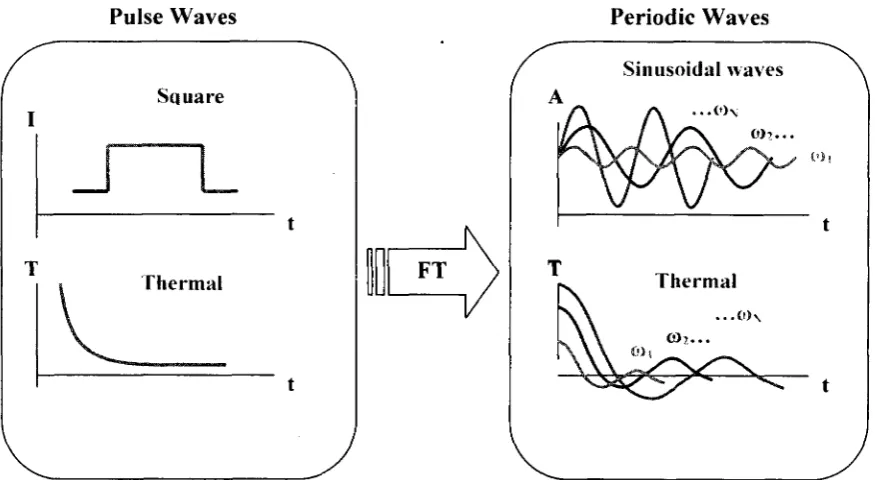
frequencies. (Figure 1-8) Based on this theory, in PPT as in PT. the sample is pulse
heated, yet the Fourier transform on the temporal decay wave in the specimen
unscrambles the mix of frequencies in each pixel. So that, a phase or magnitude image of
each pixel is provided as in Lock-in Thermography.
Pulse Waves
S q u a r e
J L
T h e r m a l FT
Periodic Waves
Sinusoidal waves
. . ( 0 \
Figure 1-8 Pulse thermography vs. Lock-in thermography (experimental configuration)
Historical Notes on Pulsed Phase Thermography
Pulse Phase approach was introduced by Maldague and Marinetti in 1996 [44]. Maldague
and his group kept working on this method and reported their progress and results on its
application. Given the non- linear and noisy character of pulsed thermographic data,
inverse solutions are difficult to reach, that's why PPT was only used as a qualitative
defect detection approach for the first couple of years from its discovery until in 1998.
Maldague and his group tried to get quantitative results using neural networks [46|.
Neural network approach was chosen due to its ability to work with non linear problems
with missing or noisy data. Although this approach opened new windows to quantitative
investigations in infrared NDT, high sampling frequency was needed for the data
acquisition system, depending on the material's thermal diffusivity.
A practical drawback of Fourier Transformation is the infinite extensions on time axis of
the basis function which causes information loss on the time evolution of the spectral
properties of the signal. The time information is needed for defect depth retrieval, so
another transform rather than Fourier Transform is needed. In 2000, Maldague et al
adopted wavelet transform for signal processing [47]. This method provided the
frequency analysis without missing on time information. However, the last two
approaches proved to be too lengthy in computational routines to be applicable in most
NDT processes. Later in 2004, they proposed a new depth retrieval approach based on
absolute phase contrast defined as [48].
A(p=<pd'-(ps (1-18)
Where the subscripts d and s stand for the defect and sound areas. They proved that the
depth changes with the blind frequency (fb), frequency at which a defect generates enough
phase contrast to be invisible, as:
zKafb1/2 (1.19)
They also tested their theory on Plexiglas and Aluminum, two materials with low and
high conductivity and the results well agreed with the theory [48]. Following this work,
steel plates with flat bottomed holes were studied by this group in 2005 [49]. The defects
were located at different depths ranging from 1 to 4.5 mm and the results showed the
same correlation between the blind frequency and the defect depth.
PPT has proved to have a great potential for NDT applications and investigations on its
1.6 Instrumentation for Infrared Thermography:
When it comes to experimental analysis, the set up and instrumentation is of great
importance. This is an overview of investigation tools, such as detectors, radiometers,
infrared cameras and a brief review of the methods to apply various thermography
techniques and data acquisition.
1.6.1 Detectors
Optical receivers are the main part of infrared radiometry systems. As of 1999, the
worldwide IR detector market was estimated to be $10 billion increasing by rate of 30%
every year [51]. An infrared detector or sensor is used to convert the radiant energy to
some other assessable quantity such as the electrical signal. There are two types of
sensors: thermal detectors and photonic detectors.
1.6.1.1 Thermal Detectors
In thermal detectors, the incident radiation raises the surface temperature which changes
the electrical conductivity of the heated material and in turn affects the output signal.
Thermal detectors response is independent of incident wavelength and this characteristic
makes it unique in this way. To discuss the sensitivity of thermal detectors, one should be
familiar with effective conductivity GR which is given by [52]:
GR=4o?A (1.20)
Where T represents the sensor temperature, a is the Stefan-Boltzmann constant, and A is
the detector-sensitive area. Then the detectivity limit is [51 ]:
£ * = , — V ~ (1-21)
V 4kT2G
k is the thermal conductivity and G is the limit of GR.
Depending on the physical property affected by the surface heating in the thermal
detector, there are different types of thermal detectors.
Bolometers, are the ones in which the electrical conductivity is the changing factor.
Thermopiles are made from many thermocouples connected in series or in parallel.
Temperature difference generates voltage difference in each thermocouple through
Thompson effect. The signal in Pneumatic detectors is generated by pressure variation of
a definite volume of gas. Another type of thermal detectors is Pyroelectric detectors that
make use of the Pyroelectric crystals. As introduced in 1984 by Granicher, temperature
change in Pyroelectric crystals produces electric polarity [52]. Temperature variation in
the detector's surface Pyroelectric crystals causes the charge variation and thus a transient
current to be picked up. Liquid crystals are also used as thermal sensors. When
illuminated by white light, they reflect color light from red to violet under temperature
changes providing the resolution of up to 0.01 °C [50].
1.6.1.2 Photonic Detectors
In Photonic detectors, incident photons on a semi conductor material will generate
excitation which is directly measured by the detector. The incident photons on
photocathode will pull away electrons from the valance to the conduction atomic band.
This method prevents unnecessary heating of the sensitive surface. There are two types of
photonic detectors: photoemissive and quantum
In photoemissive photonic detectors, the current (electron flow) will generate the
resulting signal while in quantum detectors either the change in conductivity or the
generated voltage is being measured. Since there is no heating involved in this process, it
is much faster than thermal detectors and the use of solid state material allows these
1.6.2 Infrared Imaging Instrumentation
In order to get one or two dimensional images from the detector, there are two main
approaches: using a single detector attached to an electromechanical scanning device, or
using an array of individual IR detectors with no movement applied (Focal Plain Arrays).
Since first introduced in 1973 by Shepherd and Yang [53], large arrays of 512 x 512 has
been produced by different companies and they are the most popular IR imaging tools in
today's technology. An infrared camera is made of FPA, the appropriate optics and
electronics and cooling system. There are two readout tools for the FPA, Charge Coupled
Device (CCD) and Complementary Metal Oxide Semiconductor Device (CMOSD).
CMOSD is less expensive than CCD and enables windowing (reading a section of the
array rather than the whole data) however; it has higher noise and less sensitivity. In
today's applications, CCD leads the scientific and technical field while CMOSD is being
employed in the applications such as surveillance, camcorders, snapshots, etc.
1.7 Summery
In this chapter, basic and practical concept of infrared thermography was reviewed. Also
a brief review on various NDT applications for IR thermography since its discovery was
presented. Pulse thermography and lock-in thermography as two main methods in IR
thermography and their advantages and drawbacks were described. As a conclusion,
pulse phase thermography, as a combination of both Pulse Thermography and Lock-in
Thermography was found to benefit the advantages of both methods without sharing their
imperfections.
In the imaging process, thermal and photonic detectors are explained based on their
method of converting the thermal variation of the surface to an electric signal. For further
signal processing, two types of devises (CCD and CMOSD) are used for different
applications. The next step in IR thermography would be image processing methods
which will be reviewed in the next chapter.
Chapter 2
2 Thermography Techniques
In this chapter, the main principals of heat propagation in a material are presented as well
as different numerical solutions to the heat equation. Mathematics of various image
processing methods in IR thermography is discussed to prepare for the logic behind the
algorithm developed in the next chapter.
2.1 The Heat Equation
The one dimensional heat equation is [55]:
dT(x,t) d2T(x,t) n , „ ,„ „
—y- ^ - = a V - ^ 0<x<L, t>0 (2.1)
dt dx~
In this equation, a = k/pc is the thermal diffusivity and is a property of the material with
k, p and c being heat conductivity (W.m"'.K"'), density (kg.m"3) and specific heat (J. kg"1.
K"1). T is the transient heat function in a semi-infinite material with thickness L.
This equation can be solved both for a pulse or periodic thermal waves.
2.2 Pulse Thermography (FT)
Pulse thermography is a popular method in IR thermography in which the specimen is
pulse heated and the temperature decay is recorded. Assuming the heat pulse to be perfect
Dirac delta function (in practice however, a pulse with very short duration is used), the
T{z.t)=T0 + O
exp(-4at (2.2)
In this equation, z represents the depth and O is the energy absorbed by the surface [J/trr]
and To is the initial temperature [K].
To study the temperature behavior at the surface (r=0), Eq. (2.2) becomes:
r(o,/) = r
0+-
Q e^M(2.3)
e being effusivity and defined as Jkpct
2.2.1 Data Acquisition in Pulse Thermography
A typical experimental setup for active thermography is illustrated in figure (2-1). First
the thermal pulse is sent to the specimen's surface. Second an infrared camera records the
thermal decay of the surface. The heat source and the camera are either placed on the
same or opposite sides of the sample depending on the inspection method
(Reflection/Transmission) selected.
Kciii.
^vr-uLroiu/mior |
• • » '
m
Ti
L J
IJUUUUB
ik C'ii;:u-J
Fi«ure 2-1 Experimental setup for active (optical) thermography by Transmission or Reflection mode, source: http:/Av\v\v.visiooimage.com
The data is then recorded in 3D matrices, containing both spatial (x-y coordinates) and
temporal (i coordinate) information. To process the data there are two options of (1)
working at pixel level which is the temperature changes of a fixed point in space through
time or (2) at 2D images or thermograms which are the temperature profile of the surface
on time domain. (Fig. 2-2)
X
1
o
,V
ti t2 tN
t
Figure 2-2 Thermograms on the time domain, it is also possible to study the temperature behavior of pixel (i,j) through time.
2.2.2 Defect Characterization
The temperature profile of a sample can be used for subsurface defect detection purposes.
After the heat pulse is employed on the sample's surface, it reaches the subsurface layers
and drops quickly due to diffusion and also radiation and convection losses. However, a
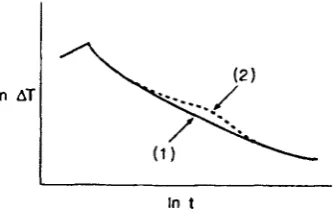
defect under the sample's surface will reduce the diffusion rate. Figure (2-3) illustrates
the temperature decay curves of two samples of the same material with and without a
subsurface defect. They behave similarly the first instants after the heat pulse is applied,
however as soon as the heat front reached the defect area with different ejfusivity. the heat
exchange rate with environment changes hence the difference in temperature above the
In AT
In t
Figure 2-3 Temperature evolution curve after absorption a rectangular heat pulse: (1) plate made of homogeneous material; (2) same plate containing a subsurface flaw (From Maldague, 1993)
This allows finding temperature contrast which is defined as:
C(t) = TM(t)-T hl(t) (2.4)
Thermal contrast is the base of many defect detection analyses. Some methods employ
the time and temperature at which the maximum of the peak is located for each pixel
(figure 2-4), to reconstruct Maximum Contrast timegrams or thermograms. Also half the
time of maximum of thermal contrast curve [57] and the slope of the curve [58] have
been used to indicate the size, depth and thermal resistance of the defect.
0.9 0.8 0./
0 6 0 5 0 4 0 3 0 2
0.1
0 0
25 30
This method provides good results as long as the sample is homogenous with fairly
shallow defects. Moreover, non-uniformity in heating process is practically inevitable,
which makes the thermal contrast curve difficult to interpret.
2.3 Lock-in Thermography (LT)
In Lock-in thermography (LT), instead of a heat pulse, modulated heat is generated by
the heat source and delivered to the surface. The input modulated wave is defined by its
angular frequency co and its magnitude / , the thermal wave generated in the sample will
propagate at the same frequency but different amplitude (A) and also a shift in the phase
value (</>). (Figure 2-5)
Input |l,«| Output |A.co.ipl
r \ I \
\J \j t <t> \J \J t
Figure 2-5 Input/ output modulated wave in lock-in thermography
The one dimensional solution to Eq. 2.1 for a modulated heat source is expressed as [60]:
T(iJ) = T0e\p(-~ )cos ITVZ
A at (2.5)
It is assumed that the thermal wave is propagating in a homogeneous semi-infinite
material where Ttl is the temperature of the surface right after stimulated by the source
a is thermal diffusivity of a material and expressed as [60]:
k,p,cp are thermal conductivity, density and specific heat.
2.3.1 Data Acquisition in Lock-in Thermography
Lock-in thermography has the advantage of not being a point by point imaging process.
In the conventional thermography methods, a laser beam would stimulate the surface at a
certain point and the detector would pick up the locally generated thermal wave from the
same point. The Fourier analysis is then to be performed on the read out signal to provide
the amplitude and phase information of that point. One drawback to the point by point
scanning process is time concerns. The measurement time should be long enough to
cover one complete modulation cycle at minimum; for instance, it would take 5 seconds
for a thermal wave with frequency of 0.2 Hz to complete its cycle. Now this should be
multiplied by the number of pixels (usually as order of 10? pixels) to obtain the total data
acquisition time. This approach could take so long for a large sample that makes it
inapplicable to the industry.
However, this problem would be solved by using an extended heating source instead of
the point heating [59]. Also it is possible to employ an infrared camera as a thermal
detector array. A Fourier transform should be performed on the signal from each pixel to
get the magnitude and phase of the modulation.
One concern is that the process should not take longer than the data acquisition itself. In
1998, Wu and Busse [59] found that the process would be particularly fast and easy using
a sinusoidal heat injection.
2.3.2 Establishing Phase and Amplitude Information
Lt works on the base of stimulating the sample's surface by modulated heat and
observing the temperature variation over the surface to reconstruct the responding
thermal wave. In case of a sinusoidal heat injection, the temperature field is also a sine
wave which can easily be recovered from three or four data points in a modulation cycle.
As shown in figure 2-6, the reference signal is reconstructed from 4 equidistant data
points, Si (i = 1 to 4) being the detector signals at pixel xi. The Amplitude A and phase <p
are [59].
<p(x,) = arctan S,(s,)-S,(s,)
S2(*,)-S4(x,X
(2.8)
Figure 2-6 Computation of phase, amplitude and thermographic images in LT. During each heating cycle, the infrared camera takes four images (Top) local thermal waves are reconstructed for any pixel (Busse, 1994)
As it is clear from equation (2.8), phase image is less affected by inhomogeneous
illumination, surface emissivity variation [59] or the reflection from the environment
[61]-Although the image can be recovered by only four data points, in practice one would
prefer to work with different modulation frequencies which would fit more than four
points in a complete cycle. Moreover, working with more data points will reduce the
noise. In that case, as shown by Wu in 1996 [62], all points in one 90°-interval can be
averaged to 1 point which is the corresponding 5, in equations (2.8) and (2.9). (Fig. 2-7)
Excitation 1024 Thermography 4 averaged thermo-images graphy thermo-images S1....S4
Figure 2-7 Reconstructing the thermal wave in LT from 1024 data points (Wu, 1996)
Finally other than the modulated heat injection, a lock-in apparatus is similar to that of
pulse thermography. (Figure 2-8)
IR-camera
HL.
Sample Thermal wave source
»<8*ar"i
Phase image
Lock-in module
Control unit
2.4 Pulse Phase Thermography (PPT)
2.4.1 Theory
Pulse phase thermography (PPT) is in fact a combination of the two previously described
Lock-in thermography and Pulsed thermography methods. PPT utilizes the time
frequency duality to extract phase images from PT results using Fourier transform, the
well known mathematical formulation in transform analysis.
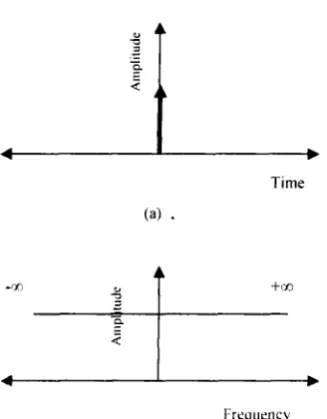
In theory, an ideal Dirac pulse of null duration can be transformed to a flat distribution
over frequencies ranging from -oo to +00 in the frequency domain. (Figure 2-9)
Time
(a)
-<x
•4
tud
c
Amp
l
i
_
i.
+QO
- > • Frequency
Figure 2-9 Time frequency duality (a) an ideal temporal pulse of zero duration and infinite amplitude and (b) its frequency spectrum
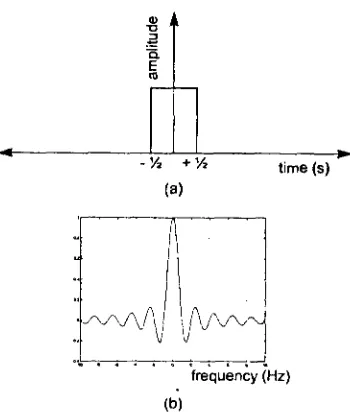
However, in practice the thermal pulse used is different from an ideal Dirac pulse in the
sense that it has finite amplitude and duration values. As an example, one can consider a
square pulse with amplitude Ap and duration AT centered on t = 0. (Figure 2-10) The
corresponding frequency spectrum would be defined by Fourier transform [50].
W ) =
A Atrsin(7ifAt ) ApAtp sinc(7fAtp) (2.10)The shape of F as a function of frequency would look like the graph in figure 2-11, which
proves that unlike an ideal Dirac pulse, here a finite frequency range is involved in the
frequency domain, each appearing with various amplitudes.
* A
a
E
- y2 + y*
0)
time (s)
frequency (Hz) (b)
2.4.2 Data Acquisition in Pulsed Phase Thermography
In Pulsed Phase thermography, after the sample surface is stimulated by a heat pulse,
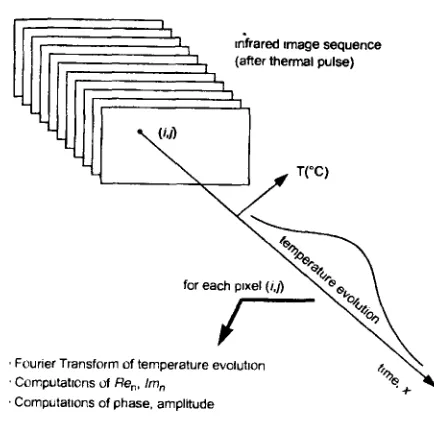
temperature evolution of the surface is recorded in N thermogram sequences. Observing
the behavior of a single pixel (i,j) during N recorded thermograms will provide a vector
T(k) where k is ranging from 0 to N-l. (Figure 2-11) Amplitude and phase images can
be extracted from this vector using a discrete one-dimensional Fourier transform [51].
Fn = J^T(k)e\p(2mkn/ N) = Re(F„) + /Im(F„) (2.11)
A=l
In this equation n stands for the frequency increment in the frequency domain.
3-, infrared image sequence L (after thermal pulse)
• Fourier Transform of temperature evolution • Computations of Ren, lmn
• Computations of phase, amplitude
Figure 2-11 Temperature evolution of pixel (i,j) through N thermograms
Establishing Phase and Amplitude in Pulsed Phase Thermography:
The imaginary and real parts of equation (2.11) are then used to extract the amplitude and
phase images [51].
A„ =^JRe;+lm; and 0n=atan
Re„ (2.12)
This process is repeated for every pixel on the surface until the ampligrams and
phasegrams for all the frequencies in the frequency domain is reached [63]. (Figure 2-12)
f. u
Figure 2-12 (Left) Amoligram and (Right) Phasegram sequence in the frequency domain
For a typical non-defective pixel like (i,j), the amplitude and phase profile would look
like figure (2-13) [63].
It can be seen from figure (2-13) that a sequence of N thermograms will provide N/2
useful frequency components and the other half can be predicted due to the odd/even
nature of the profiles.
The advantage of working in frequency domain is that the phase images are much less
sensitive to problems such as non-uniform heating, reflections from environment, and
emissivity variations in the surface. Also as compared to LT, this method has the
advantage of getting a complete phase profile from a single run.
2.4.3 Defect Characterization in Pulsed Phase Thermography Using Depth Inversion
Once the data acquisition is done, the phase contrast profiles will be employed to find the
defect's depth. Figure (2-14) shows the phase profiles of two flat bottomed holes in a
sample located at different depths z/ and z?. Considering zs as a sound area in the same
sample, the phase contrast profiles for each defected pixel is calculated
using A^ = <f>d -<f>s. As depicted in figure (2-14), phase contrast profiles have non-zero
values from /=# to a specific frequency names blind frequency (f), which has a different
value for each pixel. Blind frequency is defined as the first point in frequency domain
(while moving from higher frequencies to lower ones) at which the phase contrast is
visible for a defect. In fact blind frequency for a pixel is the point on its phasegram where
it merges with the phase profile of a sound area. As a result, deeper defects have lower
blind frequencies (fh_ > fh,, )•
-Jt)|rad| s'—^Oz,
/.-..JO.-X
• V o?tf>_ ••••
iMia.il I
36 Figure 2-14 Depth evaluation with phase contrast and
blind frequency
lb.:.
Sixvmion
Once the blind frequency is found for a defect zone, the depth z is proved to be related to
it as follows [63].
= C,I^
+C (,,3)
Where a = kl pcp is thermal diffusivity. As this term is used to fit experimental data, C|
and C? are found to be around 1 and 1.5 respectively [63].
2.5 Thermal Diffusivity
Thermal diffusivity is a significant property of a material that establishes the rate of
transitory heating and cooling and is defined as:
cc = — (2.14)
Where k, p and c are thermal conductivity, density and specific heat.
Measuring a is of great importance to researchers for various reasons. Knowing the
thermal diffusivity of a material makes it possible to predict the heat pulse behavior in it,
as well as investigating the subsurface defects and composition.
2.5.1 Diffusivity Measurement
Different techniques have been developed over time to measure the thermal diffusivity of
a material. Non-contact measurements involve a transitory excitation delivered to the
![Figure 1-1 Electromagnetic Spectrum [1]](https://thumb-us.123doks.com/thumbv2/123dok_us/1500503.1183692/21.601.110.516.373.596/figure-electromagnetic-spectrum.webp)