| INVESTIGATION
Variant Linkage Analysis Using
de Novo
Transcriptome
Sequencing Identi
fi
es a Conserved Phosphine
Resistance Gene in Insects
David I. Schlipalius,*,†,‡Andrew G. Tuck,*,†,‡Rajeswaran Jagadeesan,†,‡Tam Nguyen,*,§ Ramandeep Kaur,†Sabtharishi Subramanian,** Roberto Barrero,‡,††Manoj Nayak,†,‡and Paul R. Ebert*,‡,1 *School of Biological Sciences, The University of Queensland, St. Lucia, Queensland 4072, Australia,†Queensland Department of Agriculture and Fisheries, Queensland Government, Dutton Park, Queensland 4012, Australia,‡Plant Biosecurity Cooperative Research Centre, Canberra, Australian Capital Territory 2617, Australia,§Department of Genetics, Faculty of Biology, Hanoi National University of Education, Vietnam, **Divison of Entomology, Indian Agricultural Research Institute, New Delhi 110 012, India, and††Centre for Comparative Genomics, Murdoch University, Western Australia 6150, Australia ORCID IDs: 0000-0002-8102-7031 (D.I.S.); 0000-0002-9890-5953 (R.J.); 0000-0002-7735-665X (R.B.); 0000-0002-4435-0737 (P.R.E.)
ABSTRACT Next-generation sequencing methods enable identification of the genetic basis of traits in species that have no prior genomic information available. The combination of next-generation sequencing, variant analysis, and linkage is a powerful way of identifying candidate genes for a trait of interest. Here, we used a comparative transcriptomics [RNA sequencing (RNAseq)] and genetic linkage analysis approach to identify therph1gene.rph1variants are responsible for resistance to the fumigant phosphine (PH3) that is used to control insect pests of stored grain. In each of the four major species of pest insect of grain we have investigated, there are two major resistance genes,rph1andrph2, which interact synergistically to produce strongly phosphine-resistant insects. Using RNAseq and genetic linkage analyses, we identified candidate resistance (rph1) genes in phosphine-resistant strains of three species: Rhyzo-pertha dominica(129 candidates),Sitophilus oryzae(206 candidates), andCryptolestes ferrugineus(645 candidates). We then com-pared these candidate genes to 17 candidate resistance genes previously mapped in Tribolium castaneum and found only one orthologous gene, a cytochrome b5 fatty acid desaturase(Cyt-b5-r), to be associated with therph1locus in all four species. This gene had either missense amino acid substitutions and/or insertion/deletions/frameshift variants in each of 18 phosphine-resistant strains that were not observed in the susceptible strains of the four species. We propose a model of phosphine action and resistance in which phosphine induces lipid peroxidation through reactive oxygen species generated by dihydrolipoamide dehydrogenase, whereas disruption ofCyt-b5-rin resistant insects decreases the polyunsaturated fatty acid content of membranes, thereby limiting the potential for lipid peroxidation.
KEYWORDSpesticide; insecticide resistance; transcriptome; linkage
N
EXT-GENERATION sequencing methods offer unprece-dented opportunities to identify the genetic basis of traits in species that have no prior genomic information available. Whole-genome sequencing andde novoassembly of unchar-acterized species comes with some major challenges. Ge-nomes for uncharacterized species assembled from shortreads can be highly heterozygous and fragmentary, which impacts on determining sequence quality and the annotation of genes. The power of genome-wide sequencing or genetic variant analysis of populations becomes most apparent when combined with determination of genetic linkage as this does not depend of the quality of the genome assembly.
In fact, it is possible to dispense with detailed genome assembly and annotation and focus on the transcriptome while including a genetic approach. By focusing on the tran-scriptome, the complexity of the data being studied is reduced, resulting in much higher sequence coverage and more accu-rate sequence assembly. Working with expressed sequences assembled from uncharacterized species also facilitates the
Copyright © 2018 by the Genetics Society of America doi:https://doi.org/10.1534/genetics.118.300688
Manuscript received January 2, 2018; accepted for publication February 1, 2018; published Early Online February 28, 2018.
Supplemental material is available online atwww.genetics.org/lookup/suppl/doi:10. 1534/genetics.118.300688/-/DC1.
1Corresponding author: School of Biological Sciences, The University of Queensland,
identification and annotation of protein-coding sequences, which in turn assists in preliminary analysis of the functional significance of single-nucleotide polymorphisms (SNPs). We have used RNA sequencing (RNAseq) methods to scan the genomes of specific genetic crosses of several pest insect species that diverged from each other .120 MYA (Zhang
et al.2018) and are resistant to an important industrial chem-ical, phosphine fumigant (PH3).
Phosphine is currently the most important fumigant used for disinfestation of stored products worldwide, but resistance to phosphine in insect pests threatens its efficacy (Jagadeesan
et al.2016). The strong resistance phenotype results from two loci that work in synergy,rph1andrph2(resistance toph os-phine 1 and 2), and are responsible for resistance in every species that we have examined (Schlipalius et al. 2002, 2008; Jagadeesan et al.2013a; Nguyenet al. 2015, 2016). These two loci are recessive and when individually homozy-gous only confer a weak resistance phenotype (5–303) (Schlipalius et al. 2002; Jagadeesan et al. 2012; Nguyen
et al.2015, 2016). However, in combination the two homozy-gous loci result in a strongly resistant phenotype (100 to$ 10003) (Schlipalius et al. 2002; Jagadeesan et al. 2012, 2013a; Mauet al.2012a; Nguyenet al.2015, 2016).
We have previously characterized the genetics of resistance in four insect species that are major pests of stored grain—
Rhyzopertha dominica(Schlipaliuset al.2002, 2008),Tribolium castaneum(Jagadeesanet al.2012, 2013a),Sitophilus oryzae
(Nguyen et al. 2015, 2016), andCryptolestes ferrugineus
(Jagadeesanet al.2016)—and noticed that strong resistance to phosphine appears to follow a similar etiology with two ge-netic loci (rph1andrph2) primarily responsible for the strong resistance phenotype. The similar features of the resistance trait between species led to the discovery of therph2locus as dihy-drolipoamide dehydrogenase (DLD) in R. dominica,T. casta-neum, andS. oryzae(Schlipaliuset al.2012). Phosphine resistance at therph2locus is associated with specific mutations near the active site of the encoded protein that must retain at least partial function, as DLD is an essential enzyme in energy metabolism. Therph1locus was not previously identified.
Resistance alleles at the rph1 locus were already wide-spread infield populations of grain pest insects at the time of the discovery of strongly resistant insects, which, in addi-tion to being homozygous resistant at rph1, also carried a homozygous resistance allele at rph2 (Schlipalius et al.
2008). Therph1locus seemingly works by a different mech-anism torph2/DLD, as the effects of the two loci are syner-gistic rather than additive, as would likely be the case if they were working via the same mechanism (Raymondet al.1989; Schlipaliuset al.2008). InT. castaneum, the locus ofrph1was mapped to a candidate region containing 17 genes; these genes were predicted to be involved in lipid metabolism and chitin synthesis, as well as membrane permeability and maintaining ion gradients. The available information did not allow us to identify the resistance gene or determine which of these biochemical processes, when disrupted, was responsi-ble for resistance (Jagadeesanet al.2013a).
Given the apparent conservation of genetics of strong re-sistance to phosphine among insect species, we hypothesized that the genetic identity of the rph1 locus would likely be conserved across species as well. Thus, we took a compara-tive genomic approach using transcriptome sequencing to identifyrph1in four key species of grain pest that plague food grains across the globe:R. dominica,S. oryzae,C. ferrugineus, andT. castaneum.
Materials and Methods
Strains used
The strains used in this study and their phenotypes are out-lined in Supplemental Material, Table S4 inFile S1.R. dom-inicaandS. oryzaestrains were maintained on whole wheat at 30°70% relative humidity (RH) and 25°60% RH, respec-tively.C. ferrugineusstrains were maintained on media con-taining rolled oats, sorghum, and flour (Jagadeesan et al.
2013b) at 30°70% RH.
Fumigation
Phosphine gas generation and most fumigation bioassays were performed for 48 hr at 25°in sealed airtight desiccators as described previously (Schlipaliuset al.2008; Jagadeesan
et al.2012; Daglishet al.2014), except where stated other-wise in the text.
Genetic crosses
R. dominica crosses: An R. dominica introgressed strain, QRD_Introgressed, was developed by repeated backcrossing of a strain to the original susceptible parental line as per the scheme outlined in Figure S1. The backcrossing was per-formed using 50 virgin females of the susceptible strain mated to 50 selected male progeny of the first cross. The progeny were then allowed to mate for two generations be-fore selection and this process was repeated for three more rounds of backcrossing. To further reduce the genetic com-plexity of the introgressed strain, the final backcross was performed using a single-pair mating. As each backcross should remove50% of the genetic background of the re-sistant strain, we expected the final selected introgressed strain to have.97% genetic background similar to the sus-ceptible parental strain. As a result of the selection for the resistance genes, we also expected the regions around the resistance loci to be homozygous for variants that arose ex-clusively from the resistant parents.
S. oryzae crosses:A single-pair intercross between a suscep-tible (LS2) virgin female and a weakly resistant (QSO335) virgin male was developed as per the crossing scheme outlined inFigure S2. A single gene is responsible for phosphine re-sistance in the weakly resistant strain QSO335 (Daglishet al.
C. ferrugineus crosses: A single-pair intercross between a susceptible (CF31) virgin female and a weakly resistant (CF37) virgin male was developed as per the crossing scheme outlined inFigure S2. F4progeny were selected at 0.02 mg/ liter phosphine for 20 hr. After a 7-day recovery period, total RNA was extracted from survivors of phosphine fumigation as well as from unexposed siblings from the same generation.
RNA extraction and RNAseq: For each strain sequenced, total RNA was extracted from 60 pooled insects per strain and sent to the Australian Genome Research Facility for RNAseq. A summary of the strains sequenced and the se-quencing protocols used is outlined in Table S5 inFile S1.
Bioinformatic analysis: For R. dominica, a reference tran-scriptome was createdde novousing the 75-bp reads from the susceptible strain (QRD14). The Velvet algorithm (Zerbino and Birney 2008) was employed with k-mer length set to 21, maximum coverage set to 5003, and minimum coverage set to 103. Redundant contigs were removed. Sequencing reads from the QRD_Introgressed, QRD14, QRD369, and QRD569 strains were each mapped to thede novo R. dominica tran-scriptome using the read mapping algorithm of the CLC Geno-mics Workbench v7.0 software. Read mapping was performed with the following default parameters: length fraction = 0.5, similarity fraction = 0.8, mismatch cost = 2, deletion cost = 3, and insertion cost = 3.
For S. oryzae, a reference transcriptome was assembled from reads of the LS2 susceptible strain. The CLC Genomics Workbench v 7.0de novoassembly algorithm was used with bubble size set to 50, word size set to 23, and minimum contig length set to 200. Sequence reads of the strains LS2, QSO335, Santai, and Sangrur, as well as from the phosphine-selected and -unselected F6progeny of the LS23QSO335 cross, were mapped separately to theS. oryzae de novotranscriptome us-ing the same parameters as were used forR. dominicaabove. ForC. ferrugineus, a reference transcriptome was assem-bled using the CLC Genomics Workbench v 7.0de novo as-sembly algorithm with bubble size set to 200, word size set to 15, and minimum contig length set to 200. Sequence reads of the strains CF31, CF37, and CF73, as well as from the phos-phine-selected and -unselected F4progeny of the CF313CF37 cross were mapped separately to theC. ferrugineus de novo
transcriptome using the same parameters as forR. dominica
above. A summary of all the strains and sequencing methods used for each of the species is outlined in Table S5 inFile S1.
SNP detection
Quality-based SNP detection in CLC Genomics Workbench is based on a neighborhood quality standard (NQS) algorithm. For a SNP to be called, it was required to meet the default quality specifications: neighborhood radius (5), maximum number of gaps and mismatches (2), minimum average qual-ity of surrounding bases (15), and minimum qualqual-ity of the central base (20). We used a minimum coveragefilter of 6 and minimum variant frequency of 20% to exclude sequencing
artifacts. For each assembled transcriptome, the frequency of the variants (i.e., count/coverage expressed as a percent-age) was averaged across each contig using the R statistical package.
Comparative SNP analysis
R. dominica:Candidate genes were selected byfiltering for contigs from the resistant introgressed strain that contained one or more variant nucleotides relative to thede novo refer-ence transcriptome assembled from the sequrefer-ence of a fully susceptible strain. We required that the variants be present in essentially 100% of the relevant sequence reads that made up the contig to indicate that it had been selected to homozy-gosity in the population that survived phosphine exposure. The cutoff was actually set to accept contigs that had a var-iant frequency of.95% of the sequence reads to allow for a low frequency of sequence artifacts. This resulted in the iden-tification of contigs from the introgressed strain (that had been selected for phosphine resistance) that carried variants that had originated from the parental resistant QRD569 strain but that were absent from the susceptible reference strain.
S. oryzae: Candidate genes were selected by filtering for contigs that had average variant frequencies across the length of the contig of .95% (i.e., homozygous and strongly se-lected) in the contig sequences from the individuals of the F6 generation that had been selected as phosphine-resistant and , 90% (i.e., heterozygous) in the unselected F6 population.
C. ferrugineus: Sequence generation and analysis for
C. ferrugineuswas carried out as described forS. oryzae. Progeny of an F4intercross between a susceptible and a re-sistant strain ofS. oryzaewere either selected for phosphine resistance or unselected. The resulting transcriptome sequence was analyzed as described forS. oryzae.
Candidate genes from each species were aligned by tBLASTx against the Drosophila melanogaster official gene set (release 6.02) and theT. castaneumofficial gene set (re-lease 3.0) to identify homologs of previously mapped candi-date resistance genes. The D. melanogaster gene set was used to enable more comprehensive functional insight of identified candidates.
Linkage mapping by marker analysis in R. dominica
A readily assayed genetic marker was identified that elimi-nated a restriction enzyme recognition site located within the 14-bp DNA fragment in therph1gene that is deleted in both QRD369 and QRD569 (see Figure 2). This marker was used against a previously published mapping population of a QRD143QRD569 cross (Schlipaliuset al.2002, 2008).
The PCR reaction mixture contained TERRA (Clontech) PCR 23buffer 12.5ml, forward primer (10mM) 1.25ml, reverse primer (10mM) 1.25ml, water 7.5ml, Taq polymerase 0.5ml, and 2 ml of DNA template (5 ng). Temperature cycling conditions were as follows: 98°for 2 min, followed by 40 cy-cles of 98°20 sec, 55°30 sec, and 68°for 60 sec, with afinal extension at 68°for 60 sec, after which the temperature was held at 4°for 10 min.
The resulting fragments were digested withBstNI (New England Biolabs, Beverly, MA) under the following condi-tions: 103NEBuffer (3.1) 2.5ml, water 1ml, andBstNI en-zyme 0.5 ml at 60° overnight. The DNA was subsequently electrophoresed on a 2% agarose gel in 13TAE. Digested DNA was indicative of a phosphine-susceptible genotype at therph1locus.
Data availability
Insect strains are maintained at the Queensland Department of Agriculture and Fisheries and are available upon request. Sequence data of theCyt-b5-rhomologs for each species are available at GenBank (accession numbers MG254892-MG254895). The RNAseq data are deposited at the European Nucleotide Archive under the project accession number PRJEB24430. The determined phenotypes of each of the strains sequenced are in Table S4 inFile S1.
Results
T. castaneum candidate genes
Therph1locus inT. castaneumwas mapped previously to a region on chromosome 8 containing 17 genes (Jagadeesan
et al.2013a). We sequenced cDNA from 15 of these predicted candidate genes fromfive phosphine-resistant strains. The se-quences were compared to the T. castaneum (v3.0 release) genome (Tribolium Genome Sequencing Consortium 2008) for SNP analysis and to predict amino acid changes within the coding regions. Of the 15 genes in the mapped region, only the TC006231 predicted protein showed amino acid changes in every resistant strain sequenced, but not in the susceptible strain (QTC4) relative to the reference GA2 genome (Tribolium Genome Sequencing Consortium 2008). Thus, the results of the SNP analysis strongly suggested that TC006231 was the most likely candidate to be therph1gene inT. castaneum. The TC006231 predicted gene was identified as a cytochrome-b5 fatty acid desaturase by BLAST analysis against the National Center for Biotechnology Information nonredundant database (http://www.ncbi.nlm.nih.gov/) and the predicted protein shared a 44% sequence similarity (E-value = 1.343102115) with theD. melanogaster Cyt-b5-r gene (CG13279, FBgn0000406).
We proceeded to test the hypothesis that theCyt-b5-r ho-molog was a phosphine resistance gene by taking an unbi-ased comparative transcriptomic approach. Currently, there are no published genomic resources available for the other phosphine-resistant species we used in this study. Therefore,
our comparative approach entailed sequencing and assem-bling the transcriptomes of each species. Wefirst created ge-netic crosses between resistant and susceptible strains of each species and selected resistant progeny. We then sequenced the transcriptome and identified transcripts with nucleotide variants from the resistant parent, but not the susceptible parent, that were absolutely associated with the resistance phenotype. The identity of the proteins encoded by each of these candidate transcripts was then determined by sequence homology, which allowed us to determine whether the Cyt-b5-rortholog was associated with resistance in each species (Figure 1).
R. dominica candidate gene identification
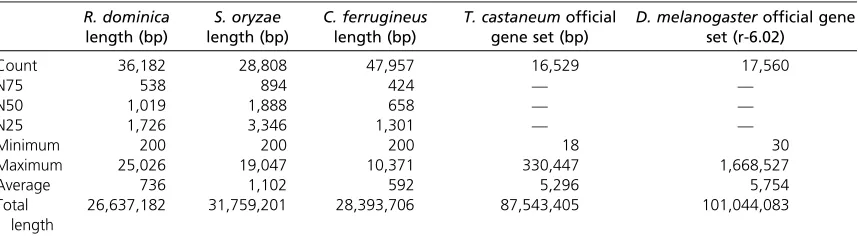
R. dominicacurrently does not have a published genome se-quence. We therefore assembledde novofrom next-generation sequence reads (RNAseq) using the Velvet (Zerbino and Birney 2008) algorithm, a reference transcriptome obtained from adults of a phosphine-susceptible strain (QRD14). There were 36,182 assembled sequences in the reference transcriptome, with an average length per sequence of 736 bp and a combined sequence length of 26.6 Mbp (Table 1). Compared to the D. melanogaster official gene set of 17,560 transcripts with an average length of 5754 bp per transcript, there is clearly fragmentation or incomplete as-sembly of the transcriptome. However, when we mapped the reads back against the transcriptome,92% of the reads from each sequenced strain mapped back to the reference genome, indicating 92% coverage of the expressed tran-scripts in adultR. dominica.
After the reference transcriptome assembly, we sequenced the transcriptome of a resistant strain having resistance alleles
Figure 1 Venn diagram showing the number of shared homologs within the candidate gene sets for the four species. Homology was determined by best similarity by BLAST (Basic Local Alignment Search Tool) with
ofrph1andrph2introgressed into the susceptible (QRD14) background (QRD_Introgressed) (see Figure S1). We then mapped the QRD_introgressed sequence reads against the as-sembled susceptible reference transcriptome, performed vari-ant analysis, and took a bulk segregvari-ant approach to candidate transcript discovery. We reasoned that the introgressed strain would be homozygous for the recessive resistance allele at both therph1andrph2resistance loci, and that the surround-ing genes would likewise be homozygous based on their tight linkage to the selected loci. Therefore, to obtain a list of po-tential resistance genes, we identified all transcripts from the phosphine-resistant QRD_Introgressed strain that were homo-zygous for nucleotide variants that originated from the resis-tant parent across their entire length. Conceptually, this strategy is similar to the regional averaging of SNP homozy-gosity method used for to identify linked genomic regions in
T. castaneum(Jagadeesanet al. 2013a) but uses transcripts of genomic sequence instead.
We also sequenced the transcriptome of the strongly re-sistant parental strain, QRD569 (homozygous for bothrph1
and rph2) (Schlipalius et al. 2008; Mauet al. 2012b). We then narrowed down the list of candidate resistance tran-scripts from the introgressed line by retaining only those that had variants derived from the resistant parental strain (QRD569). The filtered candidate transcript list of 129 se-quences was then compared for homology by tBLASTx against theT. castaneum official gene set and theD. mela-nogasterofficial gene set. The candidate transcript list is given in Table S1 inFile S1. The ortholog of theCyt-b5-rgene was found in the candidate gene list with anE-value = 5.513 102150(65% identity) against theT. castaneumofficial gene set andE-value = 8.79310293(52% identity) against the
D. melanogastergene list.
The QRD_introgressed strain is derived from the QRD569 strain that has resistance alleles at both therph1andrph2loci (Schlipaliuset al.2008). To confirm the validity of the ap-proach, we searched our candidate gene list for the known
rph2resistance gene (dld), as we expected to see transcripts for bothrph1andrph2loci in the candidate gene list. We saw two fragments of the transcript from the R. dominica dld
gene. We also saw several fragments of theSF3b1transcript, a gene adjacent to thedldgene inR. dominica(Schlipalius
et al. 2012). Identification of these sequences in the candi-date transcript list demonstrated the validity of this tech-nique for detecting regions containing candidate resistance genes and also confirmed the partial fragmentation of the assembled transcriptome sequences.
Confirmation of linkage by marker analysis
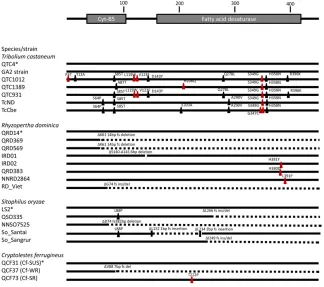
We then tested theCyt-b5-rtranscript for genetic linkage to the rph1 locus in R. dominica. To do this, we employed a 14-bp deletion variant of theCyt-b5-rgene sequence in the QRD369 (rph1only) resistant strain that eliminates a restric-tion enzyme recognirestric-tion site.
Thus, a DNA fragment across the region will only be cut by the enzyme if it originates from the susceptible parent that does not carry the deletion and therefore retains the restriction enzyme recognition site. We selected resistant progeny of a QRD143QRD369 single-pair intercross that had been main-tained in the laboratory for.60 generations (Schlipaliuset al.
2008) and genotyped them for the variant. Approximately 1000 insects were selected at 0.6 mg/liter for 20 hr and only 24 survived. It was found that 23 of the 24 survivors were homozygous for the restriction site variant of the resistant parent, with one individual homozygous for the alternative variant. The unexpected individual was a surprise, but the linkage of theCyt-b5-rhomolog to the resistance trait was very tight (x2= 10.08, d.f. = 1,P= 7.131026). The resolution of the mapping was , 0.07 cM, which given the R. dominica
recombination rate of1.2 Mbp/map unit (Schlipaliuset al.
2002) would equate to less than80 kbp, a region of DNA that could contain several genes. It is possible that the one insect that was homozygous for the allele from the sensitive parent survived due to the high number of individuals selected and the known variability of the phenotype. However, at this stage we could not exclude the possibility that the deletion itself might not be the resistance allele and that a recombination event occurred during the preceding 60 generations between the marker that was used for mapping and the actual resis-tance allele.
S. oryzae candidate gene identification
S. oryzaealso does not have genomic resources publicly avail-able. Therefore, we took a similar approach to that used for
Table 1 Summary bioinformatic statistics of reference transcriptome builds
R. dominica
length (bp) length (bp)S. oryzae C. ferrugineuslength (bp) T. castaneum official
gene set (bp) D. melanogaster
official gene set (r-6.02)
Count 36,182 28,808 47,957 16,529 17,560
N75 538 894 424 — —
N50 1,019 1,888 658 — —
N25 1,726 3,346 1,301 — —
Minimum 200 200 200 18 30
Maximum 25,026 19,047 10,371 330,447 1,668,527
Average 736 1,102 592 5,296 5,754
Total length
R. dominica. We assembled a transcriptome derived from next-generation RNAseq of a phosphine-susceptible strain (LS2) using CLC Genomics Workbench. Before using the transcript sequence list for further analysis, we noted that theCyt-b5-randdldgenes were in the assembled transcrip-tome. The final assembled transcriptome had a total of 28,808 sequences covering a total of 31.7 Mbp with an aver-age length of 1102 bp. This was comparable to the results obtained forR. dominica.
To generate a candidate list of transcripts linked to phos-phine resistance forS. oryzae, we used a single-pair intercross between susceptible (LS2) 3 weakly resistant (QSO335) strains. The QSO335 strain was expected to have a resistance allele only at therph1locus, but not therph2locus (Daglish
et al. 2014; Nguyen et al.2015, 2016). The crossing and selection scheme is outlined inFigure S2. Progeny were se-lected for resistance at the F6generation at a dose of 0.1 mg/ liter phosphine for 48 hr, and the RNAseq sequence reads of selected and unselected progeny were mapped to thede novo
reference transcriptome. The percentage of mapped reads was 90% in each case, which gave us confidence that we had 90% or greater coverage of the adultS. oryzae tran-scriptome. We subsequently performed SNP analysis on the mapped reads and identified transcripts that were homozy-gous for variants from the resistant parent across the entire length of the transcript in phosphine-resistant F6progeny and heterozygous in sibling progeny that had not been exposed to phosphine. The subsequent candidate transcript list con-tained 206 sequences. The identity of these sequences was then determined by sequence homology using tBLASTx against theT. castaneum official gene set as well as theD. melanogasterofficial gene set. The candidate transcript list is given in Table S2 inFile S1. We found theCyt-b5-rhomolog in the candidate gene list, indicating linkage to therph1 lo-cus. As we expected, thedldgene that had previously been located and mapped to therph2locus in this species was not found to be linked to phosphine resistance in the weakly re-sistant strain (QF37) that we used in this analysis as it only contains a resistance allele at therph1locus.
C. ferrugineus candidate gene identification
C. ferrugineusalso does not have genomic resources publicly available and so the approach used was very similar to that used forS. oryzae. We performed RNAseq on a susceptible strain (CF31) and used the reads to assemble a susceptible reference transcriptome, with thedldandCyt-b5-rhomologs manually assembled and annotated using CLC Genomics Workbench software. The final reference transcriptome for
C. ferrugineushad 47,937 transcripts totaling 28.4 Mbp with an average length of 592 bp, which was less than the length of the average assembled transcript in eitherR. dominicaorS. oryzae, but the total length of transcriptome sequence was comparable.
Forfinding transcripts that were linked torph1resistance, a single-pair intercross of susceptible (CF31) 3weakly re-sistant (CF37) strains was developed as per the crossing
scheme outlined in Figure S2(Jagadeesan et al.2016). In-sects of the F4 generation were selected for resistance to phosphine using a dose of 0.04 mg/liter for 48 hr, as this dose discriminates between susceptible and weakly resistant indi-viduals. RNAseq was performed on selected and unselected progeny and the reads were mapped against the de novo
reference transcriptome derived from the susceptible paren-tal strain. Subsequent SNP analysis was performed similarly to that ofS. oryzaebyfiltering the variant list for transcripts that were homozygous for SNPs across the entire length of the transcript in the selected F4progeny, but heterozygous in the unselected progeny. The subsequent candidate transcript list contained 645 sequences that were then compared for homology by tBLASTx against theT. castaneumofficial gene set and theD. melanogasterofficial gene set. The candidate transcript list is given in Table S3 inFile S1.
TheC. ferrugineus Cyt-b5-rhomolog showed homozygos-ity for a 7-bp deletion in the selected F4progeny, which was heterozygous in the unselected progeny (Figure 2). This con-firmed both linkage torph1 and a likely full disruption of protein activity due to a frameshift variant. The ortholog of thedldgene did not show linkage to resistance, but the weak resistance phenotype in the CF37 strain is likely due to ho-mozygosity for a resistance allele at rph1 and not an rph2
variant, similar to other resistant species.
Comparative homology analysis
BLAST analysis between all the candidate gene sequences from the threede novotranscriptomes, theT. castaneum of-ficial gene set, and theD. melanogaster reference gene set showed that there was only one gene that had signifi-cant homology between all three candidate gene sets and the candidate genes that had previously been mapped in
T. castaneum, TC006231 (Figure 1).
In the T. castaneum genome, another Cyt-b5 desaturase homolog (TC006232) also occurs adjacent to Cyt-b5-r
(TC006231) and was identified in the R. dominica and S. oryzaecandidate gene sets, but was excluded from the can-didate gene region inT. castaneumby genetic linkage analy-sis (Jagadeesanet al.2013a).
Sequence characterization of the Cyt-b5-r gene from multiple species
Ka/Ks ratio analysis
We evaluated whether Cyt-b5-r has evolved under strong functional constraints by using the Ka/Ks approach of calcu-lating rates of molecular evolution across genes. We aligned the wild-type protein-coding sequence ofCyt-b5-rfrom each of the four species—T. castaneum,R. dominica,S. oryzae, and
C. ferrugineus—and used the Pamillo-Blanchi-Li approach (Li
et al. 1985; Pamilo and Bianchi 1993). We used the imple-mentation by Liberles (2001) in the online calculator pro-vided by the Computational Biology Unit at the University of Bergen (http://services.cbu.uib.no/tools/kaks). Briefly, this method estimates unequal rates of substitution by taking into account transitional and transversional substitution rates as well as synonymous and nonsynonymous substitu-tion rates. The Ka/Ks ratio of the comparisons between all four species was consistently and significantly ,1, with a range of 0.26–0.3395, suggesting that the gene was under strong purifying selection prior to the widespread use of phosphine (Table S6 inFile S1).
Discussion
The challenges involved in identifying the molecular genetic basis of traits in organisms that are relatively uncharacterized and have little to no genomic information available can be readily overcome by combining classical genetic methods with next-generation sequencing.
While linkage mapping is powerful, it can require a lot of complex analysis; comparative methods can both decrease the requirement for such complexities and extend linkage
methods in multiple species, and help to confirm the genetic basis of shared traits.
We have combined next-generation sequencing and tran-scriptome assembly with bulk segregant analysis of three species of economic importance for which little genome in-formation was available. Our analysis of the genetics of phosphine resistance in these species was combined with results of genetic mapping in T. castaneum, which has a well-characterized genome. The comparative transcriptome variant analyses and genetic analysis of the four species iden-tified a fatty acid desaturase (Cyt-b5-r) ortholog with a fused cytochrome b-5 domain in all four species. TheCyt-b5-rgene was genetically confirmed to cosegregate with the previously described rph1 resistance to phosphine locus in two of the four species studied. Desaturases are responsible for intro-ducing double bonds into long-chain fatty acids; however, the exact species of fatty acids that Cyt-b5-r affects is not currently known. Previous studies in D. melanogasterhave demonstrated mitochondrial localization (Kula and Rozek 2000) by immunostaining, and have shown that this gene is expressed in muscle tissue (Levinet al.1989) and is de-velopmentally regulated (Graveleyet al. 2011; Guanet al.
2013). Interestingly, in D. melanogaster, the gene is most strongly expressed during the larval and adult phases of de-velopment (Graveleyet al.2011; Guanet al.2013) and most weakly during egg and pupal stages. These stages correspond to the most susceptible and tolerant life stages determined in grain pests, respectively (Holeet al.1976; Kauret al.2012). The predicted desaturase activity of the resistance gene strongly suggests that polyunsaturated lipids are intimately
associated with the toxicity of phosphine, possibly by making specific lipid species more susceptible to peroxidation. It remains to be elucidated exactly which lipid species the
Cyt-b5-r enzyme desaturates and the affected molecular pathways.
Nature of the polymorphisms within the gene
Sequencing of the gene from multiple strains within each species revealed that all the resistant strains have SNPs that cause amino acid missense mutations and/or large insertion/ deletion polymorphisms that cause frameshift mutations. This indicates that there is either total disruption or a high level of disruption of protein activity associated with resistance. How-ever, only point mutations have been observed in theT. cas-taneum TC006231 gene. The level of resistance caused by
rph1 variants in T. castaneum-resistant strains (3.23)
(Jagadeesan et al. 2012) is much lower than that seen in weakly resistant strains of the other species (123–303) when assessed under similar conditions (Schlipalius et al.
2002; Daglishet al.2014). This is possibly due to only partial loss-of-function effected by single amino acid changes, in contrast to the deletion mutations observed in the other species.
In insects, theCyt-b5-rgene is commonly found in a locus physically adjacent to a close homolog, also a cytochrome b5 desaturase (e.g.,T. castaneum TC006232); however, phos-phine resistance appears to be specific to Cyt-b5-r. This im-plies that the Cyt-b5-r gene and its close paralog are not redundant, but rather have different functional activities. Both of these desaturase genes usually reside either adjacent to or within 500 kb of a myosin heavy chain (Mhc) gene homolog. This is the case in diverse orders of insects whose genomes have been sequenced includingD. melanogaster,T. castaneum,Apis mellifera,Bombus terrestris,Atta cephalotes,
Camponotus floridanus,Acromyrmex echinator, andPlutella xylostella. This evidence of microsynteny implies that these genes have been physically associated across a long evolu-tionary time span and may constitute a functional locus within insects. The expression of theCyt-b5-rgene also ap-pears to be developmentally correlated with theMhcgene in
D. melanogastermuscle tissues (Levinet al.1989).
Functional homologs of theCyt-b5-rgene appear in most insects; however, some have only one cytochrome b5 desa-turase gene. Moreover, the Cyt-b5-r gene responsible for phosphine resistance does not appear to be essential. The beetle strains that we have sequenced that have nonfunc-tional copies ofCyt-b5-rdo not appear to have majorfitness deficits under laboratory conditions, such as adverse effects on development or reproduction (Jagadeesan et al. 2012; Kauret al.2012, 2013; Daglishet al.2014). Consistent with this idea, a global survey conducted in the 1970s (Champ and Dyte 1977) found that weak phosphine resistance was wide-spread and occurred in every country that used the fumigant. This implies thatrph1alleles were possibly already preexist-ing and rapidly became widespread in thefield after exten-sive phosphine exposure. However, the Cyt-b5-r gene in
susceptible beetle strains appears to be under strong purify-ing selection, and therefore any deletions (like the ones con-ferring resistance) should be costly in the wild. It may be that compensatory effects of other genes mediate the spread of the resistance allele in areas where phosphine is used.
Proposed mechanism of action
It is well established that exposure to phosphine induces oxy-radical and hydrogen peroxide production (Bolter and Chefurka 1990; Liu et al.2015). Lipid peroxidation is one of the most consistent effects unambiguously linked to phosphine exposure and has been shown to occur in all organisms; nematodes (Valmas et al.2008), insects (Chaudhry and Price 1992; Liu
et al.2015), rats (Hsuet al.2000, 2002a,b), plants (Niuet al.
2013; Miet al.2014), and cell tissue cultures (Hsuet al.1998). Furthermore, a study of lipid peroxidation in phosphine- resis-tant and -susceptibleR. dominicafound that it was significantly lower in resistant insects (Chaudhry and Price 1992). At that time, only the weak resistance phenotype was observed, making it likely that the resistant strain that was investigated carried a resistance allele atrph1. Long-chain polyunsaturated fatty acids are highly susceptible to peroxidation (Hulbert 2005) and pro-duce highly toxic compounds including 4-hydroxynonenal (4-HNE) and malondialdehyde, both of which are detected by the thiobarbituric acid reactive substances (TBARS) assay that has been used to monitor oxidative stress following phosphine ex-posure. TBARS are produced upon phosphine exposure in in-sects (Chaudhry and Price 1992). Lipid peroxidation products such as 4-HNE are likely to be major mediators of phosphine toxicity, as 4-HNE has been shown to bind most strongly to sulfhydryl moieties, such as those found in cysteine (Carini
Conclusion and future directions
We currently do not know the substrates or products of the
Cyt-b5-r enzyme, nor do we know the functional conse-quences of loss of this lipid desaturase. However, we do observe a strong functional interaction between the two (seemingly) independent pathways of lipid synthesis/desaturation via Cyt-b5-r and energy metabolism mediated by DLD, which has major toxicological consequences. A study of the Cyt-b5-r
pathway and its role in lipid peroxidation and metabolism will further our understanding of the relationship between lipids, mitochondria, and oxidative stress, and their respec-tive roles in the toxic response.
At a practical level, the knowledge that most insects carry functional orthologs of the Cyt-b5-r gene also implies that many insects may be able to achieve some measure of phos-phine resistance if exposed at low enough doses to allow the survival of weakly resistant insects. This has practical conse-quences for all industries that use phosphine as a disinfestant to manage insect pests.
Acknowledgments
We thank Hervoika Pavic and Linda Bond for technical assistance, and Daniel Ortiz-Barrientos for comments. We acknowledge the support of the Australian Government’s Coop-erative Research Centres Program (project number PBCRC3035) and the Australia–India Strategic Research Fund (GCF010006 and AISRF48516), jointly sponsored by the Indian Department of Science and Technology and the Australian Department of Innovation, Industry, Science and Research. An Australian Aid Postgraduate Scholarship was awarded to T.N.
Literature Cited
Bolter, C. J., and W. Chefurka, 1990 Extramitochondrial release of
hydrogen peroxide from insect and mouse liver mitochondria using the respiratory inhibitors phosphine, myxothiazol, and antimycin and spectral analysis of inhibited cytochromes. Arch.
Biochem. Biophys. 278: 65–72.
https://doi.org/10.1016/0003-9861(90)90232-N
Carini, M., G. Aldini, and R. M. Facino, 2004 Mass spectrometry
for detection of 4-hydroxy-trans-2-nonenal (HNE) adducts with
peptides and proteins. Mass Spectrom. Rev. 23: 281–305.
https://doi.org/10.1002/mas.10076
Champ, B. R., and C. E. Dyte, 1977 FAO global survey of pesticide
susceptibility of stored grain pests. FAO Plant Prot. Bull. 25: 49–67.
Chaudhry, M. Q., 1997 A review of the mechanisms involved in
the action of phosphine as an insecticide and phosphine
resis-tance in stored-product insects. Pestic. Sci. 49: 213–228.
https://doi.org/10.1002/(SICI)1096-9063(199703)49:3,213:: AID-PS516.3.0.CO;2-#
Chaudhry, M. Q., and N. R. Price, 1992 Comparison of the oxidant
damage induced by phosphine and the uptake and tracheal exchange of P-32 radiolabeled phosphine in the susceptible and resistant strains of Rhyzopertha-Dominica (F) (Coleoptera,
Bostrychidae). Pestic. Biochem. Physiol. 42: 167–179.https://
doi.org/10.1016/0048-3575(92)90063-6
Daglish, G. J., M. K. Nayak, and H. Pavic, 2014 Phosphine resistance
in Sitophilus oryzae (L.) from eastern Australia: inheritance,fitness
and prevalence. J. Stored Prod. Res. 59: 237–244.https://doi.org/
10.1016/j.jspr.2014.03.007
Graveley, B. R., A. N. Brooks, J. Carlson, M. O. Duff, J. M. Landolin et al., 2011 The developmental transcriptome of Drosophila
melanogaster. Nature 471: 473–479.https://doi.org/10.1038/
nature09715
Guan, X. L., G. Cestra, G. H. Shui, A. Kuhrs, R. B. Schittenhelm et al., 2013 Biochemical membrane lipidomics during
Dro-sophila development. Dev. Cell 24: 98–111. https://doi.org/
10.1016/j.devcel.2012.11.012
Hardas, S. S., R. Sultana, A. M. Clark, T. L. Beckett, L. I. Szweda et al., 2013 Oxidative modification of lipoic acid by HNE in
Alzheimer disease brain. Redox Biol. 1: 80–85. https://doi.
org/10.1016/j.redox.2013.01.002
Hole, B. D., C. H. Bell, K. A. Mills, and G. Goodship, 1976 The
toxicity of phosphine to all developmental stages of thirteen species of stored product beetles. J. Stored Prod. Res. 12: 235–244.https://doi.org/10.1016/0022-474X(76)90039-4
Hsu, C. H., G. B. Quistad, and J. E. Casida, 1998
Phosphine-in-duced oxidative stress in Hepa 1c1c7 cells. Toxicol. Sci. 46: 204–210.https://doi.org/10.1093/toxsci/46.1.204
Hsu, C. H., B. C. Han, M. Y. Liu, C. Y. Yeh, and J. E. Casida,
2000 Phosphine-induced oxidative damage in rats:
attenua-tion by melatonin. Free Radic. Biol. Med. 28: 636–642.
https://doi.org/10.1016/S0891-5849(99)00277-4
Hsu, C. H., B. C. Chi, and J. E. Casida, 2002a Melatonin reduces
phosphine-induced lipid and DNA oxidation in vitro and in vivo
in rat brain. J. Pineal Res. 32: 53–58.https://doi.org/10.1034/
j.1600-079x.2002.10809.x
Hsu, C. H., B. C. Chi, M. Y. Liu, J. H. Li, C. J. Chen et al.,
2002b Phosphine-induced oxidative damage in rats: role of
glutathione. Toxicology 179: 1–8.https://doi.org/10.1016/
S0300-483X(02)00246-9
Hulbert, A. J., 2005 On the importance of fatty acid composition
of membranes for aging. J. Theor. Biol. 234: 277–288.https://
doi.org/10.1016/j.jtbi.2004.11.024
Humphries, K. M., and L. I. Szweda, 1998a Inhibition of
mito-chondrial respiration: HNE inactivation of lipoic acid containing
dehydrogenases. Free Radic. Biol. Med. 25: S84. https://doi.
org/10.1016/S0891-5849(98)90265-9
Humphries, K. M., and L. I. Szweda, 1998b Selective inactivation
of alpha-ketoglutarate dehydrogenase and pyruvate dehydroge-nase: reaction of lipoic acid with 4-hydroxy-2-nonenal.
Biochem-istry 37: 15835–15841.https://doi.org/10.1021/bi981512h
Jagadeesan, R., P. J. Collins, G. J. Daglish, P. R. Ebert, and D. I.
Schlipalius, 2012 Phosphine resistance in the rust redflour
bee-tle, Tribolium castaneum (Coleoptera: Tenebrionidae):
inheri-tance, gene interactions andfitness costs. PLoS One 7: e31582.
Jagadeesan, R., A. Fotheringham, P. R. Ebert, and D. I. Schlipalius,
2013a Rapid genome wide mapping of phosphine resistance
loci by a simple regional averaging analysis in the red flour
beetle, Tribolium castaneum. BMC Genomics 14: 650. Jagadeesan, R., M. K. Nayak, K. Dawson, V. Byrne, and P. J. Collins,
2013b Dietary media for mass rearing of rusty grain
bee-tle, Cryptolestes ferrugineus (Stephens) and flat grain beetle,
Cryptolestes pusillus (Schonherr) (Coleoptera: Cucujidae).
J. Stored Prod. Res. 55: 68–72. https://doi.org/10.1016/j.
jspr.2013.08.004
Jagadeesan, R., P. J. Collins, M. K. Nayak, D. I. Schlipalius, and P.
R. Ebert, 2016 Genetic characterization offield-evolved
resis-tance to phosphine in the rusty grain beetle, Cryptolestes ferru-gineus (Laemophloeidae: Coleoptera). Pestic. Biochem. Physiol.
127: 67–75.https://doi.org/10.1016/j.pestbp.2015.09.008
Kaplan, P., Z. Tatarkova, P. Racay, J. Lehotsky, M. Pavlikova et al.,
2007 Oxidative modifications of cardiac mitochondria and
inhi-bition of cytochrome c oxidase activity by 4-hydroxynonenal. Redox
Kaur, R., D. I. Schlipalius, P. J. Collins, A. J. Swain, and P. R. Ebert,
2012 Inheritance and relative dominance, expressed as
toxic-ity response and delayed development, of phosphine resistance in immature stages of Rhyzopertha dominica (F.) (Coleoptera:
Bostrichidae). J. Stored Prod. Res. 51: 74–80.https://doi.org/
10.1016/j.jspr.2012.08.002
Kaur, R., P. R. Ebert, G. H. Walter, A. J. Swain, and D. I. Schlipalius,
2013 Do phosphine resistance genes influence movement and
dispersal under starvation? J. Econ. Entomol. 106: 2259–2266.
https://doi.org/10.1603/EC13234
Kula, M. E., and C. E. Rozek, 2000 Expression and translocation of
Drosophila nuclear encoded cytochrome b(5) proteins to
mito-chondria. Insect Biochem. Mol. Biol. 30: 927–935.https://doi.
org/10.1016/S0965-1748(00)00064-3
Kumar, P., S. Henikoff, and P. Ng, 2009 Predicting the effects of coding non-synonymous variants on protein function using the
SIFT algorithm. Nat. Prot. 4: 1073–1081. https://doi.org/
10.1038/nprot.2009.86
Levin, R. J., P. L. Boychuk, C. M. Croniger, J. A. Kazzaz, and C. E.
Rozek, 1989 Structure and expression of a muscle specific
gene which is adjacent to the Drosophila Myosin heavy-chain gene and can encode a cytochrome-beta related protein.
Nu-cleic Acids Res. 17: 6349–6367.https://doi.org/10.1093/nar/
17.15.6349
Li, W. H., C. I. Wu, and C. C. Luo, 1985 A new method for
esti-mating synonymous and nonsynonymous rates of nucleotide substitution considering the relative likelihood of nucleotide
and codon changes. Mol. Biol. Evol. 2: 150–174.
Liberles, D. A., 2001 Evaluation of methods for determination of a
reconstructed history of gene sequence evolution. Mol. Biol.
Evol. 18: 2040–2047. https://doi.org/10.1093/oxfordjournals.
molbev.a003745
Liu, T., L. Li, F. Zhang, and Y. Wang, 2015 Transcriptional
inhi-bition of the catalase gene in phosphine-induced oxidative stress
in Drosophila melanogaster. Pestic. Biochem. Physiol. 124: 1–7.
https://doi.org/10.1016/j.pestbp.2015.05.005
Mau, Y. S., P. J. Collins, G. J. Daglish, M. K. Nayak, and P. R. Ebert,
2012a The rph2 gene is responsible for high level resistance to
phosphine in independentfield strains of Rhyzopertha
domin-ica. PLoS One 7: e34027.
Mau, Y. S., P. J. Collins, G. J. Daglish, M. K. Nayak, H. Pavicet al.,
2012b The rph1 gene is a common contributor to the
evolu-tion of phosphine resistance in independent field isolates of
Rhyzopertha Dominica. PLoS One 7: e31541.
Mi, L. N., X. J. Niu, M. Q. Lu, J. L. Ma, J. D. Wu et al.,
2014 Phosphine-induced physiological and biochemical
re-sponses in rice seedlings. Chemosphere 100: 77–82. https://
doi.org/10.1016/j.chemosphere.2013.12.057
Nguyen, T. T., P. J. Collins, and P. R. Ebert, 2015 Inheritance and
characterization of strong resistance to phosphine in Sitophilus oryzae (L.). PLoS One 10: e0124335.
Nguyen, T. T., P. J. Collins, T. M. Duong, D. I. Schlipalius, and P. R.
Ebert, 2016 Genetic conservation of phosphine resistance in
the rice Weevil Sitophilus oryzae (L.). J. Hered. 107: 228–
237.https://doi.org/10.1093/jhered/esw001
Niu, X. J., L. N. Mi, Y. D. Li, A. S. Wei, Z. Q. Yang et al.,
2013 Physiological and biochemical responses of rice seeds to
phosphine exposure during germination. Chemosphere 93: 2239–
2244.https://doi.org/10.1016/j.chemosphere.2013.07.074
Pamilo, P., and N. O. Bianchi, 1993 Evolution of the Zfx and Zfy
genes: rates and interdependence between the genes. Mol. Biol.
Evol. 10: 271–281.
Raymond, M., D. G. Heckel, and J. G. Scott, 1989 Interactions
between pesticide genes - model and experiment. Genetics
123: 543–551.
Schlipalius, D. I., Q. Cheng, P. E. B. Reilly, P. J. Collins, and P. R.
Ebert, 2002 Genetic linkage analysis of the lesser grain borer
Rhyzopertha dominica identifies two loci that confer high-level
resistance to the fumigant phosphine. Genetics 161: 773–782.
Schlipalius, D. I., W. Chen, P. Collins, T. Nguyen, P. Reilly et al.,
2008 Gene interactions constrain the course of evolution of
phos-phine resistance in the lesser grain borer, Rhyzopertha dominica.
Heredity 100: 506–516.https://doi.org/10.1038/hdy.2008.4
Schlipalius, D. I., N. Valmas, A. G. Tuck, R. Jagadeesan, L. Ma et al.,
2012 A core metabolic enzyme mediates resistance to phosphine
gas. Science 338: 807–810.https://doi.org/10.1126/science.1224951
Stofan, D. A., K. M. Humphries, P. A. Szweda, and L. I. Szweda,
2002 Modification of essential lipoic acid residues of
alpha-ketoglutarate dehydrogenase by the lipid peroxidation product 4-hydroxy-2-nonenal. FASEB J. 16: A1208.
Tribolium Genome Sequencing Consortium, Richards, S., R. A.
Gibbs, G. M. Weinstock, S. J. Brownet al., 2008 The genome
of the model beetle and pest Tribolium castaneum. Nature 452: 949–955.https://doi.org/10.1038/nature06784
Valmas, N., S. Zuryn, and P. R. Ebert, 2008 Mitochondrial
uncou-plers act synergistically with the fumigant phosphine to disrupt mitochondrial membrane potential and cause cell death.
Toxi-cology 252: 33–39.https://doi.org/10.1016/j.tox.2008.07.060
Zerbino, D. R., and E. Birney, 2008 Velvet: algorithms for de novo
short read assembly using de Bruijn graphs. Genome Res. 18: 821–829.https://doi.org/10.1101/gr.074492.107
Zhang, S., L. Che, Y. Li, D. Liang, H. Pang et al., 2018
Evolutionary history of Coleoptera revealed by extensive sampling of genes and species. Nat. Commun. 9: 205.