Seismic Evaluation of Base Isolated
Building Using Shape Memory Alloy: A
Review
Samanvay D. Chandnao
1, Ashish R. Akhare
2P.G. Student, Department of Applied Mechanics, Govt. Engineering College Amravati, Maharashtra, India1
Professor, Department of Applied Mechanics, Govt. Engineering College Amravati, Maharashtra, India2
ABSTRACT: Shape Memory Alloys (SMAs) are belongs to those class of alloys that have various unique characteristics. Which makes them different from the other alloys and enhances their utility in control of civil structures subjected to seismic events.These alloyhas ability to recover their shape after undergoing large strains, dissipate energy through hysteresis response excellent resistance to corrosion high fatigue resistance and high strength. Many researchers were fascinated with these alloy characteristics and their use in control of civil structures subjected to seismic events over the past decades. This paper provides an extensive review of seismic applications of SMAs. Initially, a basic description of two unique effects of SMAs, namely shape memory and superelastic effect, is discussed. Next, the material models proposed to study the response of SMAs in seismic applications are briefly introduced. Finally, applications of SMAs to buildings to improve seismic response are thoroughly reviewed.
KEYWORDS: Shape memory alloy, Base isolation, Seismic response control, Recentering, Superelasticity.
I. INTRODUCTION
Earthquakes are one of the most unpredictable and difficult-to-control phenomena, which have very disastrous consequences to human civilization. Because of this, the building contents and non-structural components may suffer significant damage during a major earthquake, even if the structure itself remains basically intact. This is not tolerable for buildings whose contents are more costly and valuable than the buildings themselves. Hospitals, police and fire stations, and telecommunication centres are examples of facilities that contain valuable equipment and should remain operational immediately after an earthquake. And hence designing structures to withstand seismic forces is of primary concern for civil engineers. Conventional seismic design methods depends on the ability of structures to dissipate the input earthquake energy through inelastic deformations in specially designed regions of the structural system while avoiding an overall loss of structural stability and integrity. In the past few years, the damaging effects of strong ground motions on civil structures have exposed the limitations of conventional design methods. To overcome this limitations, already there have been intensive research work had done and still going on in the field of structural engineering over the past decades to execute smart structure technologies in seismic response control of structures.
Research Development Cell, Government College of Engineering, Jalagon (M. S), India
application in civil engineeringstructures. Dolce et al. [2]evaluated the effectiveness of SMA braces in reinforced concrete structures, results from shaking table test demonstrated that SMA bars can provide favourable self-centring capability. In addition to the mentioned applications, SMAs gained widespread popularity in framed structures. Ozbulut and Hurlebaus [3]introduced a re-centring variable friction device for vibration limitation of structures subjected to near-field excitations. Simulation results demonstrate that the proposed device has the capability to reduce the peak structural response. Asgarian and Moradi[4] evaluated the seismic performance of steel frames equipped with SMA braces. The results indicated that SMAs are capable enough for reduction in residual displacement and peak interstory drift. Jalaeefar and Asgarian [5] developed and tested a hybrid damping device with energy dissipating and re-centring characteristics using steel and SMA bars, respectively. Besides, the optimum proportion of SMA and steel was obtained in various analyses. Salari and Asgarian [6] investigated seismic performance of steel braced frames using SMA-based hybrid damper. Results proved the efficiency of the device in seismic response mitigation. McCormick et al. [7] evaluated a novel CBF to compare its seismic performance with traditional systems. They applied rigid bracing members with continuous SMA in whole brace. This text provides an in-depth look at recent development for applications of both NiTi and Cu-based SMAs in seismic engineering along with an overview of essential mechanical characteristics and modelling techniques of SMAs.
SHAPE MEMORY ALLOY
Basically shape memory alloys (SMAs) are metal alloy or one kind of smart and functional materials that can restore to their pre-determined and original shape after deformation via unloading or applying thermal load. They have two solid phases; martensitic or unstable phase in which material is at low temperature and austenite, parent, or high-temperature phase. In this regard, four characteristic temperatures are defined to determine the temperature ranges for starting and finishing the phase transformation between martensite and austenite. (Figure 1) Superelastic and shape memory effects are two unique properties of SMAs. In superelastic effect, the generated strain due to mechanical loading is fully recovered after unloading while in shape memory effect, the mechanical deformation should be removed by applying thermal load and increasing its temperature. Due to the remarkable characteristics of SMAs such as high damping performance and energy dissipation capacity, significant stiffness hardening (variable stiffness), large ductility, long fatigue life and corrosion resistance capability, they are excellent material as damper or actuator. SMA, as supplementary component, can improve the re-centring capability of elastomeric isolators and as a result, extend their service life.
Figure 1:Different Phases of SMAs
SHAPE MEMORY EFFECT
T
Twinned
Martensite
Detwinned
Martensite
2
4
3
1
Heating / recovery
Austenite
ε
σ
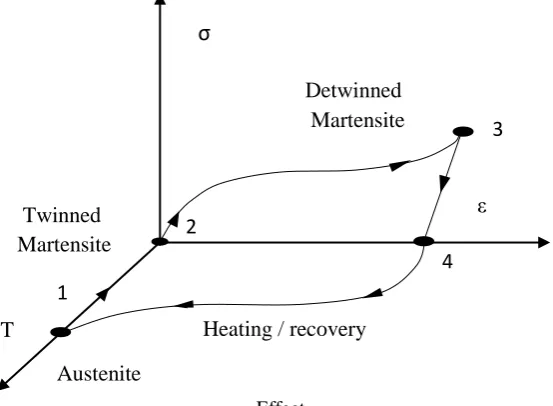
typical loading path 1-2-3-4-1, in which the SME is observed is shown in Figure 2 during the cooling of the parent phase (1-2) it transforms to twinned martensite. The material is then loaded (2-3) causing stress induced detwinning and development of inelastic strains. Upon unloading (3-4) the material remains in detwinned state and the inelastic strains are not recovered. Finally, when it is heated above Af (4-1), the SMA returns to its cubic parent phase and the inelastic strains are recovered. The crystallographic changes during this loading path are explained next. The stress-free cooling of austenite produces self-accommodating growth of the martensitic variants (1-2) such that there is no macroscopic transformation. The self-accommodated morphology is a characteristic of the crystallography of the alloy used. The growth of such groups produces no macroscopic transformation strain, but the multiple interfaces present in these structures (boundaries between the martensite variants and twinning interfaces) are very mobile. This great mobility is at the heart of the shape memory effect.Movement of these interfaces accompanied by detwinning is obtained at stress levels far lower than the plastic yield limit of martensite. This mode of deformation, called reorientation of variants, dominates at temperatures lower than Mf. During the second stage (2-3), the mechanical loading in the martensitic phase leads to reorientation of the variants and results in development of large inelastic strains. This inelastic strain is not recovered upon unloading (3-4). During the last step (4-1), heating the sample above Af induces the reverse transformation and recovers the inelastic strain. When the material approaches Af, the martensitic phase becomes unstable in the absence of stress. This results in a complete transformation to the parent phase. Since martensite variants have been reoriented bystress, the reversion to austenite produces a large transformation strain having hjthe same amplitude butopposite direction to the inelastic strain. As a result, the SMA returns to the original shape it had in the austenitic phase.
Figure 2: Stress-Strain-Temperature schematic of the crystallographic changes involved in the Shape Memory
Research Development Cell, Government College of Engineering, Jalagon (M. S), India
SUPERELASTICITY
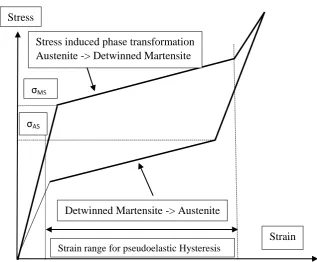
The super elasticbehaviour of SMAs is associated with stress induced strain recovery upon unloading at temperatures above Af Under most general conditions, superelastic thermo mechanical loading paths start at zero stress in the austenitic region, then move to the detwinned martensite region and then unload again to the starting point. The initial loading from austenite to achieve the required constant stress for the isobaric path is not shown. Note that isothermal condition can be achieved only by quasi-static (small strain increments) loadings, so that the latent heat generated/absorbed during the phase transformation has time to dissipate. For convenience, mostly isobaric or isothermal loading paths will be considered. Consider the thermo mechanical loading path which starts at zero stress level, above Af.
Figure 3: Superelatic effect at a constant high temperature the material is able to undergo large deformations with zero final permanent strain.
When the material is loaded at temperatures above Af, the parent phase (Austenite) undergoes thermo elastic loading up to a critical stress level called the Transformation stress. At this stress level the material undergoes a stress induced phase transformation from austenite to martensite during which large inelastic strains are developed. Any subsequent loading in the detwinned martensitic region does not produce further phase transformation, although reorientation of the martensitic twins may occur in multi-axial loading conditions. When the point is reached, the reverse transformation begins (martensite-to-austenite), leading to recovery of the inelastic strains. The material fully transforms to austenite at and the final segment of the loading path is characterized by recovery of the thermo elastic strains, leading to zero macroscopic strains upon completion of the path. The transformation process results in a hysteresis which reflects the energy dissipated in the cycle.
II. MODELLING OF SMA
Strain
Stress
Detwinned Martensite -> Austenite
Strain range for pseudoelastic Hysteresis
Stress induced phase transformation
Austenite -> Detwinned Martensite
σMS
𝜎 = 𝐸 ԑ − ԑ σ − β 𝑌
𝑛
β = Eα ԑ𝑖𝑛+ 𝑓
𝑇 ԑ 𝑐erf 𝑎ԑ 𝑢 −ԑԑ
where σ is the one-dimensional stress, ε is the one-dimensional strain, E is the elastic modulus, Y is the yield stress, β is the one-dimensional back stress, n is a constant controlling the sharpness of transition from the elastic state to the phase transformation, σ ˙ or ε ˙ denotes the ordinary time derivative of the stress or strain, and α is a constant controlling the slope of the σ –ε curve, given by
ԑ𝑖𝑛 Is the inelastic strain.
ԑ𝑖𝑛 = 𝜀 −𝜎 𝐸 𝑢 𝑥 Is the unit step function.
𝑢 𝑥 = 1,0, 𝑥 ≥ 0𝑥 < 0
erf 𝑎ԑ Is the error function.
erf 𝑥 = 2 𝑥 𝑒
𝑡2
𝑥
0 𝑑𝑡
𝑓𝑇, a, and c are material constants.
Graesser‟s model only adds the term 𝑓𝑇 ԑ 𝑐erf 𝑎ԑ 𝑢 −ԑԑ to Ozdemir‟s model which is triggered by
unit step function during the unloading process. Graesser‟s model has a relatively simple expression with the parameters that can be easily obtained and is easy to implement; but does not consider loading rate and temperature effects. By using matlab code response of SMA model is obtained.
Wilde et al. [9] improved the Graesser – Cozzarelli model for incorporation of strain hardening behaviour of SMA after completion of phase transformation. However this model and further improved by zhang and zhu[10] too did not consider loading rate and temperature effect. Since zhang and zhudeveloped model for better numerical stability and computation efficiency. Ren et al. [11] improved the Graesser Cozzarelli model which is capable to exhibiting the strain-rate-dependent hysteretic behaviour of super elastic SMA wires. The proposed model divides the hysteresis loop into three parts (i) the loading branch, (ii) the unloading branch before the completion of the reverse transformation and (iii) the elastic unloading branch after the completion of reverse transformationand employs different parameters for each part.Brinson [12] proposed a one-dimensional constitutive model is based on an internal variable approach with the assumption of non-constant material functions to describe both shape memory and superelastic effects of SMAs. There are very few models that considers both rate and temperature-dependent behaviour of SMAs one of them was proposed by Motahari and Ghassemieh [13]. The model is formulated on Gibbs free energy and the volume fraction of detwinned martensite. The model was easy to implement in numerical analysis as it uses an evolution function which describes the relationship between stress and strain with linear segments.
Research Development Cell, Government College of Engineering, Jalagon (M. S), India
(a) (b)
Figure.4(a) Cyclic Response of SMA Model: Twinning Hysteresis; Model Input ԑ = 0.016sint, Y = 30 ksi, E = 28,500 ksi, α = 0.0197, n = 3, a = 2,500, c = 0.001, 𝑓𝑇 = 0.0
(b) Cyclic Response of SMA Model: Super elasticity; Model Input ԑ = 0.016sint, Y = 30 ksi, E = 28,500 ksi, α = 0.0197, n = 3, a = 2,500, c = 0.001, 𝑓𝑇 = 0.07
III. APPLICATION
Many researchers have carried out their research work in the field of the use of SMAs in a wide range of seismic application. The variable modulus of elasticity in superelastic behaviour (T >Af) can be used to provide force and displacement control in three regimes. At low strains (ε < 1%) the elastic modulus of the austenite phase can be used to limit strains under service load conditions. At intermediate strains (1 %< ε < 6%) in the superelastic plateau) the reduced modulus can be used to limit the force transmitted to the structure while it undergoes rather large displacements. At large strains (ε >6%) the increased modulus in the stress induced martensite phase can be used to control displacements under severe earthquake loadings.Nitinol is highly resistant to corrosion. It also has an excellent fatigue resistance even though it has extraordinary ductility because deformation at large strains is facilitated by internal material friction during crystallographic reorientation as the phase transformation proceeds, rather than by conventional plastic deformation (dislocation slip) such as occurs in steel.There are various areas of building where SMAs proved there utility such as in bracing system, in beam column connection, retrofitting devices etc. but in this paper only discussed about the SMA based isolation devices.
earthquakeswithout the need for repair, due to the high fatigue life of nitinol wires. Casciati and Hamdaoui [16] proposed a new base isolation device consists of two disks, one vertical cylinder with an upper enlargement sustained by three horizontal cantilevers, and at least three inclined shape memory alloy (SMA) bars. The SMA bars were intended to limit the relative motion between the base and the superstructure, to dissipate energy by their super elastic constitutive law and to guarantee the re-centring of the device. For verification of the expected performance, a prototype was built and tested under sinusoidal waves of displacement of increasing frequency with different amplitudes. It found that for cyclic loading, the super-elastic behaviour of the alloy results in wide load-displacement loops, where a large amount of energy is dissipated.
Choi et al. [17] proposed a new concept of an isolation device in which shape memory alloy wires were incorporated in an elastomeric bearing by wrapping up a SMA wire around it. A three-span continuous steel bridge was used for seismic analyses to compare the performance of lead-rubber and the proposed bearings. The proposed bearings turned out to limit the deck relative displacement effectively with strong ground motions and recover the original undeformed shape. An alternative configuration where SMA threads are attached in parallel to the isolator raft and the ground, suggested by Attanasi et al.[18] The attachment is made on both sides so that there will always be one side effective in tension when subjected to cyclic loadingDolce et al.[2] present a study on testing and application of two full-scale isolation SMA prototype devices, that have full re-centring and some energy dissipation capabilities, as well as high resistance to large strain cycle fatigue. The devices have two separate groups of SMA wires, one intended to recenter the device, and the other to dissipate energy, The applicability of these devices was demonstrated on a small building in Italy, where a variation of the device was employed that was intended to produce only re-centring behaviourOsman E. Ozbulut [14] investigates the seismic response control of building with a new recentering variable friction device (RVFD). The VFD that is the first subcomponent of the hybrid device possesses a friction generation unit and piezoelectric actuators. The clamping force of the VFD can be adjusted according to the current level of ground motion by adjusting the voltage level of piezoelectric actuators. The RVFD combines energy dissipation capabilities of a variable friction damper (VFD) with the recentering ability of shape memory alloy (SMA) wires. Results show that the RVFD modulated with a fuzzy logic control strategy can effectively reduce interstory drifts and permanent deformations without increasing acceleration response of the building for most cases.
IV. CONCLUSION
SMAs possess number of unique properties which make them interesting for a various engineering applications. These properties include large energy dissipation capacity and excellent re-centring ability. Although actual applications of SMAs in civil engineering are rare, there have been extensive research works on the use of SMAs in civil structures for the seismic response control. This paper provides a thorough review of the application of SMAs in vibration control of buildings and bridges subjected to seismic events. The unique characteristics of SMAs such as the shape memory effect and the superelastic effect are first discussed.
With the increasing demands for high performance of structural systems, the unique capabilities of SMAs can be used in the design, construction, and retrofit of civil structures for the vibration control of structures. Although the analytical and experimental studies have proven that the structures with SMA devices improve the seismic response, further research is needed to evolve design guidelines for the SMA based seismic protection systems. The development of code and standards will increase and simplify the applications of SMAs in civil structure.
REFERENCES
[1] Hurlebaus, S. and Gaul, L. 2006. „„Smart Structure Dynamics,‟‟ Mechanical Systems and Signal Processing, 20:255_281.
[2] Dolce, M., Cardone, D. and Ponzo, F.C. 2007b. „„Shaking-table Tests on Reinforced Concrete Frames with Different Isolation Systems,‟‟ Earthquake Engineering and Structural Dynamics, 36:573_596.
Research Development Cell, Government College of Engineering, Jalagon (M. S), India
[4]Asgarian, B., Moradi, S. “Seismic response of steel braced frames with shape memory alloy braces ”, Journal of Construction steel research, Elsevier, Vol. 67, Issue 1, Pages 65-74, January 2011.
[5] JalaeefarA and Asgarian B (2013), “Experimental Investigation of Mechanical Properties of Nitinol, Structural Steel, and Their Hybrid Component.” J. Mater. Civ. Eng., Vol. 25, No. 10, pp. 1498–1505.
[6] Behrouz Asgarian, Nada Slari, Behnam Saadati. “Application of intelligent passive device based on shape memory alloys in seismic control of structure,” Structures 5 (2016) 161 – 169.
[7]McCormick, J., DesRoches, R., Fugazza, D. and Auricchio, F. 2007a. „„Seismic Assessment of Concentrically-Braced Steel Frames Using Shape Memory Alloy Braces,‟‟ Journal of Structural Engineering, 133:863_870.
[8] E. J. Graesser, F. A. Cozzarelli “Shape-Memory Alloys as NEW Materials for Aseismic Isolation,” J. Eng. Mech. 1991.117:2590-2608.
[9] Wilde, K., Gardoni, P. and Fujino, Y. 2000. „„Base Isolation System with Shape Memory Alloy Device for Elevated Highway Bridges,‟‟ Engineering Structures, 22:222_229.
[10]Zhang Y, Zhu S. A shape memory alloy-based reusable hysteretic damper for seismic hazard mitigation. Smart Mater Struct 2007; 16(5):1603–13.
[11] Ren W, Li H, Song G. “A one-dimensional strain-rate-dependent constitutive model for superelastic shape memory alloys.” Smart Mater Struct 2007; 16(1):191–7.
[12]Brinson, L.C. 1993. „„One-Dimensional Constitutive Behavior of Shape Memory Alloys: Thermomechanical Derivation with Non-Constant Material Functions and Redefined Martensite Internal Variable,‟‟ Journal of Intelligent Material Systems and Structures, 4:229-241.
[13]Motahari, S.A. and Ghassemieh, M. 2007. „„Multilinear One- Dimensional Shape Memory Material Model for Use in Structural Engineering Applications,‟‟ Engineering Structures, 29:904-913.
[14] Ozbulut, O.E. and Hurlebaus, S. 2010c. „„Neuro-Fuzzy Modeling of Temperature- and Strain-Rate-Dependent Behavior of NiTi Shape Memory Alloys for Seismic Applications,‟‟ Journal of Intelligent Materials and Structures, 21:837,849.
[15] Haiqing Liu, Xueqing Wang, Fangjin Sun, Jinping Ou,”Shaketable test of Seismic Isolation Structure Based
[16] Casciati S, Faravelli L, Hamdaoui K. “Performance of a base isolator with shape memory alloy bars.” Earthq Eng Vib 2007; 6(4):401–8.
[17] Eunsoo Choi, Dong Joo Kim, Chanyeong Jeon & Seungmin Gin,” New Smart Short Fibers for Cement Composites Manufactured by Cold Drawing”, Journal of Materials Science Research. 5, No. 2, 2016