ISSN(Online): 2319-8753 ISSN (Print) : 2347-6710
I
nternational
J
ournal of
I
nnovative
R
esearch in
S
cience,
E
ngineering and
T
echnology
(A High Impact Factor, Monthly, Peer Reviewed Journal)
Visit: www.ijirset.com Vol. 8, Issue 3, March 2019
A Robustic Analysis on Structural Behaviour
of a Bubble Deck Slab over Conventional Deck
Slab
N.Manju1, Prof. J.Shiny Mol2
PG Student, Department of Civil Engineering, Arunachala College of Engineering for Women, Nagercoil,
Tamilnadu, India1
.Asst. Professor, Department of Civil Engineering, Arunachala College of Engineering for Women, Nagercoil,
Tamilnadu, India2
.
ABSTRACT: Bubble deck slab is a method of virtually eliminating all concrete from middle of floor slab which is not performing any structural functions, thereby dramatically reducing structural dead weight. High density rubber hollow spheres replace in-effective concrete in centre of the slab thus decreasing dead weight and increasing the efficiency of floor .Bubble deck slab has less material consumption, hence it reduce emission of carbon dioxide in to atmosphere, thus we can achieve green construction.. Thus structural behaviour of a bubble deck slab is compared with conventional deck slab and advantages of using bubble deck slab is highlighted.
I. INTRODUCTION
In building constructions, the slab is a very important structural member to make aspace. And the slab is one
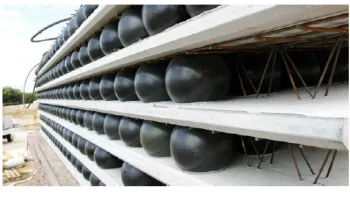
of the largest member consuming concrete . In a general way, the slab was designed only to resist vertical load. However, as people are getting more interest of residential environment recently, noise and vibration of slab are getting more important. In addition, as the span is increased, the deflection of the slab is also increased. Therefore, the slab thickness should be increase. Increasing the slab thickness makes the slabs heavier, and will increased column and foundations size. Thus, it makes buildings consuming more materials such as concrete and steel reinforcement. To avoid these disadvantages which were caused by increasing of self-weight of slabs, the Bubble Deck slab system, also known as void slab, was suggested. This system is known as bubble deck system.
Fig 1.1:Bubble deck slab
1.2OBJECTIVES OF THE STUDY
ISSN(Online): 2319-8753 ISSN (Print) : 2347-6710
I
nternational
J
ournal of
I
nnovative
R
esearch in
S
cience,
E
ngineering and
T
echnology
(A High Impact Factor, Monthly, Peer Reviewed Journal)
Visit: www.ijirset.com Vol. 8, Issue 3, March 2019
To study the structural behaviour of the bubble deck slab and conventional deck slab
To study the load carrying capacity on conventional slab & bubble deck slab.
To study the bending (deflection) behaviour of conventional slab & bubble deck slab.
To study the failure or crack on conventional slab & bubble deck slab.
II. LITERATURE REVIEW
Many journals are collected related to the topic area. The aim is to reducing the dead weight to attain the light weight structure without reducing the strength of the concrete. In journals different types of balls are used such as polyethylene balls, polypropylene balls, rubber balls, plastic balls etc..with different diameter. The behaviour of bubble deck slab is influenced by the ratio of bubble diameter to slab thickness. These bubbles can decrease the dead weight up to 30 – 50% and can increase the capacity by almost 100% with same thickness. As a result bubble deck slab can be lighter, stronger and thinner than regular reinforced concrete slabs.
III. MATERIALS USED
3.1 AGGREGATE (COARSE AND FINE)
Various properties of aggregates can influence the performance of concrete, therefore various considerations
have to be kept in mind while selecting the material.
3.2 CEMENT
Ordinary Portland cement of 53 grade was used as it satisfied the requirements of IS 269-1969
3.3WATER
IS 2000 water, used foe mixing and curing of concrete. Permissible limits for solid in water as per IS 456-2009. The maximum permissibLe limits of chloride content in water for RCc work has been reduced from 1000 mg per litre in Is 456-1978 to 500 mg per liter in IS 456-2000
3.4 Hollow Bubbles
These hollow bubbles are made using high density rubber materials. They are usually made with nonporous material that does not react chemically with the concrete or reinforcement bars. The bubbles have enough strength and stiffness to safely support the applied loads. They be of spherical or ellipsoidal in shape.
3.5 REINFORCEMENT
ISSN(Online): 2319-8753 ISSN (Print) : 2347-6710
I
nternational
J
ournal of
I
nnovative
R
esearch in
S
cience,
E
ngineering and
T
echnology
(A High Impact Factor, Monthly, Peer Reviewed Journal)
Visit: www.ijirset.com Vol. 8, Issue 3, March 2019
IV. METHODOLOGY
4.1 PARAMETERS STUDIED
The experiments are conducted on four series of test specimens. The following properties were studied for all the three grades of concrete.
Mechanical Properties
Compressive strength of concrete – cubes
Split tensile strength of concrete – cylinders
ISSN(Online): 2319-8753 ISSN (Print) : 2347-6710
I
nternational
J
ournal of
I
nnovative
R
esearch in
S
cience,
E
ngineering and
T
echnology
(A High Impact Factor, Monthly, Peer Reviewed Journal)
Visit: www.ijirset.com Vol. 8, Issue 3, March 2019
V. RESULT AND DISCUSSION
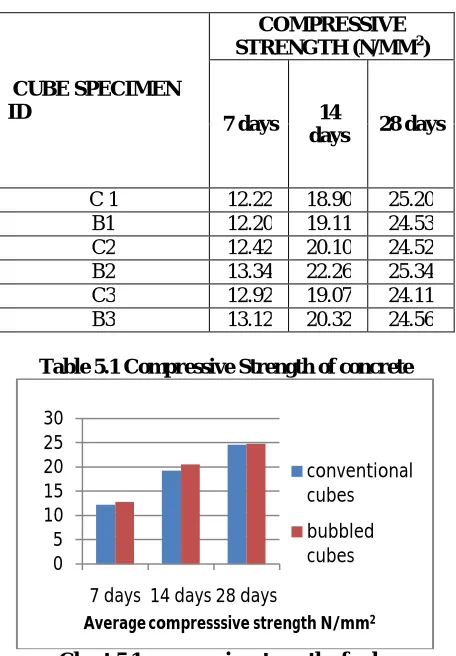
5.1 COMPRESSIVE STRENGTH TEST
CUBE SPECIMEN ID
COMPRESSIVE STRENGTH (N/MM2)
7 days 14
days 28 days
C 1 12.22 18.90 25.20
B1 12.20 19.11 24.53
C2 12.42 20.10 24.52
B2 13.34 22.26 25.34
C3 12.92 19.07 24.11
B3 13.12 20.32 24.56
Table 5.1 Compressive Strength of concrete
Chart 5.1 compressive strength of cube
From the results it is noted that the compressive strength of conventional concrete is almost similar to the bubbled cube. Only slight variations is occurred.
0 5 10 15 20 25 30
7 days 14 days 28 days
Average compresssive strength N/mm2
conventional cubes
ISSN(Online): 2319-8753 ISSN (Print) : 2347-6710
I
nternational
J
ournal of
I
nnovative
R
esearch in
S
cience,
E
ngineering and
T
echnology
(A High Impact Factor, Monthly, Peer Reviewed Journal)
Visit: www.ijirset.com Vol. 8, Issue 3, March 2019
5.2 SPLIT TENSILE STRENGTH TEST
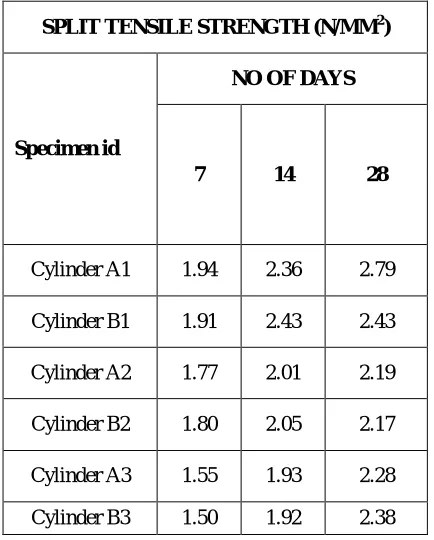
Table 5.2 Split Tensile Strength of concrete
Chart5.2: Split tensile strength of cylinder
The Split tensile strength of normal concrete is 10% of its compressive strength. From the results the split tensile strength of cylinder without ball is similar to cylinder with ball. Only slight variations occur.
0 0.5 1 1.5 2 2.5 3
7 days 14 days 28 days
Average Split tensile strength N/mm2
cylinder without ball
cylinder with ball
SPLIT TENSILE STRENGTH (N/MM2)
Specimen id
NO OF DAYS
7 14 28
Cylinder A1 1.94 2.36 2.79
Cylinder B1 1.91 2.43 2.43
Cylinder A2 1.77 2.01 2.19
Cylinder B2 1.80 2.05 2.17
Cylinder A3 1.55 1.93 2.28
ISSN(Online): 2319-8753 ISSN (Print) : 2347-6710
I
nternational
J
ournal of
I
nnovative
R
esearch in
S
cience,
E
ngineering and
T
echnology
(A High Impact Factor, Monthly, Peer Reviewed Journal)
Visit: www.ijirset.com Vol. 8, Issue 3, March 2019
5.3 SLAB TESTING 5.3.1Details of tested slabs
Size of slab= (300 x 500)mm SB1- solid slab of 80 mm thickness
BD1- Bubble deck slab of 80 mm thickness with 50 mm rubber ball used. SB2 – solid slab of 100 mm thickness
BD2 – bubble deck slab of 100 mm thickness with 80 mm ball used. SD3 – solid slab of 120 mm thickness
BD3 – bubble deck slab of 120 mm thickness with 100 mm ball used Reinforcement – 8 mm diameter bar is used
5.3.2Load vs Deflection
The load vs deflection graph was plotted taking the deflection along the X axis and the load along the Y axis. The graphs were compare with different specimens as deflection at center. It was observed that deflection increased as the load increased that is the load and deflection is proportional.
Fig 5.1 slab testing
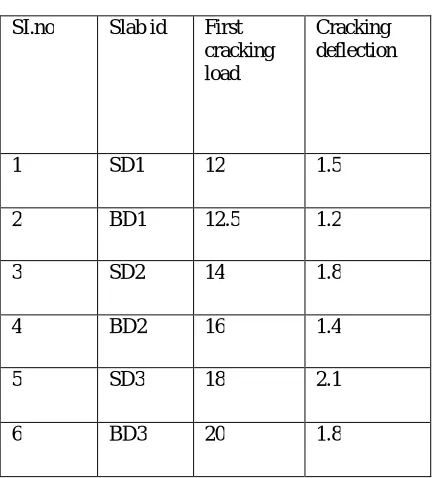
Table 5.3 first cracking load vs cracking deflection
SI.no Slab id First
cracking load
Cracking deflection
1 SD1 12 1.5
2 BD1 12.5 1.2
ISSN(Online): 2319-8753 ISSN (Print) : 2347-6710
I
nternational
J
ournal of
I
nnovative
R
esearch in
S
cience,
E
ngineering and
T
echnology
(A High Impact Factor, Monthly, Peer Reviewed Journal)
Visit: www.ijirset.com Vol. 8, Issue 3, March 2019
Chart 5.3 first cracking deflection
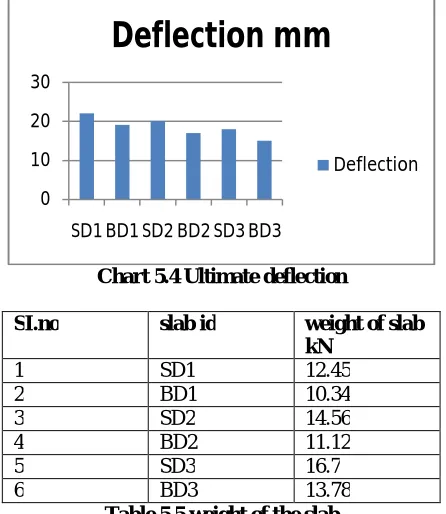
SI.NO slab id ultimate load
ultimate deflection
1 SD1 35 22
2 BD1 38 19
3 SD2 37 20
4 BD2 40 17
5 SD3 41 18
6 BD3 45 15
Table 5.4: Ultimate load vs ultimate deflection
Chart 5.4 Ultimate deflection
SI.no slab id weight of slab kN
1 SD1 12.45
2 BD1 10.34
3 SD2 14.56
4 BD2 11.12
5 SD3 16.7
6 BD3 13.78
Table 5.5 weight of the slab 0
1 2 3
SD1 BD1 SD2 BD2 SD3 BD3
Deflection mm
deflection
0 10 20 30
SD1 BD1 SD2 BD2 SD3 BD3
Deflection mm
ISSN(Online): 2319-8753 ISSN (Print) : 2347-6710
I
nternational
J
ournal of
I
nnovative
R
esearch in
S
cience,
E
ngineering and
T
echnology
(A High Impact Factor, Monthly, Peer Reviewed Journal)
Visit: www.ijirset.com Vol. 8, Issue 3, March 2019
Chart 5.5 Weight of the slab
SI.NO Specimen id Flexural strength N/mm2
1 SB1 3.9
2 BD1 4.2
3 SB2 4.3
4 BD2 4.5
5 SB3 4.5
6 BD3 4.9
Table 5.6 flexural strength of slab N/mm2 0
5 10 15 20
weight of the slab Kg
solid slab-80mm
bubble slab-80 mm
solid slab -100 mm
bubble slab-100 mm
0 1 2 3 4 5 6
FLEXURAL STRENGTH OF SLAB N/mm2
SB1
BD1
SB2
BD2
SB3
ISSN(Online): 2319-8753 ISSN (Print) : 2347-6710
I
nternational
J
ournal of
I
nnovative
R
esearch in
S
cience,
E
ngineering and
T
echnology
(A High Impact Factor, Monthly, Peer Reviewed Journal)
Visit: www.ijirset.com Vol. 8, Issue 3, March 2019
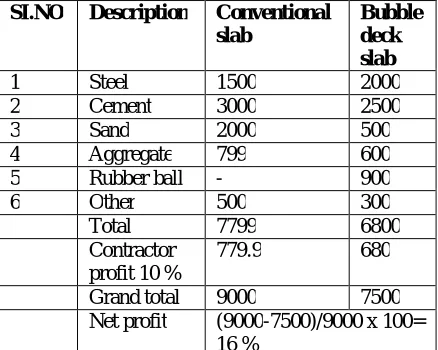
SI.NO Description Conventional slab
Bubble deck slab
1 Steel 1500 2000
2 Cement 3000 2500
3 Sand 2000 500
4 Aggregate 799 600
5 Rubber ball - 900
6 Other 500 300
Total 7799 6800
Contractor profit 10 %
779.9 680
Grand total 9000 7500
Net profit (9000-7500)/9000 x 100=
16 %
Table 5.7 : cost comparison between conventional slab and bubble deck slab
VI. CONCLUSION
It is concluded that bubble deck slab is better than conventional slab. It can be done by experimental study. The compressive strength of bubbled cube is similar to the conventional cube. The split tensile strength of cylinder with bubble is similar to the cylinder without bubble. The strength of bubble deck slab in 120 mm thickness is higher than other slab. There is 30 % reduction in weight of bubble deck slab when compared to the conventional slab. The cost of the bubble deck slab is 16 % less when compared to the conventional slab. This technology is environmentally green and sustainable. This detailed investigation prove to be the bubbled slab is more efficient than conventional slab.
ACKNOWLEDGEMENT
First and foremost we thank the almighty God for his wonderful presence with us throughout the completion of this project. This is a great pleasure to express our deep sense of gratitude and thanks to our HOD Prof. B.Parthasarathi M.E.,(Ph.D)., Project Guide Asst.Prof. J.Shiny Mol M.E., and Publishing Guide Asst. Prof. Brightson M.E.,(Ph.D)., for their valuable ideas, instantaneous help, effective support for the completion of this project.
REFERENCES
1. Abdulaziz I. Al-Negheimish, Ahmed K. El-Sayed, Majed O. Khanbari and Abdulrahman M. Alhozaimy (2017), ‘Structural behavior of
prestressed SCC hollow core slabs’ ELSEVIER Construction and Building Materials, vol.5,issue.03, pp. 334-335.
2. Abhija Mohan and Archana Sukumaran (2018), ‘Performance Analysis of Bubble Deck Slab Using Elliptical Balls’, International Journal of
Engineering Research and Technology (IJERT), vol.5, issue.02, pp.95-99.
3. Albero V., Saura H. and Montalva J.M. (2018), ‘Optimal design of prestressed concrete hollow core slabs taking in to account its fire
resistance’, ELSEVIER Advances in engineering software, vol.122, pp.81-92.
4. Amer M. Ibrahim, Nazar k. Ali and Wissam D. Salman (2012), ‘Flexural capacities of reinforced concrete two-way bubbledeck slabs of plastic
spherical voids’ Diyala Journal of engineering sciences ISSN 1999-8716 Vol. 06, No. 02, pp.9-20.
5. Bhagyashri G. Bhade and S.M Barelikar (2016), ‘An experimental study on two way bubble deck slab with spherical hollow balls’ International
journal of recent scientific research (IJRSR) Vol. 7, Issue.6, pp. 11621-11626.
6. Bhagyashri G. Bhade and Y.R.Suryawanshi (2017), ‘Structural behaviour on two way Bubble Deck slab using hollow Spherical balls’,
Vishwakarma Journal of Engineering Research (VJER), Vol.1, Issue 2, pp.16-20.
7. Bindea M., Claudia Mariya Chezan S. and Puskas A. (2015), ‘Numerical analysis of flat slabs with spherical voids subjected to shear force’,
Journal of applied engineering sciences ISSN 2247-3769 vol.5(18),Issue.1, pp.7-13.
8. Churakov A. (2014), ‘Biaxial hollow slab with innovative stypes of voids’, Construction of Unique Building and structures, ISSN vol.6(21),
ISSN(Online): 2319-8753 ISSN (Print) : 2347-6710
I
nternational
J
ournal of
I
nnovative
R
esearch in
S
cience,
E
ngineering and
T
echnology
(A High Impact Factor, Monthly, Peer Reviewed Journal)
Visit: www.ijirset.com Vol. 8, Issue 3, March 2019
9. Devyanshu Jain and Miss. Nidhi Gupta (2017), ‘Study of bubble deck slab and conventional deck slab’, International journal of advanced
technology in engineering and science (IJATES) ISSN 2348-7550 vol.5, issue.3, pp.135-139.
10. Lakshmipriya N. and karthik pandi M. (2018), ‘Study and model making of slab using bubble deck technology’, International Research Journal
of Engineering and Technology (IRJET), Vol. 05, Issue. 02, pp.72-83.
11. Maazoun A. and Vantomme J. (2017), ‘Damage assessment of hollow core reinforced and prestressed concrete slabs subjected to blast loading’,
ELSEVIER International conference on structural dynamics, vol.199, pp.2476-2481
12. Patil Nisha P., Ahire Gaurav D. and Kalyankar Shivaji H (2017), ‘Use of Rubber Ball in Deck construction’, International Journal of Advance
Research in science and Engineering (IJARSE), vol no.6, Issue no.9, pp.23-25.
13. Rinku John and Jobil Varghese (2015),
‘
A study on behaviour of bubble deck slab using ANSYS’, International Journal of Innovative science, Engineering and technology (IJISET) vol.2 issue 11, pp.132-135.
14. Sameer Ali and Manoj Kumar (2017), ‘Analytical Study Of Conventional Slab And Bubble Deck Slab Under Various Support And Loading