ABSTRACT
COLONNESE, DANIEL. Grid Service Data Needed for Estimation of Reliability in Scientific Workflow Systems. (Under the direction of Mladen Vouk.)
The emerging technologies of grid computing, web services, and service-oriented workflows will enable scientific projects to be conducted on a larger scale than ever before. Scientific workflows are often very dynamic in both structure and persistency, complex, and may involve a lot of interaction, very large data flows, and may change on very short notice. Given modern information technology tools, they can be constructed by combining dispersed network accessible services into virtual organizations. Within a scientific workflow environment, metadata or grid service data is necessary for service consumer application to discover services and for services to publish their properties. Software reliability engineering within service oriented workflow systems is still a
largely unexplored area. Emerging standards such as WS-Reliability and WS-Agreement are not yet practical to function in grid service environment. Therefore, methods of leveraging reliability service data with the existing aggregation mechanisms in Globus Toolkit 3, need explored further exploration.
The Open Grid Service Architecture (OGSA) allows registries of services. Service data information in the registries can be used for soft-state management, keeping track of metadata for service instances created from application factories, and so on. A service aggregation registry subscribes to services produced from a number of factories. Service data is express through a proposed XSD namespace shared vocabulary. Discovery policy is expressed in XPath queries.
GRID SERVICE DATA NEEDED FOR ESTIMATION OF RELIABILITY IN
SCIENTIFIC WORKFLOW SYSTEMS by
DANIEL COLONNESE
A thesis submitted to the Graduate Faculty of North Carolina State University
in partial fulfillment of the requirements for the Degree of
Master of Science COMPUTER SCIENCE
Raleigh 2004
APPROVED BY:
_______________________ _______________________ _______________________
Gregor von Laszewski Ting Yu Xiaosong Ma
__________________________
PERSONAL BIOGRAPHY
Daniel Colonnese was born in Siler City North Carolina, raised in Endicott New York, and his immediate family now resides in Fayetteville North Carolina. Daniel was homeschooled before attending Simon's Rock College of Bard in Great Barrington Massachusetts where he earned an Associates Degree with a Classics Emphasis. Daniel earned his Bachelor of Arts degree from The University of North Carolina at Chapel Hill where he majored in Political Science with a Law Emphasis. Daniel now resides in Raleigh North Carolina.
ACKNOWLEDGMENTS
This work supported in part by the DOE SciDAC grant DE-FC02-01ER25484, and by the IBM Corp. Shared University Research Program. I would like to thank the following – list of interviewees for agreeing to be interviewed as part of this research:
Dr. Eric Sills, Dr. Gary Howell, Dr. Jack Edwards, and Dr. John Blondin.
Thanks to my advisor, Mladen A. Vouk for his support and guidance for the duration of this project. Thanks to Gregor von Laszewski's for connecting this work to larger scientific community. Thanks to my girlfriend, Jennifer Britton for help proofreading. And, thank you to my parents for their continued support throughout my education and my life.
TABLE OF CONTENTS
LIST OF FIGURES V
1. INTRODUCTION 1
2. BACKGROUND: GRID SERVICES 7
2.1GLOBUS OVERVIEW 7
2.2GRID SERVICES 8
2.3SOFT STATE 9
3. BACKGROUND: SERVICE REGISTRIES 12
3.1UDDIOVERVIEW 12
3.2WSILOVERVIEW 15
3.3GRID SERVICE DATA REGISTRY OVERVIEW 16
4. BACKGROUND: WORKFLOW SYSTEMS 18
4.1HISTORICAL PERSPECTIVE 18
4.2OVERVIEW OF SOME CURRENT PROJECTS 20
4.3WORKFLOW PATTERNS 27
4.4EXPECTATIONS 30
5. GRID SERVICE DATA REGISTRY IN SCIENTIFIC WORKFLOW SYSTEMS 32
5.1MODELS FOR REPLICA SELECTION 32
5.2MODELS FOR FAULT TOLERANCE 53
6. IMPLEMENTATION DISCUSSION 67
LIST OF FIGURES
FIGURE 1:GROWTH IN NETWORK SPEED [HOUGHTON03] ... 2
FIGURE 2:GRID COMPUTING SEARCH QUERIES JUNE-SEPT 2003[GLG03]... 3
FIGURE 3:WORKFLOW ILLUSTRATION,DERIVED FROM [BAUSCH00]... 5
FIGURE 4:SERVICEDATA ATTRIBUTES,[NEWHOUSE02]... 10
FIGURE 5:OFFICE AUTOMATION AND WORKFLOW SOFTWARE PROJECTS [MUEHLEN02]... 19
FIGURE 6:WORKFLOW PATTERNS,[RION03]... 28
FIGURE 7:EXAMPLE BIOINFORMATICS SERVICE COMPOSITION WORKFLOW... 29
FIGURE 8:BIOINFORMATICS WEB SERVICES USED IN EXAMPLE WORKFLOW... 30
FIGURE 9:REPLICA SELECTION METADATA CANDIDATES... 35
FIGURE 10:HARDWARE AND PERFORMANCE MODELS EXPRESSED AS XSD... 37
FIGURE 11:OPERATIONAL PROFILE MODEL AS A STARTING POINT... 38
FIGURE 12:DERIVED AVAILABILITY MODEL... 39
FIGURE 13:MDS DATA STRUCTURE EXPRESSED AS XSD... 41
FIGURE 14:EUDATAGRID METADATA REPOSITORY EXPRESSED AS XSD... 42
FIGURE 15:NCHPCSAMPLE REPORT... 44
FIGURE 16:SERVICE DATA SET DERIVED FROM NCSTATE HPC CENTER STATISTICS... 45
FIGURE 17:FAILURE RATE METRIC... 45
FIGURE 18:XSDSCHEMA DERIVED FROM NCSTATE HPCCENTER STATISTICS... 46
FIGURE 19:SERVICE DATA SET DERIVED FROM NCSTATE HPCCENTER STATISTICS... 47
FIGURE 20:SIMPLE EXAMPLE QUERY... 48
FIGURE 21:REPLICA SELECTION ALGORITHM INSPIRED BY ERIC SILLS... 50
FIGURE 22:MESSAGE LEVEL ACCEPTANCE TESTS... 55
FIGURE 23:WSDLACCEPTANCE TESTS... 55
FIGURE 24:RECOVERY BLOCKS,[MCALLISTER&VOUK]... 58
FIGURE 25:N-VERSION PROGRAMMING,[MCALLISTER&VOUK] ... 59
FIGURE 26:CONSENSUS VOTING,[MCALLISTER&VOUK] ... 60
FIGURE 27:TOPOLOGY FOR FAULT TOLERANCE MODEL WITH INTERMEDIATE SERVICE... 61
FIGURE 28:TOPOLOGY FOR CLIENT-SIDE FAULT TOLERANCE MODEL... 62
FIGURE 29:AVAILABILITY DEFINITION... 63
FIGURE 30:SUMMARY OF METADATA MODELS... 66
FIGURE 31:SOFTWARE ACTUALLY DEPLOYED... 68
FIGURE 32:DEFAULT FILEDATA ELEMENT... 69
FIGURE 33:DEFAULT SERVICE DATA... 69
FIGURE 34:ADDED SERVICE DATA... 70
FIGURE 35:SIMPLE SERVICE DATA TO CREATE... 70
FIGURE 36:COMPLEX SERVICE DATA... 71
FIGURE 37:GETPROCESSTIMES() IMPLEMENTED IN C... 72
FIGURE 38:CODE SNIPPET TO EXECUTE AN XQUERY EXPRESSION... 73
1. Introduction
The topics discussed in this thesis including XML languages, web services, and grid computing are some of the popular and fastest growing areas of computer science research. The introduction chapter seeks to examine the larger trends which shape the context in which this thesis is presented. One must keep in mind that scientific research does not exist in a vacuum but is shaped by the prevailing fashions, paradigms, and politics of its day. The work presented in this thesis seeks to connect several topics which have been heading towards convergence for some time.
Figure 1: Growth in Network Speed [Houghton03]
Grid computing can be described as a collection of technologies that attempt to remove this conceptual bottleneck to achieve larger scale information exchange and computing efforts through a better utilization of resources in an integrated form.
Figure 2: Grid Computing Search Queries June-Sept 2003 [GLG03]
The promise of reusable software components has also deeply influenced the technologies discussed in this thesis. We have seen an evolution from
application-independent entities (Object Oriented Design), to domain independence (Design Patterns), to hardware independence (Virtual Machines), to language independence (XML
Ontologies). This process has been far from a smooth progression of new technologies obsolescing previous ones. Instead, computer scientists have grown to accept a pattern of overshooting the practical benefits of a technology and prematurely abandoning viable science from the past.
However, even the most cynical business commentator, must acknowledge that today’s scientists are experiencing a period of unprecedented cooperation and openness. The centuries-old philosophy of Bentham, Mill, and Locke that collective good is possible through the pursuit of rational self interest, has bourn out in the field of
computer science [Encarta]. Examples of such goods include open-source applications, free information, and relatively democratic public standards organizations. The Apache foundation [Apache], the Globus Alliance [Globus], and countless other research and development groups have aligned the goals of furthering individual careers with the broader goals of advancing the state of computer science.
The idea of workflow is very simple, and not new, and the need for workflows naturally come to existence as soon as any non trivial problems is decomposed in set of tasks and steps that need to be performed to obtain desirable results [WFMC]. Typically it is represented as some kind of diagram and maps naturally a mathematical graph representation. The graph can be translated to source code and compiled but it is
beneficial to keep high level graph representation of workflow so non-programmers can modify application logic without need to become programmers or script writers.
Workflows are well established technology in business domain and recently they gain popularity in scientific domain [EDSS], [wftk], [COSA], [swfl].
Workflow has many synergies with web services and grid computing. And like these other buzzwords, workflow concepts are gaining increased attention as they are applied to service composition and orchestration. One of the most insightful papers reviewed over the course of this thesis was Web Service Composition Languages: Old Wine in New Bottles? [Aalst03]. Written by some of the foremost experts in workflow theory, this paper seeks to expose the current trends towards web service composition as overhyped restatements of older concepts.
developers move to become web service providers, and computer scientists seek to provide reusable, general-purpose, scientific tool, rather than custom made scientific application. Service orchestration may also play an important role fulfilling the promises of on-demand, service-oriented computing.
Figure 3: Workflow Illustration, Derived from [Bausch00]
There are many obstacles to the widespread adoption of grid services. Service providers need not guarantee or support their services in any way, and a service oriented
One notion is that service availability can be improved through the use of multiple instances or service replicas that are aggregated into a (possibly replicated) service data registry. Studies such as [Vouk96] demonstrate the value of historical data and the measurement of empirical availability. Driving knowledge from this empirical data is crucial to developing highly available service oriented software.
IEEE Standard 610.12-1990 definition of “software reliability” is:
"The ability of a system or component to perform its required functions under stated conditions for a specified period of time." [610.12].
2. Background: Grid Services
2.1 Globus Overview
The Globus Toolkit research and development effort is a large ongoing effort headed by Argonne National Laboratory (ANL), USC/ISI, and IBM. The project has strong collaboration with many US, UK, and EU based projects. The Globus project has also received funding from DOE, NASA, NSF, and Microsoft. The overall goal of the project is to improve computing productivity in business and science. Some commonly given reasons for Grid computing are as follows:
• Lower cost of computing due to better resource utilization • Access to resources not available locally
• Better collaboration within widely dispersed organizations, allowing the • Creation of virtual organizations
• Ability to tackle problems of a scale that is not feasible otherwise • Large Scale Resource Sharing and Collaboration
The Globus Toolkit™ (GT) [Globus] is a de facto standard for open source grid software. The current version, as of May 2004, is version 3.2 (GT3). However, the Toolkit is far from complete. GT3 consists of numerous libraries, APIs, scripts, XML documents, and numerous pieces of middleware.
On the positive side, GT3 has good security tools for authentication and authorization, there are sophisticated means of resource discovery and monitoring, and Condor-G provides reliable remote service invocation. GT3 also enables high-performance remote data access. The implementation is very clean, well documented, and well referenced. There is support for multiple languages and a large user base [Newhouse02].
invocation, notification, error propagation, and termination. There is significant missing functionality, such as support for databases, sensors, instruments, and workflows. There is also little work on total system properties such as dependability and end-to-end quality of service (QoS) [Newhouse02].
2.2 Grid Services
GT3 builds atop of Web Service technologies. Web Services standards and software provide standard interface definition mechanisms, multiple protocol bindings, and local/remote transparency.
Grid Services, in GT3, have support for management of transient service instances and stateful services. A Grid Service can be a Factory service, in which case it can create other services, possibly on other servers. A Grid Service can be a Registry service that publishes information about other services. A Grid Service can also be a Gateway service to an application or data source. A Service Grid is a system consisting of relatively few persistent Grid Service and many transient services.
A Grid Service definition is a WSDL [WSDL] document with some extensions. This is sometimes called a GWSDL document. The document consists of a serviceType element with one or more portTypes. The serviceType is a machine-readable description of the service.
A portType is also called a Port, and more recently a service endpoint. This endpoint is s a URL with the following additional properties
• Globally unique
• HTTP get on a GSH + “.wsdl” returns a service definition • can derive GSH to portType Mapper from it
The GSR includes binding information and may expire. The GSR is just a service data element in the GWSDL.
There are a number of properties that a WSDL document must have to be considered a valid grid service. This data, expressed as XSD elements (XML schema), is supposed to allow for the dynamic creation and evolution of services.
The larger goal of this evolving XML meta-language is to capture the semantics meaning of a service and the data product that it provides. One of the first problems that the group developing GT3 hopes to solve is reasoning about the compatibility between two services – an essential verification and validation step when it comes to service composition or substitution. Just because two services have the same parameters and interface does mean that they are compatible. Further away still is the goal of service discovery. One of the first steps towards this goal is reasoning about the compatibility between two services which were created from the same Factory service. This problem, Replica Selection, is addressed in Chapter 5.
2.3 Soft State
Some of the information that allows for service evaluation is a unique name from which one can discover supported bindings and endpoints. There is also Grid Service Data which can be XSD-defined data structures associated with the Grid Service.
A Grid Service instance maintains a set of Service Data Elements (SDE). These are XML fragments encapsulated in standard XSD syntax. Service data can be meta-data or simple instance data instantiated by the Factory service.
name : local name for this Grid service data element.
globalName : A global name (i.e. QName) for this Grid service data element.
type : The XML schema type of the element contained in the extensibility element
goodFrom : Declares the time from which the value of the SDE carried in its extensibility element is said to be valid.
This is typically the time at which the contained element was created or aggregated.
goodUntil : Declares the time until which the value of the SDE carried in its extensibility elements is said to be valid.
This value MUST be greater than the goodFrom time.
availableUntil : Declares the time until which this named SDE is expected to be available. Prior to this time, a client SHOULD be able to query for an updated value of this SDE. This value MUST be greater than the goodFrom time.
Figure 4: ServiceData Attributes, [Newhouse02]
notify each other of events. A source publishes some data at given time intervals. A sink listens for notifications supports asynchronous delivery. These two interfaces together implement a publish/subscribe model. The accompanying libraries support 3rd part messaging services, filters, and automated client subscription.
The Factory interface supports the operation CreateService and returns a new GSH. The Registry interface supports the RegisterService and UnRegister operations. The next chapter describes how the Registry interface is combined with the notification interfaces to create a registry. The other two interfaces, HandelMap and PrimaryKey interfaces are not especially relevant to current work.
3. Background: Service Registries
In this chapter, I provide background on the three most widely known web service registry technologies. In a web service workflow system, a registry’s primary function is to provide a mechanism for service discovery. Service discovery may enable
improvements in the workflow systems such as fault-tolerance, planning, or improved performance. Since the inception of web services, many people believed that service discovery would become an essential part of web service technology. However,
programmers of grid service application have usually left service discovery to the user (as parameters) or even hard-coding the service endpoint. This is especially true for
scientific systems. Since there are usually a limited number of services that work with a scientific workflow system, the burden of discovering services is easily pushed to the user.
Academic projects have a RYO approach to service registries, and several existing scientific workflow systems have used registries. Projects such as DiscoveryNet [discoverynet], and ICENI [iceni] use custom registries. The Self-Serv [benatallah03] and Triana [Triana], projects use UDDI. This chapter of 3 types of open source registry technologies. Commercial web service registries, most notably Microsoft DISCO, are considered outside of the scope.
3.1 UDDI Overview
Universal Description, Discovery, and Integration (UDDI) version 1.0 was create
amongst the dot-com and e-commerce technologies in 2000. It was originally conceived as a machine-readable “Universal Business Registry,” an ecommerce directory that would revolutionize supply chain. The version 1.0 specification was supposes to create a standard platform on which business could compete to offer services. The UDDI
tied to XML, WSDL, XDS, and other overlapping projects. In 2004, the current version of UDDI (version 3.0) is a conglomeration of the initial web services specification (WSDL, SOAP, XSD) and the emerging technologies of XML-security and service publication. The UDDI project is currently negotiation with W3C and OASIS to turn the specification over to a standards body working group. UDDI’s authors have claimed [STENCILUDDI] that the standard is evolving to become more practical.
UDDI software offers a powerful, secure, and feature-rich web service registry at the cost of complexity and uncertainty about future versions of UDDI. UDDI has not yet been widely adapted and used in academia or in industry, but has been used successfully in some business projects. Many major corporations as well as numerous startups have been involved in the evolution of UDDI. The most influential actors IBM, Microsoft, Sun, and SAP have all published UDDI implementations.
Independent research carried out by SalCentral [Modi02] shows that over 67% of entries in public UDDI registries today are either invalidly formatted or validly formatted but unavailable. This is due to inadequate quality of service guarantees and a lack of
moderation in these registries. Furthermore, the available services are underutilized and very rarely “discovered” programmatically. In order to mitigate these problems, UDDI version 3.0 relies on a publish/subscribe model.
One interacts with a UDDI server or UDDI enabled application though a number of APIs, and their respective implementations. Today there are 6 major implementations of UDDI 2.0, however only Systinet claims to support version 3.0 features.
API Implementations
• IBM WSTK and UDDI4J
• Systinet WASP UDDI
• Microsoft UDDI SDK
• Trenian Web Services Directory
While the features and implementation of each implementation are different, they all provide mechanism to publish, find, and bind services. Publishing services is simply the matter of including a service in a UDDI registry. This can be done through a series or RPC style web service calls or by a person through a web page interface. The
specification provides mechanism for assigning a unique identifier (UDDI Key) to a newly published service. Finding or discovering a service is accomplished through creating a client-side proxy and searching by business, service, or description. Binding consists of how an application connects to, and interacts with, a web service after it's been found.
The UDDI is capable of storing the following data elements:
• businessEntity: Describes a business or other organization that typically provides Web services.
• businessService: Describes a collection of related Web services offered by an organization described by a businessEntity.
• bindingTemplate: Describes the technical information necessary to use a particular Web service.
• tModel: Describes a “technical model” representing a reusable concept, such as a Web service type, a protocol used by Web services, or a category system.
3.2 WSIL Overview
Web Services Inspection Language is project created by Microsoft and IBM that offers a lightweight, decentralized service registry in contrast to the complex centralized approach of UDDI. WSIL a specification for an XML-based meta-language and is used by the creation and consumption of web-based XML documents [APPNEL02].
A WSIL document is simple a way for an organization to aggregate and advertise its web services. The WSIL specification says:
"WSIL defines how a service requestor can discover an XML Web Service description on a Web server, enabling such requestors to easily browse Web servers for XML Web Services."
WSIL encourages organizations to locate their WSIL documents in a uniform manner. The WSIL document is published at http://example.org/inspection.wsil or
http://examples.org/services/inspection.wsil.
All WSIL documents must have a root element, <inspection>, which wraps all the service advertisements. Each service is wrapped in a <service> tag, which contains a <description> tag. Usually, the <description> element provides a reference to the namespace and the WSDL.
Academic researchers have definitely noticed WSIL, and have mentioned or discussed it in many documents, most prominently by the UK e-science project, Indiana University, and University of Chicago.
XMethods.com, a directory of publicly-available Web services, is an earlier adopter of WSIL and has developed a binding extension for its service.
3.3 Grid Service Data Registry Overview
The Globus Toolkit includes an example grid service, VOregistry. This service
implements the OGSA model of service data aggregation; it combines XSD schema data, called service data from any number of grid services. The VOregistry service listens for service to publish their service data at regular intervals, and creates an <entry> element for each service.
This model of service data aggregation makes use of the GWSDL/OGSI mechanism of portType inheritance. Every service capable of publishing its service data to the registry extends NotificationSource and the service subscribing to this data extends
NotificationSink. The conventional rules of inheritance apply to grid service, so it is possible to create further inherited services. A service’s GSWDL file can contain several <gwsdl:serviceData> elements that define the data structures of publishable service data in XSD schema.
Like UDDI and WSIL, a grid service data registry is queried through a set of APIs. The service data registry can hold any collection of XSD elements and can process complex queries as XPATH or XQUERY expressions. The processing is done on the registry side and only the query results are returned.
QoS with a publish/subscribe model based on timeouts. However, this mechanism shifts the responsibility to service providers to publish correct service data through the use of a shared XSD namespace vocabulary.
However, service data aggregation is also compatible with WSIL and UDDI. All three registries reside on a server, use a similar concept of web service discovery and all three implementations rely on the same Java XML libraries.
4. Background: Workflow Systems
4.1 Historical Perspective
This chapter provides an overview background on the numerous scientific workflow projects. The most widely used definition of term workflow is presented by the
workflow management coalition [WFMC]. Workflow can be defined as the orchestration of a set of activities to accomplish a larger and sophisticated goal, referred to as a
business process.
Mathematical and Computer Science academic work on workflow dates back to the mid-70s. Skip Ellis and Michael Zisman worked on “Office Automation” prototypes at Xerox Park. Work in this area went on from 1975-1985, but did not make significant progress until the business process re-engineering trends of the 1990s. Several early commercial products were also created with Lotus Domino being the most successful.
Simultaneously, office automation project were sponsored by the EU and the University of Dortmund.
Figure 5: Office Automation and Workflow Software Projects [Muehlen02]
By the 1990s, the automation of business workflow has matured into many successfully software products including:[Staffware], [COSA], [InConcert], [Eastman], [Domino], [Websphere], [Workflo], [I-Flow]. There are many open source workflow frameworks available as well.
Research on workflow systems was reopened from a different perspective in 2000-2001, when work began on Web Service Choreography Interface Specification (WSCI), and introduced the notions of web service composition and service orchestration. As part of their commitment to adopting web services and XML, Microsoft and IBM developed XLANG [xlang] and WSFL [wsfl] respectively. In 2002, Microsoft and IBM jointly announced the BPEL workflow language specification. The specification
Over the last 2 years, XML meta-languages have gain a lot of attention in both technical and business publications. WSCI, XLANG, WSFL, and BPEL have been debated and analyzed both from a technical and political perspective by James Snell at IBM, David Berlind for coverpages.org, and Paul Krill reporting for InfoWorld. Simultaneously, many academic projects began using these languages or systems derived from these languages.
4.2 Overview of Some Current Projects
Simultaneously, the last two years have produced an explosion of projects aimed at workflow in scientific computing. This section presents a snapshot of the rapidly
changing landscape of scientific workflow projects. This survey was conducted in search for grid service reliability implementation
LabVIEW
LabVIEW [LabVIEW] brand software, published by National Instruments Corporation is the most widely-used scientific workflow software. Experiment, simulation, and
measurement workflows can be constructed with GUI controls for RAD (rapid
application development) tools as well as scripting. LabVIEW software can both host and consume web services. Some researchers at the Trieste Workshop on Web Enabling Technologies & Strategies for Scientific e-Learning are working towards integrating LabVIEW with OGSA-compliant services. LabVIEW is often used in conjunction with Mathematica.
XCAT
an Application Coordinator analogous to a workflow engine. This XCAT is not to be confused with the IBM software of the same name used for maintenance of distributed computing system software.
GridFlow
The GridFlow project is a large collaborative project used to integrate a wide range of existing grid middleware. Existing systems for resource scheduling, resource
management, and performance services were integrated with the Globus toolkit and MDS Information Services. All these component are controlled from a user portal which provides three main functionality simulation, execution, and monitoring. Gridflow uses an XML specification to represent the workflow and offers visual editing tools.
Workflows consist of sub-workflow which are mapped onto ‘local’ and ‘global’ grid resources.
Woflan
Woflan [woflan] is a "Petri-net-based workflow diagnosis tool" developed at TU/e in the Netherlands. The Woflan program allows a user to input a workflow specification in file formats from several commercial workflow applications including Staffware [staffware], COSA [cosa], and Protos [pallas]. Woflan produces a descriptive, warning, and error messages from the input file. Woflan checks workflows for correctness, and generates diagnostics to help repair problems [Verbeek00].
Self-Serv
Self-Serv [benatallah03] is a collection of web services middleware the creation of web service from other web services. Self-Serv is based on a peer-to-peer model, in that any service is capable of executing composite services without the need for a central
BioPipe
BioPipe [biopipe] is one of a series of related packages for carrying out bioinformatics analysis from the Open Bioinformatics Foundation [obf]. Biopipe is a collection of Perl modules for constructing workflows from BioPerl [bioperl] applications. Much of the code and ideas are borrowed from the Ensembl [ensembl] pipeline project.
SCIRUN
SCIRUN [scirun] is an application begun in 1992 by National Center for Research Resources Center at Utah. SCIRUN is a GUI “scientific workbench” that allows users to construct, manage, and debug simulations in domains such as physics and neurobiology. SCIRUN simulation may be thought of as workflows since they allow for parallel and conditional execution of tasks. Some SCIRUN applications allow for jobs to be run on a grid. SCIRUN also provides extensive scientific visualization libraries.
WASA
WASA2 [wasa] is an application that supports the creation and execution of workflows from CORBA components. It includes a GUI workflow modeler as well as controls to modify a workflow while it is running. WASA2 has been used in the domains of geoprocessing and molecular biology as well as for modeling business processes. WASA2 uses a strictly object orient approach where workflows are represented as CORBA objects and can be displayed as UML diagrams.
myGrid
myGrid executes workflows defined in these documents with the IT Innovation Workflow Enactment Engine [it].
Triana
Triana [Triana] is a set of open source java libraries that provide a GUI interface for building workflows from a collection of OGSA grid services. Triana has been leveraged by several other projects including myGrid and Chimera. Triana contains an engine for coordinating and invoking a set of grid services. Triana also contains a peer-to-peer component based on JXTA [JXTA] allowing Triana to run a variety of devices including PDAs and mobile phones.
Chimera
Chimera [deelman03] is a system used to find or create a workflow for a series of OGSA grid services to provide a scientist’s requested “data product.” Chimera was begun in 1999 and is enabled by the Pegasus Planner [pegasus] described in [deelman02], a GriPhyN project at UC ISI. The Chimera is middleware designed to be invisible from a client who requests the data product. The workflow is represented as an “abstract program execution graph.” This graph is transformed into an executable DAG for the Condor DAGman [dagman] scheduler.
Ptolemy-II
Ptolemy-II [ptolemy] is a platform for visual problem solving and modeling written in Java. It was begun in 1997 at UC Berkley. Several recent SPA [SPA] efforts in including [altintas04], [ludaesher03], [vouk03], and [altintas03] have extended the Ptolemy-II platform to allow for the drag-and-drop creation of scientific workflows from libraries of actors. The Ptolemy actor is often a wrapper around a call to web service or grid service. Ptolemy leverages an XML-meta language called MoML [lee-moml] to produce a workflow document describing the relationships of the entities, properties, and ports in a workflow. Presently, Ptolemy actor libraries exist for the domains of
DiscoveryNet
DiscoveryNet [discoverynet, Curcin02] is a collection of software built on top of the UNICORE grid system for arranging database access and knowledge discovery procedures. DiscoveryNet was begun in 2001 at Imperial College of Science. DiscoveryNet provides a means of describing workflow between analysis service providers, data owners, and scientists who arrange and execute these workflows
[Rowe03]. DiscoveryNet makes use of the OGSI components and protocols as well as its own protocol for workflows, Discovery Process Markup Language [guo03]. This
language is used for constructing, running, and managing grid-services, as well as recording their history
wftk
Open-source workflow toolkit [wftk], is the name of a generalized workflow system, implemented as a series of Java libraries. wftk was begun in 1998 by Michael Roberts. wftk uses its own high level language to describe workflow, and stores workflow related documents in a series of XML “datasheets.” wftk workflow engine contain two models of a workflow: a “task-based” model, essentially a DAG, and a “state-based” model, essentially a FSM. wftk libraries can also be run as web services.
SWFL
ICENI
ICENI (Imperial College e-Science Net-worked Infrastructure) [iceni] is a collection of grid middleware used for providing and coordinating grid services for e-science
applications. ICENI includes a GUI workflow construction tool integrated into the Netbeans [netbeans] IDE. This tool can create a textual “execution plan” of the workflow in an XML-meta language derived from YAWL (Yet Another Workflow Language) [YAWLa]. The ICENI workflow system supports conditionals, loops, and parallel execution.
BioOpera
BioOpera [bioopera] is an application for the composition of various bioinformatics applications built on top of the [opera] architecture. The project was begun in 1999 at the Swiss Federal Institute of Technology. BioOpera provides a GUI tool for the
construction of workflows from web services and grid services. BioOpera represents a workflow “process template” as a DAG, and translates this set of activities into an execution script for Condor-G [bausch03]. Additionally, the web service invocation engine within BioOpera uses UDDI, and the grid service component uses service description documents [haller03-thesis].
ILab
ILab [ilab] is a set of grid middleware developed at The Fraunhofer ICT Group since 2001. ILab includes a GUI tool for the construction of workflows from grid services. This tool uses an XML-based language called Grid Application Definition Language (GADL) [der03] to assemble applications from grid services, and Grid Job Definition Language (GJobDL) to describe the runtime behavior of such applications. ILab uses Petri nets instead of DAGs to model and control the workflow.
GridAnt
allows for the specification of precondition and parallel tasks in much the same way as the Ant build tool.
DAGMan
DAGMan [dagman] is a set of C libraries which allow for the user to schedule programs based on dependencies. DAGMan is part of the Condor project and extends the Condor Job Scheduler [condor] to handle intra-job dependencies. As the name suggests,
DAGMan represents a collection of job dependencies as a directed acyclic graph. These DAGs are specified using a simple text file format. DAGMan leverages technologies from the CondorG scheduler, Globus Toolkit, and the EU Datagrid.
EDSS
The Environmental Decision Support System [edss] is a graphical tool for creating air quality simulation experiments. EDSS allows the user to define text file definitions or “templates” used by the various air quality simulation programs which are typically FORTRAN programs. The user defines a workflow, which is represented as a DAG, and can export the model for later use.
METEOR
The Managing End-To-End OpeRations [meteor] project is a collection of Java programs for constructing and executing workflows. METEOR began in 1994 and now continues as METEOR-S [Sivashanmugam03] a project on semantic web services. These projects were used to create IntelliGEN [kochut03], a bioinformatics workflow systems that coordinated a number of web services. METEOR was also used to build an information management system for Genome Databases [hall03]. METEOR has also been used in several projects for business workflows and to illustrate quality of service issues in [cardoso03].
COUGAAR
Experiment [roaringshrimp] is a project that attempts to define workflow structures and languages for distributed services-based applications. A derived work, the Microsoft Desktop Collaboration Agent Experiment [extendedexp], uses these projects to automate office tasks such as email. This project leverages techniques from narrative scripting and expert systems such as [amzi].
4.3 Workflow Patterns
Workflow Patterns is an emerging area of study that grew out of the PhD work of Bartek Kiepuszewski in 2002 []. Today, it is primarily the work of Wil van der Aalst and collaborators who expanded concepts in graph theory to understanding workflows and workflow languages. A workflow pattern is a type of data and control flow. Aalst claims: “Workflow languages can be fully characterized in terms of the evaluation strategy they use, the concepts they support, and the syntactic restrictions they impose. A number of results pertaining to this classification will be proven. [WP03]”
The study of workflow patterns holds the promise to refine the construction of workflow languages into a scientific process. The contributors to Workflow Patterns often lament that workflow products are created without much thought to their theoretical
Example Workflow Scenarios
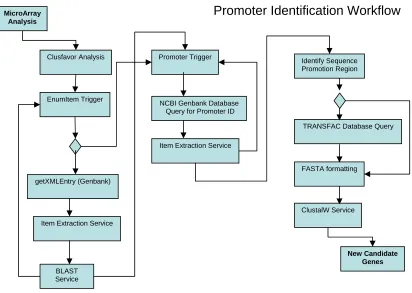
Suppose a bioinformatician is charged with identifying new genes that affect the strain of infectious bacteria he is studying. His work begins when he receives an email from a technician at the wet lab informing him that his MicroArray slide kit is finished. He now has a new set of raw data to analyze. He must to coordinate the efforts of several
sciences, extract data from several remote sources, and run several analysis programs. In effect, his goal is to identify gene sequences to ‘promote’ so as to identify new genes. Today this series of operations would be done through a process of piecemeal Perl scripts, files transfers, and email requests to get input from his colleagues. This bioinformatician must be both a biologist as well as a software engineer. The promise of workflow
software is to free this scientist from understanding the software process, so that he may spend his focusing on the biology, while the workflow software handles the details of how his workflow is executed.
MicroArray Analysis
Item Extraction Service
NCBI Genbank Database Query for Promoter ID
TRANSFAC Database Query
BLAST Service
ClustalW Service EnumItem Trigger
Item Extraction Service
getXMLEntry (Genbank) Promoter Trigger FASTA formatting New Candidate Genes Clusfavor Analysis Identify Sequence Promotion Region
This workflow is used to demonstrate Ptolemy software, and consumes three web
services provided by our research group at NC State. Today, there is only one instance of each service. However, it would be fairly easy to replicate each service on a number of hosts.
This workflow demonstrates the Basic Control Patterns: Sequence, Parallel Split, Synchronization, Exclusive Choice, and Simple Merge. This workflow includes a number a web services, but does not achieve web service composition.
Web Service Number of Invocations per workflow run BLAST N
ClustalW 1 Transfac Search N
Figure 8: Bioinformatics Web Services used in Example Workflow
4.4 Expectations
In general, given empirical reliability data in a service data elements set, some basic statistics can be used to predict reliability for the variable and single run services. We will assume that the non-service operations take no time and have 100% success rate. This, of course is not true in practice, but here it enables us to focus on service reliability issues.
One could also assume that increased probability of an exception will cause increased workflow run time. Hence, if the entire workflow fails on due the failure of any service than the average runtime is increased by the time it takes to re-run the failed experiments. In general, a single path through the workflow graph can be unrolled into a sequence of call to functions and services. The reliability of that chain is, provided service elements are independent, that of a serial reliability solution [Musa93],[Lyu96]. If any alternative services are available, then the reliability of the whole system may be estimate using known models and involves a combination of parallel and serial reliability models [Musa93],[Lyu96] .
5. Grid Service Data Registry in Scientific Workflow
Systems
There is widespread agreement that service composition and workflow technology will one day put the power of custom application development into the hands of
non-programmers. As discussed in the previous chapter, many such systems have already been developed. However one of the primary obstacles to adoption of service
composition architectures is the fact that services often “go down” while backup and substitute services are difficult to find. This is especially true when a system attempts to aggregates services from several different organizations. The creation of “virtual
organization” is one of the stated goals of the GGF and the Globus consortium.
The optimal solution is to create standard mechanisms for service discovery where the workflow engine has knowledge of the end user’s goals and expectations. Service discovery research has much overlap with semantic web research. Both areas of research are theoretical and address very difficult problems.
This chapter seeks to divide the problems of service discovery and reliability into small problems that are addressable with existing software. The first division I make is to separate reliability models into “models for replica selection” and “models for fault tolerance.” Replica selection is choosing among a number of services that assumed to be functionally and syntactically equivalent. Fault tolerance is further divided into models for redundancy and models with alternate versions. In all reliability models presented in this chapter the focus is on how new technologies such as grid service data can be used to implement existing techniques.
5.1 Models for Replica Selection
not availabley, its copy, or its functional equivalent may be. In that vein, File Replica Selection is an established concept in grid computing literature. Replica Selection is the mechanism selecting the best copy of a duplicated resource, such as a file or grid service instance. The Globus Consortium literature uses the term replica selection more narrowly as a data grid concept:
A replica selection service within a data grid responds to requests for the “best” copy of files that are replicated on multiple storage systems. Here, information sources can once again include system configuration, instantaneous performance, and predictions, but for storage systems and net-works rather than computers. [Czajkowski01].
Other literature, such as Ian Forster’s “A Decentralized, Adaptive, Replica Location Service”, describes the similarities between selecting a host for filesharing within the Gnutella network and selecting the best grid resource [Foster02]. As this paper
acknowledges, P2P networks have weak QoS guarantees and are weakened by the free-rider problem. When a list a fileshares is present in a P2P client, hosts are ranked by available bandwidth, and the success of previous request. Later in this chapter, I will illustrate how this information can be expressed as grid service data XSD schema.
Replica Selection is discussed, in the context of Chimera Astrophysics applications, and a proposed Replica Selection Service [Foster02, Vazhkudai01]. The conclusions of these Conference Proceedings, is that a software component called the “Storage Broker” will communicate with replicas and base a decision on a set of performance predicting metadata.
and thus allows the client to compare one replica with another. The metadata is illustrated as information about the hardware such as storage capabilities, volume, and bandwidth. A client may want to search, match, or invoke services from a number of replica sites.
Some interesting questions that these papers raise are: How does a client choose a single replica?, Does a client prefer reliability over performance, bandwidth over memory volume, SUN over Hewlett Packard?, and so on.
These questions become more than theoretical when constructing XQUERY/XPATH expressions to select a GSH endpoint from a VOregistry. Such questions become design issues, when a collection or workflow components share service data in the form of an XSD vocabulary. Therefore, in this chapter I attempt to construct models for replica selection within a scientific workflow application.
In this thesis, I expand the concept of replica selection to include the notion of Service Replica Selection in addition to File Replica Selection. Just as a file can be replicated on a data grid, web services can be replicated within a virtual organization to achieve
increased reliability and performance. In many ways, data retrieval is more efficient when the data is coupled with the retrieval mechanism. In my examples, I use a FileShareing service, to represent an arbitrary data retrieval or data derivation service. I assume that the grid service consumer is interested in a data product, which can be a raw file, or something derived from that file. Web Service technologies have begun to erase the distinction between data retrieval, and data derivation functions, so that a replica selection client need only be concerned with retrieving a data product and not how that data product is produced.
While previous Globus Toolkit projects use an LDAP directory or the Grid Information Services (GIS) model, the Globus Toolkit 3 project is now gravitating towards
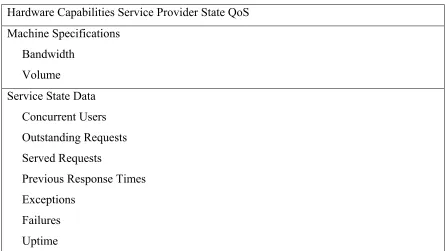
From the history of the Grid Information Services Working Group’s research, many possible replica selection MetaData ontologies have been discussed [GWD-GIS]. The broad concepts that have emerged in Grid research relevant to replica selection are:
Hardware Capabilities Service Provider State QoS Machine Specifications
Bandwidth Volume
Service State Data Concurrent Users Outstanding Requests Served Requests
Previous Response Times Exceptions
Failures Uptime
Figure 9: Replica Selection Metadata Candidates
Ideally, a client would know the probability of a provider delivering a correct data product as well as the confidence interval and the margin of error. However, it is more realistic to simply track a service’s lifetime as the number of requests and responses that have passed through. A client could use information similar to what is presented in an HTTP server’s log files to determine the reliability and average response time.
However, it is expensive in terms of space and bandwidth to keep records of everything a service has ever done, so instead I propose some service data elements that can be
derived from the log and exported to a VOregistry.
<!-- some performance information to base a decisions off of -->
<xsd:complexType name="replica_selection">
<xsd:Version>Version 1</xsd:Version>
<xsd: element name="life_time_milliseconds" type="xsd:decimal"/> <xsd: element name="request_count" type="xsd:int"/>
<xsd: element name="response_count" type="xsd:int"/>
<xsd: element name="last_response_time_milliseconds" type="xsd:decimal"/> <xsd: element name="outstanding_requests" type="xsd:int"/>
<xsd: element name="max_simultaneous_requests" type="xsd:int"/> <xsd: element name="percent_cpu_idle" type="xsd:int"/>
</xsd:complexType>
<!-- a more abstract approach -->
<xsd:complexType name="replica_selection">
<xsd:Version>Version 2</xsd:Version>
<xsd: element name="percent_utilized" type="xsd:int"/> <xsd: element name="available_grid_nodes" type="xsd:int"/> <xsd: element name="outstanding_requests" type="xsd:int"/>
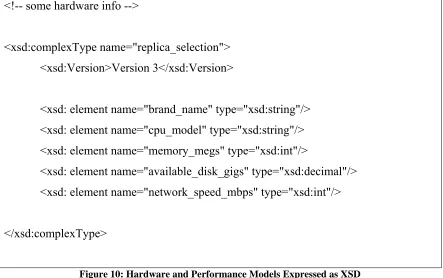
<!-- some hardware info -->
<xsd:complexType name="replica_selection">
<xsd:Version>Version 3</xsd:Version>
<xsd: element name="brand_name" type="xsd:string"/> <xsd: element name="cpu_model" type="xsd:string"/> <xsd: element name="memory_megs" type="xsd:int"/>
<xsd: element name="available_disk_gigs" type="xsd:decimal"/> <xsd: element name="network_speed_mbps" type="xsd:int"/>
</xsd:complexType>
Figure 10: Hardware and Performance Models Expressed as XSD
Replica Selection from an Operational Profile
Another MetaData model of replica selection can be constructed form the more mature research field of Software Reliability Engineering. A common practice is to define an operational profile in order to conduct reliability tests [Musa93]. The operational profile is used in much the same way as GIS MetaData or Service Data; the profile is a
collection of information used to understand how frequently a particular function or operation may be used. In conjunction with failure data, operational profile can be used to predict the reliability and perhaps other performance parameters of the service.
While practitioners of software reliability engineering may use this information to re-implement, debug, or just improve systems, a service consumer may have the option of simply selecting a different replica.
Subgroups of elements are arranged into system modes; divisions of work are called runs. The elements are given a probability of failure that is weighted by their usage probability.
By using the concept of an operational profile as a starting point, I present a simple model of measuring service reliability.
F
Number of failure where a failure = number of times a request could not complete because of an exception.
N
Total lifetime number of invocations
C
How many times am I going to call this service?
<!—service data expressed as XSD schema --> <xsd:complexType name="replica_selection">
<xsd:Version>Version 1</xsd:Version>
<xsd: element name="failure" type="xsd:int"/> <xsd: element name="lifetime " type="xsd:int"/>
</xsd:complexType>
Figure 11: Operational Profile Model as a Starting Point
• Failure rate estimate P = F / N
• Failure rate as a geometric distribution = P (1-P) ^ C
• Chance of X consecutive successes = 1 – (F0 / N0) * (F1 / N1) * … (FX / NX)
Figure 12: Derived Availability Model
However, this model is obviously too simplistic since F and N change after each request (implying use of a hypergeometric model, for example, [Lyu96] and other factors, most notably performance changes that may not be considered direct failures, should be taken into account when selecting a service replica.
Previous Data Models for Grid Service Descriptions
Back in 1997, A collaboration between Argonne National Laboratory and UC ISI
addressed the problem of creating a data set to describe a grid service. The publication, A Directory Service for Configuring High-Performance Distributed Computations
[Fitzgerald97], proposes the Metacomputing Directory Service (MDS) in order to answer questions such as these:
• What are the network interfaces (i.e., IP addresses) for the ATM network and Internet? Note: today we may not worry about ATM, but about Gigabit Ethernet, or perhaps some other combination (e.g., IP over light, or similar).
• What is the raw bandwidth of the ATM network and the Internet, and which is higher?
• Between which pairs of nodes can we use vendor protocols to access fast internal networks?
• Between which pairs of nodes must we use TCP/IP?
The resulting ontology organizes data into GlobusResource and GlobusHost objects. Many research projects have used and expanded upon the MDS ontology.
Here I present the original Globus MDS data structure expressed as XSD.
<!--
adapted from
ftp://ftp.globus.org/pub/globus/papers/hpdc97-mds.pdf -->
<xsd:complexType name="replica_selection">
<xsd:Version>Version 5</xsd:Version>
<xsd:complexType name="GlobusHost">
<xsd: element name="hostName" type="xsd:string"/> <xsd: element name="type" type="xsd:string"/> <xsd: element name="vendor" type="xsd:string"/> <xsd: element name="model" type="xsd:string"/> <xsd: element name="OStype" type="xsd:string"/>
<xsd: element name="OSversion" type="xsd:string"/>
<xsd: element name="networkNode" type="xsd:string" use="optional"/> <xsd: element name="totalSwap" type="xsd:string" use="optional"/> <xsd: element name="dataCache" type="xsd:string" use="optional"/>
<xsd:sequence>
<xsd:complexType name="GlobusResource">
<xsd: element name="administrator" type="xsd:string"/> <xsd: element name="manager" type="xsd:string" use="optional"/> <xsd: element name="provider" type="xsd:string" use="optional"/> <xsd: element name="technicion" type="xsd:string" use="optional"/> <xsd: element name="description" type="xsd:string" use="optional"/> <xsd: element name="documentation" type="xsd:string" use="optional"/> </xsd:complexType>
</xsd:sequence>
</xsd:complexType>
</xsd:complexType>
Figure 13: MDS data structure expressed as XSD
While the MDS adequately describes a grid resource, it does not address the requirements of an operational profile to track failure rates. MDS is essentially a static registry
document, meant to be read frequently and written to infrequently.
Aside from MDS, the most widely-used grid metadata service is the Metadata Repository of the EU DataGrid project. The EU DataGrid Project uses an RDBMS as the backend of the metadata registry, and integrates the querying of this database into the Globus
The database schema is simply a mapping of users (identified by X509 certificates) with roles.
<!—adapted from SQL build script
http://datagrid.in2p3.fr/cvsweb/~checkout~/edg-spitfire- server/setup/databases/MySQL/createtables_security.sql?rev=1.4&content-type=text/plain
-->
<xsd:complexType name="replica_selection">
<xsd:complexType name="USER">
<xsd: element name="X509DN" type="xsd:string"/>
<xsd:sequence>
<xsd:complexType name="ROLE">
<xsd: element name="ROLE_NAME" type="xsd:string"/> </xsd:complexType>
</xsd:sequence> </xsd:complexType>
</xsd:complexType>
Figure 14: EU DataGrid Metadata Repository Expressed as XSD
Both the MDS and the DataGrid systems are appropriate for use in a grid where users must log in, request resources, and run jobs. However, when a workflow engine acts as a proxy for a grid user, these systems are inefficient because they do not take into account QoS and performance concerns when the user is relieved of the task of service selection.
Grid services are well suited to providing access to high performance computing (HPC) resources such as network storage and Condor pool. One obvious approach to grid service data for reliability is to reproduce the availability data of HPC systems. Unfortunately, there are no standards for reporting the status of a supercomputer or cluster. Rather there are conventions and status information is presented in human-readable form. Our own NC State University High Performance and Grid Computing Information Technology Division recently confronted the problem of making availability data of our clusters visible on the web. Since there is no de facto performance reporting software, our solution was to create a collection of PHP scripts. [NCHPC04].
The [NCHPC04] website offers some performance information such as the peak number of GFlops and total TeraBytes in storage. The PHP scripts generate a report.
Notes ---
Avg. Load (Jobs) = Average number of end-user jobs running, pending execution or in suspension mode.
Avg. Util (%) = Average processor utilization
Avg. Wait (min) = Average time a submitted job waits in queue before starting
Avg. Run (min) = Average run time of a submitted job
Period: (H) = Moving hourly average, (D) = Moving daily average, (W) = Moving weekly average, (M) = Moving monthly average
mcrae.ncsc.org Status: Thu Feb 12 15:00:06 EST 2004
Avg Load (15sec, 1min, 15min exponential avg): 56.5, 56.9, 55.6 Avg Processor Utilization - (1min exponential avg): 100% 1-min paging rate pg/sec: 1e+03
Users: number of logged-in users, logged-in user idle time of the host in min ): 15, 0 Memory: (free space in /tmp, available swap space, available RAM) 43G, 112G, 3M Jobs: (Total, Pending, Running, Suspended) 89, 43, 43, 0
Load & Util Hourly (1min average, sampled every 5 min, moving 60 min average of the samples): 55.4, 100.0
Load & Util Daily (1min average, sampled every 5 min, moving 24hr average of the samples): 54.9, 99.9 Load & Util Weekly (1min average, sampled every 5 min, moving 7 day average of the samples): 50.6, 99.7
Load & Util Monthly (1min average, sampled every 5 min, moving 4 week average of the samples): 45.6, 98.6
Times: Daily Average (Number of Finished Jobs, Wait time (min), Run time (min)): 81, 139.1, 130.1 Times: Weekly Average (Number of Finished Jobs, Wait time (min), Run time (min)): 347, 264.8, 377.7
Figure 15: NCHPC Sample Report
I have applied this approach to constructing a set of grid service data for service replica selection. I propose the following data set:
Name Description
TotalRequests The total number of request that this
instance has received in its lifetime
InvalidRequests The total number of server-side exceptions caused by an invalid SOAP request
message
Exceptions The total number of service-side exceptions
that have occurred in its lifetime
AvgCueTime A running average (in seconds) of how
AvgRunTime A running average (in seconds) of how long the service provider takes to complete sending the SOAP response
AvgLoad A x (say 1) minute exponential average of
resource requests, expressed as a percentage of capacity
AvgProcUtilization A x (say 1) minute exponential average of processor usage, expressed as a percentage of capacity
OutstandingRequests Number of outstanding requests: cued and job running
Figure 16: Service Data Set Derived from NC State HPC center statistics
This service data set contains estimates of how long a service should have to wait as well as a simple derived failure rate metric.
Failure Rate Metric
Let ‘F’ be service failure rate
IF InvalidRequests < TotalRequests
F = Exceptions / TotalRequests – InvalidRequests ELSE F = 0
Figure 17: Failure Rate Metric
<xsd:complexType name="replica_selection">
<xsd:Version>Version 6</xsd:Version>
<xsd: element name="TotalRequests" type="xsd:decimal"/> <xsd: element name="InvalidRequests" type="xsd:int"/> <xsd: element name="Exceptions" type="xsd:int"/> <xsd: element name="AvgCueTime" type="xsd:int"/> <xsd: element name="AvgRunTime" type="xsd:int"/> <xsd: element name="AvgLoad" type="xsd:int"/>
<xsd: element name="AvgProcUtilization" type="xsd:int"/> <xsd: element name="OutstandingRequests" type="xsd:int"/> </xsd: complexType>
Figure 18: XSD Schema Derived from NC State HPC Center Statistics
I believed this model to me a promising data set to use as a basis for service replica selection. In order to get a feeling for the appropriate queries to make against this service data set, I surveyed several of the NC State’s high performance computing (HPC)
experts. Availablity of HPC services was considered as a service that may be
representative of the expectations scientific workflow users may have, so their opinions about a general grid service characteristic may be telling.
Preferences Survey
I interviewed several experts in the field of high performance computing in order to formulate a model that may be appropriate for selecting a grid service replica. A realistic replica selection model should balance several goods including expect run time (or
In my survey of HPC experts, I ask each expert to construct a query on a set of grid service data for selecting the optimal replica of a FileshareService. We assume that there are N identical FileshareService instances residing on disparate hardware and software platforms. All services reliably and accurately publish their properties to a VORegistry.
Name Description
TotalRequests The total number of request that this
instance has received in its lifetime
InvalidRequests The total number of server-side exceptions caused by an invalid SOAP request
message
Exceptions The total number of service-side exceptions
that have occurred in its lifetime
AvgCueTime A running average of how long a request
spends waiting in the resource manager’s cue before execution begins.
AvgRunTime A running average of how long the service
provider takes to complete sending the SOAP response
AvgLoad A 1 minute exponential average of resource
requests, expressed as a percentage of capacity
AvgProcUtilization A 1 minute exponential average of
processor usage, expressed as a percentage of capacity
OutstandingRequests Number of outstanding requests: cued and job running
An example query may be as follows
1. Select the service with the fewest OutstandingRequests
2. If the result set contain more than 1 element, select the service with the lowest AvgRunTime
3. If the result set still contains more than 1 element, select the service with the fewest Exceptions
Figure 20: Simple Example Query
This set of query preferences could be expressed as a set of XQuery ‘PathExpr’ combined with Left Outer Joins. Since, few of the survey participants are familiar with XQuery; they are free to use SQL syntax, pseudocode, or English-language descriptions.
Each survey interview begins with a brief introduction of myself and my thesis research. I explain Replica Selection as the process of choosing an endpoint or GSH from among a number of functionally identical services. The services publish a set of service data to a registry, and the client must decide what replica to invoke based only on information provided by the registry and internal state data.
I ask the survey participants to consider several 3 scenarios. First, consider a single, one-time service invocation. Second, consider invoking a service N times where N is > 1000. Third, consider the collective action problem where a large number of clients use the same replica selection queries.
Interview with Dr. Eric Sills
I spoke with Dr. Eric Sills, who is an expert of HPC systems, to help determine a set of queries against a service data registry for service replica selection. We spoke on Feb. 17, 2004.
expressed as queries, we would need to make a couple of assumptions. The first is the freshness of the service data. The number of outstanding requests and server load can change drastically from 1 second to the next. He suggested 30 seconds as a good service data lifetime, and said “any more than that and you hurt the performance of the jobs you’re monitoring.”
The other assumption is that a small difference in server load, failure rate, or cue length should be considered negligible. The difference between a few OutstandingRequests, AvgProcUtilization points, or AvgLoad should not be considered. So how much is a small difference? Sills suggests between 5-10% deviations.
The general approach that Sills advocated was to look at a primary criteria
(OutstandingRequests) and then use a secondary (AvgRunTime) and tertiary (Exceptions) criteria in case there was more than 1 result with 5-10% of the top result.
He justified his approach as what would get the service run the fastest. However, he also explained that the replica selection query is relative to how long the service may take to run. He felt that for large jobs the hardware requirements are so great that you won’t have many choices. But for small jobs, the difference between AvgCueTime will not be
significant.
Define Function
AproximateEquals (X, Y)
Float N = .1
IF ( Y <= X + (.N * X) && Y >= X -(.N * X) ) RETURN
Query Steps:
1. SELECT entry with fewest OutstandingRequests AND all entries AproximateEquals fewest OutstandingRequests
2. From the resulting subset, SELECT entry with lowest AvgRunTime AND all entries AproximateEquals lowest AvgRunTime
3. From the resulting subset, SELECT entry with fewest Exceptions
Figure 21: Replica Selection Algorithm Inspired by Eric Sills
Interview with Dr. Gary Howell
I had an interview with Dr. Gary Howell on 2/15/03. I described the problem of expressing reliability preferences as a query on a set of service data. I explained that I wished to relieve the user of selecting a service replica, by creating some pre-build queries that would do a 'reasonable' job of selecting a service instance.
Dr. Howell informed me that perhaps it was not such a good idea to take endpoint selection choices away from the user. He said, "It's really a matter of individual
preference." He went on to say that some users' may highly value a service with a faster total run-time, some may value a service with the shortest queue, and other will value a service with the most reliable history.
![Figure 1: Growth in Network Speed [Houghton03]](https://thumb-us.123doks.com/thumbv2/123dok_us/1485471.1181744/8.612.140.471.69.336/figure-growth-in-network-speed-houghton.webp)
![Figure 2: Grid Computing Search Queries June-Sept 2003 [GLG03]](https://thumb-us.123doks.com/thumbv2/123dok_us/1485471.1181744/9.612.104.495.77.368/figure-grid-computing-search-queries-june-sept-glg.webp)
![Figure 3: Workflow Illustration, Derived from [Bausch00]](https://thumb-us.123doks.com/thumbv2/123dok_us/1485471.1181744/11.612.91.523.156.482/figure-workflow-illustration-derived-from-bausch.webp)
![Figure 4: ServiceData Attributes, [Newhouse02]](https://thumb-us.123doks.com/thumbv2/123dok_us/1485471.1181744/16.612.78.530.56.654/figure-servicedata-attributes-newhouse.webp)
![Figure 5: Office Automation and Workflow Software Projects [Muehlen02]](https://thumb-us.123doks.com/thumbv2/123dok_us/1485471.1181744/25.612.89.525.65.345/figure-office-automation-workflow-software-projects-muehlen.webp)
![Figure 6: Workflow Patterns, [Rion03]](https://thumb-us.123doks.com/thumbv2/123dok_us/1485471.1181744/34.612.36.576.67.653/figure-workflow-patterns-rion.webp)