A Novel Approach for Best Performance in
Multi- Cloud Environment
N. Sakthipriya, A.R. Arunachalam, Sundararajan.M, Arulselvi S
Assistant Professor, Dept. of CSE, Bharath University, Chennai, Tamil Nadu, India
Assistant Professor, Dept. of CSE, Bharath University, Chennai, Tamil Nadu, India
Director, Research Center for Computing and Communication, Bharath University, Chennai, Tamil Nadu, India
Co-Director, Research Center for Computing and Communication, Bharath University, Tamil Nadu, India
ABSTRACT: In cloud computing to allocate best performance and cost efficient based cloud to the cloud users, such
that users can get an efficient output. The amount of time taken for choosing best performance and cost based cloud is less. In this paper ,For obtaining cloud with better performance and cost a cloud cluster is used. Computing cloud cluster is deployed on the top of a multicloud infrastructure, for solving loosely coupled Many-Task Computing applications. In this way, the cluster nodes can be provisioned with resources from different clouds to enhance the cost effectiveness of the deployment, or to implement high availability strategies. It proves the viability of this kind of solutions by evaluating theperformance , scalability and cost of different configurations of a single cluster, deployed on a multicloud environment spanning a local data centre and other different cloud sites. For calculating cost estimation CCA (cloud cost analysis) algorithm is used and for performance CPA (cloud performance analysis) algorithm is used.
I. INTRODUCTION
The terms, characteristics, and services associated with internet-based computing, are referred to as cloud computing. The characteristics, such as infrastructure, provisioning, network access, and managed metering are presented. The primary business service models being deployed and common deployment models employed by service providers and users to use and maintain the cloud services (such as the private, public, community, and hybrid clouds) are discussed. The benefits and challenges associated with cloud computing, and for those seeking to use communications services in the cloud environment, briefly presented.
Cloud computing technologies can provide benefits for IT organizations and data centers running MTC applications. Elasticity and fast provisioning, permitting the organization to increase/decrease its infrastructure capability at intervals minutes, according to the computing necessities; pay as-you-go model, permitting the organizations to purchase and pay for the precise quantity of infrastructure they need at any specific time; reduced capital costs. Since organizations will cut back or perhaps eliminate their in-house infrastructures, ensuring on a reduction in capital investment and personnel costs; access to potentially “unlimited” resources, as most cloud providers allow to deploy hundreds or even thousands of server instances simultaneously; and adaptability, as a result of the user can will cloud instances with
completely different hardware configurations, operating systems, and software packages.
II. SYSTEM ARCHITECTURE
Cloud architecture, the systems architecture of the software package systems concerned within the delivery of cloud computing, generally involves multiple cloud components communicating with each other over a loose coupling mechanism such as a messaging queue. Elastic provision implies intelligence within the use of tight or loose coupling as applied to mechanisms like these et al.
The system architecture deals with implementing cloud cluster are deployed on the top of a multicloud infrastructure,
performance and cost of different configurations of a single cluster, deployed on a multicloud infrastructure spanning a local data centre and other different cloud sites.
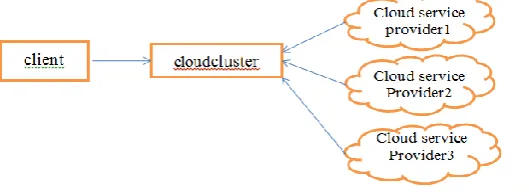
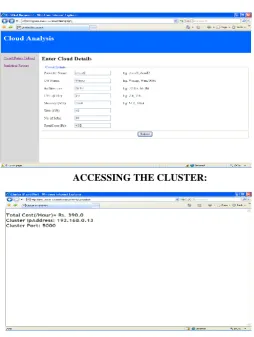
Cloud infrastructure mainly differs on the type of services that are provided by the cloud providers. The infrastructures that are build upon the server side are being passed to the client side who requests for the cloud infrastructure from the server. Clients has to register their requirements to the cloud cluster. The cloud servers provide the infrastructure as a service to the client systems. The client systems could access the cluster system provided by the servers through the ipaddress and the port number that will be provided by servers.
III. LITERATURE SURVEY
Yiduo Mei and et al, 2010 IEEE 3rd International Conference on Cloud Computing have proposed the performance measurements and analysis of network i/o applications in virtualized cloud.[1] To get rid of problems in obtaining performance The author used two categories for solving these problems. The first class aims at addressing problems associated with managing idle instances. When a domain is said to be idle, it means there’s no different runnable processes and therefore OS is executing idle-loop. The second focus of our performance it is calculated in terms of throughput performance and resource sharing effectiveness in individual virtual machine.
KaiqiXiong, Harry Perros, 2009 Congress on Services – I have projected the Service Performance and Analysis in Cloud Computing. For improving service it notice the relationship among the maximal number of customers, the minimal service resources and also the highest level of services. The obtained results gives the rules of computer service performance in cloud computing. For that we are using service centers to calculate the most effective service for customers.
Xinhui Li and et al, 2009 IEEE International Conference on Cloud Computing have proposed The Method and Tool of Cost Analysis for Cloud Computing. it uses tool to obtain a cost efficient cloud for that it calculating TCO( Total Cost of Ownership) in each cloud.TCO not only includes the capital cost, but also the cost of operating the IT infrastructure. Derrick Kond and et al, 2009 IEEE have proposed the Cost-Benefit Analysis of Cloud Computing versus Desktop Grids.[3] It compare and contrast the performance and monetary cost-benefits of clouds for desktop grid applications, ranging in computational size and storage. Volunteer Computing (VC) platforms is another cost-efficient and powerful platform that is used to calculate the cost .this application attempts to run while the computer is in use, it may impact performance of the PC.
R.S. Montero and et al, 2010 IEEE parallel and distributed computing have proposed An Elasticity Model For High Throughput Computing Clusters[4]. It uses generic cluster architecture that extends the classical benefits of virtual machines to the cluster level, therefore providing cluster consolidation, cluster partitioning and support for heterogeneous environments. In addition the capability of the virtual clusters can be supplemented with resources from a commercial cloud provider. The performance of this architecture has been evaluated within the execution of High Throughput Computing workloads.[5]
Llorente and et al, 2009 IEEE parallel computing have proposed Cloud Computing For On-Demand Grid Resource Provisioning.it give the flexibility to create arbitrary complicated grid infrastructures able to sustain the demand needed by any given service, taking advantage of the pay-per-use model and also the seemingly unlimited capability of the cloud computing paradigm.[6] It addresses mechanisms that probably is accustomed meet a given quality of service or satisfy peak demands this service may have.[7] These mechanisms imply the elastic growth of the grid infrastructure ceating use of cloud providers
IV. EXISTING SYSTEM
In existing system users have to check each and every cloud separately to check best performance and cost
DISADVANTAGES OF EXISTING SYSTEM
Building and managing physical clusters exhibits several drawbacks:
Major investments in hardware, specialized installations (cooling, power, etc.), and qualified personal.
Takes more time to find the good performance cloud.
Overloading and insufficient computational resources during peak demand periods.
User has to check each cloud one by one for calculating performance and cost.
More time to take resource allocation
Based on performance correct cost estimation cannot be generated.
PROPOSED SYSTEM
1. Regarding these limitations, cloud computing technology has been proposed as a viable solution to deploy
elastic computing clusters.[8]
2. Getting good quality resource.
3. Takes less time for finding resources.
4. Based on both performance and cost good quality resource is obtained.
5. In proposed virtual tool kit is used to utilize the resources in dual operating system environment which is
allocated by the cloud.
ADVANTAGES OF PROPOSED SYSTEM
1. Efficient output is obtained.
V. MODULE DESCRIPTION
CREATING CLOUD INFRASTRUCTURE
Cloud infrastructure refers to logical computational of resources online. Cloud infrastructure mainly differs on the type of services that are provided by the cloud providers. The infrastructure that are build upon the server side are being passed to the client side who requests for the cloud infrastructure from the server. Clients has to register their requirements to the cloud cluster. Similarly cloud service providers has to register their requirements to the cloud cluster.[9] Cloud cluster maintains an infrastructure to get the input from both client and cloud service provider. Based on their inputs it provides a best output.
Figure :Creating Cloud Infrastructure Diagram
VI. PERFORMANCE ANALYSIS
Successful development of cloud computing paradigm necessitates accurate performance evaluation of cloud data centers. As exact modeling of cloud centers is not feasible due to the nature of cloud centers and diversity of user requests. It quantify the presence in real scientific computing workloads of Many-Task Computing (MTC) users, that is, of users who employ loosely coupled applications comprising many tasks to achieve their scientific goals.[10]
It just analyzes and compares the performance offered by different configurations of the computing cluster. It have chosen Two different cluster configurations (with different number of worker nodes from the two cloud providers), and different number of jobs (depending on the cluster size).performance is calculated based on memory and cpu processing speed. CPA(cloud performance analysis)algorithm is used for calculating the best performance based cloud.[11]
CPA algorithm is implemented, which is portable and extensible and easy to use for generating and submitting workload and analyzing the performance of cloud computing environment. [12]The amount of time that it takes a computer to perform a task is primarily a function of the algorithm that is being performed.
VII. COST ANALYSIS
Figure :Accessing the Cluster Diagram
VIII. EXPERIMENTAL RESULT
CREATING CLOUD INFRASTRUCTURE:
PERFORMANCE ANALYSIS
IX. CONCLUSION
Optimization of Performance and price in Multicloudproject analyzed the challenges and viability of
deploying a computing cluster on high of a multicloud infrastructure spanning four completely different sites
for solving loosely coupled MTC applications. Performance results prove that, for the MTC work into
consideration (loosely coupled parameter sweep applications), cluster throughput scales linearly when the
cluster includes a growing range of nodes from cloud Providers.
It proves that the multicloud implementation of a computing cluster is viable from the point of view of
measurability, and doesn’t introduce vital overheads, that may cause important performance degradation.On
the other hand, the cost analysis shows that, for the workload considered, some hybrid configurations
(including local and cloud nodes) exhibit higher performance-cost quantitative relation than the local setup,
so proving that the multicloud solution is also appealing from a cost perspective
REFERENCES
1. SivadonChaisiri, Bu-Sung Lee, DusitNiyato,” Optimization of Resource Provisioning Cost in Cloud Computing”,2012 IEEE transactions on
services computing.
2. HamzehKhazaei,JelenaMisic,VojislavB.Misic,” Performance Analysis of Cloud Computing Centers Using M =G=m=m þ rQueuing
Systems”,2012 IEEE transactions on parallel and distributed systems.
3. Vijayaragavan S.P., Karthik B., Kiran T.V.U., Sundar Raj M., "Robotic surveillance for patient care in hospitals", Middle - East Journal of Scientific Research, ISSN : 1990-9233, 16(12) (2013) pp. 1820-1824
4. Yiduo Mei1,2, Ling Liu1, Xing Pu1,3, Sankaran Sivathanu1, “Performance Measurements And Analysis OfNetwork I/O Applications In
Virtualized Cloud”, 2010 IEEE 3rd International Conference On Cloud Computing.
5. KaiqiXiong, Harry Perros,” Service Performance And Analysis In Cloud Computing”, 2009 Congress On Services – I.
6. Vijayaragavan, S.P., Karthik, B., Kiran Kumar, T.V.U., Sundar Raj, M."Analysis of chaotic DC-DC converter using wavelet transform", Middle - East Journal of Scientific Research, ISSN : B27, 16(12) (2013) pp.1813-1819.
7. NezihYigitbasi, AlexandruIosup, And Dick Epema,SimonOstermann,“C-Meter: A Framework For Performance Analysis Of Computing
Clouds”,9th IEEE/Acm International Symposium On Cluster Computing And The Grid.
8. Vijayaraghavan K., Nalini S.P.K., Prakash N.U., Madhankumar D.,"Biomimetic synthesis of silver nanoparticles by aqueous extract of
Syzygium aromaticum", Materials Letters, ISSN : 0167-577X, 75() (2012) pp. 33-35.
9. Xinhui Li, Ying Li, Tiancheng Liu, JieQiu, Fengchun Wang,” The Method And Tool Of Cost Analysis For Cloud Computing”, 2009 IEEE
International Conference On Cloud Computing.
10. Derrick Kondo1, Bahman Javadi1, Paul Malecot1, Franck Cappello1, David P. Anderson2,” Cost-Benefit Analysis Of Cloud Computing
Versus Desktop Grids”,2009 IEEE
11. Vijayaraghavan, K., Nalini, S.P.K., Prakash, N.U., Madhankumar, D., "One step green synthesis of silver nano/microparticles using extracts of
Trachyspermum ammi and Papaver somniferum", Colloids and Surfaces B: Biointerfaces, ISSN : 0927-7765, 94() (2012) pp. 114-117.
12. Llorente, R. Moreno-Vozmediano, And R. Montero, “Cloud Computing For On-Demand Grid Resource Provisioning,” Advances In Parallel
13. Kulanthaivel L., Srinivasan P., Shanmugam V., Periyasamy B.M., "Therapeutic efficacy of kaempferol against AFB1 induced experimental hepatocarcinogenesis with reference to lipid peroxidation, antioxidants and biotransformation enzymes", Biomedicine and Preventive Nutrition, ISSN : 2210-5239, 2(4) (2012) pp.252-259.
14. R.S. Montero, R. Moreno-Vozmediano, And I.M. Llorente, “An Elasticity Model For High Throughput Computing Clusters,” To Be Published
In J. Parallel And Distributed Computing, Doi: 10.1016/J.Jpdc. 2010.05.005, 2010.
15. M. Murphy, B. Kagey, M. Fenn, And S. Goasguen, “Dynamic Provisioning Of Virtual Organization Clusters,” Proc. Ninth IEEE Int’lSymp.
Cluster Computing And The Grid, 2009.
16. Dr.A.Muthu Kumaravel, KNOWLEDGE BASED WEB SERVICE, International Journal of Innovative Research in Computer and
Communication Engineering, ISSN(Online): 2320-9801,pp 5881-5888, Vol. 2, Issue 9, September 2014
17. Dr.A.Muthu Kumaravel, Data Representation in web portals, International Journal of Innovative Research in Computerand Communication
Engineering, ISSN(Online): 2320-9801,pp 5693-5699, Vol. 2, Issue 9, September 2014
18. Dr.Kathir.Viswalingam, Mr.G.Ayyappan,A Victimization Optical Back Propagation Technique in Content Based Mostly Spam Filtering
,International Journal of Innovative Research in Computerand Communication Engineering ,ISSN(Online): 2320-9801 , pp 7279-7283, Vol. 2, Issue 12, December 2014
19. KannanSubramanian,FACE ECOGNITION USINGEIGENFACE AND SUPPORT ECTORMACHINE,International Journal of Innovative
Research in Computerand Communication Engineering,ISSN(Online): 2320-9801,pp 4974-4980, Vol. 2, Issue 7, July 2014.