ISSN(Online): 2319-8753 ISSN (Print): 2347-6710
International Journal of Innovative Research in Science,
Engineering and Technology
(A High Impact Factor, Monthly, Peer Reviewed Journal) Visit: www.ijirset.com
Vol. 7, Issue 7, July 2018
Sentiment Analysis using Bayesian Classifier
under Unified Framework
Vaishali D. Dusane, Prof. Dr. S.A. Itkar
Department of Computer Engineering, P. E. S. Modern College of Engineering, Pune, India
ABSTRACT: In today’s era of e-commerce and online processing, recommendation system plays a major role. For that purpose sentiment analysis should be done on product’s reviews. Many sentiment analysis techniques were proposed where treatment of aspect based sentiments and overall sentiments are done in isolation. To tackle this issue, in this work we focus on the peer-reviewed revision model (user-generated review) and global ratings, and we try to identify semantic aspects and aspect-level sentiments from review data, and to anticipate the general sentiments of reviews. We proposed a probabilistic model called Joint Aspect and Sentiment Model (JASM) based on Latent Dirichlet Allocation (LDA) to overcome problems at once under unified framework. In JASM each review document is represented in the form of opinion pairs. Also this framework can model aspect terms and the corresponding opinion words of the review for hidden aspect and sentiment detection simultaneously. It also uses global sentimental ratings and can deduce semantic aspects and feelings in terms of appearance that are significant and predictive of general sentiments of reviews. JASM uses Naïve Bayes classifier for sentiment classification which is best suited classification scheme for text classification. We evaluated JASM on text review data and results demonstrate that proposed model outperforms existing joint topic model (JTM) which is also probabilistic supervised model and used for sentiment analysis of review data. JASM increases efficiency and improves performance of the system in terms of accuracy and computational time. We also developed a recommendation system. Mostlyrecommendation system generates a cold start problem. Our system resolves this problem by using item based collaborative filtering techniques.
KEYWORDS: Sentiment analysis, aspect-based sentiment analysis, probabilistic topic model, supervised joint topic model,Naive Bayes Classifier, recommendation system, collaborative techniques.
I. INTRODUCTION
In recent years due to advancement in technology and e-commerce sites, online reviews are growing continuously. These online user generated reviews have great importance as these reviews can be used to make decisions about product purchases or to recommend the products to others. For the ease of customers to analyze that huge data sentiment analysis is done.
Sentiment analysis is the process of determining whetherthe written things are positive, negative or neutral. Sentiment analysis can be done at different levels of granularity[1] that is at sentence level or aspect level. Sentiment analysis at sentencelevel is called overall sentiment analysis and sentiment analysis at aspect level is called aspect level sentiment analysis. In overall sentiment analysis whole text or sentence is categorized as positive or negative sentiments, but customers cannot get detailed idea about the features of particular product from that. Customers have growing interest in knowing about the features and their sentiments, so that aspect level sentiment analysis is gaining interest. Aspects for any entity are the unique features of that entity. In Aspect level Sentiment Analysis hidden semantic aspects are determined and then fine grained sentiments expressed towards that aspects are identified. For aspect level sentiment analysis, probabilistic topic models [1],[2],[3],[4],[5] are used, and these models are based on Latent Dirichlet Allocation(LDA) model[6] which generates aspects as a latent topics.
ISSN(Online): 2319-8753 ISSN (Print): 2347-6710
International Journal of Innovative Research in Science,
Engineering and Technology
(A High Impact Factor, Monthly, Peer Reviewed Journal) Visit: www.ijirset.com
Vol. 7, Issue 7, July 2018
capture the aspects these models cannotpredict overall sentiments from text review data[1]. For this purpose supervised probabilistic topic model, JASM is used for sentiment analysis, which considers ratings associated with text reviews.
Sentiment classification is a special task of text classification in which text is classified according to the sentimental polarities of opinions. There are different methods for sentiment classification that classifies text and their features. As a part of proposed work, instead of using normal linear model, Naïve Bayes Classifier[7] is used for classification in joint aspect and sentiment model(JASM). Naive Bayes is probabilistic supervisedclassifier which improves classification performance by removing the irrelevant features. So that Naive Bayes is great choice for text classification. Also as a part of proposed work recommendation system[8] is developed based on the results of sentiment analysis. Often recommendation system suffers from cold start problem that means if there is entry of new user or new product in the system, about which system does not have previous information, system cannot generate recommendation results properly. So to resolve this problem item based collaborative filtering technique[9] is used.
For this work, user generated data of text reviews and ratings about mobile phones from Amazon website are used to evaluate the system.
II. REVIEW OF LITERATURE
Sentiment analysis of review data is gaining interest in recent years, as it is essential for getting the exact opinion of people about particular product. Many methods which were proposed and used for this purpose. Accuracy, efficiency, reliability and computing time of the systems are the main concerns considered in the study of the sentiment analysis of reviews.
Many supervised and unsupervised methods and different joint topic models are proposed for sentiment analysis of review data.
Sentiment analysis or opinion mining is the field of study in which opinions, emotions and attitudes of people, sentiments and evaluations towards products, services, organizations, individuals, issues, events, topics, and their attributes are analyzed from written languages. sentiment analysis is important research area in NLP, data mining and web mining.
Previously aspect level and overall sentiment analysis tasks are done in isolation but if we carefully design unification model for all sentiment analysis tasks then these tasks can support each other. This concept was proposed by ZhenHai, et.al[1] using supervised joint aspect and sentimentmodel(SJASM). In this model probabilistic joint aspect andsentiment framework based on LDA is used for detection of aspects and their orientation. And on the top of this framework supervised learning layer is constructed which relies on normal linear model that gives overall rating response for the reviews. This model achieves higher accuracy than all models mentioned above.
Also Z. Hai, et.al[2]shows that in sentiment analysis overallsentiment analysis is important task but it does not give detailed information about features of entity. For that purpose aspect based sentiment analysis for review data is performed, also most helpful reviews are selected based on aspect based review utility score.
For quick understanding of user about the opinions from huge collection of reviews, aspects, sentiment polarities and relation between them plays important role. For that purpose S.Kim, et al[3] presented a hierarchical aspect sentiment model(HASM) which discovers a hierarchical structure of aspect-based sentiments from unlabeled online reviews. In HASM, tree structure is used whose root represents an aspect and the children represent the sentiment polarities associated with it. Bayesian non parametric model, recursive Chinese Restaurant Process (rCRP) are used to extract both the structure and parameters of the tree.
ISSN(Online): 2319-8753 ISSN (Print): 2347-6710
International Journal of Innovative Research in Science,
Engineering and Technology
(A High Impact Factor, Monthly, Peer Reviewed Journal) Visit: www.ijirset.com
Vol. 7, Issue 7, July 2018
Y.Jo and A.H.Oh[5] shows that as many reviews are availablein the format of plain text so we cannot get the detailed information about these text, for this purpose Sentence- LDA(SLDA), a probabilistic generative model is proposed that assumes all words in a single sentence are generated from one aspect, after that SLDA is extended to Aspect and Sentiment
Unification Model(ASUM), which considers aspects and sentiments together for modelling sentiments towards different aspects. We get the pair of aspect and sentiment from ASUM.
D.M.Blei, et.al[6] introduced latent Dirichlet allocation(LDA) model which is generative and probabilistic model for collections of discrete data that extracts topics or features from that data. So that LDA is the base for different probabilistic joint topic models which are used for sentiment analysis.
M.S.Mubarok[7] shows the importance of Naive BayesClassifier for the classification process of sentiment analysis. Naive Bayes is probabilistic supervised classifier which improves classification performance by removing the irrelevant features. So that Naive Bayes is great choice for text classification.
We can Build Recommendation System based on the results of sentiment analysis. F.O.Isinkaye, et.al[8] introduced different methods for that purpose. Often Recommendation System suffers from cold start problem, so to resolve this problem item base collaborative filtering technique is used which was introduced by BardulSarwar, et.al[9]. B.Liu[11] defines the problem of sentiment analysis andintroduces various techniques for that at different levels of granularity.
For extracting the sentiments from text M.Taboada, et al[12]presented a lexicon-based approach. In this method Semantic Orientation CALculator(SO-CAL) is used for polarity classificationtask.
To solve the review data analysis problem called LatentAspect Rating Analysis(LARA), H. Wang, et al[13] proposed a probabilistic rating regression model. In this model detailed analysis is performed on review data at the level of topical aspects and can support aspect opinion summarization, entity ranking based on aspect ratings, and analysis of reviewers rating behavior.
Online reviews are often come with numerical ratingsprovided by users for a set of service or product aspects. For that I.Titov and R. McDonald[14] proposed statistical model which is able to discover corresponding topics from text. This model achieves high accuracy using opinion ratings which are provided by users. This approach is simple and can be used in many applications where sequential data is considered.
David M. Blei, et.al[15] introduces Supervised latent Dirichletallocation(sLDA) which is a statistical model based on LDA. The model has variety of response types. In this model maximum-likelihood procedure is derived for parameter estimation. SLDA is used to predict response values for new documents. This model was useful for labelled documents.
Rahman and Wang[16] proposed a Hidden Topic SentimentModel(HTSM) to capture topic coherence and sentiment consistency in text review document for extracting aspects and corresponding sentiment polarities.
ISSN(Online): 2319-8753 ISSN (Print): 2347-6710
International Journal of Innovative Research in Science,
Engineering and Technology
(A High Impact Factor, Monthly, Peer Reviewed Journal) Visit: www.ijirset.com
Vol. 7, Issue 7, July 2018
III. SYSTEM ARCHITECTURE / SYSTEM OVERVIEW
Fig. 1. Block Diagram of Proposed System A. System Overview
As main purpose of this work is, to use classifier which willincrease efficiency and accuracy of sentiment classificationtask and to decrease computational time of sentiment analysis.
As shown in Fig.1 the new classification technique is Naïve Bayes classifier. There are three modules in the JASM systemviz aspect and feature extraction, sentiment classification anddevelopment of recommendation system. 1) Aspect and feature extraction: For this purpose LDAbased probabilistic joint aspect and sentiment framework isused. Firstly data of user generated text reviews and ratingsfor mobile phones are given as an input to the system. Preprocessingis done on that data. In pre-processing we parsedall data using Stanford parser. Also punctuation marks andstop-words are removed.Aspects, orientations and opinion pairs are the parametersfor JASM model and these parameters are computed based onsamples obtained via the collapsed Gibbs sampling method.
For aspect detection, first hidden semantic aspects are drawnfrom review documents according to document specific aspectdistribution. Then sentiment orientations on the respective aspects are drawn on the basis of per document aspect specificsentiment distribution. Finally opinion pairs which containsaspect terms and corresponding opinion words are generatedbased on aspect and sentiment specific word distribution.
In this way we get aspects their orientations and opinionpairs(aspect term, opinion word) from LDA based model.
ISSN(Online): 2319-8753 ISSN (Print): 2347-6710
International Journal of Innovative Research in Science,
Engineering and Technology
(A High Impact Factor, Monthly, Peer Reviewed Journal) Visit: www.ijirset.com
Vol. 7, Issue 7, July 2018
As a proposed work Naive Bayes classifier is used for thispurpose. In naive Bayes classifier, calculation of posteriorprobability for each class is done using Naive Bayesianequation. The class having highest posterior probability is consideredas the result of prediction. By using this classificationtechnique, performance of the sentiment classification task andoverall system increases.
3) Recommendation System: Output of the sentiment analysisis used to build the recommendation system. But as weknow recommendation system generates a cold start problem.
If there is an introduction of new users or new items in system,it can cause the cold start problem, because there will be insufficientdata on these new entries for recommendation systemto work accurately. In order to make appropriate recommendationsthere should be sufficient information about new entries.So to remove this problem item based collaborative filteringtechnique is used, that will predict good recommendations tothe users.
In item based collaborative filtering technique similaritybetween items is calculated by using cosine similarity measureand then most similar items are selected according to that.
Prediction is computed using weighted sum technique and thenoutput interface is generated in terms of prediction. Finallyrecommendation is done according to results of prediction.
In this way Aspects and features are extracted usingLDA based model and text classification is done byusing Naive Bayes classifier. Also recommendation systemis implemented which does not generates a cold start problem.
B. Mathematical Model
Here S is the System having,
where,
I= Text Reviews and Ratings for mobile phones
O= Semantic aspects, Aspect-level sentiments, Overall sentiments
where,
f1=Probabilistic joint aspect and sentiment framework, f2=Naive Bayes Classification,
f3=Item based collaborative filtering
f1 is Probabilistic joint aspect and sentiment framework
where,
If1= Text reviews
Of1= Aspects, Orientation, Opinion pairs
Ff1= Calculation of parameters of the JASM model on the basis of samples obtained via the collapsed Gibbs sampling method.
f2 is Naive Bayes classification
where,
If2= Class information Of2= Indexed Data
ISSN(Online): 2319-8753 ISSN (Print): 2347-6710
International Journal of Innovative Research in Science,
Engineering and Technology
(A High Impact Factor, Monthly, Peer Reviewed Journal) Visit: www.ijirset.com
Vol. 7, Issue 7, July 2018
P(c|x) is the posterior probability of class (c, target) given predictor (x, attributes). P(x|c) is the likelihood which is the probability of predictor given class.
P(c) is the prior probability of class. P(x) is the prior probability of predictor. f3 is Item based collaborative filtering
where,
If3= Ratings table Of3= Output interface Ff3 are,
Cosine similarity,
Weighted Sum technique,
where,
i,j are two item vectors.
Pu,i is prediction on an item i for user u. . Si,j is similarity between items i and j. . N is list of N items.
R Rating given by user u.
IV. SYSTEM ANALYSIS
1) Dataset Information: Here, we created the dataset byusing user generated reviews and ratings for different mobilephones from Amazon website and it is used as a input toJoint Aspect and Sentiment Model(JASM). These all reviewsare in text format.
2) Software and Hardware Requirements: For theimplementation of this system we use 1GB and more RAM,1.1 GHz speed and 20GB Hard Disk. The Intel-CORE i3 andabove processor can be used. We used Windows 7 operatingSystem with Java version 1.8. Eclipse environment is used for system development.
This work is useful for improving the quality of theproduct to fulfill the customer’s requirements. Also betterrecommendations can be provided to customers.
3) Performance Parameters: Two parameters are used to measure the performance of the sentiment analysis system. 1) Accuracy: Accuracy measures the proportion of thesentiment labels which comes with the overall ratings,that are predicted correctly in results, is defined as,
where,
n is no of opinion pairs in review.
ISSN(Online): 2319-8753 ISSN (Print): 2347-6710
International Journal of Innovative Research in Science,
Engineering and Technology
(A High Impact Factor, Monthly, Peer Reviewed Journal) Visit: www.ijirset.com
Vol. 7, Issue 7, July 2018
If accuracy of the system is greater, the performance ofthe system is high.
2) Computation Time: Computation time is time taken togenerate the result of whole sentiment analysis task. Ifwe get semantic aspect rapidly, quality improvementof the product can be done in a faster way. So if thecomputing time is less, the system will be moreuseful.
A. Implemented Results
1) Result Tables
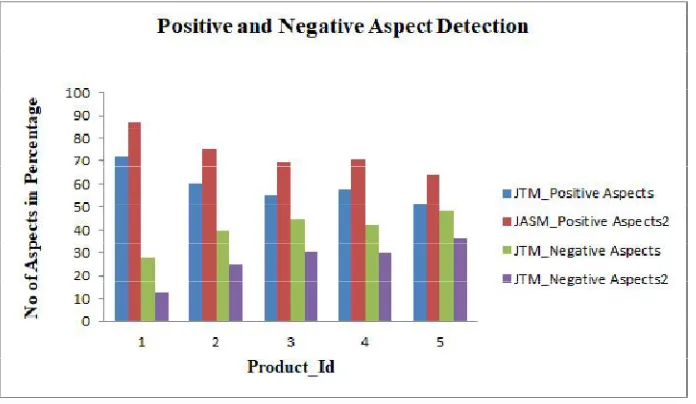
Table I gives the value of detected positive and negativeaspects in percentage for JTM and JASM models. TABLE I
NUMBER OF POSITIVE AND NEGATIVE ASPECTS IN PERCENTAGE
It is observed that in JASM the aspect are detected more accurately. So in JASM the percentage of positive aspect detection increases and percentage of negative aspect detection decreases than JTM.
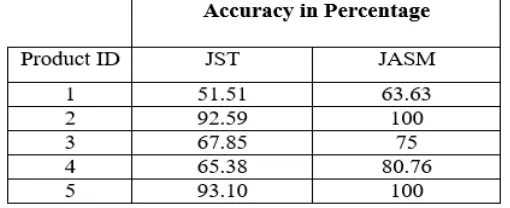
Table II gives the value of aspect level sentiment classification accuracy of JTM and JASM model in percentage. TABLE II
SENTIMENT CLASSIFICATION ACCURACY OF JTM AND JASM MODEL IN PERCENTAGE.
ISSN(Online): 2319-8753 ISSN (Print): 2347-6710
International Journal of Innovative Research in Science,
Engineering and Technology
(A High Impact Factor, Monthly, Peer Reviewed Journal) Visit: www.ijirset.com
Vol. 7, Issue 7, July 2018
TABLE III
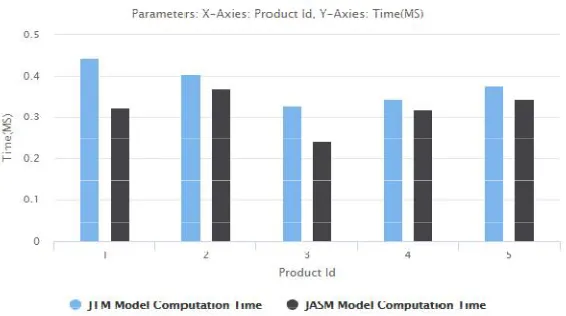
COMPUTATION TIME FOR JTM AND JASM MODEL IN MILLISECOND.
From the values of table III It is observed that computation time required for JASM is less than that for JTM. 2) Result Graphs
Fig 2 represents the bar graph that shows the result of aspect level sentiment analysis. Graph has x-axis as a product Id and y-axis as number of detected positive and negative aspects in percentage.
Fig. 2. Aspect level sentiment analysis for different products It is observed that more positive aspects are detected in JASM model.
ISSN(Online): 2319-8753 ISSN (Print): 2347-6710
International Journal of Innovative Research in Science,
Engineering and Technology
(A High Impact Factor, Monthly, Peer Reviewed Journal) Visit: www.ijirset.com
Vol. 7, Issue 7, July 2018
Fig. 3. Sentiment classification accuracy for JTM and JASM model fordifferent product From Fig.3 it is observed that sentiment classification accuracy increases for every product in JASM model. Fig 4 represents the bar graph that gives computation time in millisecond for JTM and JASM model.
Fig. 4. Computation time for JTM and JASM model for different products From Fig.4 it is observed that For JASM requires less computation time than that of JTM.
ISSN(Online): 2319-8753 ISSN (Print): 2347-6710
International Journal of Innovative Research in Science,
Engineering and Technology
(A High Impact Factor, Monthly, Peer Reviewed Journal) Visit: www.ijirset.com
Vol. 7, Issue 7, July 2018
calculatedfor implemented system and compared with existing JTM model. Also computation time required for JASM is calculatedand compared with JTM.
It is observed that JASM generates more accurate resultsfor each product. Also JASM model requires less computationtime than JTM model.
V. CONCLUSION
In this work, we focus on treatment of aspect based sentiments and overall sentiments, and our aim is to increase the accuracy and decrease the computation time of the sentiment analysis system. For that we have developed supervised probabilistic model that is joint aspect and sentiment model(JASM)which is based on Latent Dirichlet Allocation(LDA) model, which perform the aspect based and overall sentiment identification under unified framework. This model considers ratings associated with text reviews as supervised information, also determines aspects and their opinion words.
As Sentiment classification is the important part in sentiment analysis, so for improvement in accuracy and time complexity Naive Bayes classifier is used as it is great choice for text classification. Naive Bayes classifier requires short computational time for training the data and improves classification performance in terms of accuracy and computation time by removing irrelevant features.
Also recommendation system is developed based on resultsof sentiment analysis. Mostly recommendation system generates a cold start problem, but JASM system overcomes it by using item based collaborative filtering techniques.
ACKNOWLEDGMENT
Every orientation work has a mark of many people and itis the responsibility of author to convey an intense gratitudefor the same. I feel colossal pleasure to express deep senseof gratitude and indebtedness to my guide Prof. (Mrs) Dr. S.A. Itkar, for constant uplifting and virtuous guidance. I alsoexpress my sincere gratitude to the Department of ComputerEngineering and Library of my college. Last but not the least; Iam grateful to my friends and my parents for their best wishes.
REFERENCES
[1] Zhen Hai, Gao Cong, Kuiyu Chang, Peng Cheng, and ChunyanMiao,”Analyzing Sentiments in One Go: A Supervised Joint Topic ModelingApproach,”IEEE Transactions on Knowledge and Data Engineering,2017.
[2] Z. Hai, G. Cong, K. Chang, W. Liu, and P. Cheng, Coarse-to-fine review selection via supervised joint aspect and sentiment model, in Proceedingsof the 37th International ACM SIGIR Conference on Research andDevelopment in Information Retrieval, ser. SIGIR 14.New York, NY,USA: ACM, 2014, pp. 617626.
[3] S. Kim, J. Zhang, Z. Chen, A. Oh, and S. Liu, A hierarchical aspectsentimentmodel for online reviews, in Proceedings of the Twenty-SeventhAAAI Conference on Artificial Intelligence, ser. AAAI13. AAAI Press,2013, pp. 526533.
[4] C. Lin, Y. He, R. Everson, and S. Ruger, Weakly supervised jointsentiment-topic detection from text,IEEE Transactions on Knowledge andData Engineering, vol. 24, no. 6, pp. 11341145, Jun. 2012.
[5] Y. Jo and A. H. Oh, Aspect and sentiment unification model for onlinereview analysis, in Proceedings of the fourth ACM international conferenceonWeb search and data mining, ser. WSDM11. New York, NY, USA:ACM, 2011, pp. 815824.
[6] D. M. Blei, A. Y. Ng, and M. I. Jordan, Latent dirichlet allocation,J.Mach. Learn. Res., vol. 3, pp. 9931022, March 2003.
[7] Mohamad Syahrul Mubarok, Adiwijaya, and Muhammad DwiAldhi,”Aspect-based sentiment analysis to review products using NaveBayes,”American Institute of Physics,2017.
[8] F.O. Isinkaye a, Y.O. Folajimi b, B.A. Ojokoh, “Recommendation systems:Principles, methods and evaluation,”Egyptian Informatics Journal(2015) 16, 261273,2015.
[9] BadrulSarwar, George Karypis, Joseph Konstan, and John Riedl, ItemBased Collaborative Filtering Recommendation Algorithms, WWW10,May 15, 2001.
[10] C. Lin and Y. He, Joint sentiment/topic model for sentiment analysis, inProceedings of the 18th ACM conference on Information and knowledgemanagement, ser. CIKM09. New York, NY, USA: ACM, 2009, pp. 375384.
ISSN(Online): 2319-8753 ISSN (Print): 2347-6710
International Journal of Innovative Research in Science,
Engineering and Technology
(A High Impact Factor, Monthly, Peer Reviewed Journal) Visit: www.ijirset.com
Vol. 7, Issue 7, July 2018
[13] H. Wang, Y. Lu, and C. Zhai, Latent aspect rating analysis on reviewtext data: A rating regression approach, in Proceedings of the 16th ACMSIGKDD International Conference on Knowledge Discovery and DataMining, ser. KDD10. New York, NY, USA: ACM, 2010, pp. 783792. [14] I. Titov and R. McDonald, A joint model of text and aspect ratings for sentiment summarization,in Proceedings of ACL-08: HLT. Columbus, Ohio: Association for Computational Linguistics, June 2008, pp. 308316.
[15] D. M. Blei and J. D. McAuliffe, Supervised topic models, in Proceedingsof the 21st Annual Conference on Neural Information Processing Systems- Volume 7, Vancouver, Canada, 2007, pp. 121 128.
[16] M. M. Rahman and H. Wang, Hidden topic sentiment model, inProceedings of the 25th International Conference on World Wide Web,ser.WWW16. Republic and Canton of Geneva, Switzerland: InternationalWorld Wide Web Conferences Steering Committee, 2016, pp. 155165. [17] P. Melville, W. Gryc, and R. D. Lawrence, Sentiment analysis of blogsby combining lexical knowledge with text classification, in Proceedingsof the 15th ACM SIGKDD International Conference on KnowledgeDiscovery and Data Mining, ser. KDD09. New York, NY, USA: ACM,