Saliency Tree: Saliency Detection Method
Integrating Diffusion-Based Compactness And
Local Contrast
Arya Pradeep, Neethu SubashM.Tech Student, Dept. of CSE, Mar Athenesius College of Engineering, Kerala, India
Assistant Professor, Dept. of CSE, Mar Athenesius College of Engineering, Kerala, India
ABSTRACT: Salient region detection is a challenging problem and an important topic in computer vision. It has a wide range of applications, such as object recognition and segmentation.. The proposed method is a bottom-up salient region detection method that integrates compactness and local contrast cues. Furthermore, to produce a pixel-accurate saliency map that more uniformly covers the salient objects, we propagate the saliency information using a diffusion process. Next, a saliency-directed region merging approach with dynamic scale control scheme is proposed to generate the saliency tree, in which each leaf node represents a primitive region and each non-leaf node represents a non primitive region generated during the region merging process. Finally, by exploiting a regional center-surround scheme based node selection criterion, a systematic saliency tree analysis including salient node selection, regional saliency adjustment and selection is performed to obtain final regional saliency measures and to derive the high-quality pixel-wise saliency map. The compactness and uniqueness of the extracted salient object is high by incorporating this method.
KEYWORDS: Saliency tree, Saliency Detection, Diffusion, Compactness, Local Contrast, Saliency Map
I. INTRODUCTION
and connectivity priors derived from common backgrounds in natural images [10]. These methods are primarily motivated by the psychophysical observations that salient objects seldom touch the image boundary, and most background regions can be easily connected to each other.
The global contrast based method [7] sometimes produces high saliency values for non-salient regions, especially for regions with complex patterns or rare background distracters. A typical limitation of the compactness based method [9] is that some salient regions may be wrongly suppressed when the foreground objects and background are similar. Finally, background based methods [12] can perform very well. However, they fail when the salient objects touch the image boundary. In this work, we integrated local contrast and compactness visual cues to generate saliency maps. Compared with the global contrast method, the local contrast method is a more appropriate complement to compactness. When the foreground is similar to some background regions, global contrast and compactness methods may wrongly suppress the foreground region. However, local contrast methods may properly highlight the foreground region based on the contrast with its neighboring region. With the main motivation to improve the overall saliency detection performance and especially enhance the applicability on complicated images, we propose saliency tree as a novel saliency model in this paper. In this paper, we have presented saliency tree as a novel saliency detection framework, which provides a hierarchical representation of saliency for generating high-quality regional and pixel-wise saliency maps. Initial regional saliency is measured by integrating the above generated map combining local contrast and compactness with spatial sparsity and object prior of primitive regions to build a reasonable basis for generating the saliency tree. Then saliency-directed region merging, regional centre-surround scheme, salient node selection, regional saliency adjustment and selection, and pixel-wise saliency map derivation are proposed and systematically integrated into a complete saliency tree model. Saliency tree achieves a consistently higher saliency detection performance compared to the state-of-theart saliency models, and especially enhances the applicability on complicated images.
II. RELATED WORK
Global contrast-based methods compute the saliency of individual pixels or image regions using contrast relationships over the complete image. Zhai and Shah [19] computed pixel-level saliency using the contrast with all other pixels. Bruce and Tsotsos [20] exploited Shannon’s self information measure in a local context to compute saliency. Achanta et al. [6] achieved globally consistent results based on a frequency-tuned method, which directly defines pixel saliency using the difference from the average image color. Goferman et al. [21] highlighted salient objects with their contexts by simultaneously modeling local low-level clues, global considerations, visual organization rules, and high-level features.
Cheng et al. [7] proposed a regional contrast-based saliency extraction algorithm, which simultaneously considers the global region contrast over the entire image in the Lab color space and the spatial coherence, and used them to compute a saliency map.
Lang et al. [22] detected salient positions by determining the consistently sparse elements from the entire image. Cheng et al. [23] proposed a soft image abstraction approach that captures large-scale perceptually homogeneous elements, thus effectively estimating global saliency cues. Zhu et al. [24] proposed a tag-saliency model for estimating the probability that each over-segmented region is salient, according to the global contrast of low- and high-level information in the scene.
Compactness-based methods have recently produced promising results. Gopalakrishnan et al. [28] considered that low-level features in the background have a larger spread than the salient regions. They presented a robust salient region detection framework based on the color and orientation distribution of images, and used the compact assumption to select a saliency map using the smaller spatial variances.
Perazzi et al. [9] derived a pixel-accurate saliency map by simultaneously exploiting color and position to rate a region’s uniqueness and spatial distribution. These are formulated in a unified way using high-dimensional Gaussian filters. Shi et al. [29] proposed a generic and fast computational framework called PISA, which imposes spatial prior terms on the color and structure contrast measures, so that the salient pixels are constrained to be compact and centered in the image. They concluded that fusing complementary contrast measures with a spatial prior significantly improved the effectiveness of the detection process.
III.PROPOSED ALGORITHM
The approach most related to ours is Yang et al. [12], which casts saliency detection into a graph-based ranking problem. When ranking with background queries, they used nodes on the image boundary as background seeds. This may incorrectly suppress salient regions when the salient objects touch the image boundary. Unlike Yang et al. [12], we directly use foreground seeds obtained using the local contrast or compactness, to rank the saliency of the whole image regions.
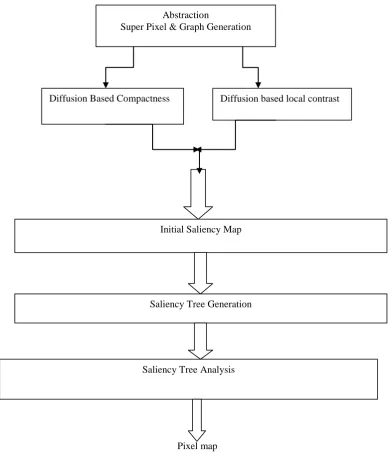
Pixel map
Fig. 1: Flow-chart of the proposed system
Our main contributions are fourfold. First, the proposed saliency tree model enables a hierarchical representation of saliency, which is different from the existing saliency models. Note that the recent model exploits hierarchical inference
Abstraction
Super Pixel & Graph Generation
Diffusion Based Compactness Diffusion based local contrast
Initial Saliency Map
Saliency Tree Generation
for fusing multi-layer saliency cues, and takes the advantage of hierarchical saliency detection for improving the performance. The proposed model is considerably different from [27] in the complete framework of saliency tree generation and analysis, which selects the most suitable region representation by exploiting the hierarchy of tree structure, to effectively improve the saliency detection performance. Second, on the basis of our previous work [25], [21], we integrate the pixel wise saliency map generated from local contrast and compactness at region level to reasonably initialize regional saliency measures. Third, we propose a saliency-directed region merging approach with dynamic scale control scheme for saliency tree generation, which can preserve meaningful regions at different scales. Finally, we propose a systematic procedure of saliency tree analysis including regional center-surround scheme based node selection criterion, salient node selection, regional saliency adjustment and selection to generate high-quality regional saliency map and to derive the final pixel-wise saliency map.
A. Super Pixel Abstraction
Following the observation of Perazzi et al. [9] that abstracting an input image into homogeneous super pixels can improve the performance of salient object detection, we used the SLIC model to abstract the input image into
uniform and compact regions. After abstracting the image, we construct a graph G = (V, E).Each node corresponds to a
super pixel generated by the SLIC model. Most existing algorithms [12], connect each node to neighboring nodes and nodes that share common boundaries with neighboring nodes (k-regular graph). However, in this graph, each node is only connected to its neighboring nodes. Additionally, each pair of boundary nodes are connected to each other to reduce the geodesic distance of similar super pixels.
B. Diffusion-Based Compactness
Salient objects generally correspond to real objects; therefore they are grouped together into connected regions. Therefore, salient objects typically have compact spatial distributions, whereas background regions have a wider distribution over the entire image. Motivated by this, we calculate the spatial variance of the superpixels. Salient objects are generally surrounded by background regions. Thus, in the spatial domain, the colors of background regions typically have a larger spread over the whole image, when compared with salient colors. Colors that exhibit large spatial variance across the image are less likely to be salient. A psychophysical study [23] showed that humans favor the center of
images, and accordingly people usually frame objects of interest near the image center when taking photographs. The
preliminary saliency map Scom calculated by diffusion-based compactness is finally defined using
Scom=1−Norm(sv(i)+sd(i)) eq.(1)
where Norm(x) is a function that normalizes x to the range between 0 and 1 sv(i) is the spatial variance of superpixel and
sd(i) is the spatial distance of super pixel.
C. Diffusion-Based Local Contrast
Although compactness based methods achieve good results in some aspects, they have limitations. When the foreground objects and background have similar appearances, some salient regions may be wrongly suppressed. To mitigate this, some approaches integrate the compactness visual cue with other cues. Perazzi et al. [9] unified the compactness and uniqueness into a single high-dimensional Gaussian filtering framework. However, we found that the local contrast is more complementary to compactness than the global contrast. When a foreground region is similar to some background regions, global contrast and compactness methods may wrongly suppress the foreground, whereas local contrast methods can highlight the foreground based on the contrast with its neighbor. In this section, we determine the saliency using the local contrast of an image superpixel with respect to its neighboring superpixels. To enhance the reliability of the foreground detection (especially for complicated images) and improve the overall quality of salient
region segmentation, we define the distribution measure for a superpixel vi with respect to the centroid of saliency map
Sloc is an N dimensional column vector determined using
Sloc=Norm((1/(D−αW))−lc) eq. (2)
where D is Lab color distance, W is Lab color weight and lc is the saliency map produced using the local contrast that
D. Initial Saliency Map Integration
The compactness and local contrast saliency cues methods efficiently produce two different saliency maps, Scom and
Sloc. These maps are complementary to each other. We directly integrate these two different saliency maps to define the
final saliency map S.
S = Norm(Scom+Sloc) From(1)and(2) eq.(3)
E. Saliency Tree Generation
Starting from the primitive regions with their initial regional saliency measures, a saliency-directed region merging approach is proposed to generate the saliency tree, which is a binary partition tree with saliency measures. Specifically, the region merging sequence is recorded by exploiting the structure of binary partition tree, in which each node is assigned with regional saliency measure. Each primitive region is represented by a leaf node in the saliency tree, and each non-primitive region, which is generated during the region merging process, is represented by a non-leaf node in the saliency tree.
F. Saliency Tree Analysis
Saliency tree provides for an image a hierarchical saliency representation, which can be fully exploited to generate high-quality regional saliency map and pixel-wise saliency map. The pixel-wise saliency map is derived, for a visual comparison with saliency maps generated using the state-of the art saliency models, and can see that the quality of pixel-wise saliency map is better than other saliency maps.
IV.EXPERIMENTS AND RESULTS
The implementation of this paper is done in Mat Lab. The salient object with more compactness and uniqueness is extracted. The experiment is performed in ASD dataset and its compactness and uniqueness is evaluated.
TABLE 1: COMAPRISON WITH EXISTING MODELS
Existing Method Proposed Method
Compactness (perimetre) 150 200
Uniqueness 5673 8637
The extracted object as the result of this process will be salient object which is easily detected by human eye. The compactness which measures the exact boundary of the object in the image seems to be increased as the diffusion based compactness and local contrast is used. The diffusion process thus being used that enables to calculate each and every pixel values for the entire image and thus well defined boundary of the object is enabled. The uniqueness means the number of pixels having unique color value that have high chance to attract human attention. The human eye has high chance to focus those pixels having unique color and thus uniqueness is able to improve by incorporating diffusion process to this method. As the comparison is made between pixels rather than based in relation with human eye vision as we are using in global contrast there seems to have more increment in the value of uniqueness as well as the compactness of the image. The perimeter defines the total perimeter of the object included in the image that measures the compactness of the image
The input image which is given as input for the experiment process is always color image. From which the salient object is extracted from the input image which has more compactness and uniqueness is compared to previous method.
Fig: 3.Extracted salient objects by existing system Fig: 4.Extracted salient objects by proposed system
V. CONCLUSION AND FUTURE WORK
Saliency detection framework,which provides a hierarchical representation of saliency for generating high-quality regional and pixel-wise saliency maps. Initial regional saliency is measured by integrating salient regions in images by integrating two complementary visual cues (compactness and local contrast) with diffusion processes. Additionally, local contrast can effectively recover the incorrectly suppressed salient regions using compactness cues. Then saliency-directed region merging, regional center-surround scheme, salient node selection, regional saliency adjustment and selection, and pixel-wise saliency map derivation are proposed and systematically integrated into a complete saliency tree model and especially enhances the applicability on complicated images. The compactness and uniqueness of the extracted salient image is more enhanced by this method. The future method can be used with incorporating more features like objectness and uniqueness can enhance more salient object extraction.
REFERENCES
1. Zhi Liu, Wenbin Zou, and Olivier Le Meur, “Saliency tree, a novel saliency detection framework,” IEEE Transactions On Image
Processing, Vol. 23, No. 5,pp. May 2014
2. Li Zhou, Zhaohui Yang, Qing Yuan, Zongtan Zhou, and Dewen Hu, “Salient Region Detection via Integrating Diffusion-Based Compactness and Local Contrast,” IEEE Transactions On Image Processing, Vol. 24, No. 11, pp. 3308-3320, November 2015. 3. C. Koch and S. Ullman, “Shifts in selective visual attention: Towards the underlying neural circuitry,” Human Neurobiology, vol. 4, no. 4,
pp. 219–227, 1985.
4. D.Walther and C. Koch, “Modeling attention to salient proto-objects,” Neural Networks, vol. 19, no. 9, pp. 1395–1407, August 2006. 5. J. Han, K. N. Ngan, M. Li, and H.-J. Zhang, “Unsupervised extraction of visual attention objects in color images,” IEEE Transactions on
Circuits and Systems for Video Technology, vol. 16, no. 1, pp. 141–145, January 2006.
6. B. C. Ko and J.-Y. Nam, “Object-of-interest image segmentation based on human attention and semantic region clustering,” Journal of
Optical Society of America A, vol. 23, no. 10, pp. 2462–2470, October 2006.
7. S. Frintrop, M. Klodt, and E. Rome, “A real-time visual attention system using integral images,” in Proc. International Conference on Computer Vision Systems (ICVS), March 2007.
8. L. Zhang, M. H. Tong, T. K. Marks, H. Shan, and G. W. Cottrell, “SUN: A Bayesian framework for saliency using natural statistics,” Journal of Vision, vol. 8, no. 7, pp. 1–20, 12 2008.
9. N. Bruce and J. Tsotsos, “Saliency based on information maximization,” Advances in Neural Information Processing Systems, vol. 18, pp. 155–162, 2006.
10. A. Oliva, A. Torralba, M. Castelhano, and J. Henderson, “Top-down control of visual attention in object detection,” International
11. A. Torralba, A. Oliva, M. S. Castelhano, and J. M. Henderson, “Contextual guidance of eye movements and attention in real-world scenes: the role of global features in object search,” Psychological Review, vol. 113, pp. 766–786, 2006.
12. M. Mancas, B. Gosselin, and B. Macq, “Perceptual image representation,” Journal of Image and Video Processing, vol. 2007, no. 2, pp. 3–3, 2007.
13. D. Gao, V. Mahadevan, and N. Vasconcelos, “On the plausibility of the discriminant center-surround hypothesis for visual saliency,” Journal of Vision, vol. 8, no. 7, pp. 1–18, 6 2008.
14. D. Gao and N. Vasconcelos, “Discriminant saliency for visual recognition from cluttered scenes,” Advances in Neural Information
Processing Systems, pp. 481–488, 2004
15. “Integrated learning of saliency, complex features, and object detectors from cluttered scenes,” IEEE Conference on Computer Vision and
Pattern Recognition, vol. 2, pp. 282–287, 2005.
16. .V. Mahadevan and N. Vasconcelos, “Background subtraction in highly dynamic scenes,” IEEE Conference on Computer Vision and
Pattern Recognition, June 2008.
17. Y.-F. Ma and H.-J. Zhang, “Contrast-based image attention analysis by using fuzzy growing,” ACM International Conference on
Multimedia, pp. 374–381, November 2003.
18. R. Achanta, F. Estrada, P. Wils, and S. Süsstrunk, “Salient region detection and segmentation,” International Conference on Computer
Vision Systems, vol. 5008, pp. 66–75, 2008
19. S. Frintrop, M. Klodt, and E. Rome, “A real-time visual attention system using integral images,” in Proc. International Conference on
Computer Vision Systems (ICVS), March 2007.
20. Y. Hu, X. Xie, W.-Y. Ma, L.-T. Chia, and D. Rajan, “Salient region detection using weighted feature maps based on the human visual attention model,” Springer Lecture Notes in Computer Science, vol. 3332, no. 2, pp. 993–1000, October 2004.
21. H. J. Seo and P. Milanfar, “Static and space-time visual saliency detection by self-resemblance,” Jounal of Vision, vol. 9, no. 12, pp. 1–27, November 2009.
22. .P. L. Rosin, “A simple method for detecting salient regions,” Pattern Recognition, vol. 42, no. 11, pp. 2363 – 2371, 2009.
23. .W. Tsai, “Moment-preserving thresholding: A new approach,” Computer Vision Graphics and Image Processing, vol. 29, pp. 377–393, 1985.
24. X. Hou and L. Zhang, “Saliency detection: A spectral residual approach,” IEEE Computer Vision and Pattern Recognition, pp. 1–8, June 2007..
25. C. Guo, Q. Ma, and L. Zhang, “Spatio-temporal saliency detection using phase spectrum of quaternion fourier transform,” in Proc. IEEE
Computer Vision and Pattern Recognition, 2008
26. P. Bian and L. Zhang, “Biological plausibility of spectral domain approach for spatiotemporal visual saliency,” Advances in
Neuro-Information Processing, vol. 5506/2009, pp. 251–258, 2009.
27. C. Guo, Q. Ma, and L. Zhang, “Spatio-temporal saliency detection using phase spectrum of quaternion fourier transform,” in Proc. IEEE
Computer Vision and Pattern Recognition, 2008.
28. J. Harel, C. Koch, and P. Perona, “Graph-based visual saliency,” Advances in Neural Information Processing Systems, pp. 545–552, 2007.
29. P. Bian and L. Zhang, “Biological plausibility of spectral domain approach for spatiotemporal visual saliency,” Advances in
Neuro-Information Processing, vol. 5506/2009, pp. 251–258, 2009.
30. R. Achanta, S. Hemami, F. Estrada, and S. Süsstrunk, “Frequency-tuned salient region detection,” IEEE Conference on Computer Vision
and Pattern Recognition, pp. 1597–1604, June 2009
31. Attention based on information maximization,” Journal of Vision, vol. 7, no. 9, pp. 950–950, 6 2007
BIOGRAPHY
Arya Pradeep is a M.Tech Final Year Student in Department of Computer Science and Engineering, Mar Athanasius College of Engineering, Kerala, India.