An Approach to Secure Data in Disruption
Tolerant Network
Mayuri Gourkhede,
Neha Titarmare
M.Tech Student, Dept of CSE, Rajiv Gandhi College of Engineering and Research, Nagpur, India
Assistant Professor, Dept of CSE, Rajiv Gandhi College of Engineering and Research, Nagpur, India
ABSTRACT: Mobile nodes in secured environments such as a battlefield or a hostile region are likely to suffer from intermittent network connectivity and frequent partitions. Disruption-tolerant network (DTN) technologies are becoming successful solutions that allow wireless devices carried by individuals to communicate with each other and access the confidential information or command reliably by exploiting external storage nodes. The concept of attribute-based encryption (ABE) is a promising approach that fulfils the requirements for secure data retrieval in DTNs. Cipher text-policy attribute-based encryption (CP-ABE) is a promising cryptographic solution to the access control issues. Data can be easily hacked by third person if they have the key credentials with them. To overcome the drawback of existing system we planned to proposed a system where data will be transferred securely in DTN from one end to other end with respect to parameters like geo-location, valid timestamp and ip-address.
KEYWORDS: Access control, attribute-based encryption(ABE), disruption-tolerant network(DTN), secure data retrieval.
I. INTRODUCTION
Disruption Tolerant Networks utilize the mobility of nodes. The nodes can move anywhere at any time. Due to the intermittent connectivity it is very difficult to maintain end-to-end connections.[12] An end-to-end path between a source and a destination pair may not always exist where the links between intermediate nodes may be opportunistic, predictably connectable, or periodically connected. To allow nodes to communicate with each other in these extreme networking environments, recently the research community has proposed a new architecture called the disruption tolerant network (DTN). Several DTN routing schemes have been proposed[1,2]. Typically, the source node‟s message may need to wait in the intermediate nodes for substantial amount of time when there is no connection to the final destination. After the connection is eventually established, the message is delivered to the destination node.
Roy [13] and Chuah [5] introduced storage nodes in DTNs where data is stored or replicated such that only authorized mobile nodes can access the necessary information quickly and efficiently. Many military applications require increased protection of confidential data including access control methods that are cryptographically enforced [14]. A DTN is a network of smaller networks. It is an overlay on top of special-purpose networks, including the Internet [5]. DTNs accommodate the mobility and limited power of evolving wireless communication devices. DTNs overcome the problems associated with intermittent connectivity, long or variable delay, asymmetric data rates, and high error rates by using store-and forward message switching.
conventional pair wise key or group key primitives. Thus, we still need to design a scalable solution that can provide fine-grain access control.
CP-ABE based encryption scheme that provides fine-grained access control. In a CP-ABE scheme, each user is associated with a set of attributes based on which the user‟s private key is generated. Contents are encrypted under an access policy such that only those users whose attributes match the access policy are able to decrypt [9]. The aim is to secure data in DTN. Data can be easily hacked by third person if they have the key credentials with them so our proposed approach is to overcome the drawback of existing system we planned to proposed the system where data will be transferred securely in DTN from one end to other end with respect to parameters geo-location, valid timestamp and ipaddress.With the help of CP-ABE scheme we propose a system such that data should be secure in DTN. A CP-ABE scheme consists of the following four algorithms:[3,13]
1. Setup: This is a randomized algorithm that takes a security parameter as input, and outputs the public parameters PK
and a master key MK. PK is used for encryption and MK is used to generate user secret keys and is known only to the
central authority.
2. Encryption: This is a randomized algorithm that takes as input a message M, an access structure T, and the public parameters PK. It outputs the cipher text CT.
3. KenGen: This is a randomized algorithm that takes as input the set of a user (say X)‟s attributes SX, the master key MK and outputs a secret key SK that identifies with SX.
4. Decryption: This algorithm takes as input the cipher text CT, a secret key SK for an attribute set SX. If SX satisfies
the access structure embedded in CT, it will return the original message.
II. RELATED WORK
EXISTING SYSTEM:
The concept of attribute-based encryption (ABE) is a promising approach that fulfils the requirements for secure data retrieval in DTNs. ABE features a mechanism that enables an access control over encrypted data using access policies and ascribed attributes among private keys and ciphertext,the problem of applying the ABE to DTNs introduces several security and privacy challenges. Since some users may change their associated attributes at some point (for example, moving their region), or some private keys might be compromised, key revocation (or update) for each attribute is necessary in order to make systems secure.[17] This implies that revocation of any attribute or any single user in an attribute group would affect the other users in the group. For example, if a user joins or leaves an attribute group, the associated attribute key should be changed and redistributed to all the other members in the same group for backward or forward secrecy. It may result in bottleneck during rekeying procedure, or security degradation due to the windows of vulnerability if the previous attribute key is not updated immediately.
III. PROPOSED WORK
Data can be easily hacked by third person if they have the key credentials with them. To overcome the drawback of existing system we planned to proposed the system where data will be transferred securely in DTN from one end to other end with respect to parameters geo-location, valid timestamp and ipaddress.
PROPOSED ARCHITECTURE:
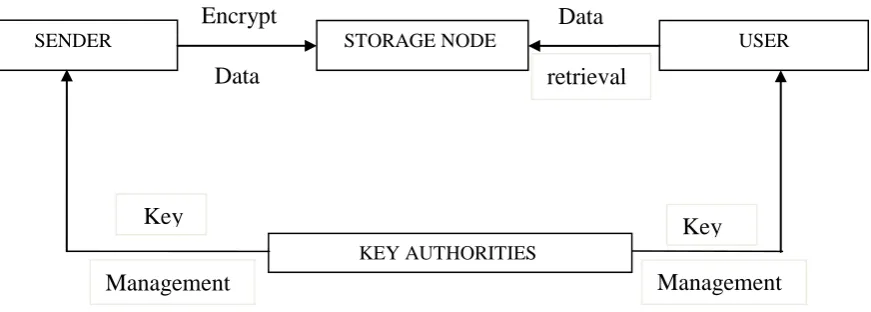
Fig. Shows the proposed architecture of DTN
The description of module are as follows:
1. Key Authorities :
They are key generation centres that generate public/secret parameters for CP-ABE. The key authorities consist of a central authority and multiple local authorities. We assume that there are secure and reliable communication channels between a central authority and each local authority during the initial key setup and generation phase. Each local authority manages different attributes and issues corresponding attribute keys to users. They grant differential access rights to individual users based on the users‟ attributes. The key authorities are assumed to be honest-but-curious. That is, they will honestly execute the assigned tasks in the system, however they would like to learn information of encrypted contents as much as possible.
SENDER
STORAGE NODE USER
KEY AUTHORITIES
Encrypt
Data
Data
retrieval
Key
Management
Key
2. Storage node :
This is an entity that stores data from senders and provide corresponding access to users. It may be mobile or static [17]. Similar to the previous schemes, we also assume the storage node to be semi-trusted, that is honest-but-curious.
3. Sender :
This is an entity who owns confidential messages or data (e.g., a commander) and wishes to store them into the external data storage node for ease of sharing or for reliable delivery to users in the extreme networking environments. A sender is responsible for defining (attribute based) access policy and enforcing it on its own data by encrypting the data under the policy before storing it to the storage node.
4. User :
This is a mobile node who wants to access the data stored at the storage node (e.g., a soldier). If a user possesses a set of attributes satisfying the access policy of the encrypted data defined by the sender, and is not revoked in any of the attributes, then he will be able to decrypt the cipher text and obtain the data.
IV. RESULTS
It is expected that the proposed approach should be secure the confidential data and transferred securely from a source
node to a destination nodewith respect to parameters like geo-location, valid timestamp and ip-address.
V. CONCLUSION AND FUTURE WORK
Our project is not a unique one but DTN concept is very useful for securing the confidential data from sender to receiver and it is used in many applications such as military application, commercial application, scientific application etc.The future work is how to construct a cipher text policy attribute-based encryption scheme which would have both:the flexible delegation and attribute revocation properties, without involving a Mediator in the system Architecture.
REFERENCES
1. J. Burgess, B. Gallagher, D. Jensen, and B. N. Levine, “Maxprop:Routing for vehicle-based disruption tolerant networks,” in Proc.IEEE
INFOCOM, 2006.
2. M. Chuah and P. Yang, “Node density-based adaptive routing scheme for disruption tolerant networks,” in Proc. IEEE MILCOM, 2006.
3. M. Chuah and P. Yang, “Performance evaluation of content-based information retrieval schemes for DTNs,” in Proc. IEEE
MILCOM,2007.
4. J. Bethencourt, A. Sahai, and B. Waters, “Cipher text-policy attribute based encryption,” in Proc. IEEE Symp. Security Privacy, 2007.
5. A. Lewko and B. Waters, “Decentralizing attribute-based encryption,”Cryptology ePrint Archive: Rep. 2010/351, 2010.
6. M. Pirretti, P. Traynor, P. Mc Daniel, and B. Waters, “Secure attribute based systems,” in Proc. ACM Conf. Comput. Commun. Security,
2006.
7. S. Rafaeli and D. Hutchison, “A survey of key management for secure group communication,” Comput. Survey., vol. 35, no. 3, pp.
309–329,2003.
8. L. Cheung and C. Newport, “Provably secure cipher text policy ABE,” in Proc. ACM Conf. Comput. Commun. Security, 2007, pp.
456–465.
9. X. Liang, Z. Cao, H. Lin, and D. Xing, “Provably secure and efficient bounded cipher text policy attribute based encryption,” in Proc.
ASIACCS,2009
10. M. Chase and S. S. M. Chow, “Improving privacy and security in Multiautority based attribute based encryption ” in Proc. ACM
Conf. Computer. Commun. Security, 2009.
11. A Survey of Secure Data Transfer in Disruption Tolerant Network in International Journal of Advanced Research I computer and
communication Engineering by E K Girisan1, Shidha S2.
12. D.S.Delphin Hepsiba, S.Simla Mercy, S.Prabu,” Secured Data Forwarding Technique in Disruption Tolerant Networks-Survey”in
international Journal of Advanced Research in Computer and Communication Engineering Vol. 3, Issue 2, February 2014.
15. M. K. et al. Plutus: scalable secure file sharing on untrusted storage. In Proceedings of ACM Usenix, 2002.
16. A. Harrinton and C. Jensen. Cryptographic access control in a distributed file system. In Proceedings of ACM SACMAT, 2003
17. Junbeom Hur and Kyungtae Kang, Member, IEEE, ACM. IEEE TRANSACTIONS ON NETWORKING VOL:22 NO:1 YEAR 2014.
BIOGRAPHY